

The DOI matches its Crossref record; 64 of the 64 references it cites were found in a registry or an index.
Psychotherapeutic benefits of compassion-focused therapy: an early systematic review
Open accessAbstract
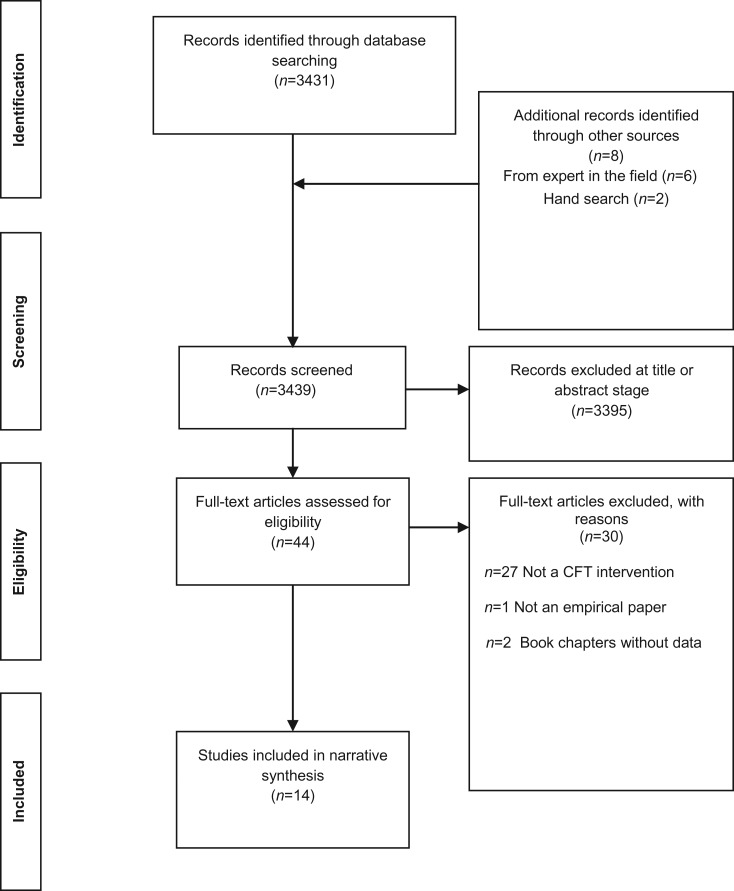
BACKGROUND: Compassion-focused therapy (CFT) is a relatively novel form of psychotherapy that was developed for people who have mental health problems primarily linked to high shame and self-criticism. The aim of this early systematic review was to draw together the current research evidence of the effectiveness of CFT as a psychotherapeutic intervention, and to provide recommendations that may inform the development of further trials. METHOD: A comprehensive search of electronic databases was undertaken to systematically identify literature relating to the effectiveness of CFT as a psychotherapeutic intervention. Reference lists of key journals were hand searched and contact with experts in the field was made to identify unpublished data. RESULTS: Fourteen studies were included in the review, including three randomized controlled studies. The findings from the included studies were, in the most part, favourable to CFT, and in particular seemed to be effective for people who were high in self-criticism. CONCLUSIONS: CFT shows promise as an intervention for mood disorders, particularly those high in self-criticism. However, more large-scale, high-quality trials are needed before it can be considered evidence-based practice. The review highlights issues from the current evidence that may be used to inform such trials.
Overview
The claims and statistics of this paper haven’t been checked yet.
Run the check — free, no account needed. It reads the open-access text and checks the sources it cites.
Integrity signals
Registry
Cites
Statistics
Figures
Verification
Claims the paper makes
The claims and statistics of this paper haven’t been checked yet.
Run the check — free, no account needed. It reads the open-access text and checks the sources it cites.
Claims other papers make about this one
Each is checked against this paper’s own text: does it say what the citing paper says it does?
The source backs part of the claim, not all of it — or backs it for a different population, condition or comparison.
In the citing paper
“A number of studies have provided empirical evidence for CFT’s effectiveness in treating a range of conditions, including mood and anxiety disorders (Leaviss and Uttley, 2015; Wilson et al., 2018), substance use disorders (Held et al., 2018), and OCD (Petrocchi et al., 2021).”
From Feasibility and preliminary outcomes of compassion-focused acceptance and commitment therapy delivered via telehealth in a community behavioral health clinic (2025) · cites this paper as Leaviss and Uttley, 2015
Experimental — accuracy not yet measuredThe source backs part of the claim, not all of it — or backs it for a different population, condition or comparison.
In the citing paper
“Pre-treatment shame proneness, which has been demonstrated to be correlated with self-compassion/self-criticism and has also been shown to be a predictor of response to compassion-focused interventions (Leaviss and Uttley, 2015), was not as consistently connected to treatment effect in this study.”
From Feasibility and preliminary outcomes of compassion-focused acceptance and commitment therapy delivered via telehealth in a community behavioral health clinic (2025) · cites this paper as Leaviss and Uttley, 2015
Experimental — accuracy not yet measuredThe source backs part of the claim, not all of it — or backs it for a different population, condition or comparison.
In the citing paper
“Notably, Leaviss and Uttley [72] demonstrated that CFT yields multiple therapeutic advantages, especially for individuals characterized by high self-criticism, such as maladaptive perfectionists.”
From The Influence of Positive and Negative Aspects of Perfectionism on Psychological Distress in Emerging Adulthood: Exploring the Mediating Role of Self-Compassion (2023) · cites this paper as [72]
Experimental — accuracy not yet measuredThe source backs part of the claim, not all of it — or backs it for a different population, condition or comparison.
In the citing paper
“CFT and CMT have been shown to reduce suffering and improve QoL in a range of health problems such as anxiety/depression, eating disorders, phobias and pain management30–33”
From SafeSpace: what is the feasibility and acceptability of a codesigned virtual reality intervention, incorporating compassionate mind training, to support people undergoing cancer treatment in a clinical setting? (2022) · cites this paper as [31]
Experimental — accuracy not yet measuredThe cited source says what the claim attributes to it.
In the citing paper
“While the earliest review of selfcompassion-related therapies concluded that treatment effectiveness was difficult to evaluate given methodological weaknesses in the field (Leaviss and Uttley 2015)”
From Effectiveness of Self-Compassion Related Therapies: a Systematic Review and Meta-analysis (2019) · cites this paper as Leaviss and Uttley 2015
The cited source says what the claim attributes to it.
In the citing paper
“Treatment effect, as measured by quantitative outcome and process measures, may be related to pre-treatment levels of psychological inflexibility, and self-criticism/self-compassion, consistent with Leaviss and Uttley’s (2015) finding that those exhibiting higher self-criticism benefit most from compassion-focused interventions”
From Feasibility and preliminary outcomes of compassion-focused acceptance and commitment therapy delivered via telehealth in a community behavioral health clinic (2025) · cites this paper as Leaviss and Uttley’s (2015)
The cited source says what the claim attributes to it.
In the citing paper
“There is empirical evidence of CFT and other compassion-based interventions in reducing psychopathology, shame, and self-criticism, and improving well-being (Kirby, 2017; Leaviss & Uttley, 2015), particularly with adolescents (Bluth et al., 2016; Figueiredo et al., 2021)”
From THE EFFICACY OF A COMPASSION, ACCEPTANCE AND MINDFULNESS-BASED PILOT INTERVENTION FOR ADOLESCENTS’ TEST ANXIETY: A CASE STUDY USING THE ACADEMIC PROGRAM (2023) · cites this paper as Leaviss & Uttley, 2015
The cited source says what the claim attributes to it.
In the citing paper
“This growing body of literature has been synthesized in several systematic reviews, which generally conclude that CFT appears efficacious in treating a range of clinical populations, although the existing studies vary considerably in terms of study quality and content of the therapeutic intervention and -format (Beaumont and Martin, 2015; Craig et al., 2020; Leaviss and Uttley, 2015).”
From Group-based compassion-focused therapy for prolonged grief symptoms in adults – Results from a randomized controlled trial (2022) · cites this paper as Leaviss and Uttley, 2015
The cited source says what the claim attributes to it.
In the citing paper
“CFT aims to facilitate compassion in order to increase psychological well-being (Leaviss and Uttley, 2015).”
From Group-based compassion-focused therapy for prolonged grief symptoms in adults – Results from a randomized controlled trial (2022) · cites this paper as Leaviss and Uttley, 2015
The cited source says what the claim attributes to it.
In the citing paper
“As the evidence base of using CFT in groups emerges, researchers have trialled a number of different durations of groups and follow-up periods.16”
In the citing paper
“Cultivating compassion for self and others has also become a central focus for the development of psychotherapies [35, 37, 40, 61, 67, 69, 77, 96].”
From The development of compassionate engagement and action scales for self and others (2017) · cites this paper as [77]
In the citing paper
“it is likely that most compassion focused therapies, for which there a few now [69] work in both direct and indirect ways on mental health problems [67, 69, 77].”
From The development of compassionate engagement and action scales for self and others (2017) · cites this paper as [77]
Self-check
Percentages, sums and reported differences re-computed from the paper’s own numbers.
The self-check needs the paper’s full text.
Citations
Cites
Preferred reporting items for systematic reviews and meta-analyses: the PRISMA Statement.
(2009) · PubMed Central · Cited by 44,859
Preferred reporting items for systematic reviews and meta-analyses: The PRISMA statement
Moher, D., Liberati, A., Tetzlaff, J., Altman, D. G., & the PRISMA Group* (2009) · Annals of Internal Medicine · doi:10.7326/0003-4819-151-4-200908180-00135 · Cited by 37,554
The Cochrane Collaboration's tool for assessing risk of bias in randomised trials
Higgins, J. P. T., Altman, D. G., Gotzsche, P. C., Juni, P., Moher, D., Oxman, A. D., Savovic, J., Schulz, K. F., Weeks, L., Sterne, J. A. C., et al. (2011) · BMJ · doi:10.1136/bmj.d5928 · Cited by 33,817
Preferred Reporting Items for Systematic Reviews and Meta-Analyses: The PRISMA Statement
Moher, D., Liberati, A., Tetzlaff, J., & Altman, D. G. (2009) · Journal of Clinical Epidemiology · doi:10.1016/j.jclinepi.2009.06.005 · Cited by 19,575
Grading quality of evidence and strength of recommendations
(2004) · BMJ · doi:10.1136/bmj.328.7454.1490 · Cited by 8,477
(1996) · Cited by 3,692
A conceptual framework for implementation fidelity
Carroll, C., Patterson, M., Wood, S., Booth, A., Rick, J., & Balain, S. (2007) · Implementation Science · doi:10.1186/1748-5908-2-40 · Cited by 2,559
Fredrickson, B. L., Cohn, M. A., Coffey, K. A., Pek, J., & Finkel, S. M. (2008) · Journal of Personality and Social Psychology · doi:10.1037/a0013262 · Cited by 2,365 · cited 3×
“Similarly, the practice of ‘loving kindness’-based meditation has been shown to increase positive emotions, mindfulness, feelings of purpose in life and social support, and to decrease illness symptoms (Fredrickson et al. 2008). From a biological perspective, the practice of CM has been shown to reduce stress-linked i…”
BackgroundThe Handbook of evolutionary psychology
(2006) · Choice Reviews Online · doi:10.5860/choice.44-0622 · Cited by 2,128
Exploring compassion: A meta-analysis of the association between self-compassion and psychopathology
MacBeth, A., & Gumley, A. (2012) · Clinical Psychology Review · doi:10.1016/j.cpr.2012.06.003 · Cited by 1,838 · cited 2×
“The meta-analysis by Macbeth & Gumley (2012) supports this relationship.”
BackgroundMethod
Research works printed but not linked: 2
- 2001, An Open Heart: Practicing Compassion in Everyday Life
- 2004, Guideline Development Methods. Information for National Collaborating Centres and Guideline Developers
Cited by
Sorted by citations
Items 101–200 of 545
Shepherd, D. A., Seyb, S., & Williams, T. A. (2023) · Journal of Business Venturing · doi:10.1016/j.jbusvent.2023.106290 · Cited by 46
Matos, M., Palmeira, L., Albuquerque, I., Cunha, M. I. V. A., de Lima, M. P., Galhardo, A. B., Maratos, F. A., & Gilbert, P. (2021) · Mindfulness · doi:10.1007/s12671-021-01778-3 · Cited by 44
Mindfulness- and compassion-based interventions for family carers of older adults: A scoping review.
Murfield, J., Moyle, W., & O'Donovan, A. (2021) · International Journal of Nursing Studies · doi:10.1016/j.ijnurstu.2019.103495 · Cited by 35
Dimensions of grace: Factor analysis of three grace scales.
Bufford, R. K., Sisemore, T. A., & Blackburn, A. M. (2016) · Psychology of Religion and Spirituality · doi:10.1037/rel0000064 · Cited by 41
Motivational interviewing in compassion‐based interventions: Theory and practical applications
Steindl, S. R., Kirby, J. N., & Tellegan, C. (2018) · Clinical Psychologist · doi:10.1111/cp.12146 · Cited by 40
Stevenson, J., Mattiske, J. K., & Nixon, R. D. V. (2019) · Behaviour Research and Therapy · doi:10.1016/j.brat.2019.103492 · Cited by 45
Kealy, D., Laverdière, O., Cox, D. W., & Hewitt, P. L. (2020) · Journal of Mental Health · doi:10.1080/09638237.2020.1836557 · Cited by 46
Bartels‐Velthuis, A. A., Schroevers, M. J., der Ploeg, K. M. V., Koster, F., Fleer, J., & van den Brink, E. (2016) · Mindfulness · doi:10.1007/s12671-016-0518-8 · Cited by 43
Individualized Virtual Reality for Increasing Self-Compassion: Evaluation Study
Halim, I., Stemmet, L., Hach, S., Porter, R., Liang, H., Vaezipour, A., Henry, J. D., & Baghaei, N. (2023) · JMIR Mental Health · doi:10.2196/47617 · Cited by 44
Kirby, J. N., & Gilbert, P. (2019) · Mindfulness · doi:10.1007/s12671-018-1088-8 · Cited by 34
Time to Get Personal: Individualised Virtual Reality for Mental Health
Baghaei, N., Stemmet, L., Hlasnik, A., Emanov, K., Hach, S., Naslund, J. A., Billinghurst, M., Khaliq, I., & Liang, H.-N. (2020) · Extended Abstracts of the 2020 CHI Conference on Human Factors in Computing Systems · doi:10.1145/3334480.3382932 · Cited by 34
van Lotringen, C. M., Lusi, B., Westerhof, G. J., Ludden, G., Kip, H., Kelders, S. M., & Noordzij, M. L. (2023) · JMIR Mental Health · doi:10.2196/42403 · Cited by 38
Steindl, S. R., Yiu, R. X. Q., Baumann, T., & Matos, M. (2019) · Australian Psychologist · doi:10.1111/ap.12433 · Cited by 44
An Evolutionary Approach to Shame-Based Self-Criticism, Self-Forgiveness, and Compassion
Gilbert, P., & Woodyatt, L. (2017) · Springer eBooks · doi:10.1007/978-3-319-60573-9_3 · Cited by 38
Zucchelli, F., Donnelly, O., Williamson, H., & Hooper, N. (2018) · Journal of Cognitive Psychotherapy · doi:10.1891/0889-8391.32.3.171 · Cited by 30
“Compassion-Focused Therapy in particular holds a burgeoning evidence-base for shame (Leaviss & Uttley, 2015) and, accordingly, the extent to which ACT cultivates self-compassion has become a subject of interest (e.g., Luoma & Platt, 2015).”
BackgroundPsilocybin-Assisted Compassion Focused Therapy for Depression
Pots, W. T. M., & Chakhssi, F. (2022) · Frontiers in Psychology · doi:10.3389/fpsyg.2022.812930 · Cited by 35
Developing a Compassionate Internal Supervisor: Compassion‐Focused Therapy for Trainee Therapists
Bell, T., Dixon, A., & Kolts, R. L. (2016) · Clinical Psychology & Psychotherapy · doi:10.1002/cpp.2031 · Cited by 43
Murphy, A. (2016) · Contemporary Buddhism · doi:10.1080/14639947.2016.1228324 · Cited by 38
Designing Individualised Virtual Reality Applications for Supporting Depression: A Feasibility Study
Baghaei, N., Stemmet, L., Khaliq, I., Ahmadi, A., Halim, I., Liang, H., Xu, W., Billinghurst, M., & Porter, R. (2021) · ACM SIGCHI Symposium on Engineering Interactive Computing Systems (EICS) · doi:10.1145/3459926.3464761 · Cited by 37
Farr, J., Ononaiye, M., & Irons, C. (2021) · Psychology and Psychotherapy Theory Research and Practice · doi:10.1111/papt.12353 · Cited by 44
Byrne, G., & Ní Ghráda, Á. (2019) · Aggression and Violent Behavior · doi:10.1016/j.avb.2019.01.001 · Cited by 32
Trindade, I. A., Ferreira, C., & Pinto-Gouveia, J. (2020) · Journal of Contextual Behavioral Science · doi:10.1016/j.jcbs.2019.12.005 · Cited by 31
Fan, Y.-C., Hsiao, F.-H., & Hsieh, C.-C. (2023) · Palliative and Supportive Care · doi:10.1017/s1478951522001316 · Cited by 31
Compassion-focused therapy for trauma in people with intellectual disabilities: A conceptual review
Cowles, M., Randle‐Phillips, C., & Medley, A. R. (2018) · Journal of Intellectual Disabilities · doi:10.1177/1744629518773843 · Cited by 39
Thew, G. R., Gregory, J. D., Roberts, K., & Rimes, K. A. (2017) · Psychology and Psychotherapy Theory Research and Practice · doi:10.1111/papt.12137 · Cited by 34
Compassion focused therapy for anger: A pilot study of a group intervention for veterans with PTSD
Grodin, J., Clark, J. L., Kolts, R. L., & Lovejoy, T. I. (2019) · Journal of Contextual Behavioral Science · doi:10.1016/j.jcbs.2019.06.004 · Cited by 35
Blackburn, M. R., & Hogg, R. C. (2024) · PLOS ONE · doi:10.1371/journal.pone.0307597 · Cited by 31
Fox, J., Cattani, K., & Burlingame, G. M. (2020) · Psychotherapy Research · doi:10.1080/10503307.2020.1783708 · Cited by 37
Clapton, N., Williams, J. P., & Jones, R. S. P. (2017) · Journal of Applied Research in Intellectual Disabilities · doi:10.1111/jar.12424 · Cited by 36
da Silva, D. R., Rijo, D., Castilho, P., & Gilbert, P. (2019) · Clinical Case Studies · doi:10.1177/1534650119849491 · Cited by 34
Ashfield, E., Chan, C., & Lee, D. (2020) · Psychology and Psychotherapy Theory Research and Practice · doi:10.1111/papt.12275 · Cited by 28
Savari, Y., Mohagheghi, H., & Petrocchi, N. (2021) · Mindfulness · doi:10.1007/s12671-020-01584-3 · Cited by 35
Dunn, B. D. (2017) · Cognitive Therapy and Research · doi:10.1007/s10608-017-9831-3 · Cited by 29
Dhokia, M., Elander, J., Clements, K., & Gilbert, P. (2020) · Psychology of Addictive Behaviors · doi:10.1037/adb0000579 · Cited by 26
Compassion-based initiatives in educational settings
Welford, M., & Langmead, K. (2015) · Educational and Child Psychology · doi:10.53841/bpsecp.2015.32.1.71 · Cited by 27
Connectedness: The Updated and Expanded Pillar of Lifestyle Psychiatry and Lifestyle Medicine
Merlo, G., Snellman, L., & Sugden, S. G. (2025) · American Journal of Lifestyle Medicine · doi:10.1177/15598276251345455 · Cited by 37
Exploiting the plasticity of compassion to improve psychotherapy
Förster, K., & Kanske, P. (2021) · Current Opinion in Behavioral Sciences · doi:10.1016/j.cobeha.2021.01.010 · Cited by 27
Koutra, K., Mouatsou, C., & Psoma, S. (2023) · Behavioral Sciences · doi:10.3390/bs13110932 · Cited by 25
Loving-Kindness Meditation and Compassion Meditation: Do They Affect Emotions in a Different Way?
Sirotina, U., & Щебетенко, С. (2020) · Mindfulness · doi:10.1007/s12671-020-01465-9 · Cited by 29
A Bibliometric Review of Self-Compassion Research: Science Mapping the Literature, 1999 to 2020
Swami, V., Andersen, N., & Furnham, A. (2021) · Mindfulness · doi:10.1007/s12671-021-01662-0 · Cited by 25
Malighetti, C., Bernardelli, L., Pancini, E., Riva, G., & Villani, D. (2023) · Cyberpsychology Behavior and Social Networking · doi:10.1089/cyber.2022.0246 · Cited by 25
Compassion Focused Therapy Groups: Evidence from Routine Clinical Practice
McManus, J., Tsivos, Z., Woodward, S., Fraser, J., & Hartwell, R. (2018) · Behaviour Change · doi:10.1017/bec.2018.16 · Cited by 25
Saarinen, A. I. L., Keltikangas‐Järvinen, L., Hintsa, T., Pulkki-Råbäck, L., Ravaja, N., Lehtimäki, T. J., Raitakari, O. T., & Hintsanen, M. (2020) · International Journal of Behavioral Medicine · doi:10.1007/s12529-020-09886-5 · Cited by 25
Misurya, I., Misurya, P., & Dutta, A. (2020) · Cureus · doi:10.7759/cureus.10998 · Cited by 24
Ong, C. W., Lee, E. B., Petersen, J. M., Levin, M. E., & Twohig, M. P. (2021) · Journal of Clinical Psychology · doi:10.1002/jclp.23187 · Cited by 32
Salvati, M., & Chiorri, C. (2021) · Journal of Homosexuality · doi:10.1080/00918369.2021.1990686 · Cited by 24
Johannsen, M., Schlander, C., Farver-Vestergaard, I., Lundorff, M., Wellnitz, K. B., Komischke-Konnerup, K. B., & O'Connor, M. (2022) · Psychiatry Research · doi:10.1016/j.psychres.2022.114683 · Cited by 23
da Silva, D. R., Rijo, D., Salekin, R. T., Paulo, M., Miguel, R. R., & Gilbert, P. (2020) · Journal of Experimental Criminology · doi:10.1007/s11292-020-09418-x · Cited by 24
Michelle, M. C. L., Schwannauer, M., & Chan, S. W. Y. (2019) · Psychology and Psychotherapy Theory Research and Practice · doi:10.1111/papt.12245 · Cited by 22
The tangled roots of inner speech, voices and delusions
Rosen, C., McCarthy‐Jones, S., Chase, K. A., Humpston, C. S., Melbourne, J. K., Kling, L. R., & Sharma, R. P. (2018) · Psychiatry Research · doi:10.1016/j.psychres.2018.04.022 · Cited by 25
Les dimensions incarnée et interpersonnelle de la compassion
Khoury, B., & Dionne, F. (2020) · Annales Médico-psychologiques revue psychiatrique · doi:10.1016/j.amp.2020.11.018 · Cited by 25
Self-compassion and adjustment in epilepsy and psychogenic nonepileptic seizures
Clegg, S., Sirois, F. M., & Reuber, M. (2019) · Epilepsy & Behavior · doi:10.1016/j.yebeh.2019.106490 · Cited by 21
Neff, K. D., & Knox, M. C. (2020) · Springer eBooks · doi:10.1007/978-3-319-24612-3_1159 · Cited by 29
Bratt, A. S., Gralberg, I.-M., Svensson, I., & Rusner, M. (2020) · Clinical Child Psychology and Psychiatry · doi:10.1177/1359104520931583 · Cited by 20
Solastalgia: Climatic Anxiety—An Emotional Geography to Find Our Way Out
Ferrarello, S. (2023) · The Journal of Medicine and Philosophy A Forum for Bioethics and Philosophy of Medicine · doi:10.1093/jmp/jhad006 · Cited by 20
Saarinen, A. I. L., Keltikangas‐Järvinen, L., Cloninger, C. R., Veijola, J. M., Elovainio, M. J., Lehtimäki, T. J., Raitakari, O. T., & Hintsanen, M. (2019) · Journal of Affective Disorders · doi:10.1016/j.jad.2019.03.029 · Cited by 19
Duarte, C., Gilbert, P., Stalker, C., Catarino, F., Basran, J. K., Scott, S., Horgan, G. W., & Stubbs, R. J. (2019) · Journal of Health Psychology · doi:10.1177/1359105319890019 · Cited by 24
Forbes, Y., Moffitt, R. L., Bokkel, M. V., & Donovan, C. L. (2020) · Journal of Cognitive Psychotherapy · doi:10.1891/jcpsy-d-20-00015 · Cited by 28
Self-disgust and urge to be thin in eating disorders: how can self-compassion help?
Marques, C., Simão, M., Guiomar, R. N. R. M., & Castilho, P. (2021) · Eating and Weight Disorders - Studies on Anorexia Bulimia and Obesity · doi:10.1007/s40519-020-01099-9 · Cited by 27
McLean, L., Steindl, S. R., & Bambling, M. (2022) · Mindfulness · doi:10.1007/s12671-022-01837-3 · Cited by 25
Compassion Questionnaires: Scales Development and Validation
Khoury, B., Vergara, R. C., & Spinelli, C. (2023) · Cognitive Therapy and Research · doi:10.1007/s10608-023-10416-2 · Cited by 24
Position paper – CFT for psychosis
Heriot-Maitland, C. (2023) · Psychology and Psychotherapy Theory Research and Practice · doi:10.1111/papt.12490 · Cited by 21
Individualised Virtual Reality for Supporting Depression: Feedback from Mental Health Professionals
Baghaei, N., Ahmadi, A., Khaliq, I., & Liang, H. (2021) · IEEE International Symposium on Mixed and Augmented Reality Adjunct (ISMAR-Adjunct) · doi:10.1109/ismar-adjunct54149.2021.00022 · Cited by 18
Northover, C., Deacon, J., King, J. A., & Irons, C. (2021) · OBM Integrative and Complementary Medicine · doi:10.21926/obm.icm.2104056 · Cited by 23
A scoping review of therapies used to treat psychological trauma post perinatal bereavement
Martin, C. J. H., & Reid, K. (2022) · Journal of Reproductive and Infant Psychology · doi:10.1080/02646838.2021.2021477 · Cited by 20
Paetzold, I., Schick, A., Rauschenberg, C., Hirjak, D., Banaschewski, T., Meyer‐Lindenberg, A., Butz, S., Floesser, C., Schültke, L., Boehnke, J. R., et al. (2022) · JMIR Formative Research · doi:10.2196/39511 · Cited by 17
Effects of soothing images and soothing sounds on mood and well‐being
Witten, E., Ryynanen, J., Wisdom, S., Tipp, C., & Chan, S. W. Y. (2022) · British Journal of Clinical Psychology · doi:10.1111/bjc.12400 · Cited by 18
Linde, J., Luoma, J. B., Rück, C., Ramnerö, J., & Lundgren, T. (2022) · Behavior Modification · doi:10.1177/01454455221129989 · Cited by 26
Stiegler, J. R., Molde, H., & Schanche, E. (2017) · Clinical Psychology & Psychotherapy · doi:10.1002/cpp.2144 · Cited by 18
Brodar, K. E., Crosskey, L. B., & Thompson, R. J. (2015) · Journal of Psychology and Theology · doi:10.1177/009164711504300401 · Cited by 23
Li, Y., Coster, S., Norman, I., Chien, W. T., Qin, J., Ling Tse, M., & Bressington, D. (2021) · Early Intervention in Psychiatry · doi:10.1111/eip.12929 · Cited by 17
Pérez-Aranda, A., Barceló-Soler, A., Andrés-Rodríguez, L., Peñarrubia-María, M. T., Tuccillo, R., Borraz-Estruch, G., García-Campayo, J., Feliu-Soler, A., & Luciano, J. V. (2017) · Mindfulness & Compassion · doi:10.1016/j.mincom.2017.10.002 · Cited by 17
Escala de Compasión (ECOM) para población mexicana
Tello, A. L., & Moreno-Coutiño, A. B. (2018) · Psicología y Salud · doi:10.25009/pys.v29i1.2565 · Cited by 17
Shame and Psychotherapy: Theory, Method and Practice
Sinha, M. (2017) · Springer eBooks · doi:10.1007/978-3-319-53100-7_11 · Cited by 17
Mui, E. Y. W., Chan, S. K. W., Chan, P. Y., Hui, C. L. M., Chang, W. C., Lee, E. H. M., & Chen, E. Y. H. (2019) · International Review of Psychiatry · doi:10.1080/09540261.2019.1659236 · Cited by 17
Randomised controlled trial of an online version of compassion mind training in a nonclinical sample
Halamová, J., Kanovský, M., Pačutová, A., & Kupeli, N. (2020) · Europe’s Journal of Psychology · doi:10.5964/ejop.v16i2.1683 · Cited by 21
Jemima, R., Strelan, P., & Proeve, M. J. (2021) · Journal of Contextual Behavioral Science · doi:10.1016/j.jcbs.2021.08.001 · Cited by 21
Dentale, F., Petrocchi, N., Vecchione, M., Biagioli, C., Gennaro, A., & Violani, C. (2017) · Psychology and Psychotherapy Theory Research and Practice · doi:10.1111/papt.12136 · Cited by 19
Roohi, R., Kerman Branch, I. A. U., Soltani, A. A., Department of Psychology, K. B., Zinedine Meimand, Z., Department of Psychology, K. B., Razavi Nematollahi, V., & Department of Psychology, K. B. (2019) · Quarterly Journal of Child Mental Health · doi:10.29252/jcmh.6.3.16 · Cited by 16
Luoma, J. B., & Chwyl, C. (2020) · Current Psychology · doi:10.1007/s12144-020-00920-z · Cited by 17
Inhibitors and facilitators of compassion‐focused imagery in personality disorder
Naismith, I., Mwale, A. L., & Feigenbaum, J. (2017) · Clinical Psychology & Psychotherapy · doi:10.1002/cpp.2161 · Cited by 21
Rabon, J. K., Sirois, F. M., Barton, A. L., & Hirsch, J. K. (2021) · Self and Identity · doi:10.1080/15298868.2021.1884592 · Cited by 22
Therapist competencies necessary for the delivery of compassion‐focused therapy: A Delphi study
Liddell, A. E., Allan, S., & Goss, K. (2016) · Psychology and Psychotherapy Theory Research and Practice · doi:10.1111/papt.12105 · Cited by 20
Matos, M., McEwan, K., Kanovský, M., Halamová, J., Steindl, S. R., Ferreira, N. B., Linharelhos, M., Rijo, D., Asano, K., Vilas, S. P., et al. (2023) · International Journal of Environmental Research and Public Health · doi:10.3390/ijerph20031845 · Cited by 21
Lonergan, A. (2017) · Europe’s Journal of Psychology · doi:10.5964/ejop.v13i2.1199 · Cited by 21
D’Amico, F., Feliu‐Soler, A., Montero‐Marín, J., Peñarrubia‐María, M. T., Navarro‐Gil, M., Gordon, W. V., García‐Campayo, J., & Luciano, J. V. (2020) · Journal of Clinical Medicine · doi:10.3390/jcm9030726 · Cited by 17
Bond, C., Tsikandilakis, M., Stacey, G., Hui, A., & Timmons, S. (2021) · Nurse Education Today · doi:10.1016/j.nedt.2021.104788 · Cited by 13
Carroll, C. (2016) · Scientometrics · doi:10.1007/s11192-016-2085-0 · Cited by 14
Brown, A. C., Latham, C., Danquah, A., Dunlop, B. J., & Taylor, P. J. (2022) · Psychology and Psychotherapy Theory Research and Practice · doi:10.1111/papt.12394 · Cited by 14
Maner, S., Morris, P. G., & Flewitt, B. I. (2022) · Clinical Psychology & Psychotherapy · doi:10.1002/cpp.2801 · Cited by 19
Palmer-Cooper, E. C., Woods, C., & Richardson, T. H. (2023) · Journal of Affective Disorders · doi:10.1016/j.jad.2023.08.117 · Cited by 15
Compassion focused therapy for women in the perinatal period: a summary of the current literature
Millard, L. A., & Wittkowski, A. (2023) · Frontiers in Psychiatry · doi:10.3389/fpsyt.2023.1288797 · Cited by 22
A Narrative Review of Compassion Focused Therapy on Positive Mental Health Outcomes
Kotera, Y., Beaumont, J., Edwards, A., Cotterill, M., Kirkman, A., Tofani, A. C., McPhilbin, M., Takhi, S. K., Barnes, K., Todowede, O. O., et al. (2024) · Behavioral Sciences · doi:10.3390/bs14080643 · Cited by 17
McLean, L., Bambling, M., & Steindl, S. R. (2018) · Journal of Interpersonal Violence · doi:10.1177/0886260518793975 · Cited by 20
Teaching Compassionate Mind Training to help midwives cope with traumatic clinical incidents
Martin, C. J. H., Beaumont, E., Norris, G., & Cullen, G. (2020) · British Journal of Midwifery · doi:10.12968/bjom.2021.29.1.26 · Cited by 15
Introducing compassion focused psychosexual therapy
Vosper, J., Irons, C., Mackenzie-White, K., Saunders, F., Lewis, R., & Gibson, S. (2021) · Sexual & Relationship Therapy · doi:10.1080/14681994.2021.1902495 · Cited by 17
Mavituna, S., Hahn, E. W., Hahne, I., Bergmann, N., Pijnenborg, G. H. M., Ta, T. M. T., Tafelski, L., & Böge, K. (2022) · Current Psychology · doi:10.1007/s12144-022-02908-3 · Cited by 18
CFT & people with intellectual disabilities
Hardiman, M., Willmoth, C., & Walsh, J. J. (2017) · Advances in Mental Health and Intellectual Disabilities · doi:10.1108/amhid-07-2017-0030 · Cited by 14
Navab, M., Dehghani, A., & Salehi, M. (2019) · Counselling and Psychotherapy Research · doi:10.1002/capr.12212 · Cited by 21
Murfield, J., Moyle, W., & O’Donovan, A. (2020) · International Journal of Geriatric Psychiatry · doi:10.1002/gps.5257 · Cited by 21
Metadata
- Authors
- Leaviss, J., & Uttley, L.
- Affiliations
- University of Sheffield (GB)
- Corresponding author
- Leaviss, J.
- Venue
- Psychological Medicine
- Publisher
- Cambridge University Press (CUP)
- Published
- 2014-09-12
- Volume
- 45
- Issue
- 5
- Pages
- 927-945
- ISSN
- 0033-2917 (ISSN-L)
- 1469-8978
- PMC
- PMC4413786
- OpenAlex
- W2150285866
- Cited by
- 546
- References
- 64
- Citations by year
- 2026: 34 · 2025: 48 · 2024: 55 · 2023: 50 · 2022: 50 · 2021: 56 · 2020: 104 · 2019: 41 · 2018: 28 · 2017: 41 · 2016: 19 · 2015: 17 · 2014: 1
- FWCI
- 3.93
- Type
- journal article
- Language
- en
- Open access
- hybrid
- doi.org
- Locations
- Psychological Medicine (publishedVersion, cc-by)
- Europe PMC (PubMed Central) (publishedVersion, cc-by)
- PubMed Central (publishedVersion, cc-by)
- PubMed (publishedVersion)
- White Rose Research Online (University of Leeds, The University of Sheffield, University of York) (acceptedVersion)
- Funders
- University of Sheffield
- Topics
- Social Sciences › Psychology › Clinical Psychology › Mindfulness and Compassion Interventions
- Social Sciences › Psychology › Clinical Psychology › Psychotherapy Techniques and Applications
- Social Sciences › Psychology › Experimental and Cognitive Psychology › Anxiety, Depression, Psychometrics, Treatment, Cognitive Processes
- Keywords
- compassion-focused therapy, shame, self-criticism, mood disorders, treatment efficacy, evidence-based practice
- MeSH terms
- Mental Disorders, Empathy, Humans, Psychotherapy, Self Concept, Shame, Treatment Outcome
About these checks
Registry, retraction, Cites and statistics results are computed, not judged, with one exception: a printed reference that no index lists is read once by a model before it counts as a citation error. Claims are extracted by a model and kept only when their quote appears verbatim in the text; each cited source is then checked, with a model’s help, for whether it says what the claim relies on. Those verdicts can be wrong — read the claim’s quote and the cited source before relying on one.
Statistics and arithmetic are recomputed, not judged.
Confidence bands are shown only for fields calibrated on our annotated test set. None is calibrated yet, so no band is shown.
What counts as a claim ›How we measure confidence ›How we check this ›
Are you an author, or do you see a problem with this page? Request a review
