

Minimal clinically important difference on the Beck Depression Inventory—II according to the patient's perspective.
Open accessThe DOI matches its Crossref record; 29 of the 30 references it cites were found in a registry or an index.
Abstract
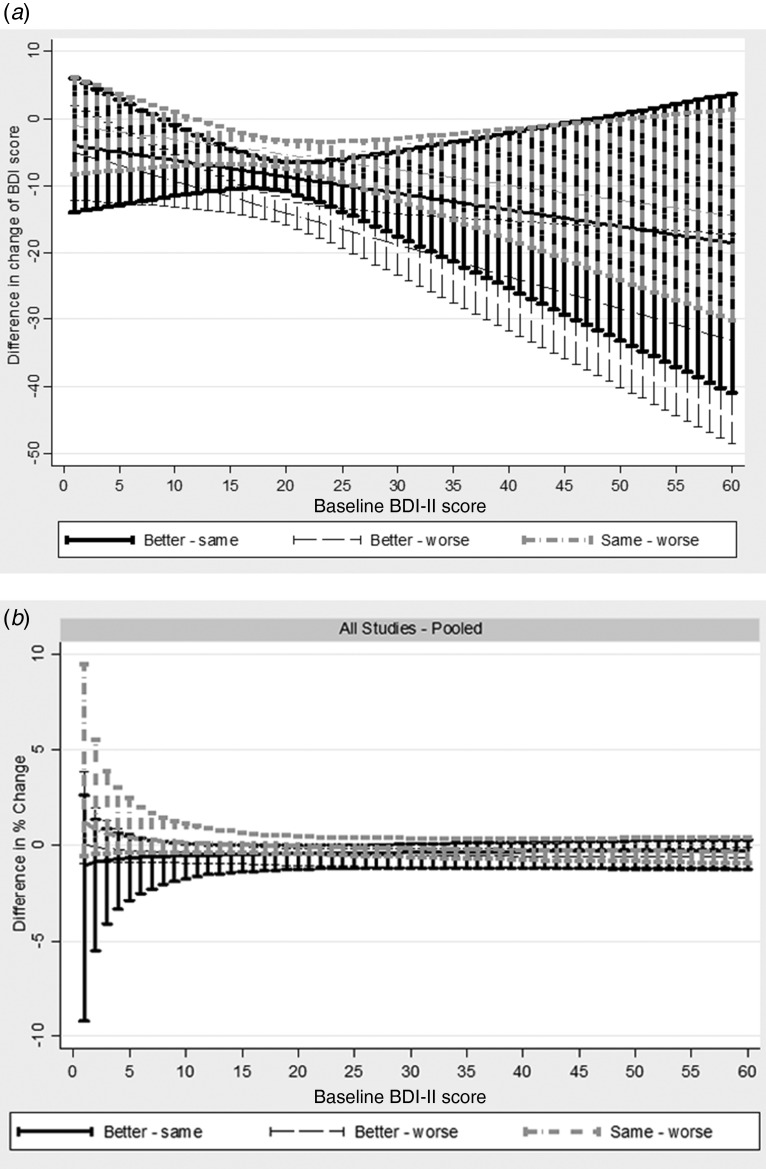
Background: The Beck Depression Inventory, 2nd edition (BDI-II) is widely used in research on depression. However, the minimal clinically important difference (MCID) is unknown. MCID can be estimated in several ways. Here we take a patient-centred approach, anchoring the change on the BDI-II to the patient's global report of improvement. Method: We used data collected ( n = 1039) from three randomized controlled trials for the management of depression. Improvement on a ‘global rating of change’ question was compared with changes in BDI-II scores using general linear modelling to explore baseline dependency, assessing whether MCID is best measured in absolute terms (i.e. difference) or as percent reduction in scores from baseline (i.e. ratio), and receiver operator characteristics (ROC) to estimate MCID according to the optimal threshold above which individuals report feeling ‘better’. Results: Improvement in BDI-II scores associated with reporting feeling ‘better’ depended on initial depression severity, and statistical modelling indicated that MCID is best measured on a ratio scale as a percentage reduction of score. We estimated a MCID of a 17.5% reduction in scores from baseline from ROC analyses. The corresponding estimate for individuals with longer duration depression who had not responded to antidepressants was higher at 32%. Conclusions: MCID on the BDI-II is dependent on baseline severity, is best measured on a ratio scale, and the MCID for treatment-resistant depression is larger than that for more typical depression. This has important implications for clinical trials and practice.
Overview
The claims and statistics of this paper haven’t been checked yet.
Free: it reads the open-access text and checks the first 5 claims that cite a source we can check. Create a free account to check every claim.
Integrity signals
Registry
Cites
Statistics
Figures
Verification
Claims the paper makes
The claims and statistics of this paper haven’t been checked yet.
Free: it reads the open-access text and checks the first 5 claims that cite a source we can check. Create a free account to check every claim.
Claims other papers make about this one
Each is checked against this paper’s own text: does it say what the citing paper says it does?
In the citing paper
“In addition to the significant decline in depression scores, we also observed a clinically significant decline of ≥3 points [32] and a minimal clinically important difference (MCID) of more than the threshold of 17.5% [33] in LS interventions with and without SMS.”
Self-check
Percentages, sums and reported differences re-computed from the paper’s own numbers.
The self-check needs the paper’s full text.
Citations
Cites
Diagnostic and Statistical Manual of Mental Disorders
Williams, J. B. W., & First, M. (2013) · Encyclopedia of Social Work · doi:10.1093/acrefore/9780199975839.013.104 · Cited by 109,519
Measuring inconsistency in meta-analyses
Higgins, J. P. T., Thompson, S. G., Deeks, J. J., & Altman, D. G. (2003) · BMJ · doi:10.1136/bmj.327.7414.557 · Cited by 63,139 · cited 2×
“We also tested for study heterogeneity by calculating χ2 (D’Agostino & Weintraub, 1995) and I2 (Higgins et al. 2003) statistics.”
(2005) · Statistics for Biology and Health · doi:10.1007/0-387-27255-0_9 · Cited by 20,133
McCullagh, P., & Nelder, J. A. (1989) · doi:10.1007/978-1-4899-3242-6 · Cited by 16,836
Jacobson, N. S., & Truax, P. (1991) · Journal of Consulting and Clinical Psychology · doi:10.1037/0022-006x.59.1.12 · Cited by 7,770 · cited 2×
“…medium, provided the original work is properly cited. empirically determine the MCIDs of other depression and quality-of-life measures have relied upon calculating the difference in symptom scores between groups of people classified as ‘ill’ or ‘well’ (Jacobson & Truax, 1991; McMillan et al. 2010).”
WinBUGS - A Bayesian modelling framework: Concepts, structure, and extensibility
Lunn, D. J., Thomas, A., Best, N., & Spiegelhalter, D. (2000) · Statistics and Computing · doi:10.1023/a:1008929526011 · Cited by 5,368
Jaeschke, R., Singer, J., & Guyatt, G. H. (1989) · Controlled Clinical Trials · doi:10.1016/0197-2456(89)90005-6 · Cited by 4,982 · cited 1×
“A more patient-centred approach is to ask the patient to rate his/her improvement on a ‘global rating of change’ scale (Jaeschke et al. 1989), and calculate the corresponding difference in score.”
The Statistical Evaluation of Medical Tests for Classification and Prediction
Pepe, M. S. (2003) · doi:10.1093/oso/9780198509844.001.0001 · Cited by 2,198
The Statistical Evaluation of Medical Tests for Classification and Prediction
(2005) · Technometrics · doi:10.1198/tech.2005.s278 · Cited by 1,899
Perkins, N. J., & Schisterman, E. F. (2006) · American Journal of Epidemiology · doi:10.1093/aje/kwj063 · Cited by 1,759
Research works printed but not linked: 2
- NCCMH (2004). Depression: Management of Depression in Primary and Secondary Care. British Psychological Society and Royal College of Psychiatrists: Leicester and London [full guideline].
- Beck A, Steer RA, Brown GK (1996). Beck Depression Inventory – Second Edition: Manual. The Psychological Corporation: San Antonio, TX.
Cited by
Equivalence Testing for Psychological Research: A Tutorial
Lakens, D., Scheel, A. M., & Isager, P. M. (2018) · Advances in Methods and Practices in Psychological Science · doi:10.1177/2515245918770963 · Cited by 1,560
Small Effects: The Indispensable Foundation for a Cumulative Psychological Science
Götz, F. M., Gosling, S. D., & Rentfrow, P. J. (2022) · Perspectives on Psychological Science · doi:10.1177/1745691620984483 · Cited by 538
Kazemi, A., Noorbala, A. A., Azam, K., Eskandari, M. H., & Djafarian, K. (2019) · Clinical Nutrition · doi:10.1016/j.clnu.2018.04.010 · Cited by 534
Students’ mental health problems before, during, and after COVID-19 lockdown in Italy
Meda, N., Pardini, S., Slongo, I., Bodini, L., Zordan, M. A., Rigobello, P., Visioli, F., & Novara, C. (2021) · Journal of Psychiatric Research · doi:10.1016/j.jpsychires.2020.12.045 · Cited by 398
Bailey, A. P., Hetrick, S. E., Rosenbaum, S., Purcell, R., & Parker, A. G. (2018) · Psychological Medicine · doi:10.1017/s0033291717002653 · Cited by 338
Physical activity for women with breast cancer after adjuvant therapy
Lahart, I. M., Metsios, G. S., Nevill, A. M., & Carmichael, A. R. (2018) · Cochrane Database of Systematic Reviews · doi:10.1002/14651858.cd011292.pub2 · Cited by 282
Using anchor-based methods to determine the smallest effect size of interest
Anvari, F., & Lakens, D. (2021) · Journal of Experimental Social Psychology · doi:10.1016/j.jesp.2021.104159 · Cited by 231
Pivonello, R., Fleseriu, M., Newell-Price, J., Bertagna, X., Findling, J., Shimatsu, A., Gu, F., Auchus, R., Leelawattana, R., Lee, E. J., et al. (2020) · The Lancet Diabetes & Endocrinology · doi:10.1016/s2213-8587(20)30240-0 · Cited by 222
Fuhr, D. C., Weobong, B., Lazarus, A., Vanobberghen, F., Weiss, H. A., Singla, D. R., Tabana, H., Afonso, E., De Sa, A., D'Souza, E., et al. (2019) · The Lancet Psychiatry · doi:10.1016/s2215-0366(18)30466-8 · Cited by 181
Walther, A., Breidenstein, J., & Miller, R. (2019) · JAMA Psychiatry · doi:10.1001/jamapsychiatry.2018.2734 · Cited by 176
How much change is enough? Evidence from a longitudinal study on depression in UK primary care
Kounali, D., Button, K. S., Lewis, G., Gilbody, S., Kessler, D., Araya, R., Duffy, L., Lanham, P., Peters, T. J., Wiles, N., et al. (2022) · Psychological Medicine · doi:10.1017/s0033291720003700 · Cited by 164
Self-citationPsychological therapies for treatment-resistant depression in adults
Ijaz, S., Davies, P., Williams, C. J., Kessler, D., Lewis, G., & Wiles, N. (2018) · Cochrane Database of Systematic Reviews · doi:10.1002/14651858.cd010558.pub2 · Cited by 155
Self-citationTestosterone, mood, behaviour and quality of life
Zitzmann, M. (2020) · Andrology · doi:10.1111/andr.12867 · Cited by 176
Non-pharmacological interventions for treating chronic prostatitis/chronic pelvic pain syndrome
Franco, J. V. A., Turk, T., Jung, J. H., Xiao, Y., Iakhno, S., Garrote, V., & Vietto, V. (2018) · Cochrane Database of Systematic Reviews · doi:10.1002/14651858.cd012551.pub3 · Cited by 165
Weobong, B., Weiss, H. A., McDaid, D., Singla, D. R., Hollon, S. D., Nadkarni, A., Park, A.-L., Bhat, B., Katti, B., Anand, A., et al. (2017) · PLOS Medicine · doi:10.1371/journal.pmed.1002385 · Cited by 135
Lewis, G., Duffy, L., Ades, A., Amos, R., Araya, R., Brabyn, S., Button, K. S., Churchill, R., Derrick, C., Dowrick, C., et al. (2019) · The Lancet Psychiatry · doi:10.1016/s2215-0366(19)30366-9 · Cited by 120
Self-citationMcCloud, T., Jones, R., Lewis, G., Bell, V., & Tsakanikos, E. (2020) · JMIR mHealth and uHealth · doi:10.2196/15418 · Cited by 118
Self-citationMehrotra, R., Cukor, D., Unruh, M. L., Rue, T. C., Heagerty, P. J., Cohen, S. D., Dember, L. M., Díaz‐Linhart, Y., Dubovsky, A. N., Greene, T., et al. (2019) · Annals of Internal Medicine · doi:10.7326/m18-2229 · Cited by 131
Hengartner, M. P., & Plöderl, M. (2022) · BMJ Evidence-Based Medicine · doi:10.1136/bmjebm-2020-111600 · Cited by 114
Buckman, J. E. J., Saunders, R., Stott, J., Arundell, L.-L., O'Driscoll, C., Davies, M. R., Eley, T. C., Hollon, S. D., Kendrick, T., Ambler, G., et al. (2021) · Epidemiology and Psychiatric Sciences · doi:10.1017/s2045796021000342 · Cited by 114
Self-citationA randomized trial of aerobic exercise on cognitive control in major depression
Olson, R. L., Brush, C. J., Ehmann, P. J., & Alderman, B. L. (2017) · Clinical Neurophysiology · doi:10.1016/j.clinph.2017.01.023 · Cited by 118
Hargrove, N., Tobgy, N. E., Zhou, O., Pinder, M. A., Plant, B., Askin, N., Bieber, L., Collister, D., Whitlock, R. H., Tangri, N., et al. (2021) · Clinical Journal of the American Society of Nephrology · doi:10.2215/cjn.15080920 · Cited by 130
Bauer-Staeb, C., Kounali, D.-Z., Welton, N. J., Griffith, E., Wiles, N. J., Lewis, G., Faraway, J. J., & Button, K. S. (2021) · Journal of Clinical Epidemiology · doi:10.1016/j.jclinepi.2021.04.002 · Cited by 99
Self-citationBuckman, J. E. J., Saunders, R., Stott, J. C. H., Cohen, Z. D., Arundell, L.-L., Eley, T. C., Hollon, S. D., Kendrick, T., Ambler, G., Watkins, E. R., et al. (2022) · JAMA Psychiatry · doi:10.1001/jamapsychiatry.2022.0100 · Cited by 119
Self-citationDunn, B. D., German, R. E., Khazanov, G., Xu, C., Hollon, S. D., & DeRubeis, R. J. (2020) · Clinical Psychological Science · doi:10.1177/2167702619863427 · Cited by 92
Pharmacological interventions for treating chronic prostatitis/chronic pelvic pain syndrome
Franco, J. V. A., Turk, T., Jung, J. H., Xiao, Y., Iakhno, S., Tirapegui, F. I., Garrote, V., & Vietto, V. (2019) · Cochrane Database of Systematic Reviews · doi:10.1002/14651858.cd012552.pub2 · Cited by 119
Papola, D., Purgato, M., Gastaldon, C., Bovo, C., van Ommeren, M., Barbui, C., & Tol, W. A. (2020) · Cochrane Database of Systematic Reviews · doi:10.1002/14651858.cd012417.pub2 · Cited by 85
A High Polyphenol Diet Improves Psychological Well-Being: The Polyphenol Intervention Trial (PPhIT)
Kontogianni, M. D., Vijayakumar, A., Rooney, C., Noad, R. L., Appleton, K. M., McCarthy, D., Donnelly, M., Young, I. S., McKinley, M. C., McKeown, P. P., et al. (2020) · Nutrients · doi:10.3390/nu12082445 · Cited by 83
Equivalence Testing for Psychological Research: A TutorialPreprint
Lakens, D., Scheel, A. M., & Isager, P. M. (2017) · PsyArXiv (OSF Preprints) · doi:10.31234/osf.io/v3zkt · Cited by 126
Kessler, D. S., MacNeill, S. J., Tallon, D., Lewis, G., Peters, T. J., Hollingworth, W., Round, J., Burns, A., Chew-Graham, C. A., Anderson, I. M., et al. (2018) · BMJ · doi:10.1136/bmj.k4218 · Cited by 81
Self-citationNorouzi, E., Hosseini, F., Vaezmosavi, M., Gerber, M., Pühse, U., & Brand, S. (2019) · European Journal of Sport Science · doi:10.1080/17461391.2019.1683610 · Cited by 114
Jiskoot, G., Dietz de Loos, A., Beerthuizen, A., Timman, R., Busschbach, J., & Laven, J. (2020) · PLOS ONE · doi:10.1371/journal.pone.0233876 · Cited by 76
Gold, C., Eickholt, J., Aßmus, J., Stige, B., Wake, J. D., Baker, F. A., Tamplin, J., Clark, I. N., Lee, Y.-E. C., Jacobsen, S. L., et al. (2019) · BMJ Open · doi:10.1136/bmjopen-2018-023436 · Cited by 92
Sochacki, K. R., Brown, L., Cenkus, K., Stasi, S. D., Harris, J. D., & Ellis, T. J. (2018) · Arthroscopy The Journal of Arthroscopic and Related Surgery · doi:10.1016/j.arthro.2018.03.020 · Cited by 82
Pharmacological interventions for treatment-resistant depression in adults
Davies, P., Ijaz, S., Williams, C. J., Kessler, D., Lewis, G., & Wiles, N. (2019) · Cochrane Database of Systematic Reviews · doi:10.1002/14651858.cd010557.pub2 · Cited by 73
Self-citationBuckman, J. E. J., Saunders, R., Cohen, Z. D., Barnett, P., Clarke, K., Ambler, G., DeRubeis, R. J., Gilbody, S., Hollon, S. D., Kendrick, T., et al. (2021) · Psychological Medicine · doi:10.1017/s0033291721001367 · Cited by 70
Self-citationLong-term outcomes of osilodrostat in Cushing's disease: LINC 3 study extension
Fleseriu, M., Newell-Price, J. D. C., Pivonello, R., Shimatsu, A., Auchus, R. J., Scaroni, C. M., Belaya, Z. E., Feelders, R. A., Vila, G., Houde, G., et al. (2022) · European Journal of Endocrinology · doi:10.1530/eje-22-0317 · Cited by 78
Eggart, M., Todd, J., & Valdés‐Stauber, J. (2021) · PLoS ONE · doi:10.1371/journal.pone.0253913 · Cited by 85
How to use and report Bayesian hypothesis tests.
Dienes, Z. P. (2021) · Psychology of Consciousness Theory Research and Practice · doi:10.1037/cns0000258 · Cited by 94
Measures of Depression and Depressive Symptoms
Smarr, K. L., & Keefer, A. L. (2020) · Arthritis Care & Research · doi:10.1002/acr.24191 · Cited by 73
Non-pharmacological interventions for treating chronic prostatitis/chronic pelvic pain syndrome
Franco, J. V. A., Turk, T., Jung, J. H., Xiao, Y., Iakhno, S., Garrote, V., & Vietto, V. (2018) · Cochrane Database of Systematic Reviews · doi:10.1002/14651858.cd012551.pub2 · Cited by 76
Kryger, M., Crytzer, T. M., Fairman, A. D., Quinby, E., Karavolis, M., Pramana, G., Setiawan, I. M. A., McKernan, G., Parmanto, B., & Dicianno, B. E. (2019) · Journal of Medical Internet Research · doi:10.2196/14305 · Cited by 64
Wong, S. Y. S., Sun, Y. Y., Chan, A. T. Y., Leung, M. K. W., Chao, D. V. K., Li, C. C. K., Chan, K. K. H., Tang, W. K., Mazzucchelli, T., Au, A. M. L., et al. (2018) · The Annals of Family Medicine · doi:10.1370/afm.2206 · Cited by 60
Gerber, M., Beck, J., Brand, S., Cody, R., Donath, L., Eckert, A., Faude, O., Fischer, X., Hatzinger, M., Holsboer‐Trachsler, E., et al. (2019) · Trials · doi:10.1186/s13063-019-3468-3 · Cited by 66
Guinot, M., Maindet, C., Hodaj, H., Hodaj, E., Bachasson, D., Baillieul, S., Cracowski, J., & Launois, S. H. (2021) · Arthritis Care & Research · doi:10.1002/acr.24118 · Cited by 60
Perini, I., Gustafsson, P. A., Igelström, K. M., Jasiunaite-Jokubaviciene, B., Kämpe, R., Mayo, L. M., Molander, J., Olausson, H., Zetterqvist, M., & Heilig, M. A. (2021) · Translational Psychiatry · doi:10.1038/s41398-021-01341-7 · Cited by 57
The Experience of Post-Stroke Pain and The Impact on Quality of Life: An Integrative Review
Payton, H., & Soundy, A. (2020) · Behavioral Sciences · doi:10.3390/bs10080128 · Cited by 59
Geng, X., Wang, X., Zhou, G., Li, F., Li, Y., Zhao, M., Chu, H., Li, J., Si, T., Liu, Z., et al. (2020) · Journal of Bone and Joint Surgery · doi:10.2106/jbjs.20.00169 · Cited by 55
Hordacre, B. G., Comacchio, K., Williams, L. J., & Hillier, S. (2020) · Journal of Neurology · doi:10.1007/s00415-020-10315-6 · Cited by 54
Latent variable mixture modelling and individual treatment prediction
Saunders, R., Buckman, J. E. J., & Pilling, S. (2020) · Behaviour Research and Therapy · doi:10.1016/j.brat.2019.103505 · Cited by 47
Jhamb, M., Steel, J. L., Yabes, J. G., Roumelioti, M., Erickson, S. J., Devaraj, S. M., Vowles, K. E., Yoram Vodovotz, B., Beach, S. R., Weisbord, S. D., et al. (2023) · JAMA Internal Medicine · doi:10.1001/jamainternmed.2023.2215 · Cited by 48
Werner‐Seidler, A., Hitchcock, C., Bevan, A., McKinnon, A., Gillard, J., Dahm, T., Chadwick, I., Panesar, I., Breakwell, L., Mueller, V., et al. (2018) · Behaviour Research and Therapy · doi:10.1016/j.brat.2018.03.004 · Cited by 51
Physical activity for diabetes-related depression: A systematic review and meta-analysis
Narita, Z. C., Inagawa, T., Stickley, A., & Sugawara, N. (2019) · Journal of Psychiatric Research · doi:10.1016/j.jpsychires.2019.03.014 · Cited by 55
Predicting mood decline following temporal lobe epilepsy surgery in adults
Doherty, C. M., Nowacki, A. S., McAndrews, M. P., McDonald, C. R., Reyes, A., Kim, M. S., Hamberger, M. J., Najm, I., Bingaman, W. E., Jehi, L. E., et al. (2021) · Epilepsia · doi:10.1111/epi.16800 · Cited by 48
Button, K. S., Chambers, C. D., Lawrence, N., & Munafò, M. R. (2020) · Psychology Learning & Teaching · doi:10.1177/1475725719857659 · Cited by 42
Self-citationGold, S. M., Friede, T., Meyer, B., Moss-Morris, R. E., Hudson, J. L., Asseyer, S., Bellmann–Strobl, J., Leisdon, A., Ißels, L., Ritter, K., et al. (2023) · The Lancet Digital Health · doi:10.1016/s2589-7500(23)00109-7 · Cited by 51
Krämer, R., Köhne-Volland, L., Schumacher, A., & Köhler, S. (2022) · JMIR Formative Research · doi:10.2196/34330 · Cited by 40
Yang, X., Zhao, J., Chen, Y., Zu, S., & Zhao, J. (2018) · Journal of Affective Disorders · doi:10.1016/j.jad.2017.10.014 · Cited by 40
Effects of Dance on Pain in Patients with Fibromyalgia: A Systematic Review and Meta‐Analysis
Murillo-García, Á., Villafaina, S., Adsuar, J. C., Gusi, N., & Collado‐Mateo, D. (2018) · Evidence-based Complementary and Alternative Medicine · doi:10.1155/2018/8709748 · Cited by 64
Robinson, J., Khan, N., Fusco, L., Malpass, A., Lewis, G., & Dowrick, C. (2017) · BMJ Open · doi:10.1136/bmjopen-2016-014519 · Cited by 39
Self-citationLagueux, É., Bernier, M., Bourgault, P., Whittingstall, K., Mercier, C., Léonard, G., Laroche, S., & Tousignant‐Laflamme, Y. (2017) · Clinical Journal of Pain · doi:10.1097/ajp.0000000000000522 · Cited by 48
Lynch, T. R., Hempel, R. J., Whalley, B., Byford, S., Chamba, R., Clarke, P., Clarke, S., Kingdon, D. G., O'Mahen, H., Remington, B., et al. (2020) · The British Journal of Psychiatry · doi:10.1192/bjp.2019.53 · Cited by 38
Hitchcock, C., Gormley, S., Rees, C., Rodrigues, E., Gillard, J., Panesar, I., Wright, I. M., Hammond, E. R., Watson, P., Werner‐Seidler, A., et al. (2018) · Behaviour Research and Therapy · doi:10.1016/j.brat.2018.08.008 · Cited by 43
Davis, M. T., DellaGiogia, N., Maruff, P., Pietrzak, R. H., & Esterlis, I. (2021) · Translational Psychiatry · doi:10.1038/s41398-021-01327-5 · Cited by 37
Fleseriu, M., Auchus, R. J., Greenman, Y., Zacharieva, S., Geer, E. B., Salvatori, R., Pivonello, R., Feldt‐Rasmussen, U., Kennedy, L., Buchfelder, M., et al. (2022) · European Journal of Endocrinology · doi:10.1530/eje-22-0506 · Cited by 41
Heenan, A., Pipe, A., Lemay, K. R., Davidson, J. R., & Tulloch, H. E. (2019) · Behavioral Sleep Medicine · doi:10.1080/15402002.2019.1594815 · Cited by 39
Hobbs, C., Lewis, G., Dowrick, C., Kounali, D., Peters, T. J., & Lewis, G. (2021) · Psychological Medicine · doi:10.1017/s0033291719003878 · Cited by 35
Self-citationCourse of residual symptoms according to the duration of euthymia in remitted bipolar patients
Samalin, L., Reinares, M., de Chazeron, I., Torrent, C., Bonnín, C. D. M., Hidalgo‐Mazzei, D., Murru, A., Pacchiarotti, I., Geoffroy, P. A., Bellivier, F., et al. (2016) · Acta Psychiatrica Scandinavica · doi:10.1111/acps.12568 · Cited by 40
Buckman, J. E. J., Saunders, R., O’Driscoll, C., Cohen, Z. D., Stott, J. C. H., Ambler, G., Gilbody, S. M., Hollon, S. D., Kendrick, T., Watkins, E. R., et al. (2021) · Acta Psychiatrica Scandinavica · doi:10.1111/acps.13285 · Cited by 42
Self-citationKeller, M., Zweerings, J., Klasen, M., Zvyagintsev, M., Iglesias, J., Quiñones, R. M., & Mathiak, K. (2021) · Frontiers in Psychiatry · doi:10.3389/fpsyt.2021.715898 · Cited by 36
Meditation‐based lifestyle modification in mild to moderate depression—A randomized controlled trial
Bringmann, H. C., Michalsen, A., Jeitler, M., Kessler, C. S., Brinkhaus, B., Brunnhuber, S., & Sedlmeier, P. (2022) · Depression and Anxiety · doi:10.1002/da.23249 · Cited by 34
Mehrotra, S., Sudhir, P., Rao, G., Thirthalli, J., & Srikanth, T. (2018) · Behavioral Sciences · doi:10.3390/bs8040036 · Cited by 34
Intradialytic Exercise: One Size Doesn’t Fit All
Valenzuela, P. L., de-Alba-Peñaranda, A. M., Pedrero‐Chamizo, R., Morales, J. S., Cobo, F., Botella, A., González‐Gross, M., Pérez, M., Lucía, A., & López, M. T. M. (2018) · Frontiers in Physiology · doi:10.3389/fphys.2018.00844 · Cited by 41
Kopf-Beck, J., Müller, C. L., Tamm, J., Fietz, J., Rek, N., Just, L., Spock, Z. I., Weweck, K., Takano, K., Rein, M., et al. (2024) · Psychotherapy and Psychosomatics · doi:10.1159/000535492 · Cited by 30
Lee, J. C., Wilson, A. C., Corlier, J., Tadayonnejad, R., Marder, K. G., Pleman, C. M., Krantz, D. E., Wilke, S. A., Levitt, J. G., Ginder, N. D., et al. (2020) · Journal of Affective Disorders · doi:10.1016/j.jad.2020.09.011 · Cited by 34
Kendrick, T., Dowrick, C. F., Lewis, G., Moore, M. V., Leydon, G., Geraghty, A. W. A., Griffiths, G. O., Zhu, S., Yao, G., May, C. R., et al. (2024) · Health Technology Assessment · doi:10.3310/plrq4216 · Cited by 39
Self-citationCombining mirtazapine with SSRIs or SNRIs for treatment-resistant depression: the MIR RCT
Kessler, D. S., Burns, A., Tallon, D., Lewis, G., MacNeill, S., Round, J. A., Hollingworth, W., Chew-Graham, C. A., Anderson, I. M., Campbell, J., et al. (2018) · Health Technology Assessment · doi:10.3310/hta22630 · Cited by 39
Self-citationIntensive Communicative Therapy Reduces Symptoms of Depression in Chronic Nonfluent Aphasia
Mohr, B., Stahl, B., Berthier, M. L., & Pulvermüller, F. (2017) · Neurorehabilitation and neural repair · doi:10.1177/1545968317744275 · Cited by 38
Twayej, A. J., Al‐Hakeim, H. K., Al-Dujaili, A. H., & Maes, M. H. J. (2019) · The World Journal of Biological Psychiatry · doi:10.1080/15622975.2019.1612090 · Cited by 34
Kopf‐Beck, J., Zimmermann, P., Egli, S., Rein, M., Kappelmann, N., Fietz, J., Tamm, J., Rek, K., Lucae, S., Brem, A., et al. (2020) · BMC Psychiatry · doi:10.1186/s12888-020-02880-x · Cited by 55
Quality of life one year after epilepsy surgery
Ives-Deliperi, V. L., & Butler, J. T. (2017) · Epilepsy & Behavior · doi:10.1016/j.yebeh.2017.08.014 · Cited by 32
Mind the Psychedelic Hype: Characterizing the Risks and Benefits of Psychedelics for Depression
Meling, D., Ehrenkranz, R. C., Nayak, S. M., Aicher, H., Funk, X., van Elk, M., Graziosi, M., Bauer, P. R., Scheidegger, M., & Yaden, D. B. (2024) · Psychoactives · doi:10.3390/psychoactives3020014 · Cited by 35
Cognitive behavioural therapy for depression in women with PCOS: systematic review and meta-analysis
Jiskoot, G., van der Kooi, A.-L., Busschbach, J. J. V., Laven, J. S. E., & Beerthuizen, A. (2022) · Reproductive BioMedicine Online · doi:10.1016/j.rbmo.2022.05.001 · Cited by 40
Horticultural therapy program for mental health of prisoners: Case report
Lee, A.-Y., Kim, S.-Y., Kwon, H. J., & Park, S.-A. (2020) · Integrative Medicine Research · doi:10.1016/j.imr.2020.100495 · Cited by 48
Garcia, R. G., Cohen, J. E., Stanford, A. D., Gabriel, A. S., Stowell, J. A., Aizley, H. G., Barbieri, R., Gitlin, D., Napadow, V., & Goldstein, J. M. (2021) · Journal of Psychiatric Research · doi:10.1016/j.jpsychires.2021.07.048 · Cited by 30
Torres‐Ferrús, M., Gallardo, V. J., Alpuente, A., Caronna, E., Giné-Ciprés, E., & Pozo‐Rosich, P. (2024) · Cephalalgia · doi:10.1177/03331024231222923 · Cited by 29
Rief, W., Bleichhardt, G., Dannehl, K., Euteneuer, F., & Wambach, K. (2018) · Psychotherapy and Psychosomatics · doi:10.1159/000487893 · Cited by 32
Jacobus, J., Squeglia, L. M., Escobar, S., McKenna, B. S., Mejia, M. H., Bagot, K. S., Taylor, C. T., & Huestis, M. A. (2017) · Psychopharmacology · doi:10.1007/s00213-017-4725-3 · Cited by 31
Pumar, M., Roll, M., Fung, P., Rolls, T., Walsh, J., Bowman, R., Fong, K. M., & Yang, I. A. (2019) · Journal of Thoracic Disease · doi:10.21037/jtd.2019.10.23 · Cited by 28
Rodrigues‐de‐Souza, D. P., Fernández‐de‐las‐Peñas, C., Martín‐Vallejo, J., Blanco-Blanco, J. F., Gutiérrez, L. M., & Alburquerque‐Sendín, F. (2016) · Brazilian Journal of Physical Therapy · doi:10.1590/bjpt-rbf.2014.0175 · Cited by 30
García-Robles, A., Yáñez, A. M., Bennasar‐Veny, M., Navarro, C., Salvá, J., Ibarra, O., Gómez-Juanes, R., Serrano-Ripoll, M. J., Oliván‐Blázquez, B., Gili, M., et al. (2022) · Psychiatry Research · doi:10.1016/j.psychres.2022.114975 · Cited by 29
Kendrick, T., Stuart, B. L., Leydon, G., Geraghty, A. W. A., Yao, L., Dewar-Haggart, R., Williams, S. J., Zhu, S., Dowrick, C. F., Lewis, G., et al. (2017) · BMJ Open · doi:10.1136/bmjopen-2016-015266 · Cited by 29
Self-citationNaumann, J., Kruza, I., Denkel, L. A., Kienle, G. S., & Huber, R. (2020) · BMC Psychiatry · doi:10.1186/s12888-020-02941-1 · Cited by 28
Testosterone and depressive symptoms among men in the Diabetes Prevention Program
Kim, C., Barrett-Connor, E. L., Aroda, V. R., Mather, K. J., Christophi, C. A., Horton, E. S., Pi-Sunyer, X., Bray, G. A., Labrie, F., & Golden, S. H. (2016) · Psychoneuroendocrinology · doi:10.1016/j.psyneuen.2016.06.009 · Cited by 25
Peck, K. R., Coffey, S. F., McGuire, A. P., Voluse, A. C., & Connolly, K. M. (2018) · Journal of Anxiety Disorders · doi:10.1016/j.janxdis.2018.09.001 · Cited by 27
Jiang, X., Wang, X., Zhang, M., Yu, L., He, J., Wu, S., Yan, J., Zheng, Y., Zhou, Y., & Chen, Y. (2024) · Journal of Advanced Research · doi:10.1016/j.jare.2024.05.030 · Cited by 31
Richards, S. H., Dickens, C. M., Anderson, R., Richards, D. A., Taylor, R. S., Ukoumunne, O. C., Kessler, D. S., Turner, K. M., Kuyken, W., Gandhi, M., et al. (2016) · Trials · doi:10.1186/s13063-016-1184-9 · Cited by 23
Otte, C., Chae, W. R., Nowacki, J., Kaczmarczyk, M., Piber, D., Roepke, S., Märschenz, S., Lischewski, S., Schmidt, S. H., Ettrich, B., et al. (2020) · BMJ Open · doi:10.1136/bmjopen-2020-040119 · Cited by 26
Koçak, F. A., Tunç, H., Sütbeyaz, S. T., Akkuş, S., Köseoğlu, B. F., & Yılmaz, E. (2017) · Turkish Journal of Physical Medicine and Rehabilitation · doi:10.5606/tftrd.2017.154 · Cited by 31
Radically open dialectical behaviour therapy for refractory depression: the RefraMED RCT
Lynch, T. R., Hempel, R. J., Whalley, B., Byford, S., Chamba, R., Clarke, P., Clarke, S., Kingdon, D., O’Mahen, H., Remington, B., et al. (2018) · Efficacy and Mechanism Evaluation · doi:10.3310/eme05070 · Cited by 22
Metadata
- Authors
- Button, K. S., Kounali, D., Thomas, L., Wiles, N. J., Peters, T. J., Welton, N. J., Ades, A. E., & Lewis, G.
- Affiliations
- University of Bristol (GB)
- University College London (GB)
- Corresponding author
- Button, K. S.
- Venue
- Psychological Medicine
- Publisher
- Cambridge University Press (CUP)
- Published
- 2015-07-13
- Volume
- 45
- Issue
- 15
- Pages
- 3269-3279
- ISSN
- 0033-2917 (ISSN-L)
- 1469-8978
- PMC
- PMC4611356
- OpenAlex
- W2128283668
- Cited by
- 332
- References
- 30
- Citations by year
- 2026: 38 · 2025: 38 · 2024: 36 · 2023: 25 · 2022: 29 · 2021: 39 · 2020: 39 · 2019: 28 · 2018: 33 · 2017: 19 · 2016: 8
- FWCI
- 30.22
- Type
- journal article
- Language
- en
- Open access
- hybrid
- doi.org
- Locations
- Psychological Medicine (publishedVersion, cc-by)
- PubMed Central (publishedVersion, cc-by)
- PubMed (publishedVersion)
- The University of Bath Online Publications Store (The University of Bath) (submittedVersion, cc-by)
- UCL Discovery (University College London) (submittedVersion)
- Bristol Research (University of Bristol) (submittedVersion)
- Funders
- Ministerul Cercetării, Inovării şi Digitalizării
- National Institute for Health and Care Research (NF-SI-0514-10114, NF-SI-0512-10026, RP-PG-0610-10048, SPCR-068)
- University College London
- Medical Research Council (MR/K025643/1)
- Programme Grants for Applied Research (RP-PG-0610-10048)
- NIHR School for Primary Care Research
- Scottish Mental Health Research Network
- Topics
- Social Sciences › Psychology › Experimental and Cognitive Psychology › Anxiety, Depression, Psychometrics, Treatment, Cognitive Processes
- Social Sciences › Decision Sciences › Management Science and Operations Research › Psychometric Methodologies and Testing
- Social Sciences › Economics, Econometrics and Finance › Economics and Econometrics › Health Systems, Economic Evaluations, Quality of Life
- Keywords
- minimal clinically important difference, Beck Depression Inventory-II, depression, global rating of change, treatment-resistant depression, depression severity, antidepressant response, receiver operating characteristic
- MeSH terms
- Adult, Depression, Depressive Disorder, Female, Humans, Male, Middle Aged, Psychiatric Status Rating Scales, Psychometrics, Severity of Illness Index, Randomized Controlled Trials as Topic, Outcome Assessment, Health Care, Depressive Disorder, Treatment-Resistant
About these checks
Registry, retraction, Cites and statistics results are computed, not judged, with one exception: a printed reference that no index lists is read once by a model before it counts as a citation error. Claims are extracted by a model and kept only when their quote appears verbatim in the text; each cited source is then checked, with a model’s help, for whether it says what the claim relies on. Those verdicts can be wrong — read the claim’s quote and the cited source before relying on one.
Statistics and arithmetic are recomputed, not judged.
Confidence bands are shown only for fields calibrated on our annotated test set. None is calibrated yet, so no band is shown.
What counts as a claim ›How we measure confidence ›How we check this ›
Are you an author, or do you see a problem with this page? Request a review
Data sources
Bibliographic data: Semantic Scholar, OpenAlex, Crossref.
Contains information from the Semantic Scholar Academic Graph Datasets, made available under the ODC Attribution License (ODC-BY 1.0).
Semantic Scholar’s data is described in: Kinney, R., et al. (2023). The Semantic Scholar Open Data Platform. arXiv:2301.10140.
