

Effects of a transdiagnostic unguided Internet intervention (‘velibra’) for anxiety disorders in primary care: results of a randomized controlled trial
Open accessThe DOI matches its Crossref record; 63 of the 65 references it cites were found in a registry or an index.
Abstract
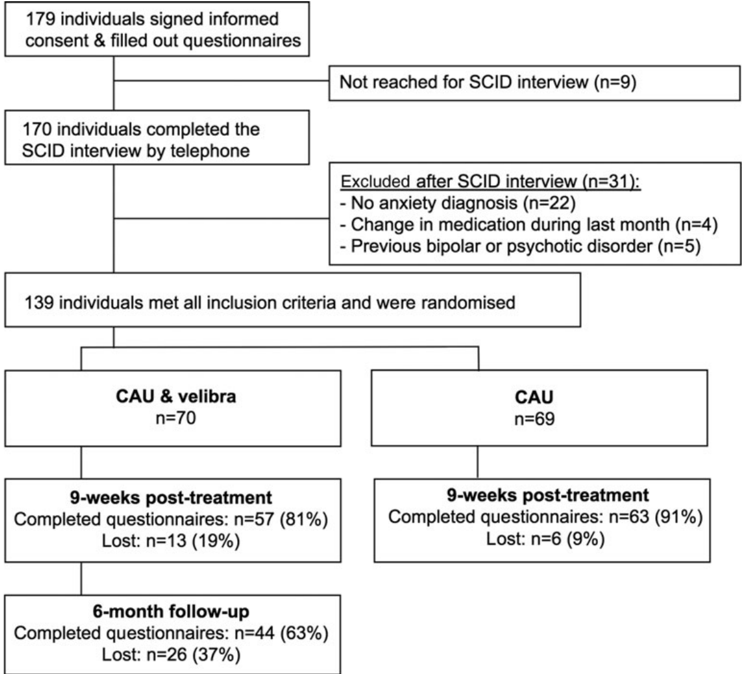
Background: Internet-based cognitive–behavioural treatment (ICBT) for anxiety disorders has shown some promise, but no study has yet examined unguided ICBT in primary care. This randomized controlled trial (RCT) investigated whether a transdiagnostic, unguided ICBT programme for anxiety disorders is effective in primary care settings, after a face-to-face consultation with a physician (MD). We hypothesized that care as usual (CAU) plus unguided ICBT would be superior to CAU in reducing anxiety and related symptoms among patients with social anxiety disorder (SAD), panic disorder with or without agoraphobia (PDA) and/or generalized anxiety disorder (GAD). Method: Adults ( n = 139) with at least one of these anxiety disorders, as reported by their MD and confirmed by a structured diagnostic interview, were randomized. Unguided ICBT was provided by a novel transdiagnostic ICBT programme (‘velibra’). Primary outcomes were generic measures, such as anxiety and depression symptom severity, and diagnostic status at post-treatment (9 weeks). Secondary outcomes included anxiety disorder-specific measures, quality of life, treatment adherence, satisfaction, and general psychiatric symptomatology at follow-up (6 months after randomization). Results: CAU plus unguided ICBT was more effective than CAU at post-treatment, with small to medium between-group effect sizes on primary (Cohen's d = 0.41–0.47) and secondary (Cohen's d = 0.16–0.61) outcomes. Treatment gains were maintained at follow-up. In the treatment group, 28.2% of those with a SAD diagnosis, 38.3% with a PDA diagnosis, and 44.8% with a GAD diagnosis at pretreatment no longer fulfilled diagnostic criteria at post-treatment. Conclusions: The unguided ICBT intervention examined is effective for anxiety disorders when delivered in primary care.
Overview
The claims and statistics of this paper haven’t been checked yet.
Free: it reads the open-access text and checks the first 5 claims that cite a source we can check. Create a free account to check every claim.
Integrity signals
Registry
Cites
Statistics
Figures
Verification
Claims the paper makes
The claims and statistics of this paper haven’t been checked yet.
Free: it reads the open-access text and checks the first 5 claims that cite a source we can check. Create a free account to check every claim.
Claims other papers make about this one
Each is checked against this paper’s own text: does it say what the citing paper says it does?
The source backs part of the claim, not all of it — or backs it for a different population, condition or comparison.
In the citing paper
“Specifically, internet-delivered CBT (iCBT) for anxiety disorders yielded a moderate effect on QOL, both in single studies [77–80] and meta-analyses [81•, 82].”
From Correlates of Quality of Life in Anxiety Disorders: Review of Recent Research (2021) · cites this paper as [77]
Experimental — accuracy not yet measured
Self-check
Percentages, sums and reported differences re-computed from the paper’s own numbers.
The self-check needs the paper’s full text.
Citations
Cites
WARE, J. E., KOSINSKI, M., & KELLER, S. D. (1996) · Medical Care · doi:10.1097/00005650-199603000-00003 · Cited by 17,392 · cited 2×
“…Lovibond & Lovibond, 1995), the Beck Anxiety Inventory (BAI; Beck et al. 1988), the Beck Depression Inventory-II (BDI-II; Beck et al. 1996), the Brief Symptom Inventory (BSI; Derogatis, 1993) and the Short-Form Health Survey-12 (SF-12; Ware et al. 1996) were used as primary outcome measures.”
MethodAn inventory for measuring clinical anxiety: Psychometric properties.
Beck, A. T., Epstein, N., Brown, G., & Steer, R. A. (1988) · Journal of Consulting and Clinical Psychology · doi:10.1037/0022-006x.56.6.893 · Cited by 14,407 · cited 3×
“Because not all participants suffered from the same primary disorder, disorder- Effects of a transdiagnostic unguided Internet intervention (‘velibra’) for anxiety disorders 69 unspecific measures such as the Depression Anxiety Stress Scales – Short Form (DASS-21; Lovibond & Lovibond, 1995), the Beck Anxiety Inventory…”
BackgroundKessler, R. C. (1994) · Archives of General Psychiatry · doi:10.1001/archpsyc.1994.03950010008002 · Cited by 12,370 · cited 1×
“Anxiety disorders are common and associated with substantial disability (Kessler et al. 1994; Mendlowicz & Stein, 2000).”
Background(1995) · Cited by 6,909
Development and validation of the Penn State Worry Questionnaire
Meyer, T. J., Miller, M. L., Metzger, R. L., & Borkovec, T. D. (1990) · Behaviour Research and Therapy · doi:10.1016/0005-7967(90)90135-6 · Cited by 5,099 · cited 2×
“The 16-item Penn State Worry Questionnaire (PSWQ; Meyer et al. 1990) was used to capture the generality, excessiveness and uncontrollability of pathological worry (Cronbach’s α = 0.”
MethodInfluentialAnxiety disorders in primary care: prevalence, impairment, comorbidity, and detection
Kroenke, K., Spitzer, R. L., Williams, J. B. W., Monahan, P. O., & Löwe, B. (2007) · Annals of Internal Medicine · doi:10.7326/0003-4819-146-5-200703060-00004 · Cited by 4,741 · cited 3×
“…approach requires treatment providers to manage only one rather than several online programmes and reduces the importance of properly coding a single principal diagnosis, particularly when symptoms of several anxiety disorders are simultaneously present, which is common (Kroenke et al. 2007).”
BackgroundInfluentialMattick, R. P., & Clarke, J. C. (1998) · Behaviour Research and Therapy · doi:10.1016/s0005-7967(97)10031-6 · Cited by 3,367 · cited 1×
“To measure social anxiety symptoms, we used the Social Phobia Scale (SPS) and the Social Interaction Anxiety Scale (SIAS; Mattick & Clarke, 1998).”
MethodThe empirical status of cognitive-behavioral therapy: A review of meta-analyses
Butler, A. C., Chapman, J. E., Forman, E. M., & Beck, A. T. (2006) · Clinical Psychology Review · doi:10.1016/j.cpr.2005.07.003 · Cited by 3,215 · cited 1×
“Evidence-based psychotherapies, such as cognitive–behavioural therapy (CBT), are at least as effective as pharmacotherapy and should be considered, especially if initial treatment with medications proves inadequate (Issakidis et al. 2004; Butler et al. 2006).”
BackgroundRegier, D. A. (1993) · Archives of General Psychiatry · doi:10.1001/archpsyc.1993.01820140007001 · Cited by 1,999 · cited 2×
“Patients with anxiety disorders are thus likely to receive their only treatment from general medical providers (Regier et al. 1993; Katz et al. 1998), which is in most cases pharmacotherapy (Weiller et al. 1998; Wang et al. 2002).”
BackgroundThe client satisfaction questionnaire
Attkisson, C. C., & Zwick, R. (1982) · Evaluation and Program Planning · doi:10.1016/0149-7189(82)90074-x · Cited by 1,743 · cited 1×
“At post-treatment, a measure of global patient satisfaction was also administered (Client Satisfaction Questionnaire; CSQ-8; Attkisson & Zwick, 1982).”
Method
Research works printed but not linked: 3
- First MB, Spitzer RL, Gibbon M, Williams JBW (1995). Structured Clinical Interview for DSM-IV Axis I Disorders (SCID-I). American Psychiatric Press: Washington, DC.
- Beck AT, Steer RA, Brown GK (1996). BDI-II, Beck Depression Inventory: Manual. Harcourt Brace: Boston, MA.
- Derogatis LR (1993). Brief Symptom Inventory (BSI): Administration, Scoring and Procedures Manual. National Computer Systems: Minneapolis,MN.
Cited by
Standalone smartphone apps for mental health—a systematic review and meta-analysis
Weisel, K. K., Fuhrmann, L. M., Berking, M., Baumeister, H., Cuijpers, P., & Ebert, D. D. (2019) · npj Digital Medicine · doi:10.1038/s41746-019-0188-8 · Cited by 447
Transdiagnostic psychiatry: a systematic review
Fusar‐Poli, P., Solmi, M., Brondino, N., Davies, C., Chae, C., Politi, P., Borgwardt, S., Lawrie, S. M., Parnas, J., & McGuire, P. (2019) · World Psychiatry · doi:10.1002/wps.20631 · Cited by 409
Gan, D. Z. Q., McGillivray, L., Han, J., Christensen, H., & Torok, M. (2021) · Frontiers in Digital Health · doi:10.3389/fdgth.2021.764079 · Cited by 305
Pauley, D., Cuijpers, P., Papola, D., Miguel, C., & Karyotaki, E. (2021) · Psychological Medicine · doi:10.1017/s0033291721001999 · Cited by 170
Lim, S. M., Shiau, C. W. C., Cheng, L. J., & Lau, Y. (2022) · Behavior Therapy · doi:10.1016/j.beth.2021.09.007 · Cited by 163
CBT at the crossroads: the rise of transdiagnostic treatments.
Schaeuffele, C., Schulz, A., Knaevelsrud, C., Renneberg, B., & Boettcher, J. (2021) · International Journal of Cognitive Therapy · doi:10.1007/s41811-020-00095-2 · Cited by 150
Self-citationCorrelates of Quality of Life in Anxiety Disorders: Review of Recent Research
Wilmer, M. T., Anderson, K., & Reynolds, M. (2021) · Current Psychiatry Reports · doi:10.1007/s11920-021-01290-4 · Cited by 150
Dahlhausen, F., Zinner, M., Bieske, L., Ehlers, J. P., Boehme, P., & Fehring, L. (2021) · JMIR mHealth and uHealth · doi:10.2196/33012 · Cited by 136
“Although further research on the evidence of mHealth apps is needed in general [10], patient benefits have already been confirmed for various DiGA in randomized controlled trials [38-41].”
BackgroundIntegration of personalized drug delivery systems into digital health
Raijada, D. K., Wac, K., Greisen, E., Rantanen, J., & Genina, N. (2021) · Advanced Drug Delivery Reviews · doi:10.1016/j.addr.2021.113857 · Cited by 161
“app, which aims to help with tinnitus [147], and (2) Velibra , a therapy program for anxiety disorders [148].”
BackgroundMak, W. W., Tong, A. C., Yip, S. Y., Lui, W. W., Chio, F. H., Chan, A. T., & Wong, C. C. (2018) · JMIR Mental Health · doi:10.2196/mental.8597 · Cited by 123
“Nonetheless, the effect sizes in our online self-compassion and mindfulness-based programs (as well as in CBP) were comparable with other unguided internet-based CBT trials, for instance, Berger et al [65], supporting these approaches to be noninferior to other unguided internet-based CBTs.”
Twomey, C., O’Reilly, G., & Meyer, B. (2017) · Psychiatry Research · doi:10.1016/j.psychres.2017.06.081 · Cited by 103
Self-citationSchaeuffele, C., Meine, L. E., Schulz, A., Weber, M. C., Moser, A., Paersch, C., Recher, D., Boettcher, J., Renneberg, B., Flückiger, C., et al. (2024) · Nature Human Behaviour · doi:10.1038/s41562-023-01787-3 · Cited by 91
Self-citationBeintner, I., Vollert, B., Zarski, A.-C., Bolinski, F., Musiat, P., Görlich, D., Ebert, D. D., & Jacobi, C. (2019) · Journal of Medical Internet Research · doi:10.2196/14181 · Cited by 89
“Although higher adherence has been shown to be linked to larger intervention effects in numerous trials [23-28], other trials [29-33] found no impact of adherence on outcomes.”
Papola, D., Miguel, C., Mazzaglia, M., Franco, P., Tedeschi, F., Romero, S. A., Patel, A., Ostuzzi, G., Gastaldon, C., Karyotaki, E., et al. (2023) · JAMA Psychiatry · doi:10.1001/jamapsychiatry.2023.3971 · Cited by 138
Beevers, C. G., Pearson, R., Hoffman, J. S., Foulser, A. A., Shumake, J., & Meyer, B. (2017) · Journal of Consulting and Clinical Psychology · doi:10.1037/ccp0000171 · Cited by 69
“There are a number of Internet-based (Berger et al., 2016; Boettcher, Hasselrot, Sund, Andersson, & Carlbring, 2014) and face-to-face interventions (Hofmann & Smits, 2008) that could be used for such a purpose.”
BackgroundSelf-citationJabir, A. I., Lin, X., Martinengo, L., Sharp, G., Theng, Y.-L., & Tudor Car, L. (2024) · Journal of Medical Internet Research · doi:10.2196/48168 · Cited by 66
Holtdirk, F., Mehnert, A., Weiss, M., Mayer, J., Meyer, B., Bröde, P., Claus, M., & Watzl, C. (2021) · PLOS ONE · doi:10.1371/journal.pone.0251276 · Cited by 62
Self-citationRomijn, G., Batelaan, N., Kok, R., Koning, J., van Balkom, A., Titov, N., & Riper, H. (2019) · Journal of Medical Internet Research · doi:10.2196/11706 · Cited by 52
“8% [31] and n=70, 77% [53]) and therefore we classified these studies as OR trials.”
BackgroundMethodInfluentialMorgan, C., Mason, E., Newby, J. M., Mahoney, A. E. J., Hobbs, M. J., McAloon, J., & Andrews, G. (2017) · Internet Interventions · doi:10.1016/j.invent.2017.10.003 · Cited by 58
“…such as telephone calls, diagnostic interviews, moderated discussion forums, or personalised automated email reminders (e.g., Berger et al., 2011; Berger et al., 2017; Boettcher et al., 2012; Christensen et al., 2004a, 2004b; Dear et al., 2014; Donker et al., 2013a, 2013b; Karyotaki et al.,…”
BackgroundPapola, D., Ostuzzi, G., Tedeschi, F., Gastaldon, C., Purgato, M., Giovane, C. D., Pompoli, A., Pauley, D., Karyotaki, E., Sijbrandij, M., et al. (2021) · The British Journal of Psychiatry · doi:10.1192/bjp.2021.148 · Cited by 71
Mäder, M., Timpel, P., Schönfelder, T., Militzer-Horstmann, C., Scheibe, S., Heinrich, R., & Häckl, D. (2023) · BMC Health Services Research · doi:10.1186/s12913-023-09287-w · Cited by 65
“The majority ( n = 10) of the listed DiGA can be prescribed for one or two indications, except for Deprexis with six, Velibra with four and Vivira with 20 indications.”
BackgroundMethodInfluentialDigital health in the era of personalized healthcare
Cancela, J., Charlafti, I., Colloud, S., & Wu, C. (2020) · Elsevier eBooks · doi:10.1016/b978-0-12-820077-3.00002-x · Cited by 68
Powell, J., Williams, V., Atherton, H., Bennett, K., Yang, Y., Davoudianfar, M., Hellsing, A., Martin, A., Mollison, J., Shanyinde, M., et al. (2020) · Journal of Medical Internet Research · doi:10.2196/16804 · Cited by 44
“This study adds to the body of work showing small positive effects for unguided digital self-help for social anxiety [5,9-14] and a range of other mental health problems [29].”
ResultLantzsch, H., Eckhardt, H., Campione, A., Busse, R., & Henschke, C. (2022) · BMC Health Services Research · doi:10.1186/s12913-022-08500-6 · Cited by 50
“In three trials (n = 3/13) [26, 36, 40], at least one outcome was measured by different survey instruments.”
BackgroundKolominsky‐Rabas, P. L., Tauscher, M., Gerlach, R., Perleth, M., & Dietzel, N. (2022) · Zeitschrift für Evidenz Fortbildung und Qualität im Gesundheitswesen · doi:10.1016/j.zefq.2022.09.008 · Cited by 56
McCall, H. C., Hadjistavropoulos, H. D., & Sundström, C. R. F. (2021) · Journal of Medical Internet Research · doi:10.2196/26939 · Cited by 41
“Low Unclear Low Low Low Berger et al, 2017 [78]”
BackgroundMethodInfluentialGonzález-Robles, A., Díaz-García, A., García-Palacios, A., Roca, P., Ramos-Quiroga, J. A., & Botella, C. (2020) · Journal of Medical Internet Research · doi:10.2196/18220 · Cited by 40
“Transdiagnostic treatments have been developed and tested in several RCTs for anxiety disorders [21-24] and anxiety and depressive disorders [25-27], and their number continues to grow.”
BackgroundThe Effectiveness of an Internet Intervention Aimed at Reducing Alcohol Consumption in Adults
Zill, J. M., Christalle, E., Meyer, B., Härter, M. C., & Dirmaier, J. (2019) · Deutsches Ärzteblatt international · doi:10.3238/arztebl.2019.0127 · Cited by 52
Self-citationCevasco, K. E., Morrison Brown, R. E., Woldeselassie, R., & Kaplan, S. (2024) · Journal of Medical Systems · doi:10.1007/s10916-024-02059-x · Cited by 35
Saad, A., Bruno, D., Camara, B., D’Agostino, J., & Bolea-Alamanac, B. M. (2021) · JMIR Mental Health · doi:10.2196/27404 · Cited by 36
“Tables 1 and 2 describe the interventions studied, whereas further information about the studies has been summarized in Multimedia Appendix 1 [2,19-39] and Multimedia Appendix 2 [40-53].”
InfluentialGonzález-Robles, A., Díaz-García, A., Miguel, C., García-Palacios, A., & Botella, C. (2018) · PLOS ONE · doi:10.1371/journal.pone.0207396 · Cited by 30
Ebenfeld, L., Lehr, D., Ebert, D. D., Stegemann, S. K., Riper, H. M., Funk, B., & Berking, M. (2021) · Journal of Medical Internet Research · doi:10.2196/20829 · Cited by 33
“Recent outcome studies [13-15], meta-analyses, and reviews [16-24] provide ample evidence that internet-based interventions based on cognitive behavioral therapy principles (iCBT) are effective in treating panic disorder.”
BackgroundBraun, P., Drüge, M., Hennemann, S., Nitsch, F. J., Staeck, R., & Apolinário-Hagen, J. (2022) · Frontiers in Digital Health · doi:10.3389/fdgth.2022.840869 · Cited by 27
“health applications (medical apps) for mental health such as selfapy (48), velibra (49) or deprexis (50) have been integrated”
BackgroundParker, E. L., Banfield, M., Fassnacht, D. B., Hatfield, T., & Kyrios, M. (2021) · BMC Family Practice · doi:10.1186/s12875-021-01445-5 · Cited by 37
“One further study reported sustained treatment gains in treatment group participants for whom follow-up assessments were conducted [57].”
BackgroundWeisel, K. K., Zarski, A.-C., Berger, T., Krieger, T., Moser, C. T., Schaub, M. P., Görlich, D., Berking, M., & Ebert, D. D. (2020) · Journal of Medical Internet Research · doi:10.2196/16450 · Cited by 25
“Research investigating internet-based transdiagnostic treatment protocols for different anxiety disorders and comorbid depression has found these type of interventions to be efficacious [20-22].”
BackgroundSelf-citationChow, D. Y.-W., Jiang, X., & You, J. H. S. (2022) · Journal of Affective Disorders · doi:10.1016/j.jad.2022.05.048 · Cited by 30
Digital health applications in the area of mental health
Schreiter, S., Mascarell-Maricic, L., Rakitzis, O., Volkmann, C., Kaminski, J. A., & Daniels, M. A. (2023) · Deutsches Ärzteblatt international · doi:10.3238/arztebl.m2023.0208 · Cited by 37
Meyer, B., Utter, G.-L., & Hillman, C. (2021) · JMIR Mental Health · doi:10.2196/31173 · Cited by 22
“The development process followed a framework developed by GAIA over the course of more than a decade and is generally consistent with models such as the patient-focused, person-centered approach described by Yardley et al [51-54].”
Self-citationApolinário-Hagen, J. (2019) · Psychiatry Investigation · doi:10.30773/pi.2018.06.26 · Cited by 20
Challenges and opportunities for e-mental health policy: an Estonian case study
Sogomonjan, M. (2020) · Contemporary Social Science · doi:10.1080/21582041.2020.1720795 · Cited by 19
“…of e-mental health therapies blended with traditional guided mental health interventions, already in use in the EU, Australia and the USA, has shown how they can facilitate and increase access to treatment (Berger et al., 2017; Hickie et al., 2010; Høifødt et al., 2013; Rollman et al., 2017).”
BackgroundSchwartz, D. G., Spitzer, S., Khalemsky, M., Bejar, A. H. C., Ray, S., Chiou, J., Sakhnini, R., Lanin, R., Meir, M. M., & Tsai, M. (2024) · Health Policy and Technology · doi:10.1016/j.hlpt.2024.100848 · Cited by 19
Yu, J. S., Szigethy, E., Wallace, M., Solano, F., & Oser, M. (2018) · Telemedicine and e-Health · doi:10.1089/tmj.2017.0280 · Cited by 15
“Although at least one study has found that extent of usage and modules completed are not significantly related to symptom outcomes, 45 it makes sense that the extent to which individuals engage with a digital program may have differential effects on outcomes.”
Heddaeus, D., Dirmaier, J., Brettschneider, C., Daubmann, A., Grochtdreis, T., Knesebeck, O. V. D., König, H., Löwe, B., Maehder, K., Porzelt, S., et al. (2019) · BMJ Open · doi:10.1136/bmjopen-2019-032408 · Cited by 16
Sippli, K., Deckert, S., Schmitt, J. M., & Scheibe, M. (2025) · npj Digital Medicine · doi:10.1038/s41746-025-01879-6 · Cited by 27
“Some instruments, such as the SF-12, were counted as two measurement instruments in cases where, for example, resultsformentalandphysicalhealthwereanalysedseparately.”
InfluentialHoltdirk, F., Mehnert-Theuerkauf, A., Weiss, M., Meyer, B., & Watzl, C. (2020) · Trials · doi:10.1186/s13063-019-3987-y · Cited by 18
“As in other interventions developed by our group [34, 39, 40], there is no fixed or generic sequence in which modules must be completed, nor is there a minimum number of sessions that must be finished.”
BackgroundSelf-citationOser, M. L., Wallace, M. L., Solano, F. X., & Szigethy, E. (2019) · JMIR Mental Health · doi:10.2196/11981 · Cited by 15
“Digital CBT is effective in treating anxiety [8,9] even in non-US primary care settings [10,11]; however, its viability and effectiveness for addressing anxiety in a US primary care setting are not known.”
BackgroundResultArndt, A., Rubel, J., Berger, T., & Lutz, W. (2020) · Internet Interventions · doi:10.1016/j.invent.2020.100319 · Cited by 13
Braun, P., Schwientek, A.-K., Angerer, P., Guthardt, L., Icks, A., Loerbroks, A., & Apolinário-Hagen, J. (2023) · Digital Health · doi:10.1177/20552076231173568 · Cited by 15
Robichaud, M., Talbot, F., Titov, N., Dear, B. F., Hadjistavropoulos, H. D., Hadjistavropoulos, T., & Jbilou, J. (2019) · Behavioural and Cognitive Psychotherapy · doi:10.1017/s135246581900047x · Cited by 17
“(Baumeister et al., 2014; Berger et al., 2011a; Berger et al., 2011b; Berger et al., 2017; Kayrouz et al., 2016a; Kobak et al., 2015; Lintvedt et al., 2013b; Morgan et al., 2017; Richards and Richardson, 2012; Rosso et al., 2017; Titov et al., 2013).”
Meyer, B., Weiss, M., Holtkamp, M., Arnold, S., Brückner, K., Schröder, J., Scheibe, F., & Nestoriuc, Y. (2017) · BMC Psychiatry · doi:10.1186/s12888-017-1229-y · Cited by 12
Self-citationInternet-Interventionen: Ein Überblick
Berger, T., & Krieger, T. (2018) · PiD - Psychotherapie im Dialog · doi:10.1055/a-0592-0282 · Cited by 17
“[8] Berger T, Urech A, Krieger T et al.”
BackgroundSelf-citationKrause, N., Riemann-Lorenz, K., Steffen, T., Rahn, A. C., Pöttgen, J., Stellmann, J., Köpke, S., Friede, T., Icks, A., Vomhof, M., et al. (2021) · BMJ Open · doi:10.1136/bmjopen-2020-041720 · Cited by 10
Effectiveness of digital interventions for eight mental disorders: A meta-analytic synthesis
Harrer, M., Miguel, C., Tong, L., Kuper, P., Sprenger, A. A., Furukawa, Y., Wang, Y., van Ballegooijen, W., Čihařová, M., Panagiotopoulou, O. M., et al. (2025) · Internet Interventions · doi:10.1016/j.invent.2025.100860 · Cited by 13
“For depression, we found one trial evaluating deprexis (GAIA AG, Germany; Berger et al., 2011).”
Liu, J., Li, C., Qiu, Y.-F., Yu, Y.-Q., Zeng, L., Wu, M., Han, Y., & Yang, F. (2024) · Psychiatry Research · doi:10.1016/j.psychres.2024.116324 · Cited by 10
Treatment of Anxiety Disorders in the Digital Age
Blackburn, A. M., & Goetter, E. M. (2019) · Current clinical psychiatry · doi:10.1007/978-3-030-30687-8_16 · Cited by 8
Wolff, L. L., Rapp, M. A., & Mocek, A. (2022) · Psychiatrische Praxis · doi:10.1055/a-1875-3635 · Cited by 9
Meyer, B., Riepenhausen, A., Betz, L. T., Jauch‐Chara, K., & Reshetnik, A. (2025) · BMC Cardiovascular Disorders · doi:10.1186/s12872-025-04698-5 · Cited by 16
“This DTx followed the same design and development approach used by our team for similar evidence-based interventions addressing conditions such as depression, anxiety disorders, substance use disorders, breast cancer survivorship, epilepsy, and multiple sclerosis [38–44].”
InfluentialSelf-citationJung, H. W., Jang, K.-W., Nam, S., Kim, A. Y., Lee, J., Ahn, M. E., Lee, S., Kim, Y. J., Shin, J.-K., & Roh, D. D. (2025) · Journal of Clinical Medicine · doi:10.3390/jcm14051771 · Cited by 11
Bendig, E., Meißner, E., Erb, B., Weger, L., Küchler, A., Bauereiß, N., Ebert, D. D., & Baumeister, H. (2021) · BMJ Open · doi:10.1136/bmjopen-2020-041573 · Cited by 7
Bielinski, L. L., Wälchli, G., Nissen, C., Berger, T., & Moggi, F. (2023) · JMIR Research Protocols · doi:10.2196/47656 · Cited by 7
“For this study, the CSQ-8 was adapted for an internet intervention (as has been done in previous studies [57,58]).”
Self-citationRomagnoli, A., Zovi, A., Sabbatucci, M., Ferrara, F., & Vitiello, A. (2023) · Journal of Interprofessional Education & Practice · doi:10.1016/j.xjep.2023.100656 · Cited by 7
Wen, X., Gou, M., Chen, H., Kishimoto, T., Qian, M., Margraf, J., & Berger, T. (2024) · JMIR Mental Health · doi:10.2196/50535 · Cited by 9
“The effectiveness of WCBT is significant and can be maintained for 4 years after the end of the intervention [18-20].”
BackgroundSelf-citationDigitale Gesundheitsanwendungen mit psychotherapeutischem Fokus
Guth, M., Wiebe, A., & Philipsen, A. (2023) · Der Nervenarzt · doi:10.1007/s00115-023-01446-y · Cited by 6
“In einem RCT [30] konnte eine signifikante Symptomreduktion im Vergleich zu einer Care-as-usual-Kontrollgruppe nach 9 Wochen sowie nach 6 Monaten gezeigt werden.”
BackgroundInfluentialKrause, N., Derad, C., von Glasenapp, B., Riemann-Lorenz, K., Meyer, B., Asendorf, T., Temmes, H., van de Loo, M., Gold, S. M., Schubert, C., et al. (2025) · Multiple Sclerosis Journal · doi:10.1177/13524585251356410 · Cited by 6
“32,33 When examining participants who completed nearly all ( ⩾ 75”
Self-citationRomagnoli, A., Valentino, F., Zovi, A., Caprodossi, A., Vitiello, A., & Ferrara, F. (2023) · Journal of Pharmaceutical Innovation · doi:10.1007/s12247-023-09767-w · Cited by 5
Sogomonjan, M., Kerikmäe, T., & Ööpik, P. (2018) · TalTech Journal of European Studies · doi:10.1515/bjes-2018-0019 · Cited by 4
“Only a small number of participants in our review completed all sessions of iCBT (Berger et al., 2017; Høifødt et al., 2013; Newby et al., 2013; Rollman et al., 2017; Simblett et al., 2017; Gilbody et al., 2017; Kivi et al., 2014; de Graaf et al., 2009; Levin et al., 2011; de Graaf et al., 2011; Hickie et al., 2010; K…”
BackgroundResultInfluentialRubel, J. A., Quest, J., Pruessner, L., Timm, C., Hartmann, S. F., Barnow, S., Rittmeyer, L., Rosenbaum, D., & Lalk, C. (2022) · Internet Interventions · doi:10.1016/j.invent.2022.100584 · Cited by 4
Cho, I., Kim, B.-H., Lee, H., Song, Y., Chang, M. J., Kim, J., & Han, E. (2025) · Journal of Anxiety Disorders · doi:10.1016/j.janxdis.2025.103074 · Cited by 7
Schittenhelm, J. M., von Borell, C., Clément, C. C., Schüller, J. S., Stangier, U., & Hoyer, J. (2023) · Trials · doi:10.1186/s13063-023-07168-5 · Cited by 7
“ICBTs may reduce the threshold to seek treatment and provide cost-efficient [10, 11] and highly scalable access to scientifically evaluated treatment programs [12].”
BackgroundSogomonjan, M., Kerikmäe, T., Ööpik, P., & Ross, P. (2019) · Cogent Psychology · doi:10.1080/23311908.2019.1637623 · Cited by 3
“…and efficient method of mental health care delivery under strictly controlled conditions where patients were allowed to take additional medication (Berger et al., 2017; Newby et al., 2013; Bergstrom et al., 2010; Nordgren et al., 2014; Perini et al., 2009; Ruwaard et al., 2009; Andersson et al.,…”
MethodAeschlimann, A., Heim, E., Killikelly, C., Mahmoud, N., Haji, F., Stoeckli, R. T., Aebersold, M., Thoma, M. V., & Maercker, A. (2025) · Internet Interventions · doi:10.1016/j.invent.2025.100800 · Cited by 2
“This rate aligns with typical adherence levels in other IBIs, which range from 32 % to 46 % (Berger et al., 2017; Cuijpers et al., 2022; Kazlauskas et al., 2020).”
González-Robles, A., Romero-Ferreiro, V., Roca, P., Rodríguez‐Jiménez, T., & Díaz‐García, A. (2026) · General Hospital Psychiatry · doi:10.1016/j.genhosppsych.2026.03.008 · Cited by 3
The Use of Technology to Augment Clinical Care in Depression and Anxiety Disorders: An Evidence Map
Maher, A. R., Apaydin, E. A., Raaen, L. B., Motala, A., Shanman, R., & Hempel, S. (2019) · RAND Corporation eBooks · doi:10.7249/rr2177 · Cited by 2
“…et al., 2017; Berger, Boettcher, and Caspar, 2014; Berger, Caspar, et al., 2011; Berger, Hämmerli, et al., 2011; Berger, Hohl, and Caspar, 2009; Berger et al., 2016; Bergström et al., 2010; Birney et al., 2016; Blackwell et al., 2015; Boeschoten et al., 2016; Boettcher, Aström, et al., 2014;…”
Albrecht, U., von Jan, U., Lawin, D., Pustozerov, E., & Dittrich, F. (2023) · Studies in health technology and informatics · doi:10.3233/shti230165 · Cited by 4
“12([18]) Anxiety std 139 20; 13 3 6 no Ib 13 back pain std 215 –; 2 10 3 no 1b”
Rubel, J., Quest, J., Pruessner, L., Timm, C., Hartmann, S., Barnow, S., Rittmeyer, L., Rosenbaum, D., & Lalk, C. (2023) · JMIR Research Protocols · doi:10.2196/41440 · Cited by 2
Berger, T., Friedl, N., Weisel, K. K., Baumeister, H., & Ebert, D. D. (2023) · Springer eBooks · doi:10.1007/978-3-662-65816-1_4 · Cited by 1
Self-citationTherapie von Angsterkrankungen
Zwanzger, P., & Ehlich, B. (2023) · NeuroTransmitter · doi:10.1007/s15016-023-3086-x · Cited by 1
Panic Disorder and Agoraphobia
Koch, E. I., & Fernando, M. A. (2018) · Springer eBooks · doi:10.1007/978-3-319-70539-2_27 · Cited by 1
Improving the Efficiency and Scalability of Cognitive Behavioral Therapies
Dobias, M., Schleider, J. L., & Ollendick, T. H. (2021) · Elsevier eBooks · doi:10.1016/b978-0-12-818697-8.00075-3 · Cited by 2
Beintner, I., Vollert, B., Zarski, A., Bolinski, F., Musiat, P., Görlich, D., Ebert, D. D., & Jacobi, C. (2019) · doi:10.2196/preprints.14181 · Cited by 1
Robles, V. A. G. (2019) · Tesis Doctorals en Xarxa (Consorci de Serveis Universitaris de Catalunya) · doi:10.6035/14109.2019.233592
Dobrowolski, C., & Chapleau, A. (2019) · American Journal of Occupational Therapy · doi:10.5014/ajot.2019.73s1-po6051
Online treatment programmes for suicidal persons: Current evidence and future directions
Meyer, B. (2021) · doi:10.1093/med/9780198834441.003.0059
Self-citationInnovative Applikationen mit Kehrseite
Weih, M. (2021) · NeuroTransmitter · doi:10.1007/s15016-021-9198-2
Romijn, G., Batelaan, N. M., Kok, R., Koning, J., van Balkom, A. J. L. M., Titov, N., & Riper, H. M. (2018) · doi:10.2196/preprints.11706
Vollmer, L., & Walzer, S. (2022) · Springer eBooks · doi:10.1007/978-3-658-35691-0_10
Exposure for Multiple Anxiety Disorders
Stewart, K. E., & Antony, M. M. (2022) · Springer eBooks · doi:10.1007/978-3-031-04927-9_2
Cognitive Behavioral Therapy in Switzerland
Khazaal, Y., Kalogeropolou, E., Favrod, J., Kramer, U., & Jermann, F. (2022) · Springer eBooks · doi:10.1007/978-3-030-82555-3_30
DiGA, weitere psychotherapeutische Anwendungen und primärpräventive Anwendungen
Meisenzahl, E. M., & Sprick, U. (2023) · Springer eBooks · doi:10.1007/978-3-662-64457-7_5
Aeschlimann, A., Heim, E., Killikelly, C., Mahmoud, N., Haji, F., Stoeckli, R. T., Aebersold, M., Thoma, M. V., & Maercker, A. (2024) · SSRN Electronic Journal · doi:10.2139/ssrn.4995408
Baumeister, A., Schuurmans, L., & Moritz, S. (2025) · Internet Interventions · doi:10.1016/j.invent.2025.100867 · Cited by 1
“However, as stated before, only two of the included studies evaluated comparable (transdiagnostic, unguided) interventions (Bell et al., 2012; Berger et al., 2017).”
InfluentialSelf-citationJacob, G. A., Menne, B., Firus, C., & Schröder, J. (2025) · doi:10.2196/preprints.89747
Lantzsch, H., Eckhardt, H., Campione, A., Busse, R., & Henschke, C. (2022) · Figshare · doi:10.6084/m9.figshare.21185667
Lantzsch, H., Eckhardt, H., Campione, A., Busse, R., & Henschke, C. (2022) · Figshare · doi:10.6084/m9.figshare.21185670
Adler, L., Meyer, B., Betz, L. T., Häuser, W., & Knitza, J. (2026) · doi:10.2196/preprints.107347
Self-citationEffect Sizes of Permanently Listed Digital Health Applications (DiGAs) in GermanyPreprint
Fritz, M. S., & Zenner, H. P. (2026) · Research Square · doi:10.21203/rs.3.rs-10879796/v1
Schmitz, A., Frey, S., Karimzadeh, A., Neves, A. L. (. L. )., Mayr, A., & Weltermann, B. (2026) · Scientific Reports · doi:10.1038/s41598-026-68875-y
Ko, Y., Kim, J., Park, S., Kim, H., Seo, J. H., Park, I. H., Lee, J., & Kim, J. (2026) · Journal of Medical Internet Research · doi:10.2196/101125
“…digital CBT programs targeting anxiety disorders, such as Veli-bra and FearFighter, offer structured cognitive restructuring and exposure modules [26,27], and digital modules specific to panic disorder have also been introduced in the form of exposure therapy and self-guided mindfulness training…”
Metadata
- Authors
- Berger, T., Urech, A., Krieger, T., Stolz, T., Schulz, A., Vincent, A., Moser, C. T., Moritz, S., & Meyer, B.
- Affiliations
- University of Bern (CH)
- University Medical Center Hamburg-Eppendorf (DE)
- City, University of London (GB)
- Corresponding author
- Berger, T.
- Venue
- Psychological Medicine
- Publisher
- Cambridge University Press (CUP)
- Published
- 2016-09-22
- Volume
- 47
- Issue
- 1
- Pages
- 67-80
- ISSN
- 0033-2917 (ISSN-L)
- 1469-8978
- OpenAlex
- W2523083215
- Cited by
- 98
- References
- 65
- Citations by year
- 2026: 5 · 2025: 9 · 2024: 6 · 2023: 15 · 2022: 11 · 2021: 18 · 2020: 7 · 2019: 14 · 2018: 9 · 2017: 4
- FWCI
- 13.88
- Type
- journal article
- Language
- en
- Open access
- hybrid
- doi.org
- Locations
- Psychological Medicine (publishedVersion, cc-by)
- PubMed (publishedVersion)
- BORIS (University Library Bern) (submittedVersion, other-oa)
- Open Access CRIS of the University of Bern
- Funders
- National Science Foundation
- Schweizerischer Nationalfonds zur Förderung der Wissenschaftlichen Forschung (144824, PP00P1_144824/1)
- Topics
- Social Sciences › Psychology › Applied Psychology › Digital Mental Health Interventions
- Social Sciences › Psychology › Experimental and Cognitive Psychology › Anxiety, Depression, Psychometrics, Treatment, Cognitive Processes
- Social Sciences › Psychology › Clinical Psychology › Psychological Treatments and Assessments
- Keywords
- transdiagnostic treatment, anxiety disorders, primary care, social anxiety disorder, panic disorder with agoraphobia, generalized anxiety disorder, medication adherence, treatment satisfaction, quality of life, depressive symptoms, maintenance of treatment gains
- MeSH terms
- Adult, Anxiety Disorders, Female, Humans, Male, Middle Aged, Primary Health Care, Cognitive Behavioral Therapy, Outcome Assessment, Health Care, Internet
About these checks
Registry, retraction, Cites and statistics results are computed, not judged, with one exception: a printed reference that no index lists is read once by a model before it counts as a citation error. Claims are extracted by a model and kept only when their quote appears verbatim in the text; each cited source is then checked, with a model’s help, for whether it says what the claim relies on. Those verdicts can be wrong — read the claim’s quote and the cited source before relying on one.
Statistics and arithmetic are recomputed, not judged.
Confidence bands are shown only for fields calibrated on our annotated test set. None is calibrated yet, so no band is shown.
What counts as a claim ›How we measure confidence ›How we check this ›
Are you an author, or do you see a problem with this page? Request a review
Data sources
Bibliographic data: Semantic Scholar, OpenAlex, Crossref.
Contains information from the Semantic Scholar Academic Graph Datasets, made available under the ODC Attribution License (ODC-BY 1.0).
Semantic Scholar’s data is described in: Kinney, R., et al. (2023). The Semantic Scholar Open Data Platform. arXiv:2301.10140.
