

Effects of a transdiagnostic unguided Internet intervention (‘velibra’) for anxiety disorders in primary care: results of a randomized controlled trial
Open accessThe DOI matches its Crossref record; 63 of the 65 references it cites were found in a registry or an index.
Abstract
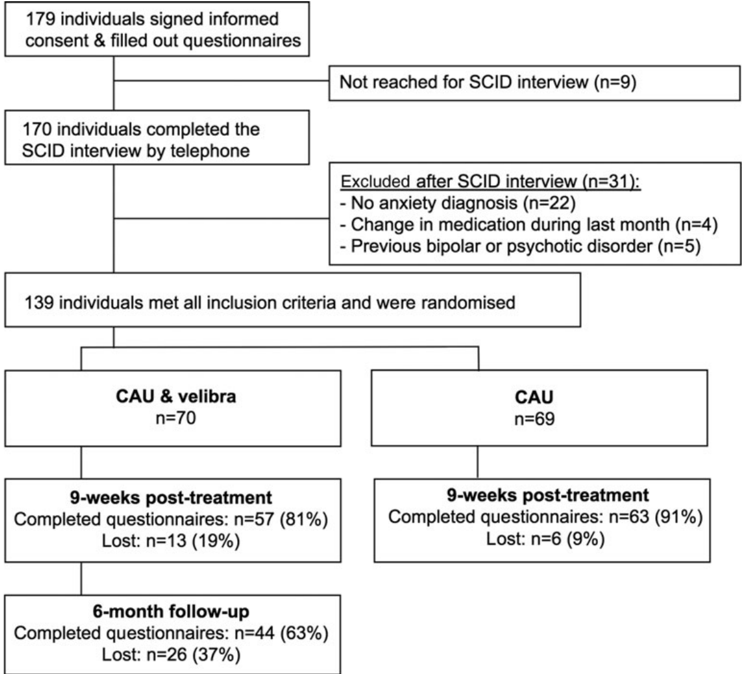
Background: Internet-based cognitive–behavioural treatment (ICBT) for anxiety disorders has shown some promise, but no study has yet examined unguided ICBT in primary care. This randomized controlled trial (RCT) investigated whether a transdiagnostic, unguided ICBT programme for anxiety disorders is effective in primary care settings, after a face-to-face consultation with a physician (MD). We hypothesized that care as usual (CAU) plus unguided ICBT would be superior to CAU in reducing anxiety and related symptoms among patients with social anxiety disorder (SAD), panic disorder with or without agoraphobia (PDA) and/or generalized anxiety disorder (GAD). Method: Adults ( n = 139) with at least one of these anxiety disorders, as reported by their MD and confirmed by a structured diagnostic interview, were randomized. Unguided ICBT was provided by a novel transdiagnostic ICBT programme (‘velibra’). Primary outcomes were generic measures, such as anxiety and depression symptom severity, and diagnostic status at post-treatment (9 weeks). Secondary outcomes included anxiety disorder-specific measures, quality of life, treatment adherence, satisfaction, and general psychiatric symptomatology at follow-up (6 months after randomization). Results: CAU plus unguided ICBT was more effective than CAU at post-treatment, with small to medium between-group effect sizes on primary (Cohen's d = 0.41–0.47) and secondary (Cohen's d = 0.16–0.61) outcomes. Treatment gains were maintained at follow-up. In the treatment group, 28.2% of those with a SAD diagnosis, 38.3% with a PDA diagnosis, and 44.8% with a GAD diagnosis at pretreatment no longer fulfilled diagnostic criteria at post-treatment. Conclusions: The unguided ICBT intervention examined is effective for anxiety disorders when delivered in primary care.
Overview
The claims and statistics of this paper haven’t been checked yet.
Free: it reads the open-access text and checks the first 5 claims that cite a source we can check. Create a free account to check every claim.
Integrity signals
Registry
Cites
Statistics
Figures
Verification
Claims the paper makes
The claims and statistics of this paper haven’t been checked yet.
Free: it reads the open-access text and checks the first 5 claims that cite a source we can check. Create a free account to check every claim.
Claims other papers make about this one
Each is checked against this paper’s own text: does it say what the citing paper says it does?
The source backs part of the claim, not all of it — or backs it for a different population, condition or comparison.
In the citing paper
“Specifically, internet-delivered CBT (iCBT) for anxiety disorders yielded a moderate effect on QOL, both in single studies [77–80] and meta-analyses [81•, 82].”
From Correlates of Quality of Life in Anxiety Disorders: Review of Recent Research (2021) · cites this paper as [77]
Experimental — accuracy not yet measured
Self-check
Percentages, sums and reported differences re-computed from the paper’s own numbers.
The self-check needs the paper’s full text.
Citations
Cites
WARE, J. E., KOSINSKI, M., & KELLER, S. D. (1996) · Medical Care · doi:10.1097/00005650-199603000-00003 · Cited by 17,392 · cited 2×
“…Lovibond & Lovibond, 1995), the Beck Anxiety Inventory (BAI; Beck et al. 1988), the Beck Depression Inventory-II (BDI-II; Beck et al. 1996), the Brief Symptom Inventory (BSI; Derogatis, 1993) and the Short-Form Health Survey-12 (SF-12; Ware et al. 1996) were used as primary outcome measures.”
MethodAn inventory for measuring clinical anxiety: Psychometric properties.
Beck, A. T., Epstein, N., Brown, G., & Steer, R. A. (1988) · Journal of Consulting and Clinical Psychology · doi:10.1037/0022-006x.56.6.893 · Cited by 14,407 · cited 3×
“Because not all participants suffered from the same primary disorder, disorder- Effects of a transdiagnostic unguided Internet intervention (‘velibra’) for anxiety disorders 69 unspecific measures such as the Depression Anxiety Stress Scales – Short Form (DASS-21; Lovibond & Lovibond, 1995), the Beck Anxiety Inventory…”
BackgroundKessler, R. C. (1994) · Archives of General Psychiatry · doi:10.1001/archpsyc.1994.03950010008002 · Cited by 12,370 · cited 1×
“Anxiety disorders are common and associated with substantial disability (Kessler et al. 1994; Mendlowicz & Stein, 2000).”
Background(1995) · Cited by 6,909
Development and validation of the Penn State Worry Questionnaire
Meyer, T. J., Miller, M. L., Metzger, R. L., & Borkovec, T. D. (1990) · Behaviour Research and Therapy · doi:10.1016/0005-7967(90)90135-6 · Cited by 5,099 · cited 2×
“The 16-item Penn State Worry Questionnaire (PSWQ; Meyer et al. 1990) was used to capture the generality, excessiveness and uncontrollability of pathological worry (Cronbach’s α = 0.”
MethodInfluentialAnxiety disorders in primary care: prevalence, impairment, comorbidity, and detection
Kroenke, K., Spitzer, R. L., Williams, J. B. W., Monahan, P. O., & Löwe, B. (2007) · Annals of Internal Medicine · doi:10.7326/0003-4819-146-5-200703060-00004 · Cited by 4,741 · cited 3×
“…approach requires treatment providers to manage only one rather than several online programmes and reduces the importance of properly coding a single principal diagnosis, particularly when symptoms of several anxiety disorders are simultaneously present, which is common (Kroenke et al. 2007).”
BackgroundInfluentialMattick, R. P., & Clarke, J. C. (1998) · Behaviour Research and Therapy · doi:10.1016/s0005-7967(97)10031-6 · Cited by 3,367 · cited 1×
“To measure social anxiety symptoms, we used the Social Phobia Scale (SPS) and the Social Interaction Anxiety Scale (SIAS; Mattick & Clarke, 1998).”
MethodThe empirical status of cognitive-behavioral therapy: A review of meta-analyses
Butler, A. C., Chapman, J. E., Forman, E. M., & Beck, A. T. (2006) · Clinical Psychology Review · doi:10.1016/j.cpr.2005.07.003 · Cited by 3,215 · cited 1×
“Evidence-based psychotherapies, such as cognitive–behavioural therapy (CBT), are at least as effective as pharmacotherapy and should be considered, especially if initial treatment with medications proves inadequate (Issakidis et al. 2004; Butler et al. 2006).”
BackgroundRegier, D. A. (1993) · Archives of General Psychiatry · doi:10.1001/archpsyc.1993.01820140007001 · Cited by 1,999 · cited 2×
“Patients with anxiety disorders are thus likely to receive their only treatment from general medical providers (Regier et al. 1993; Katz et al. 1998), which is in most cases pharmacotherapy (Weiller et al. 1998; Wang et al. 2002).”
BackgroundThe client satisfaction questionnaire
Attkisson, C. C., & Zwick, R. (1982) · Evaluation and Program Planning · doi:10.1016/0149-7189(82)90074-x · Cited by 1,743 · cited 1×
“At post-treatment, a measure of global patient satisfaction was also administered (Client Satisfaction Questionnaire; CSQ-8; Attkisson & Zwick, 1982).”
MethodWang, P. S., Aguilar-Gaxiola, S., Alonso, J., Angermeyer, M. C., Borges, G., Bromet, E. J., Bruffaerts, R., de Girolamo, G., de Graaf, R., Gureje, O., et al. (2007) · The Lancet · doi:10.1016/s0140-6736(07)61414-7 · Cited by 1,655 · cited 2×
“However, only a minority of diagnosable cases is identified as such in primary care (Kessler et al. 1999; Löwe et al. 2003), and when recognized, only few patients are referred to specialized mental health care (Wang et al. 2007).”
BackgroundA cognitive-motivational analysis of anxiety.
Mogg, K., & Bradley, B. P. (1998) · Behaviour Research and Therapy · doi:10.1016/s0005-7967(98)00063-1 · Cited by 1,642 · cited 1×
“…principles, such as anxiety as an evolutionary adaptive emotion, the ‘false alarm’ model of anxiety, experiential avoidance, and the role of approach v. avoidance motivation (Mogg & Bradley, 1998; Carver, 2006; Grawe, 2007; Barlow et al. 2010; McManus et al. 2010; Bateson et al. 2011).”
BackgroundInternet-based cognitive behaviour therapy for symptoms of depression and anxiety: A meta-analysis
SPEK, V., CUIJPERS, P., NYKLÍČEK, I., RIPER, H., KEYZER, J., & POP, V. (2007) · Psychological Medicine · doi:10.1017/s0033291706008944 · Cited by 1,586 · cited 1×
“Several meta-analyses suggest that guided treatments lead to better outcomes than unguided treatments (Spek et al. 2007; Richards & Richardson, 2012).”
BackgroundGueorguieva, R., & Krystal, J. H. (2004) · Archives of General Psychiatry · doi:10.1001/archpsyc.61.3.310 · Cited by 1,529 · cited 1×
“The mixed-effects models approach uses all available data of each subject and does not involve the substitution of missing values but estimates parameters about missing values (Gueorguieva & Krystal, 2004).”
MethodComputer-based psychological treatments for depression: A systematic review and meta-analysis
Richards, D., & Richardson, T. (2012) · Clinical Psychology Review · doi:10.1016/j.cpr.2012.02.004 · Cited by 1,442 · cited 1×
“Several meta-analyses suggest that guided treatments lead to better outcomes than unguided treatments (Spek et al. 2007; Richards & Richardson, 2012).”
BackgroundToward a unified treatment for emotional disorders
Barlow, D. H., Allen, L. B., & Choate, M. L. (2004) · Behavior Therapy · doi:10.1016/s0005-7894(04)80036-4 · Cited by 1,430
Chambless, D. L., Caputo, G. C., Bright, P., & Gallagher, R. (1984) · Journal of Consulting and Clinical Psychology · doi:10.1037/0022-006x.52.6.1090 · Cited by 1,247 · cited 3×
“The 14-item Agoraphobic Cognitions Questionnaire (ACQ; Chambless et al. 1984) was used 70 T. Berger et al. to measure cognitions regarding the catastrophic consequences of experiencing panic (Cronbach’s α = 0.79).”
MethodInfluentialQuality of Life in Individuals With Anxiety Disorders
Mendlowicz, M. V., & Stein, M. B. (2000) · American Journal of Psychiatry · doi:10.1176/appi.ajp.157.5.669 · Cited by 955 · cited 1×
“Anxiety disorders are common and associated with substantial disability (Kessler et al. 1994; Mendlowicz & Stein, 2000).”
Background(2010) · Cited by 874
The Mobility Inventory for Agoraphobia
Chambless, D. L., Caputo, G. C., Jasin, S. E., Gracely, E. J., & Williams, C. (1985) · Behaviour Research and Therapy · doi:10.1016/0005-7967(85)90140-8 · Cited by 775 · cited 2×
“Agoraphobic avoidance was assessed using the Mobility Inventory for Agoraphobia (Chambless et al. 1985), which consists of the two subscales ‘avoidance alone’ (MIA; Cronbach’s α = 0.96) and ‘avoidance accompanied’ (MIB; Cronbach’s α = 0.96).”
MethodInfluentialBaldwin, D. S., Anderson, I. M., Nutt, D. J., Bandelow, B., Bond, A., Davidson, J. R. T., den Boer, J. A., Fineberg, N. A., Knapp, M., Scott, J., et al. (2005) · Journal of Psychopharmacology · doi:10.1177/0269881105059253 · Cited by 617 · cited 1×
“Although medication can be an effective treatment option (Baldwin et al. 2005), many patients do not receive psychotropic medication at an appropriate dose and for an appropriate duration (Stein et al. 2004).”
BackgroundApproach, Avoidance, and the Self-Regulation of Affect and Action
Carver, C. S. (2006) · Motivation and Emotion · doi:10.1007/s11031-006-9044-7 · Cited by 602 · cited 1×
“…principles, such as anxiety as an evolutionary adaptive emotion, the ‘false alarm’ model of anxiety, experiential avoidance, and the role of approach v. avoidance motivation (Mogg & Bradley, 1998; Carver, 2006; Grawe, 2007; Barlow et al. 2010; McManus et al. 2010; Bateson et al. 2011).”
BackgroundInternet-Delivered Psychological Treatments
Andersson, G. (2016) · Annual Review of Clinical Psychology · doi:10.1146/annurev-clinpsy-021815-093006 · Cited by 595 · cited 1×
“ICBT has been shown to be effective for a variety of anxiety and mood disorders (Andersson, 2016).”
BackgroundAdequacy of Treatment for Serious Mental Illness in the United States
Wang, P. S., Demler, O., & Kessler, R. C. (2002) · American Journal of Public Health · doi:10.2105/ajph.92.1.92 · Cited by 581 · cited 2×
“Patients with anxiety disorders are thus likely to receive their only treatment from general medical providers (Regier et al. 1993; Katz et al. 1998), which is in most cases pharmacotherapy (Weiller et al. 1998; Wang et al. 2002).”
BackgroundPatients' preferences in the treatment of depressive disorder in primary care
van Schaik, D. J. F., Klijn, A. F. J., van Hout, H. P. J., van Marwijk, H. W. J., Beekman, A. T. F., de Haan, M., & van Dyck, R. (2004) · General Hospital Psychiatry · doi:10.1016/j.genhosppsych.2003.12.001 · Cited by 428
E-health: transforming the physician/patient relationship
Ball, M. J., & Lillis, J. (2001) · International Journal of Medical Informatics · doi:10.1016/s1386-5056(00)00130-1 · Cited by 403 · cited 1×
“We combined the possibility of self-referral with the requirement of an MD consultation for safety reasons and because individuals increasingly obtain (mental) health information through the Internet prior to or in parallel with seeing their physician (Ball & Lillis, 2001).”
BackgroundWaller, R., & Gilbody, S. (2009) · Psychological Medicine · doi:10.1017/s0033291708004224 · Cited by 393 · cited 1×
“Moreover, an examination of the participant flow through the trial shows that the number of participants lost prior to randomization and from pre- to post-treatment was lower than the numbers reported in a meta-analysis of computerized CBT treatments (Waller & Gilbody, 2009).”
ResultKessler, D., Lloyd, K., Lewis, G., Gray, D. P., & Heath, I. (1999) · BMJ · doi:10.1136/bmj.318.7181.436 · Cited by 385
Berger, T., Hämmerli, K., Gubser, N., Andersson, G., & Caspar, F. (2011) · Cognitive Behaviour Therapy · doi:10.1080/16506073.2011.616531 · Cited by 383 · cited 3×
“However, especially in the field of anxiety disorders, good outcomes have also been reported in trials of unguided ICBT (Berger et al. 2011a; Dear et al. 2015).”
BackgroundMethodSelf-citationExposure and cognitive restructuring for social phobia: A controlled study
Mattick, R. P., Peters, L., & Clarke, J. C. (1989) · Behavior Therapy · doi:10.1016/s0005-7894(89)80115-7 · Cited by 373
Meyer, B., Berger, T., Caspar, F., Beevers, C. G., Andersson, G., & Weiss, M. (2009) · Journal of Medical Internet Research · doi:10.2196/jmir.1151 · Cited by 363 · cited 1×
“…was developed by Gaia AG, Hamburg, Germany, an e-Health company that has developed several previous Internet interventions, including ‘deprexis’, a depression-focused programme that has been tested in several RCTs (e.g. Meyer et al. 2009; Berger et al. 2011b; Moritz et al. 2012; Klein et al. 2016).”
Self-citation(2000) · American Journal of Public Health · doi:10.2105/ajph.90.4.602 · Cited by 360 · cited 1×
“General practitioners (GPs) are usually the first professional contact for patients with anxiety disorders (Bijl & Ravelli, 2000; Wang et al. 2007).”
BackgroundBeard, C., & Amir, N. (2008) · Behaviour Research and Therapy · doi:10.1016/j.brat.2008.05.012 · Cited by 319 · cited 1×
“Velibra consists of six treatment modules, the first five of which are followed by a ‘training session’, containing exercises addressing cognitive bias modification for interpretation (CBM-I; Beard & Amir, 2008).”
BackgroundHedman, E., Andersson, G., Ljótsson, B., Andersson, E., Rück, C., Mörtberg, E., & Lindefors, N. (2011) · PLoS ONE · doi:10.1371/journal.pone.0018001 · Cited by 285 · cited 1×
“…effectiveness of ICBT for anxiety disorders when delivered in psychiatric settings (Aydos et al. 2009; Bergstrom et al. 2010; Andrews et al. 2011; Hedman et al. 2011; Ruwaard et al. 2012; Hedman et al. 2013; El Alaoui et al. 2015; Titov et al. 2015) and a few trials have investigated ICBT in…”
BackgroundBerger, T., Caspar, F., Richardson, R., Kneubühler, B., Sutter, D., & Andersson, G. (2011) · Behaviour Research and Therapy · doi:10.1016/j.brat.2010.12.007 · Cited by 265 · cited 2×
“However, especially in the field of anxiety disorders, good outcomes have also been reported in trials of unguided ICBT (Berger et al. 2011a; Dear et al. 2015).”
BackgroundMethodSelf-citationDetecting panic disorder in medical and psychosomatic outpatients
Löwe, B., Gräfe, K., Zipfel, S., Spitzer, R. L., Herrmann-Lingen, C., Witte, S., & Herzog, W. (2003) · Journal of Psychosomatic Research · doi:10.1016/s0022-3999(03)00072-2 · Cited by 252 · cited 1×
“However, only a minority of diagnosable cases is identified as such in primary care (Kessler et al. 1999; Löwe et al. 2003), and when recognized, only few patients are referred to specialized mental health care (Wang et al. 2007).”
Background(2006) · Cited by 241
Dear, B. F., Staples, L. G., Terides, M. D., Karin, E., Zou, J., Johnston, L., Gandy, M., Fogliati, V. J., Wootton, B. M., McEvoy, P. M., et al. (2015) · Journal of Anxiety Disorders · doi:10.1016/j.janxdis.2015.09.003 · Cited by 230 · cited 2×
“However, especially in the field of anxiety disorders, good outcomes have also been reported in trials of unguided ICBT (Berger et al. 2011a; Dear et al. 2015).”
BackgroundAnxiety: an evolutionary approach
Bateson, M., Brilot, B., & Nettle, D. (2011) · The Canadian Journal of Psychiatry · doi:10.1177/070674371105601202 · Cited by 228 · cited 1×
“…principles, such as anxiety as an evolutionary adaptive emotion, the ‘false alarm’ model of anxiety, experiential avoidance, and the role of approach v. avoidance motivation (Mogg & Bradley, 1998; Carver, 2006; Grawe, 2007; Barlow et al. 2010; McManus et al. 2010; Bateson et al. 2011).”
BackgroundIndividually-tailored, internet-based treatment for anxiety disorders: a randomized controlled trial
Carlbring, P., Maurin, L., Törngren, C., Linna, E., Eriksson, T., Sparthan, E., Strååt, M., Marquez von Hage, C., Bergman-Nordgren, L., & Andersson, G. (2011) · Behaviour Research and Therapy · doi:10.1016/j.brat.2010.10.002 · Cited by 227 · cited 3×
“…to patient symptom characteristics and co-morbidities, and transdiagnostic ICBT, which is designed to target common underlying symptoms and predisposing psychological factors for anxiety and depression (Barlow et al. 2004), have yielded promising results (Titov et al. 2010; Carlbring et al. 2011).”
BackgroundUnified Protocol for Transdiagnostic Treatment of Emotional Disorders: Therapist Guide
Barlow, D. H., Farchione, T. J., Fairholme, C. P., Ellard, K. K., Boisseau, C. L., Allen, L. B., & Ehrenreich May, J. T. (2010) · doi:10.1093/med:psych/9780199772667.001.0001 · Cited by 208
Bergström, J., Andersson, G., Ljótsson, B., Rück, C., Andréewitch, S., Karlsson, A., Carlbring, P., Andersson, E., & Lindefors, N. (2010) · BMC Psychiatry · doi:10.1186/1471-244x-10-54 · Cited by 202 · cited 2×
“In recent years, a series of studies has evaluated the effectiveness of ICBT for anxiety disorders when delivered in psychiatric settings (Aydos et al. 2009; Bergstrom et al. 2010; Andrews et al. 2011; Hedman et al. 2011; Ruwaard et al. 2012; Hedman et al. 2013; El Alaoui et al. 2015; Titov et al. 2015) and a few tria…”
BackgroundTransdiagnostic Internet treatment for anxiety disorders: A randomized controlled trial
Titov, N., Andrews, G., Johnston, L., Robinson, E., & Spence, J. (2010) · Behaviour Research and Therapy · doi:10.1016/j.brat.2010.05.014 · Cited by 196 · cited 3×
“…to patient symptom characteristics and co-morbidities, and transdiagnostic ICBT, which is designed to target common underlying symptoms and predisposing psychological factors for anxiety and depression (Barlow et al. 2004), have yielded promising results (Titov et al. 2010; Carlbring et al. 2011).”
BackgroundQuality of Care for Primary Care Patients With Anxiety Disorders
Stein, M. B., Sherbourne, C. D., Craske, M. G., Means-Christensen, A., Bystritsky, A., Katon, W., Sullivan, G., & Roy-Byrne, P. P. (2004) · American Journal of Psychiatry · doi:10.1176/appi.ajp.161.12.2230 · Cited by 191 · cited 2×
“Although medication can be an effective treatment option (Baldwin et al. 2005), many patients do not receive psychotropic medication at an appropriate dose and for an appropriate duration (Stein et al. 2004).”
BackgroundTitov, N., Dear, B. F., Staples, L. G., Bennett-Levy, J., Klein, B., Rapee, R. M., Shann, C., Richards, D., Andersson, G., Ritterband, L., et al. (2015) · Psychiatric Services · doi:10.1176/appi.ps.201400477 · Cited by 181 · cited 1×
“…(Aydos et al. 2009; Bergstrom et al. 2010; Andrews et al. 2011; Hedman et al. 2011; Ruwaard et al. 2012; Hedman et al. 2013; El Alaoui et al. 2015; Titov et al. 2015) and a few trials have investigated ICBT in primary care settings (Newby et al. 2013; Williams & Andrews, 2013; Newby et al. 2014;…”
BackgroundNewby, J. M., Mackenzie, A., Williams, A. D., McIntyre, K., Watts, S., Wong, N., & Andrews, G. (2013) · Psychological Medicine · doi:10.1017/s0033291713000111 · Cited by 181 · cited 1×
“2015) and a few trials have investigated ICBT in primary care settings (Newby et al. 2013; Williams & Andrews, 2013; Newby et al. 2014; Nordgren et al. 2014).”
BackgroundThe Effectiveness of Online Cognitive Behavioral Treatment in Routine Clinical Practice
Ruwaard, J., Lange, A., Schrieken, B., Dolan, C. V., & Emmelkamp, P. (2012) · PLoS ONE · doi:10.1371/journal.pone.0040089 · Cited by 173 · cited 2×
“In recent years, a series of studies has evaluated the effectiveness of ICBT for anxiety disorders when delivered in psychiatric settings (Aydos et al. 2009; Bergstrom et al. 2010; Andrews et al. 2011; Hedman et al. 2011; Ruwaard et al. 2012; Hedman et al. 2013; El Alaoui et al. 2015; Titov et al. 2015) and a few tria…”
BackgroundAdvancing psychotherapy and evidence‐based psychological interventions
Emmelkamp, P. M. G., David, D., Beckers, T., Muris, P., Cuijpers, P., Lutz, W., Andersson, G., Araya, R., Banos Rivera, R. M., Barkham, M., et al. (2014) · International Journal of Methods in Psychiatric Research · doi:10.1002/mpr.1411 · Cited by 164
Self-citationBerger, T., Boettcher, J., & Caspar, F. (2014) · Psychotherapy · doi:10.1037/a0032527 · Cited by 158 · cited 1×
“Although transdiagnostic and tailored approaches may not be more effective than disorder-specific treatments (Berger et al. 2014; Dear et al. 2015; Fogliati et al. 2016), they have other advantages, particularly when delivered in primary care.”
BackgroundSelf-citationAndrews, G., Davies, M., & Titov, N. (2011) · Australian & New Zealand Journal of Psychiatry · doi:10.3109/00048674.2010.538840 · Cited by 152 · cited 2×
“In recent years, a series of studies has evaluated the effectiveness of ICBT for anxiety disorders when delivered in psychiatric settings (Aydos et al. 2009; Bergstrom et al. 2010; Andrews et al. 2011; Hedman et al. 2011; Ruwaard et al. 2012; Hedman et al. 2013; El Alaoui et al. 2015; Titov et al. 2015) and a few tria…”
BackgroundKlein, J. P., Berger, T., Schröder, J., Späth, C., Meyer, B., Caspar, F., Lutz, W., Arndt, A., Greiner, W., Gräfe, V., et al. (2016) · Psychotherapy and Psychosomatics · doi:10.1159/000445355 · Cited by 146
Self-citationNordgren, L. B., Hedman, E., Etienne, J., Bodin, J., Kadowaki, Å., Eriksson, S., Lindkvist, E., Andersson, G., & Carlbring, P. (2014) · Behaviour Research and Therapy · doi:10.1016/j.brat.2014.05.007 · Cited by 145 · cited 1×
“…Bergstrom et al. 2010; Andrews et al. 2011; Hedman et al. 2011; Ruwaard et al. 2012; Hedman et al. 2013; El Alaoui et al. 2015; Titov et al. 2015) and a few trials have investigated ICBT in primary care settings (Newby et al. 2013; Williams & Andrews, 2013; Newby et al. 2014; Nordgren et al. 2014).”
BackgroundHedman, E., Ljótsson, B., Rück, C., Bergström, J., Andersson, G., Kaldo, V., Jansson, L., Andersson, E., Andersson, E., Blom, K., et al. (2013) · Acta Psychiatrica Scandinavica · doi:10.1111/acps.12079 · Cited by 144 · cited 1×
“…when delivered in psychiatric settings (Aydos et al. 2009; Bergstrom et al. 2010; Andrews et al. 2011; Hedman et al. 2011; Ruwaard et al. 2012; Hedman et al. 2013; El Alaoui et al. 2015; Titov et al. 2015) and a few trials have investigated ICBT in primary care settings (Newby et al. 2013;…”
BackgroundWilliams, A. D., & Andrews, G. (2013) · PLoS ONE · doi:10.1371/journal.pone.0057447 · Cited by 143 · cited 1×
“…Bergstrom et al. 2010; Andrews et al. 2011; Hedman et al. 2011; Ruwaard et al. 2012; Hedman et al. 2013; El Alaoui et al. 2015; Titov et al. 2015) and a few trials have investigated ICBT in primary care settings (Newby et al. 2013; Williams & Andrews, 2013; Newby et al. 2014; Nordgren et al. 2014).”
BackgroundMedication management of depression in the United States and Ontario
Katz, S. J., Kessler, R. C., Lin, E. H. B., & Wells, K. B. (1998) · Journal of General Internal Medicine · doi:10.1046/j.1525-1497.1998.00022.x · Cited by 141 · cited 2×
“Patients with anxiety disorders are thus likely to receive their only treatment from general medical providers (Regier et al. 1993; Katz et al. 1998), which is in most cases pharmacotherapy (Weiller et al. 1998; Wang et al. 2002).”
BackgroundA randomized controlled trial of internet-based therapy in depression
Moritz, S., Schilling, L., Hauschildt, M., Schröder, J., & Treszl, A. (2012) · Behaviour Research and Therapy · doi:10.1016/j.brat.2012.04.006 · Cited by 140 · cited 2×
“…was developed by Gaia AG, Hamburg, Germany, an e-Health company that has developed several previous Internet interventions, including ‘deprexis’, a depression-focused programme that has been tested in several RCTs (e.g. Meyer et al. 2009; Berger et al. 2011b; Moritz et al. 2012; Klein et al. 2016).”
MethodWeiller, E., Bisserbe, J.-C., Maier, W., & Lecrubier, Y. (1998) · British Journal of Psychiatry · doi:10.1192/s0007125000293471 · Cited by 132 · cited 1×
“Patients with anxiety disorders are thus likely to receive their only treatment from general medical providers (Regier et al. 1993; Katz et al. 1998), which is in most cases pharmacotherapy (Weiller et al. 1998; Wang et al. 2002).”
BackgroundWhat does a transdiagnostic approach have to offer the treatment of anxiety disorders?
McManus, F., Shafran, R., & Cooper, Z. (2010) · British Journal of Clinical Psychology · doi:10.1348/014466509x476567 · Cited by 128 · cited 1×
“…principles, such as anxiety as an evolutionary adaptive emotion, the ‘false alarm’ model of anxiety, experiential avoidance, and the role of approach v. avoidance motivation (Mogg & Bradley, 1998; Carver, 2006; Grawe, 2007; Barlow et al. 2010; McManus et al. 2010; Bateson et al. 2011).”
BackgroundISSAKIDIS, C., SANDERSON, K., CORRY, J., ANDREWS, G., & LAPSLEY, H. (2004) · Psychological Medicine · doi:10.1017/s003329170300881x · Cited by 110 · cited 1×
“Evidence-based psychotherapies, such as cognitive–behavioural therapy (CBT), are at least as effective as pharmacotherapy and should be considered, especially if initial treatment with medications proves inadequate (Issakidis et al. 2004; Butler et al. 2006).”
BackgroundNewby, J. M., Mewton, L. R., Williams, A. D., & Andrews, G. (2014) · Journal of Affective Disorders · doi:10.1016/j.jad.2014.04.037 · Cited by 107 · cited 2×
“2015) and a few trials have investigated ICBT in primary care settings (Newby et al. 2013; Williams & Andrews, 2013; Newby et al. 2014; Nordgren et al. 2014).”
BackgroundEl Alaoui, S., Hedman, E., Kaldo, V., Hesser, H., Kraepelien, M., Andersson, E., Rück, C., Andersson, G., Ljótsson, B., & Lindefors, N. (2015) · Journal of Consulting and Clinical Psychology · doi:10.1037/a0039198 · Cited by 99 · cited 1×
“…psychiatric settings (Aydos et al. 2009; Bergstrom et al. 2010; Andrews et al. 2011; Hedman et al. 2011; Ruwaard et al. 2012; Hedman et al. 2013; El Alaoui et al. 2015; Titov et al. 2015) and a few trials have investigated ICBT in primary care settings (Newby et al. 2013; Williams & Andrews, 2013;…”
BackgroundFogliati, V. J., Dear, B. F., Staples, L. G., Terides, M. D., Sheehan, J., Johnston, L., Kayrouz, R., Dear, R., McEvoy, P. M., & Titov, N. (2016) · Journal of Anxiety Disorders · doi:10.1016/j.janxdis.2016.03.005 · Cited by 86 · cited 1×
“Although transdiagnostic and tailored approaches may not be more effective than disorder-specific treatments (Berger et al. 2014; Dear et al. 2015; Fogliati et al. 2016), they have other advantages, particularly when delivered in primary care.”
BackgroundAydos, L., Titov, N., & Andrews, G. (2009) · Australasian Psychiatry · doi:10.1080/10398560903284943 · Cited by 49 · cited 2×
“In recent years, a series of studies has evaluated the effectiveness of ICBT for anxiety disorders when delivered in psychiatric settings (Aydos et al. 2009; Bergstrom et al. 2010; Andrews et al. 2011; Hedman et al. 2011; Ruwaard et al. 2012; Hedman et al. 2013; El Alaoui et al. 2015; Titov et al.…”
Background
Research works printed but not linked: 3
- First MB, Spitzer RL, Gibbon M, Williams JBW (1995). Structured Clinical Interview for DSM-IV Axis I Disorders (SCID-I). American Psychiatric Press: Washington, DC.
- Beck AT, Steer RA, Brown GK (1996). BDI-II, Beck Depression Inventory: Manual. Harcourt Brace: Boston, MA.
- Derogatis LR (1993). Brief Symptom Inventory (BSI): Administration, Scoring and Procedures Manual. National Computer Systems: Minneapolis,MN.
Cited by
Standalone smartphone apps for mental health—a systematic review and meta-analysis
Weisel, K. K., Fuhrmann, L. M., Berking, M., Baumeister, H., Cuijpers, P., & Ebert, D. D. (2019) · npj Digital Medicine · doi:10.1038/s41746-019-0188-8 · Cited by 447
Transdiagnostic psychiatry: a systematic review
Fusar‐Poli, P., Solmi, M., Brondino, N., Davies, C., Chae, C., Politi, P., Borgwardt, S., Lawrie, S. M., Parnas, J., & McGuire, P. (2019) · World Psychiatry · doi:10.1002/wps.20631 · Cited by 409
Gan, D. Z. Q., McGillivray, L., Han, J., Christensen, H., & Torok, M. (2021) · Frontiers in Digital Health · doi:10.3389/fdgth.2021.764079 · Cited by 305
Lim, S. M., Shiau, C. W. C., Cheng, L. J., & Lau, Y. (2022) · Behavior Therapy · doi:10.1016/j.beth.2021.09.007 · Cited by 163
Pauley, D., Cuijpers, P., Papola, D., Miguel, C., & Karyotaki, E. (2021) · Psychological Medicine · doi:10.1017/s0033291721001999 · Cited by 170
Metadata
- Authors
- Berger, T., Urech, A., Krieger, T., Stolz, T., Schulz, A., Vincent, A., Moser, C. T., Moritz, S., & Meyer, B.
- Affiliations
- University of Bern (CH)
- University Medical Center Hamburg-Eppendorf (DE)
- City, University of London (GB)
- Corresponding author
- Berger, T.
- Venue
- Psychological Medicine
- Publisher
- Cambridge University Press (CUP)
- Published
- 2016-09-22
- Volume
- 47
- Issue
- 1
- Pages
- 67-80
- ISSN
- 0033-2917 (ISSN-L)
- 1469-8978
- OpenAlex
- W2523083215
- Cited by
- 98
- References
- 65
- Citations by year
- 2026: 5 · 2025: 9 · 2024: 6 · 2023: 15 · 2022: 11 · 2021: 18 · 2020: 7 · 2019: 14 · 2018: 9 · 2017: 4
- FWCI
- 13.88
- Type
- journal article
- Language
- en
- Open access
- hybrid
- doi.org
- Locations
- Psychological Medicine (publishedVersion, cc-by)
- PubMed (publishedVersion)
- BORIS (University Library Bern) (submittedVersion, other-oa)
- Open Access CRIS of the University of Bern
- Funders
- National Science Foundation
- Schweizerischer Nationalfonds zur Förderung der Wissenschaftlichen Forschung (144824, PP00P1_144824/1)
- Topics
- Social Sciences › Psychology › Applied Psychology › Digital Mental Health Interventions
- Social Sciences › Psychology › Experimental and Cognitive Psychology › Anxiety, Depression, Psychometrics, Treatment, Cognitive Processes
- Social Sciences › Psychology › Clinical Psychology › Psychological Treatments and Assessments
- Keywords
- transdiagnostic treatment, anxiety disorders, primary care, social anxiety disorder, panic disorder with agoraphobia, generalized anxiety disorder, medication adherence, treatment satisfaction, quality of life, depressive symptoms, maintenance of treatment gains
- MeSH terms
- Adult, Anxiety Disorders, Female, Humans, Male, Middle Aged, Primary Health Care, Cognitive Behavioral Therapy, Outcome Assessment, Health Care, Internet
About these checks
Registry, retraction, Cites and statistics results are computed, not judged, with one exception: a printed reference that no index lists is read once by a model before it counts as a citation error. Claims are extracted by a model and kept only when their quote appears verbatim in the text; each cited source is then checked, with a model’s help, for whether it says what the claim relies on. Those verdicts can be wrong — read the claim’s quote and the cited source before relying on one.
Statistics and arithmetic are recomputed, not judged.
Confidence bands are shown only for fields calibrated on our annotated test set. None is calibrated yet, so no band is shown.
What counts as a claim ›How we measure confidence ›How we check this ›
Are you an author, or do you see a problem with this page? Request a review
Data sources
Bibliographic data: Semantic Scholar, OpenAlex, Crossref.
Contains information from the Semantic Scholar Academic Graph Datasets, made available under the ODC Attribution License (ODC-BY 1.0).
Semantic Scholar’s data is described in: Kinney, R., et al. (2023). The Semantic Scholar Open Data Platform. arXiv:2301.10140.
