

Amygdala reactivity in ethnic minorities and its relationship to the social environment: an fMRI study
Open accessThe DOI matches its Crossref record; 48 of the 48 references it cites were found in a registry or an index.
Abstract
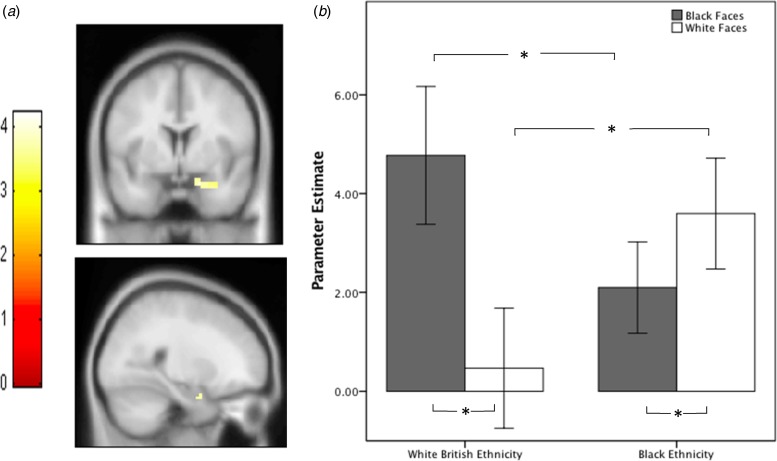
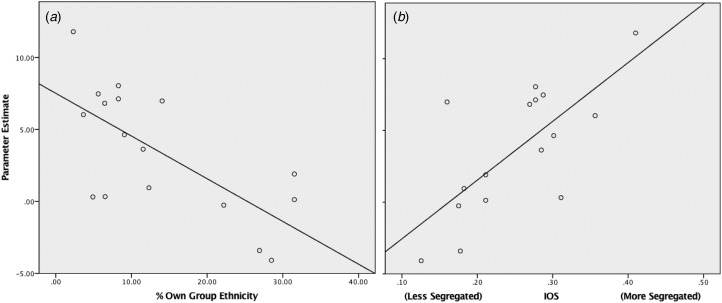
Background: Ethnic minority individuals have an increased risk of developing a psychotic disorder, particularly if they live in areas of ethnic segregation, or low own group ethnic density. The neurobiological mechanisms underlying this ethnic minority associated risk are unknown. We used functional MRI to investigate neural responses to faces of different ethnicity, in individuals of black ethnicity, and a control group of white British ethnicity individuals. Methods: In total 20 individuals of black ethnicity, and 22 individuals of white British ethnicity underwent a 3T MRI scan while viewing faces of black and white ethnicity. Own group ethnic density was calculated from the 2011 census. Neighbourhood segregation was quantified using the Index of Dissimilarity method. Results: At the within-group level, both groups showed greater right amygdala activation to outgroup faces. Between groups, the black ethnicity group showed greater right amygdala activation to white faces, compared to the white ethnicity group. Within the black ethnicity group, individuals living in areas of lower own group ethnic density showed greater right amygdala reactivity to white faces (r = −0.61, p = 0.01). Conclusions: This is the first time an increased amygdala response to white faces has been demonstrated in individuals of black ethnicity. In the black ethnicity group, correlations were observed between amygdala response and neighbourhood variables associated with increased psychosis risk. These results may have relevance for our understanding of the increased rates of paranoia and psychotic disorders in ethnic minority individuals.
Overview
The claims and statistics of this paper haven’t been checked yet.
Free: it reads the open-access text and checks the first 5 claims that cite a source we can check. Create a free account to check every claim.
Integrity signals
Registry
Cites
Statistics
Figures
Verification
Claims the paper makes
The claims and statistics of this paper haven’t been checked yet.
Free: it reads the open-access text and checks the first 5 claims that cite a source we can check. Create a free account to check every claim.
Claims other papers make about this one
Each is checked against this paper’s own text: does it say what the citing paper says it does?
The cited source says what the claim attributes to it.
In the citing paper
“Indeed we have found evidence that black minority ethnic status is associated with greater amygdalar activation to out-group (i.e. white faces) than vice versa, neurobiological correlates of these theories/findings (McCutcheon et al., 2018) (McCutcheon et al., 2018).”
From The effects of psychosocial stress on dopaminergic function and the acute stress response (2019) · cites this paper as McCutcheon et al., 2018
Self-check
Percentages, sums and reported differences re-computed from the paper’s own numbers.
The self-check needs the paper’s full text.
Citations
Cites
Kessler, R. C., Berglund, P., Demler, O., Jin, R., Koretz, D., Merikangas, K. R., Rush, A. J., Walters, E. E., & Wang, P. S. (2003) · JAMA · doi:10.1001/jama.289.23.3095 · Cited by 7,988
Schizophrenia and migration: A meta-analysis and review
Cantor-Graae, E., & Selten, J.-P. (2005) · American Journal of Psychiatry · doi:10.1176/appi.ajp.162.1.12 · Cited by 1,237 · cited 2×
“In various settings, the increased risk appears greatest for individuals of black ethnicity (Cantor-graae et al. 2005; Bresnahan et al. 2007).”
Separable Neural Components in the Processing of Black and White Faces
Cunningham, W. A., Johnson, M. K., Raye, C. L., Gatenby, J. C., Gore, J. C., & Banaji, M. R. (2004) · Psychological Science · doi:10.1111/j.0956-7976.2004.00760.x · Cited by 689
Specifying race-ethnic differences in risk for psychiatric disorder in a USA national sample
BRESLAU, J., AGUILAR-GAXIOLA, S., KENDLER, K. S., SU, M., WILLIAMS, D., & KESSLER, R. C. (2006) · Psychological Medicine · doi:10.1017/s0033291705006161 · Cited by 673 · cited 2×
“Similarly, in the United States a number of studies have reported reduced rates of depression and anxiety in African Americans (Kessler et al. 2003; Riolo et al. 2005; Breslau et al. 2006; Himle et al. 2009; Asnaani et al. 2010; Gibbs et al. 2013).”
BackgroundRiolo, S. A., Nguyen, T. A., Greden, J. F., & King, C. A. (2005) · American Journal of Public Health · doi:10.2105/ajph.2004.047225 · Cited by 595 · cited 1×
“Similarly, in the USA a number of studies have reported reduced rates of depression and anxiety in African Americans (Kessler et al. 2003; Riolo et al. 2005; Breslau et al. 2006; Himle et al. 2009; Asnaani et al. 2010; Gibbs et al. 2013).”
A meta-analysis of the risk for psychotic disorders among first- and second-generation immigrants
Bourque, F., van der Ven, E., & Malla, A. (2011) · Psychological Medicine · doi:10.1017/s0033291710001406 · Cited by 566 · cited 3×
“2015), and the effect persists among second-generation migrants, indicating that the risk is associated with being a member of a minority group, rather than the act of migration itself (Hutchinson et al. 1996; Bresnahan et al. 2007; Bourque et al. 2011).”
FEARON, P., KIRKBRIDE, J. B., MORGAN, C., DAZZAN, P., MORGAN, K., LLOYD, T., HUTCHINSON, G., TARRANT, J., LUN ALAN FUNG, W., HOLLOWAY, J., et al. (2006) · Psychological Medicine · doi:10.1017/s0033291706008774 · Cited by 541 · cited 4×
“In the UK, individuals of black ethnicity were found to have incidence rate ratios compared with the white British population of between six and nine (Fearon et al. 2006).”
InfluentialDifferential response in the human amygdala to racial outgroup vs ingroup face stimuli
Hart, A. J., Whalen, P. J., Shin, L. M., McInerney, S. C., Fischer, H., & Rauch, S. L. (2000) · NeuroReport · doi:10.1097/00001756-200008030-00004 · Cited by 454 · cited 1×
“One previous study demonstrating greater amygdala activity to outgroup faces included four participants of black ethnicity but did not comment on this subgroup specifically (Hart et al. 2000).”
Lieberman, M. D., Hariri, A., Jarcho, J. M., Eisenberger, N. I., & Bookheimer, S. Y. (2005) · Nature Neuroscience · doi:10.1038/nn1465 · Cited by 362 · cited 5×
“Our finding of increased right amygdala reactivity to black faces in the white British ethnicity group has been repeatedly demonstrated in white ethnicity participants (Cunningham et al. 2004; Lieberman et al. 2005; Wheeler & Fiske, 2005; Ronquillo et al. 2007; Chekroud et al. 2014).”
InfluentialTaylor, S. F., Kang, J., Brege, I. S., Tso, I. F., Hosanagar, A., & Johnson, T. D. (2012) · Biological Psychiatry · doi:10.1016/j.biopsych.2011.09.007 · Cited by 344 · cited 2×
“Although amygdala hyperactivity has been linked to paranoid symptoms in psychosis (Goghari et al. 2010; Pinkham et al. 2015; Underwood et al. 2016), reactivity during facial processing is not consistently raised in schizophrenia (Taylor et al. 2012).”
A cross-ethnic comparison of lifetime prevalence rates of anxiety disorders
Asnaani, A., Richey, J. A., Dimaite, R., Hinton, D. E., & Hofmann, S. G. (2010) · Journal of Nervous & Mental Disease · doi:10.1097/nmd.0b013e3181ea169f · Cited by 331 · cited 1×
“Similarly, in the USA a number of studies have reported reduced rates of depression and anxiety in African Americans (Kessler et al. 2003; Riolo et al. 2005; Breslau et al. 2006; Himle et al. 2009; Asnaani et al. 2010; Gibbs et al. 2013).”
Controlling Racial Prejudice: Social-Cognitive Goals Affect Amygdala and Stereotype Activation
Wheeler, M. E., & Fiske, S. T. (2005) · Psychological Science · doi:10.1111/j.0956-7976.2005.00780.x · Cited by 320
Migration, Ethnicity, and Psychosis: Toward a Sociodevelopmental Model
Morgan, C., Charalambides, M., Hutchinson, G., & Murray, R. M. (2010) · Schizophrenia Bulletin · doi:10.1093/schbul/sbq051 · Cited by 313 · cited 1×
“Cognitive models propose that minority status is associated with greater levels of social threat (Combs et al. 2002; Morgan et al. 2010).”
BackgroundRace and risk of schizophrenia in a US birth cohort: another example of health disparity?
Bresnahan, M., Begg, M. D., Brown, A., Schaefer, C., Sohler, N., Insel, B., Vella, L., & Susser, E. (2007) · International Journal of Epidemiology · doi:10.1093/ije/dym041 · Cited by 312
Reininghaus, U., Kempton, M. J., Valmaggia, L., Craig, T. K. J., Garety, P., Onyejiaka, A., Gayer-Anderson, C., So, S. H., Hubbard, K., Beards, S., et al. (2016) · Schizophrenia Bulletin · doi:10.1093/schbul/sbv190 · Cited by 304
The buffering effects of ethnic density on experienced racism and health
Bécares, L., Nazroo, J., & Stafford, M. (2009) · Health & Place · doi:10.1016/j.healthplace.2008.10.008 · Cited by 303 · cited 1×
“One hypothesis is that higher own group ethnic density buffers the individual from the adverse psychiatric consequences of social isolation and racist experiences (Bécares et al. 2009).”
Himle, J. A., Baser, R. E., Taylor, R. J., Campbell, R. D., & Jackson, J. S. (2009) · Journal of Anxiety Disorders · doi:10.1016/j.janxdis.2009.01.002 · Cited by 278 · cited 1×
“Similarly, in the USA a number of studies have reported reduced rates of depression and anxiety in African Americans (Kessler et al. 2003; Riolo et al. 2005; Breslau et al. 2006; Himle et al. 2009; Asnaani et al. 2010; Gibbs et al. 2013).”
Kirkbride, J. B., Jones, P. B., Ullrich, S., & Coid, J. W. (2014) · Schizophrenia Bulletin · doi:10.1093/schbul/sbs151 · Cited by 271 · cited 4×
“Additionally,whilethelinkbetweenpsychosisriskandown groupethnicdensityiswellestablished,theevidencefortheinflu-enceofethnicsegregationislessclear(Kirkbride et al. 2007, 2014).”
InfluentialExtending the amygdala in theories of threat processing
Fox, A. S., Oler, J. A., Tromp, D. P. M., Fudge, J. L., & Kalin, N. H. (2015) · Trends in Neurosciences · doi:10.1016/j.tins.2015.03.002 · Cited by 255 · cited 3×
“This outgroup effect has been consistently demonstrated in multiple studies of individuals of white ethnicity, but has not been thoroughly investigated in individuals of black ethnicity (Cunningham et al. 2004; Lieberman et al. 2005; Wheeler & Fiske, 2005; Ronquillo et al. 2007; Chekroud et al. 2014; Fox et al. 2015).”
Common mental disorders and ethnicity in England: the EMPIRIC Study
WEICH, S., NAZROO, J., SPROSTON, K., McMANUS, S., BLANCHARD, M., ERENS, B., KARLSEN, S., KING, M., LLOYD, K., STANSFELD, S., et al. (2004) · Psychological Medicine · doi:10.1017/s0033291704002715 · Cited by 229 · cited 2×
“…in first-generation immigrants, this appears to be driven by manic presentations, and there is no evidence of increased rates of depression or anxiety in the UK black ethnicity population (Shaw et al. 1999; Brugha et al. 2004; Weich et al. 2004; Swinnen & Selten, 2007; Mindlis & Boffetta, 2017).”
Coid, J. W., Kirkbride, J. B., Barker, D., Cowden, F., Stamps, R., Yang, M., & Jones, P. B. (2008) · Archives of General Psychiatry · doi:10.1001/archpsyc.65.11.1250 · Cited by 227 · cited 3×
“…other ethnic groups, including non-British white individuals, and Asian individuals, have increased rates of psychosis as well, and migrants may be exposed to other adverse experiences in addition to those associated with being a member of a minority group (Fearon et al. 2006; Coid et al. 2008).”
Goghari, V. M., Sponheim, S. R., & MacDonald, A. W. (2010) · Neuroscience & Biobehavioral Reviews · doi:10.1016/j.neubiorev.2009.09.004 · Cited by 224 · cited 5×
“However, the fact that in patients with schizophrenia greater amygdala responses are associated with paranoid symptoms suggests this may not be the case (Goghari et al. 2010; Pinkham et al. 2015; Underwood et al. 2016).”
InfluentialNeighbourhood-level effects on psychoses: re-examining the role of context
KIRKBRIDE, J. B., MORGAN, C., FEARON, P., DAZZAN, P., MURRAY, R. M., & JONES, P. B. (2007) · Psychological Medicine · doi:10.1017/s0033291707000499 · Cited by 222 · cited 1×
“Additionally,whilethelinkbetweenpsychosisriskandown groupethnicdensityiswellestablished,theevidencefortheinflu-enceofethnicsegregationislessclear(Kirkbride et al. 2007, 2014).”
Social Predictors of Psychotic Experiences: Specificity and Psychological Mechanisms
Bentall, R. P., & Fernyhough, C. (2008) · Schizophrenia Bulletin · doi:10.1093/schbul/sbn103 · Cited by 206 · cited 1×
“Implications for understanding the mechanisms underlying ethnic minority associated risk for psychosis Cognitive models of psychosis propose an increased level of social threat anticipation as part of a pathway to the development of persecutory beliefs (Bentall & Fernyhough, 2008).”
Impact of ethnic density on adult mental disorders: narrative review
Shaw, R. J., Atkin, K., Bécares, L., Albor, C. B., Stafford, M., Kiernan, K. E., Nazroo, J. Y., Wilkinson, R. G., & Pickett, K. E. (2012) · British Journal of Psychiatry · doi:10.1192/bjp.bp.110.083675 · Cited by 170 · cited 2×
“group forms a larger proportion of the population is relatively protective against schizophrenia (Shaw et al. 2012; Kirkbride et al. 2014).”
Akdeniz, C., Tost, H., Streit, F., Haddad, L., Wüst, S., Schäfer, A., Schneider, M., Rietschel, M., Kirsch, P., & Meyer-Lindenberg, A. (2014) · JAMA Psychiatry · doi:10.1001/jamapsychiatry.2014.35 · Cited by 151 · cited 1×
“One previous fMRI study investigated the neural correlates of the stress response in Turkish migrants living in Germany, and identified differences in anterior cingulate activation (Akdeniz et al. 2014).”
The effects of skin tone on race-related amygdala activity: an fMRI investigation
Ronquillo, J., Denson, T. F., Lickel, B., Lu, Z.-L., Nandy, A., & Maddox, K. B. (2007) · Social Cognitive and Affective Neuroscience · doi:10.1093/scan/nsl043 · Cited by 141 · cited 3×
“This outgroup effect has been consistently demonstrated in multiple studies of individuals of white ethnicity, but has not been thoroughly investigated in individuals of black ethnicity (Cunningham et al. 2004; Lieberman et al. 2005; Wheeler & Fiske, 2005; Ronquillo et al. 2007; Chekroud et al. 2014; Fox et al. 2015).”
Mood disorders and migration: Meta-analysis
Swinnen, S. G. H. A., & Selten, J.-P. (2007) · British Journal of Psychiatry · doi:10.1192/bjp.bp.105.020800 · Cited by 137 · cited 1×
“…in first-generation immigrants, this appears to be driven by manic presentations, and there is no evidence of increased rates of depression or anxiety in the UK black ethnicity population (Shaw et al. 1999; Brugha et al. 2004; Weich et al. 2004; Swinnen & Selten, 2007; Mindlis & Boffetta, 2017).”
Hutchinson, G., Takei, N., Fahy, T. A., Bhugra, D., Gilvarry, C., Moran, P., Mallett, R., Sham, P., Leff, J., & Murray, R. M. (1996) · British Journal of Psychiatry · doi:10.1192/bjp.169.6.776 · Cited by 132 · cited 2×
“2015), and the effect persists among second-generation migrants, indicating that the risk is associated with being a member of a minority group, rather than the act of migration itself (Hutchinson et al. 1996; Bresnahan et al. 2007; Bourque et al. 2011).”
Wickham, S., Taylor, P., Shevlin, M., & Bentall, R. P. (2014) · PLoS ONE · doi:10.1371/journal.pone.0105140 · Cited by 131 · cited 3×
“Amygdala hyperactivity to frequent outgroup exposure could therefore partially underlie the greater levels of paranoia seen in both ethnic minority patient and population samples (Bhugra et al. 2000; Combs et al. 2002; Cohen et al. 2004; Veling et al. 2007; Wickham et al. 2014), and potentially have relevance as regar…”
A review of neuroimaging studies of race-related prejudice: does amygdala response reflect threat?
Chekroud, A. M., Everett, J. A. C., Bridge, H., & Hewstone, M. (2014) · Frontiers in Human Neuroscience · doi:10.3389/fnhum.2014.00179 · Cited by 127 · cited 9×
“A greater right amygdala neural response to pictures of faces of people with an outgroup ethnicity, compared with those with in-group ethnicity, has been interpreted as representing threat appraisal (Chekroud et al. 2014).”
BackgroundResultInfluentialA systematic review and meta-analysis of the ethnic density effect in psychotic disorders
Bosqui, T. J., Hoy, K., & Shannon, C. (2013) · Social Psychiatry and Psychiatric Epidemiology · doi:10.1007/s00127-013-0773-0 · Cited by 99 · cited 1×
“Living in areas of low own group ethnic density has been shown to increase the risk of psychosis in ethnic minorities (Bosqui et al. 2014).”
Shaw, C. M., Creed, F., Tomenson, B., Riste, L., Cruickshank, J. K., & Rait, G. (1999) · BMJ · doi:10.1136/bmj.318.7179.302 · Cited by 95
Amygdala Hyperactivity at Rest in Paranoid Individuals With Schizophrenia
Pinkham, A. E., Liu, P., Lu, H., Kriegsman, M., Simpson, C., & Tamminga, C. (2015) · American Journal of Psychiatry · doi:10.1176/appi.ajp.2014.14081000 · Cited by 93 · cited 5×
“However, the fact that in patients with schizophrenia greater amygdala responses are associated with paranoid symptoms suggests this may not be the case (Goghari et al. 2010; Pinkham et al. 2015; Underwood et al. 2016).”
InfluentialVeling, W., Selten, J., Mackenbach, J. P., & Hoek, H. W. (2007) · Schizophrenia Research · doi:10.1016/j.schres.2007.06.024 · Cited by 91 · cited 4×
“Amygdala hyperactivity to frequent outgroup exposure could therefore partially underlie the greater levels of paranoia seen in both ethnic minority patient and population samples (Bhugra et al. 2000; Combs et al. 2002; Cohen et al. 2004; Veling et al. 2007; Wickham et al. 2014), and potentially have relevance as regar…”
BackgroundInfluentialØdegaard’s Selection Hypothesis Revisited: Schizophrenia in Surinamese Immigrants to the Netherlands
Selten, J.-P., Cantor-Graae, E., Slaets, J., & Kahn, R. S. (2002) · American Journal of Psychiatry · doi:10.1176/appi.ajp.159.4.669 · Cited by 80 · cited 1×
“It has subsequently become clear that this increased risk is not secondary to selective migration (Selten et al. 2002; van der Ven et al. 2015), and the effect persists among second-generation migrants, indicating that the risk is associated with being a member of a minority group, rather than the…”
BackgroundGibbs, T. A., Okuda, M., Oquendo, M. A., Lawson, W. B., Wang, S., Thomas, Y. F., & Blanco, C. (2013) · American Journal of Public Health · doi:10.2105/ajph.2012.300891 · Cited by 77 · cited 1×
“Similarly, in the USA a number of studies have reported reduced rates of depression and anxiety in African Americans (Kessler et al. 2003; Riolo et al. 2005; Breslau et al. 2006; Himle et al. 2009; Asnaani et al. 2010; Gibbs et al. 2013).”
Mood disorders in first- and second-generation immigrants: Systematic review and meta-analysis
Mindlis, I., & Boffetta, P. (2017) · British Journal of Psychiatry · doi:10.1192/bjp.bp.116.181107 · Cited by 75 · cited 1×
“…in first-generation immigrants, this appears to be driven by manic presentations, and there is no evidence of increased rates of depression or anxiety in the UK black ethnicity population (Shaw et al. 1999; Brugha et al. 2004; Weich et al. 2004; Swinnen & Selten, 2007; Mindlis & Boffetta, 2017).”
Ethnic differences in subclinical paranoia: An expansion of norms of the Paranoia Scale.
Combs, D. R., Penn, D. L., & Fenigstein, A. (2002) · Cultural Diversity and Ethnic Minority Psychology · doi:10.1037/1099-9809.8.3.248 · Cited by 68 · cited 4×
“Amygdala hyperactivity to frequent outgroup exposure could therefore partially underlie the greater levels of paranoia seen in both ethnic minority patient and population samples (Bhugra et al. 2000; Combs et al. 2002; Cohen et al. 2004; Veling et al. 2007; Wickham et al. 2014), and potentially have relevance as regar…”
InfluentialRisk factors and the prevalence of neurosis and psychosis in ethnic groups in Great Britain
Brugha, T. S., Jenkins, R., Bebbington, P., Meltzer, H., Lewis, G., & Farrell, M. (2004) · Social Psychiatry and Psychiatric Epidemiology · doi:10.1007/s00127-004-0830-9 · Cited by 59 · cited 2×
“…in first-generation immigrants, this appears to be driven by manic presentations, and there is no evidence of increased rates of depression or anxiety in the UK black ethnicity population (Shaw et al. 1999; Brugha et al. 2004; Weich et al. 2004; Swinnen & Selten, 2007; Mindlis & Boffetta, 2017).”
Racial Differences in Paranoid Ideation and Psychoses in an Older Urban Population
Cohen, C. I., Magai, C., Yaffee, R., & Walcott-Brown, L. (2004) · American Journal of Psychiatry · doi:10.1176/appi.ajp.161.5.864 · Cited by 55 · cited 3×
“Amygdala hyperactivity to frequent outgroup exposure could therefore partially underlie the greater levels of paranoia seen in both ethnic minority patient and population samples (Bhugra et al. 2000; Combs et al. 2002; Cohen et al. 2004; Veling et al. 2007; Wickham et al. 2014), and potentially have relevance as regar…”
Cognitive and neural models of threat appraisal in psychosis: a theoretical integration
Underwood, R., Kumari, V., & Peters, E. (2016) · Psychiatry Research · doi:10.1016/j.psychres.2016.03.016 · Cited by 51 · cited 6×
“However, the fact that in patients with schizophrenia greater amygdala responses are associated with paranoid symptoms suggests this may not be the case (Goghari et al. 2010; Pinkham et al. 2015; Underwood et al. 2016).”
Influentialvan der Ven, E., Dalman, C., Wicks, S., Allebeck, P., Magnusson, C., van Os, J., & Selten, J. (2014) · Psychological Medicine · doi:10.1017/s0033291714001780 · Cited by 44 · cited 1×
“It has subsequently become clear that this increased risk is not secondary to selective migration (Selten et al. 2002; van der Ven et al. 2015), and the effect persists among second-generation migrants, indicating that the risk is associated with being a member of a minority group, rather than the…”
BackgroundWiley Blackwell encyclopedia of race, ethnicity and nationalism
Kendall, J. G. (2016) · Reference Reviews · doi:10.1108/rr-06-2016-0153 · Cited by 42
Neural correlates of race-related social evaluations for African Americans and White Americans.
Greer, T. M., Vendemia, J. M. C., & Stancil, M. (2012) · Neuropsychology · doi:10.1037/a0030035 · Cited by 17 · cited 1×
“Taken with evidence that experiences of racism are correlated with amygdala activation to white faces in black individuals (Greer et al. 2012), this suggests that environmental exposures are associated with functional alterations in the brain circuits involved in threat processing.”
Reactivity to social stress in ethnic minority men
Gevonden, M. J., Myin‐Germeys, I., Wichers, M., Booij, J., van den Brink, W., van Winkel, R., & Selten, J. (2016) · Psychiatry Research · doi:10.1016/j.psychres.2016.10.076 · Cited by 14
A comparison of symptoms in cases with first onset of schizophrenia across four groups
Bhugra, D., Hilwig, M., Corridon, B., Neehall, J., Rudge, S., Mallett, R., & Leff, J. (2000) · Research Portal (King's College London) · Cited by 8
Yalonetzky, G. (2015) · Wiley eBooks · doi:10.1002/9781118663202.wberen484 · Cited by 4 · cited 1×
“A score of 0 is equivalent to no segregation, while a score of 1 is equivalent to complete segregation (see online Supplementary Methods for further information) (Yalonetzky, 2015).”
Research works printed but not linked: 1
- Ødegaard Ø (1932) Emigration and Insanity: A Study of Mental Disease among the Norwegian born Population of Minnesota. Acta Psychiatr Neurol Scand Suppl 4, 1– 206.
Cited by
McCutcheon, R. A., Reis Marques, T., & Howes, O. D. (2020) · JAMA Psychiatry · doi:10.1001/jamapsychiatry.2019.3360 · Cited by 1,481
Self-citationThe effects of psychosocial stress on dopaminergic function and the acute stress response
Bloomfield, M. A., McCutcheon, R. A., Kempton, M., Freeman, T. P., & Howes, O. (2019) · eLife · doi:10.7554/elife.46797 · Cited by 112
“Alternatively, as these participants were healthy it remains possible that these participants have resilience and so the observed findings may be due to adaptive allostatic down-regulations (McEwen, 1998).”
BackgroundSelf-citationThe ethnic density effect in psychosis: a systematic review and multilevel meta-analysis
Baker, S., Jackson, M. C., Jongsma, H. E., & Saville, C. W. N. (2021) · The British Journal of Psychiatry · doi:10.1192/bjp.2021.96 · Cited by 72
Dykxhoorn, J. L., Lewis, G., Hollander, A., Kirkbride, J. B., & Dalman, C. (2020) · The Lancet Psychiatry · doi:10.1016/s2215-0366(20)30059-6 · Cited by 45
McCutcheon, R. A., Bloomfield, M. A. P., Dahoun, T., Mehta, M., & Howes, O. D. (2019) · Schizophrenia Research · doi:10.1016/j.schres.2018.12.011 · Cited by 35
Self-citation
Metadata
- Authors
- McCutcheon, R., Bloomfield, M. A. P., Dahoun, T., Quinlan, M., Terbeck, S., Mehta, M., & Howes, O.
- Affiliations
- King's College London (GB)
- Hammersmith Hospital (GB)
- University of Plymouth (GB)
- Corresponding author
- Howes, Oliver
- ORCID
- Venue
- Psychological Medicine
- Publisher
- Cambridge University Press (CUP)
- Published
- 2018-01-12
- Volume
- 48
- Issue
- 12
- Pages
- 1985-1992
- ISSN
- 0033-2917 (ISSN-L)
- 1469-8978
- PMC
- PMC5933521
- OpenAlex
- W2769305838
- Cited by
- 26
- References
- 48
- Citations by year
- 2026: 2 · 2025: 6 · 2024: 2 · 2023: 2 · 2022: 4 · 2021: 3 · 2020: 2 · 2019: 4 · 2018: 1
- FWCI
- 1.49
- Type
- journal article
- Language
- en
- Open access
- hybrid
- doi.org
- Locations
- Psychological Medicine (publishedVersion, cc-by)
- Europe PMC (PubMed Central) (publishedVersion, cc-by)
- PubMed Central (publishedVersion, cc-by)
- PubMed (publishedVersion)
- Liverpool John Moores University (acceptedVersion)
- Research Portal (King's College London) (submittedVersion, cc-by)
- PEARL (University of Plymouth) (submittedVersion)
- PEARL (University of Plymouth) (submittedVersion, other-oa)
- UCL Discovery (University College London) (submittedVersion)
- Funders
- Eli Lilly and Company
- South London and Maudsley NHS Foundation Trust
- Sunovion
- Wellcome Trust (200102/Z/15/Z, 094849, /Z/15/Z, 094849/Z/10/Z, 200102)
- Maudsley Charity (094849/Z/10/Z)
- FORUM Pharmaceuticals
- National Institute for Health and Care Research (CL-2015-18-005, ACF-2014-17-008, ACF-2017-13-014)
- King's College London (200102/Z/15/Z)
- European Commission (607616)
- Servier
- H. Lundbeck A/S
- Medical Research Council (MC- A656-5QD30, MR/L022176/1, 094849/Z/10/Z, MR/N026063/1, MR/N027078/1)
- Topics
- Life Sciences › Neuroscience › Cognitive Neuroscience › Face Recognition and Perception
- Social Sciences › Sociology and Political Science › Social and Intergroup Psychology
- Social Sciences › Sociology and Political Science › Racial and Ethnic Identity Research
- Keywords
- amygdala reactivity, ethnic minorities, Black ethnicity, neighbourhood segregation, index of dissimilarity, face perception, psychosis risk, paranoia, social environment
- MeSH terms
- Facial Recognition, Adult, Amygdala, Brain Mapping, Female, United Kingdom, Humans, Magnetic Resonance Imaging, Male, Minority Groups, Residence Characteristics, Social Environment, Social Perception, Black People, White People, Young Adult
About these checks
Registry, retraction, Cites and statistics results are computed, not judged, with one exception: a printed reference that no index lists is read once by a model before it counts as a citation error. Claims are extracted by a model and kept only when their quote appears verbatim in the text; each cited source is then checked, with a model’s help, for whether it says what the claim relies on. Those verdicts can be wrong — read the claim’s quote and the cited source before relying on one.
Statistics and arithmetic are recomputed, not judged.
Confidence bands are shown only for fields calibrated on our annotated test set. None is calibrated yet, so no band is shown.
What counts as a claim ›How we measure confidence ›How we check this ›
Are you an author, or do you see a problem with this page? Request a review
Data sources
Bibliographic data: Semantic Scholar, OpenAlex, Crossref.
Contains information from the Semantic Scholar Academic Graph Datasets, made available under the ODC Attribution License (ODC-BY 1.0).
Semantic Scholar’s data is described in: Kinney, R., et al. (2023). The Semantic Scholar Open Data Platform. arXiv:2301.10140.
