

Short sleep duration and poor sleep quality predict next-day suicidal ideation: an ecological momentary assessment study
Open accessThe DOI matches its Crossref record; 59 of the 61 references it cites were found in a registry or an index.
Abstract
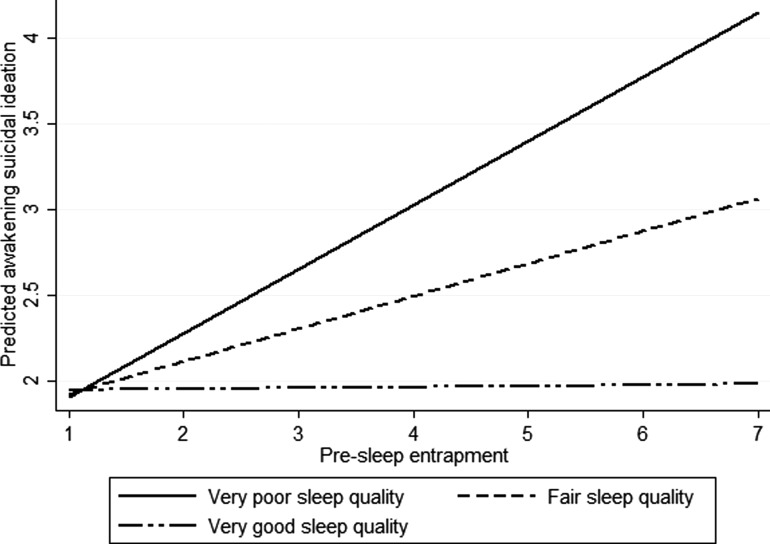
Background: Sleep problems are a modifiable risk factor for suicidal thoughts and behaviors. Yet, sparse research has examined temporal relationships between sleep disturbance, suicidal ideation, and psychological factors implicated in suicide, such as entrapment. This is the first in-the-moment investigation of relationships between suicidal ideation, objective and subjective sleep parameters, and perceptions of entrapment. Methods: Fifty-one participants with current suicidal ideation completed week-long ecological momentary assessments. An actigraph watch was worn for the duration of the study, which monitored total sleep time, sleep efficiency, and sleep latency. Daily sleep diaries captured subjective ratings of the same sleep parameters, with the addition of sleep quality. Suicidal ideation and entrapment were measured at six quasi-random time points each day. Multi-level random intercept models and moderation analyses were conducted to examine the links between sleep, entrapment, and suicidal ideation, adjusting for anxiety and depression severity. Results: Analyses revealed a unidirectional relationship whereby short sleep duration (both objective and subjective measures), and poor sleep quality, predicted the higher severity of next-day suicidal ideation. However, there was no significant association between daytime suicidal ideation and sleep the following night. Sleep quality moderated the relationship between pre-sleep entrapment and awakening levels of suicidal ideation. Conclusions: This is the first study to report night-to-day relationships between sleep disturbance, suicidal ideation, and entrapment. Findings suggest that sleep quality may alter the strength of the relationship between pre-sleep entrapment and awakening suicidal ideation. Clinically, results underscore the importance of assessing and treating sleep disturbance when working with those experiencing suicidal ideation.
Overview
The claims and statistics of this paper haven’t been checked yet.
Free: it reads the open-access text and checks the first 5 claims that cite a source we can check. Create a free account to check every claim.
Integrity signals
Registry
Cites
Statistics
Figures
Verification
Claims the paper makes
The claims and statistics of this paper haven’t been checked yet.
Free: it reads the open-access text and checks the first 5 claims that cite a source we can check. Create a free account to check every claim.
Claims other papers make about this one
Each is checked against this paper’s own text: does it say what the citing paper says it does?
The source backs part of the claim, not all of it — or backs it for a different population, condition or comparison.
In the citing paper
“Between days, short sleep duration (both objective and subjective), poor subjective sleep quality and increased sleep latency (i.e., time to fall asleep) predicted (mean) next-day suicidal ideation (51, 74).”
From Don't Miss the Moment: A Systematic Review of Ecological Momentary Assessment in Suicide Research (2022) · cites this paper as [51]
Experimental — accuracy not yet measuredThe source backs part of the claim, not all of it — or backs it for a different population, condition or comparison.
In the citing paper
“The remaining five articles investigated the association of depressive symptoms with sleep/wake cycles [32,33,36] and physical activity [37,38] using actimetry sensors.”
From Current state and future directions of technology-based ecological momentary assessment and intervention for major depressive disorder: a systematic review (2019) · cites this paper as [33]
Experimental — accuracy not yet measuredThe cited source says what the claim attributes to it.
In the citing paper
“It is therefore noteworthy that in addition to demonstrating temporal precedence in the relation between sleep disturbance and STBs, a few studies have found evidence that this association is unidirectional; not only does sleep temporally predict STBs, at least in the case of suicidal ideation, but suicidal ideation, in turn, does not predict subsequent sleep behavior (Littlewood et al., 2019;”
From Sleep and suicide: A systematic review and meta-analysis of longitudinal studies (2020) · cites this paper as Littlewood et al., 2019
The cited source says what the claim attributes to it.
In the citing paper
“In contrast, another study that used actigraphy, sleep diaries, and EMA found that shorter sleep and poor sleep quality predicted greater SI on the following day, although the reverse was not found (34).”
From New methods for assessing rapid changes in suicide risk (2021) · cites this paper as [34]
The cited source says what the claim attributes to it.
In the citing paper
“(pseudo)random sampling schedules were most frequently used [57%, n = 13 (42, 47, 51, 58, 61, 65, 69, 71, 79, 83, 85, 86, 88)], followed by fixed sampling [26%, n = 6 (45, 66, 67, 72, 80, 82)], and protocols that combined both fixed and (pseudo)random sampling [13%, n = 3 (47, 56, 60)].”
From Don't Miss the Moment: A Systematic Review of Ecological Momentary Assessment in Suicide Research (2022) · cites this paper as [51]
3 more claims about this paper
Create a free account to see every claim other papers make about this one.
Self-check
Percentages, sums and reported differences re-computed from the paper’s own numbers.
The self-check needs the paper’s full text.
Citations
Cites
The Pittsburgh Sleep Quality Index: a new instrument for psychiatric practice and research
Buysse, D. J., Reynolds, C. F., Monk, T. H., Berman, S. R., & Kupfer, D. J. (1989) · Psychiatry Research · doi:10.1016/0165-1781(89)90047-4 · Cited by 35,234
Risk factors for suicidal thoughts and behaviors: A meta-analysis of 50 years of research
Franklin, J. C., Ribeiro, J. D., Fox, K. R., Bentley, K. H., Kleiman, E. M., Huang, X., Musacchio, K. M., Jaroszewski, A. C., Chang, B. P., & Nock, M. K. (2017) · Psychological Bulletin · doi:10.1037/bul0000084 · Cited by 3,784
Suicide as an outcome for mental disorders: A meta-analysis
Harris, E. C., & Barraclough, B. (1997) · British Journal of Psychiatry · doi:10.1192/bjp.170.3.205 · Cited by 2,589 · cited 2×
“Measures of depression and anxiety were included as possible confounding variables, given their strong inter-relationships with sleep disturbance and suicidal ideation (Harris & Barraclough, 1997; Tsuno et al. 2005).”
BackgroundThe consensus sleep diary: standardizing prospective sleep self-monitoring
Carney, C. E., Buysse, D. J., Ancoli-Israel, S., Edinger, J. D., Krystal, A. D., Lichstein, K. L., & Morin, C. M. (2012) · Sleep · doi:10.5665/sleep.1642 · Cited by 2,172
Sleep function and synaptic homeostasis
Tononi, G., & Cirelli, C. (2006) · Sleep Medicine Reviews · doi:10.1016/j.smrv.2005.05.002 · Cited by 2,151 · cited 1×
“SWS is thought to serve a restorative function, re-establishing synaptic homeostasis (Tononi & Cirelli, 2006); while insufficient SWS is associated with deficits in cognitive functioning (Lowe et al. 2017).”
BackgroundRisks of all-cause and suicide mortality in mental disorders: a meta-review
Chesney, E., Goodwin, G. M., & Fazel, S. (2014) · World Psychiatry · doi:10.1002/wps.20128 · Cited by 2,115 · cited 2×
“Sleep disturbance (Sivertsen et al. 2009) and suicidal thoughts (Chesney et al. 2014) are commonly reported by people with diagnoses of different types of mental health problems.”
BackgroundLöwe, B., Kroenke, K., Herzog, W., & Gräfe, K. (2004) · Journal of Affective Disorders · doi:10.1016/s0165-0327(03)00198-8 · Cited by 1,558
Recommendations for a standard research assessment of insomnia
Buysse, D. J., Ancoli-Israel, S., Edinger, J. D., Lichstein, K. L., & Morin, C. M. (2006) · Sleep · doi:10.1093/sleep/29.9.1155 · Cited by 1,206
Tsuno, N., Besset, A., & Ritchie, K. (2005) · The Journal of Clinical Psychiatry · doi:10.4088/jcp.v66n1008 · Cited by 1,084
The Experience Sampling Method
Larson, R., & Csikszentmihalyi, M. (2014) · Flow and the Foundations of Positive Psychology · doi:10.1007/978-94-017-9088-8_2 · Cited by 1,034 · cited 2×
“Surprisingly, this is a key departure from previous EMA protocols, which tend to follow seminal guidance by Larson & Csikszentmihalyi (1983) by standardizing the sampling schedules from 8:00 to 22:00 (e.g. Ben-Zeev et al. 2012).”
BackgroundMethodGILBERT, P., & ALLAN, S. (1998) · Psychological Medicine · doi:10.1017/s0033291798006710 · Cited by 972 · cited 1×
“For instance, one such candidate mechanism is entrapment, which is a psychological construct that refers to the desire to escape together with the perception that escape is not possible (Gilbert & Allan, 1998).”
BackgroundKleiman, E. M., Turner, B. J., Fedor, S., Beale, E. E., Huffman, J. C., & Nock, M. K. (2017) · Journal of Abnormal Psychology · doi:10.1037/abn0000273 · Cited by 831
Meta-analysis of sleep disturbance and suicidal thoughts and behaviors
Pigeon, W. R., Pinquart, M., & Conner, K. (2012) · The Journal of Clinical Psychiatry · doi:10.4088/jcp.11r07586 · Cited by 815 · cited 2×
“One such factor found to be associated with increased vulnerability for suicidal ideation and behaviors is sleep disturbance (Pigeon et al. 2012; Malik et al. 2014; Littlewood et al. 2017).”
Background(2016) · City Research Online (City University London) · Cited by 747
The SBSM Guide to Actigraphy Monitoring: Clinical and Research Applications
Ancoli-Israel, S., Martin, J. L., Blackwell, T., Buenaver, L., Liu, L., Meltzer, L. J., Sadeh, A., Spira, A. P., & Taylor, D. J. (2015) · Behavioral Sleep Medicine · doi:10.1080/15402002.2015.1046356 · Cited by 559
Manual for the State-Trait Anxiety Inventory STAI (Form Y) ("Self-Evaluation Questionnaire")
Spielberger, C. D. (1983) · Cited by 558
Sleep and emotions: Bidirectional links and underlying mechanisms
Kahn, M., Sheppes, G., & Sadeh, A. (2013) · International Journal of Psychophysiology · doi:10.1016/j.ijpsycho.2013.05.010 · Cited by 550 · cited 1×
“This is a surprising gap in the literature, given the wealth of research, which indicates that daytime emotions, such as loneliness and low mood, negatively impact sleep (Vandekerckhove & Cluydts, 2010; Kahn et al. 2013).”
ResultThe neurocognitive consequences of sleep restriction: A meta-analytic review
Lowe, C. J., Safati, A., & Hall, P. A. (2017) · Neuroscience & Biobehavioral Reviews · doi:10.1016/j.neubiorev.2017.07.010 · Cited by 520 · cited 1×
“SWS is thought to serve a restorative function, re-establishing synaptic homeostasis (Tononi & Cirelli, 2006); while insufficient SWS is associated with deficits in cognitive functioning (Lowe et al. 2017).”
BackgroundThe Sleep Condition Indicator: a clinical screening tool to evaluate insomnia disorder
Espie, C. A., Kyle, S. D., Hames, P., Gardani, M., Fleming, L., & Cape, J. (2014) · BMJ Open · doi:10.1136/bmjopen-2013-004183 · Cited by 517
Self-citationvan Spijker, B. A. J., Batterham, P. J., Calear, A. L., Farrer, L., Christensen, H., Reynolds, J., & Kerkhof, A. J. F. M. (2014) · Suicide and Life-Threatening Behavior · doi:10.1111/sltb.12084 · Cited by 492
The integrated motivational-volitional model of suicidal behavior
O’Connor, R. C. (2011) · Crisis · doi:10.1027/0227-5910/a000120 · Cited by 491
Risk factors for late-life suicide: A prospective community-based study
Turvey, C. L., Conwell, Y., Jones, M. P., Phillips, C., Simonsick, E., Pearson, J. L., & Wallace, R. (2002) · The American Journal of Geriatric Psychiatry · doi:10.1097/00019442-200207000-00006 · Cited by 406
Christensen, H., Batterham, P. J., Gosling, J. A., Ritterband, L. M., Griffiths, K. M., Thorndike, F. P., Glozier, N., O'Dea, B., Hickie, I. B., & Mackinnon, A. J. (2016) · The Lancet Psychiatry · doi:10.1016/s2215-0366(15)00536-2 · Cited by 365
The emotional brain and sleep: An intimate relationship
Vandekerckhove, M., & Cluydts, R. (2010) · Sleep Medicine Reviews · doi:10.1016/j.smrv.2010.01.002 · Cited by 350 · cited 1×
“This is a surprising gap in the literature, given the wealth of research, which indicates that daytime emotions, such as loneliness and low mood, negatively impact sleep (Vandekerckhove & Cluydts, 2010; Kahn et al. 2013).”
ResultThe epidemiology of insomnia: Associations with physical and mental health.
Sivertsen, B., Krokstad, S., Øverland, S., & Mykletun, A. (2009) · Journal of Psychosomatic Research · doi:10.1016/j.jpsychores.2009.05.001 · Cited by 342
Lemola, S., Ledermann, T., & Friedman, E. M. (2013) · PLoS ONE · doi:10.1371/journal.pone.0071292 · Cited by 310 · cited 2×
“This is problematic because of the fluctuation of both sleep problems (Vallieres et al. 2005; Lemola et al. 2013) and suicidal ideation (Ben-Zeev et al.”
BackgroundRibeiro, J. D., Pease, J. L., Gutierrez, P. M., Silva, C., Bernert, R. A., Rudd, M. D., & Joiner, T. E. (2012) · Journal of Affective Disorders · doi:10.1016/j.jad.2011.09.049 · Cited by 304
Experience sampling research in individuals with mental illness: reflections and guidance
Palmier-Claus, J. E., Myin-Germeys, I., Barkus, E., Bentley, L., Udachina, A., Delespaul, P. A. E. G., Lewis, S. W., & Dunn, G. (2011) · Acta Psychiatrica Scandinavica · doi:10.1111/j.1600-0447.2010.01596.x · Cited by 287
Bernert, R. A., Turvey, C. L., Conwell, Y., & Joiner, T. E. (2014) · JAMA Psychiatry · doi:10.1001/jamapsychiatry.2014.1126 · Cited by 248
Johnson, J., Gooding, P., & Tarrier, N. (2008) · Psychology and Psychotherapy: Theory, Research and Practice · doi:10.1348/147608307x244996 · Cited by 222 · cited 1×
“Contemporary theories of suicidal behavior posit that entrapment is a proximal factor for suicidal thoughts (Johnson et al. 2008; O’Connor, 2011; O’Connor & Portzky, 2018).”
BackgroundSelf-citationMalik, S., Kanwar, A., Sim, L. A., Prokop, L. J., Wang, Z., Benkhadra, K., & Murad, M. H. (2014) · Systematic Reviews · doi:10.1186/2046-4053-3-18 · Cited by 206
Effects of Cognitive Behavioral Therapy for Insomnia on Suicidal Ideation in Veterans
Trockel, M., Karlin, B. E., Taylor, C. B., Brown, G. K., & Manber, R. (2015) · Sleep · doi:10.5665/sleep.4410 · Cited by 190
Bernert, R. A., Hom, M. A., Iwata, N. G., & Joiner, T. E. (2017) · The Journal of Clinical Psychiatry · doi:10.4088/jcp.16m11193 · Cited by 175
Good sleep — its timing and physiological sleep characteristics
ÅKERSTEDT, T., HUME, K., MINORS, D., & WATERHOUSE, J. (1997) · Journal of Sleep Research · doi:10.1111/j.1365-2869.1997.00221.x · Cited by 169
Winsler, A., Deutsch, A., Vorona, R. D., Payne, P. A., & Szklo-Coxe, M. (2015) · Journal of Youth and Adolescence · doi:10.1007/s10964-014-0170-3 · Cited by 164
REM sleep, dream variables and suicidality in depressed patients
Ağargün, M. Y., & CARTWRIGHT, R. D. (2003) · Psychiatry Research · doi:10.1016/s0165-1781(03)00111-2 · Cited by 159 · cited 1×
“…(Sabo et al. 1991; Bernert et al. 2017b); greater nocturnal awakenings (Ballard et al. 2016; Bernert et al. 2017b); and abnormalities in rapid-eye movement (REM) sleep, such as increased REM activity and time spent in REM sleep (Sabo et al. 1991; Keshavan et al. 1994; Agargun & Cartwright, 2003).”
BackgroundO’Connor, R. C., & Portzky, G. (2018) · Current Opinion in Psychology · doi:10.1016/j.copsyc.2017.07.021 · Cited by 126 · cited 1×
“Contemporary theories of suicidal behavior posit that entrapment is a proximal factor for suicidal thoughts (Johnson et al. 2008; O’Connor, 2011; O’Connor & Portzky, 2018).”
BackgroundVariability and predictability in sleep patterns of chronic insomniacs
VALLIÈRES, A., IVERS, H., BASTIEN, C. H., BEAULIEU‐BONNEAU, S., & MORIN, C. M. (2005) · Journal of Sleep Research · doi:10.1111/j.1365-2869.2005.00480.x · Cited by 123
Real-time predictors of suicidal ideation: mobile assessment of hospitalized depressed patients
Ben-Zeev, D., Young, M. A., & Depp, C. A. (2012) · Psychiatry Research · doi:10.1016/j.psychres.2011.11.025 · Cited by 122 · cited 2×
“Surprisingly, this is a key departure from previous EMA protocols, which tend to follow seminal guidance by Larson & Csikszentmihalyi (1983) by standardizing the sampling schedules from 8:00 to 22:00 (e.g. Ben-Zeev et al. 2012).”
BackgroundMethodSleep, depression, and suicide
Sabo, E. M., Reynolds, C. F., Kupfer, D. J., & Berman, S. (1991) · Psychiatry Research · doi:10.1016/0165-1781(91)90025-k · Cited by 115
Nadorff, M. R., Anestis, M. D., Nazem, S., Harris, H. C., & Winer, E. S. (2013) · Journal of Affective Disorders · doi:10.1016/j.jad.2013.10.011 · Cited by 106
Littlewood, D. L., Gooding, P. A., Panagioti, M., & Kyle, S. D. (2016) · Journal of Clinical Sleep Medicine · doi:10.5664/jcsm.5592 · Cited by 105
Self-citationBernert, R. A., Luckenbaugh, D. A., Duncan, W. C., Iwata, N. G., Ballard, E. D., & Zarate, C. A. (2017) · Journal of Affective Disorders · doi:10.1016/j.jad.2016.08.050 · Cited by 102
Mulligan, L. D., Haddock, G., Emsley, R., Neil, S. T., & Kyle, S. D. (2016) · Journal of Abnormal Psychology · doi:10.1037/abn0000180 · Cited by 101
Self-citationExamining the role of psychological factors in the relationship between sleep problems and suicide
Littlewood, D., Kyle, S. D., Pratt, D., Peters, S., & Gooding, P. (2017) · Clinical Psychology Review · doi:10.1016/j.cpr.2017.03.009 · Cited by 101
Self-citationSleep disturbances and suicidal ideation in sleep medical center patients
Krakow, B. J., Ribeiro, J. D., Ulibarri, V. A., Krakow, J., & Joiner, T. E. (2011) · Journal of Affective Disorders · doi:10.1016/j.jad.2010.12.001 · Cited by 98
Sleep and suicide: an analysis of a cohort of 394,000 Taiwanese adults
Gunnell, D., Chang, S.-S., Tsai, M. K., Tsao, C. K., & Wen, C. P. (2013) · Social Psychiatry and Psychiatric Epidemiology · doi:10.1007/s00127-013-0675-1 · Cited by 80
Understanding the role of sleep in suicide risk: qualitative interview study
Littlewood, D. L., Gooding, P. A., Kyle, S. D., Pratt, D., & Peters, S. (2016) · BMJ Open · doi:10.1136/bmjopen-2016-012113 · Cited by 75
Self-citationBallard, E. D., Vande Voort, J. L., Bernert, R. A., Luckenbaugh, D. A., Richards, E. M., Niciu, M. J., Furey, M. L., Duncan, W. C., & Zarate, C. A. (2016) · The Journal of Clinical Psychiatry · doi:10.4088/jcp.15m09943 · Cited by 74
Sleep and suicidality in psychotic patients
Keshavan, M. S., Reynolds, C. F., Montrose, D., Miewald, J., Downs, C., & Sabo, E. M. (1994) · Acta Psychiatrica Scandinavica · doi:10.1111/j.1600-0447.1994.tb01498.x · Cited by 67
Ellis, T. E., Rufino, K. A., & Nadorff, M. R. (2019) · Behavioral Sleep Medicine · doi:10.1080/15402002.2017.1299738 · Cited by 50 · cited 2×
“…pilot work shows that psychological interventions for sleep disturbance, such as cognitive behavioral therapy for insomnia and imagery rehearsal therapy for nightmares, may engender improvements in both sleep and suicidal thoughts (Trockel et al. 2015; Christensen et al. 2016; Ellis et al. 2017).”
BackgroundExploring the Construct of Subjective Sleep Quality in Patients With Insomnia
Hartmann, J. A., Carney, C. E., Lachowski, A., & Edinger, J. D. (2015) · The Journal of Clinical Psychiatry · doi:10.4088/jcp.14m09066 · Cited by 47
Elbaz, M. S. M., Yauy, K., Metlaine, A., Martoni, M., & Léger, D. (2012) · Cited by 41
The unidirectional relationship of nightmares on self-harmful thoughts and behaviors.
Hochard, K. D., Heym, N., & Townsend, E. (2015) · Dreaming · doi:10.1037/a0038617 · Cited by 37 · cited 1×
“A 5-day diary study assessed bidirectional relationships between nightmares and self-harmful thoughts and behaviors in a sample of university students, whilst controlling for depressive symptoms and negative affect (Hochard et al. 2015).”
BackgroundZuromski, K. L., Cero, I., & Witte, T. K. (2017) · Journal of Abnormal Psychology · doi:10.1037/abn0000282 · Cited by 37 · cited 5×
“and suicidal ideation (Ribeiro et al. 2012; Zuromski et al. 2017), to show that poor sleep duration preceded increased severity of nextday suicidal ideation.”
BackgroundResultInfluentialHochard, K. D., Heym, N., & Townsend, E. (2016) · Suicide and Life-Threatening Behavior · doi:10.1111/sltb.12285 · Cited by 23 · cited 4×
“Preliminary evidence from three methodologically diverse studies indicates that perceptions of entrapment may be important in understanding the associations between sleep problems, and suicidal thoughts and behaviors (Littlewood et al. 2016a, b; Hochard et al. 2017).”
BackgroundResultInfluentialMajor Mood Disorders and Suicidal Behavior
Rihmer, Z., & Döme, P. (2016) · Wiley eBooks · doi:10.1002/9781118903223.ch4 · Cited by 17 · cited 1×
“…given the particularly high incidence of sleep disturbance reported by people with depression (Tsuno et al. 2005) and strong links between depression and suicide (Harris & Barraclough, 1997; Rihmer & Dome, 2016), this study focused on people who had experienced a major depressive episode(s).”
Background(2017) · Sage eBooks · doi:10.4135/9781483381411.n173 · Cited by 15
Scale for Suicide Ideation: Psychometric properties of a self-report version
Beck, A. T., Steer, R. A., & Ranieri, W. F. (1988) · Journal of Clinical Psychology · doi:10.1002/1097-4679(198807)44:4<499::aid-jclp2270440404>3.0.co;2-6 · cited 2×
“Self-report measures of sleep (Sleep Condition Indicator; SCI), suicidal ideation (Beck Scale for Suicidal Ideation; BSSI), symptoms of depression (Beck Depression Inventory II; BDI-II), and anxiety (trait portion of the State Trait Anxiety Inventory; STAI-T) were also administered (see Table 1).”
Background
Research works printed but not linked: 3
- Snijders T and Bosker R (1999) Multilevel Analysis: An Introduction to Basic and Applied Multilevel Analysis. London: Sage.
- First M, (1997) Structured Clinical Interview for DSM-IV Clinical Version (SCID-I/CV). Washington, DC: American Psychiatric Press.
- Beck AT, Steer RA and Brown GK (1996) Manual for the Beck Depression Inventory, 2nd edn., San Antionio, Tx: Psychological Corporation.
Cited by
Sleep and suicide: A systematic review and meta-analysis of longitudinal studies
Liu, R. T., Steele, S. J., Hamilton, J. L., Do, Q. B. P., Furbish, K., Burke, T. A., Martinez, A. P., & Gerlus, N. (2020) · Clinical Psychology Review · doi:10.1016/j.cpr.2020.101895 · Cited by 239
“This resulted in additional data required for meta-analysis being obtained from the authors of three studies (Kivelä et al., 2019; Littlewood et al., 2019; Wang et al., 2019).”
BackgroundMethodHarris, L. M., Huang, X., Linthicum, K. P., Bryen, C. P., & Ribeiro, J. D. (2020) · Scientific Reports · doi:10.1038/s41598-020-70866-6 · Cited by 201
Colombo, D., Fernández-Álvarez, J., Patané, A., Semonella, M., Kwiatkowska, M., García-Palacios, A., Cipresso, P., Riva, G., & Botella, C. (2019) · Journal of Clinical Medicine · doi:10.3390/jcm8040465 · Cited by 194
“to collect both self-reports and sleep/wake cycles with an embedded actimetry sensor [33].”
BackgroundMethodInfluentialSleep problem, suicide and self-harm in university students: A systematic review
Russell, K., Allan, S., Beattie, L., Bohan, J., MacMahon, K., & Rasmussen, S. (2019) · Sleep Medicine Reviews · doi:10.1016/j.smrv.2018.12.008 · Cited by 168
“feelings of entrapment and suicidal ideation (78, 87).”
BackgroundDon't Miss the Moment: A Systematic Review of Ecological Momentary Assessment in Suicide Research
Kivelä, L., van der Does, W. A. J., Riese, H., & Antypa, N. (2022) · Frontiers in Digital Health · doi:10.3389/fdgth.2022.876595 · Cited by 163
Metadata
- Authors
- Littlewood, D. L., Kyle, S. D., Carter, L.-A., Peters, S., Pratt, D., & Gooding, P.
- Affiliations
- Manchester Academic Health Science Centre (GB)
- University of Oxford (GB)
- University of Manchester (GB)
- Corresponding author
- Littlewood, Donna L.
- ORCID
- Venue
- Psychological Medicine
- Publisher
- Cambridge University Press (CUP)
- Published
- 2018-04-26
- Volume
- 49
- Issue
- 3
- Pages
- 403-411
- ISSN
- 0033-2917 (ISSN-L)
- 1469-8978
- PMC
- PMC6331731
- OpenAlex
- W2790470671
- Cited by
- 209
- References
- 61
- Citations by year
- 2026: 26 · 2025: 26 · 2024: 26 · 2023: 26 · 2022: 31 · 2021: 28 · 2020: 30 · 2019: 14 · 2018: 2
- FWCI
- 21.70
- Type
- journal article
- Language
- en
- Open access
- hybrid
- doi.org
- Locations
- Psychological Medicine (publishedVersion, cc-by)
- Europe PMC (PubMed Central) (publishedVersion, cc-by)
- PubMed Central (publishedVersion, cc-by)
- PubMed (publishedVersion)
- Research Explorer (The University of Manchester) (submittedVersion, cc-by)
- Funders
- National Institute for Health and Care Research (DRF-2012-05-163)
- University of Manchester
- Medical Research Council
- Topics
- Social Sciences › Psychology › Clinical Psychology › Suicide and Self-Harm Studies
- Social Sciences › Psychology › Experimental and Cognitive Psychology › Sleep and related disorders
- Social Sciences › Psychology › Experimental and Cognitive Psychology › Mental Health Research Topics
- Keywords
- suicidal ideation, sleep duration, sleep quality, entrapment, sleep disorders, actigraphy, sleep efficiency, sleep latency, suicide risk factors, anxiety, depression
- MeSH terms
- Ecological Momentary Assessment, Adult, Female, Humans, Sleep Initiation and Maintenance Disorders, Male, Middle Aged, Surveys and Questionnaires, Risk Factors, Actigraphy, Suicidal Ideation
About these checks
Registry, retraction, Cites and statistics results are computed, not judged, with one exception: a printed reference that no index lists is read once by a model before it counts as a citation error. Claims are extracted by a model and kept only when their quote appears verbatim in the text; each cited source is then checked, with a model’s help, for whether it says what the claim relies on. Those verdicts can be wrong — read the claim’s quote and the cited source before relying on one.
Statistics and arithmetic are recomputed, not judged.
Confidence bands are shown only for fields calibrated on our annotated test set. None is calibrated yet, so no band is shown.
What counts as a claim ›How we measure confidence ›How we check this ›
Are you an author, or do you see a problem with this page? Request a review
Data sources
Bibliographic data: Semantic Scholar, OpenAlex, Crossref.
Contains information from the Semantic Scholar Academic Graph Datasets, made available under the ODC Attribution License (ODC-BY 1.0).
Semantic Scholar’s data is described in: Kinney, R., et al. (2023). The Semantic Scholar Open Data Platform. arXiv:2301.10140.
