

More than doubling the clinical benefit of each hour of therapist time: a randomised controlled trial of internet cognitive therapy for social anxiety disorder
Open accessThe DOI matches its Crossref record; 49 of the 49 references it cites were found in a registry or an index; none of the 9 sources its claims cite is checked for support yet.
Abstract
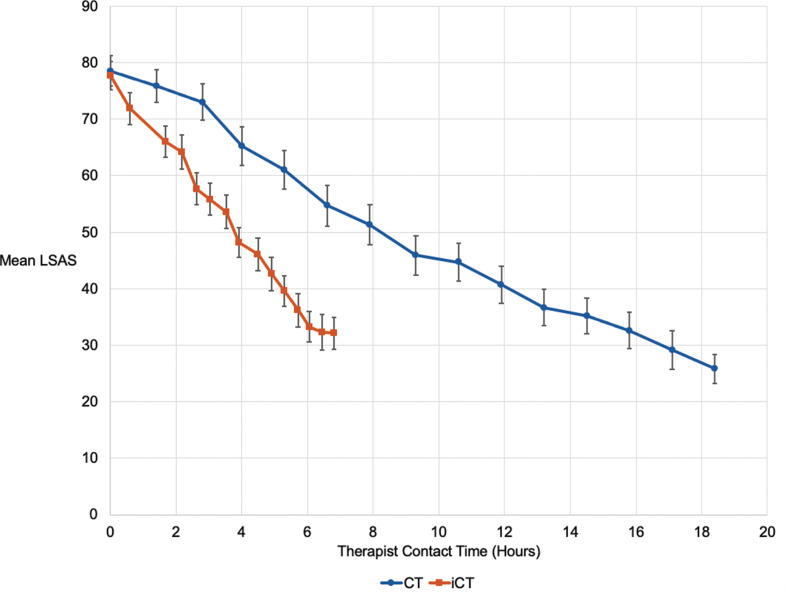
Background: Cognitive therapy for social anxiety disorder (CT-SAD) is recommended by NICE (2013) as a first-line intervention. Take up in routine services is limited by the need for up to 14 ninety-min face-to-face sessions, some of which are out of the office. An internet-based version of the treatment (iCT-SAD) with remote therapist support may achieve similar outcomes with less therapist time. Methods: 102 patients with social anxiety disorder were randomised to iCT-SAD, CT-SAD, or waitlist (WAIT) control, each for 14 weeks. WAIT patients were randomised to the treatments after wait. Assessments were at pre-treatment/wait, midtreatment/wait, posttreatment/wait, and follow-ups 3 & 12 months after treatment. The pre-registered (ISRCTN 95 458 747) primary outcome was the social anxiety disorder composite, which combines 6 independent assessor and patient self-report scales of social anxiety. Secondary outcomes included disability, general anxiety, depression and a behaviour test. Results: CT-SAD and iCT-SAD were both superior to WAIT on all measures. iCT-SAD did not differ from CT-SAD on the primary outcome at post-treatment or follow-up. Total therapist time in iCT-SAD was 6.45 h. CT-SAD required 15.8 h for the same reduction in social anxiety. Mediation analysis indicated that change in process variables specified in cognitive models accounted for 60% of the improvements associated with either treatment. Unlike the primary outcome, there was a significant but small difference in favour of CT-SAD on the behaviour test. Conclusions: When compared to conventional face-to-face therapy, iCT-SAD can more than double the amount of symptom change associated with each therapist hour.
Overview
CoChat Summary
## TL;DR
This randomized controlled trial found that internet cognitive therapy for social anxiety disorder (iCT-SAD) produced similar outcomes to standard face-to-face cognitive therapy (CT-SAD) while using much less therapist time. By the end of treatment, iCT-SAD achieved the same LSAS reduction as CT-SAD with 6.45 therapist hours versus 15.8 hours, or 2.45 times more symptom change per hour.
## Key findings
- Both active treatments beat waitlist: CT-SAD and iCT-SAD were “superior to WAIT on all measures,” with large post-treatment effect sizes on the primary social anxiety composite of d = 2.20 for iCT-SAD and d = 2.38 for CT-SAD.
- Comparable primary outcomes between therapies: iCT-SAD did not differ significantly from CT-SAD on the primary outcome at post-treatment or follow-up; between-treatment effect sizes on the primary outcome were small (ds range 0.22 to 0.31).
- Therapist time was much lower in iCT-SAD: iCT-SAD required 6.45 h of therapist contact, whereas CT-SAD required 15.8 h for the same LSAS reduction; the paper reports this as 2.45 times more symptom change per hour of therapist contact time.
- Process change mattered: Mediation analysis indicated that changes in the cognitive-model process variables accounted for about 60% of the improvements associated with both treatments.
## Methods
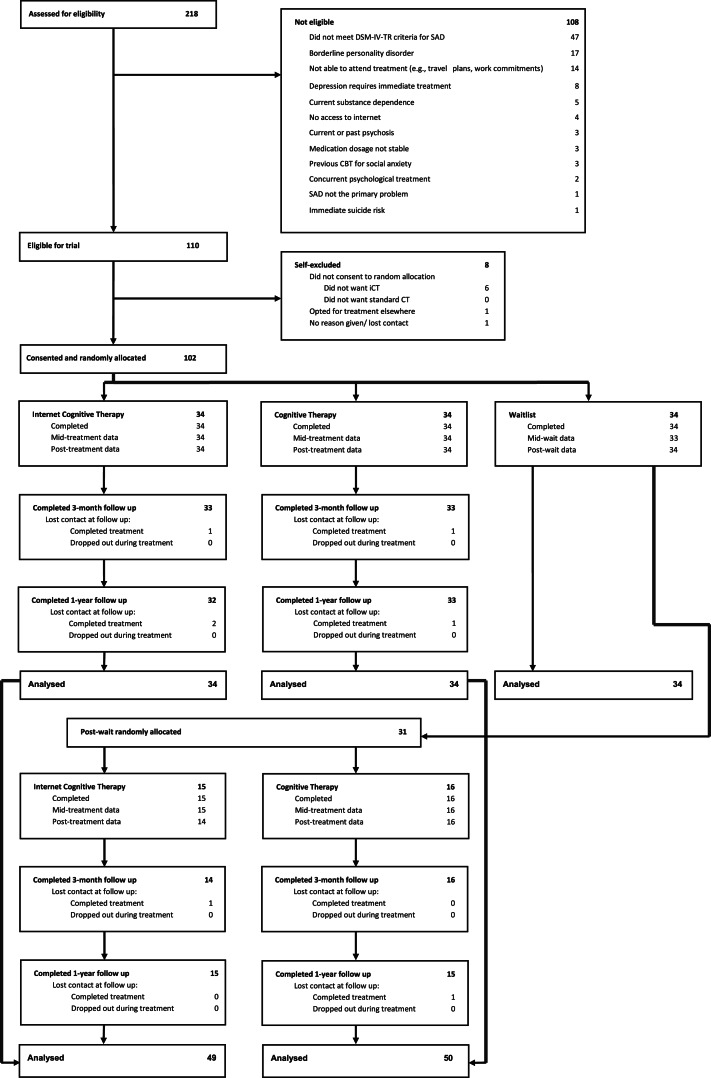
- Design: Randomized controlled trial with 102 patients assigned to iCT-SAD, CT-SAD, or waitlist (WAIT) for 14 weeks; WAIT participants were later randomized to treatment if still eligible. Patients receiving treatment were followed up at 3 and 12 months.
- Sample/data: Adults aged 18–65 meeting DSM-IV criteria for social anxiety disorder, with SAD as the main problem, internet access from home, and no recent change in psychotropic medication; referrals came from Improving Access to Psychological Therapy (IAPT) services in Oxford and London.
- Main analysis: Continuous outcomes were analyzed with linear mixed-effects regression using all available data and covariates including baseline score and PHQ; mediation analyses tested whether changes in process variables mediated treatment effects, and effect sizes were reported as Cohen’s d.
## Limitations
- Stated by the paper: The authors note that using the same experienced therapists for both delivery modes was a rigorous test, but that further studies are required to see whether therapists in routine services with less prior CT experience can achieve similarly positive results with iCT-SAD.
- Stated by the paper: The behavior test comparison was complicated by the fact that it was conducted in the clinic where CT-SAD patients had their treatment, and the authors say future behavior tests should be conducted elsewhere.
- Evident from the text: The trial compared iCT-SAD against CT-SAD delivered by highly experienced therapists and did not assess competence for iCT-SAD because no measure was available, so generalizability to routine practice and comparative delivery fidelity are uncertain.
Model-written summary. Check it against the paper before relying on it.
Integrity signals
Registry
Cites
Statistics
Figures
Verification
Claims the paper makes
0 Valid · 0 Not valid · 7 Not checked · 36 Own results and interpretations
A result the paper reports from its own data — it cites no other source for it, so there is none to check. The quote shows it is in the paper.
In the paper
“Total therapist time in iCT-SAD was 6.45 h.”
- Also stated in: § Therapeutic change per hour of therapy · plain
“iCT patients had dropped 45.5 points on the LSAS after an average of 6.45 h contact with their therapist.”
§ More than doubling the clinical benefit of each hour of therapist time: a randomised controlled trial of internet cognitive therapy for social anxiety disorder > Abstract > Results
plain- Asserted: passes — The authors put it forward as true.
- Checkable: passes — It can be checked against evidence.
- Load-bearing: passes — The paper’s conclusions depend on it.
- Based: passes — The paper gives a reason why it holds.
- Also stated in: § Therapeutic change per hour of therapy · plain
A result the paper reports from its own data — it cites no other source for it, so there is none to check. The quote shows it is in the paper.
In the paper
“Mediation analysis indicated that change in process variables specified in cognitive models accounted for 60% of the improvements associated with either treatment.”
- Also stated in: § Discussion · hedged
“For both internet and face-to-face versions, change in processes specified in the models accounted for around 60% improvement associated with treatment.”
§ More than doubling the clinical benefit of each hour of therapist time: a randomised controlled trial of internet cognitive therapy for social anxiety disorder > Abstract > Results
hedgedstates an association- Asserted: passes — The authors put it forward as true.
- Checkable: passes — It can be checked against evidence.
- Load-bearing: passes — The paper’s conclusions depend on it.
- Based: passes — The paper gives a reason why it holds.
- Also stated in: § Discussion · hedged
A result the paper reports from its own data — it cites no other source for it, so there is none to check. The quote shows it is in the paper.
In the paper
“The presence of avoidant personality disorder did not predict outcome in either treatment.”
§ More than doubling the clinical benefit of each hour of therapist time: a randomised controlled trial of internet cognitive therapy for social anxiety disorder > Results > Predictors of treatment response
plain- Asserted: passes — The authors put it forward as true.
- Checkable: passes — It can be checked against evidence.
- Load-bearing: unclear — It is unclear whether the paper’s conclusions depend on it.
- Based: passes — The paper gives a reason why it holds.
A result the paper reports from its own data — it cites no other source for it, so there is none to check. The quote shows it is in the paper.
In the paper
“Within iCT, individuals who practised giving presentations to a virtual audience more frequently had better outcomes (standardised β = −0.420, p = 0.003).”
§ More than doubling the clinical benefit of each hour of therapist time: a randomised controlled trial of internet cognitive therapy for social anxiety disorder > Results > Predictors of treatment response
plainstates an association- Asserted: passes — The authors put it forward as true.
- Checkable: passes — It can be checked against evidence.
- Load-bearing: unclear — It is unclear whether the paper’s conclusions depend on it.
- Based: passes — The paper gives a reason why it holds.
A result the paper reports from its own data — it cites no other source for it, so there is none to check. The quote shows it is in the paper.
In the paper
“For both iCT-SAD and CT-SAD scores on the process composite at mid-treatment/wait mediated the relationship between randomisation (treatment v. wait) and scores on the primary outcome measure at post-treatment/wait”
§ More than doubling the clinical benefit of each hour of therapist time: a randomised controlled trial of internet cognitive therapy for social anxiety disorder > Results > Mediation analysis
plainstates a cause- Asserted: passes — The authors put it forward as true.
- Checkable: passes — It can be checked against evidence.
- Load-bearing: passes — The paper’s conclusions depend on it.
- Based: passes — The paper gives a reason why it holds.
15 more claims
Create a free account to see all 43 claims and to verify the 9 references still open.
- It may state two separate claims as one. 11
- Probably not a substantial claim. 15
Claims other papers make about this one
Each is checked against this paper’s own text: does it say what the citing paper says it does?
The source backs part of the claim, not all of it — or backs it for a different population, condition or comparison.
In the citing paper
“we used a conservative estimated mean difference of half this value (22 points). This calculation (using β = 0.9, α = 0.05, and a LSAS standard deviation of 19) indicated a required minimum sample of 16 participants per arm. Given the planned analyses of secondary measures and allowing for attrition (up to 20% dropout), we need 30 participants per group, making a total sample size of 60”
From Translated and culturally adapted internet-delivered cognitive therapy for social anxiety disorder in Japanese clinical settings: study protocol for a randomised controlled trial (2024) · cites this paper as [8]
Experimental — accuracy not yet measuredThe cited source says what the claim attributes to it.
In the citing paper
“In the UK, an internet-delivered version of this treatment protocol (iCT-SAD) was developed to support wider access and dissemination [8, 9].”
The cited source says what the claim attributes to it.
In the citing paper
“A randomised controlled trial in the UK found it to show strong efficacy, with outcomes comparable to face-to-face CT-SAD, but requiring much less therapist time per client [8].”
Statistics that don’t add up
Each reported p-value recomputed from its test statistic and degrees of freedom, each partial η² from its F, and each ratio, mean difference or B printed with a p checked against its own confidence interval.
Rated minor: it would not touch a result — a value no result rests on, a p-value that stays on the same side of the significance level, or a conflict that is clerical, resolved elsewhere in the paper, or outside its own findings.
In the paper
“t(65) = 3.3, p < 0.001”
§ More than doubling the clinical benefit of each hour of therapist time: a randomised controlled trial of internet cognitive therapy for social anxiety disorder > Results > Treatment credibility and therapeutic alliance
Reported p < .001 · recomputed p = .002
Statistics recomputed
Every reported test result, recomputed from its test statistic and degrees of freedom. A result shows as not adding up only once an independent check has confirmed it.
- Doesn’t add upt(65) = 3.3reported p < .001 · recomputed p = .002
“t(65) = 3.3, p < .001”
Self-check
Percentages, sums and reported differences re-computed from the paper’s own numbers.
Self-check results appear here once an independent check has confirmed them.
Citations
Cites
R: A Language and Environment for Statistical Computing
R Core Team (2025) · doi:10.32614/r.manuals · Cited by 352,181
Baron, R. M., & Kenny, D. A. (1986) · Journal of Personality and Social Psychology · doi:10.1037/0022-3514.51.6.1173 · Cited by 91,532 · cited 1×
“…the potential mediating effect of process variables on clinical outcomes, we applied the analytic procedure described in Freeman et al. (2017), which follows the Baron and Kenny (1986) approach but uses linear mixed-effects models at each step to account for repeated measures within participants.”
The PHQ-9: Validity of a brief depression severity measure
Kroenke, K., Spitzer, R. L., & Williams, J. B. W. (2001) · Journal of General Internal Medicine · doi:10.1046/j.1525-1497.2001.016009606.x · Cited by 44,910 · cited 1×
“The Generalized Anxiety Disorder scale (GAD-7: Spitzer, Kroenke, Williams, & Löwe, 2006) and the Patient Health Questionnaire (PHQ-9: Kroenke, Spitzer, & Williams, 2001) were used to assess anxious and depressed mood, respectively.”
A Brief Measure for Assessing Generalized Anxiety Disorder: The GAD-7
Spitzer, R. L., Kroenke, K., Williams, J. B. W., & Löwe, B. (2006) · Archives of Internal Medicine · doi:10.1001/archinte.166.10.1092 · Cited by 31,765 · cited 1×
“The Generalized Anxiety Disorder scale (GAD-7: Spitzer, Kroenke, Williams, & Löwe, 2006) and the Patient Health Questionnaire (PHQ-9: Kroenke, Spitzer, & Williams, 2001) were used to assess anxious and depressed mood, respectively.”
Measurement of social-evaluative anxiety.
Watson, D., & Friend, R. (1969) · Journal of Consulting and Clinical Psychology · doi:10.1037/h0027806 · Cited by 3,467 · cited 1×
“…Social Anxiety Scale (LSAS: Baker, Heinrichs, Kim, & Hofmann, 2002), Social Phobia Inventory (SPIN: Connor et al., 2000), Social Phobia Scale (SPS: Mattick and Clarke, 1998), Social Interaction Anxiety Scale (SIAS: Mattick & Clarke, 1998), Fear of Negative Evaluation (FNE: Watson & Friend, 1969).”
Mattick, R. P., & Clarke, J. C. (1998) · Behaviour Research and Therapy · doi:10.1016/s0005-7967(97)10031-6 · Cited by 3,367 · cited 1×
“…Social Anxiety Scale (LSAS: Baker, Heinrichs, Kim, & Hofmann, 2002), Social Phobia Inventory (SPIN: Connor et al., 2000), Social Phobia Scale (SPS: Mattick and Clarke, 1998), Social Interaction Anxiety Scale (SIAS: Mattick & Clarke, 1998), Fear of Negative Evaluation (FNE: Watson & Friend, 1969).”
A cognitive-behavioral model of anxiety in social phobia
Rapee, R. M., & Heimberg, R. G. (1997) · Behaviour Research and Therapy · doi:10.1016/s0005-7967(97)00022-3 · Cited by 2,987 · cited 1×
“Cognitive therapy aims to treat SAD by changing the key maintenance processes specified in Clark and Wells (1995) and similar (Hofmann, 2007; Rapee & Heimberg, 1997) cognitive models.”
The Work and Social Adjustment Scale: a simple measure of impairment in functioning
Mundt, J. C., Marks, I. M., Shear, M. K., & Greist, J. M. (2002) · British Journal of Psychiatry · doi:10.1192/bjp.180.5.461 · Cited by 2,515 · cited 1×
“Cognitive therapy for social anxiety disorder (CT-SAD) is recommended by NICE (2013) as a first-line intervention.”
MethodPsychosomatic medicine in Germany: more timely than ever
Zipfel, S., Herzog, W., Kruse, J., & Henningsen, P. (2016) · Psychotherapy and Psychosomatics · doi:10.1159/000447701 · Cited by 2,323
Psychometric properties of the credibility/expectancy questionnaire
Devilly, G. J., & Borkovec, T. D. (2000) · Journal of Behavior Therapy and Experimental Psychiatry · doi:10.1016/s0005-7916(00)00012-4 · Cited by 2,295 · cited 1×
“Initial ratings of the credibility of psychological treatment have also often been shown to predict outcome (Devilly & Borkovec, 2000) and did so in iCT-SAD.”
Research works printed but not linked: 5
- First, B. M., Spitzer, R. L., Gibbon, M., & Williams, J. B. W. (1995). User's guide for the structured clinical interview for DSM-IV axis I disorders: SCID-I clinician version. Washington, DC: American Psychiatric Press.
- Brown, T. A., Nardo, P. A., & Barlow, D. H. (1994). Anxiety disorders interview schedule for DSM-IV. Albany, NY: Graywind Publications Inc.
- NICE. (2013). Social anxiety disorder: Recognition, assessment and treatment (clinical guideline 159). London, UK: National Institute for Health and Care Excellence. Retrieved from https://www.nice.org.uk/guidance/cg159. 31869048
- American Psychiatric Association (1994). Diagnostic and statistical manual of mental disorders (Vol. 4th). Washington, D.C.: Author.
- Rosenthal, R., & Rosnow, R. L. (1991). Essentials of behavioural research: Methods and data analysis (2nd ed.). New York: McGraw-Hill.
Cited by
Hedman‐Lagerlöf, E., Carlbring, P., Svärdman, F., Riper, H., Cuijpers, P., & Andersson, G. (2023) · World Psychiatry · doi:10.1002/wps.21088 · Cited by 259
The use of artificial intelligence in psychotherapy: development of intelligent therapeutic systems
Spytska, L. (2025) · BMC Psychology · doi:10.1186/s40359-025-02491-9 · Cited by 113
“This conclusion is consistent with Clark et al. [45], who demonstrated that online cognitive therapy may greatly expand therapists’ reach, boosting treatment outcomes in disorders such as social anxiety disorder.”
The Neuropsychology of Anxiety: An enquiry into the functions of the septo-hippocampal system
McNaughton, N., & Gray, J. A. (2024) · doi:10.1093/oso/9780198843313.001.0001 · Cited by 97
Creswell, C., Taylor, L., Giles, S., Howitt, S., Radley, L., Whitaker, E., Brooks, E., Knight, F., Raymont, V., Hill, C., et al. (2024) · The Lancet Psychiatry · doi:10.1016/s2215-0366(23)00429-7 · Cited by 45
Anxiety Screening: Evidence Report and Systematic Review for the US Preventive Services Task Force
O’Connor, E., Henninger, M. L., Perdue, L. A., Coppola, E. L., Thomas, R. G., & Gaynes, B. N. (2023) · JAMA · doi:10.1001/jama.2023.6369 · Cited by 52
Leigh, E., & Clark, D. M. (2022) · Journal of Child Psychology and Psychiatry · doi:10.1111/jcpp.13680 · Cited by 46
Self-citationThew, G. R., Kwok, A. P. L., Lissillour Chan, M. H., Powell, C. L. Y. M., Wild, J., Leung, P. W. L., & Clark, D. M. (2022) · Internet Interventions · doi:10.1016/j.invent.2022.100539 · Cited by 28
“It aims to replicate the content and procedures of the face-to-face cognitive therapy (CT-SAD) protocol (see Clark et al., 2006; Warnock-Parkes et al., 2020), which in the UK is a primary treatment recommendation for adults with SAD (NICE, 2013).”
BackgroundInfluentialSelf-citationScholten, W., Seldenrijk, A., Hoogendoorn, A. W., Bosman, R. C., Muntingh, A., Karyotaki, E., Andersson, G., Berger, T., Carlbring, P., Furmark, T., et al. (2023) · JAMA Psychiatry · doi:10.1001/jamapsychiatry.2023.1291 · Cited by 33
Jackson, H. M., Calear, A. L., Batterham, P. J., Ohan, J. L., Farmer, G. M., & Farrer, L. M. (2023) · Journal of Medical Internet Research · doi:10.2196/44673 · Cited by 25
“At least 1 significant positive finding was reported in each of the 4 studies evaluating improvements in social anxiety symptoms [77,79,100,105] and in 1 study evaluating improvements in depression, anxiety, and stress [85].”
Remote cognitive behaviour therapy for social anxiety disorder: A meta-analysis
Winter, H. R., Norton, A. R., Burley, J., & Wootton, B. M. (2023) · Journal of Anxiety Disorders · doi:10.1016/j.janxdis.2023.102787 · Cited by 31
Mechler, J., Lindqvist, K., Magnusson, K., Ringström, A., Krafman, J. D., Alvinzi, P., Kassius, L., Sowa, J., Andersson, G., & Carlbring, P. (2024) · npj Mental Health Research · doi:10.1038/s44184-024-00063-0 · Cited by 24
“It is worth noting that Clark et al. 64 tested ICBT and reported an exceptionally high effect size of d = 2.2.”
BackgroundInfluentialThe efficacy of psychotherapy for social anxiety disorder, a systematic review and meta-analysis
de Ponti, N., Matbouriahi, M., Franco, P., Harrer, M., Miguel, C., Papola, D., Sicimoğlu, A., Cuijpers, P. J., & Karyotaki, E. (2024) · Journal of Anxiety Disorders · doi:10.1016/j.janxdis.2024.102881 · Cited by 37
Vernmark, K., Buhrman, M., Carlbring, P., Hedman‐Lagerlöf, E., Kaldo, V., & Andersson, G. (2024) · Digital Health · doi:10.1177/20552076241287059 · Cited by 29
“31”
Thiblin, E., Woodford, J., Reuther, C., Lundgren, J., Lutvica, N., & von Essén, L. (2022) · Cancer Medicine · doi:10.1002/cam4.5377 · Cited by 18
“S ee t h e T e r m s a nd C ond iti on s ( h tt p s :/ / on li n e li b r a r y . w il e y . c o m /t e r m s - a nd - c ond iti o n s ) 74– 76 This finding may be explained by psychology program students only supporting a mean of 2.7 parents.”
BackgroundInfluentialWarnock‐Parkes, E., Wild, J., Thew, G. R., Kerr, A., Grey, N., & Clark, D. M. (2022) · The Cognitive Behaviour Therapist · doi:10.1017/s1754470x22000496 · Cited by 22
“, 2020) and an effective internet-delivered version of the treatment has also been developed (Clark et al., 2022).”
Self-citationSun, L., Dai, X., Zhu, S., Liu, Z., & Zhongming, Z. (2025) · Journal of Affective Disorders · doi:10.1016/j.jad.2025.02.092 · Cited by 18
Linardon, J., Messer, M., Reid, R., Bolger, T., & Andersson, G. (2025) · Cognitive Behaviour Therapy · doi:10.1080/16506073.2025.2542364 · Cited by 23
A guide for self-help guides: best practice implementation
Shafran, R., Egan, S. J., de Valle, M. K., Davey, E., Carlbring, P., Creswell, C., & Wade, T. D. (2024) · Cognitive Behaviour Therapy · doi:10.1080/16506073.2024.2369637 · Cited by 17
“…cases, can be considered a form of guided self-help although some forms of internet-based CBT are more akin to therapist-delivered interventions whereby the therapist is leading the intervention and uses the materials on the internet to support the therapy and save time (e.g. Clark et al., 2023).”
BackgroundHall, M., Luo, A., Bhullar, N., Moses, K., & Wootton, B. M. (2024) · Australian Psychologist · doi:10.1080/00050067.2024.2356804 · Cited by 16
“Second, much research, including studies with large sample sizes (Boettcher et al., 2018; Clark et al., 2023; Neufeld et al., 2020) have been published since this 2014 meta-analysis was conducted, and thus an update based on this new literature is required.”
Sakai, M., Yoshinaga, N., Thew, G. R., & Clark, D. M. (2024) · Frontiers in Psychiatry · doi:10.3389/fpsyt.2024.1368722 · Cited by 12
Self-citationSudden gains in face-to-face and internet-based cognitive therapy for social anxiety disorder
Thew, G. R., Ehlers, A., & Clark, D. M. (2023) · Behaviour Research and Therapy · doi:10.1016/j.brat.2023.104334 · Cited by 14
“Data were drawn from a waitlist-controlled RCT (Clark et al., 2022) comparing face-to-face CT-SAD (n = 50) with therapist-guided inter-net-based iCT-SAD (n = 49).”
MethodSelf-citationLeigh, E., Nicol-Harper, R., Charakopoulou-Travlou, M., & Clark, D. M. (2023) · Internet Interventions · doi:10.1016/j.invent.2023.100664 · Cited by 14
Self-citationŠipka, D., Lopes, R. D. C. T., Krieger, T., Klein, J. P., & Berger, T. (2025) · Psychotherapy and Psychosomatics · doi:10.1159/000542425 · Cited by 14
“Research on internet-based treatments for SAD has been particularly extensive in the last two decades [20, 22 – 24].”
Pan, J., Thew, G. R., & Clark, D. M. (2025) · Journal of Affective Disorders · doi:10.1016/j.jad.2025.04.100 · Cited by 10
Self-citationWild, J., Warnock‐Parkes, E., Stott, R. B., Kwok, A. P., Chan, M. H. L., Powell, C. L. Y. M., Leung, P. W. L., Clark, D. M., & Thew, G. R. (2023) · Journal of Affective Disorders · doi:10.1016/j.jad.2023.03.017 · Cited by 10
Self-citationShalom, J. G., Shaul-Tsoran, I., Strauss, A. Y., Huppert, J. D., Andersson, G., & Aderka, I. M. (2024) · Cognitive Behaviour Therapy · doi:10.1080/16506073.2024.2331188 · Cited by 7
“Internet-delivered cognitive behavioral therapy (ICBT) for SAD has been found to be an effective and cost-efficient alternative to face-to-face treatment (D. M. Clark et al., 2023; Guo et al., 2021).”
BackgroundYoshinaga, N., Thew, G. R., Hayashi, Y., Matsuoka, J., Tanoue, H., Takanashi, R., Araki, M., Kanai, Y., Smith, A., Grant, S. H. L., et al. (2023) · JMIR Formative Research · doi:10.2196/45136 · Cited by 6
“iCT-SAD is a therapist-guided internet intervention developed in the United Kingdom [24,25] based on the Clark and Wells cognitive model of SAD [9].”
BackgroundMethodInfluentialSelf-citationA 6-month supported online program for the treatment of persecutory delusions: Feeling Safer
Freeman, D. H., Isham, L., Freeman, J. D., Rosebrock, L. E., Kabir, T., Kenny, A., Diamond, R., Beckley, A., Rouse, N., Ahmed, M., et al. (2025) · Psychological Medicine · doi:10.1017/s0033291725100676 · Cited by 7
Pavlova, B., Warnock-Parkes, E., Alda, M., Uher, R., & Clark, D. M. (2024) · International Journal of Bipolar Disorders · doi:10.1186/s40345-023-00321-8 · Cited by 5
“Our secondary social anxiety outcome measure, LSAS, was used in most studies that evaluated individual CBT for social anxiety disorder in people without severe mental illness (Clark et al. 2003, 2006, 2022; Mörtberg et al. 2007; Goldin et al. 2012).”
MethodResultSelf-citationSafety and Efficacy of Modular Digital Psychotherapy for Social Anxiety: Randomized Controlled Trial
Garvert, M. M., McFadyen, J., Linke, S., McCloud, T. L., Meyer, S. S., Sobanska, S., Sharp, P. B., Long, A., Huys, Q. J. M., & Ahmadi, M. (2025) · Journal of Medical Internet Research · doi:10.2196/64138 · Cited by 6
“The efficacy of the Alena app either matched [39,40] or surpassed [9] that observed for previous digital interventions for social anxiety, although interventions including support from a human therapist can show enhanced effects [41].”
Yilmaz, C., Nemani, A., Schittenhelm, J. M., Clark, D. M., Thew, G. R., & Stangier, U. (2025) · Behaviour Research and Therapy · doi:10.1016/j.brat.2025.104825 · Cited by 8
Self-citationPan, J. (2023) · JMIR Research Protocols · doi:10.2196/48437 · Cited by 7
“For example, the average time spent in VRET is 8 minutes per session [12], and the therapist’s time in iCBT can be saved by more than half for the same level of reduction in social anxiety [13].”
BackgroundWinter, H. R., Norton, A. R., & Wootton, B. M. (2025) · Cognitive Behaviour Therapy · doi:10.1080/16506073.2025.2540916 · Cited by 5
“…internet-delivered cognitive therapy based on the Clark and Wells (1995) model has shown transportability across cultures demonstrating excellent clinical outcomes in recent trials in the United Kingdom (Clark et al., 2023), Hong Kong (Thew et al., 2022) and Japan (Yoshinaga et al., 2023).”
Hall, S. S., Hall, C., Partlett, C., Jeayes, A., Rattu, N. R., Henshaw, H., Martin, J., & Shoesmith, E. (2026) · PLOS Digital Health · doi:10.1371/journal.pdig.0001466 · Cited by 3
Sudden gains in internet cognitive therapy for social anxiety disorder in routine clinical practice
Yim, S. H., Clark, D. M., Salkovskis, P. M., & Thew, G. R. (2024) · Internet Interventions · doi:10.1016/j.invent.2024.100788 · Cited by 3
“More recently, Thew et al. (2023) explored sudden gains using data from the Clark et al. (2022) RCT, which compared face-to-face CT-SAD to iCT-SAD.”
Self-citationTitov, N., Dear, B. F., Staples, L., Fisher, A. C., Hadjistavropoulos, H. D., & Nielssen, O. B. (2025) · Internet Interventions · doi:10.1016/j.invent.2025.100857 · Cited by 4
“…despite the presence of severe symptoms, but will accept and derive benefit from low intensity services such as those provided by DMHSs with many studies showing equivalence in outcomes of face to face and internet delivered treatments (e.g, Clark et al., 2022; Hedman-Lagerl ¨ of et al., 2023).”
Clark, D. M. (2023) · PSICOTERAPIA E SCIENZE UMANE · doi:10.3280/pu2023-001011 · Cited by 3
Self-citationNixon, R. D. V., Elizabeth, M., Fassnacht, D. B., van Agteren, J. E., Edney, L. C., & Wild, J. (2024) · European Journal of Psychotraumatology · doi:10.1080/20008066.2024.2420459 · Cited by 3
Self-citationShalom, J. G., Prihar, A., Strauss, A. Y., Huppert, J. D., Andersson, G., & Aderka, I. M. (2025) · Behavior Therapy · doi:10.1016/j.beth.2025.01.002 · Cited by 3
Bakanaitė, R., Bakanienė, I., & Kanyeredzi, A. (2025) · European Psychiatry · doi:10.1177/15305627251358855 · Cited by 5
“Clark et al. 42 found a nonsignificant effect size favoring iCBT in treating social anxiety disorder (g = 0.0116, 95% CI: - 0.4727 to 0.4958).”
InfluentialSchittenhelm, J. M., von Rechenberg, R., Schäfer, L., Weber, L., Schüller, J. S., Stangier, U., & Hoyer, J. (2026) · Behaviour Research and Therapy · doi:10.1016/j.brat.2026.104983 · Cited by 3
Reconceptualizing cognitive-behavioral processes in youth anxiety in the digital age
Skjerdingstad, N., & Leigh, E. (2026) · Nature Mental Health · doi:10.1038/s44220-026-00633-5 · Cited by 3
“Cognitive behavioral therapy is widely recognized as a first-line treat-ment for SAD 35 , and online delivery has been considered a crucial step in addressing implementation challenges 36,37 .”
Brunner, I. C., Støme, L. N., & Kenter, R. M. F. (2026) · Internet Interventions · doi:10.1016/j.invent.2026.100983 · Cited by 2
Are Virtual Forests Just for Relaxation, or Can They Enhance the Benefits of Therapy?
Hu, Y. Z., Beggs, M., Xue, Y., Gao, S., Seok, J., Xiao, Y., Zhou, Z., Zhou, Y., Mariakakis, A. T., & Chignell, M. (2025) · Healthcare · doi:10.3390/healthcare13060621 · Cited by 3
Warnock‐Parkes, E., Thew, G. R., Murray, H., Grey, N., Wild, J., Kerr, A., Smith, A., Stott, R. B., Ehlers, A., & Clark, D. M. (2025) · Cognitive Behaviour Therapy · doi:10.1080/16506073.2025.2518427 · Cited by 5
“For example, during a recent trial of CT-SAD, patients completed an average of 13.5 behavioural experiments within face-to-face treatment sessions and 21.5 experiments during a course of CT-SAD delivered online (iCT-SAD: Clark et al., 2023).”
InfluentialSelf-citationMcNaughton, N., & Gray, J. A. (2024) · Oxford University Press eBooks · doi:10.1093/oso/9780198843313.003.0012 · Cited by 2
Sine of the times: Can sinusoidal waves model changes in the therapeutic alliance over time?
Shalom, J. G., Korem, M., Strauss, A. Y., Huppert, J. D., Andersson, G., & Aderka, I. M. (2025) · Internet Interventions · doi:10.1016/j.invent.2025.100845 · Cited by 1
“However, Clark et al. (2023) and Lindegaard et al. (2020) found that therapeutic alliance in ICBT for SAD significantly predicted treatment outcome.”
Luyten, P., Speybrouck, D., Martin, P., Claes, S. J., Midgley, N., Eeren, H. V., Busschbach, J. J. V., & Tang, E. (2026) · JMIR Research Protocols · doi:10.2196/80511 · Cited by 3
“Blended psychotherapy, which combines online work and in-person FTF sessions, may help to bridge this treatment gap as a potentially cost-effective treatment that complements other treatments for depression [7,9,10,13-16].”
InfluentialKnapstad, M., & Smith, O. R. (2026) · Internet Interventions · doi:10.1016/j.invent.2026.100913 · Cited by 1
Salgado, J., Gomes, M., Csabai, M., Daele, T. V., Doyle, F., Eimontas, J., Elster, R. N., Gosar, D., Haddouk, L., Karekla, M., et al. (2026) · European Psychologist · doi:10.1027/1016-9040/a000588 · Cited by 1
Therapeutic alliance in two forms of guided self‐help for binge eating
Jenkins, P. E., & Wake, S. J. (2024) · Clinical Psychology & Psychotherapy · doi:10.1002/cpp.2959 · Cited by 5
Fundamentals of the septo-hippocampal system
McNaughton, N., & Gray, J. A. (2024) · Oxford University Press eBooks · doi:10.1093/oso/9780198843313.003.0009 · Cited by 1
Memory and the septo-hippocampal system
McNaughton, N., & Gray, J. A. (2024) · Oxford University Press eBooks · doi:10.1093/oso/9780198843313.003.0008 · Cited by 1
Yoshinaga, N., Thew, G. R., Hayashi, Y., Tanoue, H., Nakai, M., & Clark, D. M. (2024) · Trials · doi:10.1186/s13063-024-08303-6
“In the UK, an internet-delivered version of this treat-ment protocol (iCT-SAD) was developed to support wider access and dissemination [8, 9].”
BackgroundMethodResultInfluentialSelf-citationWhat do hippocampal cell fields represent?
McNaughton, N., & Gray, J. A. (2024) · Oxford University Press eBooks · doi:10.1093/oso/9780198843313.003.0007
McNaughton, N., & Gray, J. A. (2024) · Oxford University Press eBooks · doi:10.1093/oso/9780198843313.003.0001 · Cited by 1
The neurology of anxiety—planning circuits
McNaughton, N., & Gray, J. A. (2024) · Oxford University Press eBooks · doi:10.1093/oso/9780198843313.003.0011
A theory of the septo-hippocampal system (SHS)
McNaughton, N., & Gray, J. A. (2024) · Oxford University Press eBooks · doi:10.1093/oso/9780198843313.003.0010
Symptoms and syndromes of anxiety
McNaughton, N., & Gray, J. A. (2024) · Oxford University Press eBooks · doi:10.1093/oso/9780198843313.003.0013
The neurology of anxiety—survival circuits
McNaughton, N., & Gray, J. A. (2024) · Oxford University Press eBooks · doi:10.1093/oso/9780198843313.003.0006
McNaughton, N., & Gray, J. A. (2024) · Oxford University Press eBooks · doi:10.1093/oso/9780198843313.003.0002
The treatment of anxiety and fear disorders
McNaughton, N., & Gray, J. A. (2024) · Oxford University Press eBooks · doi:10.1093/oso/9780198843313.003.0014
McNaughton, N., & Gray, J. A. (2024) · Oxford University Press eBooks · doi:10.1093/oso/9780198843313.002.0011
McNaughton, N., & Gray, J. A. (2024) · Oxford University Press eBooks · doi:10.1093/oso/9780198843313.003.0015
McNaughton, N., & Gray, J. A. (2024) · Oxford University Press eBooks · doi:10.1093/oso/9780198843313.002.0009
The anxiolytic drugs—our key tool
McNaughton, N., & Gray, J. A. (2024) · Oxford University Press eBooks · doi:10.1093/oso/9780198843313.003.0004
McNaughton, N., & Gray, J. A. (2024) · Oxford University Press eBooks · doi:10.1093/oso/9780198843313.003.0003
List of online appendices and reviews
McNaughton, N., & Gray, J. A. (2024) · Oxford University Press eBooks · doi:10.1093/oso/9780198843313.002.0010
A conceptual theory of the goal inhibition system
McNaughton, N., & Gray, J. A. (2024) · Oxford University Press eBooks · doi:10.1093/oso/9780198843313.003.0005
McNaughton, N., & Gray, J. A. (2024) · Oxford University Press eBooks · doi:10.1093/oso/9780198843313.002.0006
McNaughton, N., & Gray, J. A. (2024) · Oxford University Press eBooks · doi:10.1093/oso/9780198843313.002.0004
McNaughton, N., & Gray, J. A. (2024) · Oxford University Press eBooks · doi:10.1093/oso/9780198843313.002.0005
Thew, G. R., Ehlers, A., & Clark, D. M. (2024) · Internet Interventions · doi:10.1016/j.invent.2024.100786
Self-citationMeyerbröker, K., & Emmelkamp, P. M. G. (2025) · CBT: science into practice · doi:10.1007/978-3-031-91439-3_11
Was Epictetus Right? Do Feelings REALLY Result from Thoughts? (Preprint)Preprint
Burns, D. D., Spangler, D. L., & Karmel, J. (2025) · doi:10.2196/preprints.81848
Thew, G. R., Powell, C. L. Y. M., Chan, L. S., Cheung, E. S. L., Chung, J. L. T., Li, C. L., So, M. M., Hsu, Y. K., Ng, M. Y., Siu, S. H., et al. (2025) · JMIR Formative Research · doi:10.2196/69818
“…Cognitive Therapy for Social Anxiety Disorder (iCT-SAD), a therapist-guided treatment based on the social anxiety disorder (SAD) model of Clark and Wells [1], was designed to replicate the face-to-face treatment protocol and has shown good efficacy in the United Kingdom [2,3] and Hong Kong [4,5].”
Self-citationRalph, T., Cook, L., Peters, A. J., & Lawrence, D. (2025) · Journal of Police and Criminal Psychology · doi:10.1007/s11896-025-09788-w
Thew, G. R., Lee, M., Wolsey, I., Giles, F., Hayden, E., Jell, G., Peacock, J., Pimm, J., Ryder, J., Salvadori, A., et al. (2026) · JMIR Human Factors · doi:10.2196/68671 · Cited by 1
“…undertake treatment, for example, SilverCloud (SilverCloud Health) [19], iCT-SAD (internet-delivered cognitive therapy for social anxiety disorder) [20] or iCT-PTSD (internet-delivered cognitive therapy for posttraumatic stress disorder) [21], or those attending a brief psychoeducation-only group.”
Self-citationHall, S. S., Hall, C. L., Partlett, C., Jeayes, A., Rattu, N. R., Henshaw, H., Martin, J. L., & Shoesmith, E. (2026) · Research Square · doi:10.21203/rs.3.rs-7565290/v1
Wild, J., Tyson, G., Thew, G. R., Wilkins, A., Beierl, E. T., El-Salahi, S., Lorenz, H., Storch, C., Browne, H., Morris, D. A., et al. (2026) · JAMA Network Open · doi:10.1001/jamanetworkopen.2025.57241
Self-citationSchüller, J. S., Kujat, J., Schittenhelm, J. M., von Rechenberg, R., Čerič, A., Hoyer, J., & Stangier, U. (2026) · Clinical Psychology in Europe · doi:10.32872/cpe.15687
“Behavioural experiments (BEs) are the key mechanism driving symptom change (Yilmaz et al., 2025).”
InfluentialStandal, B., Gullslett, M. K., Kenter, R. M. F., Nordgreen, T., & Teig, I. L. (2026) · doi:10.2196/preprints.94640
Internet Cognitive Therapy for Prolonged Grief Disorder (iCT-PG): a developmental case series
Smith, K. V., Wild, J., Stonciute, S., & Ehlers, A. (2026) · European Journal of Psychotraumatology · doi:10.1080/20008066.2026.2627050 · Cited by 4
“Similar to the other iCT programmes (Clark et al., 2023; Ehlers et al., 2023; Leigh & Clark, 2023) the aim of the iCT-PG programme was to (1) target the cognitive maintenance mechanisms of PGD using cognitive therapy techniques, (2) harness the latest technology in an effort to support programme…”
Self-citationTichelaar, M., Ebrahimi, O. V., Aresti, E., Buckman, J. E. J., Saunders, R., Suh, J. W., Wheatley, J., Pilling, S., & O’Driscoll, C. (2026) · Journal of Affective Disorders · doi:10.1016/j.jad.2026.121880 · Cited by 1
Standal, B., Kenter, R. M. F., Gullslett, M. K., Nordgreen, T., & Teig, I. L. (2026) · Journal of Medical Internet Research · doi:10.2196/94640 · Cited by 2
“Within this expanding landscape, therapist-gui-ded internet-delivered cognitive behavioral therapy (guided iCBT) has emerged as an effective and scalable treatment for common mental disorders [7,8], demonstrating high patient acceptance [9] and potential time-saving benefits for therapists [10,11].”
Hua, D. Y.-H., Jell, G., Hart, L., Sollesse, S., & Reeves, E. (2026) · Behaviour and Information Technology · doi:10.1080/0144929x.2026.2697311
Standal, B., Kenter, R. M. F., Gullslett, M. K., Nordgreen, T., & Teig, I. L. (2026) · Frontiers in Digital Health · doi:10.3389/fdgth.2026.1955151
Cerazy, D., & Kraszewski, S. (2026) · doi:10.2196/preprints.115272
Petersén, N., Santoft, F., Jayaram‐Lindström, N., Jansson‐Fröjmark, M., Alfonsson, S., & Bohman, B. (2026) · Trials · doi:10.1186/s13063-026-10063-4
Metadata
- Authors
- Clark, D. M., Wild, J., Warnock-Parkes, E., Stott, R., Grey, N., Thew, G., & Ehlers, A.
- Affiliations
- University of Oxford (GB)
- King's College London (GB)
- Sussex Partnership NHS Foundation Trust (GB)
- Corresponding author
- Clark, David M.
- Venue
- Psychological Medicine
- Publisher
- Cambridge University Press (CUP)
- Published
- 2022-07-15
- Volume
- 53
- Issue
- 11
- Pages
- 5022-5032
- ISSN
- 0033-2917 (ISSN-L)
- 1469-8978
- PMC
- PMC10476054
- OpenAlex
- W4285491857
- Semantic Scholar
- e823d97799dd3c8062b072ebe54e786fa8647ab1
- Cited by
- 88
- References
- 49
- Citations by year
- 2026: 18 · 2025: 19 · 2024: 36 · 2023: 11 · 2022: 4
- FWCI
- 15.46
- Type
- journal article
- Language
- en
- Open access
- hybrid
- doi.org
- Locations
- Psychological Medicine (publishedVersion, cc-by)
- PubMed Central (publishedVersion, cc-by)
- PubMed (publishedVersion)
- Funders
- Wellcome (200796)
- Topics
- Social Sciences › Psychology › Applied Psychology › Digital Mental Health Interventions
- Social Sciences › Psychology › Experimental and Cognitive Psychology › Anxiety, Depression, Psychometrics, Treatment, Cognitive Processes
- Social Sciences › Psychology › Clinical Psychology › Psychological Treatments and Assessments
- Keywords
- social anxiety disorder, cognitive therapy, process parameters, mediation analysis, treatment outcomes, general anxiety, depression
- MeSH terms
- Phobia, Social, Anxiety, Humans, Therapy, Computer-Assisted, Cognitive Behavioral Therapy, Treatment Outcome, Internet
About these checks
Registry, retraction, Cites and statistics results are computed, not judged, with one exception: a printed reference that no index lists is read once by a model before it counts as a citation error. Claims are extracted by a model and kept only when their quote appears verbatim in the text; each cited source is then checked, with a model’s help, for whether it says what the claim relies on. Those verdicts can be wrong — read the claim’s quote and the cited source before relying on one.
A language model drew the claims from the paper on 2026-10-11, under version 3 of the claim definition (model deepseek-v4.1-flash, prompt extract-v3).
A second model labelled each claim on 2026-10-11 (model jev-1.13-20260917, definition revision gold-guideline-v0.2).
Statistics and arithmetic are recomputed, not judged.
Confidence bands are shown only for fields calibrated on our annotated test set. None is calibrated yet, so no band is shown.
What counts as a claim ›How we measure confidence ›How we check this ›
Are you an author, or do you see a problem with this page? Request a review
Data sources
Bibliographic data: Semantic Scholar, OpenAlex, Crossref.
Contains information from the Semantic Scholar Academic Graph Datasets, made available under the ODC Attribution License (ODC-BY 1.0).
Semantic Scholar’s data is described in: Kinney, R., et al. (2023). The Semantic Scholar Open Data Platform. arXiv:2301.10140.
