

Anxiety, enjoyment, and boredom in language learning amongst junior secondary students in rural China: How do they contribute to L2 achievement?
Open accessThe DOI matches its Crossref record; 47 of the 47 references it cites were found in a registry or an index; 1 of the 9 sources its claims cite were checked for support.
Abstract
Abstract Building on the control-value theory, the present study examined the independent and joint predictive effects of three emotions—enjoyment, anxiety, and boredom—on L2 achievement over time. The participants of the study were a group of junior secondary English learners in rural China, a population that has hitherto never featured in L2 learning research. Questionnaire data and achievement data were collected at four different time points (Time 1–Time 4: T1–T4) from a large sample of 954 learners. Structural equation modeling results show that: (a) the three emotions at T1 predicted English achievement at T2 (one week after T1) and T3 (five weeks after T1) independently, while only enjoyment predicted achievement at T4 (nine weeks after T1); (b) when combined, enjoyment was the strongest and most enduring predictor across T2–T4, followed by anxiety predicting achievement at T2–T3 negatively, while boredom completely lost its predictive power across T2–T4.
Overview
CoChat Summary
## TL;DR
This longitudinal study of 954 junior secondary EFL learners in rural China examined how anxiety, enjoyment, and boredom predicted English achievement over four time points. Enjoyment was the most durable predictor; anxiety and boredom predicted achievement earlier but lost predictive power over time.
## Key findings
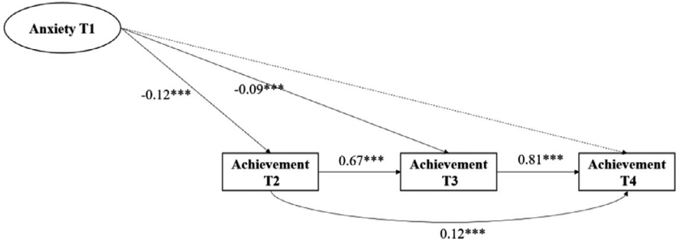
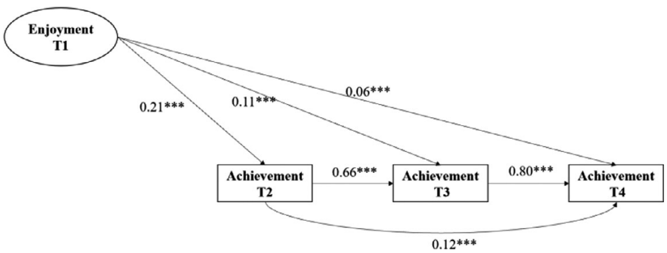
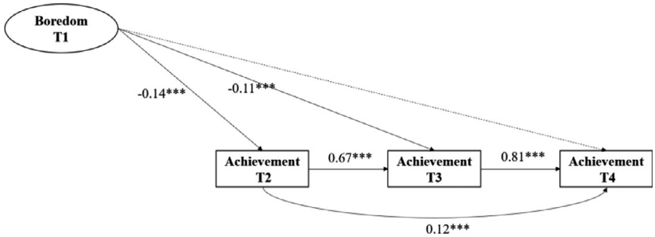
- At Time 1, the three emotions independently predicted later English achievement: anxiety negatively predicted T2 (β = -.12, p < .001) and T3 (β = -.09, p < .001) but not T4; enjoyment positively predicted T2 (β = .21, p < .001), T3 (β = .11, p < .001), and T4 (β = .06, p < .001); boredom negatively predicted T2 (β = -.14, p < .001) and T3 (β = -.11, p < .001) but not T4.
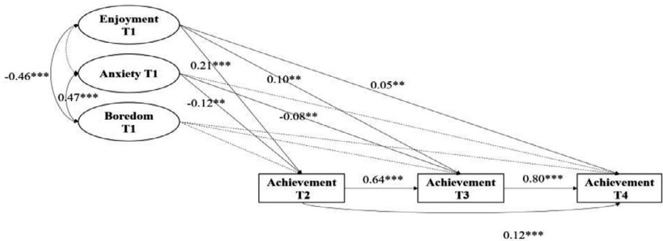
- When the three emotions were modeled together, enjoyment remained the strongest and most enduring predictor: T2 (β = .21, p < .001), T3 (β = .10, p < .01), and T4 (β = .05, p < .01).
- In the joint model, anxiety also predicted achievement negatively at T2 (β = -.12, p < .01) and T3 (β = -.08, p < .01), but not T4; boredom had no significant predictive effect at any later time point.
- The emotions were related to each other in the joint model: enjoyment was negatively related to boredom (β = -.46, p < .001) and boredom was positively related to anxiety (β = .46, p < .001); enjoyment and anxiety were not significantly correlated.
## Methods
- Longitudinal panel design built around the control-value theory, with measurements at four time points over about ten weeks: emotion questionnaire data at T1 and English achievement scores at T2, T3, and T4.
- Sample: 954 junior secondary English learners in one rural school in Anhui Province, China; 358 female and 596 male students, mean age 13 (SD = .81).
- Main analysis: confirmatory factor analysis and structural equation modeling in Mplus 8.3, with autoregressive controls and covariates (age, gender, SES, onset age of English learning).
## Limitations
- The paper states that the panel design with autoregressive controls and covariates “still does not suffice to establish causality.”
- It also states that only three emotions were examined; other L2 emotions may matter, and future research should include them.
- It further states that emotions were measured at one time point, unidirectional effects were tested only, and no reciprocal relations or indirect mechanisms were assessed; the text also makes evident that the sample came from one school in one rural county, which limits generalizability.
Model-written summary. Check it against the paper before relying on it.
Integrity signals
Registry
Cites
Statistics
Figures
Verification
Claims the paper makes
1 Valid · 0 Not valid · 5 Not checked · 69 Own results and interpretations
The cited sources support only part of this claim — read each source’s verdict below.
In the paper
“The results seem to suggest that the patterns between emotions and achievement may vary across different contexts.”
What the sources say
- Partly supportedcites Dewaele and Alfawzan (2018) matched to “Does the effect of enjoyment outweigh that of anxiety in foreign language performance?” (2018) sourceExperimental — accuracy not yet measured
Our copy does carry the two-context comparison the claim rests on, and its numbers differ across contexts: in Study 1 (London pupils) FLE (Rho = .34, p < .0001, r2 = 11.6) and FLCA (Rho = -.30, p < .0001, r2 = 9.0) were both significantly linked to test results (5.1, Results), whereas in Study 2 (Saudi EFL learners) only FLE was significant (Rho = 0.242, p < 0.003, r2 = 5.8) and the FLCA relation failed to reach significance (Rho = -0.145, p = 0.075) (5.2, Results) — echoed in the Conclusion's contrast between 'the significant negative relationship between FLCA and performance in Study 1 and the marginal negative effect in Study 2'. However, the authors' own interpretation runs the other way: the Discussion (6.) calls Study 2 'a similar picture', and the paper sets out to test whether similar patterns would make the relationship 'universal rather than a random effect of the local context' (3./4.1). It also never isolates context as the explanation — Study 1 used self-reported school test results and Study 2 the LexTALE proficiency test, with different ages, languages and a correlational design that 'cannot establish causality' (6.). So the variation in magnitude is in the source, but the attribution of that variation to differing contexts is the citing authors' inference. (LLM, conf=0.70)
- Not matchedcites Li et al. (2020)
This doesn’t read as a citation we can look up.
hedgedstates an associationn = 2- Asserted: passes — The authors put it forward as true.
- Checkable: passes — It can be checked against evidence.
- Load-bearing: passes — The paper’s conclusions depend on it.
- Based: passes — The paper gives a reason why it holds.
- Partly supported
In the paper
“As hypothesized, enjoyment at T1 was significantly and positively associated with FL achievements at T2 -T4, with small-to-medium effect sizes (Plonsky & Oswald, 2014).”
What the sources say
- Not checked — no full text of the sourcecites Plonsky & Oswald, 2014 matched to “How Big Is “Big”? Interpreting Effect Sizes in L2 Research” (2014) source
plainstates an association- Asserted: passes — The authors put it forward as true.
- Checkable: passes — It can be checked against evidence.
- Load-bearing: passes — The paper’s conclusions depend on it.
- Based: passes — The paper gives a reason why it holds.
A result the paper reports from its own data — it cites no other source for it, so there is none to check. The quote shows it is in the paper.
In the paper
“The path from anxiety at T1 to FL achievement at T4 was not statistically significant.”
plain- Asserted: passes — The authors put it forward as true.
- Checkable: passes — It can be checked against evidence.
- Load-bearing: passes — The paper’s conclusions depend on it.
- Based: passes — The paper gives a reason why it holds.
A result the paper reports from its own data — it cites no other source for it, so there is none to check. The quote shows it is in the paper.
In the paper
“The paths from boredom at T1 to FL achievement at T2 ( β = -.14, p < .001), and to FL achievement at T3 ( β = -.11, p < .001)”
plainstates a cause- Asserted: passes — The authors put it forward as true.
- Checkable: passes — It can be checked against evidence.
- Load-bearing: passes — The paper’s conclusions depend on it.
- Based: passes — The paper gives a reason why it holds.
A result the paper reports from its own data — it cites no other source for it, so there is none to check. The quote shows it is in the paper.
In the paper
“The paths from enjoyment at T1 to FL achievement at T2 ( β = .21, p < .001), to FL achievement at T3 ( β = .11, p < .001), and to FL achievement at T4 ( β = .06, p < .001) were all statistically significant.”
plainstates a cause- Asserted: passes — The authors put it forward as true.
- Checkable: passes — It can be checked against evidence.
- Load-bearing: passes — The paper’s conclusions depend on it.
- Based: passes — The paper gives a reason why it holds.
49 more claims
Create a free account to see all 75 claims and to verify the 1 reference still open.
- Probably not a substantial claim. 11
- It may state two separate claims as one. 11
Claims other papers make about this one
Each is checked against this paper’s own text: does it say what the citing paper says it does?
In the citing paper
“Structural equation modeling revealed that these emotions independently showed associations with English achievement at T2 (one week later) and T3 (five weeks later).However, only FLE was significantly associated with achievement at T4 (nine weeks later), while the significant associations between FLCA and acquisition disappeared at the end of the project.”
From Disentangling the causal role of motivation, enjoyment, and anxiety in second language speech learning: A final report (2025) · cites this paper as Li and Wei, 2023
In the citing paper
“Consequently, FLE appears to predict the extent to which L2 learning occurs (Dewaele et al., 2024;Li & Wei, 2023;Saito et al., 2018).”
From Disentangling the causal role of motivation, enjoyment, and anxiety in second language speech learning: A final report (2025) · cites this paper as Li & Wei, 2023
Citations
Cites
Foreign Language Classroom Anxiety
HORWITZ, E. K., HORWITZ, M. B., & COPE, J. (1986) · The Modern Language Journal · doi:10.1111/j.1540-4781.1986.tb05256.x · Cited by 9,773 · cited 4×
“The shortened version consists of eight items that were extracted from the original 33-item FLCAS by Dewaele and MacIntyre (2014).”
BackgroundMethodInfluentialPekrun, R. (2006) · Educational Psychology Review · doi:10.1007/s10648-006-9029-9 · Cited by 7,823 · cited 6×
“(2021a) proposed the construct of foreign language learning boredom (FLLB) and conceptualized it as a three-dimensional achievement emotion following the control-value theory (Pekrun, 2006) that we will turn to later.”
BackgroundMethodInfluentialCurran, P. J., West, S. G., & Finch, J. F. (1996) · Psychological Methods · doi:10.1037/1082-989x.1.1.16 · Cited by 5,512 · cited 1×
“The skewness and kurtosis indicators show that all the observed variables were normally distributed (Curran et al., 1996).”
BackgroundHow Big Is “Big”? Interpreting Effect Sizes in L2 Research
Plonsky, L., & Oswald, F. L. (2014) · Language Learning · doi:10.1111/lang.12079 · Cited by 1,960 · cited 1×
“As hypothesized, enjoyment at T1 was significantly and positively associated with FL achievements at T2–T4, with small-to-medium effect sizes (Plonsky & Oswald, 2014).”
BackgroundThe two faces of Janus? Anxiety and enjoyment in the foreign language classroom
Dewaele, J.-M., & MacIntyre, P. D. (2014) · Studies in Second Language Learning and Teaching · doi:10.14746/ssllt.2014.4.2.5 · Cited by 1,757 · cited 5×
“Supporting the holistic view on an individual’s diverse emotions (Fredrickson, 2003; MacIntyre & Gregersen, 2012), Dewaele and MacIntyre (2014) suggest that FLE is the positive counterpart of FLCA.”
BackgroundMethodInfluentialInternational Handbook of Emotions in Education
(2014) · Routledge eBooks · doi:10.4324/9780203148211 · Cited by 1,579 · cited 1×
“Based on boredom research in general educational contexts (Goetz & Hall, 2014; Tze et al., 2016), Li et al. (2021a) proposed the construct of foreign language learning boredom (FLLB) and conceptualized it as a three-dimensional achievement emotion following the control-value theory (Pekrun, 2006)…”
BackgroundThe Control-Value Theory of Achievement Emotions
Pekrun, R., Frenzel, A. C., Goetz, T., & Perry, R. P. (2007) · Emotion in Education · doi:10.1016/b978-012372545-5/50003-4 · Cited by 1,195
THE EFFECT OF AFFECT ON FOREIGN LANGUAGE LEARNING: A REVIEW OF THE ANXIETY RESEARCH
Scovel, T. (1978) · Language Learning · doi:10.1111/j.1467-1770.1978.tb00309.x · Cited by 1,047 · cited 3×
“Whilst earlier studies argued that some anxieties may have a facilitating effect on performance (Alpert & Haber, 1960; Scovel, 1978), recent studies revealed an overall negative correlation between FLCA and achievement (Botes et al.”
BackgroundAnxiety in academic achievement situations.
Alpert, R., & Haber, R. N. (1960) · The Journal of Abnormal and Social Psychology · doi:10.1037/h0045464 · Cited by 1,045 · cited 1×
“Whilst earlier studies argued that some anxieties may have a facilitating effect on performance (Alpert & Haber, 1960; Scovel, 1978), recent studies revealed an overall negative correlation between FLCA and achievement (Botes et al., 2020; Teimouri et al., 2019; Zhang, 2019).”
The Value of Positive Emotions
Fredrickson, B. (2003) · American Scientist · doi:10.1511/2003.4.330 · Cited by 1,006 · cited 1×
“Supporting the holistic view on an individual’s diverse emotions (Fredrickson, 2003; MacIntyre & Gregersen, 2012), Dewaele and MacIntyre (2014) suggest that FLE is the positive counterpart of FLCA.”
Background
Research works printed but not linked: 2
- Kline, R. B. (2010). Principles and practices of structural equation modeling (3rd ed.). Guilford.
- Li, C. (2021b). Looking back and looking forward: SLA research from a positive psychology perspective over the past decade (2012 -2022). Foreign Language Education , 42 , 57 -63.
Cited by
Items 101–200 of 313
Yang, T., Xu, W., & Li, H. T. (2026) · Acta Psychologica · doi:10.1016/j.actpsy.2026.106441 · Cited by 19
Zhao, T., & Xi, L. (2024) · Language Teaching Research · doi:10.1177/13621688241240676 · Cited by 13
Explaining the penetrating role of technology in online foreign language learning achievement
Huang, F., & Zhang, H. (2024) · Foreign Language Annals · doi:10.1111/flan.12781 · Cited by 15
Zhi-jie, W., Zhao, Q., & Ma, Y. (2024) · System · doi:10.1016/j.system.2024.103548 · Cited by 12
Teachers reflecting on boredom in the language classroom
Li, B., & Zeng, Y. (2024) · Studies in Second Language Learning and Teaching · doi:10.14746/ssllt.42828 · Cited by 12
Foreign language enjoyment in translanguaged EFL classrooms
Yüzlü, M. Y. (2025) · International Journal of Multilingualism · doi:10.1080/14790718.2025.2482034 · Cited by 10
“…language, further examination is needed regarding the relationship between the use of different languages or meaning-making resources in FL classes, as suggested by translanguaging and FLE, particularly among high school students, a demographic that has received limited attention (Li & Wei, 2023).”
Huang, J. (2023) · Language Teaching Research · doi:10.1177/13621688231199821 · Cited by 20
“…students are more likely to have positive relationships with teachers (Hajovsky et al., 2017; Murray & Zvoch, 2011), exhibit higher levels of emotional engagement and enjoyment in FL/L2 learning (C. Li & Li, 2023), and achieve higher levels of language performance (Huang, 2022; Zou & Zhang, 2011).”
InfluentialGender differences in academic boredom and its development in secondary school
Feuchter, M. D., & Preckel, F. (2023) · Learning and Individual Differences · doi:10.1016/j.lindif.2023.102379 · Cited by 15
Hu, X., Gao, J., & Romano, D. M. (2024) · Heliyon · doi:10.1016/j.heliyon.2024.e37619 · Cited by 14
“Most previous methods for assessing emotions focus on developing independent questionnaires or interview that capture emotions through state-based descriptions of enjoyment or anxiety [26,30,31].”
Chen, N., Li, Y. M., & Hui, A. N. N. (2024) · Research Methods in Applied Linguistics · doi:10.1016/j.rmal.2024.100158 · Cited by 14
Tabari, M. A., Golparvar, S. E., & Khezrlou, S. (2025) · System · doi:10.1016/j.system.2025.103629 · Cited by 16
Derakhshan, A., & Alrabai, F. (2025) · Journal of Multilingual and Multicultural Development · doi:10.1080/01434632.2025.2503413 · Cited by 9
“According to the available literature, learner enjoyment enhances task engagement, leading to higher levels of focus, effort, and persever-ance (Derakhshan and Azari Noughabi 2024; Derakhshan and Fathi 2024c; Li and Dewaele 2024; Li and Wei 2023; Wang, Wu, and Wang 2024).”
Maternal education, classroom emotions, and literacy outcomes among grade 3/4 EFL learners
Yeung, S. S., Tsang, A., Lam, W. C., & Law, T. S. T. (2023) · Journal of Multilingual and Multicultural Development · doi:10.1080/01434632.2023.2187397 · Cited by 12
“…importance of FLA and FLB in EFL learning outcomes when the three emotions are considered simultaneously (e.g. Dewaele, Botes, and Greiff 2022b) but are in line with the emerging evidence that FLE plays a unique role in EFL learning outcomes (e.g, Li and Li 2022; Raccanello, Hall, and Burro 2018).”
EFL Students’ L2 Achievement: The Role of Teachers’ Organizational Commitment and Loving Pedagogy
Ye, D., Sun, S., & Zhao, D. (2022) · Frontiers in Psychology · doi:10.3389/fpsyg.2022.937624 · Cited by 17
“…et al., 2013), a multitude of inquiries have been conducted on the role of students’ personal qualities in their L2 achievement (e.g., Erten and Burden, 2014; Soodmand Afshar et al., 2014; Li and Lynch, 2016; Subekti, 2018; Shih, 2019; Taheri et al., 2019; Li, 2020; Li and Wei, 2022, among others).”
BackgroundLi, C., & Wei, L. (2022) · Studies in Second Language Acquisition · doi:10.1017/s0272263122000250 · Cited by 9
“In the original publication of this article (Li & Wei, 2022), three separate minor errors appeared.”
BackgroundSelf-citationMa, L., Hau, K., Liu, L., & Liu, J. (2025) · IRAL - International Review of Applied Linguistics in Language Teaching · doi:10.1515/iral-2024-0166 · Cited by 10
“Despite these insights, much of the existing literature has primarily adopted a variable-centered approach, focusing on exploring the correlations between variables while overlooking the inherent heterogeneity among FL learners (e.g. Li and Li 2023; Ma et al. 2024a).”
InfluentialWang, Y., & Wang, S. (2025) · Innovation in Language Learning and Teaching · doi:10.1080/17501229.2025.2450667 · Cited by 8
Beyond aptitudes and experiences: The unique role of mindsets in emotions in language classrooms
Lou, N. M., Chaffee, K. E., & Noels, K. A. (2025) · Learning and Individual Differences · doi:10.1016/j.lindif.2025.102688 · Cited by 14
Gao, J., Xu, D., Romano, D. M., & Hu, X. (2025) · Frontiers in Psychiatry · doi:10.3389/fpsyt.2025.1585302 · Cited by 11
Enferad, R., Amirian, S. M. R., Noughabi, M. A., MacIntyre, P. D., & Ringeisen, T. (2025) · Language Teaching Research · doi:10.1177/13621688251352279 · Cited by 16
Li, C., & Sun, P. P. (2026) · Language Teaching Research · doi:10.1177/13621688251411484 · Cited by 10
Self-citationXiao, J., & Zhang, Y. (2024) · International Journal of English Language Studies · doi:10.32996/ijels.2024.6.2.7 · Cited by 10
“This was further corroborated by Li and Wei (2023), who, through a longitudinal study, confirmed FLE's lasting influence on foreign language test results.”
BackgroundResultInfluentialHuang, F., & Zhang, H. (2024) · System · doi:10.1016/j.system.2024.103507 · Cited by 8
Lei, J., & Ye, W. (2025) · System · doi:10.1016/j.system.2025.103676 · Cited by 9
Li, K., Fan, Q., & Hu, P. (2025) · Innovation in Language Learning and Teaching · doi:10.1080/17501229.2025.2509754 · Cited by 9
Enjoymeter for Exploring Micro-Scale Changes in Foreign Language Enjoyment
Wang, R. (2022) · Frontiers in Psychology · doi:10.3389/fpsyg.2022.882748 · Cited by 7
Li, J., Wang, C., King, R. B., & Zhao, Y. H. (2025) · Applied Linguistics Review · doi:10.1515/applirev-2024-0075 · Cited by 11
Wei, B., Jiang, W., Liu, J., Wu, J., Xu, C., Guo, Y., & Xie, M. (2025) · Child and Adolescent Psychiatry and Mental Health · doi:10.1186/s13034-025-00965-7 · Cited by 8
“Research indicates that a negative psychological state often impedes high learning engagement [10, 11].”
Yang, H., & Wu, X. (2025) · Innovation in Language Learning and Teaching · doi:10.1080/17501229.2025.2573687 · Cited by 8
What is Most and Least Enjoyable in the EFL Classroom? A Large-scale Inductive Qualitative Study
Tsang, A., & Lee, K. F. K. (2024) · RELC Journal · doi:10.1177/00336882241292090 · Cited by 9
“Although previous studies have shown that boredom and enjoyment are not polar opposites (e.g. Dewaele et al., 2023a; Li and Li, 2023; Tsang and Dewaele, 2023), boredom was found to be a salient reason for what was perceived to be least enjoyable in the current study.”
Foreign Language Learning Boredom, Academic Engagement, and Achievement: A Mediation Model
Li, L., Wu, Y., & Kang, X. (2022) · Asian Journal of Interdisciplinary Research · doi:10.54392/ajir2233 · Cited by 6
Wang, K., Wu, Y., & Kang, X. (2024) · PLoS ONE · doi:10.1371/journal.pone.0303965 · Cited by 9
Li, Y., Liu, W., & Ren, S. (2025) · PLoS ONE · doi:10.1371/journal.pone.0317761 · Cited by 7
Jiang, H. (2025) · Frontiers in Psychology · doi:10.3389/fpsyg.2025.1549660 · Cited by 8
Lam, A. L.-K., & Tsang, A. (2025) · Computer Assisted Language Learning · doi:10.1080/09588221.2025.2486148 · Cited by 6
Mapping the research on foreign language boredom: A systematic literature review
Zhang, J., & Li, R. (2025) · Acta Psychologica · doi:10.1016/j.actpsy.2025.105387 · Cited by 10
Ye, X. S., & Hu, G. (2025) · Language Teaching Research · doi:10.1177/13621688251367858 · Cited by 16
Teimouri, Y. (2025) · Studies in Second Language Learning and Teaching · doi:10.14746/ssllt.46706 · Cited by 10
Pawlak, M., Kruk, M., & Botes, E. (2026) · Language Teaching Research · doi:10.1177/13621688251412206 · Cited by 10
Hu, P., Gao, B., Fan, J., & Li, K. (2024) · Journal of Multilingual and Multicultural Development · doi:10.1080/01434632.2024.2362365 · Cited by 7
“Moreover, research has indicated that the relationships between emotions and learning achievement may vary across language learning contexts or task types (Dewaele and Li 2021; Li and Wei 2023).”
InfluentialHan, S.-M., & Liu, E. (2024) · The Asia-Pacific Education Researcher · doi:10.1007/s40299-024-00959-7 · Cited by 14
“These results contrast with previous studies, which identified enjoyment as having a facilitating effect and anxiety and boredom as having a detrimental effect on achievement (e.g., Dewaele et al., 2023b; Jin & Zhang, 2021; Li & Wei, 2022; Liu & Wang, 2021; Liu et al., 2022; Zhao & Wang, 2023).”
Zhang, H., & Huang, F. (2025) · Assessing Writing · doi:10.1016/j.asw.2025.100949 · Cited by 6
Trebits, A. (2025) · Language Awareness · doi:10.1080/09658416.2025.2504513 · Cited by 5
“Li and Wei (2023) investigated the longitudinal effects of anxiety, enjoyment, and boredom on L2 achievement.”
InfluentialChou, M. (2025) · SAGE Open · doi:10.1177/21582440251340552 · Cited by 6
“The present study aligns with Li and Wei (2023) and Pawlak et al. (2024), suggesting no significant gender differences in positive and negative emotions related to learning English among primary school pupils in Taiwan.”
Lee, S.-P., Chang, S. L., Su, H., Cui, Z.-Y., & Lee, S.-D. (2022) · Frontiers in Psychology · doi:10.3389/fpsyg.2022.958938 · Cited by 6
Le-Thi, D. (2024) · SAGE Open · doi:10.1177/21582440241239894 · Cited by 11
“…scales have thus far been used to measure L2 enjoyment: one involving the enjoyment of the activity of learning or using an L2 (Teimouri, 2017), and the other concerning both enjoyment of the activity of L2 learning or using and the factors situated in the L2 learning context (C. Li & Wei, 2023).”
Staedtler, A., Querol-Julián, M., Hernández, E. S., & Botes, E. (2025) · System · doi:10.1016/j.system.2025.103697 · Cited by 5
Li, L., Chen, X., Jiang, T., & Wang, J. (2025) · International Journal of Multilingualism · doi:10.1080/14790718.2025.2528658 · Cited by 5
“The results revealed a strong negative correlation between FLE and FLB in both groups, consistent with previous findings by Li (2022) ( r = − .671, p .001), Li and Han (2022) ( r = − .534, p .001), Li and Li (2022) ( r = − .42, p .001), and Liu and Wang (2023) ( r = − .538, p .001).”
Chinese EFL learners’ enjoyment and anxiety in an online class: An idiodynamic approach
Liu, L., & Lee, J. S. (2025) · Studies in Second Language Learning and Teaching · doi:10.14746/ssllt.31610 · Cited by 5
Khalili, A., Zohrabi, M., & Dobakhti, L. (2025) · SAGE Open · doi:10.1177/21582440251367151 · Cited by 4
“The above-mentioned definition of affective teacher factors indicates their affinity with the main variables that constitute the pillars of positive psychology (C. Li & Li, 2023; Zeng et al., 2019).”
Li, J., Li, Y., Wang, H., Chen, J., Li, R., & Zhang, H. (2025) · Language Learning · doi:10.1111/lang.70013 · Cited by 5
“…have demonstrated a stronger association between foreign language anxiety and lower achievement than between enjoyment and higher achievement (Botes et al., 2022; C. Li & Wei, 2023; Teimouri et al., 2019; X. Zhang, 2019), suggesting that anxiety has a more immediate and disruptive effect.”
Liu, E., Dewaele, J., & Wang, J. (2026) · Applied Linguistics Review · doi:10.1515/applirev-2023-0176 · Cited by 5
“This fi nding re fl ects previous studies that found a positive linear relationship between age of onset with anxiety and boredom and a linear negative relationship between age of onset and enjoyment with Chinese university and middle school student samples, respectively (Li 2022; Li and Wei 2022).”
InfluentialWei, D., Mensel, L. V., & Xu, C. (2026) · System · doi:10.1016/j.system.2026.103975 · Cited by 6
The stone left unturned: boredom among young EFL learners
Mahmoudi‐Gahrouei, V., Kruk, M., Moafian, F., & Boroujeni, M. F. (2024) · IRAL - International Review of Applied Linguistics in Language Teaching · doi:10.1515/iral-2023-0180 · Cited by 8
Almutlaq, S. A. (2024) · Journal of Language Teaching and Research · doi:10.17507/jltr.1505.09 · Cited by 9
“Such a result is a promising finding as FLE is found to be a pivotal positive emotion that is associated with a good learning experience (Li & Wei, 2022; Dewaele & Alfawzan, 2018).”
BackgroundImsa-ard, P. (2025) · rEFLections · doi:10.61508/refl.v32i1.275575 · Cited by 9
Yuan, H., Lv, M., & Wang, W. (2025) · System · doi:10.1016/j.system.2025.103714 · Cited by 9
Enjoyment in the Foreign Language Teaching Environment: Saudi Teachers’ Perspectives
Al-Dosari, S. M., Mohsen, M. A., & Curle, S. M. (2022) · PSYCHOLINGUISTICS · doi:10.31470/2309-1797-2022-32-1-29-50 · Cited by 8
“Guided by the broaden-and-build theory, MacIntyre and Gregersen (2012) suggested that if teachers design activities that students find enjoyable, it will, in turn, create an optimal learning in the language classroom. According to them, positive emotions enable students to absorb language. Dewaele (2019) conducted a s…”
BackgroundMethodInfluentialDewaele, J., Guedat‐Bittighoffer, D., Botes, E., & Dat, M. (2024) · Canadian Modern Language Review/ La Revue canadienne des langues vivantes · doi:10.3138/cmlr-2023-0012 · Cited by 8
Mai, X., Leng, L., & Zhang, L. J. (2024) · Innovation in Language Learning and Teaching · doi:10.1080/17501229.2024.2431725 · Cited by 6
“…classes, the past four decades of second language acquisition (SLA) research has predominantly focused on examining the negative academic emotions (i.e. anxiety, burnout, shame, hopelessness, and boredom) (Boudreau, MacIntyre, and Dewaele 2018; Derakhshan et al. 2022a; Li and Li 2023; Zhang 2000).”
THREE ENTANGLED FOREIGN LANGUAGE LEARNER EMOTIONS ANXIETY, ENJOYMENT AND BOREDOM.
Dewale, J.-M., & Ferrer, M. S. (2022) · Elia · doi:10.12795/elia.2022.i22.08 · Cited by 7
Jian, W., & Tengyao, Z. (2023) · Journal of Contemporary Language Research · doi:10.58803/jclr.2023.385904.1007 · Cited by 6
Zuo, Y. (2023) · Modern English Education · doi:10.18095/meeso.2023.24.1.238 · Cited by 4
Chatgpt: The Catalyst for Teacher-Student Rapport and Grit Development in L2 ClassPreprint
Ghafouri, M. R. (2023) · SSRN Electronic Journal · doi:10.2139/ssrn.4573454 · Cited by 4
Tran, T. T. C., Ho, T. T. Q., & Dau, M. L. (2025) · European Journal of Education and Psychology · doi:10.32457/ejep.v18i1.2978 · Cited by 6
Wirtz, M. A., & Pfenninger, S. E. (2025) · Research Methods in Applied Linguistics · doi:10.1016/j.rmal.2025.100259 · Cited by 10
Tong, Q. (2025) · Language Teaching Research · doi:10.1177/13621688251368655 · Cited by 3
Xie, F. (2025) · Acta Psychologica · doi:10.1016/j.actpsy.2025.105692 · Cited by 6
Fu, Y.-C., Lin, Z., Zeng, G., & Lu, X. (2025) · Current Psychology · doi:10.1007/s12144-025-08846-0 · Cited by 7
“This region, situated in the southwestern part of China, is characterized by its underdeveloped educational conditions.”
InfluentialSadoughi, M., Hejazi, S. Y., & Alrabai, F. (2026) · Perceptual and Motor Skills · doi:10.1177/00315125251414175 · Cited by 4
Razkane, H., Laaboudi, D., & Hosayny, O. E. (2026) · Current Psychology · doi:10.1007/s12144-025-08592-3 · Cited by 7
“Furthermore, other psychological factors such as motivation and self-esteem cannot only mediate the effect of the outcomes obtained but also influence language acquisition/ learning processes (Bao & Liu, 2021 ; Li & Wei, 2022).”
Weng, T., & Peng, J. (2026) · BMC Psychology · doi:10.1186/s40359-026-04312-z · Cited by 3
“FLB was assessed using selected items from the Foreign Language Learning Boredom Scale [28].”
InfluentialEnjoyment and second/foreign language learning: a three-level meta-analysis
Chen, X., Dewaele, J., & Zhou, Z. (2026) · Innovation in Language Learning and Teaching · doi:10.1080/17501229.2026.2699419 · Cited by 4
Control–Value Appraisals and Achievement Emotions: A Moderation Analysis
Abuzant, M., Daher, W. M., & Mahamid, F. (2023) · Psych · doi:10.3390/psych5040080 · Cited by 6
“Investigating the relationship between FLA, FLE, and FLLB, Li and Wei [33] reported that higher levels of boredom were linked to lower levels of FLE, which was also reported by Kurk and colleagues [34].”
BackgroundResultThe salient antecedents of boredom in formal English language learning
Alrajhi, A. S. (2024) · Cogent Education · doi:10.1080/2331186x.2024.2342672 · Cited by 7
“Recently, there has been a growing attention to emotions in foreign language learning research, including boredom as an academic emotion (Dewaele et al., 2023; Dewaele & Li, 2020; Li, 2021; Li & Wei, 2023).”
Wang, L., Huang, J., Ye, W., & Lei, J. (2025) · SAGE Open · doi:10.1177/21582440251328125 · Cited by 6
“…to a wide range of learner-internal and learner-external variables including gender, age, education level, language learning experience, motivation, language proficiency, attitude toward the teacher, among many others (e.g., Alrabai, 2022; Botes et al., 2022; C. Li & Li, 2023;Liu & Hong, 2021).”
InfluentialStudy on the integrated teaching of English education, mental health and students' wellbeing
Zhao, Q., & Shang, H. (2022) · Frontiers in Psychiatry · doi:10.3389/fpsyt.2022.953325 · Cited by 6
A theatre experiment: A research paradigm with applications for second language learning?
Ulbricht, N. J., & Kruger, M. (2023) · Cogent Arts and Humanities · doi:10.1080/23311983.2023.2204625 · Cited by 5
Amiri, E. (2023) · American Journal of Human Psychology · doi:10.54536/ajhp.v1i1.1889 · Cited by 5
Alenazi, S., & Bensalem, E. (2024) · Vigo International Journal of Applied Linguistics · doi:10.35869/vial.v0i21.4491 · Cited by 11
The Impact of the Double Reduction Policy on the Educational Anxiety of Parents Under Big Data
Yang, H. (2024) · International Journal of Sociotechnology and Knowledge Development · doi:10.4018/ijskd.342131 · Cited by 3
Wu, X., & Chen, L. (2024) · Learning and Motivation · doi:10.1016/j.lmot.2024.102043 · Cited by 5
Zhang, H., & Yang, S. (2025) · International Journal of Applied Linguistics · doi:10.1111/ijal.12750 · Cited by 4
From Global to Local: Investigating the Role of Enjoyment and Anxiety in Interpreting Achievement
Hu, T., Li, C., Xu, H., & Tang, M. (2025) · International Journal of Applied Linguistics · doi:10.1111/ijal.12843 · Cited by 2
Self-citationLi, J., Guo, B., Yang, Z., & Zhang, Y. (2025) · The Journal of Educational Research · doi:10.1080/00220671.2025.2579521 · Cited by 2
Cui, Y., Meng, Y., Tang, L., Zhang, X., & Kong, L. (2026) · Current Psychology · doi:10.1007/s12144-026-09090-w · Cited by 2
“Recent research suggests achieve - ment goals are crucial for understanding and navigating participation in achievement contexts, linked to learner-internal variables (Li & Li, 2023).”
Zhao, X., Wang, S., Zhang, Y., & Liu, G. (2026) · Studies in Second Language Learning and Teaching · doi:10.14746/ssllt.53127 · Cited by 5
Xu, K., & Wang, J. (2023) · English Language Teaching · doi:10.5539/elt.v16n12p58 · Cited by 2
“In contrast to this finding, Li and Wei (2022) used the Foreign Language Learning Boredom Scale (FLLBS) with 954 seventh-grade learners and found a dynamic negative relationship between FLCB and ELA.”
BackgroundResultZuo, Y. (2023) · The Journal of AsiaTEFL · doi:10.18823/asiatefl.2023.20.4.5.833 · Cited by 4
Xue, Y. (2024) · Entertainment Computing · doi:10.1016/j.entcom.2024.100807 · Cited by 2
Jie, B., Sulaiman, N. A., & Shukor, S. S. (2024) · International Journal of Learning Teaching and Educational Research · doi:10.26803/ijlter.23.7.2 · Cited by 4
Anxiety in English Language Learning
He, D., & Haji-Othman, N. A. (2024) · Springer texts in education · doi:10.1007/978-3-031-66532-5_14 · Cited by 4
Tsang, A. (2024) · Language Teaching for Young Learners · doi:10.1075/ltyl.00053.tsa · Cited by 3
Theoretical and Empirical Research on Foreign Language Anxiety and Foreign Language Enjoyment in SLA
Li, X. (2024) · International Journal of Education and Humanities · doi:10.54097/sdg23s94 · Cited by 3
“With growing attention to socio-psychological aspects in L2 learning, Li and Wei (2023) aimed to determine how anxiety, enjoyment, and boredom predict FL achievement over four-time points (Time 1-Time 4).”
BackgroundInfluentialImsa-ard, P. (2024) · Heliyon · doi:10.1016/j.heliyon.2024.e40578 · Cited by 5
Learners’ perceptions of corrective feedback during written telecollaboration
Sippel, L., & Martin, I. A. (2024) · Language Teaching Research · doi:10.1177/13621688241298741 · Cited by 4
Held, T., Mejeh, M., Putwain, D. W., & Hascher, T. (2025) · Learning and Individual Differences · doi:10.1016/j.lindif.2025.102682 · Cited by 8
Zhao, Y., Curle, S. M., & Yang, L. (2025) · Asian-Pacific Journal of Second and Foreign Language Education · doi:10.1186/s40862-025-00321-4 · Cited by 3
“The lack of attention to these emotions hinders a comprehensive understanding of students’ emotional landscape and the collective influences of multiple emotions on the learning process and outcomes (Dewaele & Li, 2020; Li & Li, 2023).”
Metadata
- Authors
- Li, C., & Wei, L.
- Affiliations
- Huazhong University of Science and Technology (CN)
- University College London (GB)
- Corresponding author
- Wei, Li
- ORCID
- Venue
- Studies in Second Language Acquisition
- Publisher
- Cambridge University Press (CUP)
- Published
- 2022-03-08
- Volume
- 45
- Issue
- 1
- Pages
- 93-108
- ISSN
- 0272-2631 (ISSN-L)
- 1470-1545
- OpenAlex
- W4220918091
- Cited by
- 317
- References
- 43
- Citations by year
- 2026: 73 · 2025: 91 · 2024: 73 · 2023: 52 · 2022: 28
- FWCI
- 229.58
- Type
- journal article
- Language
- en
- Update notices
- correction (2022-03-08)
- Open access
- hybrid
- doi.org
- Locations
- Studies in Second Language Acquisition (publishedVersion, cc-by)
- UCL Discovery (University College London) (submittedVersion)
- Funders
- The National Social Science Fund of China (19CYY017)
- Topics
- Social Sciences › Arts and Humanities › Language and Linguistics › EFL/ESL Teaching and Learning
- Social Sciences › Psychology › Developmental and Educational Psychology › Education, Achievement, and Giftedness
- Social Sciences › Psychology › Developmental and Educational Psychology › Second Language Acquisition and Learning
- Keywords
- anxiety, enjoyment, boredom, second language achievement, English as a foreign language, junior high school students, control-value theory
About these checks
Registry, retraction, Cites and statistics results are computed, not judged, with one exception: a printed reference that no index lists is read once by a model before it counts as a citation error. Claims are extracted by a model and kept only when their quote appears verbatim in the text; each cited source is then checked, with a model’s help, for whether it says what the claim relies on. Those verdicts can be wrong — read the claim’s quote and the cited source before relying on one.
The claim verdicts this report counts are experimental: their accuracy is not yet measured.
A language model drew the claims from the paper on 2026-10-10, under version 3 of the claim definition (model deepseek-v4.1-flash, prompt extract-v3).
A second model labelled each claim on 2026-10-10 (model jev-1.13-20260917, definition revision gold-guideline-v0.2).
Cited sources are checked with a language model’s help (qwen3.8-omni-flash).
Statistics and arithmetic are recomputed, not judged.
Confidence bands are shown only for fields calibrated on our annotated test set. None is calibrated yet, so no band is shown.
What counts as a claim ›How we measure confidence ›How we check this ›
Are you an author, or do you see a problem with this page? Request a review
Data sources
Bibliographic data: Semantic Scholar, OpenAlex, Crossref.
Contains information from the Semantic Scholar Academic Graph Datasets, made available under the ODC Attribution License (ODC-BY 1.0).
Semantic Scholar’s data is described in: Kinney, R., et al. (2023). The Semantic Scholar Open Data Platform. arXiv:2301.10140.
