

Anxiety, enjoyment, and boredom in language learning amongst junior secondary students in rural China: How do they contribute to L2 achievement?
Open accessThe DOI matches its Crossref record; 47 of the 47 references it cites were found in a registry or an index; 1 of the 9 sources its claims cite were checked for support.
Abstract
Abstract Building on the control-value theory, the present study examined the independent and joint predictive effects of three emotions—enjoyment, anxiety, and boredom—on L2 achievement over time. The participants of the study were a group of junior secondary English learners in rural China, a population that has hitherto never featured in L2 learning research. Questionnaire data and achievement data were collected at four different time points (Time 1–Time 4: T1–T4) from a large sample of 954 learners. Structural equation modeling results show that: (a) the three emotions at T1 predicted English achievement at T2 (one week after T1) and T3 (five weeks after T1) independently, while only enjoyment predicted achievement at T4 (nine weeks after T1); (b) when combined, enjoyment was the strongest and most enduring predictor across T2–T4, followed by anxiety predicting achievement at T2–T3 negatively, while boredom completely lost its predictive power across T2–T4.
Overview
CoChat Summary
## TL;DR
This longitudinal study of 954 junior secondary EFL learners in rural China examined how anxiety, enjoyment, and boredom predicted English achievement over four time points. Enjoyment was the most durable predictor; anxiety and boredom predicted achievement earlier but lost predictive power over time.
## Key findings
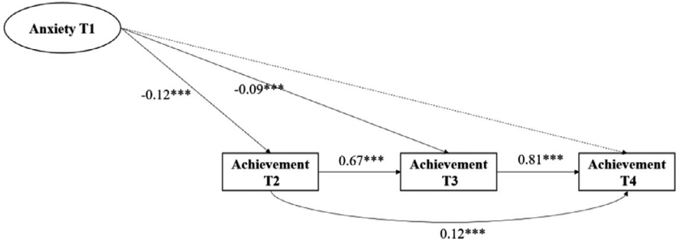
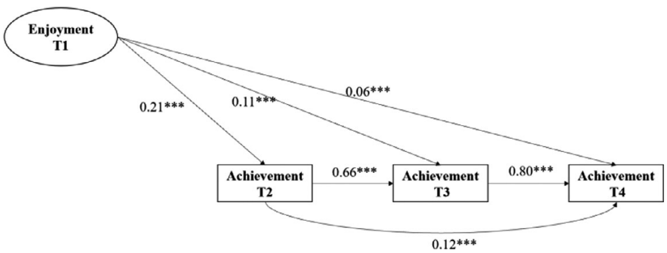
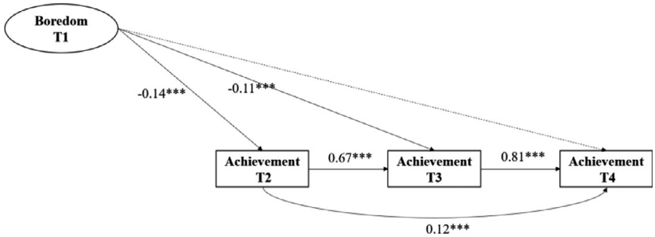
- At Time 1, the three emotions independently predicted later English achievement: anxiety negatively predicted T2 (β = -.12, p < .001) and T3 (β = -.09, p < .001) but not T4; enjoyment positively predicted T2 (β = .21, p < .001), T3 (β = .11, p < .001), and T4 (β = .06, p < .001); boredom negatively predicted T2 (β = -.14, p < .001) and T3 (β = -.11, p < .001) but not T4.
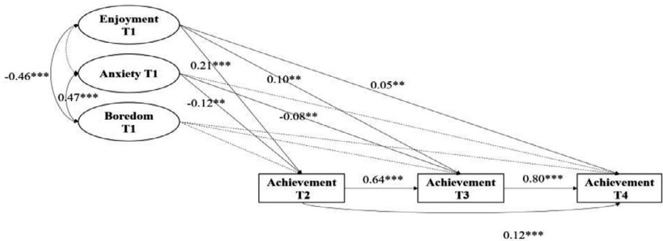
- When the three emotions were modeled together, enjoyment remained the strongest and most enduring predictor: T2 (β = .21, p < .001), T3 (β = .10, p < .01), and T4 (β = .05, p < .01).
- In the joint model, anxiety also predicted achievement negatively at T2 (β = -.12, p < .01) and T3 (β = -.08, p < .01), but not T4; boredom had no significant predictive effect at any later time point.
- The emotions were related to each other in the joint model: enjoyment was negatively related to boredom (β = -.46, p < .001) and boredom was positively related to anxiety (β = .46, p < .001); enjoyment and anxiety were not significantly correlated.
## Methods
- Longitudinal panel design built around the control-value theory, with measurements at four time points over about ten weeks: emotion questionnaire data at T1 and English achievement scores at T2, T3, and T4.
- Sample: 954 junior secondary English learners in one rural school in Anhui Province, China; 358 female and 596 male students, mean age 13 (SD = .81).
- Main analysis: confirmatory factor analysis and structural equation modeling in Mplus 8.3, with autoregressive controls and covariates (age, gender, SES, onset age of English learning).
## Limitations
- The paper states that the panel design with autoregressive controls and covariates “still does not suffice to establish causality.”
- It also states that only three emotions were examined; other L2 emotions may matter, and future research should include them.
- It further states that emotions were measured at one time point, unidirectional effects were tested only, and no reciprocal relations or indirect mechanisms were assessed; the text also makes evident that the sample came from one school in one rural county, which limits generalizability.
Model-written summary. Check it against the paper before relying on it.
Integrity signals
Registry
Cites
Statistics
Figures
Verification
Claims the paper makes
1 Valid · 0 Not valid · 5 Not checked · 69 Own results and interpretations
The cited sources support only part of this claim — read each source’s verdict below.
In the paper
“The results seem to suggest that the patterns between emotions and achievement may vary across different contexts.”
What the sources say
- Partly supportedcites Dewaele and Alfawzan (2018) matched to “Does the effect of enjoyment outweigh that of anxiety in foreign language performance?” (2018) sourceExperimental — accuracy not yet measured
Our copy does carry the two-context comparison the claim rests on, and its numbers differ across contexts: in Study 1 (London pupils) FLE (Rho = .34, p < .0001, r2 = 11.6) and FLCA (Rho = -.30, p < .0001, r2 = 9.0) were both significantly linked to test results (5.1, Results), whereas in Study 2 (Saudi EFL learners) only FLE was significant (Rho = 0.242, p < 0.003, r2 = 5.8) and the FLCA relation failed to reach significance (Rho = -0.145, p = 0.075) (5.2, Results) — echoed in the Conclusion's contrast between 'the significant negative relationship between FLCA and performance in Study 1 and the marginal negative effect in Study 2'. However, the authors' own interpretation runs the other way: the Discussion (6.) calls Study 2 'a similar picture', and the paper sets out to test whether similar patterns would make the relationship 'universal rather than a random effect of the local context' (3./4.1). It also never isolates context as the explanation — Study 1 used self-reported school test results and Study 2 the LexTALE proficiency test, with different ages, languages and a correlational design that 'cannot establish causality' (6.). So the variation in magnitude is in the source, but the attribution of that variation to differing contexts is the citing authors' inference. (LLM, conf=0.70)
- Not matchedcites Li et al. (2020)
This doesn’t read as a citation we can look up.
hedgedstates an associationn = 2- Asserted: passes — The authors put it forward as true.
- Checkable: passes — It can be checked against evidence.
- Load-bearing: passes — The paper’s conclusions depend on it.
- Based: passes — The paper gives a reason why it holds.
- Partly supported
In the paper
“As hypothesized, enjoyment at T1 was significantly and positively associated with FL achievements at T2 -T4, with small-to-medium effect sizes (Plonsky & Oswald, 2014).”
What the sources say
- Not checked — no full text of the sourcecites Plonsky & Oswald, 2014 matched to “How Big Is “Big”? Interpreting Effect Sizes in L2 Research” (2014) source
plainstates an association- Asserted: passes — The authors put it forward as true.
- Checkable: passes — It can be checked against evidence.
- Load-bearing: passes — The paper’s conclusions depend on it.
- Based: passes — The paper gives a reason why it holds.
A result the paper reports from its own data — it cites no other source for it, so there is none to check. The quote shows it is in the paper.
In the paper
“The path from anxiety at T1 to FL achievement at T4 was not statistically significant.”
plain- Asserted: passes — The authors put it forward as true.
- Checkable: passes — It can be checked against evidence.
- Load-bearing: passes — The paper’s conclusions depend on it.
- Based: passes — The paper gives a reason why it holds.
A result the paper reports from its own data — it cites no other source for it, so there is none to check. The quote shows it is in the paper.
In the paper
“The paths from boredom at T1 to FL achievement at T2 ( β = -.14, p < .001), and to FL achievement at T3 ( β = -.11, p < .001)”
plainstates a cause- Asserted: passes — The authors put it forward as true.
- Checkable: passes — It can be checked against evidence.
- Load-bearing: passes — The paper’s conclusions depend on it.
- Based: passes — The paper gives a reason why it holds.
A result the paper reports from its own data — it cites no other source for it, so there is none to check. The quote shows it is in the paper.
In the paper
“The paths from enjoyment at T1 to FL achievement at T2 ( β = .21, p < .001), to FL achievement at T3 ( β = .11, p < .001), and to FL achievement at T4 ( β = .06, p < .001) were all statistically significant.”
plainstates a cause- Asserted: passes — The authors put it forward as true.
- Checkable: passes — It can be checked against evidence.
- Load-bearing: passes — The paper’s conclusions depend on it.
- Based: passes — The paper gives a reason why it holds.
49 more claims
Create a free account to see all 75 claims and to verify the 1 reference still open.
- Probably not a substantial claim. 11
- It may state two separate claims as one. 11
Citations
Cites
Foreign Language Classroom Anxiety
HORWITZ, E. K., HORWITZ, M. B., & COPE, J. (1986) · The Modern Language Journal · doi:10.1111/j.1540-4781.1986.tb05256.x · Cited by 5,697 · cited 4×
“The shortened version consists of eight items that were extracted from the original 33-item FLCAS by Dewaele and MacIntyre (2014).”
BackgroundMethodInfluentialPekrun, R. (2006) · Educational Psychology Review · doi:10.1007/s10648-006-9029-9 · Cited by 5,566 · cited 6×
“(2021a) proposed the construct of foreign language learning boredom (FLLB) and conceptualized it as a three-dimensional achievement emotion following the control-value theory (Pekrun, 2006) that we will turn to later.”
BackgroundMethodInfluentialCurran, P. J., West, S. G., & Finch, J. F. (1996) · Psychological Methods · doi:10.1037/1082-989x.1.1.16 · Cited by 5,512 · cited 1×
“The skewness and kurtosis indicators show that all the observed variables were normally distributed (Curran et al., 1996).”
BackgroundHow Big Is “Big”? Interpreting Effect Sizes in L2 Research
Plonsky, L., & Oswald, F. L. (2014) · Language Learning · doi:10.1111/lang.12079 · Cited by 1,960 · cited 1×
“As hypothesized, enjoyment at T1 was significantly and positively associated with FL achievements at T2–T4, with small-to-medium effect sizes (Plonsky & Oswald, 2014).”
BackgroundThe two faces of Janus? Anxiety and enjoyment in the foreign language classroom
Dewaele, J.-M., & MacIntyre, P. D. (2014) · Studies in Second Language Learning and Teaching · doi:10.14746/ssllt.2014.4.2.5 · Cited by 1,757 · cited 5×
“Supporting the holistic view on an individual’s diverse emotions (Fredrickson, 2003; MacIntyre & Gregersen, 2012), Dewaele and MacIntyre (2014) suggest that FLE is the positive counterpart of FLCA.”
BackgroundMethodInfluentialInternational Handbook of Emotions in Education
(2014) · Routledge eBooks · doi:10.4324/9780203148211 · Cited by 1,579 · cited 1×
“Based on boredom research in general educational contexts (Goetz & Hall, 2014; Tze et al., 2016), Li et al. (2021a) proposed the construct of foreign language learning boredom (FLLB) and conceptualized it as a three-dimensional achievement emotion following the control-value theory (Pekrun, 2006)…”
BackgroundThe Control-Value Theory of Achievement Emotions
Pekrun, R., Frenzel, A. C., Goetz, T., & Perry, R. P. (2007) · Emotion in Education · doi:10.1016/b978-012372545-5/50003-4 · Cited by 1,195
THE EFFECT OF AFFECT ON FOREIGN LANGUAGE LEARNING: A REVIEW OF THE ANXIETY RESEARCH
Scovel, T. (1978) · Language Learning · doi:10.1111/j.1467-1770.1978.tb00309.x · Cited by 1,047 · cited 3×
“Whilst earlier studies argued that some anxieties may have a facilitating effect on performance (Alpert & Haber, 1960; Scovel, 1978), recent studies revealed an overall negative correlation between FLCA and achievement (Botes et al.”
BackgroundAnxiety in academic achievement situations.
Alpert, R., & Haber, R. N. (1960) · The Journal of Abnormal and Social Psychology · doi:10.1037/h0045464 · Cited by 1,045 · cited 1×
“Whilst earlier studies argued that some anxieties may have a facilitating effect on performance (Alpert & Haber, 1960; Scovel, 1978), recent studies revealed an overall negative correlation between FLCA and achievement (Botes et al., 2020; Teimouri et al., 2019; Zhang, 2019).”
The Value of Positive Emotions
Fredrickson, B. (2003) · American Scientist · doi:10.1511/2003.4.330 · Cited by 1,006 · cited 1×
“Supporting the holistic view on an individual’s diverse emotions (Fredrickson, 2003; MacIntyre & Gregersen, 2012), Dewaele and MacIntyre (2014) suggest that FLE is the positive counterpart of FLCA.”
BackgroundEmotions that facilitate language learning: the positive-broadening power of the imagination
MacIntyre, P., & Gregersen, T. (2012) · Studies in Second Language Learning and Teaching · doi:10.14746/ssllt.2012.2.2.4 · Cited by 843 · cited 3×
“The research implication is also obvious: as positive psychologists in SLA argue (Dewaele & Li, 2020; MacIntyre & Gregersen, 2012), a more holistic view on diverse emotions especially positive emotions like FLE should be embraced in future research.”
BackgroundForeign language enjoyment and anxiety: The effect of teacher and learner variables
Dewaele, J.-M., Witney, J., Saito, K., & Dewaele, L. (2018) · Language Teaching Research · doi:10.1177/1362168817692161 · Cited by 780
SECOND LANGUAGE ANXIETY AND ACHIEVEMENT: A META-ANALYSIS
Teimouri, Y., Goetze, J., & Plonsky, L. (2019) · Studies in Second Language Acquisition · doi:10.1017/s0272263118000311 · Cited by 611
Li, C., Jiang, G., & Dewaele, J.-M. (2018) · System · doi:10.1016/j.system.2018.06.004 · Cited by 557 · cited 5×
“Most of the existing FLE studies look at how enjoyment arises (Dewaele et al., 2018; Li et al., 2018), and how it is linked to a multitude of learner-internal factors (e.g., age, onset age of FL learning, relative FL standing, self-perceived FL proficiency, and FL attitude) as well as…”
BackgroundMethodInfluentialSelf-citationInternational handbook of emotions in education
(2014) · Choice Reviews Online · doi:10.5860/choice.185634 · Cited by 533
Dewaele, J.-M., & Li, C. (2021) · Language Teaching Research · doi:10.1177/13621688211014538 · Cited by 532 · cited 1×
“…identified wide-ranging learner-internal factors (e.g., control appraisal, value appraisal, achievement goal, L2 proficiency, and physical state) (Dewaele & Li, 2021; Li 2021b; Li & Dewaele, 2020) and learner-external factors (e.g., task difficulty, teacher personality, classroom atmosphere,…”
Self-citation2. An Overview of Language Anxiety Research and Trends in its Development
MacIntyre, P. D. (2017) · New Insights into Language Anxiety · doi:10.21832/9781783097722-003 · Cited by 477 · cited 1×
“In addition, as MacIntyre (2017) argued, a contextualized approach is required to examine emotions like anxiety.”
BackgroundDoes the effect of enjoyment outweigh that of anxiety in foreign language performance?
Dewaele, J.-M., & Alfawzan, M. (2018) · Studies in Second Language Learning and Teaching · doi:10.14746/ssllt.2018.8.1.2 · Cited by 418 · cited 5×
“Our findings partially confirm the body of prior work in SLA and in general education (Dewaele et al., 2018; Li, 2020; Raccanello et al., 2019).”
BackgroundMethodResultInfluentialEvaluating the Relationship Between Boredom and Academic Outcomes: A Meta-Analysis
Tze, V. M. C., Daniels, L. M., & Klassen, R. M. (2016) · Educational Psychology Review · doi:10.1007/s10648-015-9301-y · Cited by 383 · cited 1×
“Based on boredom research in general educational contexts (Goetz & Hall, 2014; Tze et al., 2016), Li et al.”
BackgroundLi, C. (2020) · Journal of Multilingual and Multicultural Development · doi:10.1080/01434632.2019.1614187 · Cited by 379 · cited 1×
“Our findings partially confirm the body of prior work in SLA and in general education (Dewaele et al., 2018; Li, 2020; Raccanello et al., 2019).”
ResultSelf-citationForeign Language Anxiety and Foreign Language Performance: A Meta‐Analysis
ZHANG, X. (2019) · The Modern Language Journal · doi:10.1111/modl.12590 · Cited by 346 · cited 1×
“Whilst earlier studies argued that some anxieties may have a facilitating effect on performance (Alpert & Haber, 1960; Scovel, 1978), recent studies revealed an overall negative correlation between FLCA and achievement (Botes et al., 2020; Teimouri et al., 2019; Zhang, 2019).”
BackgroundThe Value of Positive Emotions
Fredrickson, B. (2003) · American Scientist · doi:10.1511/2003.26.330 · Cited by 337
Botes, E., Dewaele, J.-M., & Greiff, S. (2020) · Journal for the Psychology of Language Learning · doi:10.52598/jpll/2/1/3 · Cited by 333 · cited 1×
“Whilst earlier studies argued that some anxieties may have a facilitating effect on performance (Alpert & Haber, 1960; Scovel, 1978), recent studies revealed an overall negative correlation between FLCA and achievement (Botes et al., 2020; Teimouri et al., 2019; Zhang, 2019).”
Foreign language learning boredom: Conceptualization and measurement
Li, C., Dewaele, J.-M., & Hu, Y. (2023) · Applied Linguistics Review · doi:10.1515/applirev-2020-0124 · Cited by 323 · cited 8×
“Secondly, our examination of the relations between achievement emotions and FL achievements was limited to FLE, FLCA, and FLLB.”
BackgroundMethodInfluentialSelf-citationBoredom in online classes in the Iranian EFL context: Sources and solutions
Derakhshan, A., Kruk, M., Mehdizadeh, M., & Pawlak, M. (2021) · System · doi:10.1016/j.system.2021.102556 · Cited by 316 · cited 1×
“…2020) and learner-external factors (e.g., task difficulty, teacher personality, classroom atmosphere, teaching style, and class organization) (Derakhshan et al., 2021; Kruk, 2022; Pawlak et al., 2020a) accounting for FLLB. Li et al. (2021a) revealed that FLLB is characterized by various…”
BackgroundThe Effect of Perception of Teacher Characteristics on Spanish EFL Learners’ Anxiety and Enjoyment
DEWAELE, J., MAGDALENA, A. F., & SAITO, K. (2019) · The Modern Language Journal · doi:10.1111/modl.12555 · Cited by 301 · cited 2×
“, teacher style, teacher personality, teacher FL use, and classroom environment) (Dewaele et al., 2019; Li et al., 2021b).”
BackgroundEmotions in Second Language Acquisition: a critical review and research agenda
Dewaele, J., & Li, C. (2020) · BIROn (Birkbeck, University of London) · Cited by 284
Self-citationA Control–Value Theory Approach to Boredom in English Classes Among University Students in China
LI, C. (2021) · The Modern Language Journal · doi:10.1111/modl.12693 · Cited by 280 · cited 4×
“…wide-ranging learner-internal factors (e.g., control appraisal, value appraisal, achievement goal, L2 proficiency, and physical state) (Dewaele & Li, 2021; Li 2021b; Li & Dewaele, 2020) and learner-external factors (e.g., task difficulty, teacher personality, classroom atmosphere, teaching…”
BackgroundInfluentialSelf-citationHorwitz, E. K. (2017) · New Insights into Language Anxiety · doi:10.21832/9781783097722-004 · Cited by 252 · cited 2×
“Horwitz (2017) recently also argued that there is a curvilinear rather than linear relationship between anxiety and achievement.”
BackgroundThe complex relationship between classroom emotions and EFL achievement in China
Li, C., Dewaele, J.-M., & Jiang, G. (2020) · Applied Linguistics Review · doi:10.1515/applirev-2018-0043 · Cited by 251
Self-citationInvestigating factors responsible for boredom in English classes: The case of advanced learners
Pawlak, M., Kruk, M., Zawodniak, J., & Pasikowski, S. (2020) · System · doi:10.1016/j.system.2020.102259 · Cited by 229 · cited 2×
“…(e.g., task difficulty, teacher personality, classroom atmosphere, teaching style, and class organization) (Derakhshan et al., 2021; Kruk, 2022; Pawlak et al., 2020a) accounting for FLLB. Li et al. (2021a) revealed that FLLB is characterized by various negative feelings or/and symptoms (e.g.,…”
BackgroundReciprocal relations between students’ academic enjoyment, boredom, and achievement over time
Putwain, D. W., Becker, S., Symes, W., & Pekrun, R. (2018) · Learning and Instruction · doi:10.1016/j.learninstruc.2017.08.004 · Cited by 228 · cited 1×
“In another four-wave longitudinal study, Putwain et al. (2018) examined the enjoyment and boredom experiences of primary students in England and the data showed that enjoyment was positively linked to mathematics achievement, while boredom was linked negatively.”
BackgroundLi, C., Huang, J., & Li, B. (2021) · System · doi:10.1016/j.system.2020.102393 · Cited by 219 · cited 8×
“Secondly, our examination of the relations between achievement emotions and FL achievements was limited to FLE, FLCA, and FLLB.”
BackgroundMethodInfluentialSelf-citationBuilding human strength: Psychology's forgotten mission: (529932010-003)
Seligman, M. E. P. (1998) · PsycEXTRA Dataset · doi:10.1037/e529932010-003 · Cited by 209 · cited 1×
“This resonates with the positive psychology view: building on human strengths or fostering positive traits to promote competence rather than focusing passively on how to prevent from negative sides (Seligman, 1998).”
BackgroundKruk, M. (2022) · Computer Assisted Language Learning · doi:10.1080/09588221.2019.1677722 · Cited by 199 · cited 2×
“Future research should include out-of-class English learning activities as an important arena for diverse emotional experiences (Kruk, 2022; Kruk & Pawlak, 2022; Li, 2021b) because we are in a digital era where technologyenhanced mobile learning has become increasingly popular especially during the COVID-19 time and i…”
BackgroundContemporary language motivation theory – 60 years since Gardner and Lambert (1959)
Hegedűs, G. (2020) · The Hungarian Educational Research Journal · doi:10.1556/063.2020.00018 · Cited by 162
Enjoyment, Boredom, Anxiety in Elementary Schools in Two Domains: Relations With Achievement
Raccanello, D., Brondino, M., Moè, A., Stupnisky, R., & Lichtenfeld, S. (2019) · The Journal of Experimental Education · doi:10.1080/00220973.2018.1448747 · Cited by 116 · cited 3×
“Our findings partially confirm the body of prior work in SLA and in general education (Dewaele et al., 2018; Li, 2020; Raccanello et al., 2019).”
MethodResultPawlak, M., Kruk, M., & Zawodniak, J. (2022) · Language Teaching Research · doi:10.1177/1362168820914004 · Cited by 102 · cited 2×
“…(e.g., task difficulty, teacher personality, classroom atmosphere, teaching style, and class organization) (Derakhshan et al., 2021; Kruk, 2022; Pawlak et al., 2020a) accounting for FLLB. Li et al. (2021a) revealed that FLLB is characterized by various negative feelings or/and symptoms (e.g.,…”
BackgroundWestphal, A., Kretschmann, J., Gronostaj, A., & Vock, M. (2018) · Learning and Individual Differences · doi:10.1016/j.lindif.2018.01.016 · Cited by 68 · cited 1×
“Westphal et al. (2018), for example, examined enjoyment, anxiety, and boredom experienced inmathematics and Germanas-first-language classes, finding significant negative relationships between enjoyment and the two negative emotions—anxiety and boredom, and a positive relationship between the two…”
BackgroundZhang, X., Hu, B. Y., Ren, L., & Zhang, L. (2019) · Contemporary Educational Psychology · doi:10.1016/j.cedpsych.2019.101792 · Cited by 68 · cited 1×
“Following the procedures in previous studies (e.g., Zhang et al., 2019), the scores of participants’ both parents’ education levels and monthly family income were standardized by transforming them into z-scores.”
Method3. The Emotional Underpinnings of Gardner’s Attitudes and Motivation Test Battery
MacIntyre, P. D., Dewaele, J., Macmillan, N., & Li, C. (2019) · Multilingual Matters eBooks · doi:10.21832/9781788925211-008 · Cited by 68
Self-citationLi, C., & Dewaele, J. (2020) · BIROn (Birkbeck, University of London) · Cited by 54
Self-citationUnderstanding Emotions in English Language Learning in Virtual Worlds
Kruk, M., & Pawlak, M. (2022) · Routledge eBooks · doi:10.4324/9781003240068 · Cited by 46 · cited 1×
“Future research should include out-of-class English learning activities as an important arena for diverse emotional experiences (Kruk, 2022; Kruk & Pawlak, 2022; Li, 2021b) because we are in a digital era where technologyenhanced mobile learning has become increasingly popular especially during the…”
BackgroundSECOND LANGUAGE ANXIETY AND ACHIEVEMENT: A META-ANALYSIS – ERRATUM
Teimouri, Y., Goetze, J., & Plonsky, L. (2019) · Studies in Second Language Acquisition · doi:10.1017/s0272263119000445 · Cited by 39
Understanding Emotions in English Language Learning in Virtual Worlds: Introduction
Kruk, M., & Pawlak, M. (2022) · Understanding Emotions in English Language Learning in Virtual Worlds · doi:10.4324/9781003240068-1
Control-Value Theory of Achievement Emotions
Pekrun, R., & Perry, R. P. (n.d.) · International Handbook of Emotions in Education · doi:10.4324/9780203148211.ch7
Goetz, T., & Hall, N. C. (n.d.) · International Handbook of Emotions in Education · doi:10.4324/9780203148211.ch16
Research works printed but not linked: 2
- Kline, R. B. (2010). Principles and practices of structural equation modeling (3rd ed.). Guilford.
- Li, C. (2021b). Looking back and looking forward: SLA research from a positive psychology perspective over the past decade (2012 -2022). Foreign Language Education , 42 , 57 -63.
Cited by
Dewaele, J.-M., Botes, E., & Greiff, S. (2023) · Studies in Second Language Acquisition · doi:10.1017/s0272263122000328 · Cited by 215
“…(Botes et al., 2020a, 2022; Dewaele et al., 2018; Li, 2020; Piechurska-Kuciel, 2017; Wei et al., 2019) except in Dewaele and Alfawzan (2018) and in Li and Wei (2022) where FLEwas “the strongest andmost enduring predictor” of FL achievement (p. 1) while the negative effect of FLB weakened over…”
BackgroundResultInfluentialDewaele, J.-M., Botes, E., & Meftah, R. (2023) · Annual Review of Applied Linguistics · doi:10.1017/s0267190523000016 · Cited by 207
“Dewaele and MacIntyre (2016) argued that FLE is more than superficial pleasure because it has a cognitive dimension that needs to be engaged for FLE to occur:”
BackgroundResultInfluentialLi, C. (2025) · Language Teaching Research · doi:10.1177/13621688221090324 · Cited by 169
“Such research is vital because boredom permeates different educational contexts and has deleterious effects on SLA (Li & Han, 2022; Li & Wei, 2022).”
Self-citationLi, C., Dewaele, J.-M., Pawlak, M., & Kruk, M. (2025) · Language Teaching Research · doi:10.1177/13621688221111623 · Cited by 163
“The findings are similar to those revealed by Li (2022) and Li and Wei (2022).”
Self-citationDerakhshan, A., & Associate Professor of Applied Linguistics, D. O. E. L. A. L. (2022) · Language Related Research · doi:10.52547/lrr.13.5.2 · Cited by 158
“…skills, engagement, and many more that determine one’s academic success (Derakhshan, 2022b; Derakhshan, 2021; Fan & Wang, 2022; Fathi et al., 2021, Li & Wei, 2022; Liu & Chu, 2022; Seligman, 2011; Shakki, 2022; Teo et al., 2022; Wang, Derakhshan, & Azari Noughabi, 2022; Xie & Derkhshan, 2021;…”
Metadata
- Authors
- Li, C., & Wei, L.
- Affiliations
- Huazhong University of Science and Technology (CN)
- University College London (GB)
- Corresponding author
- Wei, Li
- ORCID
- Venue
- Studies in Second Language Acquisition
- Publisher
- Cambridge University Press (CUP)
- Published
- 2022-03-08
- Volume
- 45
- Issue
- 1
- Pages
- 93-108
- ISSN
- 0272-2631 (ISSN-L)
- 1470-1545
- OpenAlex
- W4220918091
- Cited by
- 317
- References
- 43
- Citations by year
- 2026: 73 · 2025: 91 · 2024: 73 · 2023: 52 · 2022: 28
- FWCI
- 229.58
- Type
- journal article
- Language
- en
- Update notices
- correction (2022-03-08)
- Open access
- hybrid
- doi.org
- Locations
- Studies in Second Language Acquisition (publishedVersion, cc-by)
- UCL Discovery (University College London) (submittedVersion)
- Funders
- The National Social Science Fund of China (19CYY017)
- Topics
- Social Sciences › Arts and Humanities › Language and Linguistics › EFL/ESL Teaching and Learning
- Social Sciences › Psychology › Developmental and Educational Psychology › Education, Achievement, and Giftedness
- Social Sciences › Psychology › Developmental and Educational Psychology › Second Language Acquisition and Learning
- Keywords
- anxiety, enjoyment, boredom, second language achievement, English as a foreign language, junior high school students, control-value theory
About these checks
Registry, retraction, Cites and statistics results are computed, not judged, with one exception: a printed reference that no index lists is read once by a model before it counts as a citation error. Claims are extracted by a model and kept only when their quote appears verbatim in the text; each cited source is then checked, with a model’s help, for whether it says what the claim relies on. Those verdicts can be wrong — read the claim’s quote and the cited source before relying on one.
The claim verdicts this report counts are experimental: their accuracy is not yet measured.
A language model drew the claims from the paper on 2026-10-10, under version 3 of the claim definition (model deepseek-v4.1-flash, prompt extract-v3).
A second model labelled each claim on 2026-10-10 (model jev-1.13-20260917, definition revision gold-guideline-v0.2).
Cited sources are checked with a language model’s help (qwen3.8-omni-flash).
Statistics and arithmetic are recomputed, not judged.
Confidence bands are shown only for fields calibrated on our annotated test set. None is calibrated yet, so no band is shown.
What counts as a claim ›How we measure confidence ›How we check this ›
Are you an author, or do you see a problem with this page? Request a review
Data sources
Bibliographic data: Semantic Scholar, OpenAlex, Crossref.
Contains information from the Semantic Scholar Academic Graph Datasets, made available under the ODC Attribution License (ODC-BY 1.0).
Semantic Scholar’s data is described in: Kinney, R., et al. (2023). The Semantic Scholar Open Data Platform. arXiv:2301.10140.
