

Anxiety, enjoyment, and boredom in language learning amongst junior secondary students in rural China: How do they contribute to L2 achievement?
Open accessThe DOI matches its Crossref record; 47 of the 47 references it cites were found in a registry or an index; 1 of the 9 sources its claims cite were checked for support.
Abstract
Abstract Building on the control-value theory, the present study examined the independent and joint predictive effects of three emotions—enjoyment, anxiety, and boredom—on L2 achievement over time. The participants of the study were a group of junior secondary English learners in rural China, a population that has hitherto never featured in L2 learning research. Questionnaire data and achievement data were collected at four different time points (Time 1–Time 4: T1–T4) from a large sample of 954 learners. Structural equation modeling results show that: (a) the three emotions at T1 predicted English achievement at T2 (one week after T1) and T3 (five weeks after T1) independently, while only enjoyment predicted achievement at T4 (nine weeks after T1); (b) when combined, enjoyment was the strongest and most enduring predictor across T2–T4, followed by anxiety predicting achievement at T2–T3 negatively, while boredom completely lost its predictive power across T2–T4.
Overview
CoChat Summary
## TL;DR
This longitudinal study of 954 junior secondary EFL learners in rural China examined how anxiety, enjoyment, and boredom predicted English achievement over four time points. Enjoyment was the most durable predictor; anxiety and boredom predicted achievement earlier but lost predictive power over time.
## Key findings
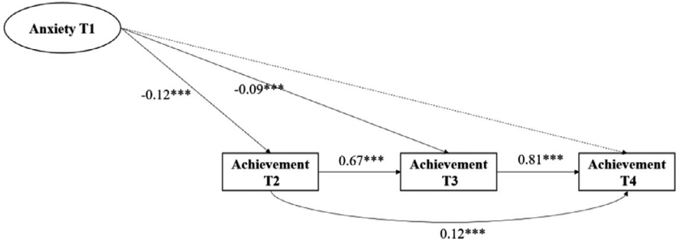
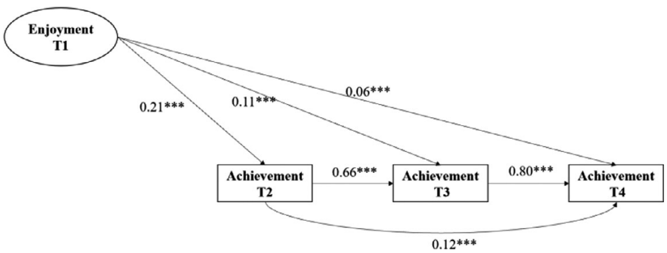
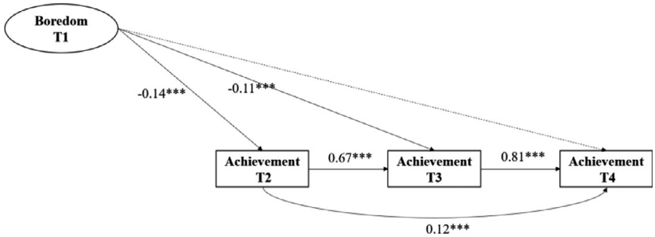
- At Time 1, the three emotions independently predicted later English achievement: anxiety negatively predicted T2 (β = -.12, p < .001) and T3 (β = -.09, p < .001) but not T4; enjoyment positively predicted T2 (β = .21, p < .001), T3 (β = .11, p < .001), and T4 (β = .06, p < .001); boredom negatively predicted T2 (β = -.14, p < .001) and T3 (β = -.11, p < .001) but not T4.
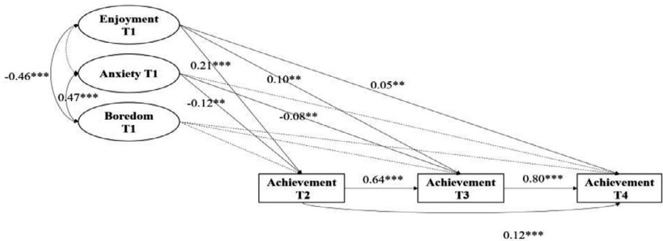
- When the three emotions were modeled together, enjoyment remained the strongest and most enduring predictor: T2 (β = .21, p < .001), T3 (β = .10, p < .01), and T4 (β = .05, p < .01).
- In the joint model, anxiety also predicted achievement negatively at T2 (β = -.12, p < .01) and T3 (β = -.08, p < .01), but not T4; boredom had no significant predictive effect at any later time point.
- The emotions were related to each other in the joint model: enjoyment was negatively related to boredom (β = -.46, p < .001) and boredom was positively related to anxiety (β = .46, p < .001); enjoyment and anxiety were not significantly correlated.
## Methods
- Longitudinal panel design built around the control-value theory, with measurements at four time points over about ten weeks: emotion questionnaire data at T1 and English achievement scores at T2, T3, and T4.
- Sample: 954 junior secondary English learners in one rural school in Anhui Province, China; 358 female and 596 male students, mean age 13 (SD = .81).
- Main analysis: confirmatory factor analysis and structural equation modeling in Mplus 8.3, with autoregressive controls and covariates (age, gender, SES, onset age of English learning).
## Limitations
- The paper states that the panel design with autoregressive controls and covariates “still does not suffice to establish causality.”
- It also states that only three emotions were examined; other L2 emotions may matter, and future research should include them.
- It further states that emotions were measured at one time point, unidirectional effects were tested only, and no reciprocal relations or indirect mechanisms were assessed; the text also makes evident that the sample came from one school in one rural county, which limits generalizability.
Model-written summary. Check it against the paper before relying on it.
Integrity signals
Registry
Cites
Statistics
Figures
Verification
Claims the paper makes
1 Valid · 0 Not valid · 5 Not checked · 69 Own results and interpretations
The cited sources support only part of this claim — read each source’s verdict below.
In the paper
“The results seem to suggest that the patterns between emotions and achievement may vary across different contexts.”
What the sources say
- Partly supportedcites Dewaele and Alfawzan (2018) matched to “Does the effect of enjoyment outweigh that of anxiety in foreign language performance?” (2018) sourceExperimental — accuracy not yet measured
Our copy does carry the two-context comparison the claim rests on, and its numbers differ across contexts: in Study 1 (London pupils) FLE (Rho = .34, p < .0001, r2 = 11.6) and FLCA (Rho = -.30, p < .0001, r2 = 9.0) were both significantly linked to test results (5.1, Results), whereas in Study 2 (Saudi EFL learners) only FLE was significant (Rho = 0.242, p < 0.003, r2 = 5.8) and the FLCA relation failed to reach significance (Rho = -0.145, p = 0.075) (5.2, Results) — echoed in the Conclusion's contrast between 'the significant negative relationship between FLCA and performance in Study 1 and the marginal negative effect in Study 2'. However, the authors' own interpretation runs the other way: the Discussion (6.) calls Study 2 'a similar picture', and the paper sets out to test whether similar patterns would make the relationship 'universal rather than a random effect of the local context' (3./4.1). It also never isolates context as the explanation — Study 1 used self-reported school test results and Study 2 the LexTALE proficiency test, with different ages, languages and a correlational design that 'cannot establish causality' (6.). So the variation in magnitude is in the source, but the attribution of that variation to differing contexts is the citing authors' inference. (LLM, conf=0.70)
- Not matchedcites Li et al. (2020)
This doesn’t read as a citation we can look up.
hedgedstates an associationn = 2- Asserted: passes — The authors put it forward as true.
- Checkable: passes — It can be checked against evidence.
- Load-bearing: passes — The paper’s conclusions depend on it.
- Based: passes — The paper gives a reason why it holds.
- Partly supported
In the paper
“As hypothesized, enjoyment at T1 was significantly and positively associated with FL achievements at T2 -T4, with small-to-medium effect sizes (Plonsky & Oswald, 2014).”
What the sources say
- Not checked — no full text of the sourcecites Plonsky & Oswald, 2014 matched to “How Big Is “Big”? Interpreting Effect Sizes in L2 Research” (2014) source
plainstates an association- Asserted: passes — The authors put it forward as true.
- Checkable: passes — It can be checked against evidence.
- Load-bearing: passes — The paper’s conclusions depend on it.
- Based: passes — The paper gives a reason why it holds.
A result the paper reports from its own data — it cites no other source for it, so there is none to check. The quote shows it is in the paper.
In the paper
“The path from anxiety at T1 to FL achievement at T4 was not statistically significant.”
plain- Asserted: passes — The authors put it forward as true.
- Checkable: passes — It can be checked against evidence.
- Load-bearing: passes — The paper’s conclusions depend on it.
- Based: passes — The paper gives a reason why it holds.
A result the paper reports from its own data — it cites no other source for it, so there is none to check. The quote shows it is in the paper.
In the paper
“The paths from boredom at T1 to FL achievement at T2 ( β = -.14, p < .001), and to FL achievement at T3 ( β = -.11, p < .001)”
plainstates a cause- Asserted: passes — The authors put it forward as true.
- Checkable: passes — It can be checked against evidence.
- Load-bearing: passes — The paper’s conclusions depend on it.
- Based: passes — The paper gives a reason why it holds.
A result the paper reports from its own data — it cites no other source for it, so there is none to check. The quote shows it is in the paper.
In the paper
“The paths from enjoyment at T1 to FL achievement at T2 ( β = .21, p < .001), to FL achievement at T3 ( β = .11, p < .001), and to FL achievement at T4 ( β = .06, p < .001) were all statistically significant.”
plainstates a cause- Asserted: passes — The authors put it forward as true.
- Checkable: passes — It can be checked against evidence.
- Load-bearing: passes — The paper’s conclusions depend on it.
- Based: passes — The paper gives a reason why it holds.
49 more claims
Create a free account to see all 75 claims and to verify the 1 reference still open.
- Probably not a substantial claim. 11
- It may state two separate claims as one. 11
Claims other papers make about this one
Each is checked against this paper’s own text: does it say what the citing paper says it does?
In the citing paper
“Structural equation modeling revealed that these emotions independently showed associations with English achievement at T2 (one week later) and T3 (five weeks later).However, only FLE was significantly associated with achievement at T4 (nine weeks later), while the significant associations between FLCA and acquisition disappeared at the end of the project.”
From Disentangling the causal role of motivation, enjoyment, and anxiety in second language speech learning: A final report (2025) · cites this paper as Li and Wei, 2023
In the citing paper
“Consequently, FLE appears to predict the extent to which L2 learning occurs (Dewaele et al., 2024;Li & Wei, 2023;Saito et al., 2018).”
From Disentangling the causal role of motivation, enjoyment, and anxiety in second language speech learning: A final report (2025) · cites this paper as Li & Wei, 2023
Citations
Cites
Foreign Language Classroom Anxiety
HORWITZ, E. K., HORWITZ, M. B., & COPE, J. (1986) · The Modern Language Journal · doi:10.1111/j.1540-4781.1986.tb05256.x · Cited by 9,773 · cited 4×
“The shortened version consists of eight items that were extracted from the original 33-item FLCAS by Dewaele and MacIntyre (2014).”
BackgroundMethodInfluentialPekrun, R. (2006) · Educational Psychology Review · doi:10.1007/s10648-006-9029-9 · Cited by 7,823 · cited 6×
“(2021a) proposed the construct of foreign language learning boredom (FLLB) and conceptualized it as a three-dimensional achievement emotion following the control-value theory (Pekrun, 2006) that we will turn to later.”
BackgroundMethodInfluentialCurran, P. J., West, S. G., & Finch, J. F. (1996) · Psychological Methods · doi:10.1037/1082-989x.1.1.16 · Cited by 5,512 · cited 1×
“The skewness and kurtosis indicators show that all the observed variables were normally distributed (Curran et al., 1996).”
BackgroundHow Big Is “Big”? Interpreting Effect Sizes in L2 Research
Plonsky, L., & Oswald, F. L. (2014) · Language Learning · doi:10.1111/lang.12079 · Cited by 1,960 · cited 1×
“As hypothesized, enjoyment at T1 was significantly and positively associated with FL achievements at T2–T4, with small-to-medium effect sizes (Plonsky & Oswald, 2014).”
BackgroundThe two faces of Janus? Anxiety and enjoyment in the foreign language classroom
Dewaele, J.-M., & MacIntyre, P. D. (2014) · Studies in Second Language Learning and Teaching · doi:10.14746/ssllt.2014.4.2.5 · Cited by 1,757 · cited 5×
“Supporting the holistic view on an individual’s diverse emotions (Fredrickson, 2003; MacIntyre & Gregersen, 2012), Dewaele and MacIntyre (2014) suggest that FLE is the positive counterpart of FLCA.”
BackgroundMethodInfluentialInternational Handbook of Emotions in Education
(2014) · Routledge eBooks · doi:10.4324/9780203148211 · Cited by 1,579 · cited 1×
“Based on boredom research in general educational contexts (Goetz & Hall, 2014; Tze et al., 2016), Li et al. (2021a) proposed the construct of foreign language learning boredom (FLLB) and conceptualized it as a three-dimensional achievement emotion following the control-value theory (Pekrun, 2006)…”
BackgroundThe Control-Value Theory of Achievement Emotions
Pekrun, R., Frenzel, A. C., Goetz, T., & Perry, R. P. (2007) · Emotion in Education · doi:10.1016/b978-012372545-5/50003-4 · Cited by 1,195
THE EFFECT OF AFFECT ON FOREIGN LANGUAGE LEARNING: A REVIEW OF THE ANXIETY RESEARCH
Scovel, T. (1978) · Language Learning · doi:10.1111/j.1467-1770.1978.tb00309.x · Cited by 1,047 · cited 3×
“Whilst earlier studies argued that some anxieties may have a facilitating effect on performance (Alpert & Haber, 1960; Scovel, 1978), recent studies revealed an overall negative correlation between FLCA and achievement (Botes et al.”
BackgroundAnxiety in academic achievement situations.
Alpert, R., & Haber, R. N. (1960) · The Journal of Abnormal and Social Psychology · doi:10.1037/h0045464 · Cited by 1,045 · cited 1×
“Whilst earlier studies argued that some anxieties may have a facilitating effect on performance (Alpert & Haber, 1960; Scovel, 1978), recent studies revealed an overall negative correlation between FLCA and achievement (Botes et al., 2020; Teimouri et al., 2019; Zhang, 2019).”
The Value of Positive Emotions
Fredrickson, B. (2003) · American Scientist · doi:10.1511/2003.4.330 · Cited by 1,006 · cited 1×
“Supporting the holistic view on an individual’s diverse emotions (Fredrickson, 2003; MacIntyre & Gregersen, 2012), Dewaele and MacIntyre (2014) suggest that FLE is the positive counterpart of FLCA.”
Background
Research works printed but not linked: 2
- Kline, R. B. (2010). Principles and practices of structural equation modeling (3rd ed.). Guilford.
- Li, C. (2021b). Looking back and looking forward: SLA research from a positive psychology perspective over the past decade (2012 -2022). Foreign Language Education , 42 , 57 -63.
Cited by
Dewaele, J.-M., Botes, E., & Greiff, S. (2023) · Studies in Second Language Acquisition · doi:10.1017/s0272263122000328 · Cited by 215
“…(Botes et al., 2020a, 2022; Dewaele et al., 2018; Li, 2020; Piechurska-Kuciel, 2017; Wei et al., 2019) except in Dewaele and Alfawzan (2018) and in Li and Wei (2022) where FLEwas “the strongest andmost enduring predictor” of FL achievement (p. 1) while the negative effect of FLB weakened over…”
BackgroundResultInfluentialDewaele, J.-M., Botes, E., & Meftah, R. (2023) · Annual Review of Applied Linguistics · doi:10.1017/s0267190523000016 · Cited by 207
“Dewaele and MacIntyre (2016) argued that FLE is more than superficial pleasure because it has a cognitive dimension that needs to be engaged for FLE to occur:”
BackgroundResultInfluentialLi, C. (2025) · Language Teaching Research · doi:10.1177/13621688221090324 · Cited by 169
“Such research is vital because boredom permeates different educational contexts and has deleterious effects on SLA (Li & Han, 2022; Li & Wei, 2022).”
Self-citationLi, C., Dewaele, J.-M., Pawlak, M., & Kruk, M. (2025) · Language Teaching Research · doi:10.1177/13621688221111623 · Cited by 163
“The findings are similar to those revealed by Li (2022) and Li and Wei (2022).”
Self-citationDerakhshan, A., & Associate Professor of Applied Linguistics, D. O. E. L. A. L. (2022) · Language Related Research · doi:10.52547/lrr.13.5.2 · Cited by 158
“…skills, engagement, and many more that determine one’s academic success (Derakhshan, 2022b; Derakhshan, 2021; Fan & Wang, 2022; Fathi et al., 2021, Li & Wei, 2022; Liu & Chu, 2022; Seligman, 2011; Shakki, 2022; Teo et al., 2022; Wang, Derakhshan, & Azari Noughabi, 2022; Xie & Derkhshan, 2021;…”
Tsang, A., & Dewaele, J. M. (2024) · Applied Linguistics Review · doi:10.1515/applirev-2022-0077 · Cited by 127
Solhi, M., Derakhshan, A., & ÜNSAL-GÖRKEMOĞLU, B. (2023) · Journal of Multilingual and Multicultural Development · doi:10.1080/01434632.2023.2175834 · Cited by 143
“Research has presented important findings about the nature of the phenomenon, sources of bore-dom as well as coping strategies (e.g. Derakhshan, Fathi, et al. 2022; Kruk 2016; Kruk, Pawlak, and Zawodniak 2021; Li and Wei 2022; Pawlak et al. 2020; Wang 2023).”
Derakhshan, A., Wang, Y., & Ghiasvand, F. (2024) · Applied Linguistics Review · doi:10.1515/applirev-2023-0089 · Cited by 111
Yanlin, Z., & Yang, L. (2022) · Frontiers in Psychology · doi:10.3389/fpsyg.2022.987554 · Cited by 153
“However, up to now, there is a paucity of empirical research using large-scale quantitative designs to investigate the relationship between boredom and other individual and contextual variables (Li, 2022).”
BackgroundResultInfluentialChatGPT: The catalyst for teacher-student rapport and grit development in L2 class
Ghafouri, M. (2024) · System · doi:10.1016/j.system.2023.103209 · Cited by 98
Wang, M., & Wang, Y. (2024) · Learning and Motivation · doi:10.1016/j.lmot.2024.101981 · Cited by 100
Li, S., Wu, H., & Wang, Y. (2024) · Acta Psychologica · doi:10.1016/j.actpsy.2024.104143 · Cited by 97
Lee, J. S., Yeung, N. M., & Osburn, M. B. (2022) · Journal of Multilingual and Multicultural Development · doi:10.1080/01434632.2022.2112587 · Cited by 98
“IDLE learners often practice English in a low affective filter environment due to the absence of teachers and classmates, both of whom are regarded as major sources of language anxiety (Kiaer, Morga-Brown, and Choi 2021; Li and Dewaele 2021; Li and Wei 2022).”
Fathi, J., & Hejazi, S. Y. (2023) · Current Psychology · doi:10.1007/s12144-023-05187-8 · Cited by 94
“Furthermore, empirical findings stress the mediating role of FLE in linking various L2 motivational factors with different L2 learning outcomes (Li & Wei, 2022; Tahmouresi & Papi, 2021).”
Wang, H., Wang, Y., & Li, S. (2023) · Frontiers in Psychology · doi:10.3389/fpsyg.2023.1098916 · Cited by 102
“L2 engagement was measured from four dimensions through 16 items adapted from Li and Li (2022) questionnaire which was constructed based on the scales developed by Hiver et al.”
MethodAnalyzing Likert scale surveys with Rasch models
Yamashita, T. (2022) · Research Methods in Applied Linguistics · doi:10.1016/j.rmal.2022.100022 · Cited by 128
Li, C., Feng, E., Zhao, X., & Dewaele, J. (2024) · Studies in Second Language Acquisition · doi:10.1017/s0272263124000366 · Cited by 75
“…empirical studies have explored the links between FLLB and L2 achievement (commonly operationalized as scores in curriculum-based language course exams such as midterm/end-term exams) or self-perceived L2 proficiency in diverse L2 contexts (e.g., Li & Li, 2023; Liu & Wang, 2023; Zhao & Wang, 2023).”
InfluentialSelf-citationDong, L., Liu, M., & Yang, F. (2022) · Frontiers in Psychology · doi:10.3389/fpsyg.2022.860603 · Cited by 97
“…for clearer construct purposes (Dewaele and MacIntyre, 2016) and validations, and has been applied in varying FL learning contexts, such as in Germany (Resnik and Dewaele, 2021), Iran (Elahi Shirvan and Taherian, 2021), and China (Li et al., 2018; Jiang and Dewaele, 2019; Dewaele and Li, 2022).”
BackgroundResultInfluentialWang, H., Xu, L., & Li, J. (2023) · Frontiers in Psychology · doi:10.3389/fpsyg.2023.1054657 · Cited by 97
“…of positive emotions, such as love (Pavelescu and Petrić, 2018), grit (Wei et al., 2020), and the most frequently discussed enjoyment (e.g., Dewaele and MacIntyre, 2014, 2016; Dewaele and Alfawzan, 2018; Jiang and Dewaele, 2019; Dewaele and Li, 2021; Tahmouresi and Papi, 2021; Li and Wei, 2022).”
BackgroundResultWang, X. (2022) · Frontiers in Psychology · doi:10.3389/fpsyg.2022.914682 · Cited by 84
Zhao, X., & Wang, D. (2023) · Journal of Multilingual and Multicultural Development · doi:10.1080/01434632.2023.2194872 · Cited by 69
“This study provides further evidence to confirm that FLE and FLLB are twins with adverse natures in the L2 learning process, which corroborates earlier findings of Dewaele and Li (2021), Li and Han (2022), Li and Wei (2022), and Zhao and Wang (2023).”
InfluentialThe merit of grit and emotions in L2 Chinese online language achievement: a case of Arabian students
Zhao, X., Sun, P. P., & Gong, M. (2023) · International Journal of Multilingualism · doi:10.1080/14790718.2023.2202403 · Cited by 63
“Although positive and negative emotions play vital roles in L2 English attainment, how emotions contribute to learning success may vary across contexts, cultural backgrounds, educational experiences, and linguistic variations (Li & Wei, 2022).”
InfluentialAchievement emotions and control-value appraisals in foreign language learning
Li, C., Pawlak, M., & Kruk, M. (2023) · Journal of Multilingual and Multicultural Development · doi:10.1080/01434632.2023.2183961 · Cited by 76
“Following the three-dimension taxonomy of CVT, based on interview and open-ended questionnaire data from non-English majors in China, Li, Dewaele, and Hu (2022) described foreign language learning boredom (FLLB) as a multi-dimensional construct with (1) negative valence, (2) a low degree of activation/arousal, and (3)…”
InfluentialSelf-citationSolhi, M., Derakhshan, A., Pawlak, M., & ÜNSAL-GÖRKEMOĞLU, B. (2024) · Language Teaching Research · doi:10.1177/13621688241239178 · Cited by 67
“Given the fact that the debilitating effects of L2 boredom on academic achievement have been confirmed by various studies (e.g. Li & Wei, 2023; Mousavian Rad et al., 2022; Wang & Li, 2022), identifying the antecedents of L2WB would be insightful in understanding and diagnosing practices that are…”
Language attitudes: construct, measurement, and associations with language achievements
Li, C., & Wei, L. (2022) · Journal of Multilingual and Multicultural Development · doi:10.1080/01434632.2022.2137516 · Cited by 101
“…(1971) also pointed out that language attitude is linked to motivation (instrumental or integrative) and emotion (positive or negative), both of which have been evidenced as signi fi cant factors of language achievement (Botes, Dewaele, and Grei ff 2020; Li and Wei 2022; Mas-goret and Gardner 2003).”
Self-citationJin, Y. (2024) · Learning and Motivation · doi:10.1016/j.lmot.2024.101960 · Cited by 69
Taherian, T., Shirvan, M. E., Yazdanmehr, E., Kruk, M., & Pawlak, M. (2023) · The Asia-Pacific Education Researcher · doi:10.1007/s40299-023-00751-z · Cited by 80
“Secondly, learners in classroom contexts with IDLE-rich activities could learn and practice English in an environment conducive to lowering the affective filter (less monotony, boredom and anxiety) (Kiaer et al., 2021; Kruk, 2022; Li & Dewaele, 2021; Li & Wei, 2022).”
Dewaele, J., Guedat‐Bittighoffer, D., & Dat, M. (2024) · International Journal of Applied Linguistics · doi:10.1111/ijal.12607 · Cited by 73
Li, C. (2024) · Studies in Second Language Learning and Teaching · doi:10.14746/ssllt.43371 · Cited by 62
Self-citationWang, C., Li, X., & Zou, B. (2025) · European Journal of Education · doi:10.1111/ejed.70054 · Cited by 65
Yao, Y., Zhu, X., & Zhan, J. (2024) · Assessing Writing · doi:10.1016/j.asw.2024.100832 · Cited by 54
Learner-internal and learner-external factors for boredom amongst Chinese university EFL students
Li, C., & Han, Y. (2022) · Applied Linguistics Review · doi:10.1515/applirev-2021-0159 · Cited by 54
Self-citationDomain-Specific L2 Grit, Anxiety, Boredom, and Enjoyment in Online Chinese Learning
Zhao, X., & Wang, D. (2023) · The Asia-Pacific Education Researcher · doi:10.1007/s40299-023-00777-3 · Cited by 66
“That is, FLE can be defined as a positive, activating, and activity-related emotion, FLA as a negative, deactivating, and out-come-related emotion, and FLLB as a negative, deactivating, and activity-related emotion (Li & Li, 2023).”
InfluentialSaito, K., Dewaele, J.-M., In’nami, Y., & Abe, M. (2025) · Studies in Second Language Acquisition · doi:10.1017/s0272263125000038 · Cited by 43
“…and cooperation; Li, Huang et al., 2021), teaching methods (e.g., more communicative vs. traditional/language – focused methods; Dewaele et al., 2024), teacher characteristics (e.g., the use of humor; Dewaele et al., 2022), and long – term development behaviors (Li & Wei, 2023; Saito et al., 2018).”
InfluentialWang, X., & Hui, L. (2024) · System · doi:10.1016/j.system.2024.103418 · Cited by 58
Tsang, A., & Lee, J. S. (2023) · System · doi:10.1016/j.system.2023.103047 · Cited by 55
Derakhshan, A., & Fathi, J. (2025) · Innovation in Language Learning and Teaching · doi:10.1080/17501229.2025.2487932 · Cited by 44
“While previous research has explored the effects of boredom and perceived teacher support on L2 learning outcomes (e.g. Li and Wei 2023; Luo and Derakhshan 2024), the interplay between these variables remains complex and under-explored.”
InfluentialThe predictive role of anxiety and motivation in L2 proficiency: An empirical causal model
Alrabai, F. (2022) · Language Teaching Research · doi:10.1177/13621688221136247 · Cited by 50
“…in the present study between anxiety and L2 proficiency is well recognized in L2 literature (e.g. Dewaele & Alfawzan, 2018; Horwitz, 2001; Li & Wei, 2022; Li et al., 2020; MacIntyre, 1999; Sparks et al., 2018, 2019; Teimouri et al., 2019; Zhang, 2019) and so are the positive associations…”
InfluentialZhao, X., Lan, G., & Chen, T. (2023) · Language Teaching Research · doi:10.1177/13621688231180465 · Cited by 43
“Its appearance is indubitably accompanied by aversion indications (e.g. disengagement, dragging, distracting, and daydreaming), leading to unsatisfactory learning attainments (Li & Wei, 2023; Li et al., 2023).”
Jin, Y., MacIntyre, P. D., Jiang, N., & Ren, J. (2023) · Journal of Multilingual and Multicultural Development · doi:10.1080/01434632.2023.2221676 · Cited by 42
“It has been shown to be related to a growing number of learning contexts, and promote desire of learning (Alrabai 2022; Dewaele 2019), perseverance of effort (Khajavy and Aghaee 2022) and performance (Li and Li 2023).”
Solhi, M. (2024) · Journal of Psycholinguistic Research · doi:10.1007/s10936-024-10071-y · Cited by 71
“…these two affective orientations have been acknowledged to be closely associated with FLA (Dewaele et al., 2023; El Deen, 2023; Gao & Liu, 2022; Li & Wei, 2023), investigating the interplay between these emotional dispositions can contribute to a deeper understanding of the factors that…”
BackgroundWang, H., Patterson, M. M., & Peng, A. (2024) · Language Teaching Research · doi:10.1177/13621688241237214 · Cited by 45
“Another negative emotion experienced by L2 learners is boredom (Kruk et al., 2022; Li & Wei, 2023; Pawlak et al., 2021).”
Zhang, Q., Song, Y., & Zhao, C. (2024) · System · doi:10.1016/j.system.2024.103346 · Cited by 60
Self-guides, enjoyment, gender, and achievement: a survey of Chinese EFL high school students
Liu, E., Wang, J., & Bai, S. (2022) · Journal of Multilingual and Multicultural Development · doi:10.1080/01434632.2022.2153854 · Cited by 38
“…willingness to communicate, and language performance (e.g. Dewaele and Alfawzan 2018; Dewaele and MacIntyre 2014; Elahi Shirvan et al. 2021; Lee, Xie, and Lee 2021; Li 2019; Li, Huang, and Li 2021; Li and Wei 2022; Liu and Wang 2021; Teimouri, Plonsky, and Tabandeh 2020; Zhang, Dai, and Wang 2020).”
The role of learner character strengths and classroom emotions in L2 resilience
Alrabai, F., & Alamer, A. (2022) · Frontiers in Psychology · doi:10.3389/fpsyg.2022.956216 · Cited by 39
“…anxiety as recognized by a vast line of L2 research (Dewaele and MacIntyre, 2014, 2016; Dewaele and Dewaele, 2017; Khajavy et al., 2018; Li et al., 2018; Jiang and Dewaele, 2019; Li and Xu, 2019; Elahi et al., 2021) and boredom (Dewaele et al., 2018; Dewaele and Li, 2022; Li and Wei, 2022).”
BackgroundDerakhshan, A., Zhang, L. J., & Zhaleh, K. (2023) · Studies in Second Language Learning and Teaching · doi:10.14746/ssllt.31733 · Cited by 53
Zhu, X., Zhan, J., & Yao, Y. (2022) · IRAL - International Review of Applied Linguistics in Language Teaching · doi:10.1515/iral-2022-0105 · Cited by 41
Liu, Q., & Zhou, W. (2024) · Acta Psychologica · doi:10.1016/j.actpsy.2024.104504 · Cited by 64
Zhao, X., & Wang, D. (2024) · International Journal of Applied Linguistics · doi:10.1111/ijal.12680 · Cited by 49
Jie, Z., & Yan, Y. (2025) · Learning and Motivation · doi:10.1016/j.lmot.2025.102185 · Cited by 33
Noughabi, M. A., Yang, S., Botes, E., & Dewaele, J. (2024) · Language Teaching Research · doi:10.1177/13621688241250364 · Cited by 42
“Since positive psychology in SLA also addresses language teachers’ flourishing in their professional undertakings (Dewaele et al., 2019), it is then essential to explore how FLTE contributes to teachers’ work engagement and well-being.”
Kruk, M., Pawlak, M., Shirvan, M. E., & Soleimanzadeh, S. (2022) · Research Methods in Applied Linguistics · doi:10.1016/j.rmal.2022.100038 · Cited by 30
Dewaele, J., & Meftah, R. (2023) · Journal of the European Second Language Association · doi:10.22599/jesla.94 · Cited by 38
Boredom and achievement in L2 learning: a meta-analysis
Li, C., Feng, E., & Li, S. (2025) · Applied Linguistics Review · doi:10.1515/applirev-2024-0266 · Cited by 43
“” A proliferation of studies have explored the relationship between general boredom (e.g., foreign language learning boredom) and L2 achievement (Li et al. 2023a; Li et al. 2024a; Li and Wei 2023).”
InfluentialSelf-citationCsizér, K., & Albert, Á. (2024) · The Asia-Pacific Education Researcher · doi:10.1007/s40299-023-00808-z · Cited by 42
“…is important to enhance our theoretical knowledge of language learning processes, and although such studies already exist (Dewaele et al., 2022a; Li & Wei, 2022; Shao et al., 2020), ours is novel since it measures a wider array of emotions than what is usually found in earlier research…”
Wang, Y., Liu, W., & Li, S. (2026) · Journal of Multilingual and Multicultural Development · doi:10.1080/01434632.2026.2679605 · Cited by 55
Antecedents and effects of students’ enjoyment and boredom in synchronous online English courses
Apridayani, A., & Waluyo, B. (2022) · Journal of Multilingual and Multicultural Development · doi:10.1080/01434632.2022.2152457 · Cited by 39
Liu, E., & Wang, J. (2023) · International Journal of Multilingualism · doi:10.1080/14790718.2023.2177653 · Cited by 41
“A few existing studies have con fi rmed the adverse e ff ects of FLB on language learning such as willingness to communicate (Zhang et al., 2022), engagement (Dewaele & Li, 2021), and achievement (Li & Wei, 2022).”
InfluentialMa, L., Liu, L., Luo, S., & Liu, J. (2023) · Journal of Multilingual and Multicultural Development · doi:10.1080/01434632.2023.2298691 · Cited by 35
What can multi-factors contribute to Chinese EFL learners’ implicit L2 knowledge?
Zhang, R., & Chen, Y. (2024) · IRAL - International Review of Applied Linguistics in Language Teaching · doi:10.1515/iral-2024-0021 · Cited by 28
“Although the control-value theory concerns the conceptual integration of cognition, motivation, and emotion, a vast array of studies has been limited to the study of emotions (e.g., Li and Li 2023).”
Peng, J., & MacIntyre, P. D. (2025) · Learning and Individual Differences · doi:10.1016/j.lindif.2025.102638 · Cited by 37
Xu, J. H., & Liu, Q. (2025) · Learning and Motivation · doi:10.1016/j.lmot.2025.102100 · Cited by 48
Dewaele, J., & Botes, E. (2025) · International Journal of Applied Linguistics · doi:10.1111/ijal.12749 · Cited by 38
Zhao, X., Hossain, M. K., & Sun, P. P. (2026) · Journal of Computer Assisted Learning · doi:10.1002/jcal.70181 · Cited by 33
Dong, L. (2022) · Journal of Multilingual and Multicultural Development · doi:10.1080/01434632.2022.2159032 · Cited by 30
“Research had shown that language learners commonly experience boredom while attending FL classes, which negatively predicted language learning engagement and outcomes (Derakhshan et al. 2021; Li and Li 2022).”
Fathi, J., Pawlak, M., Kruk, M., & Mohammaddokht, F. (2024) · Language Teaching Research · doi:10.1177/13621688241265546 · Cited by 34
Boredom in online foreign language classrooms: Antecedents and solutions from students’ perspective
Shimray, R., & Wangdi, T. (2023) · Journal of Multilingual and Multicultural Development · doi:10.1080/01434632.2023.2178442 · Cited by 34
“…or boredom in the foreign language classroom has become a subject of great interest for EFL researchers, with many addressing the detrimental effect of academic boredom on the learners’ learning process and their academic outcomes (Li and Wei 2022; Tam et al. 2020; Wang and Xu 2021; Xie 2021).”
Zhang, H., & Huang, F. (2023) · Language Teaching Research · doi:10.1177/13621688231216199 · Cited by 30
“L2 learning is challenging, and enjoyment is critical in motivating learners to learn an L2 (C. Li & Wei, 2023).”
Zhang, T., Zhang, R., & Peng, P. (2024) · Acta Psychologica · doi:10.1016/j.actpsy.2024.104353 · Cited by 37
Enjoyment in foreign language learning: A systematic review
Zhang, Z., Gao, X. A., & Liu, T. (2024) · Heliyon · doi:10.1016/j.heliyon.2024.e37215 · Cited by 43
“Many studies (18.6 % of 118 studies) demonstrated that enjoyment could facilitate learners ’ self-perceived and actual FL academic achievement in general [54] and in specific domains, including writing [55], speaking [56], and vocabulary [57].”
BackgroundInfluentialLuo, R., & Wang, Y. (2023) · Frontiers in Psychology · doi:10.3389/fpsyg.2023.1145773 · Cited by 32
“Similarly, Wang and Li (2022) study reported that learners had a relatively high level of FLE (M = 3.91) and a moderate level of FLB (M = 2.33) when they transformed a face-to-face English course to online teaching.”
BackgroundInfluentialPawlak, M., Kruk, M., Csizér, K., & Zawodniak, J. (2023) · Applied Linguistics Review · doi:10.1515/applirev-2022-0150 · Cited by 23
Boredom and English language conversational topics: an idiodynamic approach
Shirvan, M. E., Shahnama, M., Pawlak, M., & Kruk, M. (2024) · Innovation in Language Learning and Teaching · doi:10.1080/17501229.2024.2388652 · Cited by 21
“Yet other studies have addressed the relationship of L2 boredom and individual difference (ID) variables (e.g. enjoyment, anxiety, grit, engagement, motivation) (e.g. Dewaele and Li 2021; Kruk 2022; Li and Wei 2022; Pawlak, Zarrinabadi, and Kruk 2022; Zhang, Saeedian, and Fathi 2022).”
Chevalère, J., Yun, H. S., Henke, A., Pinkwart, N., Hafner, V. V., & Lazarides, R. (2023) · Learning and Instruction · doi:10.1016/j.learninstruc.2023.101799 · Cited by 25
“These theoretical assumptions have proven robust across a range of school subjects (Forsblom et al., 2022; K ¨ ogler & G ¨ ollner, 2018; Li & Wei, 2022; Mercan, 2020; Simonton et al., 2017) and student populations (Lichtenfeld et al., 2022; Mercan, 2020; Putwain et al., 2021).”
BackgroundMa, L., & Xu, L. H. (2024) · International Journal of Applied Linguistics · doi:10.1111/ijal.12647 · Cited by 26
Sun, J., & Wang, Y. (2025) · Research Methods in Applied Linguistics · doi:10.1016/j.rmal.2025.100193 · Cited by 27
Zhao, X., Lan, G., & Zhang, H. (2023) · Applied Linguistics Review · doi:10.1515/applirev-2023-0046 · Cited by 29
Feng, E., Zhao, X., & Wang, H. (2023) · IRAL - International Review of Applied Linguistics in Language Teaching · doi:10.1515/iral-2023-0087 · Cited by 26
The Effect of GeoGebra Software on Achievement and Engagement Among Secondary School Students
R. Hidayat, Kamarazan, N. A., Nasir, N., et al. (2023) · Malaysian Journal of Mathematical Sciences · doi:10.47836/mjms.17.4.06 · Cited by 17
Ma, L., Xiao, L., Liu, N., & Liu, J. (2023) · Language Teaching Research · doi:10.1177/13621688231217026 · Cited by 19
“Consequently, emotions, recognized as crucial elements in mental well-being, have garnered substantial attention in the realm of FL education (e.g. Dewaele et al., 2018; Li & Li, 2023; Li et al., 2021).”
Li, Z., & Li, X. (2024) · Humanities and Social Sciences Communications · doi:10.1057/s41599-024-03049-7 · Cited by 30
“…language learning contexts, Chinese secondary students also experience a constellation of emotions in language learning, and that the presence of one does not necessarily mean the lack of another (Dewaele and MacIntyre 2014; Jiang and Dewaele 2019; Li and Wei 2023; MacIntyre and Gregersen 2012).”
InfluentialEmbarrassment in English language classrooms: Conceptualization, antecedents, and consequences
Khajavy, G. H., Smid, D., Mercer, S., & Murillo-Miranda, C. (2025) · Studies in Second Language Acquisition · doi:10.1017/s027226312400072x · Cited by 31
“Previous studies (e.g., Li & Wei, 2023) have found that L2 emotions are related to achievement.”
Abbott, M. L., & Lee, K. (2023) · System · doi:10.1016/j.system.2023.103061 · Cited by 22
Tsang, A., & Davis, C. (2024) · The Asia-Pacific Education Researcher · doi:10.1007/s40299-024-00828-3 · Cited by 32
“This corroborates the strong negative correlations between enjoyment and boredom reported previously (e.g. Li & Li, 2023; Tsang & Dewaele, 2023).”
Exploring the Relationship Between Emotions and FLL Achievement: A Meta-Analysis
He, N., Cao, R., & Mou, C. (2024) · The Asia-Pacific Education Researcher · doi:10.1007/s40299-024-00850-5 · Cited by 22
“…the focus of continuous empirical and theoretical inquiry in the past three decades (MacIntyre, 2017; Teimouri et al., 2019), emerging evidence indicates that enjoyment is equally, if not more crucial with regard to learning achievement (Dewaele & Alfawzan, 2018; Li & Wei, 2022; Shao et al., 2020).”
InfluentialGao, J., & Zuo, Y. (2025) · Frontiers in Psychology · doi:10.3389/fpsyg.2024.1512105 · Cited by 23
“Additionally, most studies target undergraduate students (Zhang and Han, 2024), with limited research on middle and primary school students (Dewaele and Li, 2022; Li and Li, 2023) and even less focus on vocational students.”
Wu, Y., & Kang, X. (2023) · Journal of Language Teaching · doi:10.54475/jlt.2023.002 · Cited by 19
Wang, C., & Zou, B. (2025) · IRAL - International Review of Applied Linguistics in Language Teaching · doi:10.1515/iral-2024-0310 · Cited by 35
The relationship between boredom and second language achievement: A multilevel meta-analysis
Huang, F., & Zhang, H. (2025) · Studies in Second Language Acquisition · doi:10.1017/s0272263125000142 · Cited by 22
“A growing body of research has investigated the relationship between FLB and language learning achievement, consistently revealing a negative correlation (Li & Wei, 2023; Tsang & Dewaele, 2023; Zhao & Wang, 2023).”
InfluentialZhao, X., Liu, G., Liu, E., & Shirvan, M. E. (2025) · Journal of Multilingual and Multicultural Development · doi:10.1080/01434632.2025.2539922 · Cited by 21
“This finding echoes a growing body of research underscoring the pivotal influence of positive affects on language learning (Lan, Zhao, and Gong 2023; Li and Li 2023; Tsang and Dewaele 2024).”
Chen, H.-J. (2023) · Innovation in Language Learning and Teaching · doi:10.1080/17501229.2023.2255977 · Cited by 24
“In other words, the presence of enjoyment does not necessarily mean the absence of anxiety and vice versa (Li and Wei 2023).”
BackgroundEmotions in English language classrooms among Chinese top university students
Liu, M., Wu, X., & Yang, F. (2024) · Scientific Reports · doi:10.1038/s41598-024-67880-3 · Cited by 20
“These findings generally support those in other relevant studies 5,9,28,29,42,45,48 .”
BackgroundResultInfluentialTsang, A., & Yeung, S. S. (2024) · Language Teaching Research · doi:10.1177/13621688241275733 · Cited by 16
Goetze, J. (2023) · Modern Language Journal · doi:10.1111/modl.12832 · Cited by 23
Dewaele, J., Meftah, R., & Zhou, L. (2024) · International Journal of Applied Positive Psychology · doi:10.1007/s41042-023-00141-2 · Cited by 17
“Similarly, in a longitudinal study involving 954 junior secondary EFL learners in rural China, Li and Wei (2023) found that the effects of emotions on achievement changed over time.”
Cheng, X., Gao, L. X., & Liu, Y. (2024) · System · doi:10.1016/j.system.2024.103375 · Cited by 20
Yetkin, R., & Altınkaya, Z. Ö. (2024) · British Educational Research Journal · doi:10.1002/berj.4075 · Cited by 16
Ma, L., Liu, L., & Liu, J. (2024) · Innovation in Language Learning and Teaching · doi:10.1080/17501229.2024.2418353 · Cited by 13
Yeşilçınar, S., Dewaele, J., & Erdemir, N. (2025) · Perceptual and Motor Skills · doi:10.1177/00315125241280333 · Cited by 11
Development and validation of the Short-Form Foreign Language Classroom Boredom Scale (S-FLCBS)
Pawlak, M., Botes, E., Kruk, M., & Stempfer, L. (2025) · Language Teaching Research · doi:10.1177/13621688251368647 · Cited by 12
Metadata
- Authors
- Li, C., & Wei, L.
- Affiliations
- Huazhong University of Science and Technology (CN)
- University College London (GB)
- Corresponding author
- Wei, Li
- ORCID
- Venue
- Studies in Second Language Acquisition
- Publisher
- Cambridge University Press (CUP)
- Published
- 2022-03-08
- Volume
- 45
- Issue
- 1
- Pages
- 93-108
- ISSN
- 0272-2631 (ISSN-L)
- 1470-1545
- OpenAlex
- W4220918091
- Cited by
- 317
- References
- 43
- Citations by year
- 2026: 73 · 2025: 91 · 2024: 73 · 2023: 52 · 2022: 28
- FWCI
- 229.58
- Type
- journal article
- Language
- en
- Update notices
- correction (2022-03-08)
- Open access
- hybrid
- doi.org
- Locations
- Studies in Second Language Acquisition (publishedVersion, cc-by)
- UCL Discovery (University College London) (submittedVersion)
- Funders
- The National Social Science Fund of China (19CYY017)
- Topics
- Social Sciences › Arts and Humanities › Language and Linguistics › EFL/ESL Teaching and Learning
- Social Sciences › Psychology › Developmental and Educational Psychology › Education, Achievement, and Giftedness
- Social Sciences › Psychology › Developmental and Educational Psychology › Second Language Acquisition and Learning
- Keywords
- anxiety, enjoyment, boredom, second language achievement, English as a foreign language, junior high school students, control-value theory
About these checks
Registry, retraction, Cites and statistics results are computed, not judged, with one exception: a printed reference that no index lists is read once by a model before it counts as a citation error. Claims are extracted by a model and kept only when their quote appears verbatim in the text; each cited source is then checked, with a model’s help, for whether it says what the claim relies on. Those verdicts can be wrong — read the claim’s quote and the cited source before relying on one.
The claim verdicts this report counts are experimental: their accuracy is not yet measured.
A language model drew the claims from the paper on 2026-10-10, under version 3 of the claim definition (model deepseek-v4.1-flash, prompt extract-v3).
A second model labelled each claim on 2026-10-10 (model jev-1.13-20260917, definition revision gold-guideline-v0.2).
Cited sources are checked with a language model’s help (qwen3.8-omni-flash).
Statistics and arithmetic are recomputed, not judged.
Confidence bands are shown only for fields calibrated on our annotated test set. None is calibrated yet, so no band is shown.
What counts as a claim ›How we measure confidence ›How we check this ›
Are you an author, or do you see a problem with this page? Request a review
Data sources
Bibliographic data: Semantic Scholar, OpenAlex, Crossref.
Contains information from the Semantic Scholar Academic Graph Datasets, made available under the ODC Attribution License (ODC-BY 1.0).
Semantic Scholar’s data is described in: Kinney, R., et al. (2023). The Semantic Scholar Open Data Platform. arXiv:2301.10140.
