

Anxiety, enjoyment, and boredom in language learning amongst junior secondary students in rural China: How do they contribute to L2 achievement?
Open accessThe DOI matches its Crossref record; 47 of the 47 references it cites were found in a registry or an index; 1 of the 9 sources its claims cite were checked for support.
Abstract
Abstract Building on the control-value theory, the present study examined the independent and joint predictive effects of three emotions—enjoyment, anxiety, and boredom—on L2 achievement over time. The participants of the study were a group of junior secondary English learners in rural China, a population that has hitherto never featured in L2 learning research. Questionnaire data and achievement data were collected at four different time points (Time 1–Time 4: T1–T4) from a large sample of 954 learners. Structural equation modeling results show that: (a) the three emotions at T1 predicted English achievement at T2 (one week after T1) and T3 (five weeks after T1) independently, while only enjoyment predicted achievement at T4 (nine weeks after T1); (b) when combined, enjoyment was the strongest and most enduring predictor across T2–T4, followed by anxiety predicting achievement at T2–T3 negatively, while boredom completely lost its predictive power across T2–T4.
Overview
CoChat Summary
## TL;DR
This longitudinal study of 954 junior secondary EFL learners in rural China examined how anxiety, enjoyment, and boredom predicted English achievement over four time points. Enjoyment was the most durable predictor; anxiety and boredom predicted achievement earlier but lost predictive power over time.
## Key findings
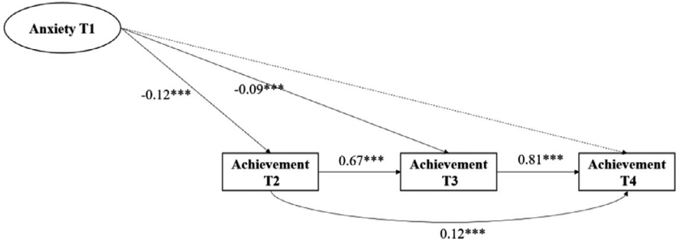
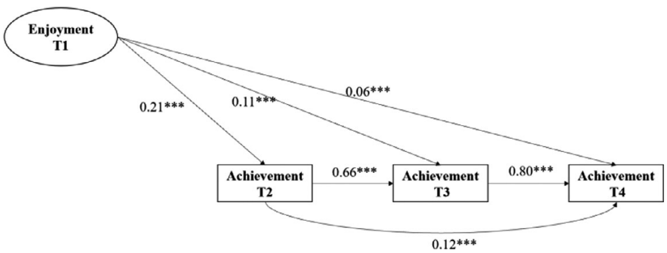
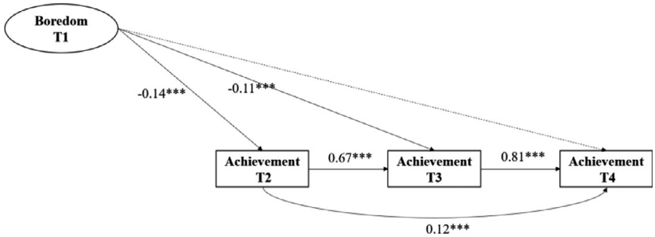
- At Time 1, the three emotions independently predicted later English achievement: anxiety negatively predicted T2 (β = -.12, p < .001) and T3 (β = -.09, p < .001) but not T4; enjoyment positively predicted T2 (β = .21, p < .001), T3 (β = .11, p < .001), and T4 (β = .06, p < .001); boredom negatively predicted T2 (β = -.14, p < .001) and T3 (β = -.11, p < .001) but not T4.
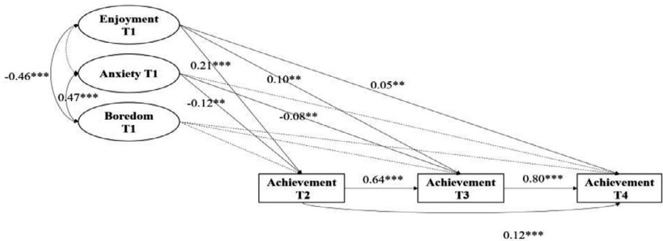
- When the three emotions were modeled together, enjoyment remained the strongest and most enduring predictor: T2 (β = .21, p < .001), T3 (β = .10, p < .01), and T4 (β = .05, p < .01).
- In the joint model, anxiety also predicted achievement negatively at T2 (β = -.12, p < .01) and T3 (β = -.08, p < .01), but not T4; boredom had no significant predictive effect at any later time point.
- The emotions were related to each other in the joint model: enjoyment was negatively related to boredom (β = -.46, p < .001) and boredom was positively related to anxiety (β = .46, p < .001); enjoyment and anxiety were not significantly correlated.
## Methods
- Longitudinal panel design built around the control-value theory, with measurements at four time points over about ten weeks: emotion questionnaire data at T1 and English achievement scores at T2, T3, and T4.
- Sample: 954 junior secondary English learners in one rural school in Anhui Province, China; 358 female and 596 male students, mean age 13 (SD = .81).
- Main analysis: confirmatory factor analysis and structural equation modeling in Mplus 8.3, with autoregressive controls and covariates (age, gender, SES, onset age of English learning).
## Limitations
- The paper states that the panel design with autoregressive controls and covariates “still does not suffice to establish causality.”
- It also states that only three emotions were examined; other L2 emotions may matter, and future research should include them.
- It further states that emotions were measured at one time point, unidirectional effects were tested only, and no reciprocal relations or indirect mechanisms were assessed; the text also makes evident that the sample came from one school in one rural county, which limits generalizability.
Model-written summary. Check it against the paper before relying on it.
Integrity signals
Registry
Cites
Statistics
Figures
Verification
Claims the paper makes
1 Valid · 0 Not valid · 5 Not checked · 69 Own results and interpretations
The cited sources support only part of this claim — read each source’s verdict below.
In the paper
“The results seem to suggest that the patterns between emotions and achievement may vary across different contexts.”
What the sources say
- Partly supportedcites Dewaele and Alfawzan (2018) matched to “Does the effect of enjoyment outweigh that of anxiety in foreign language performance?” (2018) sourceExperimental — accuracy not yet measured
Our copy does carry the two-context comparison the claim rests on, and its numbers differ across contexts: in Study 1 (London pupils) FLE (Rho = .34, p < .0001, r2 = 11.6) and FLCA (Rho = -.30, p < .0001, r2 = 9.0) were both significantly linked to test results (5.1, Results), whereas in Study 2 (Saudi EFL learners) only FLE was significant (Rho = 0.242, p < 0.003, r2 = 5.8) and the FLCA relation failed to reach significance (Rho = -0.145, p = 0.075) (5.2, Results) — echoed in the Conclusion's contrast between 'the significant negative relationship between FLCA and performance in Study 1 and the marginal negative effect in Study 2'. However, the authors' own interpretation runs the other way: the Discussion (6.) calls Study 2 'a similar picture', and the paper sets out to test whether similar patterns would make the relationship 'universal rather than a random effect of the local context' (3./4.1). It also never isolates context as the explanation — Study 1 used self-reported school test results and Study 2 the LexTALE proficiency test, with different ages, languages and a correlational design that 'cannot establish causality' (6.). So the variation in magnitude is in the source, but the attribution of that variation to differing contexts is the citing authors' inference. (LLM, conf=0.70)
- Not matchedcites Li et al. (2020)
This doesn’t read as a citation we can look up.
hedgedstates an associationn = 2- Asserted: passes — The authors put it forward as true.
- Checkable: passes — It can be checked against evidence.
- Load-bearing: passes — The paper’s conclusions depend on it.
- Based: passes — The paper gives a reason why it holds.
- Partly supported
In the paper
“As hypothesized, enjoyment at T1 was significantly and positively associated with FL achievements at T2 -T4, with small-to-medium effect sizes (Plonsky & Oswald, 2014).”
What the sources say
- Not checked — no full text of the sourcecites Plonsky & Oswald, 2014 matched to “How Big Is “Big”? Interpreting Effect Sizes in L2 Research” (2014) source
plainstates an association- Asserted: passes — The authors put it forward as true.
- Checkable: passes — It can be checked against evidence.
- Load-bearing: passes — The paper’s conclusions depend on it.
- Based: passes — The paper gives a reason why it holds.
A result the paper reports from its own data — it cites no other source for it, so there is none to check. The quote shows it is in the paper.
In the paper
“The path from anxiety at T1 to FL achievement at T4 was not statistically significant.”
plain- Asserted: passes — The authors put it forward as true.
- Checkable: passes — It can be checked against evidence.
- Load-bearing: passes — The paper’s conclusions depend on it.
- Based: passes — The paper gives a reason why it holds.
A result the paper reports from its own data — it cites no other source for it, so there is none to check. The quote shows it is in the paper.
In the paper
“The paths from boredom at T1 to FL achievement at T2 ( β = -.14, p < .001), and to FL achievement at T3 ( β = -.11, p < .001)”
plainstates a cause- Asserted: passes — The authors put it forward as true.
- Checkable: passes — It can be checked against evidence.
- Load-bearing: passes — The paper’s conclusions depend on it.
- Based: passes — The paper gives a reason why it holds.
A result the paper reports from its own data — it cites no other source for it, so there is none to check. The quote shows it is in the paper.
In the paper
“The paths from enjoyment at T1 to FL achievement at T2 ( β = .21, p < .001), to FL achievement at T3 ( β = .11, p < .001), and to FL achievement at T4 ( β = .06, p < .001) were all statistically significant.”
plainstates a cause- Asserted: passes — The authors put it forward as true.
- Checkable: passes — It can be checked against evidence.
- Load-bearing: passes — The paper’s conclusions depend on it.
- Based: passes — The paper gives a reason why it holds.
49 more claims
Create a free account to see all 75 claims and to verify the 1 reference still open.
- Probably not a substantial claim. 11
- It may state two separate claims as one. 11
Claims other papers make about this one
Each is checked against this paper’s own text: does it say what the citing paper says it does?
In the citing paper
“Structural equation modeling revealed that these emotions independently showed associations with English achievement at T2 (one week later) and T3 (five weeks later).However, only FLE was significantly associated with achievement at T4 (nine weeks later), while the significant associations between FLCA and acquisition disappeared at the end of the project.”
From Disentangling the causal role of motivation, enjoyment, and anxiety in second language speech learning: A final report (2025) · cites this paper as Li and Wei, 2023
In the citing paper
“Consequently, FLE appears to predict the extent to which L2 learning occurs (Dewaele et al., 2024;Li & Wei, 2023;Saito et al., 2018).”
From Disentangling the causal role of motivation, enjoyment, and anxiety in second language speech learning: A final report (2025) · cites this paper as Li & Wei, 2023
Citations
Cites
Foreign Language Classroom Anxiety
HORWITZ, E. K., HORWITZ, M. B., & COPE, J. (1986) · The Modern Language Journal · doi:10.1111/j.1540-4781.1986.tb05256.x · Cited by 9,773 · cited 4×
“The shortened version consists of eight items that were extracted from the original 33-item FLCAS by Dewaele and MacIntyre (2014).”
BackgroundMethodInfluentialPekrun, R. (2006) · Educational Psychology Review · doi:10.1007/s10648-006-9029-9 · Cited by 7,823 · cited 6×
“(2021a) proposed the construct of foreign language learning boredom (FLLB) and conceptualized it as a three-dimensional achievement emotion following the control-value theory (Pekrun, 2006) that we will turn to later.”
BackgroundMethodInfluentialCurran, P. J., West, S. G., & Finch, J. F. (1996) · Psychological Methods · doi:10.1037/1082-989x.1.1.16 · Cited by 5,512 · cited 1×
“The skewness and kurtosis indicators show that all the observed variables were normally distributed (Curran et al., 1996).”
BackgroundHow Big Is “Big”? Interpreting Effect Sizes in L2 Research
Plonsky, L., & Oswald, F. L. (2014) · Language Learning · doi:10.1111/lang.12079 · Cited by 1,960 · cited 1×
“As hypothesized, enjoyment at T1 was significantly and positively associated with FL achievements at T2–T4, with small-to-medium effect sizes (Plonsky & Oswald, 2014).”
BackgroundThe two faces of Janus? Anxiety and enjoyment in the foreign language classroom
Dewaele, J.-M., & MacIntyre, P. D. (2014) · Studies in Second Language Learning and Teaching · doi:10.14746/ssllt.2014.4.2.5 · Cited by 1,757 · cited 5×
“Supporting the holistic view on an individual’s diverse emotions (Fredrickson, 2003; MacIntyre & Gregersen, 2012), Dewaele and MacIntyre (2014) suggest that FLE is the positive counterpart of FLCA.”
BackgroundMethodInfluentialInternational Handbook of Emotions in Education
(2014) · Routledge eBooks · doi:10.4324/9780203148211 · Cited by 1,579 · cited 1×
“Based on boredom research in general educational contexts (Goetz & Hall, 2014; Tze et al., 2016), Li et al. (2021a) proposed the construct of foreign language learning boredom (FLLB) and conceptualized it as a three-dimensional achievement emotion following the control-value theory (Pekrun, 2006)…”
BackgroundThe Control-Value Theory of Achievement Emotions
Pekrun, R., Frenzel, A. C., Goetz, T., & Perry, R. P. (2007) · Emotion in Education · doi:10.1016/b978-012372545-5/50003-4 · Cited by 1,195
THE EFFECT OF AFFECT ON FOREIGN LANGUAGE LEARNING: A REVIEW OF THE ANXIETY RESEARCH
Scovel, T. (1978) · Language Learning · doi:10.1111/j.1467-1770.1978.tb00309.x · Cited by 1,047 · cited 3×
“Whilst earlier studies argued that some anxieties may have a facilitating effect on performance (Alpert & Haber, 1960; Scovel, 1978), recent studies revealed an overall negative correlation between FLCA and achievement (Botes et al.”
BackgroundAnxiety in academic achievement situations.
Alpert, R., & Haber, R. N. (1960) · The Journal of Abnormal and Social Psychology · doi:10.1037/h0045464 · Cited by 1,045 · cited 1×
“Whilst earlier studies argued that some anxieties may have a facilitating effect on performance (Alpert & Haber, 1960; Scovel, 1978), recent studies revealed an overall negative correlation between FLCA and achievement (Botes et al., 2020; Teimouri et al., 2019; Zhang, 2019).”
The Value of Positive Emotions
Fredrickson, B. (2003) · American Scientist · doi:10.1511/2003.4.330 · Cited by 1,006 · cited 1×
“Supporting the holistic view on an individual’s diverse emotions (Fredrickson, 2003; MacIntyre & Gregersen, 2012), Dewaele and MacIntyre (2014) suggest that FLE is the positive counterpart of FLCA.”
Background
Research works printed but not linked: 2
- Kline, R. B. (2010). Principles and practices of structural equation modeling (3rd ed.). Guilford.
- Li, C. (2021b). Looking back and looking forward: SLA research from a positive psychology perspective over the past decade (2012 -2022). Foreign Language Education , 42 , 57 -63.
Cited by
Items 201–300 of 313
Flores, J. S., Canalís, Á. H., Fernández-Costales, A., & Senar, F. (2025) · Journal of Multilingual and Multicultural Development · doi:10.1080/01434632.2025.2521426 · Cited by 4
“In this sense, works such as those of Li and Wei (2023) or Senar et al. (2023a), have shown a close relationship between second language proficiency and attitudes towards a second language and its culture.”
Amiri, E., Karfa, A. E., & Jabbouri, A.-B. (2023) · European Journal of Education Studies · doi:10.46827/ejes.v10i9.4954 · Cited by 5
“These are three of the frequently and intensely experienced academic emotions (see Li & Wei, 2022; Goetz et al., 2007; Tsang & Dewaele, 2023).”
BackgroundUnderstanding Positive Psychological Factors for Sustainable EFL Learning
Hu, X., Sidhu, G. K., Alias, N., & Fu, F. (2023) · Environment-Behaviour Proceedings Journal · doi:10.21834/ebpj.v8i23.4462 · Cited by 3
Enjoyment of Foreign Language Learning: A Systematic ReviewPreprint
Zhang, Z., Gao, X. A., & Liu, T. (2024) · SSRN Electronic Journal · doi:10.2139/ssrn.4886419 · Cited by 2
Current Status and Prospect of Research on Foreign Language Learning Enjoyment
Yang, Y. (2024) · Education Language and Sociology Research · doi:10.22158/elsr.v5n1p38 · Cited by 1
Halim, A., Jamil, H., Miswanto, M., et al. (2023) · Progresiva Jurnal Pemikiran dan Pendidikan Islam · doi:10.22219/progresiva.v12i02.29415 · Cited by 1
Multidimensional Academic Anxiety: Examining Domain-Specific Differences and Motivational Impacts
Li, Q., & Palaroan, R. M. (2024) · Education and human development · doi:10.5772/intechopen.1008203 · Cited by 8
Ulfah, B., Nooryastuti, N. A., & Widiati, U. (2025) · rEFLections · doi:10.61508/refl.v32i1.263871 · Cited by 1
Motivational and Emotional Factors Involved in Language Learning
Zarrinabadi, N. (2025) · Second language learning and teaching · doi:10.1007/978-3-031-75615-3_3 · Cited by 1
Foreign Language Enjoyment for Teaching and Learning: Experiences of Pakistani Teachers
Habib, H., Sair, H. K., Shahbaz, M., & Hafeez, M. R. (2025) · Journal of Arts and Linguistics Studies · doi:10.71281/jals.v3i1.291 · Cited by 2
Pan, L., Li, X., He, X., Luo, H., & Gu, Q. (2025) · Frontiers in Psychology · doi:10.3389/fpsyg.2025.1573713 · Cited by 6
“As a result of this policy, the number of Thai overseas students enrolled in Chinese universities has escalated from 667 in 2000 to 28,608 in 2018, with consistent year-on-year growth in recent years (Liang and Li, 2023).”
InfluentialAl-Amri, H. M. (2025) · Saudi Journal of Language Studies · doi:10.1108/sjls-01-2025-0007 · Cited by 5
Jia, R., Sudina, E., & Du, K. (2025) · Research Methods in Applied Linguistics · doi:10.1016/j.rmal.2025.100235 · Cited by 2
Nguyễn, N., & Hoang, T. (2025) · The Journal of AsiaTEFL · doi:10.18823/asiatefl.2025.22.2.21.477 · Cited by 2
Barwasser, A., Asaro‐Saddler, K., Saddler, B., Nobel, K., & Grünke, M. (2025) · Psychology in the Schools · doi:10.1002/pits.70052 · Cited by 3
Exploring Chinese ethnic minority high school students’ boredom as they learn English in classroom
Zeng, J., Huang, Z., Chen, H., & Xu, L. (2025) · Asia Pacific Journal of Education · doi:10.1080/02188791.2025.2537389 · Cited by 1
Wu, H. (2025) · Journal of Multilingual and Multicultural Development · doi:10.1080/01434632.2025.2534456 · Cited by 2
“FLB has been proven to have a detrimental effect on learners as it disturbs their motivation and self-efficacy, diminishes willingness to communicate, reduces classroom engagement, and eventually undermines L2 achievement (Bensalem et al. 2025; Li and Wei 2023; Sun, Shi, and Yan 2024).”
Lyu, J. (2025) · Frontiers in Psychology · doi:10.3389/fpsyg.2025.1609330 · Cited by 7
“Research further shows boredom predicts lower L2 achievement (Li and Wei, 2023) and leads to maladaptive coping strategies, such as avoidance, which obstruct progress (Solhi et al., 2023).”
Turn over a new leaf: classroom concordancing and L2 boredom among high school EFL learners
Mahmoudi‐Gahrouei, V., Kruk, M., & Boroujeni, S. A. (2025) · Computer Assisted Language Learning · doi:10.1080/09588221.2025.2552118 · Cited by 3
Wu, Y. (2025) · Journal of Multilingual and Multicultural Development · doi:10.1080/01434632.2025.2567036 · Cited by 4
Staedtler, A., Botes, E., Hernández, E. S., & Querol-Julián, M. (2025) · International Journal of Multilingualism · doi:10.1080/14790718.2025.2578407 · Cited by 1
Tsang, A., & Yeung, S. S. (2025) · International Journal of Applied Linguistics · doi:10.1111/ijal.70044 · Cited by 1
Zhao, H., & Zhang, Y. (2025) · Language Teaching Research · doi:10.1177/13621688251383245 · Cited by 2
Tsang, A., & Moorhouse, B. L. (2026) · System · doi:10.1016/j.system.2026.103981 · Cited by 1
Shamushaki, M. T. B., & Zhaleh, K. (2026) · Acta Psychologica · doi:10.1016/j.actpsy.2026.106412 · Cited by 3
Sun, W., & Shi, H. (2026) · Applied Linguistics Review · doi:10.1515/applirev-2024-0194 · Cited by 2
“In response, scholars have called for broader investigations into a wider range of emotions in L2 research (e.g., Li and Li 2023; Li et al. 2023b; Saito et al. 2025).”
Silletti, F., Coppola, G., Semeraro, C., Cassibba, R., Palladino, P., Gatti, M., & Musso, P. (2026) · British Journal of Educational Psychology · doi:10.1111/bjep.70082 · Cited by 1
Wang, Y., Sun, Y., & Ke, W. (2026) · Behavioral Sciences · doi:10.3390/bs16040580 · Cited by 1
“However, research in SLA has long focused on trait-like emotions at the general-domain level (Dewaele & Alfawzan, 2018; Dewaele & MacIntyre, 2014; C. Li & Wei, 2023) or skill-specific level (Güvendir & Uzun, 2023; Papi, 2022), leaving the dynamic nature of task-specific emotions relatively…”
When AI support shapes affect in L2 writing: Task-specific emotions across genre-based writing tasks
Jiang, Z., Huang, Z., & Yang, N. (2026) · System · doi:10.1016/j.system.2026.104041 · Cited by 3
Pan, J., & Chen, H. (2026) · Frontiers in Psychology · doi:10.3389/fpsyg.2026.1802306 · Cited by 2
“Research on general language learning indicates that enjoyment enhances achievement, whereas boredom undermines it (e.g., Botes et al., 2022; Li and Li, 2023).”
Wang, C., Li, X., Jin, H., & Zou, B. (2026) · Computer Assisted Language Learning · doi:10.1080/09588221.2026.2680421 · Cited by 4
The effects of generative AI on foreign language emotions: A meta-analysis
Chen, S., Yu, L., Huang, R., Bai, X., & Qin, J. (2026) · Acta Psychologica · doi:10.1016/j.actpsy.2026.107336 · Cited by 3
Development and Validation of the Second or Foreign Language Boredom Coping Strategies Scale
Solhi, M., Kruk, M., Shirvan, M. E., Pawlak, M., & Taherian, T. (2026) · Language Teaching Research · doi:10.1177/13621688261456524 · Cited by 2
Sun, W., & Pan, F. (2026) · Language Teaching · doi:10.1017/s0261444826101396 · Cited by 1
The Effect of Emotions on Reading Comprehension
Zhang, L. (2023) · Lecture Notes in Education Psychology and Public Media · doi:10.54254/2753-7048/22/20230313 · Cited by 2
刘, 珊. (2024) · Advances in Education · doi:10.12677/ae.2024.142292 · Cited by 1
Yang, X., Song, L., Zhao, Y., & Cheng, D. (2024) · British Journal of Educational Psychology · doi:10.1111/bjep.12671 · Cited by 1
Albert, Á., & Csizér, K. (2025) · Studies in Second Language Learning and Teaching · doi:10.14746/ssllt.49262 · Cited by 1
An Overview of the Empirical Research on Foreign Language Learning Boredom (from 2013 to 2022)
王, 建. (2022) · Advances in Social Sciences · doi:10.12677/ass.2022.1110572 · Cited by 2
An Empirical Study of Enjoyment in College English PAD Class in China
Mai, X. (2023) · Frontiers in Educational Research · doi:10.25236/fer.2023.061516
“Published by Francis Academic Press, UK -114concentration and achievement (Li & Wei, 2022) ([10]).”
MethodA descriptive study about language anxiety while learning English as a second language
González-Anaya, A. G. (2023) · Revista de Sociología Contemporánea · doi:10.35429/jocs.2023.28.10.19.25 · Cited by 1
Liu, Q., & Zhou, W. (2024) · SSRN Electronic Journal · doi:10.2139/ssrn.4811509 · Cited by 1
Understanding emotions in English Language learning in virtual worlds
Ding, Q., & Cheng, X. (2023) · Interactive Learning Environments · doi:10.1080/10494820.2023.2196532
Huang, Q., Muhamad, M. M., Nawi, N. R. C., et al. (2023) · International Journal of Academic Research in Progressive Education and Development · doi:10.6007/ijarped/v12-i3/18077
“Furthermore, this study found that Chinese high school students experience a moderate level of enjoyment in foreign language learning (3 M=3.368 4), slightly lower than that of rural middle school students in China (M=3.83, SD=0.73) (Li & Wei, 2023), and fifth-grade students in Turkey (M=3.87, SD=0.394) (Ozer & Altay,…”
BackgroundInfluentialLi, X. (2023) · Lecture Notes in Education Psychology and Public Media · doi:10.54254/2753-7048/31/20231404 · Cited by 1
Foreign language anxiety and enjoyment performance in classroom: Literature study
Yahya, N. Z., & Wardani, A. N. (2024) · Routledge eBooks · doi:10.1201/9781003376125-18 · Cited by 1
杨, 蕊. (2024) · Modern Linguistics · doi:10.12677/ml.2024.124255
Tabari, M. A., Golparvar, S. E., & Khezrlou, S. (2024) · SSRN Electronic Journal · doi:10.2139/ssrn.4826246
A postcolonial structuralist critique of Yolisa Madolo’s Ndinetyala kusini na? (Am I guilty?)
Diko, M. (2024) · South African Journal of African Languages · doi:10.1080/02572117.2023.2288336
Tusino, T., Purworejo, U. M., Dewi, P., & Sharif, T. I. S. T. (2024) · The Journal of AsiaTEFL · doi:10.18823/asiatefl.2024.21.2.15.474
“Defined as an inner sense of emptiness, apathy, and lack of purpose (Zawodniak, et al., 2017), boredom in language learning is a current phenomenon (Li, 2022).”
InfluentialForeign Language Boredom of Second Language Learners in China
Chu, H., & Peng, S. (2024) · Lecture Notes in Education Psychology and Public Media · doi:10.54254/2753-7048/59/20241715
Collaborative Teaching and Teacher ZPD
Yixuan, J. (2024) · Springer eBooks · doi:10.1007/978-3-031-64002-5_16
Hidayati, D. S., Romadhon, M. G. E., & Mustofa, M. (2024) · Ethical Lingua Journal of Language Teaching and Literature · doi:10.30605/25409190.716 · Cited by 2
Wu, H. (2024) · Studia Neophilologica · doi:10.1080/00393274.2024.2407625
English Language Learning Anxiety Among Middle School Students
Shahzadi, A., & Semmi (2025) · Research Journal for Social Affairs · doi:10.71317/rjsa.003.02.0168
Převrátilová, S. (2025) · Frontiers The Interdisciplinary Journal of Study Abroad · doi:10.36366/frontiers.v37i2.984
Zheng, S., Liu, Y., Peng, X., & Liu, Y. (2026) · PLoS ONE · doi:10.1371/journal.pone.0356390
Wei, X. (2025) · Journal of English and Applied Linguistics · doi:10.59588/2961-3094.1141 · Cited by 2
Bu, X. (2024) · International Conference on Education and E-Learning (ICEEL) · doi:10.1145/3719487.3719529 · Cited by 2
“The scale of foreign language engagement is modified according to Li, C., Li, W., & Cai, J.’s version [27], comprising 16 items which detect five dimensions of cognitive engagement, affective engagement, behavioral engagement, social engagement, and motivational engagement.”
Gordon, C. (2025) · Modern English Education · doi:10.18095/meeso.2025.26.1.306
Nie, K., Zhang, H. S., & Khan, A. (2025) · Applied Linguistics Review · doi:10.1515/applirev-2024-0077
Team Presentations in the Engineering Classroom: Challenges and Strategies
Sharma, R., & John, D. (2025) · IEEE International Professional Communication Conference (ProComm) · doi:10.1109/procomm64814.2025.00049
Positive and Negative Emotions of Chinese as a Second Language Learners and the Influencing Factors
Li, J., & Tsung, L. (2025) · SAGE Open · doi:10.1177/21582440251367146 · Cited by 3
“In the study conducted by C. Li and Wei (2023), the three emotions were examined to see their independent and joint effects on EFL learners’ achievement.”
陈, 芷. (2025) · Advances in Psychology · doi:10.12677/ap.2025.159527
Han, J., Yang, Y., & Ren, B. (2025) · Language Teaching Research · doi:10.1177/13621688251371143 · Cited by 1
Mohammadi, V., & Yousofi, N. (2025) · Discover Psychology · doi:10.1007/s44202-025-00526-1 · Cited by 2
“While research on learner enjoyment (FLE) has flourished (e.g., [9, 30, 74]), empirical investigation into FLTE remains relatively nascent and scarce (e.g., [19, 53, 66].”
Systematic scoping review into educational linguistics praxis in language learning and teaching
Chen, B., & Guo, W. (2025) · Southern African Linguistics and Applied Language Studies · doi:10.2989/16073614.2025.2566084 · Cited by 1
“The predictive effect of achievement emotions in learning outcomes is categorised into independent and joint predictive effects (e.g. Li and Wei 2023).”
InfluentialXu, K., He, L., & Wang, J. (2026) · Discover Psychology · doi:10.1007/s44202-025-00574-7 · Cited by 5
“The significantly higher levels of boredom in ERT compared with offline classes ( M ERT = 2.67; M offline = 2.27) confirmed the previous findings [11, 12, 26, 34].”
InfluentialLuo, W. (2026) · Acta Psychologica · doi:10.1016/j.actpsy.2026.106355 · Cited by 1
Li, Y., Fan, L., & Rubie-Davies, C. M. (2026) · Contemporary Educational Psychology · doi:10.2139/ssrn.6187341
Kırmızı, Ö., Öz, G., & Kızıldağ, A. (2026) · SSRN Electronic Journal · doi:10.2139/ssrn.6192704
Song, Q. (2026) · Innovation in Language Learning and Teaching · doi:10.1080/17501229.2026.2642396
Li, M., & Qi, X. (2026) · BMC Psychology · doi:10.1186/s40359-026-04593-4
Zhu, X., & Liu, J. (2025) · doi:10.1145/3797552.3797746
“Drawing on control-value theory, Li and Wei [1] identified enjoyment as the most robust and enduring predictor of L2 achievement among junior secondary students in rural China, surpassing anxiety and boredom.”
Predictive effects of foreign language listening emotions on listening achievement
Chen, S., Yu, L., Huang, R., & Tian, L. (2026) · Frontiers in Psychology · doi:10.3389/fpsyg.2026.1809011 · Cited by 1
Differential engagement pathways to EFL speaking performance: F2F vs. Metaverse
Lee, S., Kim, N. J., & Ahn, T. Y. (2026) · Educational Technology Research and Development · doi:10.1007/s11423-026-10633-y
Zhao, M., Zhuang, W., & Schwieter, J. W. (2026) · Frontiers in Psychology · doi:10.3389/fpsyg.2026.1816321 · Cited by 1
“…Language (EFL) contexts, predominantly focusing on individual affective variables such as enjoyment, anxiety, or grit (Dewaele and MacIntyre, 2014; Li and Wei, 2023; Li and Han, 2022; Saito et al., 2018; Teimouri et al., 2019; Zhao and Wang, 2023), rather than on the coordinated operation of…”
Deviyanti, R., & Nikolov, M. (2026) · Innovation in Language Learning and Teaching · doi:10.1080/17501229.2026.2676132
Guo, X., & Wang, M. (2026) · Studies in Second Language Learning and Teaching · doi:10.14746/ssllt.40934
Xu, J. (2026) · European Journal of Education · doi:10.1111/ejed.70720 · Cited by 1
Anxiety, enjoyment and boredom in online foreign language learning: A systematic review
Sun, J. (2026) · Acta Psychologica · doi:10.1016/j.actpsy.2026.107249 · Cited by 1
A Diachronic Investigation of Individual Differences and Writing Quality in Data-Driven Learning
Zhao, Y. J., 曹思琦, & Dong, J. (2026) · Language Teaching Research · doi:10.1177/13621688261449333
Almutlaq, S. A. (2026) · Current Psychology · doi:10.1007/s12144-026-09675-5
“Li and Wei ( 2023) found that enjoyment, anxiety, and boredom significantly predict FL achievement, with enjoyment exerting the strongest, most lasting influence.”
Fernández-Costales, A., Riaño, X. A. G., Avello-Rodríguez, R., et al. (2026) · Journal of Language Identity & Education · doi:10.1080/15348458.2026.2687425
Zhou, X., Huang, M., Riget, P. N., & Chow, T. U. (2026) · International Journal of Applied Linguistics · doi:10.1111/ijal.70302
How Language Attitudes Shape French Language Achievement: The Mediating Role of Student Engagement
Gong, J., Chen, X., & Li, Y. (2026) · Behavioral Sciences · doi:10.3390/bs16071255
“This indicates that language attitudes manifest as learning behaviors (Li & Wei, 2022).”
Alleviating the Burden of Anxiety: Enjoyment as a Shield for Foreign Language Self-Efficacy
Ölmez-Çağlar, F., & Ölmez, G. N. (2026) · Sakarya University Journal of Education · doi:10.19126/suje.1891637
Qu, G., Lyu, Z., & Yang, Q. (2026) · Journal of Computer Assisted Learning · doi:10.1002/jcal.70293 · Cited by 3
Ye, Y., Wu, X., Weng, K., & Lin, R. (2026) · Frontiers in Psychology · doi:10.3389/fpsyg.2026.1906693 · Cited by 1
“Enjoyment tends to correlate negatively with both anxiety and boredom, whereas anxiety and boredom tend to be positively related (Dewaele et al., 2023; Li and Wei, 2023; Wang and Li, 2022).”
Tsang, A., & Kam Tai, K. W. A. N. (2026) · TESOL Quarterly · doi:10.1002/tesq.70201
Dewaele, J., & González, J. O. (2026) · Second language learning and teaching · doi:10.1007/978-3-032-30199-4_6 · Cited by 1
TRACING ENJOYMENT AND ANXIETY IN THE EFL CLASSROOM OVER TIME
Altınkaya, Z. Ö. (2026) · Eğitimde Kuram ve Uygulama · doi:10.17244/eku.1920669 · Cited by 1
Li, C., & Sun, P. P. (2026) · Innovation in Language Learning and Teaching · doi:10.1080/17501229.2026.2709149
Self-citationThe Qualitative Phase in Individual Differences Scale Development in SLA: A Methodological Synthesis
Lyu, M., Wu, C., Jia, R., & Sudina, E. (2026) · Research Synthesis in Applied Linguistics · doi:10.1080/29984475.2026.2713533
Pluralism Behind Boredom Coping in Language Learning: Evidence From a Q Methodology Study
Solhi, M., Thumvichit, A., Pawlak, M., & Kruk, M. (2026) · Language Teaching Research · doi:10.1177/13621688261475046 · Cited by 1
党, 绍. (2026) · Advances in Psychology · doi:10.12677/ap.2026.168416
Wang, C., & Zhao, Z. (2026) · European Journal of Education · doi:10.1111/ejed.70843
Nikitina, L., Yuan, F., & Furuoka, F. (2026) · SAGE Open · doi:10.1177/21582440261486108
Yang, H., Hu, Y., Gu, J., & Huang, C. (2026) · International Journal of Applied Linguistics · doi:10.1111/ijal.70360 · Cited by 1
Testing discontinuity in the foreign language classroom anxiety–proficiency link
Saito, K., Dewaele, J., & González, J. O. (2026) · Second language Research · doi:10.1177/02676583261473361 · Cited by 1
Metadata
- Authors
- Li, C., & Wei, L.
- Affiliations
- Huazhong University of Science and Technology (CN)
- University College London (GB)
- Corresponding author
- Wei, Li
- ORCID
- Venue
- Studies in Second Language Acquisition
- Publisher
- Cambridge University Press (CUP)
- Published
- 2022-03-08
- Volume
- 45
- Issue
- 1
- Pages
- 93-108
- ISSN
- 0272-2631 (ISSN-L)
- 1470-1545
- OpenAlex
- W4220918091
- Cited by
- 317
- References
- 43
- Citations by year
- 2026: 73 · 2025: 91 · 2024: 73 · 2023: 52 · 2022: 28
- FWCI
- 229.58
- Type
- journal article
- Language
- en
- Update notices
- correction (2022-03-08)
- Open access
- hybrid
- doi.org
- Locations
- Studies in Second Language Acquisition (publishedVersion, cc-by)
- UCL Discovery (University College London) (submittedVersion)
- Funders
- The National Social Science Fund of China (19CYY017)
- Topics
- Social Sciences › Arts and Humanities › Language and Linguistics › EFL/ESL Teaching and Learning
- Social Sciences › Psychology › Developmental and Educational Psychology › Education, Achievement, and Giftedness
- Social Sciences › Psychology › Developmental and Educational Psychology › Second Language Acquisition and Learning
- Keywords
- anxiety, enjoyment, boredom, second language achievement, English as a foreign language, junior high school students, control-value theory
About these checks
Registry, retraction, Cites and statistics results are computed, not judged, with one exception: a printed reference that no index lists is read once by a model before it counts as a citation error. Claims are extracted by a model and kept only when their quote appears verbatim in the text; each cited source is then checked, with a model’s help, for whether it says what the claim relies on. Those verdicts can be wrong — read the claim’s quote and the cited source before relying on one.
The claim verdicts this report counts are experimental: their accuracy is not yet measured.
A language model drew the claims from the paper on 2026-10-10, under version 3 of the claim definition (model deepseek-v4.1-flash, prompt extract-v3).
A second model labelled each claim on 2026-10-10 (model jev-1.13-20260917, definition revision gold-guideline-v0.2).
Cited sources are checked with a language model’s help (qwen3.8-omni-flash).
Statistics and arithmetic are recomputed, not judged.
Confidence bands are shown only for fields calibrated on our annotated test set. None is calibrated yet, so no band is shown.
What counts as a claim ›How we measure confidence ›How we check this ›
Are you an author, or do you see a problem with this page? Request a review
Data sources
Bibliographic data: Semantic Scholar, OpenAlex, Crossref.
Contains information from the Semantic Scholar Academic Graph Datasets, made available under the ODC Attribution License (ODC-BY 1.0).
Semantic Scholar’s data is described in: Kinney, R., et al. (2023). The Semantic Scholar Open Data Platform. arXiv:2301.10140.
