

The ecological validity of tests of executive function
Open accessThe DOI matches its Crossref record; 52 of the 52 references it cites were found in a registry or an index; 3 of the 27 sources its claims cite were checked for support.
Abstract
Ninety-two mixed etiology neurological patients and 216 control participants were assessed on a range of neuropsychological tests, including 10 neuropsychological measures of executive function derived from 6 different tests. People who knew the patients well (relatives or carers) completed a questionnaire about the patient's dysexecutive problems in everyday life, and this paper reports the extent to which the tests predicted the patients' everyday life problems. All of the tests were significantly predictive of at least some of the behavioral and cognitive deficits reported by patients' carers. However, factor analysis of the patients' dysexecutive symptoms suggested a fractionation of the dysexecutive syndrome, with neuropsychological tests loading differentially on 3 underlying cognitive factors (Inhibition, Intentionality, and Executive Memory), supporting the conclusions that different tests measure different cognitive processes, and that there may be limits to the fractionation of the executive system.
Overview
CoChat Summary
TL;DR
In 92 mixed-etiology neurological patients and 216 controls, executive-function tests were generally correlated with carer-reported everyday dysexecutive problems, but different tests predicted different symptom factors. The dysexecutive syndrome fractionated at the behavioral level into five factors, with the first three (Inhibition, Intentionality, Executive Memory) showing differential relations to executive tests.
Key findings
- All executive tests were significantly predictive of at least some carer-reported behavioral/cognitive deficits; patients performed worse than controls on all executive measures except Cognitive Estimates (t(127) = −.98, p = .33). Under Bonferroni correction, significant patient-control differences remained for MWCST Categories and Perseverative Errors, all three Trail Making measures, and SET.
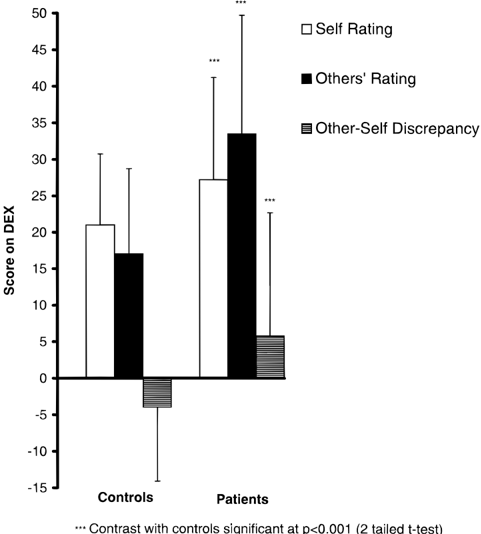
- On the Dysexecutive Questionnaire (DEX), patients rated themselves as showing fewer/less severe dysexecutive signs than observers (t(160) = −2.72, p < .01), whereas controls rated themselves higher than informants (t(331) = 3.65, p < .001), suggesting lack of insight in patients.
- Factor analysis of carer ratings yielded five factors explaining 67.2% of variance (21.3, 15.5, 11.6, 10.6, 8.2%); the first three were Inhibition, Intentionality, and Executive Memory. Executive tests loaded differentially: Factor 1 related to all executive tasks except MWCST; Factor 2 related most strongly to SET (r = .46); Factor 3 related to MWCST and verbal fluency.
- Sensitivity did not explain the factor-test pattern: SET was the second most sensitive measure (33.7% of patients at/below the 5th percentile of controls), Trails B 38.9%, Trails A 32.1%, B-A 25.9%, MWCST Perseverative Errors 28.6%, FAS 10.8%, Animals 8.2%, and Cognitive Estimates 3.6%.
Methods
- 92 neurological patients of varying etiologies (59% head injury, 13% dementia, 8.5% cerebrovascular accidents, 6.5% encephalitis, 13% other; mean age 38.5 years, SD = 15.1; mean NART IQ 103.2; mean WAIS-R FSIQ 92.1) and 216 controls (mean age 46.1 years, SD = 19.8; mean NART IQ 102.7).
- The DEX questionnaire covered 20 dysexecutive symptoms rated 0–4 by a relative/carer and by the participant; the neuropsychological battery included six executive tests (MWCST, Cognitive Estimates, Verbal Fluency FAS, Verbal Fluency Animals, Trail Making, SET) plus background tests of intellect, memory, language, and visual perception.
- Analyses included correlations between DEX total/self/other-self scores and tests, varimax rotated factor analysis of independent raters’ scores, factor score–test correlations, and sensitivity analysis using the proportion of patients at or below the 5th percentile of controls.
Limitations
- Stated: interpretation of Factor 1 was “perhaps premature”; the emotional/personality factors (4 and 5) “would benefit from further research”; and the possible one-way relation between confabulation and perseveration remained unresolved.
- Evident: the control group was significantly older than the patient group (t = 3.46, df = 306, p = .001), though the paper calls this conservative; sample sizes varied widely across tests (e.g., N = 42 to 84), and the design is correlational, so causality cannot be inferred.
- Evident: the DEX relies on subjective self- and carer ratings, and the mixed-etiology sample may limit generalizability to specific neurological groups.
Model-written summary. Check it against the paper before relying on it.
Integrity signals
Registry
Cites
Statistics
Figures
Verification
Claims the paper makes
3 Valid · 1 Not valid · 12 Not checked · 74 Own results and interpretations
The cited sources support only part of this claim — read each source’s verdict below.
In the paper
“By far the strongest relation, however, was with the SET, which supports previous interpretations of the test as tapping processes involved in the creation, maintenance and activation of intentions (Burgess, 1997; Burgess & Shallice, 1997; Goldstein et al., 1993; Shallice & Burgess, 1991a, 1991b).”
What the sources say
- Not checked — no full text of the sourcecites Burgess, 1997
- Not checked — no full text of the sourcecites Burgess & Shallice, 1997
- Partly supportedcites Goldstein et al., 1993 matched to “Unilateral frontal lobectomy can produce strategy application disorder.” (1993) sourceExperimental — accuracy not yet measured
In Additional Tests, the paper uses the Six Element Test (SET) to examine planning ability, which supports the broad interpretation of the test. The Discussion links prospective internal markers for behaviour change to the patient's errors on the Multiple Errands task, not specifically to the SET. The paper does not report a relation between SET performance and Intentionality; the citing sentence appears to present that relation as its own finding. (LLM, conf=0.82)
boostedstates an association- Asserted: passes — The authors put it forward as true.
- Checkable: passes — It can be checked against evidence.
- Load-bearing: passes — The paper’s conclusions depend on it.
- Based: passes — The paper gives a reason why it holds.
The cited sources support only part of this claim — read each source’s verdict below.
In the paper
“By far the strongest relation, however, was with the SET, which supports previous interpretations of the test as tapping processes involved in the creation, maintenance and activation of intentions (Burgess, 1997; Burgess & Shallice, 1997; Goldstein et al., 1993; Shallice & Burgess, 1991a, 1991b).”
What the sources say
- Not checked — no full text of the sourcecites Burgess, 1997
- Not checked — no full text of the sourcecites Burgess & Shallice, 1997
- Partly supportedcites Goldstein et al., 1993 matched to “Unilateral frontal lobectomy can produce strategy application disorder.” (1993) sourceExperimental — accuracy not yet measured
The Additional Tests section describes the Six Element Test as examining planning ability through six tasks completed within a fixed time. The Discussion links prospective triggers for changing behaviour to the patient's difficulties on the Multiple Errands task, not specifically to the Six Element Test. The paper therefore supports a planning-related interpretation of the SET but does not establish the full claim about creating, maintaining and activating intentions. (LLM, conf=0.82)
boostedstates an association- Asserted: passes — The authors put it forward as true.
- Checkable: passes — It can be checked against evidence.
- Load-bearing: passes — The paper’s conclusions depend on it.
- Based: passes — The paper gives a reason why it holds.
A result the paper reports from its own data — it cites no other source for it, so there is none to check. The quote shows it is in the paper.
In the paper
“factor analysis of the patients' dysexecutive symptoms suggested a fractionation of the dysexecutive syndrome”
hedgedstates an association- Asserted: passes — The authors put it forward as true.
- Checkable: passes — It can be checked against evidence.
- Load-bearing: passes — The paper’s conclusions depend on it.
- Based: passes — The paper gives a reason why it holds.
A result the paper reports from its own data — it cites no other source for it, so there is none to check. The quote shows it is in the paper.
In the paper
“with neuropsychological tests loading differentially on 3 underlying cognitive factors (Inhibition, Intentionality, and Executive Memory)”
plainstates an association- Asserted: passes — The authors put it forward as true.
- Checkable: passes — It can be checked against evidence.
- Load-bearing: passes — The paper’s conclusions depend on it.
- Based: passes — The paper gives a reason why it holds.
A result the paper reports from its own data — it cites no other source for it, so there is none to check. The quote shows it is in the paper.
In the paper
“All of the tests were significantly predictive of at least some of the behavioral and cognitive deficits reported by patients' carers.”
plainstates an association- Asserted: passes — The authors put it forward as true.
- Checkable: passes — It can be checked against evidence.
- Load-bearing: passes — The paper’s conclusions depend on it.
- Based: passes — The paper gives a reason why it holds.
56 more claims
Create a free account to see all 90 claims and every source verdict.
- Probably not a substantial claim. 13
- It may state two separate claims as one. 19
- The quote only partly states this claim. 1
Claims other papers make about this one
Each is checked against this paper’s own text: does it say what the citing paper says it does?
The cited source doesn’t support the claim as written.
In the citing paper
“Most troubling from a clinical perspective is that EF tests have low or no ecological validity when judged against ratings of EF in daily life or direct observations of EF performance in natural settings.”
From Impairment in Occupational Functioning and Adult ADHD: The Predictive Utility of Executive Function (EF) Ratings Versus EF Tests (2010) · cites this paper as Burgess et al., 1998
Checked by a reasoning model — may be wrong.
Experimental — accuracy not yet measuredThe cited source doesn’t support the claim as written.
In the citing paper
“These studies typically find that the variance shared between any single EF test and EF ratings ranges from just 0% to 10%.”
From Impairment in Occupational Functioning and Adult ADHD: The Predictive Utility of Executive Function (EF) Ratings Versus EF Tests (2010) · cites this paper as Burgess et al., 1998
Checked by a reasoning model — may be wrong.
Experimental — accuracy not yet measuredThe source backs part of the claim, not all of it — or backs it for a different population, condition or comparison.
In the citing paper
“Thus these results add to the evidence that performance on more 'ecologically valid' tasks can show closer concordance with observed symptoms in everyday life than performance on traditional experimentally derived tasks (Burgess et al., 1998), and can be adapted to a clinical setting.”
From The case for the development and use of ecologically valid measures of executive function in experimental and clinical neuropsychology (2006) · cites this paper as Burgess et al., 1998
Experimental — accuracy not yet measuredThe source backs part of the claim, not all of it — or backs it for a different population, condition or comparison.
In the citing paper
“Past studies found EF tests to have low-order correlations that are often nonsignificant with patient self-ratings and those of significant others of the dysexecutive symptoms they observe in patients with frontal lobe injuries”
From Impairment in Occupational Functioning and Adult ADHD: The Predictive Utility of Executive Function (EF) Ratings Versus EF Tests (2010) · cites this paper as Burgess et al., 1998
Experimental — accuracy not yet measuredThe source backs part of the claim, not all of it — or backs it for a different population, condition or comparison.
In the citing paper
“Combinations of EF tests do not fair much better, sharing just 12% -20% of the variance with EF ratings.”
From Impairment in Occupational Functioning and Adult ADHD: The Predictive Utility of Executive Function (EF) Ratings Versus EF Tests (2010) · cites this paper as Burgess et al., 1998
Experimental — accuracy not yet measured
6 more claims about this paper
Create a free account to see every claim other papers make about this one.
Self-check
Percentages, sums and reported differences re-computed from the paper’s own numbers.
Each contradiction between two passages listed here was confirmed by an independent check.
Rated minor: it would not touch a result — a value no result rests on, a p-value that stays on the same side of the significance level, or a conflict that is clerical, resolved elsewhere in the paper, or outside its own findings.
In the paper
§ Abstract
“including 10 neuropsychological measures of executive function derived from 6 different tests.”
§ INTRODUCTION
“compares the ecological validity of eleven measures of executive function taken from six different tests”
Rated minor: it would not touch a result — a value no result rests on, a p-value that stays on the same side of the significance level, or a conflict that is clerical, resolved elsewhere in the paper, or outside its own findings.
In the paper
§ Correlations Between Overall Severity of Dysexecutive Disorder and the Neuropsychological Test Measures
“all of the tests measuring executive and general intellectual functions, visual perception, and language abilities showed correlations significantly different from zero.”
§ Correlations Between Overall Severity of Dysexecutive Disorder and the Neuropsychological Test Measures
“| Cognitive Estimates ( N 5 52) | .29 n.s. | .18 n.s. | .10 n.s. |”
Citations
Cites
From Neuropsychology to Mental Structure
Shallice, T. (1988) · doi:10.1017/cbo9780511526817 · Cited by 4,072
Amick, D. J., Cooley, W. W., & Lohnes, P. R. (1972) · Contemporary Sociology · doi:10.2307/2062821 · Cited by 2,915
The somatic marker hypothesis and the possible functions of the prefrontal cortex
Damasio, A. R. (1996) · Philosophical Transactions of the Royal Society of London. Series B: Biological Sciences · doi:10.1098/rstb.1996.0125 · Cited by 2,847 · cited 2×
“cal groups: Recent evidence suggests that the dysexecutive syndrome may be fractionable, at least as regards the features of cognitive dysfunction (e.g., Burgess, 1997; Burgess & Shallice, 1994, 1996c; Damasio, 1996; Duncan et al., 1995; Owen et al., 1995; Robbins, 1996; Robbins et al., 1995; Shallice & Burgess, 1991a…”
Background(1995) · Cited by 2,809
A Modified Card Sorting Test Sensitive to Frontal Lobe Defects
Nelson, H. E. (1976) · Cortex · doi:10.1016/s0010-9452(76)80035-4 · Cited by 2,454
Negative Symptoms in Schizophrenia: Definition and Reliability
Andreasen, N. C. (1982) · Archives of General Psychiatry · doi:10.1001/archpsyc.1982.04290070020005 · Cited by 2,247
Effects of Different Brain Lesions on Card Sorting: The Role of the Frontal Lobes
MILNER, B. (1963) · Archives of Neurology · doi:10.1001/archneur.1963.00460070100010 · Cited by 2,217 · cited 2×
“…of some brain process(es) that are presumed to be utilized in situations outside the strict test situation; after all, an isolated impairment in performing the Wisconsin Card Sorting Test (WCST; Milner, 1963), with no other problems in any other situation, would be of little clinical significance.”
BackgroundDEFICITS IN STRATEGY APPLICATION FOLLOWING FRONTAL LOBE DAMAGE IN MAN
SHALLICE, T., & BURGESS, P. W. (1991) · Brain · doi:10.1093/brain/114.2.727 · Cited by 2,017 · cited 5×
“cal groups: Recent evidence suggests that the dysexecutive syndrome may be fractionable, at least as regards the features of cognitive dysfunction (e.g., Burgess, 1997; Burgess & Shallice, 1994, 1996c; Damasio, 1996; Duncan et al., 1995; Owen et al., 1995; Robbins, 1996; Robbins et al., 1995; Shallice & Burgess, 1991a…”
BackgroundMethodResultInfluentialSelf-citationThe neuropsychology of schizophrenia
Gray, J. A., Feldon, J., Rawlins, J. N. P., Hemsley, D. R., & Smith, A. D. (1991) · Behavioral and Brain Sciences · doi:10.1017/s0140525x00065055 · Cited by 1,350
Frontal Lobe Function and Dysfunction
(1991) · doi:10.1093/oso/9780195062847.001.0001 · Cited by 1,233
Research works printed but not linked: 4
- Burgess, P.W., Alderman, N., Wilson, B.A., Evans, J.J., & Emslie, H. (1996b). The Dysexecutive Questionnaire. In B.A. Wilson, N. Alderman, P.W. Burgess, H. Emslie, & J.J. Evans (Eds.), Behavioural assessment of the dysexecutive syndrome . Bury St. Edmunds, U.K.: Thames Valley Test Company.
- Burgess, P.W. & Wood, R.Ll. (1990). Neuropsychology of behaviour disorders following brain injury. In R.Ll. Wood (Ed.), Neurobehavioural sequelae of traumatic brain injury (pp. 110133). London: Taylor & Francis.
- Cicerone, K.D. & DeLuca, J. (1990). Neuropsychological predictors of head injury rehabilitation outcome. Journal of Clinical and Experimental Neuropsychology , 12 , 92 [Abstract].
- Stuss, D.T., Shallice, T., Alexander, M.P., & Picton, T.W. (1995). Amultidisciplinary approach to executive functions. Annals of the New York Academy of Sciences , 769 , 191-211.
Cited by
Items 401–500 of 942
Urbańska-Grosz, J., Sitek, E. J., Pakalska−Korcala, A., Pietraszczyk-Kędziora, B., Skwarska, K., & Walkiewicz, M. (2024) · Children · doi:10.3390/children11010131 · Cited by 43
Barker, L. A., Morton, N., Morrison, T. G., & McGuire, B. E. (2011) · Brain Injury · doi:10.3109/02699052.2011.597046 · Cited by 27
Leontyev, A., Sun, S., Wolfe, M., & Yamauchi, T. (2018) · Frontiers in Psychology · doi:10.3389/fpsyg.2018.00496 · Cited by 27
Does cognitive flexibility training enhance subjective mental functioning in healthy older adults?
Buitenweg, J. I. V., van de Ven, R. M., Ridderinkhof, K. R., & Murre, J. M. J. (2018) · Aging Neuropsychology and Cognition · doi:10.1080/13825585.2018.1519106 · Cited by 30
Executive function tests in early‐onset psychosis: which one to choose?
Holmén, A., Juuhl‐Langseth, M., Thormodsen, R., Sundet, K. S., Melle, I. S., & Rund, B. R. (2012) · Scandinavian Journal of Psychology · doi:10.1111/j.1467-9450.2012.00940.x · Cited by 30
Buckner, E. S., & Kim, P. (2011) · Educational Technology Research and Development · doi:10.1007/s11423-011-9221-6 · Cited by 27
Roy, A., Allain, P., Roulin, J.-L., Fournet, N., & Le Gall, D. (2015) · Journal of Clinical and Experimental Neuropsychology · doi:10.1080/13803395.2015.1072138 · Cited by 23
Lotto, C. R., Altafim, E. R. P., & Linhares, M. B. M. (2024) · Trauma Violence & Abuse · doi:10.1177/15248380241253036 · Cited by 37
Brands, I. M. H., Verlinden, I., & Ribbers, G. M. (2018) · Clinical Rehabilitation · doi:10.1177/0269215518795249 · Cited by 27
Goverover, Y., Toglia, J. P., & DeLuca, J. (2019) · Neuropsychological Rehabilitation · doi:10.1080/09602011.2019.1584573 · Cited by 24
Rapp, P. E., Rosenberg, B., Keyser, D. O., Nathan, D. E., Toruno, K., Cellucci, C. J., Albano, A. M., Wylie, S. A., Gibson, D., Gilpin, A. M. K., et al. (2013) · Frontiers in Neurology · doi:10.3389/fneur.2013.00091 · Cited by 31
High-dimensional detection of imaging response to treatment in multiple sclerosis
Kanber, B., Nachev, P., Barkhof, F., Calvi, A., Cardoso, M. J., Cortese, R., Prados, F., Sudre, C. H., Tur, C., Ourselin, S., et al. (2019) · npj Digital Medicine · doi:10.1038/s41746-019-0127-8 · Cited by 23
Yosef, A. B., Jacobs, J. M., Shames, J., Schwartz, I., & Gilboa, Y. (2022) · Brain Sciences · doi:10.3390/brainsci12020213 · Cited by 24
Is Executive Functioning Deficient in ADHD? It Depends on Your Definitions and Your Measures
Barkley, R. A. (2011) · The ADHD Report · doi:10.1521/adhd.2011.19.4.1 · Cited by 34
Martínez‐Pernía, D., Olavarría, L., Fernández‐Manjón, B., Cabello, V., Henríquez, F., Robert, P. H., Alvarado, L., Barría, S., Antivilo-Bruna, A., Velásquez, J. D., et al. (2023) · Applied Neuropsychology Adult · doi:10.1080/23279095.2023.2174438 · Cited by 31
Determining Fitness to Drive: Neuropsychological and Psychological Considerations
Bryer, R. C., Rapport, L. J., & Hanks, R. A. (2006) · Elsevier eBooks · doi:10.1016/b978-032302937-7.50013-7 · Cited by 26
Bowen, Z., Changlian, T., Liu, Q., Peng, W., Yang, H., Zhaoxia, L., Feng, L., Liu, J., Xiongzhao, Z., & Mingtian, Z. (2021) · Frontiers in Psychiatry · doi:10.3389/fpsyt.2021.674568 · Cited by 21
Explicit and implicit monitoring in neurodegeneration and stroke
Garcia-Cordero, I., Sedeño, L., Babino, A., Dottori, M., Melloni, M., Martorell Caro, M., Sigman, M., Herrera, E., Manes, F., García, A. M., et al. (2019) · Scientific Reports · doi:10.1038/s41598-019-50599-x · Cited by 21
Assessment of the effect of amantadine in patients with traumatic brain injury: A meta-analysis
Mohamed, M. S., Sayed, I. E., Zaki, A., & Abdelmonem, S. (2021) · The Journal of Trauma: Injury, Infection, and Critical Care · doi:10.1097/ta.0000000000003363 · Cited by 25
Assessing the dysexecutive syndrome in dementia
Gansler, D. A., Huey, E. D., Pan, J. J., Wasserman, E. M., & Grafman, J. H. (2016) · Journal of Neurology Neurosurgery & Psychiatry · doi:10.1136/jnnp-2016-313576 · Cited by 24
A history of cognitive rehabilitation
Prigatano, G. P. (2005) · Oxford University Press eBooks · doi:10.1093/acprof:oso/9780198526544.003.0001 · Cited by 24
Unawareness of deficits in ischemic injury: Role of the cingulate cortex
Palermo, S., Leotta, D., Bongioanni, M. R., & Amanzio, M. (2013) · Neurocase · doi:10.1080/13554794.2013.826686 · Cited by 24
Executive Function: Description and Explanation
Dick, A. S., & Overton, W. F. (2010) · Oxford University Press eBooks · doi:10.1093/acprof:oso/9780195327694.003.0001 · Cited by 24
Guerra‐Silla, M. D. G., Gutiérrez‐Robledo, L. M., Villalpando, J. M., Pérez‐Zepeda, M. U., Montaña‐Álvarez, M., Reyes‐Guerrero, J., & Rosas‐Carrasco, Ó. (2011) · Journal of Clinical Nursing · doi:10.1111/j.1365-2702.2010.03658.x · Cited by 30
Árnadóttir, G., Löfgren, B., & Fisher, A. G. (2010) · Journal of Rehabilitation Medicine · doi:10.2340/16501977-0621 · Cited by 20
Immersive trail making: Construct validity of an ecological neuropsychological test
Plotnik, M., Doniger, G. M., Bahat, Y., Gottleib, A., Ben‐Gal, O., Arad, E., Kribus-Shmiel, L., Kimel-Naor, S., Zeilig, G., Beeri, M. S., et al. (2017) · International Conference on Virtual Rehabilitation · doi:10.1109/icvr.2017.8007501 · Cited by 21
Dregan, A., Wolfe, C. D. A., & Gulliford, M. C. (2013) · Stroke · doi:10.1161/strokeaha.113.002990 · Cited by 23
Emmanouel, A., Mouza, E., Kessels, R. P. C., & Fasotti, L. (2014) · Brain Injury · doi:10.3109/02699052.2014.942371 · Cited by 27
Hendred, S. K., & Foster, E. R. (2016) · Archives of Physical Medicine and Rehabilitation · doi:10.1016/j.apmr.2016.05.020 · Cited by 21
Pérez, E. J. P., de León, J. M. R. S., & Winpenny-Tejedor, C. (2014) · Neuropsychological Rehabilitation · doi:10.1080/09602011.2014.993659 · Cited by 21
Metacognitive judgment and denial of deficit: Evidence from frontotemporal dementia
Fernandez‐Duque, D., & Black, S. E. (2007) · Judgment and Decision Making · doi:10.1017/s1930297500000504 · Cited by 22
Future Applications of Real-World Neuroimaging to Clinical Psychology
Crum, J. E., II (2020) · Psychological Reports · doi:10.1177/0033294120926669 · Cited by 20
Neuroanatomical correlates of processing in visual and visuospatial working memory
Suchan, B. (2007) · Cognitive Processing · doi:10.1007/s10339-007-0186-7 · Cited by 29
Évaluation écologique des fonctions exécutives chez un patient traumatisé crânien
Chevignard, M., Taillefer, C., Picq, C., & Pradat-Diehl, P. (2008) · Annales de Réadaptation et de Médecine Physique · doi:10.1016/j.annrmp.2007.10.008 · Cited by 33
The role of executive functioning in spontaneous confabulation.
Nys, G. M. S., van Zandvoort, M. J. E., Roks, G., Kappelle, L. J., de Kort, P. L. M., & de Haan, E. H. F. (2004) · PubMed · Cited by 23
Finnanger, T. G., Andersson, S., Chevignard, M., Johansen, G. O., Brandt, A. E., Hypher, R. E., Risnes, K., Rø, T. B., & Stubberud, J. (2022) · Frontiers in Human Neuroscience · doi:10.3389/fnhum.2021.761755 · Cited by 19
Aita, S. L., Moncrief, G. G., Greene, J., Trujillo, S., Carrillo, A., Iwanicki, S., Morera, C. C., Gioia, G. A., Isquith, P. Κ., & Roth, R. M. (2021) · Assessment · doi:10.1177/10731911211055673 · Cited by 19
Can executive impairments be effectively treated?
Evans, J. J. (2005) · Oxford University Press eBooks · doi:10.1093/acprof:oso/9780198526544.003.0020 · Cited by 26
Self-citationWebb, S. S., Jespersen, A., Chiu, E. G., Payne, F., Basting, R., Duta, M. D., & Demeyere, N. (2021) · Neuropsychological Rehabilitation · doi:10.1080/09602011.2020.1862679 · Cited by 25
Realistic training in VR using physical manipulation
Villegas, Á., Pérez, P., Kachach, R., Pereira, F., & González-Sosa, E. (2020) · IEEE Conference on Virtual Reality and 3D User Interfaces Abstracts and Workshops (VRW) · doi:10.1109/vrw50115.2020.00025 · Cited by 25
Idowu, M. I., Szameitat, A. J., & Parton, A. D. (2024) · Frontiers in Aging Neuroscience · doi:10.3389/fnagi.2024.1334309 · Cited by 29
Executive functioning in relation to coping in mild versus moderate-severe traumatic brain injury.
Rakers, S. E., Scheenen, M. E., Westerhof-Evers, H. J., de Koning, M. E., van der Horn, H. J., van der Naalt, J., & Spikman, J. M. (2018) · Neuropsychology · doi:10.1037/neu0000399 · Cited by 28
Assessment of Executive Functions in Clinical Settings
Suchy, Y., Ziemnik, R. E., & Niermeyer, M. A. (2017) · Elsevier eBooks · doi:10.1016/b978-0-12-803676-1.00022-2 · Cited by 28
Brands, I. M. H., Köhler, S., Stapert, S. Z., Wade, D. T., & Heugten, C. M. V. (2014) · Journal of Rehabilitation Medicine · doi:10.2340/16501977-1849 · Cited by 22
Sensitivity, specificity and predictive value of the BADS to anterior executive dysfunction
Emmanouel, A., Kessels, R. P. C., Mouza, E., & Fasotti, L. (2013) · Neuropsychological Rehabilitation · doi:10.1080/09602011.2013.863731 · Cited by 21
Camp, J. S., Karmiloff‐Smith, A., Thomas, M. S. C., & Farran, E. K. (2016) · Research in Developmental Disabilities · doi:10.1016/j.ridd.2016.07.006 · Cited by 23
Vallat‐Azouvi, C., Swaenepoël, M., Ruet, A., Bayen, É., Ghout, I., Nelson, G., Pradat-Diehl, P., Meaude, L., Aegerter, P., Charanton, J., et al. (2021) · Brain Injury · doi:10.1080/02699052.2021.1933180 · Cited by 21
García-Villamisar, D. A., & Dattilo, J. (2013) · Journal of Personality Disorders · doi:10.1521/pedi_2013_27_101 · Cited by 19
Scott, J., Mathias, J. L., Kneebone, A. C., & Krishnan, J. (2016) · Journal of Clinical and Experimental Neuropsychology · doi:10.1080/13803395.2016.1233940 · Cited by 16
Overview of executive functions in mood and depressive disorders: A review of the literature
Walters, M., & Hines-Martin, V. P. (2018) · Archives of Psychiatric Nursing · doi:10.1016/j.apnu.2018.02.011 · Cited by 22
Fan, C. L., Romero, K., & Levine, B. (2020) · BMC Geriatrics · doi:10.1186/s12877-020-01720-7 · Cited by 16
Perinatal complications and executive dysfunction in early-onset schizophrenia
Teigset, C. M., Mohn, C., & Rund, B. R. (2020) · BMC Psychiatry · doi:10.1186/s12888-020-02517-z · Cited by 21
Heinz, A. J., Fogler, K. A. J., Newcomb, M. E., Trafton, J. A., & Bonn‐Miller, M. O. (2013) · AIDS and Behavior · doi:10.1007/s10461-013-0602-1 · Cited by 18
Bradford, E. E. F., Brunsdon, V. E. A., & Ferguson, H. J. (2023) · Journal of Experimental Psychology Learning Memory and Cognition · doi:10.1037/xlm0001190 · Cited by 23
Why are they late? Timing abilities and executive control among students with learning disabilities
Grinblat, N., & Rosenblum, S. (2016) · Research in Developmental Disabilities · doi:10.1016/j.ridd.2016.07.012 · Cited by 23
Autistic Traits and Cognitive Performance in Young People with Mild Intellectual Impairment
Harris, J. M., Best, C. S., Moffat, V. J., Spencer, M. D., Philip, R. C. M., Power, M., & Johnstone, E. C. (2007) · Journal of Autism and Developmental Disorders · doi:10.1007/s10803-007-0502-1 · Cited by 24
Boulos, M. E., Colella, B., Meusel, L.-A., Sharma, B., Peter, M. K., Worthington, T., & Green, R. (2023) · Disability and Rehabilitation · doi:10.1080/09638288.2023.2177357 · Cited by 18
Bardeen, J. R., Gorday, J. Y., & Weathers, F. W. (2022) · Journal of Anxiety Disorders · doi:10.1016/j.janxdis.2022.102556 · Cited by 20
Collette, F., der Linden, M. V., & Salmon, É. (2010) · Journal of Alzheimer s Disease · doi:10.3233/jad-2010-100042 · Cited by 19
Hagberg, B. S., Billstedt, E., Nydén, A., & Gillberg, C. (2014) · European Child & Adolescent Psychiatry · doi:10.1007/s00787-014-0646-4 · Cited by 25
Palmqvist, L., Danielsson, H., Jönsson, A., & Rönnberg, J. (2020) · Journal of Intellectual Disability Research · doi:10.1111/jir.12710 · Cited by 23
A neurocognitive model of the psychopathic individual
Blair, J. (2003) · Cambridge University Press eBooks · doi:10.1017/cbo9780511550072.019 · Cited by 17
Evaluation of children with ADHD on the Ball-Search Field Task
Rosetti, M., Ulloa, R. E., Vargas-Vargas, I. L., Reyes-Zamorano, E., Palacios‐Cruz, L., de la Peña, F., Larralde, H., & Hudson, R. (2016) · Scientific Reports · doi:10.1038/srep19664 · Cited by 18
A Novel Ecological Approach Reveals Early Executive Function Impairments in Huntington’s Disease
Júlio, F., Ribeiro, M. J., Patrício, M., Malhão, A., Pedrosa, F., Gonçalves, H., Simões, M. A., van Asselen, M., Simões, M. R., Castelo-Branco, M. S., et al. (2019) · Frontiers in Psychology · doi:10.3389/fpsyg.2019.00585 · Cited by 19
McCurdy, M. D., Turner, E. M., Barakat, L. P., Hobbie, W. L., Deatrick, J. A., Paltin, I., Fisher, M. J., & Hocking, M. C. (2016) · Journal of the International Neuropsychological Society · doi:10.1017/s1355617716000771 · Cited by 23
Self-Awareness After Brain Injury: Relation with Emotion Recognition and Effects of Treatment
Lamberts, K. F., Fasotti, L., Boelen, D. H. E., & Spikman, J. M. (2016) · Brain Impairment · doi:10.1017/brimp.2016.28 · Cited by 15
Yang, Z., Sun, S., Lui, S. S. Y., Shi, H., Xie, D., Xie, W.-L., Wang, Y., Cheung, E. F. C., Shum, D., & Chan, R. C. K. (2017) · PsyCh Journal · doi:10.1002/pchj.198 · Cited by 16
Chen, Y.-Q., & Hsieh, S. (2018) · PLOS ONE · doi:10.1371/journal.pone.0198339 · Cited by 15
Anosognosia for theory of mind deficits: A single case study and a review of the literature
Pacella, V., Scandola, M., Beccherle, M., Bulgarelli, C., Avesani, R., Carbognin, G., Agostini, G., de Schotten, M. T., & Moro, V. (2020) · Neuropsychologia · doi:10.1016/j.neuropsychologia.2020.107641 · Cited by 14
Mindfulness training reduces slippery slope effects in moral decision-making and moral judgment
Du, W., Yu, H., Liu, X., & Zhou, X. (2023) · Scientific Reports · doi:10.1038/s41598-023-29614-9 · Cited by 22
Functional Correlates of Midline Brain Volume Loss in Chronic Traumatic Brain Injury
Guild, E. B., & Levine, B. (2015) · Journal of the International Neuropsychological Society · doi:10.1017/s1355617715000600 · Cited by 17
Game-based cognitive training for the aging brain
Karbach, J. (2014) · Frontiers in Psychology · doi:10.3389/fpsyg.2014.01100 · Cited by 21
Jenkins, S. D., & Brown, R. D. H. (2014) · International Conference on Quantitative InfraRed Thermography (QIRT) · doi:10.21611/qirt.2014.131 · Cited by 17
Davis, A., Wolf, T., & Foster, E. R. (2019) · American Journal of Occupational Therapy · doi:10.5014/ajot.2019.031492 · Cited by 15
Everyday action planning in schizophrenia
Seter, C., Giovannetti, T., Kessler, R. K., & Worth, S. (2011) · Neuropsychological Rehabilitation · doi:10.1080/09602011.2010.544519 · Cited by 17
Laberge, S., Bigelow, P., Lagarde, E., & Crizzle, A. M. (2020) · Journal of Community Health · doi:10.1007/s10900-020-00842-8 · Cited by 17
Alderman, N., Dawson, K., RUTTERFORD, N. A., & Reynolds, P. J. (2001) · Neuropsychological Rehabilitation · doi:10.1080/09602010042000231 · Cited by 15
Self-citationÉvaluation du syndrome dysexécutif en vie quotidienne
Chevignard, M., Taillefer, C., Picq, C., Poncet, F., & Pradat-Diehl, P. (2006) · Springer eBooks · doi:10.1007/2-287-34365-2_6 · Cited by 25
Funções Executivas em Crianças e Adolescentes com Transtorno do Espectro do Autismo: Uma Revisão
Czermainski, F. R., Bosa, C. A., & de Salles, J. F. (2013) · Americanae (AECID Library) · Cited by 84
Clauss, K. E., Witte, T. K., & Bardeen, J. R. (2021) · Journal of Personality Assessment · doi:10.1080/00223891.2021.1887879 · Cited by 15
Desfosses, M., Meadows, H., Jackson, M., & Crowe, S. F. (2014) · Australian Psychologist · doi:10.1111/ap.12071 · Cited by 17
From Attention to Goal-Directed Behavior
Aboitiz, F., & Cosmelli, D. J. (2008) · Springer eBooks · doi:10.1007/978-3-540-70573-4 · Cited by 46
Bender, H. A., Cole, J., Aponte-Samalot, M., Cruz-Laureano, D., Myers, L., Vázquez, B., & Barr, W. (2009) · Journal of the International Neuropsychological Society · doi:10.1017/s1355617709090250 · Cited by 17
Confabulation in children with autism
Spitzer, D., White, S. J., Mandy, W., & Burgess, P. W. (2016) · Cortex · doi:10.1016/j.cortex.2016.10.004 · Cited by 16
Self-citationCognition, function and awareness of disease impact in early Parkinson’s and Huntington’s disease
Júlio, F., Ribeiro, M. J., Morgadinho, A., Sousa, M., van Asselen, M., Simões, M. R., Castelo-Branco, M. S., & Januário, C. (2020) · Disability and Rehabilitation · doi:10.1080/09638288.2020.1783001 · Cited by 17
A Clinical Measure for the Assessment of Problem Solving in Brain-Injured Adults
Marshall, R. C., Karow, C. M., Morelli, C. A., Iden, K. K., & Dixon, J. C. (2003) · American Journal of Speech-Language Pathology · doi:10.1044/1058-0360(2003/079 · Cited by 13
Beliefs in being unlucky and deficits in executive functioning
Maltby, J., Day, L., Pinto, D. G., Hogan, R. A., & Wood, A. M. (2012) · Consciousness and Cognition · doi:10.1016/j.concog.2012.11.014 · Cited by 14
Personality Assessment in Ecological Settings by Means of Virtual Reality
Cipresso, P., & Riva, G. (2016) · Wiley eBooks · doi:10.1002/9781119173489.ch18 · Cited by 14
Assessment of executive functions using a 3D-video game in children and adolescents with ADHD
Takahashi, N., Ono, T., Omori, Y., Iizumi, M., Kato, H., Kasuno, S., Persing, B., & Tsuchiya, K. J. (2024) · Frontiers in Psychiatry · doi:10.3389/fpsyt.2024.1407703 · Cited by 13
Bromley, E. (2007) · Psychiatric Services · doi:10.1176/appi.ps.58.4.475 · Cited by 14
Lesimple, B., Caron, E., Lefort, M., Debarle, C., Pélégrini‐Issac, M., Cassereau, D., Delphine, S., Torkomian, G., Battisti, V., Bossale, P., et al. (2019) · Neuropsychological Rehabilitation · doi:10.1080/09602011.2019.1618345 · Cited by 13
Neuropsychological Rehabilitation: Evaluation and Treatment Approaches
Benson, D. M., & Pavol, M. A. (2007) · Springer eBooks · doi:10.1007/978-0-387-37575-5_7 · Cited by 12
Besnard, J., Allain, P., Lerma, V. C., Aubin, G., Chauviré, V., Etcharry‐Bouyx, F., & Gall, D. L. (2016) · Neuropsychological Rehabilitation · doi:10.1080/09602011.2016.1209420 · Cited by 14
Further Validation of the Menu Task: Functional Cognition Screening for Older Adults
Al‐Heizan, M. O., Marks, T. S., Giles, G. M., & Edwards, D. F. (2022) · OTJR Occupational Therapy Journal of Research · doi:10.1177/15394492221110546 · Cited by 20
Executive Dysfunction During Normal and Abnormal Aging
Rosselli, M., & Torres, V. L. (2019) · Springer eBooks · doi:10.1007/978-3-030-25077-5_8 · Cited by 18
Lack of Insight and Awareness in Schizophrenia and Neuropsychiatric Disorders
Gilleen, J., Greenwood, K., & David, A. S. (2010) · Springer eBooks · doi:10.1007/978-4-431-53871-4_3 · Cited by 12
Assessment of Executive Functions in Research
Suchy, Y., Niermeyer, M. A., & Ziemnik, R. E. (2017) · Elsevier eBooks · doi:10.1016/b978-0-12-803676-1.00009-x · Cited by 16
Wilens, T. E., Stone, M., Lanni, S. R., Berger, A. F., Wilson, R. L. H., Lydston, M., & Surman, C. B. H. (2024) · Journal of Attention Disorders · doi:10.1177/10870547231218925 · Cited by 16
Cognitive Strategies: Moderating the Relationship between Executive Functions and Daily Functioning
Fogel, Y. (2022) · International Journal of Environmental Research and Public Health · doi:10.3390/ijerph192416845 · Cited by 16
Saad, M. A. E. (2025) · Applied Neuropsychology Child · doi:10.1080/21622965.2025.2487919 · Cited by 13
Metadata
- Authors
- BURGESS, P. W., ALDERMAN, N., EVANS, J., EMSLIE, H., & WILSON, B. A.
- Affiliations
- University College London (GB)
- St Andrew's Healthcare (GB)
- Medical Research Council (GB)
- Venue
- Journal of the International Neuropsychological Society
- Publisher
- Cambridge University Press (CUP)
- Published
- 1998-11
- Volume
- 4
- Issue
- 6
- Pages
- 547-558
- ISSN
- 1355-6177 (ISSN-L)
- 1469-7661
- OpenAlex
- W2168551754
- Semantic Scholar
- 2b9e16b2fef686e2c5c62d5c3d88d54418ec6472
- Cited by
- 932
- References
- 47
- Citations by year
- 2026: 16 · 2025: 21 · 2024: 23 · 2023: 21 · 2022: 30 · 2021: 45 · 2020: 37 · 2019: 35 · 2018: 31 · 2017: 50 · 2016: 55 · 2015: 40 · 2014: 55 · 2013: 46 · 2012: 55
- FWCI
- 9.00
- Type
- journal article
- Language
- en
- Open access
- green
- discovery.ucl.ac.uk
- Locations
- Journal of the International Neuropsychological Society (publishedVersion)
- PubMed (publishedVersion)
- UCL Discovery (University College London) (submittedVersion)
- Funders
- Wellcome Trust
- Topics
- Social Sciences › Psychology › Clinical Psychology › Historical and Modern Theater Studies
- Social Sciences › Psychology › Experimental and Cognitive Psychology › Cognitive Functions and Memory
- Life Sciences › Neuroscience › Cognitive Neuroscience › Neural and Behavioral Psychology Studies
- Keywords
- executive function, dysexecutive syndrome, ecological validity, neuropsychological assessment, everyday problems, inhibition, intentionality, neurological patients
- MeSH terms
- Adult, Mental Disorders, Brain Diseases, Cognition Disorders, Frontal Lobe, Humans, Neuropsychological Tests, Surveys and Questionnaires, Severity of Illness Index, Syndrome, Reproducibility of Results
About these checks
Registry, retraction, Cites and statistics results are computed, not judged, with one exception: a printed reference that no index lists is read once by a model before it counts as a citation error. Claims are extracted by a model and kept only when their quote appears verbatim in the text; each cited source is then checked, with a model’s help, for whether it says what the claim relies on. Those verdicts can be wrong — read the claim’s quote and the cited source before relying on one.
The claim verdicts this report counts are experimental: their accuracy is not yet measured.
A language model drew the claims from the paper on 2026-09-29, under version 3 of the claim definition (model deepseek-v4.1-flash, prompt extract-v3).
A second model labelled each claim on 2026-09-29 (model jev-1.13-20260917, definition revision gold-guideline-v0.2).
Cited sources are checked with a language model’s help (gpt-6-sol).
Statistics and arithmetic are recomputed, not judged.
Confidence bands are shown only for fields calibrated on our annotated test set. None is calibrated yet, so no band is shown.
What counts as a claim ›How we measure confidence ›How we check this ›
Are you an author, or do you see a problem with this page? Request a review
Data sources
Bibliographic data: Semantic Scholar, OpenAlex, Crossref.
Contains information from the Semantic Scholar Academic Graph Datasets, made available under the ODC Attribution License (ODC-BY 1.0).
Semantic Scholar’s data is described in: Kinney, R., et al. (2023). The Semantic Scholar Open Data Platform. arXiv:2301.10140.
