

The ecological validity of tests of executive function
Open accessThe DOI matches its Crossref record; 52 of the 52 references it cites were found in a registry or an index; 3 of the 27 sources its claims cite were checked for support.
Abstract
Ninety-two mixed etiology neurological patients and 216 control participants were assessed on a range of neuropsychological tests, including 10 neuropsychological measures of executive function derived from 6 different tests. People who knew the patients well (relatives or carers) completed a questionnaire about the patient's dysexecutive problems in everyday life, and this paper reports the extent to which the tests predicted the patients' everyday life problems. All of the tests were significantly predictive of at least some of the behavioral and cognitive deficits reported by patients' carers. However, factor analysis of the patients' dysexecutive symptoms suggested a fractionation of the dysexecutive syndrome, with neuropsychological tests loading differentially on 3 underlying cognitive factors (Inhibition, Intentionality, and Executive Memory), supporting the conclusions that different tests measure different cognitive processes, and that there may be limits to the fractionation of the executive system.
Overview
CoChat Summary
TL;DR
In 92 mixed-etiology neurological patients and 216 controls, executive-function tests were generally correlated with carer-reported everyday dysexecutive problems, but different tests predicted different symptom factors. The dysexecutive syndrome fractionated at the behavioral level into five factors, with the first three (Inhibition, Intentionality, Executive Memory) showing differential relations to executive tests.
Key findings
- All executive tests were significantly predictive of at least some carer-reported behavioral/cognitive deficits; patients performed worse than controls on all executive measures except Cognitive Estimates (t(127) = −.98, p = .33). Under Bonferroni correction, significant patient-control differences remained for MWCST Categories and Perseverative Errors, all three Trail Making measures, and SET.
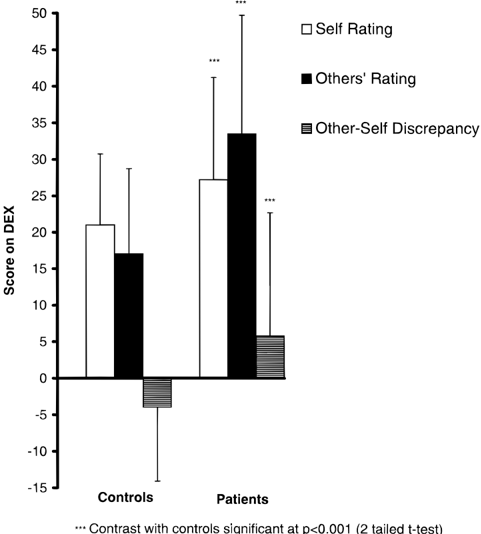
- On the Dysexecutive Questionnaire (DEX), patients rated themselves as showing fewer/less severe dysexecutive signs than observers (t(160) = −2.72, p < .01), whereas controls rated themselves higher than informants (t(331) = 3.65, p < .001), suggesting lack of insight in patients.
- Factor analysis of carer ratings yielded five factors explaining 67.2% of variance (21.3, 15.5, 11.6, 10.6, 8.2%); the first three were Inhibition, Intentionality, and Executive Memory. Executive tests loaded differentially: Factor 1 related to all executive tasks except MWCST; Factor 2 related most strongly to SET (r = .46); Factor 3 related to MWCST and verbal fluency.
- Sensitivity did not explain the factor-test pattern: SET was the second most sensitive measure (33.7% of patients at/below the 5th percentile of controls), Trails B 38.9%, Trails A 32.1%, B-A 25.9%, MWCST Perseverative Errors 28.6%, FAS 10.8%, Animals 8.2%, and Cognitive Estimates 3.6%.
Methods
- 92 neurological patients of varying etiologies (59% head injury, 13% dementia, 8.5% cerebrovascular accidents, 6.5% encephalitis, 13% other; mean age 38.5 years, SD = 15.1; mean NART IQ 103.2; mean WAIS-R FSIQ 92.1) and 216 controls (mean age 46.1 years, SD = 19.8; mean NART IQ 102.7).
- The DEX questionnaire covered 20 dysexecutive symptoms rated 0–4 by a relative/carer and by the participant; the neuropsychological battery included six executive tests (MWCST, Cognitive Estimates, Verbal Fluency FAS, Verbal Fluency Animals, Trail Making, SET) plus background tests of intellect, memory, language, and visual perception.
- Analyses included correlations between DEX total/self/other-self scores and tests, varimax rotated factor analysis of independent raters’ scores, factor score–test correlations, and sensitivity analysis using the proportion of patients at or below the 5th percentile of controls.
Limitations
- Stated: interpretation of Factor 1 was “perhaps premature”; the emotional/personality factors (4 and 5) “would benefit from further research”; and the possible one-way relation between confabulation and perseveration remained unresolved.
- Evident: the control group was significantly older than the patient group (t = 3.46, df = 306, p = .001), though the paper calls this conservative; sample sizes varied widely across tests (e.g., N = 42 to 84), and the design is correlational, so causality cannot be inferred.
- Evident: the DEX relies on subjective self- and carer ratings, and the mixed-etiology sample may limit generalizability to specific neurological groups.
Model-written summary. Check it against the paper before relying on it.
Integrity signals
Registry
Cites
Statistics
Figures
Verification
Claims the paper makes
3 Valid · 1 Not valid · 12 Not checked · 74 Own results and interpretations
The cited sources support only part of this claim — read each source’s verdict below.
In the paper
“By far the strongest relation, however, was with the SET, which supports previous interpretations of the test as tapping processes involved in the creation, maintenance and activation of intentions (Burgess, 1997; Burgess & Shallice, 1997; Goldstein et al., 1993; Shallice & Burgess, 1991a, 1991b).”
What the sources say
- Not checked — no full text of the sourcecites Burgess, 1997
- Not checked — no full text of the sourcecites Burgess & Shallice, 1997
- Partly supportedcites Goldstein et al., 1993 matched to “Unilateral frontal lobectomy can produce strategy application disorder.” (1993) sourceExperimental — accuracy not yet measured
In Additional Tests, the paper uses the Six Element Test (SET) to examine planning ability, which supports the broad interpretation of the test. The Discussion links prospective internal markers for behaviour change to the patient's errors on the Multiple Errands task, not specifically to the SET. The paper does not report a relation between SET performance and Intentionality; the citing sentence appears to present that relation as its own finding. (LLM, conf=0.82)
boostedstates an association- Asserted: passes — The authors put it forward as true.
- Checkable: passes — It can be checked against evidence.
- Load-bearing: passes — The paper’s conclusions depend on it.
- Based: passes — The paper gives a reason why it holds.
The cited sources support only part of this claim — read each source’s verdict below.
In the paper
“By far the strongest relation, however, was with the SET, which supports previous interpretations of the test as tapping processes involved in the creation, maintenance and activation of intentions (Burgess, 1997; Burgess & Shallice, 1997; Goldstein et al., 1993; Shallice & Burgess, 1991a, 1991b).”
What the sources say
- Not checked — no full text of the sourcecites Burgess, 1997
- Not checked — no full text of the sourcecites Burgess & Shallice, 1997
- Partly supportedcites Goldstein et al., 1993 matched to “Unilateral frontal lobectomy can produce strategy application disorder.” (1993) sourceExperimental — accuracy not yet measured
The Additional Tests section describes the Six Element Test as examining planning ability through six tasks completed within a fixed time. The Discussion links prospective triggers for changing behaviour to the patient's difficulties on the Multiple Errands task, not specifically to the Six Element Test. The paper therefore supports a planning-related interpretation of the SET but does not establish the full claim about creating, maintaining and activating intentions. (LLM, conf=0.82)
boostedstates an association- Asserted: passes — The authors put it forward as true.
- Checkable: passes — It can be checked against evidence.
- Load-bearing: passes — The paper’s conclusions depend on it.
- Based: passes — The paper gives a reason why it holds.
A result the paper reports from its own data — it cites no other source for it, so there is none to check. The quote shows it is in the paper.
In the paper
“factor analysis of the patients' dysexecutive symptoms suggested a fractionation of the dysexecutive syndrome”
hedgedstates an association- Asserted: passes — The authors put it forward as true.
- Checkable: passes — It can be checked against evidence.
- Load-bearing: passes — The paper’s conclusions depend on it.
- Based: passes — The paper gives a reason why it holds.
A result the paper reports from its own data — it cites no other source for it, so there is none to check. The quote shows it is in the paper.
In the paper
“with neuropsychological tests loading differentially on 3 underlying cognitive factors (Inhibition, Intentionality, and Executive Memory)”
plainstates an association- Asserted: passes — The authors put it forward as true.
- Checkable: passes — It can be checked against evidence.
- Load-bearing: passes — The paper’s conclusions depend on it.
- Based: passes — The paper gives a reason why it holds.
A result the paper reports from its own data — it cites no other source for it, so there is none to check. The quote shows it is in the paper.
In the paper
“All of the tests were significantly predictive of at least some of the behavioral and cognitive deficits reported by patients' carers.”
plainstates an association- Asserted: passes — The authors put it forward as true.
- Checkable: passes — It can be checked against evidence.
- Load-bearing: passes — The paper’s conclusions depend on it.
- Based: passes — The paper gives a reason why it holds.
56 more claims
Create a free account to see all 90 claims and every source verdict.
- Probably not a substantial claim. 13
- It may state two separate claims as one. 19
- The quote only partly states this claim. 1
Claims other papers make about this one
Each is checked against this paper’s own text: does it say what the citing paper says it does?
The cited source doesn’t support the claim as written.
In the citing paper
“Most troubling from a clinical perspective is that EF tests have low or no ecological validity when judged against ratings of EF in daily life or direct observations of EF performance in natural settings.”
From Impairment in Occupational Functioning and Adult ADHD: The Predictive Utility of Executive Function (EF) Ratings Versus EF Tests (2010) · cites this paper as Burgess et al., 1998
Checked by a reasoning model — may be wrong.
Experimental — accuracy not yet measuredThe cited source doesn’t support the claim as written.
In the citing paper
“These studies typically find that the variance shared between any single EF test and EF ratings ranges from just 0% to 10%.”
From Impairment in Occupational Functioning and Adult ADHD: The Predictive Utility of Executive Function (EF) Ratings Versus EF Tests (2010) · cites this paper as Burgess et al., 1998
Checked by a reasoning model — may be wrong.
Experimental — accuracy not yet measuredThe source backs part of the claim, not all of it — or backs it for a different population, condition or comparison.
In the citing paper
“Thus these results add to the evidence that performance on more 'ecologically valid' tasks can show closer concordance with observed symptoms in everyday life than performance on traditional experimentally derived tasks (Burgess et al., 1998), and can be adapted to a clinical setting.”
From The case for the development and use of ecologically valid measures of executive function in experimental and clinical neuropsychology (2006) · cites this paper as Burgess et al., 1998
Experimental — accuracy not yet measuredThe source backs part of the claim, not all of it — or backs it for a different population, condition or comparison.
In the citing paper
“Past studies found EF tests to have low-order correlations that are often nonsignificant with patient self-ratings and those of significant others of the dysexecutive symptoms they observe in patients with frontal lobe injuries”
From Impairment in Occupational Functioning and Adult ADHD: The Predictive Utility of Executive Function (EF) Ratings Versus EF Tests (2010) · cites this paper as Burgess et al., 1998
Experimental — accuracy not yet measuredThe source backs part of the claim, not all of it — or backs it for a different population, condition or comparison.
In the citing paper
“Combinations of EF tests do not fair much better, sharing just 12% -20% of the variance with EF ratings.”
From Impairment in Occupational Functioning and Adult ADHD: The Predictive Utility of Executive Function (EF) Ratings Versus EF Tests (2010) · cites this paper as Burgess et al., 1998
Experimental — accuracy not yet measured
6 more claims about this paper
Create a free account to see every claim other papers make about this one.
Self-check
Percentages, sums and reported differences re-computed from the paper’s own numbers.
Each contradiction between two passages listed here was confirmed by an independent check.
Rated minor: it would not touch a result — a value no result rests on, a p-value that stays on the same side of the significance level, or a conflict that is clerical, resolved elsewhere in the paper, or outside its own findings.
In the paper
§ Abstract
“including 10 neuropsychological measures of executive function derived from 6 different tests.”
§ INTRODUCTION
“compares the ecological validity of eleven measures of executive function taken from six different tests”
Rated minor: it would not touch a result — a value no result rests on, a p-value that stays on the same side of the significance level, or a conflict that is clerical, resolved elsewhere in the paper, or outside its own findings.
In the paper
§ Correlations Between Overall Severity of Dysexecutive Disorder and the Neuropsychological Test Measures
“all of the tests measuring executive and general intellectual functions, visual perception, and language abilities showed correlations significantly different from zero.”
§ Correlations Between Overall Severity of Dysexecutive Disorder and the Neuropsychological Test Measures
“| Cognitive Estimates ( N 5 52) | .29 n.s. | .18 n.s. | .10 n.s. |”
Citations
Cites
From Neuropsychology to Mental Structure
Shallice, T. (1988) · doi:10.1017/cbo9780511526817 · Cited by 4,072
Amick, D. J., Cooley, W. W., & Lohnes, P. R. (1972) · Contemporary Sociology · doi:10.2307/2062821 · Cited by 2,915
The somatic marker hypothesis and the possible functions of the prefrontal cortex
Damasio, A. R. (1996) · Philosophical Transactions of the Royal Society of London. Series B: Biological Sciences · doi:10.1098/rstb.1996.0125 · Cited by 2,847 · cited 2×
“cal groups: Recent evidence suggests that the dysexecutive syndrome may be fractionable, at least as regards the features of cognitive dysfunction (e.g., Burgess, 1997; Burgess & Shallice, 1994, 1996c; Damasio, 1996; Duncan et al., 1995; Owen et al., 1995; Robbins, 1996; Robbins et al., 1995; Shallice & Burgess, 1991a…”
Background(1995) · Cited by 2,809
A Modified Card Sorting Test Sensitive to Frontal Lobe Defects
Nelson, H. E. (1976) · Cortex · doi:10.1016/s0010-9452(76)80035-4 · Cited by 2,454
Negative Symptoms in Schizophrenia: Definition and Reliability
Andreasen, N. C. (1982) · Archives of General Psychiatry · doi:10.1001/archpsyc.1982.04290070020005 · Cited by 2,247
Effects of Different Brain Lesions on Card Sorting: The Role of the Frontal Lobes
MILNER, B. (1963) · Archives of Neurology · doi:10.1001/archneur.1963.00460070100010 · Cited by 2,217 · cited 2×
“…of some brain process(es) that are presumed to be utilized in situations outside the strict test situation; after all, an isolated impairment in performing the Wisconsin Card Sorting Test (WCST; Milner, 1963), with no other problems in any other situation, would be of little clinical significance.”
BackgroundDEFICITS IN STRATEGY APPLICATION FOLLOWING FRONTAL LOBE DAMAGE IN MAN
SHALLICE, T., & BURGESS, P. W. (1991) · Brain · doi:10.1093/brain/114.2.727 · Cited by 2,017 · cited 5×
“cal groups: Recent evidence suggests that the dysexecutive syndrome may be fractionable, at least as regards the features of cognitive dysfunction (e.g., Burgess, 1997; Burgess & Shallice, 1994, 1996c; Damasio, 1996; Duncan et al., 1995; Owen et al., 1995; Robbins, 1996; Robbins et al., 1995; Shallice & Burgess, 1991a…”
BackgroundMethodResultInfluentialSelf-citationThe neuropsychology of schizophrenia
Gray, J. A., Feldon, J., Rawlins, J. N. P., Hemsley, D. R., & Smith, A. D. (1991) · Behavioral and Brain Sciences · doi:10.1017/s0140525x00065055 · Cited by 1,350
Frontal Lobe Function and Dysfunction
(1991) · doi:10.1093/oso/9780195062847.001.0001 · Cited by 1,233
Research works printed but not linked: 4
- Burgess, P.W., Alderman, N., Wilson, B.A., Evans, J.J., & Emslie, H. (1996b). The Dysexecutive Questionnaire. In B.A. Wilson, N. Alderman, P.W. Burgess, H. Emslie, & J.J. Evans (Eds.), Behavioural assessment of the dysexecutive syndrome . Bury St. Edmunds, U.K.: Thames Valley Test Company.
- Burgess, P.W. & Wood, R.Ll. (1990). Neuropsychology of behaviour disorders following brain injury. In R.Ll. Wood (Ed.), Neurobehavioural sequelae of traumatic brain injury (pp. 110133). London: Taylor & Francis.
- Cicerone, K.D. & DeLuca, J. (1990). Neuropsychological predictors of head injury rehabilitation outcome. Journal of Clinical and Experimental Neuropsychology , 12 , 92 [Abstract].
- Stuss, D.T., Shallice, T., Alexander, M.P., & Picton, T.W. (1995). Amultidisciplinary approach to executive functions. Annals of the New York Academy of Sciences , 769 , 191-211.
Cited by
Items 501–600 of 942
Simblett, S. K., Badham, R., Greening, K., Adlam, A., RING, H. A., & Bateman, A. (2012) · Neuropsychological Rehabilitation · doi:10.1080/09602011.2012.703956 · Cited by 15
Persampiere, J., Poole, G. M., & Murphy, C. M. (2014) · Journal of Family Violence · doi:10.1007/s10896-014-9614-5 · Cited by 22
Inozemtseva, O., Pérez-Solís, L., Matute, E., & Juárez, J. (2016) · Substance Use & Misuse · doi:10.1080/10826084.2016.1178293 · Cited by 16
Pat‐Horenczyk, R., Zamir, O., Yochman, A., Schiff, M., Brickman, S., Lerner, M., & Brom, D. (2019) · Psychological Trauma Theory Research Practice and Policy · doi:10.1037/tra0000479 · Cited by 12
Cantisano, N., Meneï, P., Roualdes, V., Seizeur, R., Allain, P., Gall, D. L., Roy, A., Dinomais, M., & Besnard, J. (2020) · Journal of Cancer Survivorship · doi:10.1007/s11764-020-00961-0 · Cited by 11
Parent and Teacher Ratings of Behavioral Executive Functioning for Students With Dyslexia
Morte-Soriano, M. R., Begeny, J. C., & Ferrer, M. S. (2020) · Journal of Learning Disabilities · doi:10.1177/0022219420981986 · Cited by 19
EVIDENCE FOR AN ASSOCIATION BETWEEN GENDER-ROLE IDENTITY AND A MEASURE OF EXECUTIVE FUNCTION
Norvilitis, J. M., & Reid, H. M. (2002) · Psychological Reports · doi:10.2466/pr0.2002.90.1.35 · Cited by 14
Advances in ADHD Research through the Lifespan: Common themes and implications
Houghton, S. J. (2006) · International Journal of Disability Development and Education · doi:10.1080/10349120600716208 · Cited by 17
Counterfactual Thinking Deficit in Huntington’s Disease
Solca, F., Poletti, B., Zago, S., et al. (2015) · PLoS ONE · doi:10.1371/journal.pone.0126773 · Cited by 11
Oka, M., Nakaaki, S., Negi, A., Miyata, J., Nakagawa, A., Hirono, N., & Mimura, M. (2015) · Psychogeriatrics · doi:10.1111/psyg.12132 · Cited by 11
Outcome measurement in cognitive neurorehabilitation
Lincoln, N. B., & das Nair, R. (2008) · Cambridge University Press eBooks · doi:10.1017/cbo9781316529898.008 · Cited by 13
Zimmermann, N., de Pereira, A. P. A., & Fonseca, R. P. (2014) · Trends in Psychiatry and Psychotherapy · doi:10.1590/2237-6089-2013-0021 · Cited by 14
Filipčíková, M., Wearne, T. A., Li, R., & McDonald, S. (2021) · Journal of Clinical and Experimental Neuropsychology · doi:10.1080/13803395.2021.2000589 · Cited by 14
Caldwell, S. B., Wilson, F. C., McBrinn, J., Carton, S., Delargy, M., McCann, J. P., Walsh, J. C., & McGuire, B. E. (2014) · The Irish Journal of Psychology · doi:10.1080/03033910.2014.921228 · Cited by 13
Bertens, D., Frankenmolen, N. L., Boelen, D. H. E., Kessels, R. P. C., & Fasotti, L. (2014) · Archives of Clinical Neuropsychology · doi:10.1093/arclin/acu093 · Cited by 13
Hilton, D. C., Canu, W. H., & Jarrett, M. A. (2022) · Journal of American College Health · doi:10.1080/07448481.2022.2109038 · Cited by 20
Sato, H., Nakaaki, S., Sato, J., Shikimoto, R., Furukawa, T. A., Mimura, M., & Akechi, T. (2021) · Psychogeriatrics · doi:10.1111/psyg.12740 · Cited by 14
Methodological issues in evaluating the effectiveness of cognitive rehabilitation
Cicerone, K. D. (2005) · Oxford University Press eBooks · doi:10.1093/acprof:oso/9780198526544.003.0005 · Cited by 13
Klenberg, L., Hokkanen, L., Lahti-Nuuttila, P., & Närhi, V. (2017) · Applied Neuropsychology: Child · doi:10.1080/21622965.2016.1177531 · Cited by 11
Fluencia de acciones en personas mayores
Bartolomé, M. V. P., Ladera, V., & Rodríguez, M. (2005) · Psicothema · Cited by 11
A Verbal Planning Impairment in Adult ADHD Indexed by Script Generation Tasks
Desjardins, C., Scherzer, P., Braun, C. M. J., Godbout, L., & Poissant, H. (2010) · Journal of Attention Disorders · doi:10.1177/1087054709347167 · Cited by 10
Salthouse, T. A. (2001) · The European Journal of Cognitive Psychology · doi:10.1080/09541440042000205 · Cited by 11
Crowe, S. F., Mahony, K., & Jackson, M. (2003) · Archives of Clinical Neuropsychology · doi:10.1016/j.acn.2003.09.002 · Cited by 10
de Fockert, J. W., Rees, G. E., Frith, C., & Lavie, N. (2007) · Cited by 10
Goal Setting Deficits at 13 Years in Very Preterm Born Children
Haebich, K. M., Willmott, C., Ellis, R., Burnett, A., Scratch, S. E., Pascoe, L., Spencer‐Smith, M. M., Cheong, J. L. Y., Inder, T. E., Doyle, L. W., et al. (2017) · Journal of the International Neuropsychological Society · doi:10.1017/s1355617717001138 · Cited by 9
Psychometric Properties of the Revised Dysexecutive Questionnaire in a Non-clinical Population
Wakely, H., Radaković, R., Bateman, A., Simblett, S. K., Fish, J. E., & Gracey, F. (2022) · Frontiers in Human Neuroscience · doi:10.3389/fnhum.2022.767367 · Cited by 10
Turkstra, L. S., & Politis, A. (2017) · Perspectives in pragmatics, psychology & philosophy · doi:10.1007/978-3-319-47489-2_12 · Cited by 14
Reichelt, A. C., Killcross, S., Wilkinson, L. S., Humby, T., & Good, M. A. (2013) · Neurobiology of Learning and Memory · doi:10.1016/j.nlm.2013.05.005 · Cited by 12
Conversational fluency and executive function in adolescents with conduct disorder.
Turkstra, L. S., Fuller, T., Youngstrom, E. A., Green, K., & Kuegeler, E. (2004) · PubMed · Cited by 10
Lee, H., Taeg, H. S., SanghwangHong, Lee, E.-H., Yang, M.-J., Joung, Y., & Kim, J. (2016) · The Korean Journal of Clinical Psychology · doi:10.15842/kjcp.2016.35.2.010 · Cited by 10
Herbrich, L., Kappel, V., Winter, S., & van Noort, B. M. (2018) · Child Neuropsychology · doi:10.1080/09297049.2018.1536200 · Cited by 11
From executive control to self-control: predicting problem drinking among college students
Whitney, P. J., Hinson, J. M., & Jameson, T. L. (2006) · Applied Cognitive Psychology · doi:10.1002/acp.1230 · Cited by 16
Marshall, R. C., Karow, C. M., Morelli, C. A., Iden, K. K., & Dixon, J. C. (2003) · Brain Injury · doi:10.1080/0269905031000088496 · Cited by 10
Stavrinou, L. C., Liouta, E., Boviatsis, E., Leonardos, A., Gatzonis, S., Stathis, P. G., Sakas, D. E., & Angelakis, E. (2019) · Clinical Neurology and Neurosurgery · doi:10.1016/j.clineuro.2019.105460 · Cited by 10
Dimitriadou, M., Michaelides, M. P., Bateman, A., & Constantinidou, F. (2018) · Neuropsychological Rehabilitation · doi:10.1080/09602011.2018.1543127 · Cited by 13
Ownsworth, T., Fleming, J., & Hardwick, S. A. (2006) · Brain Impairment · doi:10.1375/brim.7.2.95 · Cited by 13
Scientific Realism and Phenomenology
Reynolds, J. (2017) · Routledge eBooks · doi:10.4324/9781315684413-3 · Cited by 10
Randolph, J. J., & Chaytor, N. S. (2013) · Springer eBooks · doi:10.1007/978-1-4614-6605-5_5 · Cited by 16
Romundstad, B., Solem, S., Brandt, A. E., Hypher, R. E., Risnes, K. R., Rø, T. B., Stubberud, J., & Finnanger, T. G. (2022) · Neuropsychological Rehabilitation · doi:10.1080/09602011.2022.2034649 · Cited by 9
Arnould, A., Rochat, L., Dromer, E., Azouvi, P., & der Linden, M. V. (2016) · Journal of Neuropsychology · doi:10.1111/jnp.12107 · Cited by 9
Steinmetz, J., Vögele, C., Theisen-Flies, C., Federspiel, C., & Sütterlin, S. (2016) · Psychology Research and Behavior Management · doi:10.2147/prbm.s108322 · Cited by 9
Planning Abilities in Patients with Anorexia Nervosa Compared with Healthy Controls
Carral-Fernández, L., González‐Blanch, C., Goddard, E., Gómez, J. G., Benito-González, P., Bustamante-Cruz, E., & del Barrio, A. G. (2016) · The Clinical Neuropsychologist · doi:10.1080/13854046.2016.1147603 · Cited by 9
Burke, T., Wynne, B., O’Brien, C., Elamin, M., Bede, P., Hardiman, O. M., & Pender, N. P. (2014) · The Irish Journal of Psychology · doi:10.1080/03033910.2015.1044554 · Cited by 10
Attention and intended action in multitasking: An understanding of cognitive workload
Khanganba, S. P. (2013) · Displays · doi:10.1016/j.displa.2013.09.001 · Cited by 9
CAN SOCIAL MEDIA BE A TOOL FOR INCREASING TOURISTS’ ENVIRONMENTALLY RESPONSIBLE BEHAVIOR?
Haque, E., Sungsuwan, T., & Sanglimsuwan, S. (2021) · GeoJournal of Tourism and Geosites · doi:10.30892/gtg.38428-762 · Cited by 18
Hughes, A., Wilson, F. C., Trew, K., & Emslie, H. C. (2013) · The Irish Journal of Psychology · doi:10.1080/03033910.2012.754323 · Cited by 12
Self-citationCognitive-motor interaction during virtual reality trail making
Ben‐Gal, O., Doniger, G. M., Cohen, M., Bahat, Y., Beeri, M. S., Zeilig, G., & Plotnik, M. (2019) · International Conference on Virtual Rehabilitation · doi:10.1109/icvr46560.2019.8994386 · Cited by 10
Wood, R. L. (2009) · Journal of Head Trauma Rehabilitation · doi:10.1097/htr.0b013e31819b118a · Cited by 11
Assessing Children’s Executive Function: BADS-C Validity
Fish, J. E., & Wilson, F. C. (2021) · Frontiers in Psychology · doi:10.3389/fpsyg.2021.626291 · Cited by 14
Longitudinal Course and Predictors of Apathetic Symptoms after Severe Traumatic Brain Injury
Arnould, A., Rochat, L., Azouvi, P., & der Linden, M. V. (2017) · Archives of Clinical Neuropsychology · doi:10.1093/arclin/acx122 · Cited by 10
The Paradox of the Frontal Lobe Paradox. A Scoping Review
Newstead, S., Lewis, J., Roderique‐Davies, G., Heirene, R. M., & John, B. (2022) · Frontiers in Psychiatry · doi:10.3389/fpsyt.2022.913230 · Cited by 13
Good things better? Reappraisal and discrete emotions in acquired brain injury
Rowlands, L., Coetzer, R., & Turnbull, O. H. (2019) · Neuropsychological Rehabilitation · doi:10.1080/09602011.2019.1620788 · Cited by 11
Farias, D., Davis, C. H., & Wilson, S. M. (2014) · Aphasiology · doi:10.1080/02687038.2014.886323 · Cited by 10
Visual reproduction test in normal elderly: Influence of schooling and visual task complexity
de Brito-Marques, P. R., Cabral‐Filho, J. E., & Miranda, R. M. (2012) · Dementia & Neuropsychologia · doi:10.1590/s1980-57642012dn06020005 · Cited by 11
Assessment and development of executive functions in school-age children
Klenberg, L. (2015) · Helda - University of Helsinki Institutional Repository · Cited by 36
Rehabilitation of Executive Functions: Implications and Strategies
Kluwe‐Schiavon, B., Sanvicente‐Vieira, B., Viola, T. W., Souza, L. S. A. E., Rigoli, M. M., Fonseca, R. P., & Grassi‐Oliveira, R. (2013) · LA Referencia (Red Federada de Repositorios Institucionales de Publicaciones Científicas) · Cited by 8
Ecological validity of manual grasping movements in an everyday-like grocery shopping task
Kim, K., & Bock, O. L. (2019) · Experimental Brain Research · doi:10.1007/s00221-019-05496-0 · Cited by 7
Selbst- und Fremdwahrnehmung von Beeinträchtigungen exekutiver Funktionen bei Erwachsenen mit ADHS
Rizzo, P., Steinhausen, H., & Drechsler, R. (2012) · Zeitschrift für Psychiatrie Psychologie und Psychotherapie · doi:10.1024/1661-4747/a000108 · Cited by 12
VanNostrand, M., Belanger, B., Purin, G., Kasser, S. L., & Cannizzaro, M. S. (2022) · Motor Control · doi:10.1123/mc.2021-0051 · Cited by 9
Executive Control Processes: Dimensions, Development and ADHD
Brocki, K. C. (2007) · Uppsala University Publications (Uppsala University) · Cited by 13
Basal Forebrain Amnesia: A Case Study
Osimani, A., Vakil, E., Blinder, G., Sobel, R., & Abarbanel, J. M. (2006) · Cognitive and Behavioral Neurology · doi:10.1097/01.wnn.0000213901.82697.d5 · Cited by 8
Counterfactual Thinking in Tourette’s Syndrome: A Study Using Three Measures
Zago, S., Ponti, A. D., Mastroianni, S., Solca, F., Tomasini, E., Poletti, B., Inglese, S., Sartori, G., & Porta, M. (2014) · Behavioural Neurology · doi:10.1155/2014/256089 · Cited by 10
Treating attention impairments: Review with a particular focus on naturalistic action rehabilitation
Park, N. W., & Barbuto, E. (2005) · Oxford University Press eBooks · doi:10.1093/acprof:oso/9780198526544.003.0008 · Cited by 11
Skymba, H. V., Shields, A. N., Rauch, A. A., Phillips, M. S., Bing‐Canar, H., Finley, J. A., Khan, H. M., Ovsiew, G. P., Durkin, N. M., Jennette, K. J., et al. (2023) · Journal of Clinical and Experimental Neuropsychology · doi:10.1080/13803395.2023.2203464 · Cited by 8
Steinmetz, J., Theisen-Flies, C., & Federspiel, C. (2014) · Applied Research in Quality of Life · doi:10.1007/s11482-014-9365-8 · Cited by 8
Buczyłowska, D., Daseking, M., & Petermann, F. (2016) · Zeitschrift für Neuropsychologie · doi:10.1024/1016-264x/a000179 · Cited by 9
Tried, tested and trusted? Language assessment for rehabilitation
Nickels, L. (2005) · Oxford University Press eBooks · doi:10.1093/acprof:oso/9780198526544.003.0015 · Cited by 9
Pitta, A. (2026) · Frontiers in Psychology · doi:10.3389/fpsyg.2026.1713652 · Cited by 11
Aita, S. L., Moncrief, G. G., Carrillo, A., Greene, J., Trujillo, S., Gioia, G. A., Isquith, P. Κ., & Roth, R. M. (2021) · Child Neuropsychology · doi:10.1080/09297049.2021.1998408 · Cited by 7
Rau, H., Suchy, Y., Butner, J., & Williams, P. (2015) · Psychological Research · doi:10.1007/s00426-015-0706-5 · Cited by 9
Józsa, G., & Józsa, K. (2020) · Magyar Pedagógia · doi:10.17670/mped.2020.1.47 · Cited by 14
The effective treatment of memory-related disabilities
Wilson, B. A. (2005) · Oxford University Press eBooks · doi:10.1093/acprof:oso/9780198526544.003.0013 · Cited by 7
Self-citationThe neural basis for a theory of cognitive rehabilitation
Robertson, I. H. (2005) · Oxford University Press eBooks · doi:10.1093/acprof:oso/9780198526544.003.0023 · Cited by 8
Impaired executive function in everyday life: A predictor of OCD relapse?
Fournet, N., Achachi, O., Roy, A., Besnard, J., Lancelot, C., Le Gall, D., & Bouvard, M. (2019) · Journal of Behavioral and Brain Science · doi:10.4236/jbbs.2019.93008 · Cited by 7
Pre-injury assessment of everyday executive function in moderate to severe traumatic brain injury
Hart, T., Rabinowitz, A. R., Whyte, J., & Kim, J. (2017) · Neuropsychological Rehabilitation · doi:10.1080/09602011.2017.1364271 · Cited by 7
Gatz, J. A., Kelly, A. M., & Clark, S. L. (2018) · The Journal of Early Adolescence · doi:10.1177/0272431618770786 · Cited by 12
Towards the Validation of Executive Functioning Assessments: A Clinical Study
Faber, D. R., Große, G. M., Klietz, M., Petri, S., Schwenkenbecher, P., Sühs, K., & Kopp, B. (2022) · Journal of Clinical Medicine · doi:10.3390/jcm11237138 · Cited by 8
Suchy, Y. (2020) · The Clinical Neuropsychologist · doi:10.1080/13854046.2020.1748827 · Cited by 9
Hildebrandt, S. (2017) · Wiley eBooks · doi:10.1002/9781119557036.ch10 · Cited by 14
The Iowa Gambling Task on HIV-infected subjects
(2019) · doi:10.1016/j.jiac.2019.09.008 · Cited by 7
Yosef, A. B., Refaeli, N., Jacobs, J. M., Shames, J., & Gilboa, Y. (2022) · International Journal of Environmental Research and Public Health · doi:10.3390/ijerph191811408 · Cited by 8
Studying hot executive function in infancy: Insights from research on emotional development
Castillo, A., & Lopez, L. D. (2022) · Infant Behavior and Development · doi:10.1016/j.infbeh.2022.101773 · Cited by 10
Evaluating Executive Functioning Deficits in Everyday Life
Barkley, R. A. (2010) · The ADHD Report · doi:10.1521/adhd.2010.18.6.9 · Cited by 8
Cognitive rehabilitation and its relationship to cognitive-neuropsychological rehabilitation
Coltheart, M., Brunsdon, R. K., & Nickels, L. (2005) · Oxford University Press eBooks · doi:10.1093/acprof:oso/9780198526544.003.0002 · Cited by 10
de Braek, D. M. J. M. S.-I., Deckers, K., Kleinhesselink, T., Banning, L. C. P., & Ponds, R. (2019) · Sports · doi:10.3390/sports7040089 · Cited by 7
For a theory of cognitive rehabilitation: Progress in the decade of the brain
Hillis, A. E. (2005) · Oxford University Press eBooks · doi:10.1093/acprof:oso/9780198526544.003.0022 · Cited by 9
Aita, S. L., Holding, E. Z., Greene, J., Carrillo, A., Moncrief, G. G., Isquith, P. Κ., Gioia, G. A., & Roth, R. M. (2022) · Child Neuropsychology · doi:10.1080/09297049.2022.2060201 · Cited by 7
Évaluations écologiques du syndrome dysexécutif: un défi de taille pour l’ergothérapie
Poncet, F., Taillefer, C., Chevignard, M., Picq, C., & Pradat-Diehl, P. (2009) · La Lettre de médecine physique et de réadaptation · doi:10.1007/s11659-009-0138-y · Cited by 13
Contribution of working memory components to the performance of the tower of hanoi in schizophrenia.
Chan, R. C. K., Wang, Y. N., Cao, X. Y., & Chen, E. Y. H. (2010) · PubMed · Cited by 9
Psychometric properties of the Dysexecutive Questionnaire (DEX): a study with Brazilian older adults
de Oliveira, C. R., de Lima, M. M. B. M. P., Barroso, S. M., & Argimon, I. I. D. L. (2021) · Psico-USF · doi:10.1590/1413-8271202126nesp10 · Cited by 10
Cognitive rehabilitation and traumatic brain injury
van den Broek, M. D. (1999) · Reviews in Clinical Gerontology · doi:10.1017/s0959259899009363 · Cited by 9
Hart, W., Garrison, K., Lambert, J. T., & Hall, B. T. (2024) · Psychological Reports · doi:10.1177/00332941241267712 · Cited by 9
The structure of executive functions in athletes: A latent variable approach
Brimmell, J., Edwards, E. J., Uiga, L., Wood, G., & Vaughan, R. S. (2025) · Psychology of sport and exercise · doi:10.1016/j.psychsport.2025.102808 · Cited by 7
Six elements test vs D-KEFS: what does “Ecological Validity” tell us?
Suchy, Y., Mora, M. G., Brothers, S. L., & DesRuisseaux, L. A. (2024) · Journal of the International Neuropsychological Society · doi:10.1017/s1355617723000723 · Cited by 7
Carer burden and positive gain in dementia
George, C., & Ferreira, N. B. (2020) · Working with Older People · doi:10.1108/wwop-02-2020-0009 · Cited by 8
Propriedades psicométricas da versão Torga do Teste Stroop
Garcia, I. Q., Pessoa, I. A., Monteiro, B., Daniel, F., Lemos, L., & Espírito‐Santo, H. (2016) · Revista Portuguesa de Investigação Comportamental e Social · doi:10.7342/ismt.rpics.2016.2.2.41 · Cited by 10
Speyer, R., Chen, Y.-W. R., Kim, J., Wilkes‐Gillan, S., Nordahl‐Hansen, A., Wu, H. C., & Cordier, R. (2021) · Review Journal of Autism and Developmental Disorders · doi:10.1007/s40489-021-00250-1 · Cited by 11
Connecting Cognitive Science and Neuroscience to Education
Daley, S. G. (2006) · Cited by 6
Assessment of Executive Function for Schizophrenia in Hong Kong
Chen, E. Y. H., & Chan, R. C. K. (2005) · The HKU Scholars Hub (University of Hong Kong) · Cited by 14
Metadata
- Authors
- BURGESS, P. W., ALDERMAN, N., EVANS, J., EMSLIE, H., & WILSON, B. A.
- Affiliations
- University College London (GB)
- St Andrew's Healthcare (GB)
- Medical Research Council (GB)
- Venue
- Journal of the International Neuropsychological Society
- Publisher
- Cambridge University Press (CUP)
- Published
- 1998-11
- Volume
- 4
- Issue
- 6
- Pages
- 547-558
- ISSN
- 1355-6177 (ISSN-L)
- 1469-7661
- OpenAlex
- W2168551754
- Semantic Scholar
- 2b9e16b2fef686e2c5c62d5c3d88d54418ec6472
- Cited by
- 932
- References
- 47
- Citations by year
- 2026: 16 · 2025: 21 · 2024: 23 · 2023: 21 · 2022: 30 · 2021: 45 · 2020: 37 · 2019: 35 · 2018: 31 · 2017: 50 · 2016: 55 · 2015: 40 · 2014: 55 · 2013: 46 · 2012: 55
- FWCI
- 9.00
- Type
- journal article
- Language
- en
- Open access
- green
- discovery.ucl.ac.uk
- Locations
- Journal of the International Neuropsychological Society (publishedVersion)
- PubMed (publishedVersion)
- UCL Discovery (University College London) (submittedVersion)
- Funders
- Wellcome Trust
- Topics
- Social Sciences › Psychology › Clinical Psychology › Historical and Modern Theater Studies
- Social Sciences › Psychology › Experimental and Cognitive Psychology › Cognitive Functions and Memory
- Life Sciences › Neuroscience › Cognitive Neuroscience › Neural and Behavioral Psychology Studies
- Keywords
- executive function, dysexecutive syndrome, ecological validity, neuropsychological assessment, everyday problems, inhibition, intentionality, neurological patients
- MeSH terms
- Adult, Mental Disorders, Brain Diseases, Cognition Disorders, Frontal Lobe, Humans, Neuropsychological Tests, Surveys and Questionnaires, Severity of Illness Index, Syndrome, Reproducibility of Results
About these checks
Registry, retraction, Cites and statistics results are computed, not judged, with one exception: a printed reference that no index lists is read once by a model before it counts as a citation error. Claims are extracted by a model and kept only when their quote appears verbatim in the text; each cited source is then checked, with a model’s help, for whether it says what the claim relies on. Those verdicts can be wrong — read the claim’s quote and the cited source before relying on one.
The claim verdicts this report counts are experimental: their accuracy is not yet measured.
A language model drew the claims from the paper on 2026-09-29, under version 3 of the claim definition (model deepseek-v4.1-flash, prompt extract-v3).
A second model labelled each claim on 2026-09-29 (model jev-1.13-20260917, definition revision gold-guideline-v0.2).
Cited sources are checked with a language model’s help (gpt-6-sol).
Statistics and arithmetic are recomputed, not judged.
Confidence bands are shown only for fields calibrated on our annotated test set. None is calibrated yet, so no band is shown.
What counts as a claim ›How we measure confidence ›How we check this ›
Are you an author, or do you see a problem with this page? Request a review
Data sources
Bibliographic data: Semantic Scholar, OpenAlex, Crossref.
Contains information from the Semantic Scholar Academic Graph Datasets, made available under the ODC Attribution License (ODC-BY 1.0).
Semantic Scholar’s data is described in: Kinney, R., et al. (2023). The Semantic Scholar Open Data Platform. arXiv:2301.10140.
