

Developing expert political judgment: The impact of training and practice on judgmental accuracy in geopolitical forecasting tournaments
Open accessThe DOI matches its Crossref record; 107 of the 107 references it cites were found in a registry or an index; 2 of the 29 sources its claims cite were checked for support.
Abstract
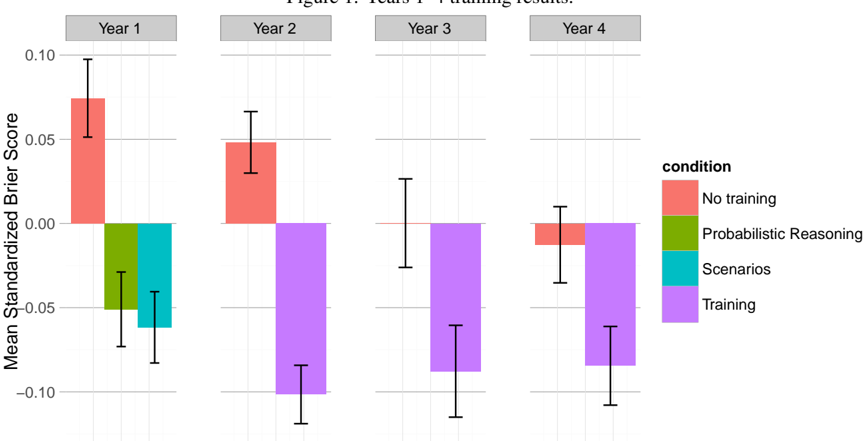
The heuristics-and-biases research program highlights reasons for expecting people to be poor intuitive forecasters. This article tests the power of a cognitive-debiasing training module (“CHAMPS KNOW”) to improve probability judgments in a four-year series of geopolitical forecasting tournaments sponsored by the U.S. intelligence community. Although the training lasted less than one hour, it consistently improved accuracy (Brier scores) by 6 to 11% over the control condition. Cognitive ability and practice also made largely independent contributions to predictive accuracy. Given the brevity of the training tutorials and the heterogeneity of the problems posed, the observed effects are likely to be lower-bound estimates of what could be achieved by more intensive interventions. Future work should isolate which prongs of the multipronged CHAMPS KNOW training were most effective in improving judgment on which categories of problems.
Overview
CoChat Summary
## TL;DR
Across four years of geopolitical forecasting tournaments, a brief CHAMPS KNOW training module consistently improved forecast accuracy, with Brier score improvements of 6% to 11% over controls. Cognitive ability and targeted practice also predicted accuracy, while cognitive motivation measures and interaction effects were generally not supported.
## Key findings
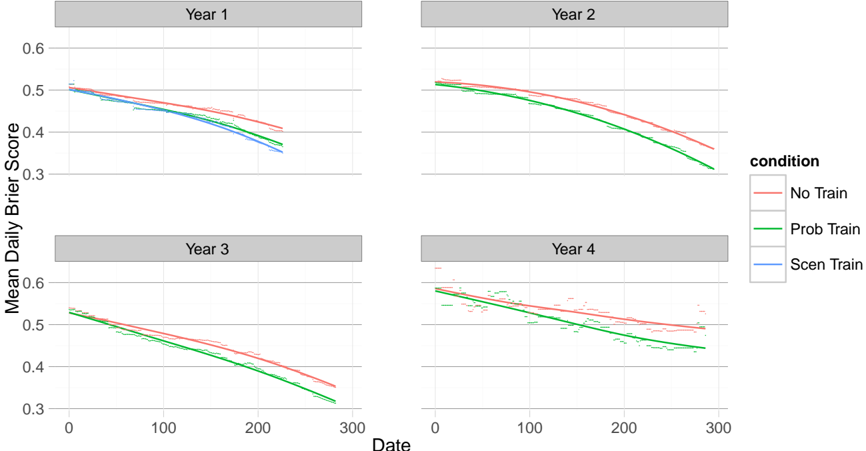
- Training improved accuracy in every tournament year: year 1 probability training improved mean Brier scores by 10% and scenario training by 11% relative to control; year 2 training improved scores by 12%; year 3 by 6%; and year 4 by 7%.
- The abstract says the training lasted less than one hour and improved accuracy (Brier scores) by 6% to 11% over the control condition.
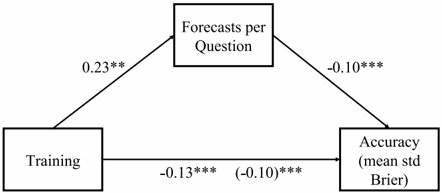
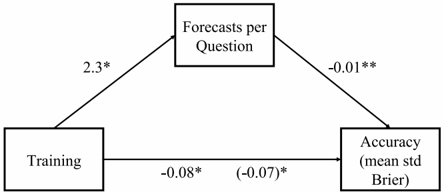
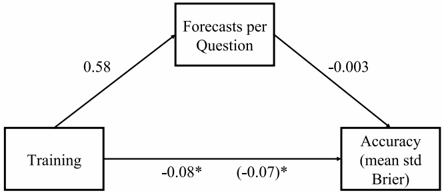
- Targeted practice mediated the training–accuracy relationship in 3 of 4 years; for year 2 the indirect effect was not significant, while for year 1 the bootstrapped indirect effect was -0.02 with a 95% CI of -0.04 to -0.01 (p = 0.01), and for year 3 it was -0.02 with a 95% CI of -0.04 to -0.01 (p = 0.05).
- Across all years, the predictors in the authors’ framework explained 10% to 20% of the variance in forecasting accuracy; cognitive ability was significant in all four years, and training was significant in all four years.
## Methods
- Four geopolitical forecasting tournaments were run between September 2011–April 2012, June 2012–April 2013, August 2013–May 2014, and August 2014–May 2015; subjects submitted probability estimates on a custom internet platform.
- Subjects were randomly assigned to training or control conditions after completing a survey with individual-differences measures including Raven’s Progressive Matrices, Cognitive Reflection Test, Berlin Numeracy Test, grit, and actively open-minded thinking; each year they answered between 100 and 150 national-security-relevant questions.
- Accuracy was measured with the traditional Brier score, and analyses used mean standardized Brier scores; the paper reports ANOVAs, t-tests, mediation analyses with bootstrapping (10,000 samples), and regressions to test training, practice, experience, and individual-differences effects.
## Limitations
- The authors state that the training was designed to win a forecasting tournament and was “solely outcome focused” rather than designed to isolate the incremental effectiveness of each principle.
- The paper states that it did not directly measure cognitive exertion, so it could not directly test deliberate practice as conceived by Ericsson; this is a stated limitation.
- Evident from the text: the forecasters chose which questions to answer, and the paper standardizes Brier scores within questions to control for differing question difficulty, which means comparisons rely on the study’s scoring adjustments rather than identical task exposure.
Model-written summary. Check it against the paper before relying on it.
Integrity signals
Registry
Cites
Statistics
Figures
Verification
Claims the paper makes
2 Valid · 0 Not valid · 15 Not checked · 64 Own results and interpretations
A result the paper reports from its own data — it cites no other source for it, so there is none to check. The quote shows it is in the paper.
In the paper
“Cognitive ability and practice also made largely independent contributions to predictive accuracy.”
plainstates an association- Asserted: passes — The authors put it forward as true.
- Checkable: passes — It can be checked against evidence.
- Load-bearing: passes — The paper’s conclusions depend on it.
- Based: passes — The paper gives a reason why it holds.
A result the paper reports from its own data — it cites no other source for it, so there is none to check. The quote shows it is in the paper.
In the paper
“Analysis of which reasoning principles were associated with greater accuracy revealed that self-reported use of comparison classes was correlated with lower Brier scores.”
plainstates an association- Asserted: passes — The authors put it forward as true.
- Checkable: passes — It can be checked against evidence.
- Load-bearing: unclear — It is unclear whether the paper’s conclusions depend on it.
- Based: passes — The paper gives a reason why it holds.
- Rests on an assumption not shown here.
A result the paper reports from its own data — it cites no other source for it, so there is none to check. The quote shows it is in the paper.
In the paper
“Across all years, these predictors collectively explained 10-20% of the variance in forecasting accuracy (Table 16).”
plainstates an association- Asserted: passes — The authors put it forward as true.
- Checkable: passes — It can be checked against evidence.
- Load-bearing: passes — The paper’s conclusions depend on it.
- Based: passes — The paper gives a reason why it holds.
A result the paper reports from its own data — it cites no other source for it, so there is none to check. The quote shows it is in the paper.
In the paper
“This interaction effect was not significant in later years.”
plain- Asserted: passes — The authors put it forward as true.
- Checkable: passes — It can be checked against evidence.
- Load-bearing: unclear — It is unclear whether the paper’s conclusions depend on it.
- Based: passes — The paper gives a reason why it holds.
A result the paper reports from its own data — it cites no other source for it, so there is none to check. The quote shows it is in the paper.
In the paper
“The effects of training were consistently significant, but a subject merely having prior experience in a year of the tournament did not yield significant improvements in Brier score (results from year 4 shown in Table 9).”
plainstates a cause- Asserted: passes — The authors put it forward as true.
- Checkable: passes — It can be checked against evidence.
- Load-bearing: passes — The paper’s conclusions depend on it.
- Based: passes — The paper gives a reason why it holds.
35 more claims
Create a free account to see all 81 claims and to verify the 2 references still open.
- Probably not a substantial claim. 19
- It may state two separate claims as one. 27
- The quote only partly states this claim. 2
Claims other papers make about this one
Each is checked against this paper’s own text: does it say what the citing paper says it does?
The cited source says what the claim attributes to it.
In the citing paper
“For example, the GJP found that just one hour of randomly assigned training had a substantial, persistent impact on improving forecasters' Brier scores (Chang et al. 2016).”
From The Value of Precision in Probability Assessment: Evidence from a Large-Scale Geopolitical Forecasting Tournament (2018) · cites this paper as Chang et al. 2016
Statistics recomputed
Every reported test result, recomputed from its test statistic and degrees of freedom. A result shows as not adding up only once an independent check has confirmed it.
- ConsistentF(2, 381) = 12.1reported p < .001 · recomputed p < .001
“F (2, 381) = 12.1, p < .001”
- Consistentt(395) = 5.95reported p < .001 · recomputed p < .001
“t (395) = 5.95, p < .001”
- Consistentt(207) = 2.32reported p = .021 · recomputed p = .021
“t (207) = 2.32, p = .021”
- Consistentt(225) = 2.2reported p = .028 · recomputed p = .029
“t (225) = 2.20, p = .028”
Self-check
Percentages, sums and reported differences re-computed from the paper’s own numbers.
Each contradiction between two passages listed here was confirmed by an independent check.
Rated minor: it would not touch a result — a value no result rests on, a p-value that stays on the same side of the significance level, or a conflict that is clerical, resolved elsewhere in the paper, or outside its own findings.
In the paper
§ 3.1 Effects of training
“Finally, in year 4, training was also significant, (trained n = 131, M Std Brier Score = -0.01, SD Std = 0.26, control n = 102, M StdBrierScore = -0.08, SD Std = 0.24), t (225) = 2.20, p = .028, a 7% score improvement.”
§ 3.2 Impact of reasoning principles on accuracy
“| Year 4 | No training | 131 | 0.38 | 0.01 | 0.10 | -0.01 | 0.26 | 0.02 | | | | Training | 102 | 0.35 | 0.01 | 0.10 | -0.08 | 0.24 | 0.02 | 7% |”
Rated minor: it would not touch a result — a value no result rests on, a p-value that stays on the same side of the significance level, or a conflict that is clerical, resolved elsewhere in the paper, or outside its own findings.
In the paper
§ 3.1 Effects of training
“In year 3, training was associated with better performance (trained n = 97, M Std Brier Score = -0.08, SD Std = 0.27, control n = 116, M Std Brier Score = 0.00, SD Std = 0.28), t (207) = 2.32, p = .021, with trained individuals again achieving greater accuracy than controls, a 6% score improvement.”
§ 3.2 Impact of reasoning principles on accuracy
“| Year 3 | No training | 116 | 0.34 | 0.01 | 0.09 | 0.00 | 0.28 | 0.03 | | | | Training | 97 | 0.32 | 0.01 | 0.09 | -0.09 | 0.27 | 0.03 | 6% |”
Citations
Cites
Tversky, A., & Kahneman, D. (1974) · Science · doi:10.1126/science.185.4157.1124 · Cited by 28,810 · cited 1×
“Research in judgment and choice has found numerous flaws in people’s intuitive understanding of probability (Bar-Hillel, 1980; Kahneman & Tversky, 1973, 1984; Lichten-stein, Slovic, Fischhoff, Layman & Combs, 1978; Slovic & Fischhoff, 1977; Tversky & Kahneman, 1974).”
Advances In Experimental Social Psychology
(2022) · Advances in Experimental Social Psychology · doi:10.1016/s0065-2601(22)x0002-6 · Cited by 22,259
Metacognition and cognitive monitoring: A new area of cognitive–developmental inquiry
Flavell, J. H. (1979) · American Psychologist · doi:10.1037/0003-066x.34.10.906 · Cited by 11,282 · cited 1×
“Recognition is only the first step and activating deliberate overrides requires self-awareness of error potential, a meta-cognitive skill (Croskerry, 2003; Flavell, 1979; Graber, 2003; Nelson & Narens, 1994).”
The role of deliberate practice in the acquisition of expert performance
Ericsson, K. A., Krampe, R. T., & Tesch-Römer, C. (1993) · Psychological Review · doi:10.1037/0033-295x.100.3.363 · Cited by 9,564 · cited 1×
“Sustained improvement likely requires practice that reinforces learning and facilitates deeper thought (Ericsson, 2006, 2008; Ericsson et al., 1993).”
BackgroundInternational Norm Dynamics and Political Change
Finnemore, M., & Sikkink, K. (1998) · International Organization · doi:10.1162/002081898550789 · Cited by 8,292 · cited 1×
“The additional KNOW module encouraged forecasters to under-https (Finnemore & Sikkink, 1998; Keohane, 2005), seek out other political perspectives and be aware of potential wildcard scenarios (Taleb, 2010).”
Grit: perseverance and passion for long-term goals
Duckworth, A. L., Peterson, C., Matthews, M. D., & Kelly, D. R. (2007) · Journal of Personality and Social Psychology · doi:10.1037/0022-3514.92.6.1087 · Cited by 6,911
Kahneman, D., & Tversky, A. (1984) · American Psychologist · doi:10.1037/0003-066x.39.4.341 · Cited by 6,544
On the psychology of prediction.
Kahneman, D., & Tversky, A. (1973) · Psychological Review · doi:10.1037/h0034747 · Cited by 6,202 · cited 3×
“Research in judgment and choice has found numerous flaws in people’s intuitive understanding of probability (Bar-Hillel, 1980; Kahneman & Tversky, 1973, 1984; Lichten-stein, Slovic, Fischhoff, Layman & Combs, 1978; Slovic & Fischhoff, 1977; Tversky & Kahneman, 1974).”
Cognitive Reflection and Decision Making
Frederick, S. (2005) · Journal of Economic Perspectives · doi:10.1257/089533005775196732 · Cited by 5,256
Development and validation of the short grit scale (grit-s)
Duckworth, A. L., & Quinn, P. D. (2009) · Journal of Personality Assessment · doi:10.1080/00223890802634290 · Cited by 3,376
Research works printed but not linked: 2
- Gigerenzer, G., Todd, P.M., & the ABC Research Group. (1999). Simple Heuristics That Make Us Smart. New York, NY: Oxford University Press.
- Surowiecki, J. (2005). The wisdom of crowds . New York, NY: Anchor.
Cited by
Five things you should know about cost overrun
Flyvbjerg, B., Ansar, A., Budzier, A., Buhl, S., Cantarelli, C., Garbuio, M., Glenting, C., Holm, M. S., Lovallo, D., Lunn, D., et al. (2018) · Transportation Research Part A: Policy and Practice · doi:10.1016/j.tra.2018.07.013 · Cited by 238
Expert biases in technology foresight. Why they are a problem and how to mitigate them
Bonaccorsi, A., Apreda, R., & Fantoni, G. (2020) · Technological Forecasting and Social Change · doi:10.1016/j.techfore.2019.119855 · Cited by 160
Regression to the tail: Why the Olympics blow up
Flyvbjerg, B., Budzier, A., & Lunn, D. (2020) · Environment and Planning A Economy and Space · doi:10.1177/0308518x20958724 · Cited by 163
“2008, Batselier and Vanhoucke 2016 and 2017, Chang et al. 2016, Horne 2007). Further de-biasing should be carried out, following Kahneman et al. (2011) and Flyvbjerg (2013). Based on the dataset presented above,”
The Cost-Benefit Fallacy: Why Cost-Benefit Analysis Is Broken and How to Fix It
Flyvbjerg, B., & Bester, D. W. (2021) · Journal of Benefit-Cost Analysis · doi:10.1017/bca.2021.9 · Cited by 98
Restructuring structured analytic techniques in intelligence
Chang, W., Berdini, E., Mandel, D. R., & Tetlock, P. E. (2017) · Intelligence & National Security · doi:10.1080/02684527.2017.1400230 · Cited by 97
Self-citationA survey of human judgement and quantitative forecasting methods
Zellner, M., Abbas, A. E., Budescu, D. V., & Galstyan, A. (2021) · Royal Society Open Science · doi:10.1098/rsos.201187 · Cited by 129
Communicating uncertainty using words and numbers
Dhami, M. K., & Mandel, D. R. (2022) · Trends in Cognitive Sciences · doi:10.1016/j.tics.2022.03.002 · Cited by 69
Friedman, J. A., Baker, J. D., Mellers, B. A., Tetlock, P. E., & Zeckhauser, R. (2018) · International Studies Quarterly · doi:10.1093/isq/sqx078 · Cited by 58
“…that even low-quality probability assessors can improve their probability assessments through training and feedback.35 For example, the GJP found that just one hour of randomly assigned training had a substantial, persistent impact on improving forecasters’ Brier scores (Chang et al. 2016).”
BackgroundSelf-citationDeep limitations? Examining expert disagreement over deep learning
Cremer, C. Z. (2021) · Progress in Artificial Intelligence · doi:10.1007/s13748-021-00239-1 · Cited by 74
“Experts who did not receive training in forecasting tend to have poor predictive judgement [29–31], even in their field of expertise and especially for long timescales.”
BackgroundBoosting: Empowering Citizens with Behavioral Science
Herzog, S. M., & Hertwig, R. (2024) · Annual Review of Psychology · doi:10.1146/annurev-psych-020924-124753 · Cited by 94
Small steps to accuracy: Incremental belief updaters are better forecasters
Atanasov, P. D., Witkowski, J., Ungar, L., Mellers, B. A., & Tetlock, P. E. (2020) · Organizational Behavior and Human Decision Processes · doi:10.1016/j.obhdp.2020.02.001 · Cited by 50
Self-citationBeard, S., Rowe, T. D., & Fox, J. (2019) · Futures · doi:10.1016/j.futures.2019.102469 · Cited by 56
Bias, Information, Noise: The BIN Model of Forecasting
Satopää, V., Salikhov, M., Tetlock, P. E., & Mellers, B. A. (2020) · Management Science · doi:10.1287/mnsc.2020.3882 · Cited by 66
Self-citationForecasting tournaments, epistemic humility and attitude depolarization
Mellers, B., Tetlock, P., & Arkes, H. R. (2019) · Cognition · doi:10.1016/j.cognition.2018.10.021 · Cited by 46
Self-citationDecision making can be improved through observational learning
Yoon, H., Scopelliti, I., & Morewedge, C. K. (2021) · Organizational Behavior and Human Decision Processes · doi:10.1016/j.obhdp.2020.10.011 · Cited by 40
Accountability and adaptive performance under uncertainty: A long-term view
Chang, W., Atanasov, P. D., Patil, S. V., Mellers, B. A., & Tetlock, P. E. (2017) · Judgment and Decision Making · doi:10.1017/s1930297500006732 · Cited by 47
“We made a good faith effort to construct a form of process accountability, organized around a training system that did repeatedly work in this task environment (Chang et al., 2016).”
BackgroundMethodResultSelf-citationImproving information evaluation for intelligence production
Irwin, D., & Mandel, D. R. (2019) · Intelligence & National Security · doi:10.1080/02684527.2019.1569343 · Cited by 46
Irwin, D., & Mandel, D. R. (2022) · Risk Analysis · doi:10.1111/risa.14009 · Cited by 40
Actively open-minded thinking is key to combating fake news: A multimethod study
Mirhoseini, M., Early, S., Shamy, N. E., & Hassanein, K. (2023) · Information & Management · doi:10.1016/j.im.2023.103761 · Cited by 56
Mandel, D. R., & Irwin, D. (2021) · Judgment and Decision Making · doi:10.1017/s1930297500008603 · Cited by 30
Curbing cost overruns in infrastructure investment
Park, J. E. (2021) · European journal of transport and infrastructure research · doi:10.18757/ejtir.2021.21.2.5504 · Cited by 30
“However, there is little evidence to indicate that the ability to forecast contingency values is getting any better (Batselier & Vanhoucke, 2016, 2017; Bordley, 2014; Chang et al., 2016; Flyvbjerg, 2008; Flyvbjerg, Holm, & Buhl, 2002; Horne, 2007; Kahneman, 2011).”
BackgroundSuperforecasting reality check: Evidence from a small pool of experts and expedited identification
Katsagounos, I., Thomakos, D. D., Litsiou, K., & Nikolopoulos, K. I. (2020) · European Journal of Operational Research · doi:10.1016/j.ejor.2020.06.042 · Cited by 25
Predicting elections: Experts, polls, and fundamentals
Graefe, A. (2018) · Judgment and Decision Making · doi:10.1017/s1930297500009219 · Cited by 23
“These large gains in accuracy are in line with prior research, which showed that reference class forecasts and base rates are one of the most effective tools for debiasing judg-mental forecasts (Chang, Chen, Mellers & Tetlock, 2016).”
Frontier AI developers need an internal audit function
Schuett, J. (2023) · Risk Analysis · doi:10.1111/risa.17665 · Cited by 30
“…2011), the challenge of becoming or remaining independent from senior management (Guénin-Paracini et al., 2015; Nordin, 2023; Roussy, 2013; Roussy & Rodrigue, 2018; Stewart & Subramaniam, 2010), and the future of internal audit (Betti & Sarens, 2021; Chambers & Odar, 2015; Christ et al., 2021).”
AI-Augmented Predictions: LLM Assistants Improve Human Forecasting Accuracy
Schoenegger, P., Park, P. S., Karger, E., Trott, S., & Tetlock, P. E. (2025) · ACM Transactions on Interactive Intelligent Systems · doi:10.1145/3707649 · Cited by 69
“This context is distinct from the more widely studied topic of time series forecasting [39], as the central inputs are judgments by human forecasters as opposed to machine learning algorithms.”
Self-citationScenario generation and scenario quality using the cone of plausibility
Dhami, M. K., Wicke, L., & Önkal, D. (2022) · Futures · doi:10.1016/j.futures.2022.102995 · Cited by 29
Forecasting the Accuracy of Forecasters from Properties of Forecasting RationalesPreprint
Karvetski, C. W., Meinel, C., Maxwell, D. T., Lu, L., Mellers, B. A., & Tetlock, P. E. (2021) · SSRN Electronic Journal · doi:10.1016/j.ijforecast.2021.09.003 · Cited by 32
Self-citationThe wisdom of many in few: Finding individuals who are as wise as the crowd.
Himmelstein, M., Budescu, D. V., & Ho, E. (2023) · Journal of Experimental Psychology General · doi:10.1037/xge0001340 · Cited by 28
Ferretti, V., Montibeller, G., & von Winterfeldt, D. (2022) · European Journal of Operational Research · doi:10.1016/j.ejor.2022.04.008 · Cited by 21
Horowitz, M. C. (2021) · Oxford University Press eBooks · doi:10.1093/oxfordhb/9780190634131.013.16 · Cited by 16
Can Oncologists Predict the Efficacy of Treatments in Randomized Trials?
Benjamin, D. M., Mandel, D. R., Barnes, T. A., Krzyzanowska, M. K., Leighl, N. B., Tannock, I. F., & Kimmelman, J. (2020) · The Oncologist · doi:10.1634/theoncologist.2020-0054 · Cited by 17
Outcome feedback reduces over-forecasting of inflation and overconfidence in forecasts
Niu, X., & Harvey, N. (2022) · Judgment and Decision Making · doi:10.1017/s1930297500009050 · Cited by 16
Jugnandan, S., & Willows, G. D. (2023) · International Journal of Consumer Studies · doi:10.1111/ijcs.12935 · Cited by 21
Bias, Information, Noise: The BIN Model of ForecastingPreprint
Satopää, V. A., Salikhov, M., Tetlock, P., & Mellers, B. (2020) · Management Sciences · doi:10.2139/ssrn.3540864 · Cited by 48
“…the internal judgment processes of forecasters by requiring them to participate in noise audits (Kahneman et al. 2016) or other training exercises (Chang et al. 2016) that gauge how similarly or differently they perform highly structured tasks in which there is no ambiguity about which cues are…”
Self-citationFive Things You Should Know about Cost OverrunPreprint
Flyvbjerg, B., Ansar, A., Budzier, A., et al. (2018) · SSRN Electronic Journal · doi:10.2139/ssrn.3248999 · Cited by 14
Metacognition biases information seeking in assessing ambiguous news
Guigon, V., Villeval, M. C., & Dreher, J. (2024) · Communications Psychology · doi:10.1038/s44271-024-00170-w · Cited by 20
“It includes as well training with speci fi c search heuristics 11,82 – 85 and probabilitycalibration exercisesto help people improve their assessment of their own knowledge and their need for further information-seeking 83,84,86 .”
In search of convergent creativity: content analysis of research on intellectual humility
Davis, D. E., Bowes, S. M., McLaughlin, A. T., Hsu, W., Gazaway, S., McElroy‐Heltzel, S. E., Tongeren, D. R. V., & Hook, J. N. (2022) · The Journal of Positive Psychology · doi:10.1080/17439760.2022.2154706 · Cited by 11
“…for addressing them, such as cues (Perry et al., 2019; Rhodes, 2019), training in common mistakes that influence forecasting combined with practice (Chang et al., 2016), building working memory (Melby-Lervåg et al., 2016), or strategies to reduce confirmation bias, such as reflective practice…”
BackgroundInference enterprise models: An approach to organizational performance improvement
Buede, D. M., Axelrad, E. T., Brown, D. P., Hudson, D. W., Laskey, K. B., Sticha, P. J., & Thomas, J. L. (2018) · Wiley Interdisciplinary Reviews Data Mining and Knowledge Discovery · doi:10.1002/widm.1277 · Cited by 11
Do People Prescribe Optimism, Overoptimism, or Neither?
Miller, J. E., Park, I., Smith, A. R., & Windschitl, P. D. (2021) · Psychological Science · doi:10.1177/09567976211004545 · Cited by 15
Climate change by the numbers: Leveraging mathematical skills for science learning online
Thacker, I. (2023) · Learning and Instruction · doi:10.1016/j.learninstruc.2023.101782 · Cited by 14
Mellers, B. A., McCoy, J. P., Lu, L., & Tetlock, P. E. (2023) · Perspectives on Psychological Science · doi:10.1177/17456916231185339 · Cited by 16
“Training improved forecaster accuracy by 6% to 11% each year relative to untrained forecasters (Chang et al., 2016).”
BackgroundSelf-citationUsing scenarios to forecast outcomes of a refugee crisis
Wicke, L., Dhami, M. K., Önkal, D., & Belton, I. (2019) · International Journal of Forecasting · doi:10.1016/j.ijforecast.2019.05.017 · Cited by 12
Calibration training for improving probabilistic judgments using an interactive app
Gruetzemacher, R., Lee, K. B., & Paradice, D. (2023) · Futures & Foresight Science · doi:10.1002/ffo2.177 · Cited by 7
Samotin, L. R., Friedman, J. A., & Horowitz, M. C. (2022) · Intelligence & National Security · doi:10.1080/02684527.2022.2142352 · Cited by 8
Scientific and Technological Advances in Law Enforcement Intelligence Analysis
Borum, R. (2020) · Advanced sciences and technologies for security applications · doi:10.1007/978-3-030-41287-6_6 · Cited by 6
Automated calibration training for forecasters
Stone, E. R., Luu, J., Costello, C., & Somerville, A. H. (2023) · Journal of Behavioral Decision Making · doi:10.1002/bdm.2334 · Cited by 7
Mandel, D. R., & Irwin, D. (2020) · Judgment and Decision Making · doi:10.31234/osf.io/hm7zu · Cited by 21
Human Forest vs. Random Forest in Time-Sensitive COVID-19 Clinical Trial PredictionPreprint
Atanasov, P. D., Joseph, R., Feijoo, F., Marshall, M., Conway, A., & Siddiqui, S. (2021) · SSRN Electronic Journal · doi:10.2139/ssrn.3981732 · Cited by 11
Diversity and Disagreement: From Fundamental Biases to Ethical Interactions
Feltz, A., & Cokely, E. T. (2024) · Springer eBooks · doi:10.1007/978-3-031-61935-9 · Cited by 7
Can Narrative‐Based Scenarios Support Quantitative Judgmental Forecasting?
Goodwin, P. B., & Wright, G. (2025) · Futures & Foresight Science · doi:10.1002/ffo2.70003 · Cited by 6
Tetlock, P. E., Lu, L., & Mellers, B. A. (2022) · International Journal of Forecasting · doi:10.1016/j.ijforecast.2022.02.008 · Cited by 10
Self-citationTetlock, P. E., Karvetski, C. W., Satopää, V., & Chen, K. (2023) · Futures & Foresight Science · doi:10.1002/ffo2.157 · Cited by 12
Self-citationForecasting Argumentation Frameworks
Irwin, B., Rago, A., & Toni, F. (2022) · Principles of Knowledge Representation and Reasoning · doi:10.24963/kr.2022/55 · Cited by 23
Predicting the future with humans and AI
Mellers, B. A., Lu, L., & McCoy, J. P. (2022) · Consumer Psychology Review · doi:10.1002/arcp.1089 · Cited by 7
Self-citationThe limits of evidence-based anti-bribery law
Davis, K. E. (2021) · University of Toronto Law Journal · doi:10.3138/utlj-2021-0055 · Cited by 15
“152 It is also worth considering hybrid approaches to regulatory decision making.”
Wilson, P. J., Roe, G. A. B., & Kiely, J. (2025) · Frontiers in Sports and Active Living · doi:10.3389/fspor.2025.1664191 · Cited by 3
Kupf, I., Thanner, G., Gerken, M., Crispin, A., & Braess, J. (2024) · BMJ Open · doi:10.1136/bmjopen-2023-081661 · Cited by 3
“36 37 For patients in routine oncological practice (and not in the palliative care setting)—no data on improving prognostication via a training programme exist to our knowledge.”
BackgroundTeaching epistemic integrity to promote reliable scientific communication
Allard, A., & Clavien, C. (2024) · Frontiers in Psychology · doi:10.3389/fpsyg.2024.1308304 · Cited by 10
Overprecision in the Survey of Professional Forecasters
Campbell, S., & Moore, D. A. (2024) · Collabra Psychology · doi:10.1525/collabra.92953 · Cited by 13
Do People Prescribe Optimism, Overoptimism, or Neither?Preprint
Miller, J. E., Park, I., Smith, A. R., & Windschitl, P. D. (2021) · doi:10.31234/osf.io/jvrhg · Cited by 2
Reputational Rationality TheoryPreprint
Dorison, C. A. (2023) · PsyArXiv (OSF Preprints) · doi:10.31234/osf.io/q27sj · Cited by 4
Improving the accuracy of social work judgements: A proof‐of‐concept study of a training programme
Wilkins, D. (2024) · Child & Family Social Work · doi:10.1111/cfs.13146 · Cited by 3
“…with a combination of targeted selection, training, group work and aggregation to significantly improve judgemental accuracy (Atanasov et al., 2020; Chang et al., 2016; Friedman et al., 2018; Karger et al., 2022; Mellers et al., 2017, 2019; Moore et al., 2017; Tetlock et al., 2014; Tetlock &…”
BackgroundExpectations and Adaptation to Environmental Threats
Ahmad, H. F., Gibson, M., Nadeem, F., Nasim, S., & Rezaee, A. (2022) · The Economic Journal · doi:10.1093/ej/ueaf071 · Cited by 6
Widmer, C. L., Summerville, A. L., Juvina, I., & Minnery, B. S. (2021) · Frontiers in Psychology · doi:10.3389/fpsyg.2021.662279 · Cited by 2
“Current best practices for human forecasting (Tetlock and Gardner, 2015; Chang et al., 2016) do not necessarily scale well in a time sensitive tournament where inexperienced forecasters are inundated with novel questions on a weekly basis.”
BackgroundReference class selection in similarity‐based forecasting of corporate sales growth
Theising, E., Wied, D., & Ziggel, D. (2022) · Journal of Forecasting · doi:10.1002/for.2927 · Cited by 2
“Moreover, the use of base rates, i.e. distributional information, is recommended by Armstrong (2005) and is part of professional forecasters and analysts’ training (Tetlock and Gardner, 2016) which is shown to improve their performance (Chang et al., 2016).”
BackgroundImproving geopolitical forecasts with 100 brains and one computer
Shinitzky, H., Shemesh, Y., Leiser, D., & Gilead, M. (2023) · International Journal of Forecasting · doi:10.1016/j.ijforecast.2023.08.004 · Cited by 6
Forecasting long-run causal effects
Bernard, D. R., Himmelstein, M., Karger, E., & Schoenegger, P. (2026) · Journal of Development Economics · doi:10.1016/j.jdeveco.2026.103820 · Cited by 2
Republicans are more optimistic about economic mobility, but no less accurate
Grossmann, M., Hamann, K., Lee, J., Levy, G., Nyhan, B. J., & Wu, V. Y. (2021) · Research & Politics · doi:10.1177/20531680211050506 · Cited by 1
Simulating Organizational Data from Redacted Input for Inference Enterprise Modeling
Sticha, P. J., Diaz, T. E., Axelrad, E. T., Vermillion, S. D., & Buede, D. M. (2021) · Digital Threats Research and Practice · doi:10.1145/3457910 · Cited by 1
Friedman, J. A. (2024) · Critical Review · doi:10.1080/08913811.2024.2433878 · Cited by 1
Motahhar, V. K., & Gruca, T. S. (2025) · International Journal of Forecasting · doi:10.1016/j.ijforecast.2024.12.001 · Cited by 1
Individual foresight: Concept, operationalization, and correlates
Schuler, B. A., Murmann, J. P., Beisemann, M., & Satopää, V. (2025) · International Journal of Forecasting · doi:10.1016/j.ijforecast.2025.01.003 · Cited by 1
Tetlock, P. E., Lu, L., & Mellers, B. (2022) · SSRN Electronic Journal · doi:10.2139/ssrn.4013831 · Cited by 1
Self-citationDorman, R. (2021) · SSRN Electronic Journal · doi:10.2139/ssrn.3732518
Scientific testimonial standards for microbial forensic evidence
Velsko, S. P. (2019) · Elsevier eBooks · doi:10.1016/b978-0-12-815379-6.00023-4
Using Probability Estimates to Evaluate a Patient With Weakness
Guzner, A., Goese, D., & Yuen, L. (2022) · Cureus · doi:10.7759/cureus.21775
“As described in a book and a series of articles, Philip Tetlock recruited a group of forecasters who estimated the probabilities of various political events [1-3].”
BackgroundForecasts: Consumption, Production, and Behavioral Responses
Rezaee, A. (2019) · AEA Randomized Controlled Trials · doi:10.1257/rct.4343
Forecasts: Consumption, Production, and Behavioral Responses
Rezaee, A. (2019) · AEA Randomized Controlled Trials · doi:10.1257/rct.4343-1.0
Forecaster evaluation as model comparisonPreprint
Merkle, E. C., & Flores, R. D. (2023) · doi:10.31219/osf.io/n5czv
Appendicitis in children in primary care: improving the diagnostic process
Blok, G. (2024) · University of Groningen research database (University of Groningen / Centre for Information Technology) · doi:10.33612/diss.875532516
Wilson, P., Roe, G. A. B., & Kiely, J. (2024) · Research Square · doi:10.21203/rs.3.rs-3861662/v1
RetractedFeltz, A., & Cokely, E. T. (2024) · Springer eBooks · doi:10.1007/978-3-031-61935-9_5
Beard, S., Rowe, T., & Fox, J. (2024) · Open Book Publishers · doi:10.11647/obp.0360.06
The Forecasting Proficiency Test: A General Use Assessment of Forecasting AbilityPreprint
Himmelstein, M., Zhu, S. M., Petrov, N., Karger, E., Helmer, J., Livnat, S., Hedley, P., Bennett, A., & Tetlock, P. (2026) · PsyArXiv (OSF Preprints) · doi:10.31234/osf.io/a7kdx · Cited by 2
Self-citationWilson, P. J., Roe, G. A. B., & Kiely, J. (2024) · The Journal of Strength and Conditioning Research · doi:10.1519/jsc.0000000000004989
“For example, Chang et al. (8) demonstrated that a single 45-minute training session in probabilistic-style thinking consistently improved forecasting accuracy.”
InfluentialOn the Cognitive Mechanics of Planning Judgment
Milz, D., McSorley, M., Thayer, S., & Gervich, C. D. (2025) · Planning Theory & Practice · doi:10.1080/14649357.2025.2497781
“Nevertheless, these same tests have identified substantial value in post hoc reflections (Chang et al., 2016).”
What Are the Prospects of Forecasting the Far Future?
Bernard, D. R., & Vivalt, E. (2025) · Oxford University Press eBooks · doi:10.1093/9780191979972.003.0012
Rethinking misinformation through plausibility estimation and confidence calibration
Guigon, V., Geay, L., & Charpentier, C. J. (2026) · Communications Psychology · doi:10.1038/s44271-026-00413-y · Cited by 5
Individual Foresight: Concept, Operationalization, and CorrelatesPreprint
Satopää, V., Beisemann, M., Murmann, J. P., & Schuler, B. A. (2025) · OSF Preprints (OSF Preprints)
Mouynes, E. (2026) · SSRN Electronic Journal · doi:10.2139/ssrn.7114978
Messingschlager, S. (2026) · SIRIUS - Zeitschrift für Strategische Analysen · doi:10.1515/sirius-2026-3010
Meindl, M., & Wilkins, D. (2026) · The British Journal of Social Work · doi:10.1093/bjsw/bcag212
Metadata
- Authors
- Chang, W., Chen, E., Mellers, B., & Tetlock, P.
- Affiliations
- University of Pennsylvania (US)
- Corresponding author
- Chang, Welton
- Venue
- Judgment and Decision Making
- Publisher
- Cambridge University Press (CUP)
- Published
- 2016-09
- Volume
- 11
- Issue
- 5
- Pages
- 509-526
- ISSN
- 1930-2975 (ISSN-L)
- OpenAlex
- W4313425124
- Cited by
- 89
- References
- 103
- Citations by year
- 2026: 7 · 2025: 8 · 2024: 17 · 2023: 10 · 2022: 12 · 2021: 16 · 2020: 7 · 2019: 5 · 2018: 5 · 2017: 2
- FWCI
- 4.32
- Type
- journal article
- Language
- en
- Open access
- gold
- doi.org
- Locations
- Judgment and Decision Making (publishedVersion, cc-by)
- RePEc: Research Papers in Economics (submittedVersion)
- DOAJ (DOAJ: Directory of Open Access Journals) (submittedVersion)
- DOAJ (DOAJ: Directory of Open Access Journals) (submittedVersion, cc-by-sa)
- Funders
- Intelligence Advanced Research Projects Activity (D11PC20061)
- Topics
- Social Sciences › Decision Sciences › General Decision Sciences › Decision-Making and Behavioral Economics
- Social Sciences › Decision Sciences › Management Science and Operations Research › Forecasting Techniques and Applications
- Health Sciences › Medicine › Family Practice › Clinical Reasoning and Diagnostic Skills
- Keywords
- geopolitical forecasting, judgment accuracy, probability judgment, heuristics and biases, forecasting tournaments, intelligence community, cognitive ability, practice effects, Brier score
About these checks
Registry, retraction, Cites and statistics results are computed, not judged, with one exception: a printed reference that no index lists is read once by a model before it counts as a citation error. Claims are extracted by a model and kept only when their quote appears verbatim in the text; each cited source is then checked, with a model’s help, for whether it says what the claim relies on. Those verdicts can be wrong — read the claim’s quote and the cited source before relying on one.
The claim verdicts this report counts are experimental: their accuracy is not yet measured.
A language model drew the claims from the paper on 2026-10-01, under version 3 of the claim definition (model deepseek-v4.1-flash, prompt extract-v3).
A second model labelled each claim on 2026-10-01 (model jev-1.13-20260917, definition revision gold-guideline-v0.2).
Statistics and arithmetic are recomputed, not judged.
Confidence bands are shown only for fields calibrated on our annotated test set. None is calibrated yet, so no band is shown.
What counts as a claim ›How we measure confidence ›How we check this ›
Are you an author, or do you see a problem with this page? Request a review
Data sources
Bibliographic data: Semantic Scholar, OpenAlex, Crossref.
Contains information from the Semantic Scholar Academic Graph Datasets, made available under the ODC Attribution License (ODC-BY 1.0).
Semantic Scholar’s data is described in: Kinney, R., et al. (2023). The Semantic Scholar Open Data Platform. arXiv:2301.10140.
