

Selective Transesterification to Control Copolymer Microstructure in the Ring-Opening Copolymerization of Lactide and ε-Caprolactone by Lanthanum Complexes
Open accessThe DOI matches its Crossref record; 69 of the 70 references it cites were found in a registry or an index, and 1 are not checked yet.
Abstract
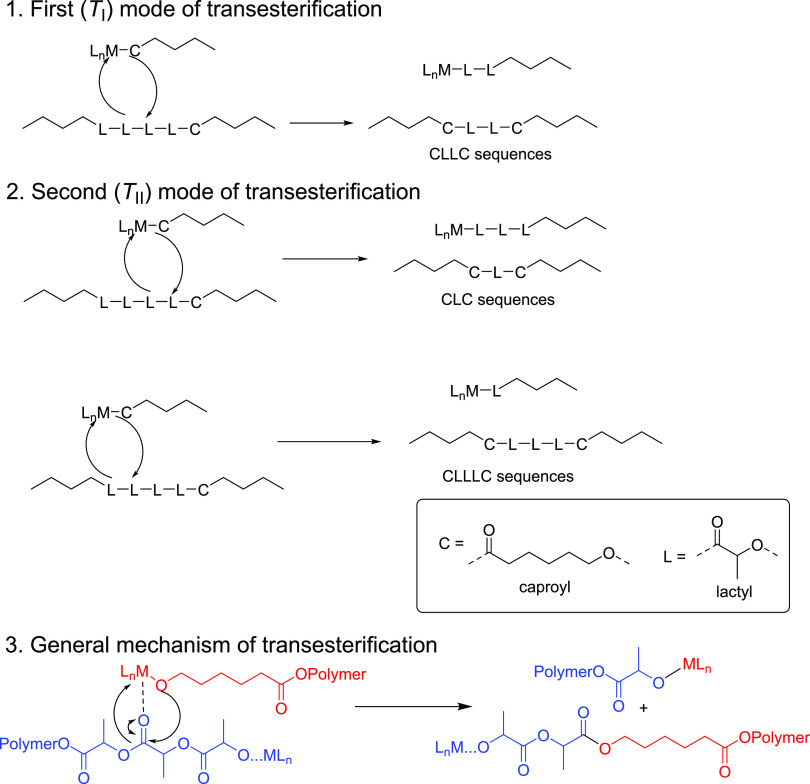
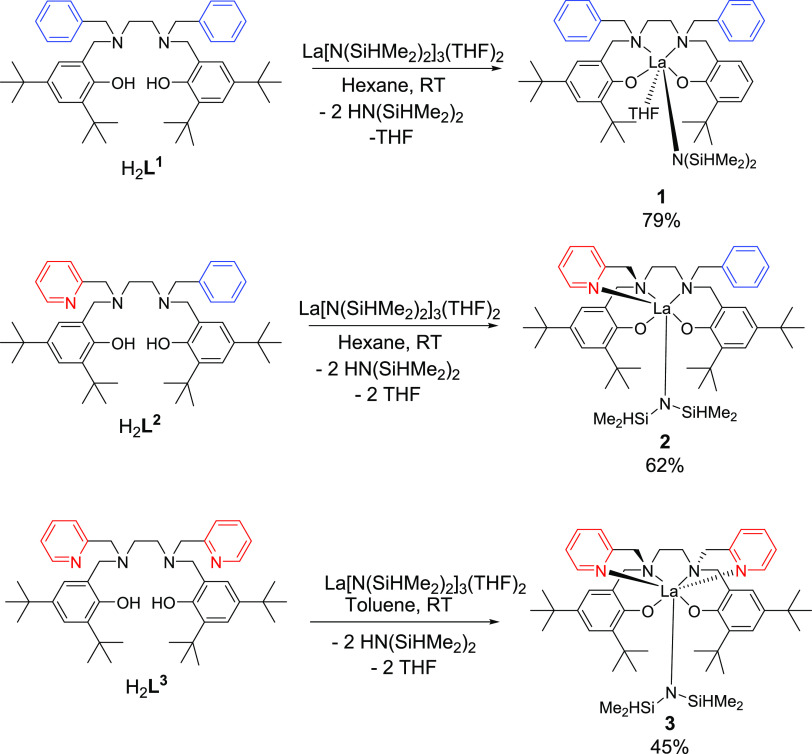
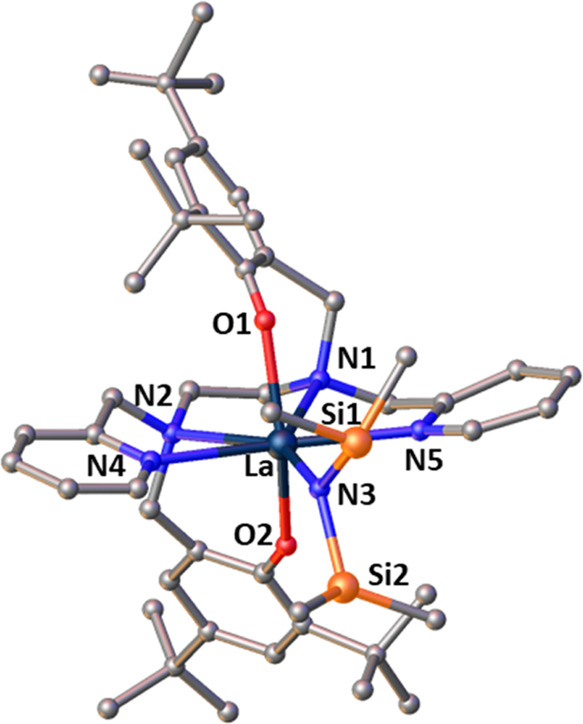
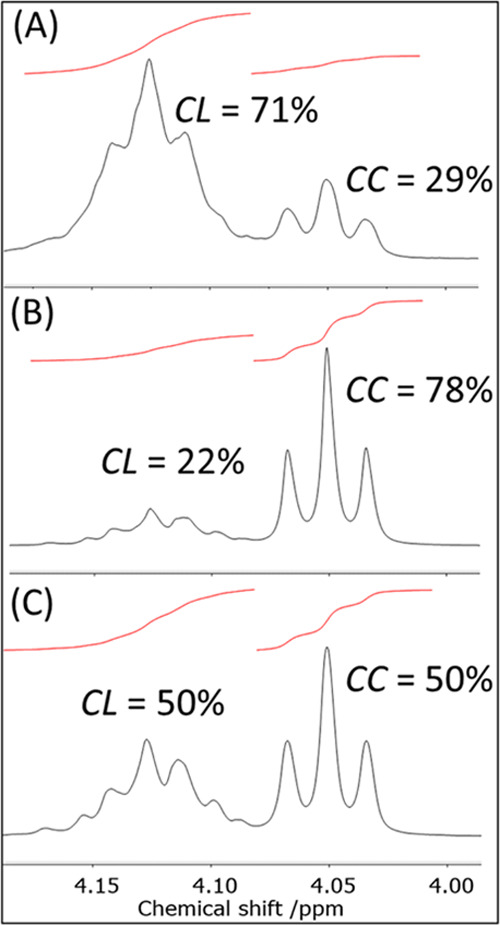
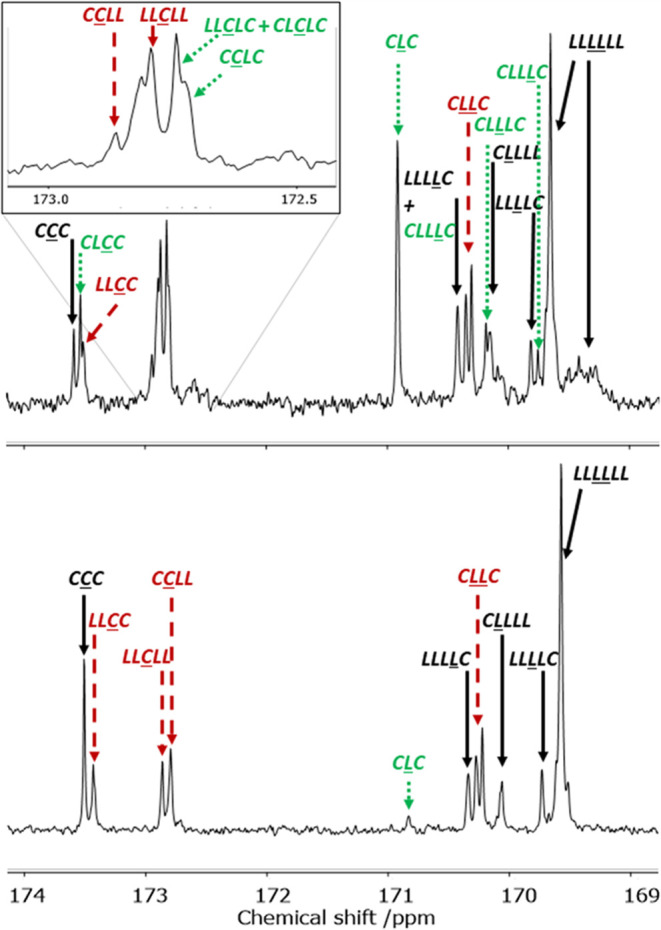
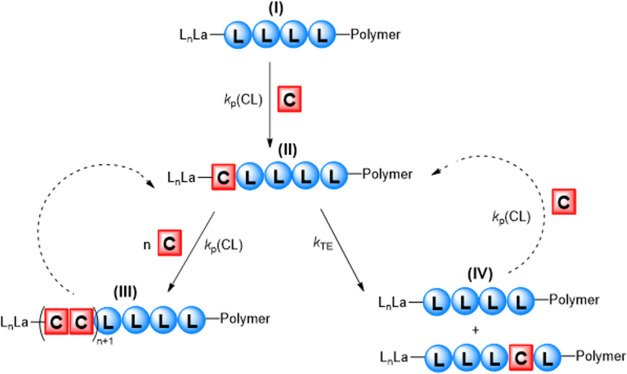
High Resolution Image Download MS PowerPoint Slide A series of novel lanthanum amido complexes, supported by ligands designed around the salan framework (salan = N, N ′- bis ( o -hydroxy, m -di- tert -butylbenzyl)-1,2-diaminoethane) were synthesized and fully characterized in the solid and solution states. The ligands incorporate benzyl or 2-pyridyl substituents at each tertiary amine center. The complexes were investigated as catalysts in the ring-opening homopolymerization of lactide (LA) and ε-caprolactone (ε-CL) and copolymerization of equimolar amounts of LA and ε-CL at ambient temperature. Solvent (THF or toluene) and the number of 2-pyridyl groups in the complex were found to influence the reactivity of the catalysts in copolymerization reactions. In all cases, complete conversion of LA to PLA was observed. The use of THF, a coordinating solvent, suppressed ε-CL polymerization, while the presence of one or more 2-pyridyl groups promoted ε-CL polymerization. Each copolymer gave a monomodal trace in gel permeation chromatography–size-exclusion chromatography (GPC-SEC) experiments, indicative of copolymer formation over homopolymerization. Copolymer microstructure was found to be dependent on catalyst structure and reaction solvent, ranging from blocky to close to alternating. Experiments revealed rapid conversion of LA in the initial stages of the reaction, followed by incorporation of ε-CL into the copolymer by either transesterification or propagation reactions. Significantly, the mode of transesterification ( T I or T II ) that occurs is determined by the structure of the metal complex and the reaction solvent, leading to the possibility of controlling copolymer microstructure through catalyst design.
Overview
The claims and statistics of this paper haven’t been checked yet.
Free: it reads the open-access text and checks the first 5 claims that cite a source we can check. Create a free account to check every claim.
Integrity signals
Registry
Cites
Statistics
Figures

Verification
Claims the paper makes
The claims and statistics of this paper haven’t been checked yet.
Free: it reads the open-access text and checks the first 5 claims that cite a source we can check. Create a free account to check every claim.
Self-check
Percentages, sums and reported differences re-computed from the paper’s own numbers.
The self-check needs the paper’s full text.
Citations
Cites
Generalized Gradient Approximation Made Simple
Perdew, J. P., Burke, K., & Ernzerhof, M. (1996) · Physical Review Letters · doi:10.1103/physrevlett.77.3865 · Cited by 215,824
Toward reliable density functional methods without adjustable parameters: The PBE0 model
Adamo, C., & Barone, V. (1999) · The Journal of Chemical Physics · doi:10.1063/1.478522 · Cited by 19,042
Intermolecular interactions from a natural bond orbital, donor-acceptor viewpoint
Reed, A. E., Curtiss, L. A., & Weinhold, F. (1988) · Chemical Reviews · doi:10.1021/cr00088a005 · Cited by 17,359
Electron affinities of the first-row atoms revisited. Systematic basis sets and wave functions
Kendall, R. A., Dunning, T. H., & Harrison, R. J. (1992) · The Journal of Chemical Physics · doi:10.1063/1.462569 · Cited by 15,496
Generalized Gradient Approximation Made Simple [Phys. Rev. Lett. 77, 3865 (1996)]
Perdew, J. P., Burke, K., & Ernzerhof, M. (1997) · Physical Review Letters · doi:10.1103/physrevlett.78.1396 · Cited by 14,614
Reed, A. E., Weinstock, R. B., & Weinhold, F. (1985) · The Journal of Chemical Physics · doi:10.1063/1.449486 · Cited by 9,925
Foster, J. P., & Weinhold, F. (1980) · Journal of the American Chemical Society · doi:10.1021/ja00544a007 · Cited by 4,975
The return of a forgotten polymer—Polycaprolactone in the 21st century
Woodruff, M. A., & Hutmacher, D. W. (2010) · Progress in Polymer Science · doi:10.1016/j.progpolymsci.2010.04.002 · Cited by 4,033
Farah, S., Anderson, D. G., & Langer, R. (2016) · Advanced Drug Delivery Reviews · doi:10.1016/j.addr.2016.06.012 · Cited by 3,443
Natural bond orbital analysis of near-Hartree–Fock water dimer
Reed, A. E., & Weinhold, F. (1983) · The Journal of Chemical Physics · doi:10.1063/1.445134 · Cited by 3,055
Controlled Ring-Opening Polymerization of Lactide and Glycolide
Dechy-Cabaret, O., Martin-Vaca, B., & Bourissou, D. (2004) · Chemical Reviews · doi:10.1021/cr040002s · Cited by 2,257
Natural localized molecular orbitals
Reed, A. E., & Weinhold, F. (1985) · The Journal of Chemical Physics · doi:10.1063/1.449360 · Cited by 2,207
Carpenter, J. E., & Weinhold, F. (1988) · Journal of Molecular Structure: THEOCHEM · doi:10.1016/0166-1280(88)80248-3 · Cited by 2,094
Synthesis of polycaprolactone: A review
Labet, M., & Thielemans, W. (2009) · Chemical Society Reviews · doi:10.1039/b820162p · Cited by 1,673
Poly(lactic acid)—Mass production, processing, industrial applications, and end of life
Castro-Aguirre, E., Iñiguez-Franco, F., Samsudin, H., Fang, X., & Auras, R. (2016) · Advanced Drug Delivery Reviews · doi:10.1016/j.addr.2016.03.010 · Cited by 1,329
50th Anniversary Perspective: There Is a Great Future in Sustainable Polymers
Schneiderman, D. K., & Hillmyer, M. A. (2017) · Macromolecules · doi:10.1021/acs.macromol.7b00293 · Cited by 1,003
Biocompatible Initiators for Lactide Polymerization
Platel, R., Hodgson, L., & Williams, C. (2008) · Polymer Reviews · doi:10.1080/15583720701834166 · Cited by 706
Self-citationThe Structure of Small Molecules and Ions
(1988) · Springer eBooks · doi:10.1007/978-1-4684-7424-4 · Cited by 629
Hormnirun, P., Marshall, E. L., Gibson, V. C., White, A. J. P., & Williams, D. J. (2004) · Journal of the American Chemical Society · doi:10.1021/ja038757o · Cited by 526
Comment on “Comment on Dunning's correlation-consistent basis sets”
Davidson, E. R. (1996) · Chemical Physics Letters · doi:10.1016/0009-2614(96)00917-7 · Cited by 414
Unique asymmetric catalysis of cis-? metal complexes of salen and its related Schiff-base ligands
Katsuki, T. (2004) · Chemical Society Reviews · doi:10.1039/b304133f · Cited by 344
Cai, C.-X., Amgoune, A., Lehmann, C. W., & Carpentier, J.-F. (2004) · Chemical Communications · doi:10.1039/b314030j · Cited by 262
Structural aspects of metal complexes with some tetradentate schiff bases
Calligaris, M., Nardin, G., & Randaccio, L. (1972) · Coordination Chemistry Reviews · doi:10.1016/s0010-8545(00)80018-1 · Cited by 231
Bonnet, F., Cowley, A. R., & Mountford, P. (2005) · Inorganic Chemistry · doi:10.1021/ic051316g · Cited by 223
Random Copolymerization of ε-Caprolactone with Lactide Using a Homosalen−Al Complex
Nomura, N., Akita, A., Ishii, R., & Mizuno, M. (2010) · Journal of the American Chemical Society · doi:10.1021/ja9089395 · Cited by 222
Bouyahyi, M., Ajellal, N., Kirillov, E., Thomas, C. M., & Carpentier, J. (2011) · Chemistry – A European Journal · doi:10.1002/chem.201002779 · Cited by 217
Pappalardo, D., Annunziata, L., & Pellecchia, C. (2009) · Macromolecules · doi:10.1021/ma9010439 · Cited by 199
Li, J., Rothstein, S. N., Little, S. R., Edenborn, H. M., & Meyer, T. Y. (2012) · Journal of the American Chemical Society · doi:10.1021/ja306866w · Cited by 186
Vanhoorne, P., Dubois, P., Jerome, R., & Teyssie, P. (1992) · Macromolecules · doi:10.1021/ma00027a008 · Cited by 184
Carpentier, J.-F. (2015) · Organometallics · doi:10.1021/acs.organomet.5b00540 · Cited by 181
Darensbourg, D. J., & Karroonnirun, O. (2010) · Macromolecules · doi:10.1021/ma101784y · Cited by 178
Salan vs. salen metal complexes in catalysis and medicinal applications: Virtues and pitfalls
Pessoa, J. C., & Correia, I. (2019) · Coordination Chemistry Reviews · doi:10.1016/j.ccr.2019.02.035 · Cited by 170
Polymerization temperature effects on the properties of l-lactide and ?-caprolactone copolymers
Grijpma, D. W., & Pennings, A. J. (1991) · Polymer Bulletin · doi:10.1007/bf00316903 · Cited by 165
Controlled ring-opening polymerization of lactide by group 3 metal complexes
Amgoune, A., Thomas, C. M., & Carpentier, J.-F. (2007) · Pure and Applied Chemistry · doi:10.1351/pac200779112013 · Cited by 154
Kasperczyk, J., & Bero, M. (1993) · Die Makromolekulare Chemie · doi:10.1002/macp.1993.021940315 · Cited by 150
Kasperczyk, J., & Bero, M. (1991) · Die Makromolekulare Chemie · doi:10.1002/macp.1991.021920812 · Cited by 131
Wang, Y., & Ma, H. (2012) · Chemical Communications · doi:10.1039/c2cc31716h · Cited by 127
Bero, M., Kasperczyk, J., & Adamus, G. (1993) · Die Makromolekulare Chemie · doi:10.1002/macp.1993.021940314 · Cited by 125
1,3-Dimethylimidazolin-2-ylidene Carbene Donor Ligation in Lanthanide Silylamide Complexes
Herrmann, W. A., Munck, F. C., Artus, G. R. J., Runte, O., & Anwander, R. (1997) · Organometallics · doi:10.1021/om9607715 · Cited by 122
Zhang, Z., Xu, X., Li, W., Yao, Y., Zhang, Y., Shen, Q., & Luo, Y. (2009) · Inorganic Chemistry · doi:10.1021/ic802177y · Cited by 107
Li, G., Lamberti, M., Pappalardo, D., & Pellecchia, C. (2012) · Macromolecules · doi:10.1021/ma3019848 · Cited by 106
Zhu, J., & Chen, E. Y. ‐. (2019) · Angewandte Chemie International Edition · doi:10.1002/anie.201813006 · Cited by 102
Catalytic metal-based systems for controlled statistical copolymerisation of lactide with a lactone
Stirling, E., Champouret, Y., & Visseaux, M. (2018) · Polymer Chemistry · doi:10.1039/c8py00310f · Cited by 99
Florczak, M., & Duda, A. (2008) · Angewandte Chemie International Edition · doi:10.1002/anie.200803540 · Cited by 94
Shen, Y., Zhu, K. J., Shen, Z., & Yao, K.-M. (1996) · Journal of Polymer Science Part A: Polymer Chemistry · doi:10.1002/(sici)1099-0518(19960715)34:9<1799::aid-pola18>3.0.co;2-1 · Cited by 93
Pilone, A., De Maio, N., Press, K., Venditto, V., Pappalardo, D., Mazzeo, M., Pellecchia, C., Kol, M., & Lamberti, M. (2015) · Dalton Transactions · doi:10.1039/c4dt02616k · Cited by 83
Klitzke, J. S., Roisnel, T., Kirillov, E., Casagrande, O. D. L., & Carpentier, J.-F. (2014) · Organometallics · doi:10.1021/om401047r · Cited by 82
Della Monica, F., Luciano, E., Roviello, G., Grassi, A., Milione, S., & Capacchione, C. (2014) · Macromolecules · doi:10.1021/ma5003358 · Cited by 74
Polycaprolactone: a biodegradable polymer with its application in the field of self-assembly study
Mandal, P., & Shunmugam, R. (2020) · Journal of Macromolecular Science Part A · doi:10.1080/10601325.2020.1831392 · Cited by 72
Bero, M., & Kasperczyk, J. (1996) · Macromolecular Chemistry and Physics · doi:10.1002/macp.1996.021971015 · Cited by 70
Li, L., Liu, B., Liu, D., Wu, C., Li, S., Liu, B., & Cui, D. (2014) · Organometallics · doi:10.1021/om5008264 · Cited by 70
Titanium pyridonates and amidates: novel catalysts for the synthesis of random copolymers
Webster, R. L., Noroozi, N., Hatzikiriakos, S. G., Thomson, J. A., & Schafer, L. L. (2013) · Chem. Commun. · doi:10.1039/c2cc37201k · Cited by 67 · cited 2×
“23,24,27,28 Notably, high temperatures are generally employed for this route, with one exception.”
Stanlake, L. J. E., Beard, J. D., & Schafer, L. L. (2008) · Inorganic Chemistry · doi:10.1021/ic8010635 · Cited by 63
Closed-Loop Polymer Upcycling by Installing Property-Enhancing Comonomer Sequences and Recyclability
Liu, X., Hong, M., Falivene, L., Cavallo, L., & Chen, E. Y.-X. (2019) · Macromolecules · doi:10.1021/acs.macromol.9b00817 · Cited by 62
Kan, C., & Ma, H. (2016) · RSC Advances · doi:10.1039/c6ra07374c · Cited by 56
Dong, X., & Robinson, J. R. (2020) · Chemical Science · doi:10.1039/d0sc03507f · Cited by 50
Ultrarapid Cerium(III)–NHC Catalysts for High Molar Mass Cyclic Polylactide
Kerr, R. W. F., Ewing, P. M. D. A., Raman, S. K., Smith, A. D., Williams, C. K., & Arnold, P. L. (2021) · ACS Catalysis · doi:10.1021/acscatal.0c04858 · Cited by 47
Titanium pyridonates for the homo- and copolymerization of rac-lactide and ε-caprolactone
Gilmour, D. J., Webster, R. L., Perry, M. R., & Schafer, L. L. (2015) · Dalton Transactions · doi:10.1039/c5dt01162k · Cited by 44 · cited 2×
“23,24,27,28 Notably, high temperatures are generally employed for this route, with one exception.”
Shi, T., Luo, W., Liu, S., & Li, Z. (2018) · Journal of Polymer Science Part A: Polymer Chemistry · doi:10.1002/pola.28932 · Cited by 39
Fadlallah, S., Jothieswaran, J., Capet, F., Bonnet, F., & Visseaux, M. (2017) · Chemistry - A European Journal · doi:10.1002/chem.201702902 · Cited by 38
Ouyang, H., Yuan, D., Nie, K., Zhang, Y., Yao, Y., & Cui, D. (2018) · Inorganic Chemistry · doi:10.1021/acs.inorgchem.8b01046 · Cited by 37
Sun, Z., Duan, R., Yang, J., Zhang, H., Li, S., Pang, X., Chen, W., & Chen, X. (2016) · RSC Advances · doi:10.1039/c6ra00289g · Cited by 35
Pazderski, L. (2013) · Annual reports on NMR spectroscopy · doi:10.1016/b978-0-12-408097-3.00002-0 · Cited by 32 · cited 1×
“53 Finally, the behavior of 1 − 3 in the presence of triphenylphosphine oxide (TPPO) was investigated, to determine if the addition of this base would displace the pyridyl ligands in 2 and 3 .”
dos Anjos, A., Bortoluzzi, A. J., Szpoganicz, B., Caro, M. S. B., Friedermann, G. R., Mangrich, A. S., & Neves, A. (2005) · Inorganica Chimica Acta · doi:10.1016/j.ica.2005.04.043 · Cited by 31
Dakshinamoorthy, D., & Peruch, F. (2011) · Polymer · doi:10.1016/j.polymer.2011.07.049 · Cited by 27
Sundaravel, K., Dhanalakshmi, T., Suresh, E., & Palaniandavar, M. (2008) · Dalton Transactions · doi:10.1039/b809142k · Cited by 26
Shao, J., Zhou, H., Wang, Y., Luo, Y., & Yao, Y. (2020) · Dalton Transactions · doi:10.1039/d0dt00179a · Cited by 24
Ou, H., Chen, H., Tseng, H.-C., Hsiao, M.-W., Chang, Y., Jheng, N., Lai, Y., Shih, T.-Y., Lin, Y., & Chen, H. (2014) · Journal of Molecular Catalysis A Chemical · doi:10.1016/j.molcata.2014.07.003 · Cited by 17
Low-Symmetry β-Diketimine Aryloxide Rare-Earth Complexes: Flexible, Reactive, and Selective
Casey, K. C., Appiah, J. K., & Robinson, J. R. (2020) · Inorganic Chemistry · doi:10.1021/acs.inorgchem.0c02170 · Cited by 14
Dong, X., & Robinson, J. R. (2021) · New Journal of Chemistry · doi:10.1039/d1nj02694a · Cited by 13
Research works printed but not linked: 3
- 10.1002/(SICI)1099-0518(19960715)34:9 · doi:10.1002/(sici)1099-0518(19960715)34:9
- Fox T. G., 1952, Bull. Am. Phys. Soc., 1, 123
- Carpenter, J. E. PhD Thesis, University of Wisconsin: Madison, WI, 1987.
Cited by
A decade of innovation: Synthesis, properties and applications of PLA copolymers
Terzopoulou, Z. N., Zamboulis, A., Bikiaris, N. D., Xanthopoulou, E., Ioannidis, R. O., & Bikiaris, D. Ν. (2025) · Progress in Polymer Science · doi:10.1016/j.progpolymsci.2025.101991 · Cited by 68
Transesterification reactions as a means to produce esters: A critical review
Devale, R. R., & Mahajan, Y. S. (2024) · The Canadian Journal of Chemical Engineering · doi:10.1002/cjce.25414 · Cited by 16
Weng, C., Li, X., & Tang, X. (2024) · Angewandte Chemie International Edition · doi:10.1002/anie.202415388 · Cited by 18
Neal, T. J., Neal, E. D., Cumby, J., & Garden, J. A. (2024) · Polymer Chemistry · doi:10.1039/d4py00169a · Cited by 12
Lu, P.-X., Wang, X.-B., Liu, J., Gao, C.-Y., Chen, Y., Jia, J., & Tong, M. (2025) · Journal of Rare Earths · doi:10.1016/j.jre.2025.11.012 · Cited by 7
Metadata
- Authors
- Beament, B., Britton, D., Malcomson, T., Akien, G. R., Halcovitch, N. R., Coogan, M. P., & Platel, R. H.
- Affiliations
- Lancaster University (GB)
- University of Manchester (GB)
- Corresponding author
- Platel, Rachel H.
- Venue
- Inorganic Chemistry
- Publisher
- American Chemical Society (ACS)
- Published
- 2023-12-21
- Volume
- 63
- Issue
- 1
- Pages
- 280-293
- ISSN
- 0020-1669 (ISSN-L)
- 1520-510X
- PMC
- PMC10777408
- OpenAlex
- W4390050689
- Cited by
- 27
- References
- 69
- Citations by year
- 2026: 11 · 2025: 10 · 2024: 6
- FWCI
- 1.72
- Type
- journal article
- Language
- en
- Open access
- hybrid
- doi.org
- Licence
- Locations
- Inorganic Chemistry (publishedVersion, cc-by)
- PubMed Central (publishedVersion, cc-by)
- PubMed (publishedVersion)
- Lancaster EPrints (Lancaster University) (submittedVersion)
- Funders
- Lancaster University
- Topics
- Physical Sciences › Materials Science › Biomaterials › biodegradable polymer synthesis and properties
- Physical Sciences › Chemical Engineering › Process Chemistry and Technology › Carbon dioxide utilization in catalysis
- Physical Sciences › Chemistry › Organic Chemistry › Organometallic Complex Synthesis and Catalysis
- Keywords
- ring-opening copolymerization, lactide, ε-caprolactone, polylactic acid, copolymer microstructure, transesterification, salan ligands, 2-pyridyl substituents, catalyst design, solvent effects, block copolymers, alternating copolymers
About these checks
Registry, retraction, Cites and statistics results are computed, not judged, with one exception: a printed reference that no index lists is read once by a model before it counts as a citation error. Claims are extracted by a model and kept only when their quote appears verbatim in the text; each cited source is then checked, with a model’s help, for whether it says what the claim relies on. Those verdicts can be wrong — read the claim’s quote and the cited source before relying on one.
Statistics and arithmetic are recomputed, not judged.
Confidence bands are shown only for fields calibrated on our annotated test set. None is calibrated yet, so no band is shown.
What counts as a claim ›How we measure confidence ›How we check this ›
Are you an author, or do you see a problem with this page? Request a review
Data sources
Bibliographic data: Semantic Scholar, OpenAlex, Crossref.
Contains information from the Semantic Scholar Academic Graph Datasets, made available under the ODC Attribution License (ODC-BY 1.0).
Semantic Scholar’s data is described in: Kinney, R., et al. (2023). The Semantic Scholar Open Data Platform. arXiv:2301.10140.
