

The DOI matches its Crossref record; 65 of the 65 references it cites were found in a registry or an index; 1 of the 82 sources its claims cite were checked for support.
Redox Cycling of Tetrahedral Iron Drives the Fenton Reactivity of Chrysotile Asbestos
Open accessAbstract
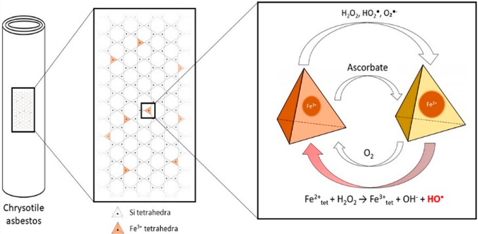
High Resolution Image Download MS PowerPoint Slide Chrysotile asbestos is a carcinogenic fibrous mineral. Its pathogenicity is partly governed by the ability of Fe on the fiber surface to catalyze the Fenton reduction of H 2 O 2 (which is produced during inflammatory processes) to form the highly toxic hydroxyl radical (HO • ). Recently, tetrahedrally coordinated Fe (Fe tet ) in the fibers’ Si sheets was identified as the principal Fe species to catalyze this process. However, as only ferric Fe tet (Fe 3+ tet ) substitutes Si tetrahedra in chrysotile, Fe tet needs to redox cycle to ferrous Fe tet (Fe 2+ tet ) to facilitate fiber-mediated reductions of H 2 O 2 to HO • . This redox cycling has never been experimentally investigated. Here we demonstrate, by consecutive ascorbate and O 2 treatments, that structural Fe tet in exposed Si sheets of chrysotile fibers can redox cycle between Fe 3+ tet and Fe 2+ tet . Reduction, back-oxidation, and rereduction of Fe 3+ tet did not labilize the exposed Si sheet and, consequently, did not promote fiber dissolution. However, in the presence of H 2 O 2, prolonged redox cycling of Fe tet increased fiber dissolution, presumably by accelerating Fe tet dissolution and subsequent labilization of the exposed Si sheet. Chrysotile fibers for which the concentration of Fe tet surface sites undergoing redox cycling was lowered through selective Fe removal showed a rebound in Fe 3+ tet surface site concentration and associated Fenton reactivity once Fe 3+ tet -depleted Si sheets were dissolved off from the fiber surfaces. To conclude, our results demonstrate that redox cycling of Fe tet on chrysotile surfaces produces Fe 2+ tet surface sites, which, as the ultimate Fenton reactive iron species on chrysotile, contribute to the fibers’ adverse chemical reactivity.
Overview
AI snapshot
Written from the paper’s full text.
TL;DR
Chrysotile asbestos surface tetrahedral Fe (Fe_tet) can redox cycle between Fe³⁺ and Fe²⁺ in exposed Si sheets, and this cycling supplies the Fe²⁺ responsible for Fenton/Haber-Weiss generation of HO•. Prolonged H₂O₂-driven cycling also enhances fiber dissolution, while Fe-depleted surfaces can recover Fenton reactivity as deeper Si sheets dissolve.
Key findings
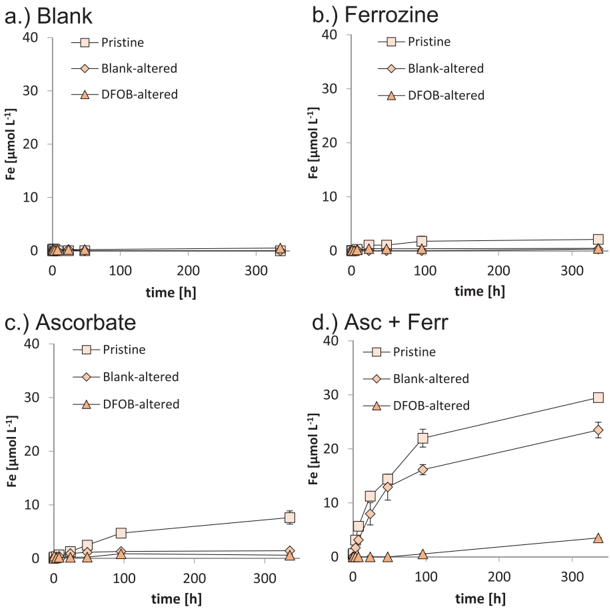
- Anoxic ascorbate + Ferrozine showed Fe³⁺_tet reduction to Fe²⁺_tet and ligand-enhanced Fe²⁺ dissolution: 29.5, 23.5, and 3.5 μmol L⁻¹ Fe mobilized after 336 h from pristine, blank-altered, and DFOB-altered fibers, respectively.
- One full redox cycle (ascorbate reduction then air oxidation) and 1.5 cycles did not labilize the exposed Si sheet or promote Si dissolution; reoxidized ascorbate-altered fibers with ascorbate + Ferrozine mobilized up to 21.8 μmol L⁻¹ Fe after 336 h.
- In oxic H₂O₂ incubations, prolonged Fe_tet redox cycling increased dissolution: after 336 h, H₂O₂ + DFOB mobilized 983 μmol L⁻¹ Mg from pristine fibers vs ~600 μmol L⁻¹ in other treatments, and Si exceeded 200 μmol L⁻¹ for all three fiber types.
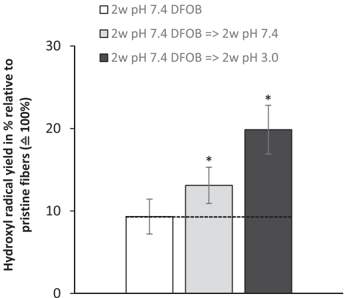
- DFOB-altered fibers had HO• yield 9% relative to pristine; after 336 h at pH 7.4 it rose to 13%, and after pH 3.0 to ~20% (2-fold), indicating newly exposed Fenton-active Fe³⁺_tet.
Methods
- Batch dissolution/preconditioning with Shijiazhuang chrysotile at 1 g L⁻¹, pH 7.4 (or pH 3.0 for recovery), 20 ± 2 °C, dark, anoxic or oxic; fiber types: pristine, blank-altered, DFOB-altered, ascorbate-altered, reoxidized ascorbate-altered.
- Treatments included 1 mmol L⁻¹ DFOB, Ferrozine, ascorbate, combinations, and 3.3 g L⁻¹ (~100 mmol L⁻¹) H₂O₂ starting; solution Mg, Fe, Si by ICP-OES; HO• by EPR spin trapping with DMPO; one-way ANOVA α = 0.05.
- Sampling was destructive at 0.5–336 h; dissolution rates calculated from 24–336 h; duplicates n = 2, EPR n = 4.
Limitations
- Stated: the H₂O₂ starting concentration (3.3 g L⁻¹) is at least 2 orders of magnitude above (patho)physiological H₂O₂ in inflamed tissues, so H₂O₂-driven Fe_tet dissolution is likely much slower in vivo; the cause of increased fiber dissolution under high H₂O₂ could not be established, and the number of H₂O₂-induced redox cycles is unknown.
- Stated: ascorbate was applied at supra-physiological concentrations.
- Evident: findings come from one chrysotile specimen (Shijiazhuang) in abiotic batch experiments up to 336 h, with no cellular or in vivo validation; extrapolation to other asbestos/mineral dusts and physiological conditions is therefore limited.
Model-written summary. Check it against the paper before relying on it.
Integrity signals
Registry
Cites
Statistics
Figures


Verification
Claims the paper makes
55 Own result · 35 Own interpretation · 18 Not checked yet · 11 Check pending · 11 No full text of the sources · 6 No basis given · 2 Sources not found · 1 Supported
Every source the paper cites for this claim was checked and supports it.
In the paper
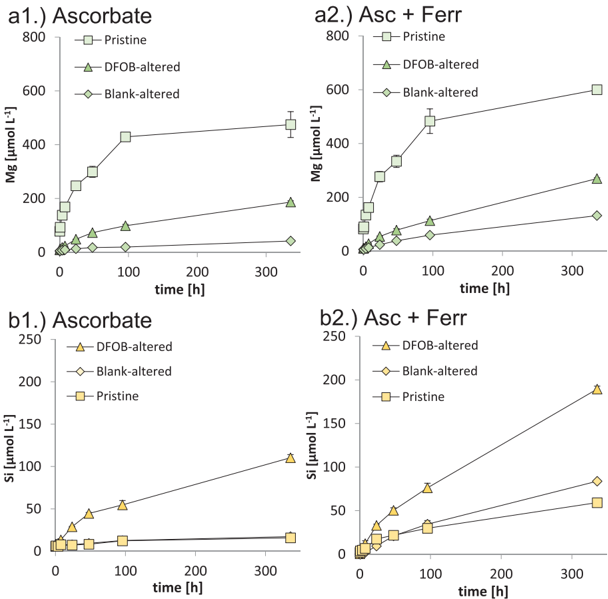
“In the presence of ascorbate, Mg rapidly dissolved from pristine fibers (Figure 2a1) until the outermost Mg sheet (corresponding with 406 μmol g -1 Mg in Shijiazhuang chrysotile 18 ) had dissolved between 48 and 96 h of incubation (first stage fiber dissolution).”
§ Redox Cycling of Tetrahedral Iron Drives the Fenton Reactivity of Chrysotile Asbestos > Reduction of Fe 3+
What the sources say
- Supportedcites [18] source
The citation is attached specifically to the estimate of 406 μmol g−1 Mg in the outermost sheet, not to the citing authors’ ascorbate experiment or its 48–96 h timing. The source’s “Relationship between net dissolution rates and mineral structure” section (page unavailable) estimates 406 μmol g−1 for the first Mg layer of pristine fibers. (LLM, conf=0.93)
plaindirect- Asserted: passes — The authors put it forward as true.
- Checkable: passes — It can be checked against evidence.
- Load-bearing: passes — The paper’s conclusions depend on it.
- Based: passes — The paper gives a reason why it holds.
- Supported
A result the paper reports from its own data — it cites no other source for it, so there is none to check. The quote shows it is in the paper.
In the paper
“To conclude, our results demonstrate that redox cycling of Fe tet on chrysotile surfaces produces Fe 2+ tet surface sites, which, as the ultimate Fenton reactive iron species on chrysotile, contribute to the fibers' adverse chemical reactivity.”
§ Redox Cycling of Tetrahedral Iron Drives the Fenton Reactivity of Chrysotile Asbestos > Abstract
boosteddirect- Asserted: passes — The authors put it forward as true.
- Checkable: passes — It can be checked against evidence.
- Load-bearing: passes — The paper’s conclusions depend on it.
- Based: passes — The paper gives a reason why it holds.
The paper states this without a source or data behind it here, so there is nothing to check it against. The quote shows it is in the paper.
In the paper
“However, in the presence of H 2 O 2 , prolonged redox cycling of Fe tet increased fiber dissolution, presumably by accelerating Fe tet dissolution and subsequent labilization of the exposed Si sheet.”
§ Redox Cycling of Tetrahedral Iron Drives the Fenton Reactivity of Chrysotile Asbestos > Abstract
plaindirect- Asserted: passes — The authors put it forward as true.
- Checkable: passes — It can be checked against evidence.
- Load-bearing: passes — The paper’s conclusions depend on it.
- Based: passes — The paper gives a reason why it holds.
A result the paper reports from its own data — it cites no other source for it, so there is none to check. The quote shows it is in the paper.
In the paper
“Here we demonstrate, by consecutive ascorbate and O 2 treatments, that structural Fe tet in exposed Si sheets of chrysotile fibers can redox cycle between Fe 3+ tet and Fe 2+ tet .”
§ Redox Cycling of Tetrahedral Iron Drives the Fenton Reactivity of Chrysotile Asbestos > Abstract
boosteddirect- Asserted: passes — The authors put it forward as true.
- Checkable: passes — It can be checked against evidence.
- Load-bearing: passes — The paper’s conclusions depend on it.
- Based: passes — The paper gives a reason why it holds.
A result the paper reports from its own data — it cites no other source for it, so there is none to check. The quote shows it is in the paper.
In the paper
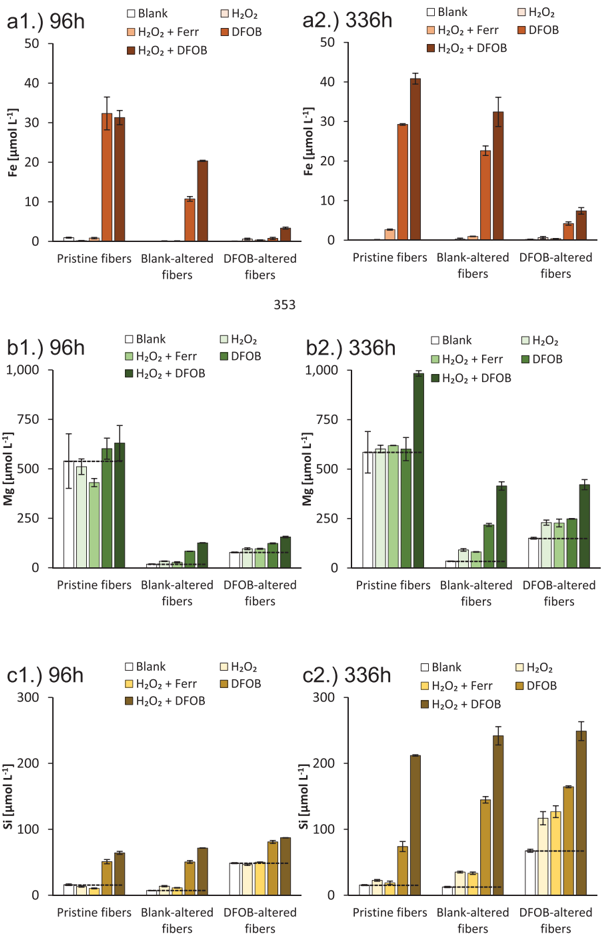
“Mg concentrations mobilized from pristine fibers after 96 h of incubation (Figure 5b1) were largely similar in blank, H 2 O 2 , H 2 O 2 + Ferrozine, DFOB and H 2 O 2 + DFOB treatments (∼400-600 μmol L -1 ).”
§ Redox Cycling of Tetrahedral Iron Drives the Fenton Reactivity of Chrysotile Asbestos > Dissolution of Fe tet from Chrysotile Surfaces by Redox Cycling.
plain- Asserted: passes — The authors put it forward as true.
- Checkable: passes — It can be checked against evidence.
- Load-bearing: unclear — It is unclear whether the paper’s conclusions depend on it.
- Based: passes — The paper gives a reason why it holds.
A result the paper reports from its own data — it cites no other source for it, so there is none to check. The quote shows it is in the paper.
In the paper
“After 336 h, Si dissolution of all three fiber types successively increased from blank to H 2 O 2 and H 2 O 2 + Ferrozine to DFOB and ultimately to H 2 O 2 + DFOB treatment (Figure 5c2).”
§ Redox Cycling of Tetrahedral Iron Drives the Fenton Reactivity of Chrysotile Asbestos > Dissolution of Fe tet from Chrysotile Surfaces by Redox Cycling.
plaindirect- Asserted: passes — The authors put it forward as true.
- Checkable: passes — It can be checked against evidence.
- Load-bearing: passes — The paper’s conclusions depend on it.
- Based: passes — The paper gives a reason why it holds.
A result the paper reports from its own data — it cites no other source for it, so there is none to check. The quote shows it is in the paper.
In the paper
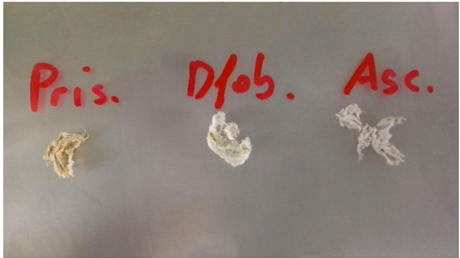
“The subsequent rereduction of reoxidized ascorbate-altered fibers by ascorbate changed the fiber color back to pale pinkish.”
§ Redox Cycling of Tetrahedral Iron Drives the Fenton Reactivity of Chrysotile Asbestos > Reoxidation of Fe 2+ tet and Subsequent Rereduction of Fe 3+
plaindirect- Asserted: passes — The authors put it forward as true.
- Checkable: passes — It can be checked against evidence.
- Load-bearing: unclear — It is unclear whether the paper’s conclusions depend on it.
- Based: passes — The paper gives a reason why it holds.
The paper states this without a source or data behind it here, so there is nothing to check it against. The quote shows it is in the paper.
In the paper
“Under the oxic conditions of the H 2 O 2 incubation experiment (Figure 5), no Fe mobilization was observed”
§ Redox Cycling of Tetrahedral Iron Drives the Fenton Reactivity of Chrysotile Asbestos > Dissolution of Fe tet from Chrysotile Surfaces through Redox Cycling.
plain- Asserted: passes — The authors put it forward as true.
- Checkable: passes — It can be checked against evidence.
- Load-bearing: passes — The paper’s conclusions depend on it.
- Based: passes — The paper gives a reason why it holds.
A result the paper reports from its own data — it cites no other source for it, so there is none to check. The quote shows it is in the paper.
In the paper
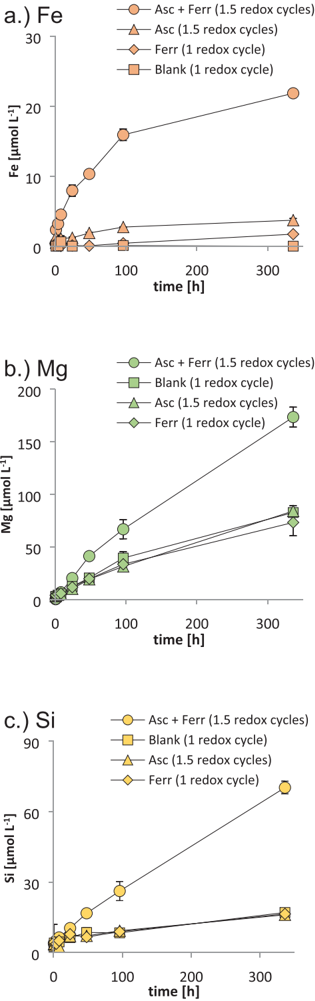
“This is supported by the approximately 20 μmol L -1 higher Fe concentrations in ascorbate + Ferrozine treatments after 336 h compared to the corresponding ascorbate-only treatments (Figures 1c,d and 4a).”
§ Redox Cycling of Tetrahedral Iron Drives the Fenton Reactivity of Chrysotile Asbestos > Redox Cycling of Fe tet on Dissolving Chrysotile Surfaces.
plaincorrelational- Asserted: passes — The authors put it forward as true.
- Checkable: passes — It can be checked against evidence.
- Load-bearing: passes — The paper’s conclusions depend on it.
- Based: passes — The paper gives a reason why it holds.
A result the paper reports from its own data — it cites no other source for it, so there is none to check. The quote shows it is in the paper.
In the paper
“Fe mobilization by DFOB and H 2 O 2 + DFOB in suspensions of blank-altered fibers, which contained secondary Fe phases originating from precipitation of the Fe content of the dissolved Mg sheet, was lower than in suspensions of pristine fibers.”
§ Redox Cycling of Tetrahedral Iron Drives the Fenton Reactivity of Chrysotile Asbestos > Dissolution of Fe tet from Chrysotile Surfaces by Redox Cycling.
plain- Asserted: passes — The authors put it forward as true.
- Checkable: passes — It can be checked against evidence.
- Load-bearing: passes — The paper’s conclusions depend on it.
- Based: passes — The paper gives a reason why it holds.
- It may state two separate claims as one. 34
- Probably not a substantial claim. 11
A result the paper reports from its own data — it cites no other source for it, so there is none to check. The quote shows it is in the paper.
In the paper
“Reduction, back-oxidation, and rereduction of Fe 3+ tet did not labilize the exposed Si sheet and, consequently, did not promote fiber dissolution.”
§ Redox Cycling of Tetrahedral Iron Drives the Fenton Reactivity of Chrysotile Asbestos > Abstract
plain- Asserted: passes — The authors put it forward as true.
- Checkable: passes — It can be checked against evidence.
- Load-bearing: passes — The paper’s conclusions depend on it.
- Based: passes — The paper gives a reason why it holds.
It may state two separate claims as one.
A result the paper reports from its own data — it cites no other source for it, so there is none to check. The quote shows it is in the paper.
In the paper
“Mg concentrations mobilized from blank-altered and DFOB-altered fibers successively increased from blank to H 2 O 2 and H 2 O 2 + Ferrozine to DFOB and ultimately to H 2 O 2 + DFOB treatment; concentrations increased with the reaction time (Figure 5b1,2).”
§ Redox Cycling of Tetrahedral Iron Drives the Fenton Reactivity of Chrysotile Asbestos > Dissolution of Fe tet from Chrysotile Surfaces by Redox Cycling.
plaindirect- Asserted: passes — The authors put it forward as true.
- Checkable: passes — It can be checked against evidence.
- Load-bearing: passes — The paper’s conclusions depend on it.
- Based: passes — The paper gives a reason why it holds.
It may state two separate claims as one.
The paper states this without a source or data behind it here, so there is nothing to check it against. The quote shows it is in the paper.
In the paper
“No Fe was mobilized in the blank treatment, and also, only a small amount of Fe was mobilized in the Ferrozine treatments (maximally 1.7 μmol L -1 after 336 h), as Fe 2+ sites on the fiber surfaces had been back-oxidized by air bubbling during fiber preconditioning (Figure 4a).”
§ Redox Cycling of Tetrahedral Iron Drives the Fenton Reactivity of Chrysotile Asbestos > Reoxidation of Fe 2+ tet and Subsequent Rereduction of Fe 3+
plain- Asserted: passes — The authors put it forward as true.
- Checkable: passes — It can be checked against evidence.
- Load-bearing: passes — The paper’s conclusions depend on it.
- Based: passes — The paper gives a reason why it holds.
It may state two separate claims as one.
A result the paper reports from its own data — it cites no other source for it, so there is none to check. The quote shows it is in the paper.
In the paper
“Mobilized Fe only exceeded low micromolar concentrations in treatments involving DFOB, and the mobilized Fe concentration was higher if in addition to DFOB also H 2 O 2 was applied, except for pristine fibers after 96 h (Figure 5a1,2).”
§ Redox Cycling of Tetrahedral Iron Drives the Fenton Reactivity of Chrysotile Asbestos > Dissolution of Fe tet from Chrysotile Surfaces by Redox Cycling.
plaindirect- Asserted: passes — The authors put it forward as true.
- Checkable: passes — It can be checked against evidence.
- Load-bearing: passes — The paper’s conclusions depend on it.
- Based: passes — The paper gives a reason why it holds.
It may state two separate claims as one.
A result the paper reports from its own data — it cites no other source for it, so there is none to check. The quote shows it is in the paper.
In the paper
“However, an unknown but supposedly larger number of Fe tet redox cycles by H 2 O 2 increased Mg and Si dissolution, specifically in suspensions of blank-altered and DFOB-altered fibers (Figure 5b2,c2, Table S7).”
§ Redox Cycling of Tetrahedral Iron Drives the Fenton Reactivity of Chrysotile Asbestos > Dissolution of Fe tet from Chrysotile Surfaces through Redox Cycling.
hedgeddirect- Asserted: passes — The authors put it forward as true.
- Checkable: passes — It can be checked against evidence.
- Load-bearing: passes — The paper’s conclusions depend on it.
- Based: unclear — It is unclear why the paper says it holds.
It may state two separate claims as one.
A result the paper reports from its own data — it cites no other source for it, so there is none to check. The quote shows it is in the paper.
In the paper
“Mobilized Fe concentrations in H 2 O 2 + Ferrozine treatments were as low as the concentrations in blank and H 2 O 2 treatments; only in pristine fiber suspensions after 336 h was the Fe concentration mildly increased (2.7 μmol L -1 ) (Figure 5a,b).”
§ Redox Cycling of Tetrahedral Iron Drives the Fenton Reactivity of Chrysotile Asbestos > Dissolution of Fe tet from Chrysotile Surfaces by Redox Cycling.
plain- Asserted: passes — The authors put it forward as true.
- Checkable: passes — It can be checked against evidence.
- Load-bearing: passes — The paper’s conclusions depend on it.
- Based: passes — The paper gives a reason why it holds.
It may state two separate claims as one.
A result the paper reports from its own data — it cites no other source for it, so there is none to check. The quote shows it is in the paper.
In the paper
“This difference was also reflected in the clearly nonstoichiometric fiber dissolution for all treatments presented in Figure 4; the Mg/Si ratio was larger than 1.5, indicating an excess of Mg dissolution (Table S7).”
§ Redox Cycling of Tetrahedral Iron Drives the Fenton Reactivity of Chrysotile Asbestos > Reoxidation of Fe 2+ tet and Subsequent Rereduction of Fe 3+
boostedcorrelational- Asserted: passes — The authors put it forward as true.
- Checkable: passes — It can be checked against evidence.
- Load-bearing: unclear — It is unclear whether the paper’s conclusions depend on it.
- Based: passes — The paper gives a reason why it holds.
It may state two separate claims as one.
A result the paper reports from its own data — it cites no other source for it, so there is none to check. The quote shows it is in the paper.
In the paper
“Mobilized Si concentrations from pristine, blank-altered, and DFOB-altered fibers after 96 h were similar for blank, H 2 O 2 , and H 2 O 2 + Ferrozine treatments but clearly higher in DFOB treatments and highest in H 2 O 2 + DFOB treatments (Figure 5c1).”
§ Redox Cycling of Tetrahedral Iron Drives the Fenton Reactivity of Chrysotile Asbestos > Dissolution of Fe tet from Chrysotile Surfaces by Redox Cycling.
boostedcorrelational- Asserted: passes — The authors put it forward as true.
- Checkable: passes — It can be checked against evidence.
- Load-bearing: passes — The paper’s conclusions depend on it.
- Based: passes — The paper gives a reason why it holds.
It may state two separate claims as one.
A result the paper reports from its own data — it cites no other source for it, so there is none to check. The quote shows it is in the paper.
In the paper
“The oxidation of ascorbate-altered fibers changed their color from pale pinkish to brown grayish (Figure S2b).”
§ Redox Cycling of Tetrahedral Iron Drives the Fenton Reactivity of Chrysotile Asbestos > Reoxidation of Fe 2+ tet and Subsequent Rereduction of Fe 3+
plaindirect- Asserted: passes — The authors put it forward as true.
- Checkable: passes — It can be checked against evidence.
- Load-bearing: fails — The paper’s conclusions may not depend on it.
- Based: passes — The paper gives a reason why it holds.
Probably not a substantial claim. The paper’s conclusions may not depend on it.
A result the paper reports from its own data — it cites no other source for it, so there is none to check. The quote shows it is in the paper.
In the paper
“determined in three KMnO 4 titrations to be 334 g L -1 (standard deviation of 2 g L -1 ).”
§ Redox Cycling of Tetrahedral Iron Drives the Fenton Reactivity of Chrysotile Asbestos > Experimental Procedure.
plain- Asserted: passes — The authors put it forward as true.
- Checkable: passes — It can be checked against evidence.
- Load-bearing: fails — The paper’s conclusions may not depend on it.
- Based: passes — The paper gives a reason why it holds.
Probably not a substantial claim. The paper’s conclusions may not depend on it. It may state two separate claims as one.
A result the paper reports from its own data — it cites no other source for it, so there is none to check. The quote shows it is in the paper.
In the paper
“Addition of the Fe 2+ -specific ligand Ferrozine to these anoxic fiber suspensions did not result in a relevant increase in Fe mobilization; mobilized Fe concentrations maximally reached 2.1 μmol L -1 (after 336 h, for pristine fibers, Figure 1b).”
§ Redox Cycling of Tetrahedral Iron Drives the Fenton Reactivity of Chrysotile Asbestos > Reduction of Fe 3+
plain- Asserted: passes — The authors put it forward as true.
- Checkable: passes — It can be checked against evidence.
- Load-bearing: passes — The paper’s conclusions depend on it.
- Based: passes — The paper gives a reason why it holds.
It may state two separate claims as one.
A result the paper reports from its own data — it cites no other source for it, so there is none to check. The quote shows it is in the paper.
In the paper
“Finally, Mg dissolution in these experiments was moderately higher than that observed for blank-altered fibers incubated at pH 7.4 in anoxic (Figure S1a1) and oxic (Figure S3a) suspensions; the difference in mobilized Mg concentration after 336 h was approximately 30-40 μmol L -1 .”
§ Redox Cycling of Tetrahedral Iron Drives the Fenton Reactivity of Chrysotile Asbestos > Reoxidation of Fe 2+ tet and Subsequent Rereduction of Fe 3+
plaincorrelational- Asserted: passes — The authors put it forward as true.
- Checkable: passes — It can be checked against evidence.
- Load-bearing: unclear — It is unclear whether the paper’s conclusions depend on it.
- Based: passes — The paper gives a reason why it holds.
It may state two separate claims as one.
The paper states this without a source or data behind it here, so there is nothing to check it against. The quote shows it is in the paper.
In the paper
“They were highest in suspensions of pristine fibers, which had an unaltered Fe surface content and speciation, and lowest in suspensions of DFOB-altered fibers, which were depleted in surface Fe.”
§ Redox Cycling of Tetrahedral Iron Drives the Fenton Reactivity of Chrysotile Asbestos > Dissolution of Fe tet from Chrysotile Surfaces by Redox Cycling.
plaincorrelational- Asserted: passes — The authors put it forward as true.
- Checkable: passes — It can be checked against evidence.
- Load-bearing: passes — The paper’s conclusions depend on it.
- Based: passes — The paper gives a reason why it holds.
It may state two separate claims as one.
A result the paper reports from its own data — it cites no other source for it, so there is none to check. The quote shows it is in the paper.
In the paper
“Finally, the addition of ascorbate to anoxic chrysotile suspensions changed the color of the fibers from brownish (as observed with pristine and blank-altered fibers) to a pale pinkish color (Figure 3 and Figure S2).”
§ Redox Cycling of Tetrahedral Iron Drives the Fenton Reactivity of Chrysotile Asbestos > Reduction of Fe 3+
plaindirect- Asserted: passes — The authors put it forward as true.
- Checkable: passes — It can be checked against evidence.
- Load-bearing: fails — The paper’s conclusions may not depend on it.
- Based: passes — The paper gives a reason why it holds.
Probably not a substantial claim. The paper’s conclusions may not depend on it.
A result the paper reports from its own data — it cites no other source for it, so there is none to check. The quote shows it is in the paper.
In the paper
“It should be noted that for reoxidized ascorbate-altered fibers dissolution was not stoichiometric; the Mg/Si dissolution rate ratio was larger than 2 (Figure 4 and Table S7).”
§ Redox Cycling of Tetrahedral Iron Drives the Fenton Reactivity of Chrysotile Asbestos > Redox Cycling of Fe tet on Dissolving Chrysotile Surfaces.
plain- Asserted: passes — The authors put it forward as true.
- Checkable: passes — It can be checked against evidence.
- Load-bearing: unclear — It is unclear whether the paper’s conclusions depend on it.
- Based: passes — The paper gives a reason why it holds.
It may state two separate claims as one.
A result the paper reports from its own data — it cites no other source for it, so there is none to check. The quote shows it is in the paper.
In the paper
“Furthermore, our results demonstrate that redox cycling of Fe tet enhances dissolution of the fibers' exposed Si sheets, but to a much smaller extent than ligand-enhanced or proton-promoted Fe tet dissolution.”
§ Redox Cycling of Tetrahedral Iron Drives the Fenton Reactivity of Chrysotile Asbestos > ■ CONCLUSIONS
boosteddirect- Asserted: passes — The authors put it forward as true.
- Checkable: passes — It can be checked against evidence.
- Load-bearing: passes — The paper’s conclusions depend on it.
- Based: passes — The paper gives a reason why it holds.
It may state two separate claims as one.
None of the sources cited for this claim have been checked yet.
In the paper
“Both ferrous and ferric Fe enter into octahedral sites in the Mg sheet (Fe 2+ oct and Fe 3+ oct , respectively), whereas only ferric Fe substitutes Si in tetrahedral sites of the Si sheet (Fe 3+ tet ).18,20,21”
§ Redox Cycling of Tetrahedral Iron Drives the Fenton Reactivity of Chrysotile Asbestos > ■ INTRODUCTION
What the sources say
plain- Asserted: passes — The authors put it forward as true.
- Checkable: passes — It can be checked against evidence.
- Load-bearing: passes — The paper’s conclusions depend on it.
- Based: passes — The paper gives a reason why it holds.
It may state two separate claims as one.
A claim is checked only against the cited paper’s full text, never its abstract, and none is available for its sources.
In the paper
“As ferrous tetrahedral Fe (Fe 2+ tet ) has a considerably larger ionic radius (63 pm) compared to Si 4+ (26 pm) and Fe 3+ tet (49 pm), 22 it does not enter into the Si sheet 22,23 and is consequently not detected in bulk-Fe analyses of silicates.18,20,21,23”
§ Redox Cycling of Tetrahedral Iron Drives the Fenton Reactivity of Chrysotile Asbestos > ■ INTRODUCTION
What the sources say
plaindirect- Asserted: passes — The authors put it forward as true.
- Checkable: passes — It can be checked against evidence.
- Load-bearing: passes — The paper’s conclusions depend on it.
- Based: passes — The paper gives a reason why it holds.
It may state two separate claims as one.
A conclusion the paper draws from its own results — it cites no other source for it, so there is none to check. The quote shows it is in the paper.
In the paper
“To conclude, our results demonstrate that redox cycling of Fe tet on chrysotile surfaces produces Fe 2+ tet surface sites, which, as the ultimate Fenton reactive iron species on chrysotile, contribute to the fibers' adverse chemical reactivity.”
§ Redox Cycling of Tetrahedral Iron Drives the Fenton Reactivity of Chrysotile Asbestos > Abstract
boosteddirect- Asserted: passes — The authors put it forward as true.
- Checkable: passes — It can be checked against evidence.
- Load-bearing: passes — The paper’s conclusions depend on it.
- Based: passes — The paper gives a reason why it holds.
It may state two separate claims as one.
In the paper
“Fe on fiber surfaces may interact with both these ROS to catalyze the generation of highly reactive hydroxyl radicals (HO • ), which cannot be enzymatically detoxified and have a high potency to damage DNA, proteins, and lipids.6,[27][28][29][30][31]”
§ Redox Cycling of Tetrahedral Iron Drives the Fenton Reactivity of Chrysotile Asbestos > ■ INTRODUCTION
What the sources say
- Not matchedcites 6,[27][28][29][30][31]
Couldn’t be matched to a paper in Crossref, so it can’t be checked.
hedgedconditional- Asserted: passes — The authors put it forward as true.
- Checkable: passes — It can be checked against evidence.
- Load-bearing: passes — The paper’s conclusions depend on it.
- Based: passes — The paper gives a reason why it holds.
It may state two separate claims as one.
- Not matched
In the paper
“Fe is substituted into the fibers' crystal structure during petrogenesis (typically 2-4 wt %) and is the most abundant redox-active metal in chrysotile.19”
§ Redox Cycling of Tetrahedral Iron Drives the Fenton Reactivity of Chrysotile Asbestos > ■ INTRODUCTION
What the sources say
- Not checked yetcites [19] source
plaindirect- Asserted: passes — The authors put it forward as true.
- Checkable: passes — It can be checked against evidence.
- Load-bearing: passes — The paper’s conclusions depend on it.
- Based: passes — The paper gives a reason why it holds.
It may state two separate claims as one.
In the paper
“During fiber dissolution at circumneutral pH, exposed Fe 3+ tet remains Fenton-active for weeks as it is embedded in the fibers' slowly dissolving Si sheets.18”
§ Redox Cycling of Tetrahedral Iron Drives the Fenton Reactivity of Chrysotile Asbestos > ■ INTRODUCTION
What the sources say
- Not checked yetcites [18] source
plaindirect- Asserted: passes — The authors put it forward as true.
- Checkable: passes — It can be checked against evidence.
- Load-bearing: passes — The paper’s conclusions depend on it.
- Based: passes — The paper gives a reason why it holds.
It may state two separate claims as one.
In the paper
“Proton-promoted and ligand-enhanced dissolution of Fe 3+ tet generates vacant tetrahedral sites, which labilize the Si sheet of chrysotile and increase Si dissolution and, subsequently, Mg dissolution from deeper sheets.18”
§ Redox Cycling of Tetrahedral Iron Drives the Fenton Reactivity of Chrysotile Asbestos > ■ INTRODUCTION
What the sources say
- Not checked yetcites [18] source
plaindirect- Asserted: passes — The authors put it forward as true.
- Checkable: passes — It can be checked against evidence.
- Load-bearing: passes — The paper’s conclusions depend on it.
- Based: passes — The paper gives a reason why it holds.
It may state two separate claims as one.
In the paper
“On dissolving chrysotile surfaces at circumneutral pH, Fe 3+ tet was demonstrated to be the most efficient Fe species (on a molar basis) at catalyzing the decomposition of H 2 O 2 and the only Fe species capable of catalyzing the generation of HO • from H 2 O 2 .18,38,39”
§ Redox Cycling of Tetrahedral Iron Drives the Fenton Reactivity of Chrysotile Asbestos > ■ INTRODUCTION
What the sources say
boosteddirect- Asserted: passes — The authors put it forward as true.
- Checkable: passes — It can be checked against evidence.
- Load-bearing: passes — The paper’s conclusions depend on it.
- Based: passes — The paper gives a reason why it holds.
It may state two separate claims as one.
In the paper
“Its pathogenicity is partly governed by the ability of Fe on the fiber surface to catalyze the Fenton reduction of H 2 O 2 (which is produced during inflammatory processes) to form the highly toxic hydroxyl radical (HO • ).”
§ Redox Cycling of Tetrahedral Iron Drives the Fenton Reactivity of Chrysotile Asbestos > Abstract
What the sources say
- Not matchedcites 6,[27][28][29][30][31]
Couldn’t be matched to a paper in Crossref, so it can’t be checked.
plaindirect- Asserted: passes — The authors put it forward as true.
- Checkable: passes — It can be checked against evidence.
- Load-bearing: passes — The paper’s conclusions depend on it.
- Based: passes — The paper gives a reason why it holds.
It may state two separate claims as one.
- Not matched
In the paper
“Of note, the concentration of ascorbate in bronchoalveolar lavages is known to increase during pulmonary oxidative stress.37”
§ Redox Cycling of Tetrahedral Iron Drives the Fenton Reactivity of Chrysotile Asbestos > ■ INTRODUCTION
What the sources say
- Not checked — no full text of the sourcecites [37] source
boosteddirect- Asserted: passes — The authors put it forward as true.
- Checkable: passes — It can be checked against evidence.
- Load-bearing: fails — The paper’s conclusions may not depend on it.
- Based: passes — The paper gives a reason why it holds.
Probably not a substantial claim. The paper’s conclusions may not depend on it.
None of the sources cited for this claim have been checked yet.
In the paper
“The slow dissolution kinetics of this Si sheet controls the dissolution of deeper Mg sheets.15,17,18”
§ Redox Cycling of Tetrahedral Iron Drives the Fenton Reactivity of Chrysotile Asbestos > ■ INTRODUCTION
What the sources say
plaindirect- Asserted: passes — The authors put it forward as true.
- Checkable: passes — It can be checked against evidence.
- Load-bearing: fails — The paper’s conclusions may not depend on it.
- Based: passes — The paper gives a reason why it holds.
Probably not a substantial claim. The paper’s conclusions may not depend on it.
A conclusion the paper draws from its own results — it cites no other source for it, so there is none to check. The quote shows it is in the paper.
In the paper
“This falsifies our hypothesis (hypothesis b) that the redox cycling of Fe tet does not increase fiber dissolution.”
§ Redox Cycling of Tetrahedral Iron Drives the Fenton Reactivity of Chrysotile Asbestos > Dissolution of Fe tet from Chrysotile Surfaces through Redox Cycling.
plaindirect- Asserted: passes — The authors put it forward as true.
- Checkable: passes — It can be checked against evidence.
- Load-bearing: passes — The paper’s conclusions depend on it.
- Based: passes — The paper gives a reason why it holds.
It may state two separate claims as one.
In the paper
“DFOB has previously been shown to effectively dissolve Fe 3+ tet from Shijiazhuang chrysotile 18,38,39 and to generate vacant sites in the exposed Si sheet which promote Si dissolution.18”
§ Redox Cycling of Tetrahedral Iron Drives the Fenton Reactivity of Chrysotile Asbestos > Fiber Preconditioning.
What the sources say
plaindirect- Asserted: passes — The authors put it forward as true.
- Checkable: passes — It can be checked against evidence.
- Load-bearing: passes — The paper’s conclusions depend on it.
- Based: passes — The paper gives a reason why it holds.
It may state two separate claims as one.
In the paper
“In the Haber-Weiss cycle, H 2 O 2 both reduces and oxidizes Fe. 32”
§ Redox Cycling of Tetrahedral Iron Drives the Fenton Reactivity of Chrysotile Asbestos > Redox Cycling of Fe tet on Dissolving Chrysotile Surfaces.
What the sources say
- Not checked — no full text of the sourcecites [32] source
plaindirect- Asserted: passes — The authors put it forward as true.
- Checkable: passes — It can be checked against evidence.
- Load-bearing: passes — The paper’s conclusions depend on it.
- Based: passes — The paper gives a reason why it holds.
Probably not a substantial claim.
In the paper
“H 2 O 2 decomposition kinetics were fastest in pristine fiber suspensions and slowest in DFOB-altered fiber suspensions.38”
§ Redox Cycling of Tetrahedral Iron Drives the Fenton Reactivity of Chrysotile Asbestos > Dissolution of Fe tet from Chrysotile Surfaces through Redox Cycling.
What the sources say
- Not checked yetcites [38] source
plaincorrelational- Asserted: passes — The authors put it forward as true.
- Checkable: passes — It can be checked against evidence.
- Load-bearing: passes — The paper’s conclusions depend on it.
- Based: passes — The paper gives a reason why it holds.
It may state two separate claims as one.
A conclusion the paper draws from its own results — it cites no other source for it, so there is none to check. The quote shows it is in the paper.
In the paper
“This clearly supra-additive increase in Fe mobilization demonstrates that ascorbate reduced the Fe sites on fiber surfaces and thereby enabled ligandenhanced Fe 2+ dissolution by Ferrozine.”
§ Redox Cycling of Tetrahedral Iron Drives the Fenton Reactivity of Chrysotile Asbestos > Redox Cycling of Fe tet on Dissolving Chrysotile Surfaces.
boosteddirect- Asserted: passes — The authors put it forward as true.
- Checkable: passes — It can be checked against evidence.
- Load-bearing: passes — The paper’s conclusions depend on it.
- Based: passes — The paper gives a reason why it holds.
It may state two separate claims as one.
In the paper
“This is in accordance with recent studies which demonstrate that coapplication of a reductant (ascorbate or Fe 2+ ) and DFOB to mineral suspensions facilitates ligand-controlled Fe(hydr)oxide dissolution.[52][53][54]”
§ Redox Cycling of Tetrahedral Iron Drives the Fenton Reactivity of Chrysotile Asbestos > Dissolution of Fe tet from Chrysotile Surfaces through Redox Cycling.
What the sources say
boosteddirect- Asserted: passes — The authors put it forward as true.
- Checkable: passes — It can be checked against evidence.
- Load-bearing: fails — The paper’s conclusions may not depend on it.
- Based: passes — The paper gives a reason why it holds.
Probably not a substantial claim. The paper’s conclusions may not depend on it.
A conclusion the paper draws from its own results — it cites no other source for it, so there is none to check. The quote shows it is in the paper.
In the paper
“Ferrozine dissolved Fe 2+ tet from chrysotile fiber surfaces, thereby labilizing the exposed Si sheet.”
§ Redox Cycling of Tetrahedral Iron Drives the Fenton Reactivity of Chrysotile Asbestos > Redox Cycling of Fe tet on Dissolving Chrysotile Surfaces.
plaindirect- Asserted: passes — The authors put it forward as true.
- Checkable: passes — It can be checked against evidence.
- Load-bearing: passes — The paper’s conclusions depend on it.
- Based: passes — The paper gives a reason why it holds.
It may state two separate claims as one.
In the paper
“Apart from chrysotile, the exceptional redox reactivity of tetrahedral Fe (Fe tet ) has also been described for nontronites, in which Fe 3+ tet is preferentially reduced over octahedral Fe (Fe oct ), suggesting a lower redox potential of Fe tet than of Fe oct .[40][41][42][43][44]”
§ Redox Cycling of Tetrahedral Iron Drives the Fenton Reactivity of Chrysotile Asbestos > ■ INTRODUCTION
What the sources say
hedgeddirect- Asserted: passes — The authors put it forward as true.
- Checkable: passes — It can be checked against evidence.
- Load-bearing: fails — The paper’s conclusions may not depend on it.
- Based: passes — The paper gives a reason why it holds.
Probably not a substantial claim. The paper’s conclusions may not depend on it. It may state two separate claims as one.
A conclusion the paper draws from its own results — it cites no other source for it, so there is none to check. The quote shows it is in the paper.
In the paper
“This supports our hypothesis (hypothesis b) that Fe tet can fully redox cycle in exposed Si sheets of chrysotile, without promoting Si dissolution.”
§ Redox Cycling of Tetrahedral Iron Drives the Fenton Reactivity of Chrysotile Asbestos > Redox Cycling of Fe tet on Dissolving Chrysotile Surfaces.
plain- Asserted: passes — The authors put it forward as true.
- Checkable: passes — It can be checked against evidence.
- Load-bearing: passes — The paper’s conclusions depend on it.
- Based: passes — The paper gives a reason why it holds.
It may state two separate claims as one.
In the paper
“presumably because dissolving Fe rapidly precipitated as secondary Fe minerals, as supported in a previous study with Shijiazhuang chrysotile.18”
§ Redox Cycling of Tetrahedral Iron Drives the Fenton Reactivity of Chrysotile Asbestos > Dissolution of Fe tet from Chrysotile Surfaces through Redox Cycling.
What the sources say
- Not checked yetcites [18] source
hedgeddirect- Asserted: passes — The authors put it forward as true.
- Checkable: passes — It can be checked against evidence.
- Load-bearing: passes — The paper’s conclusions depend on it.
- Based: passes — The paper gives a reason why it holds.
Probably not a substantial claim.
In the paper
“Increased dissolution kinetics of Fe tet from chrysotile, e.g.facilitated by chelating ligands, renders fiber surfaces depleted of Fe tet sites and consequently diminishes the fibers' Fenton reactivity.18,38,39”
§ Redox Cycling of Tetrahedral Iron Drives the Fenton Reactivity of Chrysotile Asbestos > ■ INTRODUCTION
What the sources say
plaindirect- Asserted: passes — The authors put it forward as true.
- Checkable: passes — It can be checked against evidence.
- Load-bearing: passes — The paper’s conclusions depend on it.
- Based: passes — The paper gives a reason why it holds.
Probably not a substantial claim.
In the paper
“Importantly, the pH range for which Ferrozine effectively complexes Fe 2+ ranges from pH 3.0 to 8.0 and hence includes the pH that was used in the dissolution experiments in which Ferrozine was applied (pH 7.4).47”
§ Redox Cycling of Tetrahedral Iron Drives the Fenton Reactivity of Chrysotile Asbestos > Experimental Procedure.
What the sources say
- Not checked — no full text of the sourcecites [47] source
plain- Asserted: passes — The authors put it forward as true.
- Checkable: passes — It can be checked against evidence.
- Load-bearing: passes — The paper’s conclusions depend on it.
- Based: passes — The paper gives a reason why it holds.
Probably not a substantial claim.
A conclusion the paper draws from its own results — it cites no other source for it, so there is none to check. The quote shows it is in the paper.
In the paper
“we propose that Fe from deeper Mg and Si sheets became surface-exposed as dissolution proceeded and was consequently mobilized by the ligands.”
§ Redox Cycling of Tetrahedral Iron Drives the Fenton Reactivity of Chrysotile Asbestos > Recovery of Fenton Reactivity at Dissolving Chrysotile Surfaces.
hedgeddirect- Asserted: passes — The authors put it forward as true.
- Checkable: passes — It can be checked against evidence.
- Load-bearing: passes — The paper’s conclusions depend on it.
- Based: passes — The paper gives a reason why it holds.
It may state two separate claims as one.
A conclusion the paper draws from its own results — it cites no other source for it, so there is none to check. The quote shows it is in the paper.
In the paper
“Therefore, Fe tet may redox cycle for an extended period of time in the presence of H 2 O 2 in asbestosburdened tissues, which allows fiber surfaces to continuously catalyze the generation of highly toxic HO • from H 2 O 2 .”
§ Redox Cycling of Tetrahedral Iron Drives the Fenton Reactivity of Chrysotile Asbestos > ■ CONCLUSIONS
hedgedconditional- Asserted: passes — The authors put it forward as true.
- Checkable: passes — It can be checked against evidence.
- Load-bearing: passes — The paper’s conclusions depend on it.
- Based: passes — The paper gives a reason why it holds.
It may state two separate claims as one.
A conclusion the paper draws from its own results — it cites no other source for it, so there is none to check. The quote shows it is in the paper.
In the paper
“This implies that the reduced Fenton reactivity related to a low Fe tet surface content is transient and that chrysotile remains a source of HO • production as long as the fibers are present in vivo.”
§ Redox Cycling of Tetrahedral Iron Drives the Fenton Reactivity of Chrysotile Asbestos > ■ CONCLUSIONS
hedgeddirect- Asserted: passes — The authors put it forward as true.
- Checkable: passes — It can be checked against evidence.
- Load-bearing: passes — The paper’s conclusions depend on it.
- Based: passes — The paper gives a reason why it holds.
It may state two separate claims as one.
- Rests on an assumption: The preconditioned fiber types (blank-altered, DFOB-altered, ascorbate-altered) are representative of chrysotile fibers in environmental or physiological settings.
A claim is checked only against the cited paper’s full text, never its abstract, and none is available for its sources.
In the paper
“Additionally, the crystalline and high-pressure silicapolymorph stishovite, in which Si is octahedrally coordinated, is not capable of producing radicals and seems to be non-pathogenic in vitro and in vivo.[65][66][67]”
§ Redox Cycling of Tetrahedral Iron Drives the Fenton Reactivity of Chrysotile Asbestos > ■ CONCLUSIONS
What the sources say
hedged- Asserted: passes — The authors put it forward as true.
- Checkable: passes — It can be checked against evidence.
- Load-bearing: passes — The paper’s conclusions depend on it.
- Based: passes — The paper gives a reason why it holds.
It may state two separate claims as one.
The authors state this as an assumption.
Under the experimental H2O2 conditions, Fe_tet undergoes a large number of full Haber-Weiss cycles.
“Under these conditions, Fe tet is presumed to undergo a large number of full Haber-Weiss cycles.”
The paper relies on this without support.
pH 7.4 is the physiological lung pH.
“These hypotheses were tested in batch dissolution experiments at the physiological lung pH of 7.4 (unless mentioned otherwise);”
The paper relies on this without support.
Blank-altered fibers host non-Fenton-active secondary Fe phases, such as iron (hydr)oxides on their fiber surface.
“Blank-altered fibers also host non-Fenton-active secondary Fe phases, such as iron (hydr)oxides on their fiber surface.”
The paper relies on this without support.
Redox cycling of Fe_tet on chrysotile surfaces has never been experimentally investigated.
“This redox cycling has never been experimentally investigated.”
The paper relies on this without support.
It remains unexplored whether redox cycling of Fe_tet on chrysotile surfaces accelerates Fe dissolution kinetics and subsequently promotes the labilization and dissolution of the exposed Si sheets.
“Additionally, it remains unexplored whether redox cycling of Fe tet on chrysotile surfaces accelerates Fe dissolution kinetics and subsequently promotes the labilization and dissolution of the exposed Si sheets, as observed when Fe 3+ tet undergoes proton-promoted or ligand-enhanced dissolution.18”
The paper relies on this without support.
It is not known whether surface depletion permanently rids the surface of Fe_tet or whether Fenton reactivity is recovered to some extent as fiber dissolution proceeds.
“However, it is not known whether surface depletion permanently rids the surface of Fe tet or whether Fenton reactivity is recovered to some extent as fiber dissolution proceeds.”
The paper relies on this without support.
The preconditioned fiber types (blank-altered, DFOB-altered, ascorbate-altered) are representative of chrysotile fibers in environmental or physiological settings.
“For chrysotile fibers depleted in Fe tet surface sites (e.g., due to selective Fe removal), our results demonstrate that new reactive surface Fe 3+ tet sites can become freshly exposed as fiber dissolution proceeds.”
The paper relies on this without support.
The HO• yield measured by EPR spin trapping is a valid measure of Fenton reactivity.
“we measured the HO • yield of blankaltered fibers that were incubated for 336 h at pH 7.4 in blank or ascorbate solutions under anoxic conditions (Figure S4).”
Self-check
Percentages, sums and reported differences re-computed from the paper’s own numbers.
Each contradiction between two passages listed here was confirmed by an independent check.
Rated minor: it would not touch a result — a value no result rests on, a p-value that stays on the same side of the significance level, or a conflict that is clerical, resolved elsewhere in the paper, or outside its own findings.
In the paper
§ Redox Cycling of Tetrahedral Iron Drives the Fenton Reactivity of Chrysotile Asbestos > ■ CONCLUSIONS
“Mobilized Mg (a) and Si (b) concentrations by the ascorbate treatment are presented in subpanels 1 and 2 and by the ascorbate + Ferrozine treatment in subpanels 2.”
§ Redox Cycling of Tetrahedral Iron Drives the Fenton Reactivity of Chrysotile Asbestos > Reduction of Fe 3+
“Like for Fe mobilization (Figure 1), Ferrozine application in addition to ascorbate increased Mg dissolution from all three fiber types (Figure 2a2).”
Citations
Cites
Shannon, R. D. (1976) · Acta Crystallographica Section A · doi:10.1107/s0567739476001551 · Cited by 66,145
A review of classic Fenton’s peroxidation as an advanced oxidation technique
Neyens, E., & Baeyens, J. (2003) · Journal of Hazardous Materials · doi:10.1016/s0304-3894(02)00282-0 · Cited by 2,438
Sies, H. (2017) · Redox Biology · doi:10.1016/j.redox.2016.12.035 · Cited by 2,148
Cabri, L. J. (1969) · The Canadian Mineralogist · Cited by 1,800
Toxicity of iron and hydrogen peroxide: the Fenton reaction
Winterbourn, C. C. (1995) · Toxicology Letters · doi:10.1016/0378-4274(95)03532-x · Cited by 1,415
IARC monographs on the evaluation of carcinogenic risks to humans
International Agency for Research on Cancer (1996) · Analytica Chimica Acta · doi:10.1016/s0003-2670(97)89591-8 · Cited by 1,092
Mechanisms in the Pathogenesis of Asbestosis and Silicosis
MOSSMAN, B. T., & CHURG, A. (1998) · American Journal of Respiratory and Critical Care Medicine · doi:10.1164/ajrccm.157.5.9707141 · Cited by 971
De Laat, J., & Gallard, H. (1999) · Environmental Science & Technology · doi:10.1021/es981171v · Cited by 749
A Comparative study of Fenton and Fenton-like reaction kinetics in decolourisation of wastewater
Wang, S. (2008) · Dyes and Pigments · doi:10.1016/j.dyepig.2007.01.012 · Cited by 621
The Serpentinite Multisystem Revisited: Chrysotile Is Metastable
Evans, B. W. (2004) · International Geology Review · doi:10.2747/0020-6814.46.6.479 · Cited by 613
Research works printed but not linked: 3
- WHO-IARC, 2012, IARC monographs on the evaluation of carcinogenic risks to humans 100 C, 219
- WHO-IPCS., 2014, International programme on chemical safety: Chrysotile asbestos
- Stroink G., 1980, Canadian Mineralogist, 18, 285
Cited by
Sorted by citations
Pacella, A., Ballirano, P., Carlo, M. C. D., Altieri, A., Paccapelo, M., Skogby, H., Campopiano, A., Bruno, M. R., Croce, A., Piersante, C., et al. (2024) · Environmental Geochemistry and Health · doi:10.1007/s10653-024-02196-9 · Cited by 3
Jiang, Z., Zhang, H., Yao, S., Xie, L., Wang, D., Li, J., Lin, Z., & Liu, X. (2026) · Journal of Water Process Engineering · doi:10.1016/j.jwpe.2026.109814 · Cited by 3
Karakaya, M. Ç., & Karakaya, N. (2026) · Clays and Clay Minerals · doi:10.1017/cmn.2026.10029
Bloise, A., Fuoco, I., Vespasiano, G., Giorno, E., Pacella, A., Filicetti, S., Russa, M. F. L., Pereira, D., Piersante, C., & Apollaro, C. (2026) · GeoHealth · doi:10.1029/2026gh001853
Li, X., Zhao, Y., Xu, R., Gao, S., Wang, L. X., Guo, Y., Weng, X., & Dai, Q. (2026) · Chemical Engineering Journal · doi:10.1016/j.cej.2026.181002
Metadata
- Authors
- Walter, M., Schenkeveld, W. D. C., Geroldinger, G., Gille, L., & Kraemer, S. M.
- Affiliations
- University of Vienna (AT)
- University of Veterinary Medicine Vienna (AT)
- Corresponding author
- Schenkeveld, Walter D. C.
- Venue
- ACS Earth and Space Chemistry
- Publisher
- American Chemical Society (ACS)
- Published
- 2023-12-21
- Volume
- 8
- Issue
- 1
- Pages
- 1-13
- ISSN
- 2472-3452 (ISSN-L)
- OpenAlex
- W4390060026
- Semantic Scholar
- abdb3b5e2b71feca666baf7ba0301af06f6166cf
- Cited by
- 7
- References
- 65
- Citations by year
- 2026: 6 · 2024: 1
- FWCI
- 1.19
- Type
- journal article
- Language
- en
- Open access
- hybrid
- dx.doi.org
- Licence
- Locations
- ACS Earth and Space Chemistry (publishedVersion, cc-by)
- Data Archiving and Networked Services (DANS) (submittedVersion)
- Mendeley Data (cc-by)
- Funders
- Universität Wien
- Topics
- Health Sciences › Medicine › Pulmonary and Respiratory Medicine › Occupational and environmental lung diseases
- Physical Sciences › Materials Science › Materials Chemistry › Iron oxide chemistry and applications
- Physical Sciences › Earth and Planetary Sciences › Geochemistry and Petrology › Mineralogy and Gemology Studies
- Keywords
- chrysotile, tetrahedral iron, redox cycling, Fenton reaction, hydroxyl radicals, hydrogen peroxide reduction, fiber dissolution, vitamin C, oxygen exposure, iron removal, oxidative stress
About these checks
Registry, retraction, Cites and statistics results are computed, not judged, with one exception: a printed reference that no index lists is read once by a model before it counts as a citation error. Claims are extracted by a model and kept only when their quote appears verbatim in the text; each cited source is then checked, with a model’s help, for whether it says what the claim relies on. Those verdicts can be wrong — read the claim’s quote and the cited source before relying on one.
A language model drew the claims from the paper on 2026-11-11, under version 3 of the claim definition (model deepseek-v4.1-flash, prompt extract-v3).
A second model labelled each claim on 2026-11-11 (model jev-1.13-20260917, definition revision gold-guideline-v0.2).
Cited sources are checked with a language model’s help (gpt-6-sol).
Statistics and arithmetic are recomputed, not judged.
Confidence bands are shown only for fields calibrated on our annotated test set. None is calibrated yet, so no band is shown.
What counts as a claim ›How we measure confidence ›How we check this ›
Are you an author, or do you see a problem with this page? Request a review
