

The DOI matches its Crossref record; 52 of the 53 references it cites were found in a registry or an index; 9 of the 13 sources its claims cite were checked for support.
Installing a Trigger to Upcycle High-Density Polyethylene
Open accessAbstract
Creating C═C bonds as "weak" sites in the stable C-C chains of polyethylene (PE) is an appealing strategy to promote sustainable development of the polyolefin industry. Compared to methods, such as dehydrogenation and postpolymerization modification, the copolymerization of ethylene (E) and butadiene (BD) should be a convenient and direct approach to introduce C═C bonds in PE, whereas it encounters problems in controlling the composition and regularity of the copolymer due to the mismatched activities and mechanisms between the two monomers. Herein, we report by employing the amidinate gadolinium complex, controllable E/BD copolymerization was achieved, where BD was incorporated in the uniformly discrete 1,4 mode. The obtained copolymer possesses the same physical, mechanical, processing, and antioxygen (aging at 100 °C for 28 days) properties as commercial high-density-PE, which, strikingly, were degraded by C═C bonds into α,ω-telechelic oligomers with narrow distribution. These degraded functional products were transferred to compatibilizers via atom-transfer radical polymerization or immortal ring-opening polymerization, achieving upcycling.
Overview
CoChat Summary
TL;DR
Amidinate gadolinium-catalyzed ethylene/butadiene copolymerization installs discrete in-chain C=C bonds in a high-density polyethylene-like material while preserving HDPE properties. The C=C sites allow aged copolymer to be degraded into telechelic oligomers and upcycled into block-copolymer compatibilizers.
Key findings
- The Gd complex 4 gave E/BD copolymers with controlled BD incorporation; P7 contained 97.6% E, 1.9% 1,4-BD, and 0.5% 1,2-BD, with Mw = 240.8 kDa, PDI = 3.8, Tm = 130.1 °C, and crystallinity = 51.8%. P8 had 97.7% E, 1.9% 1,4-BD, 0.4% 1,2-BD, Mw = 98.6 kDa, PDI = 1.7, Tm = 131.2 °C, and crystallinity = 57.4%.
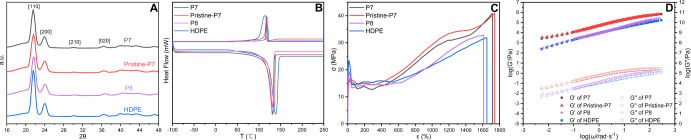
- P7 and Pristine-P7 showed the same crystalline structure and Tm as commercial HDPE; tensile strength was 40.8 and 41.1 MPa vs 32.0 MPa for HDPE, and elongation at break was 1702% and 1701% vs 1686%, attributed to higher Mw (240.8 kDa vs 119.4 kDa for HDPE).
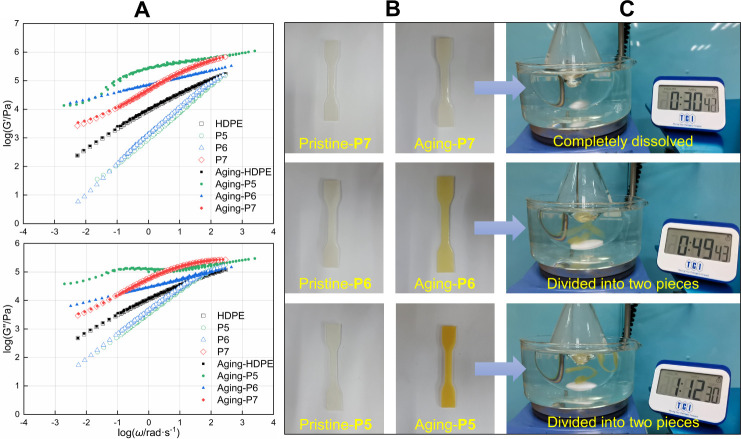
- After aging at 100 °C in air for 28 days, P7 retained its 1,4-PBD content, molecular weight, molecular weight distribution, physical/mechanical properties, and degradation behavior without cross-linking; P5 and P6, with higher 1,4-PBD contents (11.9% and 6.5%), cross-linked and only partly dissolved in 72 and 49 min, whereas P5–P7 and Aging-P7 dissolved completely in chlorobenzene at 100 °C within 30 min.
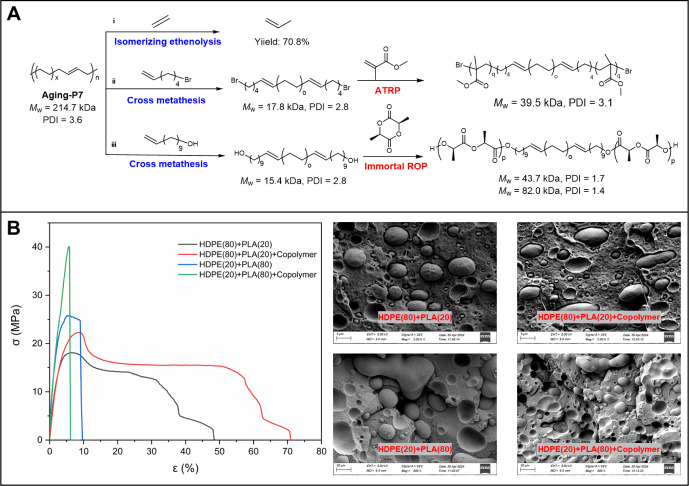
- Upcycling of Aging-P7 gave propylene in 70.3% yield by isomerizing ethenolysis; cross-metathesis with functional α-olefins gave α,ω-telechelic oligomers in quantitative yields with narrow distribution, which were converted to PMMA–PE-PMMA by ATRP with MMA and PLA–PE-PLA by immortal ring-opening polymerization of lactide; 2% PLA–PE-PLA substantially improved HDPE/PLA blend mechanical properties and reduced HDPE droplet size in SEM.
Methods
- E/BD copolymerization was catalyzed by amidinate lanthanide complexes 1–4 with increasing metal ion radii (Sc, Lu, Y, Gd); small-scale conditions included [BD]0 = 0.46 M, E pressure = 4 bar, [Al]0:[Gd]0 = 10:1, 40 °C, and larger-scale runs used 0.80 mmol catalyst, 4 L toluene, 3 h, E = 6 bar, and varied [BD]0 and [Al]0:[Cat]0.
- Copolymers were characterized by 13C NMR and 1H NMR for sequence distribution and composition, GPC for molecular weight, DSC for Tm and crystallinity, WAXS, rheology, and tensile testing; P7, Pristine-P7, P8, and commercial HDPE were compared.
- Aging was performed at 100 °C in air for 28 days; degradation/upcycling used Hoveyda-Grubbs II for isomerizing ethenolysis and cross-metathesis, followed by ATRP or immortal ring-opening polymerization to make triblock compatibilizers, with HDPE/PLA blends evaluated by stress–strain curves and SEM.
Limitations
- The paper does not state a dedicated limitations section.
- Evident from the text: the study focuses on one comonomer (BD) and one catalyst family, especially the Gd amidinate complex 4; upcycling is demonstrated on P7/Aging-P7 rather than all copolymers.
- Evident from the text: aging is limited to 100 °C for 28 days, and compatibilizer performance is tested only in HDPE/PLA blends, so longer-term aging, other waste streams, and broader mechanical recycling conditions are not established.
Model-written summary. Check it against the paper before relying on it.
Integrity signals
Registry
Cites
Statistics
Figures


Verification
Claims the paper makes
5 Valid · 2 Not valid · 4 Not checked · 43 Own results and interpretations
The cited sources support only part of this claim — read each source’s verdict below.
In the paper
“For copolymer P7, with E content increasing up to 97.6%, BD inserts in the discrete 1,4-regularity in major (1,4:1,2 = 1.9:0.5%), and CC units disappear completely (similar to P8, Table 1, entries 7 and 8), which is consistent with the most advantageous structure for a recyclable PE.24”
§ Installing a Trigger to Upcycle High-Density Polyethylene > Results and Discussion > Copolymerization of E and BD and Copolymer Identification
What the sources say
- Partly supportedcites [24] sourceExperimental — accuracy not yet measured
The paper’s discussion of PE degradation (section labeled Abstract; page unavailable) reports that internal olefins enable conversion to propylene, while high unsaturation and branching reduce yields. That supports the general rationale for a lightly unsaturated, predominantly linear PE structure, but the paper does not evaluate P7 or establish its specific 1,4-butadiene content and absence of CC units as the most advantageous structure for recyclability. (LLM, conf=0.84)
plainSingle case- Asserted: passes — The authors put it forward as true.
- Checkable: passes — It can be checked against evidence.
- Load-bearing: passes — The paper’s conclusions depend on it.
- Based: passes — The paper gives a reason why it holds.
- Partly supported
The cited sources support only part of this claim — read each source’s verdict below.
In the paper
“Thus, the degradation ability of P7 was examined in the presence of E and stoichiometric HG II following previously reported procedure.24 Telechelic macromonomers capped with vinyl ends were harvested (Table S3, entry 1; Figure S1).18”
§ Installing a Trigger to Upcycle High-Density Polyethylene > Results and Discussion > Comparison Between Copolymers and HDPE
What the sources say
- Partly supportedcites [24] sourceExperimental — accuracy not yet measured
The ethenolysis passage (indexed section labeled Abstract; page unavailable) reports cleavage of unsaturated HDPE using ethylene and a second-generation Hoveyda–Grubbs catalyst, supporting the cited procedure. It does not report an experiment on P7 or the harvesting of vinyl-capped telechelic macromonomers, and it specifies 3.6 mol % catalyst rather than a stoichiometric amount. In the citing sentence, the product claim is attached to a different citation. (LLM, conf=0.85)
- Could not verifycites [18] sourceExperimental — accuracy not yet measured
The cited paper’s Results and Discussion describe polyethylene depolymerization in n-pentane and report alkane products, not the vinyl-capped telechelic macromonomers attributed to it here. Searches for P7, stoichiometric HG II, and vinyl-capped macromonomers found no passage addressing that experiment or product; the different products reported for this paper’s own experiments do not establish a contradiction. (LLM, conf=0.76)
plainstates a causeSingle case- Asserted: passes — The authors put it forward as true.
- Checkable: passes — It can be checked against evidence.
- Load-bearing: passes — The paper’s conclusions depend on it.
- Based: passes — The paper gives a reason why it holds.
- Partly supported
A result the paper reports from its own data — it cites no other source for it, so there is none to check. The quote shows it is in the paper.
In the paper
“For both Pristine-P7 and Aging-P7, the 1,4-PBD content, the molecular weight, and the molecular weight distribution, physical and mechanical properties as well as degradation behavior, remain at almost the same levels (Figure S2 and Table S4).”
§ Installing a Trigger to Upcycle High-Density Polyethylene > Results and Discussion > Aging Experiments and Upcycling of Copolymers
plain- Asserted: passes — The authors put it forward as true.
- Checkable: passes — It can be checked against evidence.
- Load-bearing: passes — The paper’s conclusions depend on it.
- Based: passes — The paper gives a reason why it holds.
A result the paper reports from its own data — it cites no other source for it, so there is none to check. The quote shows it is in the paper.
In the paper
“In addition, it can be seen from the SEM images of HDPE/PLA (20/80) blends that the addition of triblock copolymer can reduce the droplet size of the HDPE phase during the melt mixing process.”
§ Installing a Trigger to Upcycle High-Density Polyethylene > Results and Discussion > Aging Experiments and Upcycling of Copolymers
plainstates a cause- Asserted: passes — The authors put it forward as true.
- Checkable: passes — It can be checked against evidence.
- Load-bearing: passes — The paper’s conclusions depend on it.
- Based: passes — The paper gives a reason why it holds.
A result the paper reports from its own data — it cites no other source for it, so there is none to check. The quote shows it is in the paper.
In the paper
“In the presence of 2% PLA–PE-PLA, the mechanical properties of the HDPE/PLA blends were substantially improved.”
§ Installing a Trigger to Upcycle High-Density Polyethylene > Results and Discussion > Aging Experiments and Upcycling of Copolymers
plainstates a cause- Asserted: passes — The authors put it forward as true.
- Checkable: passes — It can be checked against evidence.
- Load-bearing: passes — The paper’s conclusions depend on it.
- Based: passes — The paper gives a reason why it holds.
23 more claims
Create a free account to see all 54 claims and every source verdict.
- It may state two separate claims as one. 24
- The quote only partly states this claim. 1
- Probably not a substantial claim. 2
Self-check
Percentages, sums and reported differences re-computed from the paper’s own numbers.
Each contradiction between two passages listed here was confirmed by an independent check.
Rated minor: it would not touch a result — a value no result rests on, a p-value that stays on the same side of the significance level, or a conflict that is clerical, resolved elsewhere in the paper, or outside its own findings.
In the paper
§ Installing a Trigger to Upcycle High-Density Polyethylene > Results and Discussion > Copolymerization of E and BD and Copolymer Identification
“For copolymer P7, with E content increasing up to 97.6%, BD inserts in the discrete 1,4-regularity in major (1,4:1,2 = 1.9:0.5%), and CC units disappear completely (similar to P8, Table 1, entries 7 and 8)”
§ Installing a Trigger to Upcycle High-Density Polyethylene > Results and Discussion > Copolymerization of E and BD and Copolymer Identification
“| 7b | 4 | 7 | 0.46 | 6 | P5 | 278.48 | 116.0 | 85.5 | 11.9 | 2.6 | 94.8 | 106.1 | 2.2 | 123.6 | 28.7 | | 8b | 4 | 7 | 0.16 | 6 | P6 | 230.78 | 96.2 | 92.4 | 6.5 | 1.1 | 94.0 | 103.1 | 3.8 | 126.8 | 42.9 |”
Rated minor: it would not touch a result — a value no result rests on, a p-value that stays on the same side of the significance level, or a conflict that is clerical, resolved elsewhere in the paper, or outside its own findings.
In the paper
§ Installing a Trigger to Upcycle High-Density Polyethylene > Results and Discussion > Copolymerization of E and BD and Copolymer Identification
“Lowering the initial concentration of BD to 0.08 M, resulted in the continuous increase of E content (92.4% P6)”
§ Installing a Trigger to Upcycle High-Density Polyethylene > Results and Discussion > Copolymerization of E and BD and Copolymer Identification
“| 8b | 4 | 7 | 0.16 | 6 | P6 | 230.78 | 96.2 | 92.4 | 6.5 | 1.1 | 94.0 | 103.1 | 3.8 | 126.8 | 42.9 |”
Citations
Cites
Closed-loop recycling of polyethylene-like materials
Häußler, M., Eck, M., Rothauer, D., & Mecking, S. (2021) · Nature · doi:10.1038/s41586-020-03149-9 · Cited by 753
Jia, X., Qin, C., Friedberger, T., Guan, Z., & Huang, Z. (2016) · Science Advances · doi:10.1126/sciadv.1501591 · Cited by 534
Chemically recyclable thermoplastics from reversible-deactivation polymerization of cyclic acetals
Abel, B. A., Snyder, R. L., & Coates, G. W. (2021) · Science · doi:10.1126/science.abh0626 · Cited by 483
Catalytic deconstruction of waste polyethylene with ethylene to form propylene
Conk, R. J., Hanna, S., Shi, J. X., Yang, J., Ciccia, N. R., Qi, L., Bloomer, B. J., Heuvel, S., Wills, T., Su, J., et al. (2022) · Science · doi:10.1126/science.add1088 · Cited by 420
Polyethylene materials with in-chain ketones from nonalternating catalytic copolymerization
Baur, M., Lin, F., Morgen, T. O., Odenwald, L., & Mecking, S. (2021) · Science · doi:10.1126/science.abi8183 · Cited by 287
Chemical Recycling of Polyethylene by Tandem Catalytic Conversion to Propylene
Wang, N. M., Strong, G., DaSilva, V., Gao, L., Huacuja, R., Konstantinov, I. A., Rosen, M. S., Nett, A. J., Ewart, S., Geyer, R., et al. (2022) · Journal of the American Chemical Society · doi:10.1021/jacs.2c07781 · Cited by 259
Bambirra, S., Bouwkamp, M. W., Meetsma, A., & Hessen, B. (2004) · Journal of the American Chemical Society · doi:10.1021/ja0475297 · Cited by 251
Chemically recyclable polyolefin-like multiblock polymers
Zhao, Y., Rettner, E. M., Harry, K. L., Hu, Z., Miscall, J., Rorrer, N. A., & Miyake, G. M. (2023) · Science · doi:10.1126/science.adh3353 · Cited by 205
Catalytic Chemical Recycling of Post-Consumer Polyethylene
Arroyave, A., Cui, S., Lopez, J. C., Kocen, A. L., LaPointe, A. M., Delferro, M., & Coates, G. W. (2022) · Journal of the American Chemical Society · doi:10.1021/jacs.2c11949 · Cited by 189
Tandem Heterogeneous Catalysis for Polyethylene Depolymerization via an Olefin-Intermediate Process
Ellis, L. D., Orski, S. V., Kenlaw, G. A., Norman, A. G., Beers, K. L., Román-Leshkov, Y., & Beckham, G. T. (2021) · ACS Sustainable Chemistry & Engineering · doi:10.1021/acssuschemeng.0c07612 · Cited by 166
Research works printed but not linked: 1
- Patel, R. M. Multilayer Flexible Packaging ; 2nd ed. Wagner, J. R., Jr., William Andrew Publishing: 2016 pp. 1734
Cited by
Functional Polyolefins and Composites
Tan, C., Si, G., Zou, C., & Chen, C. (2025) · Angewandte Chemie International Edition · doi:10.1002/anie.202424529 · Cited by 82
Recent developments in recycling of post-consumer polyethylene waste
Ma, Y., Jiang, X., Xiang, X., Qu, P., & Zhu, M. (2025) · Green Chemistry · doi:10.1039/d4gc06566b · Cited by 38
Advances in sustainable polyolefins: synthesis, chemical transformation and recycling
Zhang, Y., Yang, D., Li, X., Chen, P.-A., Yao, X., & Jian, Z. (2025) · National Science Review · doi:10.1093/nsr/nwaf489 · Cited by 28
“The incorporation of an in-chain unsaturated group could be achieved via the copoly-merization of ethylene or propylene with dienes (conjugated [73 ,75 ,81 –84 ] or non-conjugated di-enes [74 ]) or through the dehydrogenation of PE [82 ,85 ] (discussed in the ‘Degradable polyolefins from chemical…”
InfluentialChen, L., Wang, Z., Fang, E., Fan, Z., & Song, S. (2025) · Angewandte Chemie International Edition · doi:10.1002/anie.202503408 · Cited by 18
Liu, K., Zhao, Y., Wolff, A. M., Harry, K. L., Rettner, E. M., Miscall, J., Rorrer, N. A., & Miyake, G. M. (2025) · Angewandte Chemie International Edition · doi:10.1002/anie.202502641 · Cited by 23
Metadata
- Authors
- Nan, T., Chen, Q., Zheng, Z., Liang, Y., Qin, Y., Wang, Y., Liu, B., & Cui, D.
- Affiliations
- University of Science and Technology of China (CN)
- Chinese Academy of Sciences (CN)
- Corresponding author
- Liu, Bo
- Cui, Dongmei
- Venue
- Journal of the American Chemical Society
- Publisher
- American Chemical Society (ACS)
- Published
- 2024-09-25
- Volume
- 146
- Issue
- 40
- Pages
- 27794-27801
- ISSN
- 0002-7863 (ISSN-L)
- 1520-5126
- PMC
- PMC11669092
- OpenAlex
- W4402814797
- Cited by
- 42
- References
- 53
- Citations by year
- 2026: 13 · 2025: 29
- FWCI
- 6.06
- Type
- journal article
- Language
- en
- Open access
- hybrid
- doi.org
- Licence
- Locations
- Journal of the American Chemical Society (publishedVersion, cc-by-nc-nd)
- PubMed Central (publishedVersion, cc-by-nc-nd)
- PubMed (publishedVersion)
- Funders
- National Natural Science Foundation of China (22171256, 22331010, U21A20279, U23B2080)
- Topics
- Physical Sciences › Chemistry › Organic Chemistry › Organometallic Complex Synthesis and Catalysis
- Physical Sciences › Materials Science › Biomaterials › biodegradable polymer synthesis and properties
- Physical Sciences › Chemistry › Organic Chemistry › Advanced Polymer Synthesis and Characterization
- Keywords
- high-density polyethylene, upcycling, C–C bond functionalization, telechelic oligomers, atom transfer radical polymerization, ring-opening polymerization, compatibilizer, polyolefin degradation
About these checks
Registry, retraction, Cites and statistics results are computed, not judged, with one exception: a printed reference that no index lists is read once by a model before it counts as a citation error. Claims are extracted by a model and kept only when their quote appears verbatim in the text; each cited source is then checked, with a model’s help, for whether it says what the claim relies on. Those verdicts can be wrong — read the claim’s quote and the cited source before relying on one.
The claim verdicts this report counts are experimental: their accuracy is not yet measured.
A language model drew the claims from the paper on 2026-10-10, under version 3 of the claim definition (model deepseek-v4.1-flash, prompt extract-v3).
A second model labelled each claim on 2026-10-10 (model jev-1.13-20260917, definition revision gold-guideline-v0.2).
Cited sources are checked with a language model’s help (gpt-6-sol).
Statistics and arithmetic are recomputed, not judged.
Confidence bands are shown only for fields calibrated on our annotated test set. None is calibrated yet, so no band is shown.
What counts as a claim ›How we measure confidence ›How we check this ›
Are you an author, or do you see a problem with this page? Request a review
Data sources
Bibliographic data: Semantic Scholar, OpenAlex, Crossref.
Contains information from the Semantic Scholar Academic Graph Datasets, made available under the ODC Attribution License (ODC-BY 1.0).
Semantic Scholar’s data is described in: Kinney, R., et al. (2023). The Semantic Scholar Open Data Platform. arXiv:2301.10140.
