

The DOI matches its Crossref record; 81 of the 81 references it cites were found in a registry or an index; none of the 71 sources its claims cite is checked for support yet.
Geochronological Constraints on the Evolution and Petrogenesis of the Malwa Plateau Subprovince of the Deccan Traps
Open accessAbstract
The eruptive history of the Malwa Plateau Subprovince of the Deccan Traps is addressed by dating 21 lavas spanning the exposed stratigraphic extent, using the 40 Ar/ 39 Ar method applied to plagioclase separates. Major, minor, and trace element geochemistry was determined for each of the dated lavas and four additional ones. Dating results indicate that the eruptions began prior to 66.8 Ma, at least 400 ka before the oldest known lava in the more extensively studied Western Ghats, representative of the main Deccan province, to the south. Eruption rates peaked from 66.4 to 66.3 Ma and then diminished until 65.6 Ma. The peak in eruption rates coincides with the well‐documented Late Maastrichtian Warming event. Malwa lavas show some major and trace element affinities with geochemically defined lava flow formations of the Western Ghats, but are generally out of the stratigraphic sequence manifest in the Western Ghats. The distinct geochemical evolution of Malwa Plateau lavas compared with those of the Western Ghats is at least in part a consequence of differences in crustal composition between the two subprovinces. Modeling of REE concentration patterns of Malwa lavas suggests that they were derived by slightly lower degrees of partial melting, at lower mantle temperatures and depths, than those in the Western Ghats. The Malwa Plateau thus appears to record an earlier, cooler stage of the Deccan plume's evolution and continued to erupt through a large part of the lifetime of the main Deccan province.
Overview
CoChat Summary
Written by AI from the paper’s full text.
TL;DR
New 40Ar/39Ar plagioclase ages and geochemistry for 25 Malwa Plateau lavas show Deccan volcanism there began by 66.834 ± 0.075 Ma, at least ~400 ka before the oldest dated Western Ghats lavas, peaked at 66.4–66.3 Ma, and continued to 65.6 Ma. Malwa lavas are geochemically distinct from Western Ghats chemotypes, and REE modeling suggests lower-degree, lower-temperature, shallower melting consistent with an earlier, cooler stage of the Deccan plume.
Key findings
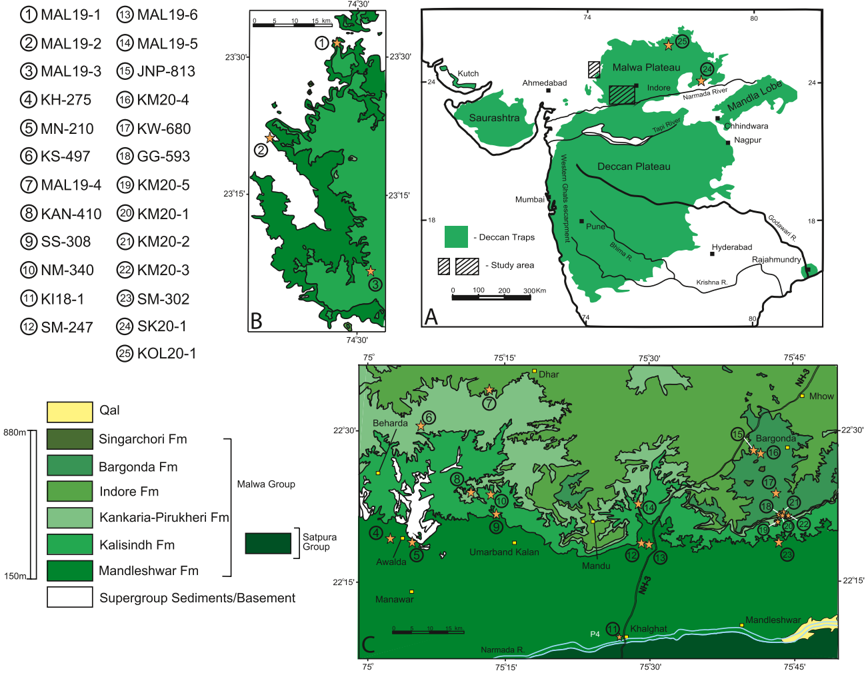
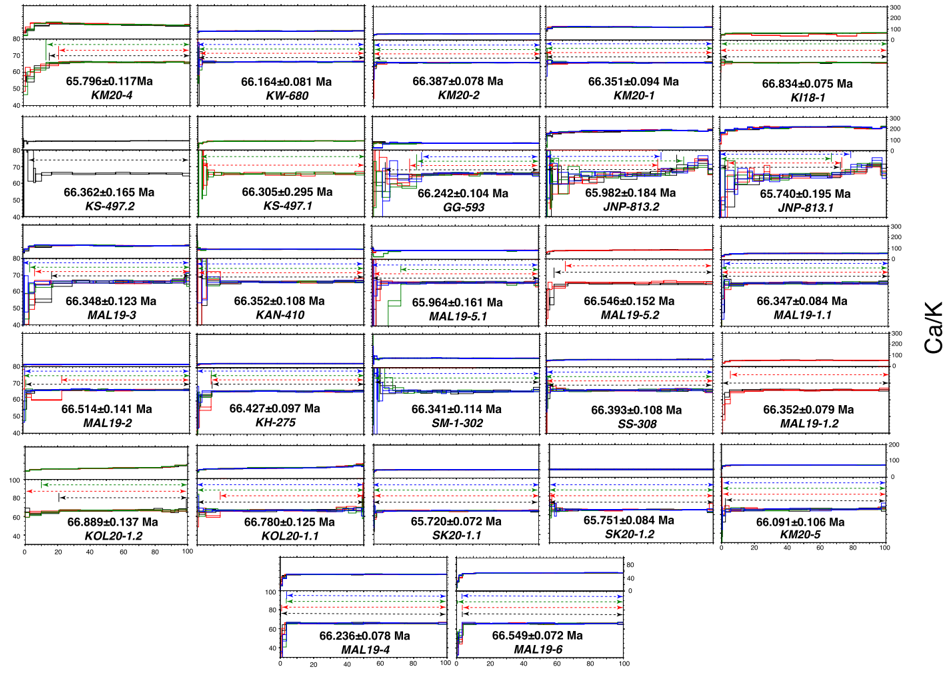
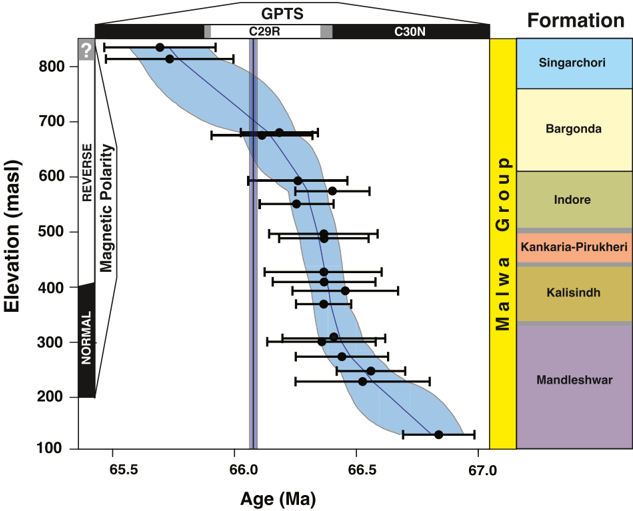
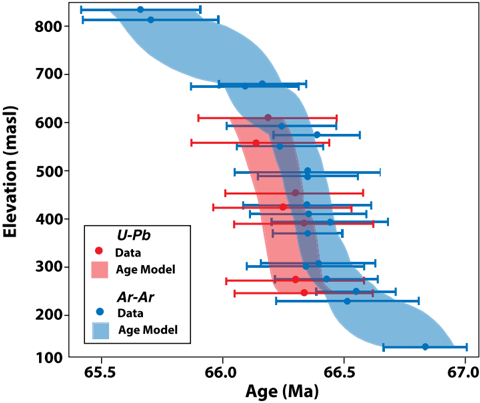
- 40Ar/39Ar dating of 21 lavas spanning the exposed stratigraphic extent shows eruptions began prior to 66.8 Ma; the oldest sample, KI18-1 of the Mandleshwar Formation, gives 66.834 ± 0.075 Ma (1σ analytical), at least 400 ka older than the oldest high-precision Western Ghats age of 66.413 ± 0.067 Ma (Sprain et al., 2019). Exposed southern Malwa lavas span ~700 m elevation and roughly 1 million years, with quasi-continuous eruptions for ~350,000 years leading up to the KPB; eruption rates peaked from 66.4 to 66.3 Ma and then diminished until 65.6 Ma, coinciding with the Late Maastrichtian Warming event.
- All but one analyzed sample are tholeiitic basalts or basaltic andesites with SiO2 49.3–54.2 wt% on a volatile-free basis; except topmost JNP-813 (TiO2 = 0.99 wt%, FeO = 10.8 wt%, MgO = 6.8 wt%), samples are high in TiO2 (2.3–3.3 wt%) and FeO (10.7–15.7 wt%) and low in MgO (3.8–6.9 wt%). One alkaline trachybasalt, MAL19-2 (66.51 ± 0.28 Ma), has strong LREE/HREE enrichment (La/Lu = 109.6).
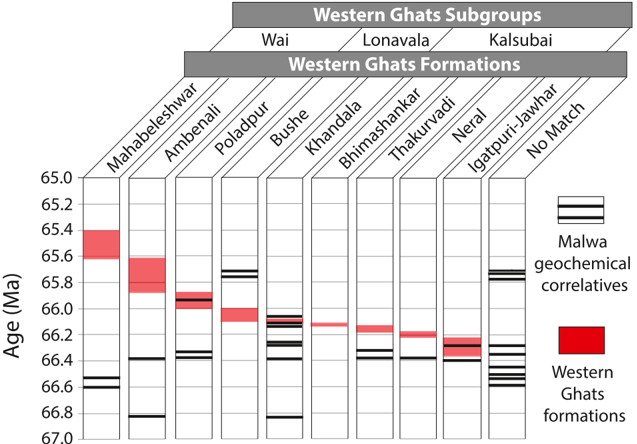
- Discriminant-function analysis returns some Malwa correlations to Western Ghats chemotypes, but many samples do not reliably match any chemotype and several matches are out of stratigraphic order; Khandala chemotypes erupted earlier in Malwa (66.8–66.2 Ma) than in the Western Ghats (66.2–66.1 Ma), while Bushe-like lavas erupted slightly later in Malwa (65.9–65.8 Ma) than in the Western Ghats (66.1–66.0 Ma).
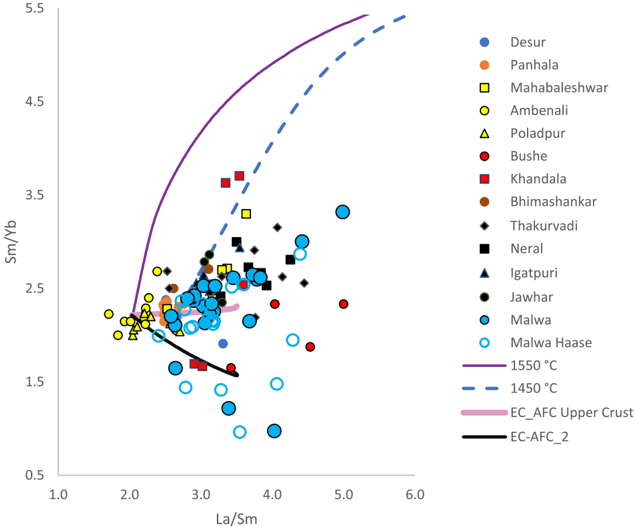
- REE modeling suggests Malwa lavas were derived by slightly lower degrees of partial melting, at lower mantle temperatures and depths, than Western Ghats lavas; Malwa thus appears to record an earlier, cooler stage of the Deccan plume’s evolution and continued erupting through a large part of the main Deccan province’s lifetime.
Methods
- Collected 25 lava samples from Malwa Plateau outcrops, predominantly in the southern region; 21 were selected for 40Ar/39Ar dating, and four were unsuitable due to plagioclase inclusions or alteration. Seven plagioclase megacrystic basalts had geochemistry previously presented by Marzoli et al. (2022).
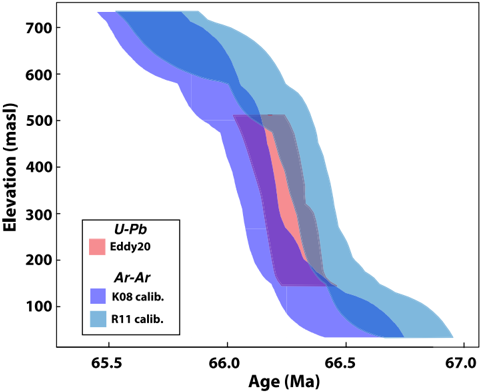
- 40Ar/39Ar dating used plagioclase separates co-irradiated with Fish Canyon sanidine in four separate 7 hr irradiations in the CLICIT facility of the Oregon State University TRIGA reactor; 4–8 aliquots per sample were analyzed in 12–15 step incremental CO2 laser heating experiments at the Berkeley Geochronology Center using a MAP 215C mass spectrometer. Weighted mean plateau ages are based on the Renne et al. (2011) calibration, and age models were produced with Chron.jl using sample elevations and 2σ weighted mean plateau ages including systematic uncertainties.
- Whole-rock major and trace element data were obtained on all 25 samples by XRF and ICP-MS at the Washington State University GeoAnalytical Lab; data were compared with Western Ghats chemotypes via discriminant-function analysis in SPSS v.27 following Peng et al. (1998) and Vanderkluysen et al. (2011), and REE patterns were modeled with REEBOX PRO and EC-AFC.
Limitations
- Stated: the duration of the waxing and waning phases of eruption rate is poorly constrained because of unknown erosion and the undated lava section below the lowest dated flow at the Narmada River; two dated samples (KOL20-1 and SK20-1) cannot be confidently placed in the age model.
- Stated: current age resolution permits only coarse climate modeling via geochemical box models, and there remains disagreement between pulsed versus quasi-continuous eruptive tempo; intercalibration uncertainties between 40Ar/39Ar and U-Pb dating persist, with offsets depending on whether the Renne et al. (2011) or Kuiper et al. (2008) calibration is used.
- Evident: sampling is concentrated in the southern Malwa Plateau where sections are least faulted and expose the maximum elevation range; geochemical correlations rely on liberal DFA criteria (Mahalanobis distance <20), and the paper notes that differences in Ti, Zr/Y, and Nb/La cast doubt on almost every correlation. The study also does not directly bear on the pulsed versus quasi-continuous eruptive tempo of the LIP as a whole.
Model-written summary. Check it against the paper before relying on it.
Integrity signals
Registry
Cites
Statistics
Figures




Verification
Claims the paper makes
38 Own result · 30 Own interpretation · 16 No full text of the sources · 13 Check pending · 12 Not checked yet · 4 Sources not found · 2 Own method · 1 No basis given
A result the paper reports from its own data — it cites no other source for it, so there is none to check. The quote shows it is in the paper.
In the paper
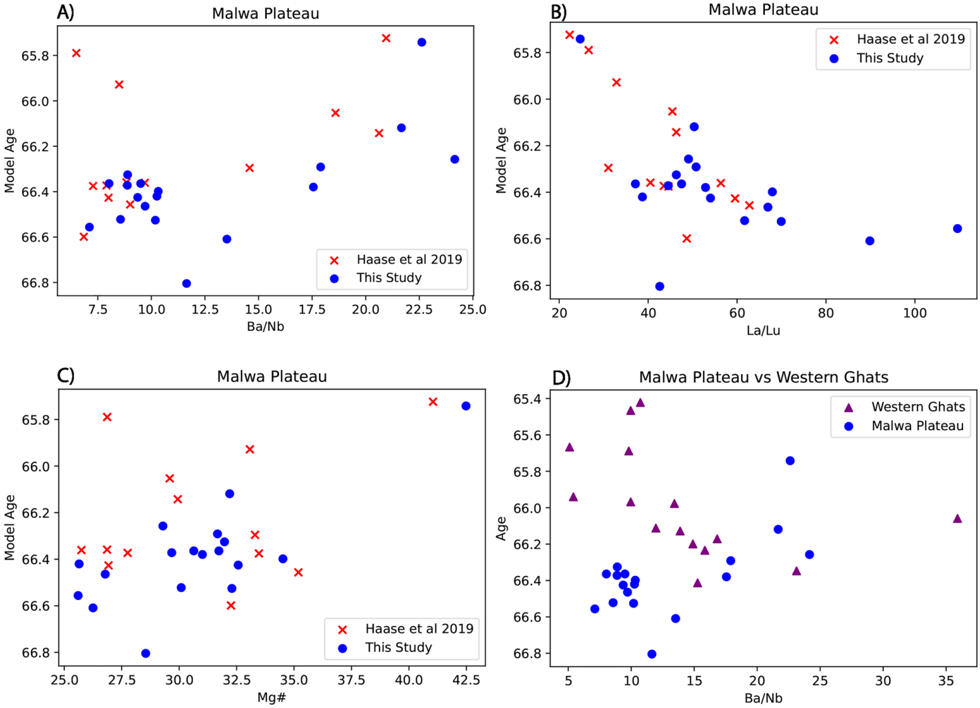
“Most samples that return a reasonable chemical correlation to a Western Ghat chemotype are vastly different in terms of their age relative to its counterpart in the main Deccan Plateau (Figure 6).”
§ Geochronological Constraints on the Evolution and Petrogenesis of the Malwa Plateau Subprovince of the Deccan Traps > 4.2. Geochemistry Results
plainstates an association- Asserted: passes — The authors put it forward as true.
- Checkable: passes — It can be checked against evidence.
- Load-bearing: passes — The paper’s conclusions depend on it.
- Based: passes — The paper gives a reason why it holds.
A result the paper reports from its own data — it cites no other source for it, so there is none to check. The quote shows it is in the paper.
In the paper
“Eruptions began as early as 66.834 ± 0.075 Ma (1σ analytical uncertainty) as indicated by the weighted mean plateau age for sample KI18-1 of the Mandleshwar Formation, sampled a few meters above the Narmada River representing the lowest exposed lava in this vicinity.”
§ Geochronological Constraints on the Evolution and Petrogenesis of the Malwa Plateau Subprovince of the Deccan Traps > 4.1. Geochronology Results
hedgedstates a causeSingle case- Asserted: passes — The authors put it forward as true.
- Checkable: passes — It can be checked against evidence.
- Load-bearing: passes — The paper’s conclusions depend on it.
- Based: passes — The paper gives a reason why it holds.
In the paper
“Overall, our major, minor, and trace element data overlap substantially with those of Haase et al. (2019) for the Malwa Plateau (Figure 4).”
§ Geochronological Constraints on the Evolution and Petrogenesis of the Malwa Plateau Subprovince of the Deccan Traps > 4.2. Geochemistry Results
What the sources say
- Not checked — no full text of the sourcecites Haase et al., 2019 source
plainstates an association- Asserted: passes — The authors put it forward as true.
- Checkable: passes — It can be checked against evidence.
- Load-bearing: unclear — It is unclear whether the paper’s conclusions depend on it.
- Based: passes — The paper gives a reason why it holds.
A result the paper states — it cites no source for it, so there is none to check. The quote shows it is in the paper.
In the paper
“The youngest Malwa basalts also overlap with Bushe basalts from the Western Ghats in low TiO 2 contents and enriched Sr-Nd isotopic compositions.”
§ Geochronological Constraints on the Evolution and Petrogenesis of the Malwa Plateau Subprovince of the Deccan Traps > 5.1. Rates of Chemical Variability
plainstates an association- Asserted: passes — The authors put it forward as true.
- Checkable: passes — It can be checked against evidence.
- Load-bearing: passes — The paper’s conclusions depend on it.
- Based: passes — The paper gives a reason why it holds.
A result the paper reports from its own data — it cites no other source for it, so there is none to check. The quote shows it is in the paper.
In the paper
“Results show that lavas currently exposed in the southern MP spanning 700 m in elevation record roughly 1 million years of eruptive history.”
§ Geochronological Constraints on the Evolution and Petrogenesis of the Malwa Plateau Subprovince of the Deccan Traps > 4.1. Geochronology Results
plain- Asserted: passes — The authors put it forward as true.
- Checkable: passes — It can be checked against evidence.
- Load-bearing: passes — The paper’s conclusions depend on it.
- Based: passes — The paper gives a reason why it holds.
- It may state two separate claims as one. 46
- Probably not a substantial claim. 10
Create a free account to see these claims.
Create a free account to see these assumptions.
59 more claims
Create a free account to see all 116 claims and to verify the 23 references still open.
Claims other papers make about this one
Each is checked against this paper’s own text: does it say what the citing paper says it does?
In the citing paper
“At Malwa Plateau, the highest basaltic eruption rates occur ~350 kyr before the K/Pg boundary and at least start ~400 kyr before Western Ghats basalts (11, 27).”
From Earth orbital rhythms links timing of Deccan trap volcanism phases and global climate change (2025) · cites this paper as [27]
In the citing paper
“Recent geochronological studies (Eddy et al., 2020;Patil Pillai et al., 2022;Tholt et al., 2023) demonstrate that longdistance correlations (used in the earlier unified chemostratigraphy and apparently supported by morphological types of the lava flows) are untenable across subprovince limits.”
From Spatio-temporal volume recalibration shows Deccan volcanism caused Terminal Cretaceous Mass Extinction (2026) · cites this paper as Tholt et al., 2023
In the citing paper
“Only the youngest Singarchori Formation of Malwa Group is of Danian age based on two dates (Tholt et al., 2023), namely, the intertrappean fossils and normal polarity (=Chron C29n) of the younger lavas recorded around Sagar (Madhya Pradesh, India; Singh et al., 2024).”
From Spatio-temporal volume recalibration shows Deccan volcanism caused Terminal Cretaceous Mass Extinction (2026) · cites this paper as Tholt et al., 2023
Self-check
Percentages, sums and reported differences re-computed from the paper’s own numbers.
Each contradiction between two passages listed here was confirmed by an independent check.
Rated minor: it would not touch a result — a value no result rests on, a p-value that stays on the same side of the significance level, or a conflict that is clerical, resolved elsewhere in the paper, or outside its own findings.
In the paper
§ Geochronological Constraints on the Evolution and Petrogenesis of the Malwa Plateau Subprovince of the Deccan Traps > 4.1. Geochronology Results
“KM20-4 at 843 masl”
§ Geochronological Constraints on the Evolution and Petrogenesis of the Malwa Plateau Subprovince of the Deccan Traps > 6. Conclusions
“| KM20-4 | 22.4615 | 75.6881 | 835 | 65.796 | 0.117 0.123 |”
Citations
Cites
Sun, S.-S., & McDonough, W. F. (1989) · Geological Society, London, Special Publications · doi:10.1144/gsl.sp.1989.042.01.19 · Cited by 16,410
McDonough, W. F., & Sun, S. (1995) · Chemical Geology · doi:10.1016/0009-2541(94)00140-4 · Cited by 14,231
Composition of the Continental Crust
Rudnick, R. L., & Gao, S. (2003) · Treatise on Geochemistry · doi:10.1016/b0-08-043751-6/03016-4 · Cited by 3,413
Westerhold, T., Marwan, N., Drury, A. J., Liebrand, D., Agnini, C., Anagnostou, E., Barnet, J. S. K., Bohaty, S. M., De Vleeschouwer, D., Florindo, F., et al. (2020) · Science · doi:10.1126/science.aba6853 · Cited by 1,946
Synchronizing Rock Clocks of Earth History
Kuiper, K. F., Deino, A., Hilgen, F. J., Krijgsman, W., Renne, P. R., & Wijbrans, J. R. (2008) · Science · doi:10.1126/science.1154339 · Cited by 1,345
Self-citationVertically extensive and unstable magmatic systems: A unified view of igneous processes
Cashman, K. V., Sparks, R. S. J., & Blundy, J. D. (2017) · Science · doi:10.1126/science.aag3055 · Cited by 1,159
Flood Basalts and Hot-Spot Tracks: Plume Heads and Tails
Richards, M. A., Duncan, R. A., & Courtillot, V. E. (1989) · Science · doi:10.1126/science.246.4926.103 · Cited by 1,137
Renne, P. R., Balco, G., Ludwig, K. R., Mundil, R., & Min, K. (2011) · Geochimica et Cosmochimica Acta · doi:10.1016/j.gca.2011.06.021 · Cited by 712
Self-citationDeccan flood basalts at the Cretaceous/Tertiary boundary?
Courtillot, V., Besse, J., Vandamme, D., Montigny, R., Jaeger, J.-J., & Cappetta, H. (1986) · Earth and Planetary Science Letters · doi:10.1016/0012-821x(86)90118-4 · Cited by 571
U-Pb constraints on pulsed eruption of the Deccan Traps across the end-Cretaceous mass extinction
Schoene, B., Eddy, M. P., Samperton, K. M., Keller, C. B., Keller, G., Adatte, T., & Khadri, S. F. R. (2019) · Science · doi:10.1126/science.aau2422 · Cited by 542
Research works printed but not linked: 5
- Bhalla M. S., 1974, Low field hysteresis and palaeomagnetic stability criterion of rock samples from Dhar (Deccan traps) India, Journal of Indian Geophysical Union, 12, 14
- Kaila K. L., 1988, Deccan flood basalts, Memoir ‐ Geologic Society of India, 91
- Khadri S. F. R., 2003, Occurrence of N–R–N sequence in the Malwa Deccan lava flows to the north of Narmada region, Madhya Pradesh, India, Current Science, 85, 1126
- Khadri S. F. R., 1994, Magnetostratigraphy of Malwa Deccan Traps Near Mandu Region, Madhya Pradesh, 199
- 10.1017/s00167568200011683 · DOI
Cited by
Earth orbital rhythms links timing of Deccan trap volcanism phases and global climate change
Westerhold, T., Dallanave, E., Penman, D., Schoene, B., Röhl, U., Gussone, N., & Kuroda, J. (2025) · Science Advances · doi:10.1126/sciadv.adr8584 · Cited by 17
Dhobale, A., Mohabey, D. M., Samant, B., Sangode, S. J., & Kumar, D. (2024) · Historical Biology · doi:10.1080/08912963.2024.2418914 · Cited by 4
Self-citationMarzoli, A., Reisberg, L. C., Capriolo, M., Callegaro, S., Renne, P. R., Chiaradia, M., Meyzen, C., Self, S., Vanderkluysen, L., & Boscaini, A. (2026) · Earth and Planetary Science Letters · doi:10.1016/j.epsl.2026.119847 · Cited by 3
Self-citationKale, V. S., Upasani, D., Rajput, M., Dole, G., & Pillai, S. P. (2026) · Geological Society of America Bulletin · doi:10.1130/b38412.1 · Cited by 3
Sen, R., Polacci, M., Hartley, M. E., Burton, M. R., & Gupta, S. (2025) · Journal of Volcanology and Geothermal Research · doi:10.1016/j.jvolgeores.2025.108493 · Cited by 2
Metadata
- Authors
- Tholt, A. J., Renne, P. R., Marzoli, A., Vanderkluysen, L., Mohabey, D., Samant, B., Dhobale, A., Pande, K., & Self, S.
- Affiliations
- University of California, Berkeley (US)
- Berkeley Geochronology Center (US)
- University of Padua (IT)
- Drexel University (US)
- Rashtrasant Tukadoji Maharaj Nagpur University (IN)
- Savitribai Phule Pune University (IN)
- Indian Institute of Technology Bombay (IN)
- Corresponding author
- Tholt, A. J.
- ORCID
- Venue
- Geochemistry, Geophysics, Geosystems
- Publisher
- American Geophysical Union (AGU)
- Published
- 2023-12
- Volume
- 24
- Issue
- 12
- ISSN
- 1525-2027 (ISSN-L)
- OpenAlex
- W4389903873
- Cited by
- 15
- References
- 81
- Citations by year
- 2026: 7 · 2025: 6 · 2024: 2
- FWCI
- 2.14
- Type
- journal article
- Language
- en
- Open access
- gold
- doi.org
- Licence
- Locations
- Geochemistry Geophysics Geosystems (publishedVersion, cc-by-nc-nd)
- Padua Research Archive (University of Padova) (submittedVersion, cc-by-nc-nd)
- DOAJ (DOAJ: Directory of Open Access Journals) (submittedVersion, cc-by-sa)
- Topics
- Physical Sciences › Earth and Planetary Sciences › Geochemistry and Petrology › Geological and Geochemical Analysis
- Physical Sciences › Earth and Planetary Sciences › Geology › Geological and Geophysical Studies
- Physical Sciences › Earth and Planetary Sciences › Paleontology › Paleontology and Stratigraphy of Fossils
- Keywords
- Deccan Traps, 40Ar/39Ar geochronology, plagioclase, eruption rate, Western Ghats, crustal composition, mantle partial melting, rare earth element patterns, mantle temperature, Cretaceous volcanism, lava geochemistry
About these checks
Registry, retraction, Cites and statistics results are computed, not judged, with one exception: a printed reference that no index lists is read once by a model before it counts as a citation error. Claims are extracted by a model and kept only when their quote appears verbatim in the text; each cited source is then checked, with a model’s help, for whether it says what the claim relies on. Those verdicts can be wrong — read the claim’s quote and the cited source before relying on one.
A language model drew the claims from the paper on 2026-11-12, under version 3 of the claim definition (model deepseek-v4.1-flash, prompt extract-v3).
A second model labelled each claim on 2026-11-12 (model jev-1.13-20260917, definition revision gold-guideline-v0.2).
Statistics and arithmetic are recomputed, not judged.
Confidence bands are shown only for fields calibrated on our annotated test set. None is calibrated yet, so no band is shown.
What counts as a claim ›How we measure confidence ›How we check this ›
Are you an author, or do you see a problem with this page? Request a review
