

Work, recovery activities, and individual well-being: A diary study.
Open accessThe DOI matches its Crossref record; 73 of the 77 references it cites were found in a registry or an index.
Abstract
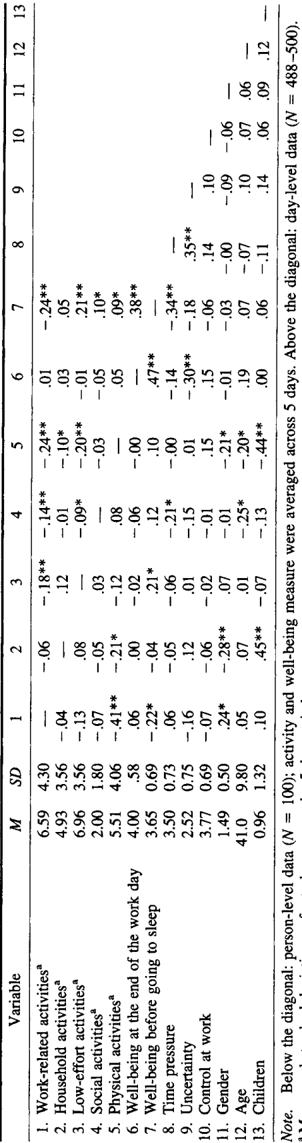
This study extends previous research on respite from work and addresses the question of how individuals use their leisure time to recover from work. It is hypothesized that time spent on work-related and household activities has a negative effect on well-being, whereas low-effort, social, and physical activities are assumed to have a positive effect. One hundred Dutch teachers completed a diary on leisure time activities and situational well-being for 5 days, and work situation variables were assessed with a questionnaire. Multilevel analyses in which preleisure well-being and work situation variables were entered as control variables supported 4 of the 5 hypotheses. Moreover, a lagged effect of high time pressure on poor situational well-being was found. The study showed that leisure time activities and a low-stress work situation contribute independently to an individual's well-being.
Overview
The claims and statistics of this paper haven’t been checked yet.
Free: it reads the open-access text and checks the first 5 claims that cite a source we can check. Create a free account to check every claim.
Integrity signals
Registry
Cites
Statistics
Figures
Verification
Claims the paper makes
The claims and statistics of this paper haven’t been checked yet.
Free: it reads the open-access text and checks the first 5 claims that cite a source we can check. Create a free account to check every claim.
Claims other papers make about this one
Each is checked against this paper’s own text: does it say what the citing paper says it does?
The cited source says what the claim attributes to it.
In the citing paper
“Research has shown that besides low-effort activities such as watching television, taking a bath, and social activities, physical activities in leisure time have a positive effect on work recovery (Sonnentag 2001).”
From Energy Management of People in Organizations: A Review and Research Agenda (2011) · cites this paper as Sonnentag 2001
Self-check
Percentages, sums and reported differences re-computed from the paper’s own numbers.
The self-check needs the paper’s full text.
Citations
Cites
Hierarchical Linear Models: Applications and Data Analysis Methods.
Longford, N. T., Bryk, A. S., & Raudenbush, S. W. (1993) · Contemporary Sociology · doi:10.2307/2075823 · Cited by 18,724
Subjective well-being: Three decades of progress.
Diener, E., Suh, E. M., Lucas, R. E., & Smith, H. L. (1999) · Psychological Bulletin · doi:10.1037/0033-2909.125.2.276 · Cited by 12,910
Handbook of Industrial and Organizational Psychology.
Hammer, T. H., Anderson, J., Gurdon, M., Jick, T., Petit, A., Stern, R., Schwartz, H., Vardi, Y., & Dunnette, M. D. (1977) · Administrative Science Quarterly · doi:10.2307/2391755 · Cited by 11,945
Healthy work: stress, productivity, and the reconstruction of working life
(1990) · Choice Reviews Online · doi:10.5860/choice.28-0381 · Cited by 8,220
Handbook of industrial and organizational psychology
(1993) · Choice Reviews Online · doi:10.5860/choice.30-5278 · Cited by 5,339
Emotional regulation in the workplace: A new way to conceptualize emotional labor.
Grandey, A. A. (2000) · Journal of Occupational Health Psychology · doi:10.1037//1076-8998.5.1.95 · Cited by 3,817
A meta-analytic examination of the correlates of the three dimensions of job burnout
Lee, R. T., & Ashforth, B. E. (1996) · Journal of Applied Psychology · doi:10.1037/0021-9010.81.2.123 · Cited by 3,262
Organizational Stress: Studies in Role Conflict and Ambiguity.
Roy, D. F., Kahn, R. L., Wolfe, D. M., Quinn, R. P., Snoek, J. D., & Rosenthal, R. A. (1965) · American Sociological Review · doi:10.2307/2091375 · Cited by 3,016
The functioning and well-being of depressed patients. Results from the Medical Outcomes Study
Wells, K. B. (1989) · JAMA · doi:10.1001/jama.262.7.914 · Cited by 2,808
International Review of Industrial and Organizational Psychology: Contents of Previous Volumes
(2003) · International Review of Industrial and Organizational Psychology 2004 · doi:10.1002/0470013311.oth1 · Cited by 2,762
Research works printed but not linked: 5
- Leitner, M. J., & Leitner, S. F. (1989). Leisure enhancement. Binghampton, NY: Howorth.
- Rasbash, J., & Woodhouse, G. (1996). MLn. London: University of London, Institute of Education.
- Semmer, N. (1984). Streβbezogene Tätigkeitsanalyse [Stress-oriented analysis of work: Psychological studies on the analysis of stress at work]. Weinheim, Germany: Beltz.
- Snijders, T. A. B., & Bosker, R. J. (1999). Multilevel analysis. An introduction to basic and advanced multilevel modeling. London: Sage.
- Sonnentag, S. (2000). Assessing daily recovery activities: First experiences with a diary method (Technical report). Konstanz, Germany, University of Konstanz.
Cited by
Items 601–700 of 848
DiStaso, M., Horan, K., LeNoble, C., Shoss, M. K., Politis, Z., & Azcarate, I. (2022) · Emerald Group Publishing Limited eBooks · doi:10.1108/978-1-64802-781-920251003 · Cited by 2
Tang, S. (2010) · Digital Commons - Lingnan (Lingnan University) · doi:10.14793/soc_etd.28 · Cited by 6
“Positive events are associated with increased well-being, especially when the individual enjoys the activity and puts a high value rating on the activity, possibly due to the influence it has on mood (Eden, 2001; Haworth, 1997; Sonnentag, 2001).”
BackgroundInfluentialBrand-Labuschagne, L. (2010) · Boloka Institutional Repository (North-west University) · Cited by 4
Trabalho docente do enfermeiro e a Síndrome de Burnout: desafios e perspectivas
Ebisui, C. T. N. (2008) · Digital Library of Theses and Dissertations (Universidade de São Paulo) · doi:10.11606/t.22.2008.tde-12012009-155856 · Cited by 23
Dahm, P. C. (2015) · University of Minnesota Digital Conservancy (University of Minnesota) · Cited by 2
Socializing To Recover From Work Stress: The Benefits Of Acting Extraverted
Cunningham, C. J. L., & Harste, R. W. (2017) · PsycEXTRA Dataset · doi:10.1037/e508312017-001
Braukmann, J. M. (2017) · Kobra (Universitätsbibliothek Kassel) · Cited by 4
The effects of exercise on organizational and personal outcomes : a work-home resources perspective
Patel, A. S. (2019) · MOspace Institutional Repository (University of Missouri) · doi:10.32469/10355/69972 · Cited by 3
Toropainen, L. (2020) · Tampere University Institutional Repository (Tampere University) · Cited by 3
Being active during lockdown: the recovery potential of physical activity for well-beingPreprint
Ginoux, C., Isoard‐Gautheur, S., Teran‐Escobar, C., Forestier, C., Chalabaëv, A., Clavel, A., & Sarrazin, P. G. (2020) · SportRxiv (OSF Preprints) · doi:10.31236/osf.io/6pgqx · Cited by 2
Hernandez, I. F. (2025) · doi:10.69622/27628245 · Cited by 2
Kim, M. (. (2020) · K-State Research Exchange (Kansas State University) · Cited by 2
PASIÓN Y ADICCIÓN AL TRABAJO: UNA INVESTIGACIÓN PSICOMÉTRICA Y PREDICTIVA.
Fernández, M. J. S. (2014) · Rovira & Virgili repository · Cited by 2
Lucchini, M., & Riva, E. (2020) · Swiss Journal of Sociology · doi:10.2478/sjs-2020-0021 · Cited by 1
“2000; Sonnentag 2001; Sonnentag et al.”
Neupane, S., Lallukka, T. M., Salonsalmi, A., Haukka, E., & Leino‐Arjas, P. (2024) · European Journal of Public Health · doi:10.1093/eurpub/ckae117 · Cited by 1
“…significant relationship with low WFS. Earlier studies have suggested that LTPA is particularly effective in reducing stress and enhancing health, although many other leisure activities, such as traveling, playing video games, or volunteering, are also known to restore positive resources [ 33, 34].”
Grady, S. M., Ellithorpe, M. E., Wirz, D. S., Ulusoy, E., Vinjamuri, S., & Eden, A. (2026) · Psychology of Popular Media · doi:10.1037/ppm0000617 · Cited by 2
Björnfot, P., & Kaptelinin, V. (2025) · European Conference on Cognitive Ergonomics · doi:10.1145/3746175.3746201 · Cited by 1
“Research has shown that introducing recovery activities helps people manage their stress, including both people who are not clinically ill [25, 29] and those with diagnosed exhaustion disorder or burnout syndrome [4].”
Thurik, R., Kato, M., van der Zwan, P., & Kageura, C. (2026) · Eurasian economic review : · doi:10.1007/s40821-026-00360-y · Cited by 1
The role of positive experience at work in the process of work–family enrichment
Vadvilavičius, T., & Stelmokienė, A. (2025) · Community Work & Family · doi:10.1080/13668803.2025.2587666 · Cited by 2
Silva, A. J., & Caetano, A. (2025) · Journal of Public Affairs · doi:10.1002/pa.70090 · Cited by 1
Usmani, A. R., Kim, S., Smets, M., & Nussbaum, M. A. (2025) · Applied Ergonomics · doi:10.1016/j.apergo.2025.104711 · Cited by 1
Guzmán, V., Gravio, C. D., Cooper, E., Lound, A., Smith, N., O’Hara, M. E., Atchison, C. J., Cooke, G., Chadeau‐Hyam, M., Elliott, P., et al. (2025) · Health Expectations · doi:10.1111/hex.70476 · Cited by 1
“Limited energy and prioritization of work reduced participants' opportunities to engage in other valued activities, such as rec-reation and leisure, which previous research suggests may contribute to long ‐ term decline in physical and mental well ‐ being [33] and in work ability [34].”
Reasons for cycling and well-being levels of cycling individuals
Tapşın, F. O., Tapşın, F. O., Çakmak, G., & ÖZDEMİR, E. (2025) · BMC Psychology · doi:10.1186/s40359-025-03738-1 · Cited by 1
“Working individuals often see physical activities such as cycling as a means of relieving stress after work or as an escape from the monotony of daily life [81, 82].”
Moal, M. L., & Torrès, O. (2026) · Journal of Agromedicine · doi:10.1080/1059924x.2026.2672146 · Cited by 1
“17 Four core recovery experiences have been identified that facilitate this: psychological detachment (mentally disengaging from work during non-work hours), relaxation (engaging in calm, low-effort activities), mastery (pursuing non-work activities that provide a sense of achievement or learning),…”
Understanding time use, stress, and recovery among medical residents
Cranley, N. M. (2012) · Cited by 1
Chapela, J. G. (2013) · electronic International Journal of Time Use Research · doi:10.13085/eijtur.10.1.9-37 · Cited by 1
“7 Suppose, to be specific, that 1 2 g g > , implying that 1 2 P P > on days where 5 Author’s calculations with data from the German Time Budget Survey 2001/2002, the Spanish Time Use Survey 2002-2003, and the American Time Use Survey (ATUS) 2003.”
BackgroundMethodInfluentialMucciardi, M. (2013) · electronic International Journal of Time Use Research · doi:10.13085/eijtur.10.1.1-8 · Cited by 2
“Variety, understood as the number of different activities undertaken (Gronau and Hamermesh, 2008; Ray, 1979; Sonnentag, 2001), ignores how time is distributed across activities engaged in. Baumgardner’s (1988) measure of physicians’ degree of specialization is constructed from quantities of…”
BackgroundSektion, M.-N., & Psychologie, F. (2008) · Cited by 1
With a little help from my boss : supervisors as resource-facilitators
Dimoff, J. K. (2016) · Saint Mary's University Institutional Repository (Saint Mary's University) · Cited by 3
El-Dokani, H., Attia, G., & Messallam, A. A. (2018) · المجلة العربیة للإدارة · doi:10.21608/aja.2018.17408 · Cited by 1
“The literature on the field of recovery includes a mixture of recovery-related concepts that need to be clarified: recovery activities (Sonnentag, 2001); Recovery Experiences (Sonnentag & Fritz, 2007); and Recovery opportunity (Rodriguez-Muñoz et al., 2015).”
BackgroundWie erholt ist Bayern? – Ergebnisse einer repräsentativen Erwerbstätigenbefragung
Schrödel, J., & Winter, W. (2019) · Springer eBooks · doi:10.1007/978-3-662-59044-7_17 · Cited by 1
Peng, X. (2020) · STARS (University of Central Florida) · Cited by 1
The dynamic effect and mechanism of commuting recovery activities on work passion
Wu, W., Feng, J., Yixun, L. I. N., & Zhao, X. (2021) · Advances in Psychological Science · doi:10.3724/sp.j.1042.2021.00610 · Cited by 1
Lee, Y., Kim, Y., & Park, H. I. (2021) · Korean Journal of Industrial and Organizational Psychology · doi:10.24230/kjiop.v34i1.27-50 · Cited by 3
Futsal: A Paradigm to Improve Decision-Making Skills of Female Football Players
Fitri, M. (2021) · LINGUISTICA ANTVERPIENSIA · Cited by 1
Al-Khudhayr, A. M., Al-Shaghab, M. A., & Al-Jabr, Q. M. (2021) · Middle East Current Psychiatry · doi:10.1186/s43045-021-00121-9 · Cited by 1
Reif, J. A. M., Spieß, E., & Pfaffinger, K. F. (2021) · Springer eBooks · doi:10.1007/978-3-030-58498-6_9 · Cited by 1
Stress, Burnout und Arbeitsengagement
Hahn, V. C., & Dormann, C. (2011) · Gabler eBooks · doi:10.1007/978-3-8349-6549-3_26 · Cited by 1
The Role of Subjective Expectations for Exhaustion and Recovery: The Sample Case of Work and Leisure
Schüttengruber, V., & Freund, A. M. (2022) · Perspectives on Psychological Science · doi:10.1177/17456916221134529 · Cited by 4
“However, everyday life yields many examples of effortful and relaxing activities in both life domains (Sonnentag, 2001).”
BackgroundWork Hard, Snore Hard: Recovery from Work for Early Career Researchers
Gatari, E., Fleuren, B. P. I., & Lai, A. Y. (2022) · Springer eBooks · doi:10.1007/978-3-031-10754-2_4 · Cited by 1
The role of recovery experiences for pre- and in-service physical education teachers’ well-being
von Haaren‐Mack, B., Schäfer, A., & Pels, F. (2024) · Teaching and Teacher Education · doi:10.1016/j.tate.2024.104848 · Cited by 1
Perché e come ridurre l'orario di lavoro
Spiegelaere, S. D., & Piasna, A. (2018) · Lirias · Cited by 1
Pitkäranta, K. (2009) · Tampere University Institutional Repository (Tampere University) · Cited by 1
SABBATICAL LEAVE RELIEF FROM JOB STRESS: WHO GAINS AND HOW MUCH?
Davidson, O. B., Eden, D., & Westman, M. (2009) · Cited by 1
Rehabilitation and everyday life in people with stress-related ill health
Eriksson, T. (2012) · Figshare · Cited by 1
Taking leisure seriously:An investigation of leisure to work enrichment
Kelly, C. M. (2016) · White Rose eTheses Online (University of Leeds, The University of Sheffield, University of York) · Cited by 2
Flynn, J. (2017) · TRAP@NCI (National College of Ireland) · Cited by 1
Loucks‐Atkinson, A. (2005) · Cited by 1
Yang, X. (2020) · The Atrium (University of Guelph) · Cited by 6
Zugay, B. (2021) · Minds at UW (University of Wisconsin) · Cited by 6
McMaster, S. (2020) · Repository@Hull (Worktribe) (University of Hull) · Cited by 1
Feeling Depleted? If English Is Not Your First Language, You Might Be Experiencing Stereotype Threat
Geiger, M. K. (2021) · The Research Repository @ WVU (West Virginia University) · doi:10.33915/etd.10212 · Cited by 1
An Examination of Nurses' Schedule Characteristics, Recovery from Work, and Well-Being
Dyck, S. E. V. (2021) · PDXScholar (Portland State University) · doi:10.15760/etd.7734 · Cited by 3
Trepte, S., Dienlin, T., & Reinecke, L. (2024) · PsyArXiv (OSF Preprints) · doi:10.31234/osf.io/fbjr6 · Cited by 1
Exhausted by 2020? Here are 5 ways to recover and feel more rested throughout 2021
Heslin, P. A. (2021) · The Conversation · doi:10.64628/aa.9nw5rxq66 · Cited by 2
Understanding time use, stress, and recovery among medical resident
Cranley, N. M. (2012) · UTC Scholar (University of Tennessee at Chattanooga) · Cited by 1
Musiikin kuuntelemisen rooli työstä palautumisen psykologisissa kokemuksissa ja prosesseissa
Peuranen, N.-S. (2023) · Jyväskylä University Digital Archive (University of Jyväskylä) · Cited by 1
Psychological Distress Among South African Civil Engineers
Aldera, D. (2022) · Open University of Cape Town (University of Cape Town) · Cited by 1
Kukila, T.-M., & Vihavainen, J. (2018) · Jyväskylä University Digital Archive (University of Jyväskylä) · Cited by 1
Orkustjórnun. Nýjar áherslur í mannauðsmálum
1964, I. B. Ó. (2014) · Skemman · Cited by 1
Rodrigues, C. M. C. (2013) · Portuguese National Funding Agency for Science, Research and Technology (RCAAP Project by FCT) · Cited by 1
On-call work scheduling: A multi-method analysis of psychological effects and moderators
Reid, T. (2010) · Repository@Hull (Worktribe) (University of Hull) · Cited by 2
Socio-demographic differences of work-life interaction among South African employees
Klerk, M. D. (2007) · Boloka Institutional Repository (North-west University) · Cited by 1
Arbeitsbeanspruchungen und Merkmale erfolgreicher Erholungsprozesse am Wochenende
Littmann, M. (2002) · KOPS (University of Konstanz)
Framing the work-life relationship : understanding the role of boundaries, context and fit
Basile, K. A. (2014) · London School of Economics and Political Science Theses Online (London School of Economics and Political Science) · Cited by 3
So, A. P. K. (2010) · Digital Commons (Liberty University) · Cited by 2
Buys, C. (2006) · Boloka Institutional Repository (North-west University)
THE EFFECTS OF PARTNER AGGRESSION ON WOMEN’S WORK
LeBlanc, M. M. (2009)
Recovery from Work as a Means to Compensate for Increasing Work Demands
Blasche, G. (2013) · Occupational Medicine & Health Affairs · doi:10.4172/2329-6879.1000124
“A number of activities have been found to foster recovery in this sense, including physical activity, social communication and loweffort activities[18], natural surroundings [19], and activities requiring pleasurable engagement such as hobbies [20].”
BackgroundDesign and Implementation of Apparel Product Support System based on SOA Environment
Han, J.-J., Choi, D.-O., & Song, H.-S. (2008) · The Journal of the Korea Contents Association · doi:10.5392/jkca.2008.8.4.001
Het belang van vrije tijd voor herstel
Konijnenburg, J. (2005) · Tijdschrift voor bedrijfs- en verzekeringsgeneeskunde · doi:10.1007/bf03074269
Werken in het onderwijs: Literatuuronderzoek
Konijnenburg, J. (2005) · Tijdschrift voor bedrijfs- en verzekeringsgeneeskunde · doi:10.1007/bf03074182
Belo, V. L. L. G. (2014) · Portuguese National Funding Agency for Science, Research and Technology (RCAAP Project by FCT) · Cited by 1
Campelo, M. S. A. (2012) · Portuguese National Funding Agency for Science, Research and Technology (RCAAP Project by FCT) · Cited by 1
Daily Recovery from Work: The Role of Guilt
Cho, E. (2013) · Digital Commons - University of South Florida (University of South Florida) · Cited by 2
Sportif et entrepreneur : le cas de Louis Garneau
Brunelle, É. (2013) · Gestion · doi:10.3917/riges.381.0012
Job and Work Design References
Parker, S. K. (2014)
The Interface of Volunteer Work and Paid Work
Sektion, M.-N., & Psychologie, F. (2008)
Kirves, K. (2009) · Tampere University Institutional Repository (Tampere University)
Understanding how young workers recover from workplace aggression and violence
Teed, M. (2013) · Saint Mary's University Institutional Repository (Saint Mary's University)
Köysti, K. (2014) · Tampere University Institutional Repository (Tampere University) · Cited by 3
Influencia de los factores Psicosociales en la Salud percibida,el Burnout y compromiso del
Eugenia, M., & Londoño, L. (2015) · Dialnet (Universidad de la Rioja)
Gesund in der Führungsspitze bleiben – Durch die systemische Brille betrachtet
Kauke, R., Bußhoff, C., & Regenbogen, B. (2016) · Springer eBooks · doi:10.1007/978-3-658-07978-9_18 · Cited by 2
Stress among police officers: a comparative study between begin/end of shift during two weeks
Pereira, I. B., Queirós, C. M. L., & da Silva, A. L. (2015) · Portuguese National Funding Agency for Science, Research and Technology (RCAAP Project by FCT)
Luta, D. (2016) · The Atrium (University of Guelph) · Cited by 1
A Case of Phased Retirement in Sweden
Palm, K. (2016) · Advances in human resources management and organizational development book series · doi:10.4018/978-1-5225-0948-6.ch018 · Cited by 1
Vahle‐Hinz, T., Friedrich, N., Bamberg, E., Keller, M., & Dettmers, J. (2014) · Zeitschrift für Arbeitswissenschaft · doi:10.1007/bf03374432
Coping with Passion: Crafting Work and Leisure to Answer a Missed Calling
Berg, J. M. (2007) · Deep Blue (University of Michigan) · Cited by 1
Ottosson, A., & Andersson, M. (2017) · Lund University Publications Student Papers (Lund University)
Einflüsse von Erholungsprozessen auf die Entstehung von lumbalem Rückenschmerz
Mierswa, T. (2016) · Dokumentenrepositorium der RUB (Ruhr University Bochum)
Reyes, S., & Guillermo, J. (2017) · LA Referencia (Red Federada de Repositorios Institucionales de Publicaciones Científicas) · Cited by 5
Psychological detachment as a moderator in work-family conflict relationships
Murphy, L. M. (2000) · doi:10.15760/etd.6038 · Cited by 1
“The manner in which people detach from work is varied, and different leisure activities after work are chosen depending on such things as personality, time constraints, family issues, and financial means (Sonnentag, 2001).”
BackgroundInfluentialde Haan, P., Soer, R., & Evers, B. (2019) · Bohn Stafleu van Loghum eBooks · doi:10.1007/978-90-368-2230-5_12
Sinclair, R. (2018) · Archipel (Université du Québec à Montréal)
The Impact of Expressive Writing on Work-Related Affective Rumination: An Experimental Study.
Doherty, R. W. (2010) · University of Surrey Open Research repository
Bremer, V., Funk, B., & Lehr, D. (2018) · PsyArXiv (OSF Preprints) · doi:10.31234/osf.io/jk5zc
The measurement of implicit motives in applied settings
Runge, M. (2019) · Ghent University Academic Bibliography (Ghent University) · Cited by 2
Metadata
- Authors
- Sonnentag, S.
- Affiliations
- University of Konstanz (DE)
- Corresponding author
- Sonnentag, Sabine
- ORCID
- Sonnentag, Sabine
- Venue
- Journal of Occupational Health Psychology
- Published
- 2001
- Volume
- 6
- Issue
- 3
- Pages
- 196-210
- ISSN
- 1076-8998 (ISSN-L)
- 1939-1307
- OpenAlex
- W2095267132
- Cited by
- 731
- References
- 77
- Citations by year
- 2026: 24 · 2025: 34 · 2024: 33 · 2023: 34 · 2022: 45 · 2021: 46 · 2020: 53 · 2019: 41 · 2018: 39 · 2017: 43 · 2016: 33 · 2015: 31 · 2014: 46 · 2013: 32 · 2012: 41
- FWCI
- 9.31
- Type
- journal article
- Language
- en
- Open access
- green
- nbn-resolving.de
- Licence
- cc-by-nc-nd
- Locations
- Journal of Occupational Health Psychology (publishedVersion)
- PubMed (publishedVersion)
- KOPS (University of Konstanz) (submittedVersion, cc-by-nc-nd)
- Topics
- Social Sciences › Psychology › Social Psychology › Workaholism, burnout, and well-being
- Social Sciences › Business, Management and Accounting › Tourism, Leisure and Hospitality Management › Recreation, Leisure, Wilderness Management
- Health Sciences › Medicine › Public Health, Environmental and Occupational Health › Workplace Health and Well-being
- Keywords
- leisure-time activities, work recovery, teachers, time pressure, work situation, housework, work activities, social activity, physical activity, diary study
- MeSH terms
- Activities of Daily Living, Adaptation, Psychological, Faculty, Holistic Health, Humans, Leisure Activities, Netherlands, Psychometrics, Quality of Life, Surveys and Questionnaires, Stress, Psychological, Work, Occupational Health
About these checks
Registry, retraction, Cites and statistics results are computed, not judged, with one exception: a printed reference that no index lists is read once by a model before it counts as a citation error. Claims are extracted by a model and kept only when their quote appears verbatim in the text; each cited source is then checked, with a model’s help, for whether it says what the claim relies on. Those verdicts can be wrong — read the claim’s quote and the cited source before relying on one.
Statistics and arithmetic are recomputed, not judged.
Confidence bands are shown only for fields calibrated on our annotated test set. None is calibrated yet, so no band is shown.
What counts as a claim ›How we measure confidence ›How we check this ›
Are you an author, or do you see a problem with this page? Request a review
Data sources
Bibliographic data: Semantic Scholar, OpenAlex, Crossref.
Contains information from the Semantic Scholar Academic Graph Datasets, made available under the ODC Attribution License (ODC-BY 1.0).
Semantic Scholar’s data is described in: Kinney, R., et al. (2023). The Semantic Scholar Open Data Platform. arXiv:2301.10140.
