

Algorithm aversion: People erroneously avoid algorithms after seeing them err.
Open accessThe DOI matches its Crossref record; 23 of the 23 references it cites were found in a registry or an index; none of the 22 sources its claims cite is checked for support yet.
Abstract
Research shows that evidence-based algorithms more accurately predict the future than do human forecasters. Yet when forecasters are deciding whether to use a human forecaster or a statistical algorithm, they often choose the human forecaster. This phenomenon, which we call algorithm aversion, is costly, and it is important to understand its causes. We show that people are especially averse to algorithmic forecasters after seeing them perform, even when they see them outperform a human forecaster. This is because people more quickly lose confidence in algorithmic than human forecasters after seeing them make the same mistake. In 5 studies, participants either saw an algorithm make forecasts, a human make forecasts, both, or neither. They then decided whether to tie their incentives to the future predictions of the algorithm or the human. Participants who saw the algorithm perform were less confident in it, and less likely to choose it over an inferior human forecaster. This was true even among those who saw the algorithm outperform the human.
Overview
CoChat Summary
TL;DR
People become less willing to use a statistical algorithm after seeing it perform and make mistakes, even when it outperforms a human forecaster. This “algorithm aversion” is driven partly by people losing confidence in algorithms more quickly than in humans after observing errors.
Key findings
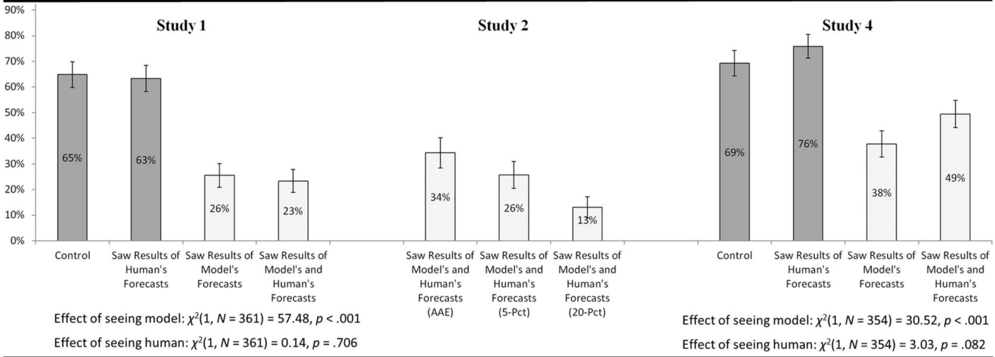
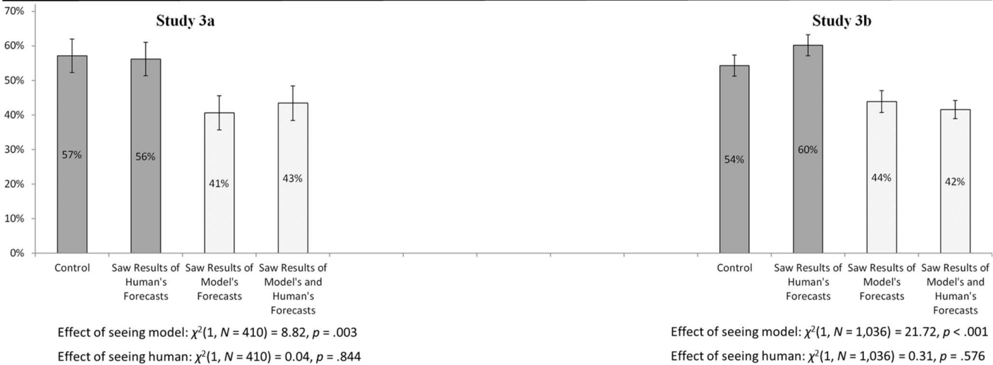
- Across five studies, seeing the algorithm perform reduced participants’ likelihood of choosing it over a human forecaster. In the model-and-human conditions, 610 of 741 participants (83%) saw the model outperform the human, yet these participants were among the least likely to choose the model.
- The model outperformed humans in all five studies. For example, bonuses if choosing model vs. human were Study 1: $1.78 vs. $1.38; Study 2: $1.77 vs. $1.09; Study 3a: $0.48 vs. $0.31; Study 3b: $0.49 vs. $0.30; Study 4: $1.79 vs. $1.38. Human forecasters produced 15–29% more error in the MBA task and 90–97% more error in the airline-passenger task.
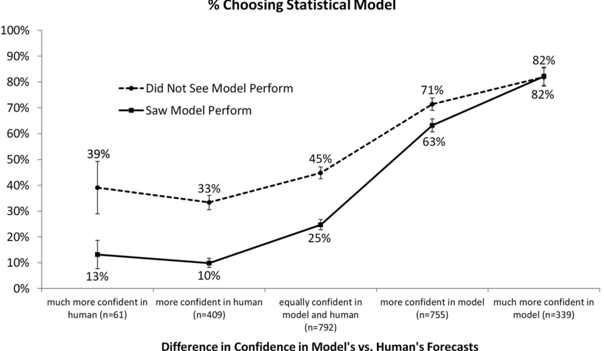
- Seeing the model perform significantly decreased confidence in the model’s forecasts in all four studies where this was tested, whereas seeing the human perform significantly decreased confidence in the human only in Study 4. Confidence in the model’s forecasts significantly mediated the effect of seeing the model perform on choosing the model; confidence in the human did not.
- In Study 2, participants paid for forecasts within 20 percentiles were less likely to choose the model than those paid within 5 percentiles, χ²(1, N = 139) = 3.56, p = .059, and those paid by average absolute error, χ²(1, N = 136) = 8.56, p = .003; this effect was mediated by confidence in their own forecasts, not confidence in the model’s forecasts.
Methods
- Five studies had participants forecast real outcomes: MBA student success (Studies 1, 2, and 4) or U.S. state rank in airline passengers (Studies 3a and 3b). Participants were assigned to control, human, model, or model-and-human conditions, then chose whether to tie incentivized bonuses to the model or the human forecaster (themselves in Studies 1–3, another participant in Study 4).
- Final samples were Study 1: 361; Study 2: 206; Study 3a: 410; Study 3b: 1,036; Study 4: 354. Studies 1, 2, and 4 were run in the Wharton Behavioral Lab; Studies 3a and 3b used Amazon Mechanical Turk.
- Main analyses compared forecasting performance and choice rates, measured confidence and beliefs, and used binary mediation analyses with Preacher and Hayes’s bootstrapping procedure.
Limitations
- The paper states it did not explore all boundaries of the effect, including whether it would persist if algorithms were many times more accurate than humans, and whether results depend on features shared by the two forecasting tasks.
- The paper states it did not explore how algorithm variations—complexity, transparency, forecaster involvement in construction, and designer expertise—affect algorithm aversion.
- The paper states algorithm aversion is not entirely driven by seeing algorithms err, and it has little to say about how best to reduce aversion among those who have seen an algorithm err. The text also cautions that cross-experiment comparisons should be made cautiously.
Model-written summary. Check it against the paper before relying on it.
Integrity signals
Registry
Cites
Statistics
Figures
Verification
Claims the paper makes
0 Valid · 2 Not valid · 16 Not checked · 90 Own results and interpretations
A result the paper reports from its own data — it cites no other source for it, so there is none to check. The quote shows it is in the paper.
In the paper
“the majority of people who were equally confident in the model's and human's forecasts chose to tie their bonuses to the human's forecasts, particularly when they had seen the model perform.”
plainstates an association- Asserted: passes — The authors put it forward as true.
- Checkable: passes — It can be checked against evidence.
- Load-bearing: passes — The paper’s conclusions depend on it.
- Based: passes — The paper gives a reason why it holds.
A result the paper reports from its own data — it cites no other source for it, so there is none to check. The quote shows it is in the paper.
In the paper
“Consistent with research on the adoption of decision aids (see Highhouse, 2008), participants thought that the human forecasters were better than the model at getting better with practice, learning from mistakes, and finding underappreciated candidates.”
plain- Asserted: passes — The authors put it forward as true.
- Checkable: passes — It can be checked against evidence.
- Load-bearing: passes — The paper’s conclusions depend on it.
- Based: passes — The paper gives a reason why it holds.
A result the paper reports from its own data — it cites no other source for it, so there is none to check. The quote shows it is in the paper.
In the paper
“Our studies show that this resistance at least partially arises from greater intolerance for error from algorithms than from humans.”
plainstates a possible cause- Asserted: passes — The authors put it forward as true.
- Checkable: passes — It can be checked against evidence.
- Load-bearing: passes — The paper’s conclusions depend on it.
- Based: passes — The paper gives a reason why it holds.
A result the paper reports from its own data — it cites no other source for it, so there is none to check. The quote shows it is in the paper.
In the paper
“Participants rightfully thought that the model was better than human forecasters at avoiding obvious mistakes, appropriately weighing various attributes, and consistently weighing information.”
plain- Asserted: passes — The authors put it forward as true.
- Checkable: passes — It can be checked against evidence.
- Load-bearing: unclear — It is unclear whether the paper’s conclusions depend on it.
- Based: passes — The paper gives a reason why it holds.
A result the paper reports from its own data — it cites no other source for it, so there is none to check. The quote shows it is in the paper.
In the paper
“This effect was evident in two distinct domains of judgment, including one in which the human forecasters produced nearly twice as much error as the algorithm.”
plain- Asserted: passes — The authors put it forward as true.
- Checkable: passes — It can be checked against evidence.
- Load-bearing: unclear — It is unclear whether the paper’s conclusions depend on it.
- Based: passes — The paper gives a reason why it holds.
75 more claims
Create a free account to see all 108 claims and to verify the 12 references still open.
- It may state two separate claims as one. 13
- Probably not a substantial claim. 16
Claims other papers make about this one
Each is checked against this paper’s own text: does it say what the citing paper says it does?
The source backs part of the claim, not all of it — or backs it for a different population, condition or comparison.
In the citing paper
“Traditional theorizing assumes trade-offs between trust and skepticism (Dietvorst et al., 2015), automation and engagement (Freeman et al., 2014), or efficiency and depth (Ishowo-Oloko et al., 2019)”
From Pedagogical partnerships with generative AI in higher education: how dual cognitive pathways paradoxically enable transformative learning (2026) · cites this paper as Dietvorst et al., 2015
Experimental — accuracy not yet measuredThe source backs part of the claim, not all of it — or backs it for a different population, condition or comparison.
In the citing paper
“Existing research typically examines trust versus skepticism in human-AI interactions as binary constructs (Dietvorst et al., 2015; Logg et al., 2019), missing the possibility that partnerships might simultaneously activate both vigilant and offloading behaviors.”
From Pedagogical partnerships with generative AI in higher education: how dual cognitive pathways paradoxically enable transformative learning (2026) · cites this paper as Dietvorst et al., 2015
Experimental — accuracy not yet measuredThe source backs part of the claim, not all of it — or backs it for a different population, condition or comparison.
In the citing paper
“It aligns with the theoretical rationale on algorithm aversion (Dietvorst et al. 2015;Hohensinn et al. 2024) and appreciation (Logg et al. 2019), which suggests that people are more likely to accept and trust AI systems when they produce desirable results but become skeptical when outcomes are unfavorable.”
From Holding AI Accountable Like Herding Cats: The Contingent Impact on the Legitimacy of Algorithmic Bureaucracy (2026) · cites this paper as Dietvorst et al. 2015
Experimental — accuracy not yet measuredThe source backs part of the claim, not all of it — or backs it for a different population, condition or comparison.
In the citing paper
“Research on algorithm appreciation and algorithm aversion further suggests that people may either defer to algorithms or reject them depending on prior experience, perceived expertise, and error visibility (Dietvorst et al., 2015; Logg et al., 2019).”
From College students' metacognitive awareness of generative-AI reliance: an experimental study of decision confidence and attribution bias (2026) · cites this paper as Dietvorst et al., 2015
Experimental — accuracy not yet measuredThe source backs part of the claim, not all of it — or backs it for a different population, condition or comparison.
In the citing paper
“Earlier research has mentioned gender, self-confidence, expertise, and general algorithm aversion or appreciation.15,28”
From Appropriate trust in artificial intelligence for the optical diagnosis of colorectal polyps: the role of human/artificial intelligence interaction (2024) · cites this paper as [28]
Experimental — accuracy not yet measured
22 more claims about this paper
Create a free account to see every claim other papers make about this one.
Statistics recomputed
Every reported test result, recomputed from its test statistic and degrees of freedom. A result shows as not adding up only once an independent check has confirmed it.
- Consistentt(360) = 4.98reported p < .001 · recomputed p < .001
“t (360) = 4.98, p < .001”
- Consistentt(204) = 6.26reported p < .001 · recomputed p < .001
“t (204) = 6.26, p < .001”
- Consistentt(405) = 7.73reported p < .001 · recomputed p < .001
“t (405) = 7.73, p < .001”
- Consistentt(353) = 5.11reported p < .001 · recomputed p < .001
“t (353) = 5.11, p < .001”
- Consistentχ²(1) = 39.94reported p < .001 · recomputed p < .001
“χ 2 (1, N = 271) = 39.94, p < .001”
19 more recomputed tests
Create a free account to see every test the Stats check recomputed.
Self-check
Percentages, sums and reported differences re-computed from the paper’s own numbers.
Self-check results appear here once an independent check has confirmed them.
Citations
Cites
Preacher, K. J., & Hayes, A. F. (2008) · Behavior Research Methods · doi:10.3758/brm.40.3.879 · Cited by 34,117 · cited 1×
“We then used Preacher and Hayes’s (2008) bootstrapping procedure to obtain unbiased 95% confidence intervals around the mediated effects.”
Method(2023) · doi:10.1126/science · Cited by 6,063
The trouble with overconfidence.
Moore, D. A., & Healy, P. J. (2008) · Psychological Review · doi:10.1037/0033-295x.115.2.502 · Cited by 2,358
“Clinical versus Actuarial Judgment.”
Dawes, R. M., Faust, D., & Meehl, P. E. (1989) · Science · doi:10.1126/science.2648573 · Cited by 2,298
The robust beauty of improper linear models in decision making.
Dawes, R. M. (1979) · American Psychologist · doi:10.1037/0003-066x.34.7.571 · Cited by 1,966
Preference and belief: Ambiguity and competence in choice under uncertainty
Heath, C., & Tversky, A. (1991) · Journal of Risk and Uncertainty · doi:10.1007/bf00057884 · Cited by 1,654
Clinical versus mechanical prediction: a meta-analysis
Grove, W. M., Zald, D. H., Lebow, B. S., Snitz, B. E., & Nelson, C. (2000) · Psychological Assessment · doi:10.1037/1040-3590.12.1.19 · Cited by 1,640
Grove, W. M., & Meehl, P. E. (1996) · Psychology, Public Policy, and Law · doi:10.1037/1076-8971.2.2.293 · Cited by 1,457 · cited 4×
“…1996), the notion that algorithms cannot properly consider individual targets (Grove & Meehl, 1996), concerns about the ethicality of relying on algorithms to make important decisions (Dawes, 1979), and the presumed inability of algorithms to incorporate qualitative data (Grove & Meehl, 1996).”
BackgroundMethodInfluential(2007) · Cited by 1,133
Competing on analytics: the new science of winning
(2007) · Choice Reviews Online · doi:10.5860/choice.44-6322 · Cited by 941
Research works printed but not linked: 1
- Clark, D. (2012, November 7). How Nate Silver won the 2012 presidential election. Harvard Business Review Blog . Retrieved from http://blogs .hbr.org/cs/2012/11/how\_nate\_silver\_won\_the\_2012\_p.html
Cited by
Items 2,501–2,600 of 3,918
Hoe SyRI het belang van transparantie onderstreept
Selbach, T., & Brink, B. (2021) · Beleid en Maatschappij · doi:10.5553/benm/138900692021048003003
Humanizing Digital Experiences: Three Essays on the Design of Digital Entities
Schanke, S. (2021) · University of Minnesota Digital Conservancy (University of Minnesota) · Cited by 2
Wang, L. (2020) · ORCA Online Research @Cardiff (Cardiff University) · Cited by 3
Tanibe, T., & Karasawa, K. (2021) · THE JAPANESE JOURNAL OF EXPERIMENTAL SOCIAL PSYCHOLOGY · doi:10.2130/jjesp.2016
Expectations of Employees Towards “AI Jobs”
Moring, A. (2022) · Springer eBooks · doi:10.1007/978-3-662-64005-0_9
Is the United Intelligence Response, the End of Speciesism and the Emergence of New Avatarism?Preprint
Silva, S. C. L. D. C. E., Stibe, A., & Cicco, R. D. (2022) · SSRN Electronic Journal · doi:10.2139/ssrn.4006441 · Cited by 1
Cognitive Pairwise Comparisons for Human Centric Design in Artificial Intelligence and Data SciencePreprint
Yuen, K. K. F. (2022) · SSRN Electronic Journal · doi:10.2139/ssrn.4048692
The Autonomy-validity Dilemma in Mechanical Prediction Procedures: The Quest for a CompromisePreprint
Neumann, M., Niessen, A. S. M., Tendeiro, J. N., & Meijer, R. R. (2021) · PsyArXiv (OSF Preprints) · doi:10.31234/osf.io/6cnxd
Fildes, R. A., & Allen, P. G. (2015) · Oxford University Press eBooks · doi:10.1093/obo/9780199846740-0064
(2021) · Human-Machine Communication · doi:10.30658/hmc.3
Algorithms and Professionals May Disagree On Companies’ ReputationsPreprint
Lees, J. M. (2022) · OSF Preprints (OSF Preprints) · doi:10.31219/osf.io/amwy4
Distribution of Data Power in Human-Machine Collaboration
Tang, X., & Yang, X. (2022) · doi:10.1145/3535782.3535804
Davis, C. W. H. (2022) · PDXScholar (Portland State University) · doi:10.15760/etd.7878 · Cited by 1
Adensamer, A., Gsenger, R., & Klausner, L. D. (2022) · arXiv (Cornell University) · doi:10.48550/arxiv.2207.10479 · Cited by 1
The Impact of Behavioral Similarity on DSS Advice Acceptance: A Field Experiment
Campbell, M., Keil, M., & Boodraj, M. (2022) · ACM SIGMIS Database the DATABASE for Advances in Information Systems · doi:10.1145/3551783.3551786
Weber‐Guskar, E., & Schlicht, T. (2022) · Vandenhoeck & Ruprecht eBooks · doi:10.13109/9783666408038.246
(2022) · Dunod eBooks · doi:10.3917/dunod.barre.2022.01.0193
Willing to Revise? Confidence and Recommendation Adoption in AI-Assisted Image Recognition
Röseler, L., Scholtes, I., Sendhoff, B., & Hannák, A. (2022) · Frontiers in artificial intelligence and applications · doi:10.3233/faia220222
Uma proposta para impulsionar as pesquisas em governança de algoritmos de IA e dadosPreprint
Braga, J., Regateiro, F. S., Stiubiener, I., & Braga, J. C. (2022) · OSF Preprints (OSF Preprints) · doi:10.31219/osf.io/xcpsd · Cited by 1
Coutinho, L. G. (2022) · Research Publications (Maastricht University) · doi:10.26481/dis.20221025lg
Lorenz, M. (2022) · eDiss (Georg-August-Universität Göttingen) · doi:10.53846/goediss-9591
Will the use of machines to identify negative activist investments backfire? Experimental evidencePreprint
Niszczota, P., & Kaszás, D. (2022) · PsyArXiv (OSF Preprints) · doi:10.31234/osf.io/f5dh6
Consumer Aversion to Platform-Induced Price Instability: Evidence from Airbnb’s Dynamic PricingPreprint
Shi, J., Joo, M., Lin, J., & Nian, T. (2022) · SSRN Electronic Journal · doi:10.2139/ssrn.4296586
Expectations of how machines use individuating information and base-rates
English, S. D., Denison, S., & Friedman, O. (2022) · Judgment and Decision Making · doi:10.1017/s1930297500003600
Diving Into the Rabbit Hole: Understanding Delegation of Decisions
Coimbra, M. R., Chimenti, P. C. P. D. S., & Nogueira, A. R. R. (2023) · IGI Global eBooks · doi:10.4018/978-1-7998-9220-5.ch014
Sheng, P. (2023) · DR-NTU (Nanyang Technological University) · doi:10.32657/10356/164691
User tests & techniques for the post-hoc explanation of deep learning
Delaney, E. D., Kenny, E. M., Greene, D., & Keane, M. T. (2023) · Elsevier eBooks · doi:10.1016/b978-0-32-396098-4.00019-3
Technoism: A new form of prejudice and discriminationPreprint
Jörling, M., Heuvinck, N., de Kerviler, G. C., & Rucker, D. D. (2023) · PsyArXiv (OSF Preprints) · doi:10.31234/osf.io/jtbc3
Technoism: A new form of prejudice and discriminationPreprint
Jörling, M., Heuvinck, N., de Kerviler, G. C., & Rucker, D. D. (2023) · PsyArXiv (OSF Preprints) · doi:10.31234/osf.io/6rxhs
Kagawa, R., Honda, H., & Nosato, H. (2023) · PsyArXiv (OSF Preprints) · doi:10.31234/osf.io/h6tp2 · Cited by 1
Algorithmic Decision-Making, Economic Behavior and Predictability in Financial Markets
Judek, J. R. (2023) · eDiss (Georg-August-Universität Göttingen) · doi:10.53846/goediss-9868
Overcoming algorithm aversion in personnel selection and admissions decisions
Neumann, M. (2023) · University of Groningen research database (University of Groningen / Centre for Information Technology) · doi:10.33612/diss.651814676 · Cited by 1
Judgmental Selection of Forecasting Models (Reprint)
Petropoulos, F., Kourentzes, N., Nikolopoulos, K. I., & Siemsen, E. (2023) · International series in management science/operations research/International series in operations research & management science · doi:10.1007/978-3-031-30085-1_3
Confidence and performance in different engineering tasks
MacRobert, C. J. (2023) · Proceedings of the Institution of Civil Engineers - Forensic Engineering · doi:10.1680/jfoen.23.00001
Parental Trust in Automated Detection of Cyberpredators
Brandimarte, L. (2023) · International Convention on Information and Communication Technology, Electronics and Microelectronics · doi:10.23919/mipro57284.2023.10159713
Bassett, R., Mehta, D. C., Thompson, S., & Al-Imarah, E. M. A. (2023) · International Journal of Pharmaceutics · doi:10.1016/j.ijpharm.2023.123192
RetractedFairness is based on quality, not just quantity
Zenkić, J., Millet, K., & Mead, N. L. (2023) · Judgment and Decision Making · doi:10.1017/jdm.2023.20
When Worlds Collide: Using What We Know About Machine Learning to Inform Assessment Practices
Ryan, A. M., Boyce, A. S., & Boyce, C. E. (2023) · Oxford University Press eBooks · doi:10.1093/oso/9780197611050.003.0002
Dreslin, B. D., Office of Workforce Development for Teachers & Scientists (WDTS) USDOE Office of Science (SC), & Baweja, J. A. (2023) · OSTI OAI (U.S. Department of Energy Office of Scientific and Technical Information) · doi:10.2172/1999810 · Cited by 2
The Narrow-Taste Effect: When Consumers Display Narrow Tastes to Algorithmic RecommendersPreprint
Gai, P. J., Leung, E., & Klesse, A.-K. (2023) · SSRN Electronic Journal · doi:10.2139/ssrn.4585195
Corte, T. D., Maele, L. V., Dietvorst, J., Verhaeghe, J., Vandendriessche, A., Neve, N. D., Vanderhaeghen, S., Dumoulin, A., Temmerman, W., DeWulf, B., et al. (2023) · SSRN Electronic Journal · doi:10.2139/ssrn.4633349
Einstellungen zu Künstlicher Intelligenz und Algorithmus Aversion im Kontext von Leadership
Arenberg, P., & Kobus, M. (2023) · Weiterbildung und Forschung der SRH Fernhochschule - the mobile university · doi:10.1007/978-3-658-42396-4_9
Yu, M., Chen, H., Cheng, Y. M., & Hu, Y. J. (2023) · SSRN Electronic Journal · doi:10.2139/ssrn.4631152 · Cited by 1
Auditors’ Planned Audit Responses to Clients’ Use of Artificial IntelligencePreprint
MacKenzie, N. L., McCallen, J., & Thayer, J. M. (2023) · SSRN Electronic Journal · doi:10.2139/ssrn.4619017 · Cited by 2
Auto-Replenishment with Human Oversight: Evidence from a Field ExperimentPreprint
Xu, L., Wang, S., & Li, M. (2023) · SSRN Electronic Journal · doi:10.2139/ssrn.4633812
Ataeizadeh, F. (2023) · Carleton University's Institutional Repository (MacOdrum Library, Carleton University) · doi:10.22215/etd/2023-15833
The Good, the Bad and the Ugly ethics of automated vehicles
Gyurász, Z., & Dražová, P. (2023) · International Conference on Emerging eLearning Technologies and Applications (ICETA) · doi:10.1109/iceta61311.2023.10343871 · Cited by 1
Nguyen, S. T., Tulabandhula, T., & Watson‐Manheim, M. B. (2024) · SSRN Electronic Journal · doi:10.2139/ssrn.4662955
Social activism of brands in the age of artificial intelligence (AI)
Leporis, T., & Spálová, L. (2023) · Media & Marketing Identity · doi:10.34135/mmidentity-2023-30
Interpretable Supervised Portfolios
Chevalier, G., Coqueret, G., & Raffinot, T. (2022) · The Journal of Financial Data Science · doi:10.3905/jfds.2024.1.154 · Cited by 1
Involvement of Domain Experts in the AI Training Does not Affect Adherence: An AutoML Study
Lebedeva, A., Protte, M., van Straaten, D., & Fahr, R. (2024) · Lecture notes in networks and systems · doi:10.1007/978-3-031-53960-2_13 · Cited by 1
Effects of Advisor Accuracy on the Utilization of Algorithmic and Human AdvicePreprint
Möller, M., & Mayr, S. (2024) · PsyArXiv (OSF Preprints) · doi:10.31234/osf.io/tgd45
Artificial Intelligence in News: The Impact of Anthropomorphic Strategies on Audience Attribution
陈, 梁., & 谭, 心. (2023) · Global Journal of Media Studies · doi:10.26599/gjms.2023.9330059 · Cited by 1
Schildt, H. A. (2020) · Oxford University Press eBooks · doi:10.1093/oso/9780198840817.002.0006
Schildt, H. A. (2020) · Oxford University Press eBooks · doi:10.1093/oso/9780198840817.002.0008
Schildt, H. A. (2020) · Oxford University Press eBooks · doi:10.1093/oso/9780198840817.002.0003
Schildt, H. A. (2020) · Oxford University Press eBooks · doi:10.1093/oso/9780198840817.002.0007
Schlicker, N., Langer, M., & Hirsch, M. C. (2024) · Forum · doi:10.1007/s12312-024-01338-5 · Cited by 1
Automated Consulting Services—Perspectives of Customers, Consultants and Companies
Stahl, N., Huettermann, M., Stallone, V., & Klaas, M. (2024) · Smart innovation, systems and technologies · doi:10.1007/978-981-97-1552-7_25
Ethical Leadership in the Age of AI
(2024) · Advances in logistics, operations, and management science book series · doi:10.4018/979-8-3693-2695-4.ch008
Kauttonen, J., & Suomala, J. (2024) · doi:10.31885/9789526548845 · Cited by 1
Artificial Intelligence and the Right to Housing
Compton, C., & Hohmann, J. M. (2023) · Oxford University Press eBooks · doi:10.1093/law/9780192882486.003.0024 · Cited by 1
Robot Rights/Human Responsibility
Gunkel, D. J. (2023) · Oxford University Press eBooks · doi:10.1093/law/9780192882486.003.0031 · Cited by 1
Artificial Intelligence and the Right to Food
Omotubora, A. (2023) · Oxford University Press eBooks · doi:10.1093/law/9780192882486.003.0023 · Cited by 1
Artificial Intelligence Screening and the Right to Asylum
Dhruv, S. (2023) · Oxford University Press eBooks · doi:10.1093/law/9780192882486.003.0022 · Cited by 1
Artificial Intelligence and Racial Discrimination
Koen, L., & Kgomotso, M. (2023) · Oxford University Press eBooks · doi:10.1093/law/9780192882486.003.0013
Ebert, I. L., & Lisa, H. (2023) · Oxford University Press eBooks · doi:10.1093/law/9780192882486.003.0034
Artificial Intelligence, the Public Space, and the Right to Be Ignored
Pin, A. (2023) · Oxford University Press eBooks · doi:10.1093/law/9780192882486.003.0012
The Limits of AI Decision-Making: Are There Decisions Artificial Intelligence Should Not Make?
Gamper, F. (2023) · Oxford University Press eBooks · doi:10.1093/law/9780192882486.003.0032 · Cited by 1
Artificial Intelligence and the Right to an Effective Remedy
de Heer, S. (2023) · Oxford University Press eBooks · doi:10.1093/law/9780192882486.003.0020
Artificial Intelligence and Freedom of Assembly
Margaret, W. (2023) · Oxford University Press eBooks · doi:10.1093/law/9780192882486.003.0006
van der Sloot, B. (2023) · Oxford University Press eBooks · doi:10.1093/law/9780192882486.003.0011
Tomada, L., & Xenidis, R. (2023) · Oxford University Press eBooks · doi:10.1093/law/9780192882486.003.0007
Artificial Intelligence and Disability Rights
Zarra, A., Favalli, S., & Matilde, C. (2023) · Oxford University Press eBooks · doi:10.1093/law/9780192882486.003.0017 · Cited by 3
When Chatbots Struggle with Customer Queries: Can Humans Help Them?
Hari, H., & Sharma, A. (2024) · Journal of Computer Information Systems · doi:10.1080/08874417.2024.2371434 · Cited by 3
Filiz, I., Kirchhoff, F., Nahmer, T., & Spiwoks, M. (2024) · doi:10.46850/sofia.9783947850068
Alashoor, T., Blicher, A., & Gleasure, R. (2024) · Lecture notes in information systems and organisation · doi:10.1007/978-3-031-58396-4_4
Schlepper, Y., Lutz, B., Lindenmeier, J., & Neumann, D. (2024) · Lecture notes in information systems and organisation · doi:10.1007/978-3-031-58396-4_3
Role of pandemic in driving adoption of artificial intelligence in healthcare industry
Oumaihka, K. (2024) · Computer Science & IT Research Journal · doi:10.51594/csitrj.v5i7.1358
Wu, D. (2024) · International Conference on Education Development and Studies (ICEDS) · doi:10.1145/3669947.3669962
Smarte oder unmenschliche Personalarbeit?
Gärtner, C. (2024) · Springer eBooks · doi:10.1007/978-3-658-44904-9_2
McCarley, J. S., Knight, M., & Fletcher, K. I. (2024) · Ergonomics · doi:10.1080/00140139.2024.2386562
How Ensembling AI and Public Managers Improves Decision-MakingPreprint
Keppeler, F., Borchert, J., Pedersen, M. J., & Nielsen, V. L. (2024) · OSF Preprints (OSF Preprints) · doi:10.31219/osf.io/2yf6r · Cited by 1
Quintavalla, A., & Temperman, J. (2023) · Oxford University Press eBooks · doi:10.1093/law/9780192882486.002.0009
Quintavalla, A., & Temperman, J. (2023) · Oxford University Press eBooks · doi:10.1093/law/9780192882486.002.0008
Quintavalla, A., & Temperman, J. (2023) · Oxford University Press eBooks · doi:10.1093/law/9780192882486.002.0007
Quintavalla, A., & Temperman, J. (2023) · Oxford University Press eBooks · doi:10.1093/law/9780192882486.002.0006
Quintavalla, A., & Temperman, J. (2023) · Oxford University Press eBooks · doi:10.1093/law/9780192882486.002.0010
Quintavalla, A., & Temperman, J. (2023) · Oxford University Press eBooks · doi:10.1093/law/9780192882486.002.0003
Kučera, D., & Formánek, I. (2024) · European Journal of Applied Business and Management · doi:10.58869/ejabm10(2)/04
Beale, S. S., & Lawrence, H. (2024) · Cambridge University Press eBooks · doi:10.1017/9781009431453.010 · Cited by 1
Navigating the Manager-AI Divide
Chandwani, S. N. (2024) · University of North Texas Digital Library (University of North Texas) · doi:10.12794/metadc2356168
Metadata
- Authors
- Dietvorst, B. J., Simmons, J. P., & Massey, C.
- Affiliations
- University of Pennsylvania (US)
- Venue
- Journal of Experimental Psychology: General
- Published
- 2015
- Volume
- 144
- Issue
- 1
- Pages
- 114-126
- ISSN
- 0096-3445 (ISSN-L)
- 1939-2222
- OpenAlex
- W3125633690
- Cited by
- 3,232
- References
- 22
- Citations by year
- 2026: 1025 · 2025: 563 · 2024: 445 · 2023: 404 · 2022: 266 · 2021: 216 · 2020: 137 · 2019: 88 · 2018: 41 · 2017: 26 · 2016: 14 · 2015: 5
- FWCI
- 13.96
- Type
- journal article
- Language
- en
- Open access
- green
- doi.org
- Locations
- Journal of Experimental Psychology General (publishedVersion)
- SSRN Electronic Journal (publishedVersion)
- PubMed (publishedVersion)
- ScholarlyCommons (University of Pennsylvania) (submittedVersion)
- Funders
- Wharton Behavioral Laboratory
- Wharton Risk Center Ackoff Doctoral Student Fellowship
- Topics
- Social Sciences › Decision Sciences › General Decision Sciences › Decision-Making and Behavioral Economics
- Social Sciences › Decision Sciences › Management Science and Operations Research › Forecasting Techniques and Applications
- Social Sciences › Human Factors and Ergonomics › Human-Automation Interaction and Safety
- Keywords
- algorithm aversion, trust in algorithms, prediction confidence, evidence-based algorithm, decision-making
- MeSH terms
- Algorithms, Avoidance Learning, Culture, Decision Making, Female, Forecasting, Humans, Male, Motivation, Comprehension, Young Adult
About these checks
Registry, retraction, Cites and statistics results are computed, not judged, with one exception: a printed reference that no index lists is read once by a model before it counts as a citation error. Claims are extracted by a model and kept only when their quote appears verbatim in the text; each cited source is then checked, with a model’s help, for whether it says what the claim relies on. Those verdicts can be wrong — read the claim’s quote and the cited source before relying on one.
A language model drew the claims from the paper on 2026-11-14, under version 3 of the claim definition (model deepseek-v4.1-flash, prompt extract-v3).
A second model labelled each claim on 2026-11-14 (model jev-1.13-20260917, definition revision gold-guideline-v0.2).
Statistics and arithmetic are recomputed, not judged.
Confidence bands are shown only for fields calibrated on our annotated test set. None is calibrated yet, so no band is shown.
What counts as a claim ›How we measure confidence ›How we check this ›
Are you an author, or do you see a problem with this page? Request a review
Data sources
Bibliographic data: Semantic Scholar, OpenAlex, Crossref.
Contains information from the Semantic Scholar Academic Graph Datasets, made available under the ODC Attribution License (ODC-BY 1.0).
Semantic Scholar’s data is described in: Kinney, R., et al. (2023). The Semantic Scholar Open Data Platform. arXiv:2301.10140.
