

Algorithm aversion: People erroneously avoid algorithms after seeing them err.
Open accessThe DOI matches its Crossref record; 23 of the 23 references it cites were found in a registry or an index; none of the 22 sources its claims cite is checked for support yet.
Abstract
Research shows that evidence-based algorithms more accurately predict the future than do human forecasters. Yet when forecasters are deciding whether to use a human forecaster or a statistical algorithm, they often choose the human forecaster. This phenomenon, which we call algorithm aversion, is costly, and it is important to understand its causes. We show that people are especially averse to algorithmic forecasters after seeing them perform, even when they see them outperform a human forecaster. This is because people more quickly lose confidence in algorithmic than human forecasters after seeing them make the same mistake. In 5 studies, participants either saw an algorithm make forecasts, a human make forecasts, both, or neither. They then decided whether to tie their incentives to the future predictions of the algorithm or the human. Participants who saw the algorithm perform were less confident in it, and less likely to choose it over an inferior human forecaster. This was true even among those who saw the algorithm outperform the human.
Overview
CoChat Summary
TL;DR
People become less willing to use a statistical algorithm after seeing it perform and make mistakes, even when it outperforms a human forecaster. This “algorithm aversion” is driven partly by people losing confidence in algorithms more quickly than in humans after observing errors.
Key findings
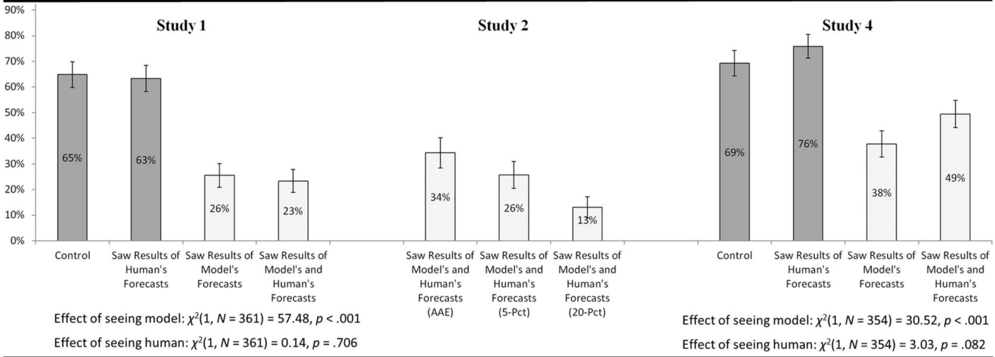
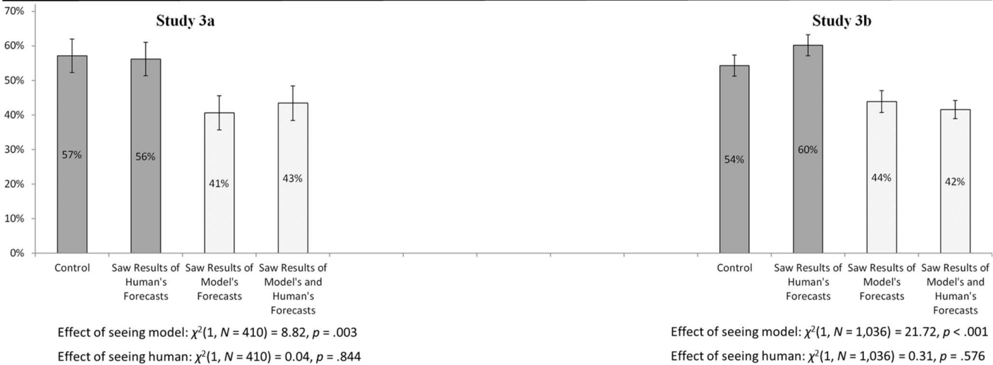
- Across five studies, seeing the algorithm perform reduced participants’ likelihood of choosing it over a human forecaster. In the model-and-human conditions, 610 of 741 participants (83%) saw the model outperform the human, yet these participants were among the least likely to choose the model.
- The model outperformed humans in all five studies. For example, bonuses if choosing model vs. human were Study 1: $1.78 vs. $1.38; Study 2: $1.77 vs. $1.09; Study 3a: $0.48 vs. $0.31; Study 3b: $0.49 vs. $0.30; Study 4: $1.79 vs. $1.38. Human forecasters produced 15–29% more error in the MBA task and 90–97% more error in the airline-passenger task.
- Seeing the model perform significantly decreased confidence in the model’s forecasts in all four studies where this was tested, whereas seeing the human perform significantly decreased confidence in the human only in Study 4. Confidence in the model’s forecasts significantly mediated the effect of seeing the model perform on choosing the model; confidence in the human did not.
- In Study 2, participants paid for forecasts within 20 percentiles were less likely to choose the model than those paid within 5 percentiles, χ²(1, N = 139) = 3.56, p = .059, and those paid by average absolute error, χ²(1, N = 136) = 8.56, p = .003; this effect was mediated by confidence in their own forecasts, not confidence in the model’s forecasts.
Methods
- Five studies had participants forecast real outcomes: MBA student success (Studies 1, 2, and 4) or U.S. state rank in airline passengers (Studies 3a and 3b). Participants were assigned to control, human, model, or model-and-human conditions, then chose whether to tie incentivized bonuses to the model or the human forecaster (themselves in Studies 1–3, another participant in Study 4).
- Final samples were Study 1: 361; Study 2: 206; Study 3a: 410; Study 3b: 1,036; Study 4: 354. Studies 1, 2, and 4 were run in the Wharton Behavioral Lab; Studies 3a and 3b used Amazon Mechanical Turk.
- Main analyses compared forecasting performance and choice rates, measured confidence and beliefs, and used binary mediation analyses with Preacher and Hayes’s bootstrapping procedure.
Limitations
- The paper states it did not explore all boundaries of the effect, including whether it would persist if algorithms were many times more accurate than humans, and whether results depend on features shared by the two forecasting tasks.
- The paper states it did not explore how algorithm variations—complexity, transparency, forecaster involvement in construction, and designer expertise—affect algorithm aversion.
- The paper states algorithm aversion is not entirely driven by seeing algorithms err, and it has little to say about how best to reduce aversion among those who have seen an algorithm err. The text also cautions that cross-experiment comparisons should be made cautiously.
Model-written summary. Check it against the paper before relying on it.
Integrity signals
Registry
Cites
Statistics
Figures
Verification
Claims the paper makes
0 Valid · 2 Not valid · 16 Not checked · 90 Own results and interpretations
A result the paper reports from its own data — it cites no other source for it, so there is none to check. The quote shows it is in the paper.
In the paper
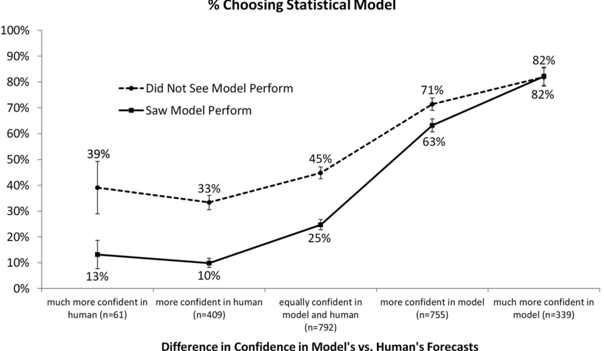
“the majority of people who were equally confident in the model's and human's forecasts chose to tie their bonuses to the human's forecasts, particularly when they had seen the model perform.”
plainstates an association- Asserted: passes — The authors put it forward as true.
- Checkable: passes — It can be checked against evidence.
- Load-bearing: passes — The paper’s conclusions depend on it.
- Based: passes — The paper gives a reason why it holds.
A result the paper reports from its own data — it cites no other source for it, so there is none to check. The quote shows it is in the paper.
In the paper
“Consistent with research on the adoption of decision aids (see Highhouse, 2008), participants thought that the human forecasters were better than the model at getting better with practice, learning from mistakes, and finding underappreciated candidates.”
plain- Asserted: passes — The authors put it forward as true.
- Checkable: passes — It can be checked against evidence.
- Load-bearing: passes — The paper’s conclusions depend on it.
- Based: passes — The paper gives a reason why it holds.
A result the paper reports from its own data — it cites no other source for it, so there is none to check. The quote shows it is in the paper.
In the paper
“Our studies show that this resistance at least partially arises from greater intolerance for error from algorithms than from humans.”
plainstates a possible cause- Asserted: passes — The authors put it forward as true.
- Checkable: passes — It can be checked against evidence.
- Load-bearing: passes — The paper’s conclusions depend on it.
- Based: passes — The paper gives a reason why it holds.
A result the paper reports from its own data — it cites no other source for it, so there is none to check. The quote shows it is in the paper.
In the paper
“Participants rightfully thought that the model was better than human forecasters at avoiding obvious mistakes, appropriately weighing various attributes, and consistently weighing information.”
plain- Asserted: passes — The authors put it forward as true.
- Checkable: passes — It can be checked against evidence.
- Load-bearing: unclear — It is unclear whether the paper’s conclusions depend on it.
- Based: passes — The paper gives a reason why it holds.
A result the paper reports from its own data — it cites no other source for it, so there is none to check. The quote shows it is in the paper.
In the paper
“This effect was evident in two distinct domains of judgment, including one in which the human forecasters produced nearly twice as much error as the algorithm.”
plain- Asserted: passes — The authors put it forward as true.
- Checkable: passes — It can be checked against evidence.
- Load-bearing: unclear — It is unclear whether the paper’s conclusions depend on it.
- Based: passes — The paper gives a reason why it holds.
75 more claims
Create a free account to see all 108 claims and to verify the 12 references still open.
- It may state two separate claims as one. 13
- Probably not a substantial claim. 16
Claims other papers make about this one
Each is checked against this paper’s own text: does it say what the citing paper says it does?
The source backs part of the claim, not all of it — or backs it for a different population, condition or comparison.
In the citing paper
“Traditional theorizing assumes trade-offs between trust and skepticism (Dietvorst et al., 2015), automation and engagement (Freeman et al., 2014), or efficiency and depth (Ishowo-Oloko et al., 2019)”
From Pedagogical partnerships with generative AI in higher education: how dual cognitive pathways paradoxically enable transformative learning (2026) · cites this paper as Dietvorst et al., 2015
Experimental — accuracy not yet measuredThe source backs part of the claim, not all of it — or backs it for a different population, condition or comparison.
In the citing paper
“Existing research typically examines trust versus skepticism in human-AI interactions as binary constructs (Dietvorst et al., 2015; Logg et al., 2019), missing the possibility that partnerships might simultaneously activate both vigilant and offloading behaviors.”
From Pedagogical partnerships with generative AI in higher education: how dual cognitive pathways paradoxically enable transformative learning (2026) · cites this paper as Dietvorst et al., 2015
Experimental — accuracy not yet measuredThe source backs part of the claim, not all of it — or backs it for a different population, condition or comparison.
In the citing paper
“It aligns with the theoretical rationale on algorithm aversion (Dietvorst et al. 2015;Hohensinn et al. 2024) and appreciation (Logg et al. 2019), which suggests that people are more likely to accept and trust AI systems when they produce desirable results but become skeptical when outcomes are unfavorable.”
From Holding AI Accountable Like Herding Cats: The Contingent Impact on the Legitimacy of Algorithmic Bureaucracy (2026) · cites this paper as Dietvorst et al. 2015
Experimental — accuracy not yet measuredThe source backs part of the claim, not all of it — or backs it for a different population, condition or comparison.
In the citing paper
“Research on algorithm appreciation and algorithm aversion further suggests that people may either defer to algorithms or reject them depending on prior experience, perceived expertise, and error visibility (Dietvorst et al., 2015; Logg et al., 2019).”
From College students' metacognitive awareness of generative-AI reliance: an experimental study of decision confidence and attribution bias (2026) · cites this paper as Dietvorst et al., 2015
Experimental — accuracy not yet measuredThe source backs part of the claim, not all of it — or backs it for a different population, condition or comparison.
In the citing paper
“Earlier research has mentioned gender, self-confidence, expertise, and general algorithm aversion or appreciation.15,28”
From Appropriate trust in artificial intelligence for the optical diagnosis of colorectal polyps: the role of human/artificial intelligence interaction (2024) · cites this paper as [28]
Experimental — accuracy not yet measured
22 more claims about this paper
Create a free account to see every claim other papers make about this one.
Statistics recomputed
Every reported test result, recomputed from its test statistic and degrees of freedom. A result shows as not adding up only once an independent check has confirmed it.
- Consistentt(360) = 4.98reported p < .001 · recomputed p < .001
“t (360) = 4.98, p < .001”
- Consistentt(204) = 6.26reported p < .001 · recomputed p < .001
“t (204) = 6.26, p < .001”
- Consistentt(405) = 7.73reported p < .001 · recomputed p < .001
“t (405) = 7.73, p < .001”
- Consistentt(353) = 5.11reported p < .001 · recomputed p < .001
“t (353) = 5.11, p < .001”
- Consistentχ²(1) = 39.94reported p < .001 · recomputed p < .001
“χ 2 (1, N = 271) = 39.94, p < .001”
19 more recomputed tests
Create a free account to see every test the Stats check recomputed.
Self-check
Percentages, sums and reported differences re-computed from the paper’s own numbers.
Self-check results appear here once an independent check has confirmed them.
Citations
Cites
Preacher, K. J., & Hayes, A. F. (2008) · Behavior Research Methods · doi:10.3758/brm.40.3.879 · Cited by 34,117 · cited 1×
“We then used Preacher and Hayes’s (2008) bootstrapping procedure to obtain unbiased 95% confidence intervals around the mediated effects.”
Method(2023) · doi:10.1126/science · Cited by 6,063
The trouble with overconfidence.
Moore, D. A., & Healy, P. J. (2008) · Psychological Review · doi:10.1037/0033-295x.115.2.502 · Cited by 2,358
“Clinical versus Actuarial Judgment.”
Dawes, R. M., Faust, D., & Meehl, P. E. (1989) · Science · doi:10.1126/science.2648573 · Cited by 2,298
The robust beauty of improper linear models in decision making.
Dawes, R. M. (1979) · American Psychologist · doi:10.1037/0003-066x.34.7.571 · Cited by 1,966
Preference and belief: Ambiguity and competence in choice under uncertainty
Heath, C., & Tversky, A. (1991) · Journal of Risk and Uncertainty · doi:10.1007/bf00057884 · Cited by 1,654
Clinical versus mechanical prediction: a meta-analysis
Grove, W. M., Zald, D. H., Lebow, B. S., Snitz, B. E., & Nelson, C. (2000) · Psychological Assessment · doi:10.1037/1040-3590.12.1.19 · Cited by 1,640
Grove, W. M., & Meehl, P. E. (1996) · Psychology, Public Policy, and Law · doi:10.1037/1076-8971.2.2.293 · Cited by 1,457 · cited 4×
“…1996), the notion that algorithms cannot properly consider individual targets (Grove & Meehl, 1996), concerns about the ethicality of relying on algorithms to make important decisions (Dawes, 1979), and the presumed inability of algorithms to incorporate qualitative data (Grove & Meehl, 1996).”
BackgroundMethodInfluential(2007) · Cited by 1,133
Competing on analytics: the new science of winning
(2007) · Choice Reviews Online · doi:10.5860/choice.44-6322 · Cited by 941
Research works printed but not linked: 1
- Clark, D. (2012, November 7). How Nate Silver won the 2012 presidential election. Harvard Business Review Blog . Retrieved from http://blogs .hbr.org/cs/2012/11/how\_nate\_silver\_won\_the\_2012\_p.html
Cited by
Human trust in artificial intelligence: Review of empirical research
Glikson, E., & Woolley, A. W. (2020) · Academy of Management Annals · doi:10.5465/annals.2018.0057 · Cited by 2,921
“Dietvorst et al. (2015) demonstrated a similar effect of an erroneous function, re-ferring to it as algorithm aversion .”
BackgroundAlgorithms at Work: The New Contested Terrain of Control
Kellogg, K. C., Valentine, M. A., & Christin, A. (2020) · Academy of Management Annals · doi:10.5465/annals.2018.0174 · Cited by 2,732
“Finally, in the context of machine learning (e.g., models that perform without using explicit instructions, relying on patterns and inference), algorithms are particularly difficult to decipher (Dietvorst, Simmons, & Massey, 2015; Weld & Bansal, 2018).”
MethodBrave new world: service robots in the frontline
Wirtz, J., Patterson, P. G., Kunz, W. H., Gruber, T., Lu, V. N., Paluch, S., & Martins, A. (2018) · Journal of Service Management · doi:10.1108/josm-04-2018-0119 · Cited by 2,315
Algorithm appreciation: People prefer algorithmic to human judgment
Logg, J. M., Minson, J. A., & Moore, D. A. (2019) · Organizational Behavior and Human Decision Processes · doi:10.1016/j.obhdp.2018.12.005 · Cited by 2,061
Resistance to Medical Artificial Intelligence
Longoni, C., Bonezzi, A., & Morewedge, C. K. (2019) · Journal of Consumer Research · doi:10.1093/jcr/ucz013 · Cited by 2,015
“…Shah, Mullainathan, and Kleinberg, 2019) , lose confidence in statistical models more quickly than in humans after seeing both make the same mistake (Dietvorst et al. 2014), and place greater weight on the same advice given by human experts versus by statistical models ( € Onkal et al. 2009).”
Machine Learning: An Applied Econometric Approach
Mullainathan, S., & Spiess, J. (2017) · Journal of Economic Perspectives · doi:10.1257/jep.31.2.87 · Cited by 1,989
“Even when an algorithm can help, we must understand the factors that determine adoption of these tools (Dawes, Faust, and Meehl 1989; Dietvorst, Simmons, and Massey 2015; Yeomans, Shah, Mullainathan, and Kleinberg 2016).”
BackgroundRahwan, I., Cebrian, M., Obradovich, N., Bongard, J., Bonnefon, J.-F., Breazeal, C., Crandall, J. W., Christakis, N. A., Couzin, I. D., Jackson, M. O., et al. (2019) · Nature · doi:10.1038/s41586-019-1138-y · Cited by 1,364
Lee, M. K. (2018) · Big Data & Society · doi:10.1177/2053951718756684 · Cited by 1,338
“Other research suggests that people trust their own judgment more, especially after the algorithm has erred, probably because they believe algorithms cannot learn from their mistakes (Dietvorst et al., 2015).”
BackgroundDietvorst, B. J., Simmons, J. P., & Massey, C. (2018) · Management Science · doi:10.1287/mnsc.2016.2643 · Cited by 1,230
“Dietvorst, Simmons, and Massey (2015) gave participants the choice of either exclusively using an algorithm’s forecasts or exclusively using their own forecasts during an incentivized forecasting task, and manipulated whether participants had experience with the algorithm prior to making this…”
BackgroundResultInfluentialSelf-citationTransforming the Customer Experience through New Technologies
Hoyer, W. D., Kroschke, M., Schmitt, B., Kraume, K., & Shankar, V. (2020) · Journal of Interactive Marketing · doi:10.1016/j.intmar.2020.04.001 · Cited by 1,049
Human Decisions and Machine Predictions
Kleinberg, J., Lakkaraju, H., Leskovec, J., Ludwig, J., & Mullainathan, S. (2018) · The Quarterly Journal of Economics · doi:10.1093/qje/qjx032 · Cited by 1,040
In AI we trust? Perceptions about automated decision-making by artificial intelligence
Araujo, T., Helberger, N., Kruikemeier, S., & de Vreese, C. H. (2020) · AI & SOCIETY · doi:10.1007/s00146-019-00931-w · Cited by 1,038
Forecasting: theory and practice
Petropoulos, F., Apiletti, D., Assimakopoulos, V., Babai, M. Z., Barrow, D. K., Ben Taieb, S., Bergmeir, C., Bessa, R. J., Bijak, J., Boylan, J. E., et al. (2022) · International Journal of Forecasting · doi:10.1016/j.ijforecast.2021.11.001 · Cited by 921
Zhang, Y., Liao, Q. V., & Bellamy, R. K. E. (2020) · Proceedings of the 2020 Conference on Fairness, Accountability, and Transparency · doi:10.1145/3351095.3372852 · Cited by 895
Rise of Machine Agency: A Framework for Studying the Psychology of Human–AI Interaction (HAII)
Sundar, S. S. (2020) · Journal of Computer-Mediated Communication · doi:10.1093/jcmc/zmz026 · Cited by 871
Artificial Intelligence in Utilitarian vs. Hedonic Contexts: The “Word-of-Machine” Effect
Longoni, C., & Cian, L. (2022) · Journal of Marketing · doi:10.1177/0022242920957347 · Cited by 831
A systematic review of algorithm aversion in augmented decision making
Burton, J. W., Stein, M., & Jensen, T. B. (2020) · Journal of Behavioral Decision Making · doi:10.1002/bdm.2155 · Cited by 814
Bankins, S., Ocampo, A. C., Marrone, M., Restubog, S. L. D., & Woo, S. E. (2024) · Journal of Organizational Behavior · doi:10.1002/job.2735 · Cited by 799
Explainable Recommendation: A Survey and New Perspectives
Zhang, Y., & Chen, X. (2020) · Foundations and Trends® in Information Retrieval · doi:10.1561/1500000066 · Cited by 755
People are averse to machines making moral decisions.
Bigman, Y. E., & Gray, K. (2018) · Cognition · doi:10.1016/j.cognition.2018.08.003 · Cited by 738
Manipulating and Measuring Model Interpretability
Poursabzi-Sangdeh, F., Goldstein, D. G., Hofman, J. M., Wortman Vaughan, J. W., & Wallach, H. (2021) · Proceedings of the 2021 CHI Conference on Human Factors in Computing Systems · doi:10.1145/3411764.3445315 · Cited by 728
“racy comparisons since there was no ground truth. These apartments were always shown last to avoid the previously studied phenomenon in which people trust a model less after seeing it make a mistake (Dietvorst et al., 2015). 2.2 Results Having run our experiment, we compared participants’ behavior across the condition…”
BackgroundMethodResultInfluentialManipulating and Measuring Model Interpretability
Poursabzi-Sangdeh, F., Goldstein, D. G., Hofman, J. M., Vaughan, J. W., & Wallach, H. (2018) · arXiv · doi:10.48550/arxiv.1802.07810 · Cited by 711
Explainable Recommendation a survey and new perspectives
Zhang, Y., & Chen, X. (2020) · Cited by 689
AI-Mediated Communication: Definition, Research Agenda, and Ethical Considerations
Hancock, J. T., Naaman, M., & Levy, K. (2020) · Journal of Computer-Mediated Communication · doi:10.1093/jcmc/zmz022 · Cited by 658
Industry 4.0: Opportunities and Challenges for Operations Management
Olsen, T. L., & Tomlin, B. (2020) · Manufacturing & Service Operations Management · doi:10.1287/msom.2019.0796 · Cited by 651
What influences algorithmic decision-making? A systematic literature review on algorithm aversion
Mahmud, H., Islam, A. K. M. N., Ahmed, S. I., & Smolander, K. (2022) · Technological Forecasting and Social Change · doi:10.1016/j.techfore.2021.121390 · Cited by 601
Cai, C. J., Winter, S., Steiner, D., Wilcox, L., & Terry, M. (2019) · Proceedings of the ACM on Human-Computer Interaction · doi:10.1145/3359206 · Cited by 594
“Algorithmic aversion has also been an underlying challenge for these systems [18, 40, 47].”
BackgroundNazaretsky, T., Ariely, M., Cukurova, M., & Alexandron, G. (2022) · British Journal of Educational Technology · doi:10.1111/bjet.13232 · Cited by 589
“Moreover, research in other domains confirms that human forecasters quickly lose trust in automated recommendation systems after seeing that they make a mistake, while they are more tolerant of the same mistake made by a human (Dietvorst et al., 2015).”
BackgroundInfluentialNewman, D. T., Fast, N. J., & Harmon, D. J. (2020) · Organizational Behavior and Human Decision Processes · doi:10.1016/j.obhdp.2020.03.008 · Cited by 550
Towards a standard for identifying and managing bias in artificial intelligence
Schwartz, R., Vassilev, A., Greene, K., Perine, L., Burt, A., & Hall, P. (2022) · doi:10.6028/nist.sp.1270 · Cited by 548
Human Decisions and Machine Predictions
Kleinberg, J., Lakkaraju, H., Leskovec, J., Ludwig, J., & Mullainathan, S. (2017) · doi:10.3386/w23180 · Cited by 545
Do as AI say: susceptibility in deployment of clinical decision-aids
Gaube, S., Suresh, H., Raue, M., Merritt, A., Berkowitz, S. J., Lermer, E., Coughlin, J. F., Guttag, J. V., Colak, E., & Ghassemi, M. (2021) · npj Digital Medicine · doi:10.1038/s41746-021-00385-9 · Cited by 543
Expanding Explainability: Towards Social Transparency in AI systems
Ehsan, U., Liao, Q. V., Muller, M., Riedl, M. O., & Weisz, J. D. (2021) · Proceedings of the 2021 CHI Conference on Human Factors in Computing Systems · doi:10.1145/3411764.3445188 · Cited by 538
Tong, S., Jia, N., Luo, X., & Fang, Z. (2021) · Strategic Management Journal · doi:10.1002/smj.3322 · Cited by 531
Understanding the Effect of Accuracy on Trust in Machine Learning Models
Yin, M., Wortman Vaughan, J., & Wallach, H. (2019) · Proceedings of the 2019 CHI Conference on Human Factors in Computing Systems · doi:10.1145/3290605.3300509 · Cited by 527
Close Encounters of the AI Kind: Use of AI Influencers As Brand Endorsers
Thomas, V. L., & Fowler, K. (2021) · Journal of Advertising · doi:10.1080/00913367.2020.1810595 · Cited by 506
Fügener, A., Grahl, J., Gupta, A., & Ketter, W. (2022) · Information Systems Research · doi:10.1287/isre.2021.1079 · Cited by 478
Making sense of recommendations
Yeomans, M., Shah, A., Mullainathan, S., & Kleinberg, J. (2019) · Journal of Behavioral Decision Making · doi:10.1002/bdm.2118 · Cited by 459
Trust and reliance on AI — An experimental study on the extent and costs of overreliance on AI
Klingbeil, A., Grützner, C., & Schreck, P. (2024) · Computers in Human Behavior · doi:10.1016/j.chb.2024.108352 · Cited by 450
Transparency and trust in artificial intelligence systems
Schmidt, P., Biessmann, F., & Teubner, T. (2020) · Journal of Decision Systems · doi:10.1080/12460125.2020.1819094 · Cited by 440
“…to trust towards humans, prior research has argued that people tend to have less trust towards AI by default, where ‘people are especially averse to algorithmic forecasters after seeing them perform, even when they see them outperform a human forecaster’ (B. J. Dietvorst et al., 2014, p. 1).”
BackgroundAI-Based Digital Assistants: Opportunities, Threats, and Research Perspectives
Maedche, A., Legner, C., Benlian, A., Berger, B., Gimpel, H., Hess, T., Hinz, O., Morana, S., & Söllner, M. (2019) · Business & Information Systems Engineering · doi:10.1007/s12599-019-00600-8 · Cited by 432
Kuhn, K. M., & Maleki, A. (2017) · Academy of Management Perspectives · doi:10.5465/amp.2015.0111 · Cited by 430
Jussupow, E., Spohrer, K., Heinzl, A., & Gawlitza, J. (2021) · Information Systems Research · doi:10.1287/isre.2020.0980 · Cited by 422
Franke, C., Groeppel-Klein, A., & Müller, K. (2023) · Journal of Advertising · doi:10.1080/00913367.2022.2154721 · Cited by 408
Köbis, N., & Mossink, L. D. (2021) · Computers in Human Behavior · doi:10.1016/j.chb.2020.106553 · Cited by 406
“This reluctance of “ human decision makers to use superior but imperfect algorithms ” (Burton, Stein, & Jensen, 2019, p.1) has been referred to as algorithm aversion (Dietvorst, Simmons, & Massey, 2015).”
BackgroundLeveraging Artificial Intelligence in Marketing for Social Good—An Ethical Perspective
Hermann, E. (2022) · Journal of Business Ethics · doi:10.1007/s10551-021-04843-y · Cited by 403
Explanations Can Reduce Overreliance on AI Systems During Decision-Making
Vasconcelos, H., Jörke, M., Grunde-McLaughlin, M., Gerstenberg, T., Bernstein, M. S., & Krishna, R. (2023) · Proceedings of the ACM on Human-Computer Interaction · doi:10.1145/3579605 · Cited by 402
“As participants complete a series of maze solving tasks, we do not provide immediate feedback since humans are particularly sensitive to seeing algorithms err [19].”
BackgroundEstimating the Impact of “Humanizing” Customer Service Chatbots
Schanke, S., Burtch, G., & Ray, G. (2021) · Information Systems Research · doi:10.1287/isre.2021.1015 · Cited by 398
The Principles and Limits of Algorithm-in-the-Loop Decision Making
Green, B., & Chen, Y. (2019) · Proceedings of the ACM on Human-Computer Interaction · doi:10.1145/3359152 · Cited by 392
Lai, V., & Tan, C. (2019) · Proceedings of the Conference on Fairness, Accountability, and Transparency · doi:10.1145/3287560.3287590 · Cited by 377
“However, humans may not trust the machine due to algorithm aversion [15].”
BackgroundMan Tang, P., Koopman, J., McClean, S. T., Zhang, J. H., Li, C. H., De Cremer, D., Lu, Y., & Ng, C. T. S. (2022) · Academy of Management Journal · doi:10.5465/amj.2020.1516 · Cited by 370
Laux, J., Wachter, S., & Mittelstadt, B. (2024) · Regulation & Governance · doi:10.1111/rego.12512 · Cited by 365
The Challenges and Opportunities of AI-Assisted Writing: Developing AI Literacy for the AI Age
Cardon, P., Fleischmann, C., Aritz, J., Logemann, M., & Heidewald, J. (2023) · Business and Professional Communication Quarterly · doi:10.1177/23294906231176517 · Cited by 234
“Historically, people tend to judge AI mistakes more harshly than mistakes made by people (Dietvorst et al., 2015), yet as professionals use AI to communicate in their own names, it is likely that others will not give any leeway in terms of inaccuracies, misinformation, and other forms of unreliable…”
BackgroundThe rise of artificial intelligence – understanding the AI identity threat at the workplace
Mirbabaie, M., Brünker, F., Möllmann Frick, N. R. J., & Stieglitz, S. (2022) · Electronic Markets · doi:10.1007/s12525-021-00496-x · Cited by 362
Kang, H., & Lou, C. (2022) · Journal of Computer-Mediated Communication · doi:10.1093/jcmc/zmac014 · Cited by 250
Kim, J., Giroux, M., & Lee, J. C. (2021) · Psychology & Marketing · doi:10.1002/mar.21498 · Cited by 353
Mersha, M., Lam, K., Wood, J., AlShami, A. K., & Kalita, J. (2024) · Neurocomputing · doi:10.1016/j.neucom.2024.128111 · Cited by 237
“Human-AI collaboration : XAI can facilitate collaboration between humans and AI systems by enabling humans to understand the reasoning behind an AI’s actions [43].”
BackgroundDetecting Depression with Audio/Text Sequence Modeling of Interviews
Al Hanai, T., Ghassemi, M., & Glass, J. (2018) · Interspeech 2018 · doi:10.21437/interspeech.2018-2522 · Cited by 343
Understanding, explaining, and utilizing medical artificial intelligence
Cadario, R., Longoni, C., & Morewedge, C. K. (2021) · Nature Human Behaviour · doi:10.1038/s41562-021-01146-0 · Cited by 342
Langer, M., & Landers, R. N. (2021) · Computers in Human Behavior · doi:10.1016/j.chb.2021.106878 · Cited by 338
Psychological roadblocks to the adoption of self-driving vehicles
Shariff, A., Bonnefon, J.-F., & Rahwan, I. (2017) · Nature Human Behaviour · doi:10.1038/s41562-017-0202-6 · Cited by 336
Understanding artificial intelligence ethics and safety
Leslie, D. (2019) · arXiv (Cornell University) · doi:10.48550/arxiv.1906.05684 · Cited by 134
Artificial Intelligence Coaches for Sales Agents: Caveats and Solutions
Luo, X., Qin, M. S., Fang, Z., & Qu, Z. (2021) · Journal of Marketing · doi:10.1177/0022242920956676 · Cited by 328
Yam, K. C., Tang, P. M., Jackson, J. C., Su, R., & Gray, K. (2023) · Journal of Applied Psychology · doi:10.1037/apl0001045 · Cited by 328
AI can help humans find common ground in democratic deliberation
Tessler, M. H., Bakker, M. A., Jarrett, D., Sheahan, H., Chadwick, M. J., Koster, R., Evans, G., Campbell-Gillingham, L., Collins, T., Parkes, D. C., et al. (2024) · Science · doi:10.1126/science.adq2852 · Cited by 195
“Moreover, there is room for healthy ,andsomepeoplemay haveaprincipledaversiontotheideathat politicalorsocialideascanbegeneratedbya computer( 40, 41 ), which may temper enthusi-asm for our approach.”
BackgroundArtificial intelligence and consumer behavior: From predictive to generative AI
Hermann, E., & Puntoni, S. (2024) · Journal of Business Research · doi:10.1016/j.jbusres.2024.114720 · Cited by 230
Fairness perceptions of algorithmic decision-making: A systematic review of the empirical literature
Starke, C., Baleis, J., Keller, B., & Marcinkowski, F. (2022) · Big Data & Society · doi:10.1177/20539517221115189 · Cited by 316
“However, empirical evidence suggests that people base their evaluations of ADM on different factors than those they use to evaluate HDM (Dietvorst et al., 2015).”
BackgroundMarketing Agility: The Concept, Antecedents, and a Research Agenda
Kalaignanam, K., Tuli, K. R., Kushwaha, T., Lee, L., & Gal, D. (2021) · Journal of Marketing · doi:10.1177/0022242920952760 · Cited by 314
Understanding algorithm aversion: When is advice from automation discounted?
Prahl, A., & Van Swol, L. (2017) · Journal of Forecasting · doi:10.1002/for.2464 · Cited by 308
Toward Trustworthy AI Development: Mechanisms for Supporting Verifiable Claims
Brundage, M., Avin, S., Wang, J., Belfield, H., Krueger, G., Hadfield, G., Khlaaf, H., Yang, J., Toner, H., Fong, R., et al. (2020) · arXiv · doi:10.48550/arxiv.2004.07213 · Cited by 306
“, studying the efficacy of interpretability tools or exploring possible interfaces–would be welcome, as would further exploration of how practitioners currently use such tools [81] [82] [83] [78] [84].”
BackgroundBad News? Send an AI. Good News? Send a Human
Garvey, A. M., Kim, T., & Duhachek, A. (2023) · Journal of Marketing · doi:10.1177/00222429211066972 · Cited by 305
Autonomous Shopping Systems: Identifying and Overcoming Barriers to Consumer Adoption
de Bellis, E., & Venkataramani Johar, G. (2020) · Journal of Retailing · doi:10.1016/j.jretai.2019.12.004 · Cited by 252
Explaining Decision-Making Algorithms through UI: Strategies to Help Non-Expert Stakeholders
Cheng, H.-F., Wang, R., Zhang, Z., O'Connell, F., Gray, T., Harper, F. M., & Zhu, H. (2019) · Proceedings of the 2019 CHI Conference on Human Factors in Computing Systems · doi:10.1145/3290605.3300789 · Cited by 292
How human–AI feedback loops alter human perceptual, emotional and social judgements
Glickman, M., & Sharot, T. (2024) · Nature Human Behaviour · doi:10.1038/s41562-024-02077-2 · Cited by 289
“40), learning its bias can be considered perfectly rational.”
Experimental evidence of effective human–AI collaboration in medical decision-making
Reverberi, C., Rigon, T., Solari, A., Hassan, C., Cherubini, P., GI Genius CADx Study Group, Antonelli, G., Awadie, H., Bernhofer, S., Carballal, S., et al. (2022) · Scientific Reports · doi:10.1038/s41598-022-18751-2 · Cited by 281
Human-machine collaboration in managerial decision making
Haesevoets, T., De Cremer, D., Dierckx, K., & Van Hiel, A. (2021) · Computers in Human Behavior · doi:10.1016/j.chb.2021.106730 · Cited by 280
Combining Human and Artificial Intelligence: Hybrid Problem-Solving in Organizations
Raisch, S., & Fomina, K. (2025) · Academy of Management Review · doi:10.5465/amr.2021.0421 · Cited by 280
“While humans sometimes ignore AI recommendations due to algorithm aversion (Dietvorst, Simmons, & Massey, 2015), they tend to follow them closely when complex outputs create cognitive over-load (Allen & Choudhury, 2022).”
BackgroundShould we welcome robot teachers?
Sharkey, A. J. C. (2016) · Ethics and Information Technology · doi:10.1007/s10676-016-9387-z · Cited by 249
My Friends, Editors, Algorithms, and I: Examining audience attitudes to news selection
Thurman, N., Moeller, J., Helberger, N., & Trilling, D. (2019) · Digital Journalism · doi:10.1080/21670811.2018.1493936 · Cited by 277
Interpretable Machine Learning
Boehmke, B., & Greenwell, B. (2019) · Hands-On Machine Learning with R · doi:10.1201/9780367816377-16 · Cited by 230
Disparate Interactions: An Algorithm-in-the-Loop Analysis of Fairness in Risk Assessments
Green, B., & Chen, Y. (2019) · Proceedings of the Conference on Fairness, Accountability, and Transparency · doi:10.1145/3287560.3287563 · Cited by 275
“algorithms than errors made by other people [17].”
BackgroundDietvorst, B. J., & Bharti, S. (2020) · Psychological Science · doi:10.1177/0956797620948841 · Cited by 273
Self-citationThe most human bot: Female gendering increases humanness perceptions of bots and acceptance of AI
Borau, S., Otterbring, T., Laporte, S., & Fosso Wamba, S. (2021) · Psychology & Marketing · doi:10.1002/mar.21480 · Cited by 272
Algorithmic bias: Senses, sources, solutions
Fazelpour, S., & Danks, D. (2021) · Philosophy Compass · doi:10.1111/phc3.12760 · Cited by 272
Wanner, J., Herm, L.-V., Heinrich, K., & Janiesch, C. (2022) · Electronic Markets · doi:10.1007/s12525-022-00593-5 · Cited by 208
Man versus machine: Complex estimates and auditor reliance on artificial intelligence
COMMERFORD, B. P., DENNIS, S. A., JOE, J. R., & ULLA, J. W. (2022) · Journal of Accounting Research · doi:10.1111/1475-679x.12407 · Cited by 270
Intelligent digital twin (iDT) for supply chain stress-testing, resilience, and viability
Ivanov, D. (2023) · International Journal of Production Economics · doi:10.1016/j.ijpe.2023.108938 · Cited by 270
Hegner, S. M., Beldad, A. D., & Brunswick, G. J. (2019) · International Journal of Human–Computer Interaction · doi:10.1080/10447318.2019.1572353 · Cited by 250
Trust me, I'm a bot – repercussions of chatbot disclosure in different service frontline settings
Mozafari, N., Weiger, W. H., & Hammerschmidt, M. (2022) · Journal of Service Management · doi:10.1108/josm-10-2020-0380 · Cited by 230
The flaws of policies requiring human oversight of government algorithms
Green, B. (2022) · Computer Law & Security Review · doi:10.1016/j.clsr.2022.105681 · Cited by 263
“, 2017), leading them to discount accurate algorithmic recommendations and to rely on inaccurate algorithmic recommendations (Dietvorst et al., 2015; Goodwin & Fildes, 1999; Lim & O'Connor, 1995; Springer et al., 2017; Yeomans et al., 2017).”
BackgroundGenerative AI in innovation and marketing processes: A roadmap of research opportunities
Cillo, P., & Rubera, G. (2025) · Journal of the Academy of Marketing Science · doi:10.1007/s11747-024-01044-7 · Cited by 176
“Hence, we propose the following research question: RQ How can firms align disclosure messages to their firms’ brand associations in order to mitigate the potential negative effect of disclosing GenAI use? they outperform humans (Dietvorst et al., 2015).”
Chong, L., Zhang, G., Goucher-Lambert, K., Kotovsky, K., & Cagan, J. (2022) · Computers in Human Behavior · doi:10.1016/j.chb.2021.107018 · Cited by 262
Expl(AI)ned: The Impact of Explainable Artificial Intelligence on Users’ Information Processing
Bauer, K., von Zahn, M., & Hinz, O. (2023) · Information Systems Research · doi:10.1287/isre.2023.1199 · Cited by 261
“…of humans and AI systems including the perceived subjectivity of the task (Castelo et al. 2019, Logg et al. 2019), seeing the system err (Dietvorst et al. 2015), being able to modify predictions (Dietvorst et al. 2018), the divergence bet-ween actual and expected predictive performance…”
BackgroundKieslich, K., Keller, B., & Starke, C. (2022) · Big Data & Society · doi:10.1177/20539517221092956 · Cited by 203
Grimmelikhuijsen, S. (2023) · Public Administration Review · doi:10.1111/puar.13483 · Cited by 259
The Flaws of Policies Requiring Human Oversight of Government Algorithms
Green, B. (2021) · doi:10.2139/ssrn.3921216 · Cited by 259
Dennis, A. R., Lakhiwal, A., & Sachdeva, A. (2023) · Journal of Management Information Systems · doi:10.1080/07421222.2023.2196773 · Cited by 203
“They anticipate consistent future performance from AI, so a mistake today means a mistake tomor-row [53].”
BackgroundInfluentialHow transparency modulates trust in artificial intelligence
Zerilli, J., Bhatt, U., & Weller, A. (2022) · Patterns · doi:10.1016/j.patter.2022.100455 · Cited by 257
Young, M. M., Bullock, J. B., & Lecy, J. D. (2019) · Perspectives on Public Management and Governance · doi:10.1093/ppmgov/gvz014 · Cited by 255
“Research on “algorithm avoidance” suggests people tend to prefer human judgment 6 over an algorithm’s, even after receiving unambiguous evidence of the latter’s superior performance (Awad et al. 2018; Bonnefon, Shariff, and Rahwan 2016; Dietvorst, Simmons, and Massey 2015; Frick 2015).”
BackgroundCarbontracker: Tracking and Predicting the Carbon Footprint of Training Deep Learning Models
Anthony, L. F. W., Kanding, B., & Selvan, R. (2020) · arXiv · doi:10.48550/arxiv.2007.03051 · Cited by 255
Metadata
- Authors
- Dietvorst, B. J., Simmons, J. P., & Massey, C.
- Affiliations
- University of Pennsylvania (US)
- Venue
- Journal of Experimental Psychology: General
- Published
- 2015
- Volume
- 144
- Issue
- 1
- Pages
- 114-126
- ISSN
- 0096-3445 (ISSN-L)
- 1939-2222
- OpenAlex
- W3125633690
- Cited by
- 3,232
- References
- 22
- Citations by year
- 2026: 1025 · 2025: 563 · 2024: 445 · 2023: 404 · 2022: 266 · 2021: 216 · 2020: 137 · 2019: 88 · 2018: 41 · 2017: 26 · 2016: 14 · 2015: 5
- FWCI
- 13.96
- Type
- journal article
- Language
- en
- Open access
- green
- doi.org
- Locations
- Journal of Experimental Psychology General (publishedVersion)
- SSRN Electronic Journal (publishedVersion)
- PubMed (publishedVersion)
- ScholarlyCommons (University of Pennsylvania) (submittedVersion)
- Funders
- Wharton Behavioral Laboratory
- Wharton Risk Center Ackoff Doctoral Student Fellowship
- Topics
- Social Sciences › Decision Sciences › General Decision Sciences › Decision-Making and Behavioral Economics
- Social Sciences › Decision Sciences › Management Science and Operations Research › Forecasting Techniques and Applications
- Social Sciences › Human Factors and Ergonomics › Human-Automation Interaction and Safety
- Keywords
- algorithm aversion, trust in algorithms, prediction confidence, evidence-based algorithm, decision-making
- MeSH terms
- Algorithms, Avoidance Learning, Culture, Decision Making, Female, Forecasting, Humans, Male, Motivation, Comprehension, Young Adult
About these checks
Registry, retraction, Cites and statistics results are computed, not judged, with one exception: a printed reference that no index lists is read once by a model before it counts as a citation error. Claims are extracted by a model and kept only when their quote appears verbatim in the text; each cited source is then checked, with a model’s help, for whether it says what the claim relies on. Those verdicts can be wrong — read the claim’s quote and the cited source before relying on one.
A language model drew the claims from the paper on 2026-11-14, under version 3 of the claim definition (model deepseek-v4.1-flash, prompt extract-v3).
A second model labelled each claim on 2026-11-14 (model jev-1.13-20260917, definition revision gold-guideline-v0.2).
Statistics and arithmetic are recomputed, not judged.
Confidence bands are shown only for fields calibrated on our annotated test set. None is calibrated yet, so no band is shown.
What counts as a claim ›How we measure confidence ›How we check this ›
Are you an author, or do you see a problem with this page? Request a review
Data sources
Bibliographic data: Semantic Scholar, OpenAlex, Crossref.
Contains information from the Semantic Scholar Academic Graph Datasets, made available under the ODC Attribution License (ODC-BY 1.0).
Semantic Scholar’s data is described in: Kinney, R., et al. (2023). The Semantic Scholar Open Data Platform. arXiv:2301.10140.
