

Algorithm aversion: People erroneously avoid algorithms after seeing them err.
Open accessThe DOI matches its Crossref record; 23 of the 23 references it cites were found in a registry or an index; none of the 22 sources its claims cite is checked for support yet.
Abstract
Research shows that evidence-based algorithms more accurately predict the future than do human forecasters. Yet when forecasters are deciding whether to use a human forecaster or a statistical algorithm, they often choose the human forecaster. This phenomenon, which we call algorithm aversion, is costly, and it is important to understand its causes. We show that people are especially averse to algorithmic forecasters after seeing them perform, even when they see them outperform a human forecaster. This is because people more quickly lose confidence in algorithmic than human forecasters after seeing them make the same mistake. In 5 studies, participants either saw an algorithm make forecasts, a human make forecasts, both, or neither. They then decided whether to tie their incentives to the future predictions of the algorithm or the human. Participants who saw the algorithm perform were less confident in it, and less likely to choose it over an inferior human forecaster. This was true even among those who saw the algorithm outperform the human.
Overview
CoChat Summary
TL;DR
People become less willing to use a statistical algorithm after seeing it perform and make mistakes, even when it outperforms a human forecaster. This “algorithm aversion” is driven partly by people losing confidence in algorithms more quickly than in humans after observing errors.
Key findings
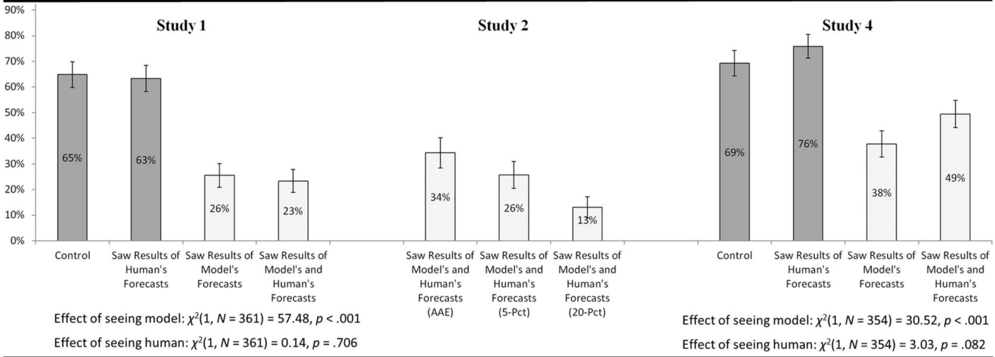
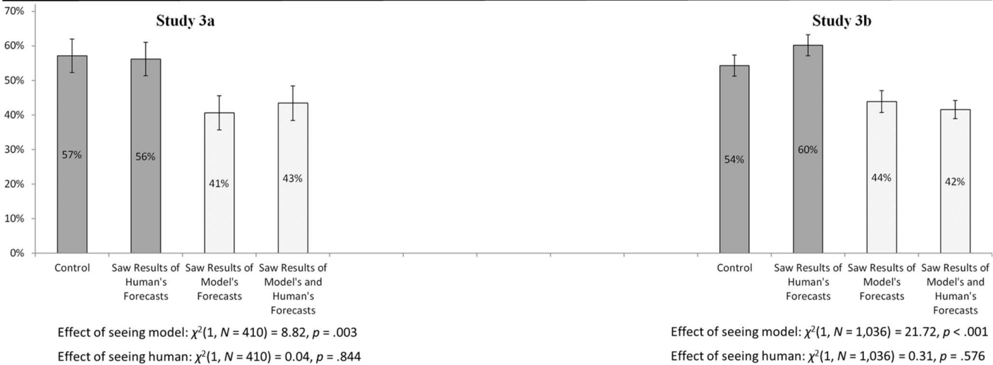
- Across five studies, seeing the algorithm perform reduced participants’ likelihood of choosing it over a human forecaster. In the model-and-human conditions, 610 of 741 participants (83%) saw the model outperform the human, yet these participants were among the least likely to choose the model.
- The model outperformed humans in all five studies. For example, bonuses if choosing model vs. human were Study 1: $1.78 vs. $1.38; Study 2: $1.77 vs. $1.09; Study 3a: $0.48 vs. $0.31; Study 3b: $0.49 vs. $0.30; Study 4: $1.79 vs. $1.38. Human forecasters produced 15–29% more error in the MBA task and 90–97% more error in the airline-passenger task.
- Seeing the model perform significantly decreased confidence in the model’s forecasts in all four studies where this was tested, whereas seeing the human perform significantly decreased confidence in the human only in Study 4. Confidence in the model’s forecasts significantly mediated the effect of seeing the model perform on choosing the model; confidence in the human did not.
- In Study 2, participants paid for forecasts within 20 percentiles were less likely to choose the model than those paid within 5 percentiles, χ²(1, N = 139) = 3.56, p = .059, and those paid by average absolute error, χ²(1, N = 136) = 8.56, p = .003; this effect was mediated by confidence in their own forecasts, not confidence in the model’s forecasts.
Methods
- Five studies had participants forecast real outcomes: MBA student success (Studies 1, 2, and 4) or U.S. state rank in airline passengers (Studies 3a and 3b). Participants were assigned to control, human, model, or model-and-human conditions, then chose whether to tie incentivized bonuses to the model or the human forecaster (themselves in Studies 1–3, another participant in Study 4).
- Final samples were Study 1: 361; Study 2: 206; Study 3a: 410; Study 3b: 1,036; Study 4: 354. Studies 1, 2, and 4 were run in the Wharton Behavioral Lab; Studies 3a and 3b used Amazon Mechanical Turk.
- Main analyses compared forecasting performance and choice rates, measured confidence and beliefs, and used binary mediation analyses with Preacher and Hayes’s bootstrapping procedure.
Limitations
- The paper states it did not explore all boundaries of the effect, including whether it would persist if algorithms were many times more accurate than humans, and whether results depend on features shared by the two forecasting tasks.
- The paper states it did not explore how algorithm variations—complexity, transparency, forecaster involvement in construction, and designer expertise—affect algorithm aversion.
- The paper states algorithm aversion is not entirely driven by seeing algorithms err, and it has little to say about how best to reduce aversion among those who have seen an algorithm err. The text also cautions that cross-experiment comparisons should be made cautiously.
Model-written summary. Check it against the paper before relying on it.
Integrity signals
Registry
Cites
Statistics
Figures
Verification
Claims the paper makes
0 Valid · 2 Not valid · 16 Not checked · 90 Own results and interpretations
A result the paper reports from its own data — it cites no other source for it, so there is none to check. The quote shows it is in the paper.
In the paper
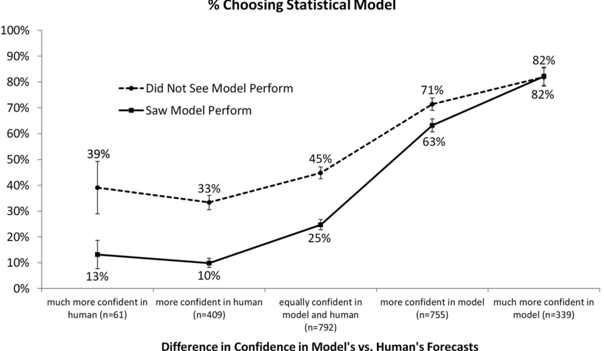
“the majority of people who were equally confident in the model's and human's forecasts chose to tie their bonuses to the human's forecasts, particularly when they had seen the model perform.”
plainstates an association- Asserted: passes — The authors put it forward as true.
- Checkable: passes — It can be checked against evidence.
- Load-bearing: passes — The paper’s conclusions depend on it.
- Based: passes — The paper gives a reason why it holds.
A result the paper reports from its own data — it cites no other source for it, so there is none to check. The quote shows it is in the paper.
In the paper
“Consistent with research on the adoption of decision aids (see Highhouse, 2008), participants thought that the human forecasters were better than the model at getting better with practice, learning from mistakes, and finding underappreciated candidates.”
plain- Asserted: passes — The authors put it forward as true.
- Checkable: passes — It can be checked against evidence.
- Load-bearing: passes — The paper’s conclusions depend on it.
- Based: passes — The paper gives a reason why it holds.
A result the paper reports from its own data — it cites no other source for it, so there is none to check. The quote shows it is in the paper.
In the paper
“Our studies show that this resistance at least partially arises from greater intolerance for error from algorithms than from humans.”
plainstates a possible cause- Asserted: passes — The authors put it forward as true.
- Checkable: passes — It can be checked against evidence.
- Load-bearing: passes — The paper’s conclusions depend on it.
- Based: passes — The paper gives a reason why it holds.
A result the paper reports from its own data — it cites no other source for it, so there is none to check. The quote shows it is in the paper.
In the paper
“Participants rightfully thought that the model was better than human forecasters at avoiding obvious mistakes, appropriately weighing various attributes, and consistently weighing information.”
plain- Asserted: passes — The authors put it forward as true.
- Checkable: passes — It can be checked against evidence.
- Load-bearing: unclear — It is unclear whether the paper’s conclusions depend on it.
- Based: passes — The paper gives a reason why it holds.
A result the paper reports from its own data — it cites no other source for it, so there is none to check. The quote shows it is in the paper.
In the paper
“This effect was evident in two distinct domains of judgment, including one in which the human forecasters produced nearly twice as much error as the algorithm.”
plain- Asserted: passes — The authors put it forward as true.
- Checkable: passes — It can be checked against evidence.
- Load-bearing: unclear — It is unclear whether the paper’s conclusions depend on it.
- Based: passes — The paper gives a reason why it holds.
75 more claims
Create a free account to see all 108 claims and to verify the 12 references still open.
- It may state two separate claims as one. 13
- Probably not a substantial claim. 16
Claims other papers make about this one
Each is checked against this paper’s own text: does it say what the citing paper says it does?
The source backs part of the claim, not all of it — or backs it for a different population, condition or comparison.
In the citing paper
“Traditional theorizing assumes trade-offs between trust and skepticism (Dietvorst et al., 2015), automation and engagement (Freeman et al., 2014), or efficiency and depth (Ishowo-Oloko et al., 2019)”
From Pedagogical partnerships with generative AI in higher education: how dual cognitive pathways paradoxically enable transformative learning (2026) · cites this paper as Dietvorst et al., 2015
Experimental — accuracy not yet measuredThe source backs part of the claim, not all of it — or backs it for a different population, condition or comparison.
In the citing paper
“Existing research typically examines trust versus skepticism in human-AI interactions as binary constructs (Dietvorst et al., 2015; Logg et al., 2019), missing the possibility that partnerships might simultaneously activate both vigilant and offloading behaviors.”
From Pedagogical partnerships with generative AI in higher education: how dual cognitive pathways paradoxically enable transformative learning (2026) · cites this paper as Dietvorst et al., 2015
Experimental — accuracy not yet measuredThe source backs part of the claim, not all of it — or backs it for a different population, condition or comparison.
In the citing paper
“It aligns with the theoretical rationale on algorithm aversion (Dietvorst et al. 2015;Hohensinn et al. 2024) and appreciation (Logg et al. 2019), which suggests that people are more likely to accept and trust AI systems when they produce desirable results but become skeptical when outcomes are unfavorable.”
From Holding AI Accountable Like Herding Cats: The Contingent Impact on the Legitimacy of Algorithmic Bureaucracy (2026) · cites this paper as Dietvorst et al. 2015
Experimental — accuracy not yet measuredThe source backs part of the claim, not all of it — or backs it for a different population, condition or comparison.
In the citing paper
“Research on algorithm appreciation and algorithm aversion further suggests that people may either defer to algorithms or reject them depending on prior experience, perceived expertise, and error visibility (Dietvorst et al., 2015; Logg et al., 2019).”
From College students' metacognitive awareness of generative-AI reliance: an experimental study of decision confidence and attribution bias (2026) · cites this paper as Dietvorst et al., 2015
Experimental — accuracy not yet measuredThe source backs part of the claim, not all of it — or backs it for a different population, condition or comparison.
In the citing paper
“Earlier research has mentioned gender, self-confidence, expertise, and general algorithm aversion or appreciation.15,28”
From Appropriate trust in artificial intelligence for the optical diagnosis of colorectal polyps: the role of human/artificial intelligence interaction (2024) · cites this paper as [28]
Experimental — accuracy not yet measured
22 more claims about this paper
Create a free account to see every claim other papers make about this one.
Statistics recomputed
Every reported test result, recomputed from its test statistic and degrees of freedom. A result shows as not adding up only once an independent check has confirmed it.
- Consistentt(360) = 4.98reported p < .001 · recomputed p < .001
“t (360) = 4.98, p < .001”
- Consistentt(204) = 6.26reported p < .001 · recomputed p < .001
“t (204) = 6.26, p < .001”
- Consistentt(405) = 7.73reported p < .001 · recomputed p < .001
“t (405) = 7.73, p < .001”
- Consistentt(353) = 5.11reported p < .001 · recomputed p < .001
“t (353) = 5.11, p < .001”
- Consistentχ²(1) = 39.94reported p < .001 · recomputed p < .001
“χ 2 (1, N = 271) = 39.94, p < .001”
19 more recomputed tests
Create a free account to see every test the Stats check recomputed.
Self-check
Percentages, sums and reported differences re-computed from the paper’s own numbers.
Self-check results appear here once an independent check has confirmed them.
Citations
Cites
Preacher, K. J., & Hayes, A. F. (2008) · Behavior Research Methods · doi:10.3758/brm.40.3.879 · Cited by 34,117 · cited 1×
“We then used Preacher and Hayes’s (2008) bootstrapping procedure to obtain unbiased 95% confidence intervals around the mediated effects.”
Method(2023) · doi:10.1126/science · Cited by 6,063
The trouble with overconfidence.
Moore, D. A., & Healy, P. J. (2008) · Psychological Review · doi:10.1037/0033-295x.115.2.502 · Cited by 2,358
“Clinical versus Actuarial Judgment.”
Dawes, R. M., Faust, D., & Meehl, P. E. (1989) · Science · doi:10.1126/science.2648573 · Cited by 2,298
The robust beauty of improper linear models in decision making.
Dawes, R. M. (1979) · American Psychologist · doi:10.1037/0003-066x.34.7.571 · Cited by 1,966
Preference and belief: Ambiguity and competence in choice under uncertainty
Heath, C., & Tversky, A. (1991) · Journal of Risk and Uncertainty · doi:10.1007/bf00057884 · Cited by 1,654
Clinical versus mechanical prediction: a meta-analysis
Grove, W. M., Zald, D. H., Lebow, B. S., Snitz, B. E., & Nelson, C. (2000) · Psychological Assessment · doi:10.1037/1040-3590.12.1.19 · Cited by 1,640
Grove, W. M., & Meehl, P. E. (1996) · Psychology, Public Policy, and Law · doi:10.1037/1076-8971.2.2.293 · Cited by 1,457 · cited 4×
“…1996), the notion that algorithms cannot properly consider individual targets (Grove & Meehl, 1996), concerns about the ethicality of relying on algorithms to make important decisions (Dawes, 1979), and the presumed inability of algorithms to incorporate qualitative data (Grove & Meehl, 1996).”
BackgroundMethodInfluential(2007) · Cited by 1,133
Competing on analytics: the new science of winning
(2007) · Choice Reviews Online · doi:10.5860/choice.44-6322 · Cited by 941
Research works printed but not linked: 1
- Clark, D. (2012, November 7). How Nate Silver won the 2012 presidential election. Harvard Business Review Blog . Retrieved from http://blogs .hbr.org/cs/2012/11/how\_nate\_silver\_won\_the\_2012\_p.html
Cited by
Items 2,601–2,700 of 3,918
Inteligência artificial e cognição : delegação da atividade cognitiva à máquina
Almgren, F. (2023) · Digital Library of Theses and Dissertations (Universidade de São Paulo) · doi:10.11606/d.2.2023.tde-05032024-121448 · Cited by 3
Assessing the Impact of Differing Perspectives in Advice-Taking BehaviorPreprint
Kumar, A., Tham, R.-H. M., & Steyvers, M. (2024) · PsyArXiv (OSF Preprints) · doi:10.31234/osf.io/seqjr
Yamim, A. P., Mai, R., & Jörling, M. (2024) · Recherche et Applications en Marketing (French Edition) · doi:10.1177/07673701241285335
AI Persuasion, Bayesian Attribution, and Career Concerns of DoctorsPreprint
Li, H., Li, J., Luo, Y., & Zhang, X. (2024) · SSRN Electronic Journal · doi:10.2139/ssrn.4973720 · Cited by 2
Heaton, S., Yun, J. H., & Ehrlich, S. K. (2024) · SSRN Electronic Journal · doi:10.2139/ssrn.5001671
Algorithm Adoption and Explanations: An Experimental Study on Self and Other PerspectivesPreprint
Bravo, F., He, Z., Shaposhnik, Y., & Valdés, L. (2024) · SSRN Electronic Journal · doi:10.2139/ssrn.5017247
Filiz, I., Kirchhoff, F., Nahmer, T., & Spiwoks, M. (2024) · doi:10.46850/sofia.9783947850099
Confides: A Visual Analytics Solution for Automated Speech Recognition Analysis and Exploration
Ha, S., Lim, C., Crouser, R. J., & Ottley, A. (2024) · Visualization · doi:10.1109/vis55277.2024.00062
Den Teufel mit dem Beelzebub austreiben?
Bizer, K., Filiz, I., Kirchhoff, F., Nahmer, T., & Spiwoks, M. (2024) · doi:10.46850/sofia.9783947850105
Strategic information disclosure to classification algorithms: an experiment
Hagenbach, J., & Salas, A. (2025) · Experimental Economics · doi:10.1017/eec.2025.10030
Peng, X., Yang, M., Zhou, L., & Wang, X. (2024) · Lecture notes in computer science · doi:10.1007/978-3-031-76806-4_5
Schäffner, V. (2024) · Verlag Karl Alber eBooks · doi:10.5771/9783495992043
Overcoming Medical Overuse with Ai Assistance: An Experimental InvestigationPreprint
Wang, Z., Wei, L., & Xue, L. (2024) · SSRN Electronic Journal · doi:10.2139/ssrn.5037526
Rebholz, T. R., Koop, A., & Hütter, M. (2024) · Technology Mind and Behavior · doi:10.1037/tmb0000136.supp
Role of the human planner in advanced forecasting systems
Imdahl, C., & Hoberg, K. (2024) · Elsevier eBooks · doi:10.1016/b978-0-443-28993-4.00062-7
Trust in Artificial Intelligence - the Role of Occupation and ExplanationsPreprint
Prinz, S. G., Weißenberger, B. E., & Kotzian, P. (2025) · SSRN Electronic Journal · doi:10.2139/ssrn.5008350
Schultze, T., & Chen, Z. (2025) · Judgment and Decision Making · doi:10.1017/jdm.2024.43
Visualization Analysis of Algorithmic Risk Research Based on CiteSpace
Li, M., & Chen, F. (2024) · International Conference on Computer Science and Management Technology (ICCSMT) · doi:10.1145/3708036.3708142
Wang, Q., & Song, J. (2024) · International Conference on Computer Science and Management Technology (ICCSMT) · doi:10.1145/3708036.3708155 · Cited by 1
Seeing Is Believing: The Role of Scatterplots in Recommender System Trust and Decision-Making
Doppalapudi, B., Rahman, M. D., & Rosen, P. (2025) · Lecture notes in computer science · doi:10.1007/978-3-031-77392-1_32 · Cited by 1
Cui, J. (2021) · University of North Texas Digital Library (University of North Texas) · doi:10.12794/metadc1833515
Designing and Evaluating Labor Market Recommender Systems
Pérennès, E. (2024) · theses.fr (ABES) · doi:10.70675/0bae8d8fz6e2fz4cc9zb9f9zf5fc18b55d9f · Cited by 1
Does Autonomy Make People Try Less Hard? Initial Weight Inertia in Human-AI CollaborationPreprint
Xia, Q., Choudhary, V., Shrestha, Y. R., & Sharma, R. (2025) · SSRN Electronic Journal · doi:10.2139/ssrn.5068677 · Cited by 1
Klostermann, M., & Kirchhoff, B. M. (2024) · Springer eBooks · doi:10.1007/978-3-658-46481-3_17
Gender Effects on the Error in Female Decision-Making: An Experimental Approach
Trequattrini, R., Cuozzo, B., Manzari, A., & Ciano, S. (2025) · SIDREA series in accounting and business administration · doi:10.1007/978-3-031-78999-1_12 · Cited by 1
Jiang, Y., Chen, J., An, S., & Zheng, T. (2025) · SSRN Electronic Journal · doi:10.2139/ssrn.5157744
AI Deployment Susceptibility: Challenges in Clinical Decision-Aid Implementation
Saadoun, O. N., ALLayith, R. A., Lafta, M. K., Shakir, K. H., Hussein, A. S., Al-Farouni, M., & Shareef, H. (2024) · International Conference on IoT, Communication and Automation Technology (ICICAT) · doi:10.1109/icicat62666.2024.10923094 · Cited by 1
Human Aversion? Do AI Agents Judge Identity More Harshly Than PerformancePreprint
Feng, Y., Choudhary, V., & Shrestha, Y. R. (2025) · SSRN Electronic Journal · doi:10.2139/ssrn.5196085 · Cited by 1
Ai Feedback vs. Human: Impact on Employee Behavior & PerformancePreprint
Houqe, M. N., Biswas, M. I., Talukder, M. S., Khan, A. R., & Kabir, M. N. (2025) · SSRN Electronic Journal · doi:10.2139/ssrn.5217569 · Cited by 1
Slobogin, C. (2025) · Cambridge University Press eBooks · doi:10.1017/9781009586931.017
Shank, D. B. (2025) · Springer eBooks · doi:10.1007/978-3-031-86061-4_6
Shank, D. B. (2025) · Springer eBooks · doi:10.1007/978-3-031-86061-4_5
Whom do we learn from?Preprint
Moorthy, A. (2025) · SSRN Electronic Journal · doi:10.2139/ssrn.5190331
The New Skill Divide: Cognitive Growth, Physical Decline, and Flexibility in an Automated WorldPreprint
Gong, Q., Wang, Q., & Zhang, W. (2025) · Research Square · doi:10.21203/rs.3.rs-6296044/v1
Vashist, D. D., Sharma, M., & Pandey, P. (2025) · IGI Global eBooks · doi:10.4018/979-8-3693-8166-3.ch002
The Type to Listen to the Machine? The Effect of Personality on the Use of AI Advice
Asbach, S., Graf‐Vlachy, L., & Fügener, A. (2025) · Lecture notes in information systems and organisation · doi:10.1007/978-3-031-80119-8_10
Leffrang, D. (2025) · Lecture notes in information systems and organisation · doi:10.1007/978-3-031-80119-8_12
DiSorbo, M. D., & Ferreira, K. (2025) · SSRN Electronic Journal · doi:10.2139/ssrn.5253399 · Cited by 2
Lie against AI: Revealing private information through AI in an economic experiment
Bershadskyy, D., Dinges, L., Fiedler, M.-A., Greif, J., Al-Hamadi, A. K., Ostermaier, N., & Weimann, J. (2026) · Journal of Economic Behavior & Organization · doi:10.1016/j.jebo.2026.107547
Building relationship on social media: AI vs. human
Oh, J., & Ki, E. (2025) · Corporate Communication Review · doi:10.63904/ccr.v1i1.11
The Negative Effects of Positive Real-Time Feedback from Artificial IntelligencePreprint
Kinch, M. A. (2025) · SSRN Electronic Journal · doi:10.2139/ssrn.5249994 · Cited by 1
The effects of disclosing an algorithm’s inner workings and analytic thinking on algorithm reliance
Pinzger, A. (2025) · Journal of Management Control · doi:10.1007/s00187-025-00391-y · Cited by 1
Krause, T. A. (2025) · dms – der moderne staat – Zeitschrift für Public Policy Recht und Management · doi:10.3224/dms.vxix.403989
Human-in-the-Loop Integration of Causal Reasoning into Intelligent Tutoring Systems
Eckler, S., Vinson, D., McKay, M. H., & Kelly, M. A. (2025) · Lecture notes in computer science · doi:10.1007/978-3-031-92970-0_14
Machines with minds: Beliefs about the mental lives of robots and implications for human reasoningPreprint
Weisman, K. (2023) · OSF Preprints (OSF Preprints) · doi:10.31219/osf.io/4rnw3_v1 · Cited by 1
Foundations and Frontiers in Decision Science - Theory, Methods and Applications
Kisku, D. R. (2025) · IntechOpen eBooks · doi:10.5772/intechopen.1008092
A Taxonomy of AI ExperimentsPreprint
Alekseev, A., & Strobel, C. (2025) · SSRN Electronic Journal · doi:10.2139/ssrn.5291490
Improving AI-Assisted Decision-Making Through Calibrated CoarseningPreprint
Hoong, R., & Dreyfuss, B. (2025) · SSRN Electronic Journal · doi:10.2139/ssrn.5286198 · Cited by 5
Xiao, Q., Wang, S., Chen, J., Xu, W., Fan, L., & Yin, J. (2025) · Current Psychology · doi:10.1007/s12144-025-08028-y
Cruz, T. D. D., & Lucena, M. (2025) · PsyArXiv (OSF Preprints) · doi:10.31234/osf.io/4azue_v2
“Subjective Biased Perception on AI Knowledge and AI Aversion”
Oezguer, K., Jan, S., & Thomas, L. (2025) · IEEE International Conference on Pervasive Computing and Communications Workshops (PerCom Workshops) · doi:10.1109/percomworkshops65533.2025.00070 · Cited by 1
Desirability vs. feasibility: a research through design inquiry of explainable AI
Corti, L., & Yang, J. (2025) · Elsevier eBooks · doi:10.1016/b978-0-44-340553-2.00010-1
Understanding Trust in AI as an Information Source: Cross-Country EvidencePreprint
Hazra, S., & Serra-García, M. (2025) · SSRN Electronic Journal · doi:10.2139/ssrn.5327285 · Cited by 1
Risk-averse algorithmic support in resource allocation problems
Narayanan, P. (2024) · doi:10.63537/pn991544
Mind the Gap: How Explicit Uncertainty Cues Improve Decision MakingPreprint
Lawal, S., & Amir, O. (2025) · SSRN Electronic Journal · doi:10.2139/ssrn.5321014 · Cited by 1
Mingyue, F., & Li, C. (2025) · SSRN Electronic Journal · doi:10.2139/ssrn.5339298
A review on algorithm aversion, appreciation, and investor return beliefs
Adeyemi, A., Karieren, O. A., Olugbile, H. A., Okwe, V. I., & Haroun, F. (2025) · International Journal of Science and Research Archive · doi:10.30574/ijsra.2025.16.1.1968
Huang, H., Meng, J., & He, X. (2025) · SSRN Electronic Journal · doi:10.2139/ssrn.5341517
Heartless Rulez! Mechanical objectivity, empathic understanding, and the permissibility of AI
Schenk, P. (2025) · Frontiers in Sociology · doi:10.3389/fsoc.2025.1604709
(2025) · Zeitschrift für Gemeinwirtschaft und Gemeinwohl · doi:10.5771/2701-4193-2025-2-105
Bazley, W. J., Bonaparte, Y., Clark, R., & Cuculiza, C. (2025) · SSRN Electronic Journal · doi:10.2139/ssrn.5346088
Lay Theories About Artificial Versus Artificial Intelligence: Rethinking Theory of MachinePreprint
Rebholz, T. R. (2025) · PsyArXiv (OSF Preprints) · doi:10.31234/osf.io/ekz9a_v2
Meng, X., Luo, J., Zhang, C., Tong, B., Qian, S., & Zhang, L. (2025) · SSRN Electronic Journal · doi:10.2139/ssrn.5352139 · Cited by 1
Trust, Risk Perception, and Usage Gaps between University Faculty and Students in Generative AIPreprint
Taguchi, S., & Tanaka, K. (2025) · SSRN Electronic Journal · doi:10.2139/ssrn.5349743
Roy, A. S. (2025) · IntechOpen eBooks · doi:10.5772/intechopen.1011314 · Cited by 1
Downen, T., Kim, S., & Lee, L. S. (2025) · SSRN Electronic Journal · doi:10.2139/ssrn.5363415
Huang, H., & Meng, J. (2025) · SSRN Electronic Journal · doi:10.2139/ssrn.5341505
Automation with Generative AI? Evidence from a Teacher Hiring PipelinePreprint
Krenk, U., Yanagizawa-Drott, D., & Awuah, K. (2025) · SSRN Electronic Journal · doi:10.2139/ssrn.5351335
Repetitive Expressions in Chatbots and Consumer Psychology
Sen, K. (2025) · Japan Marketing Review · doi:10.7222/marketingreview.2025.013
Yan, J. (2025) · Advances in Economics Management and Political Sciences · doi:10.54254/2754-1169/2025.lh25609
Empathic Algorithm Collaboration: Decision Augmentation for Socially Consequential Decision-MakingPreprint
Ware, T., Lu, T., Raghu, T. S., & Shao, B. B. M. (2025) · SSRN Electronic Journal · doi:10.2139/ssrn.5373406 · Cited by 1
Creating Value Through ERM Process
Hunziker, S. (2025) · Springer eBooks · doi:10.1007/978-3-658-48879-6_3
Sathishkumar, R., Nalini, V., Manivannan, N., & Muthulakshmi, V. (2025) · SSRN Electronic Journal · doi:10.2139/ssrn.5379806
Robo-Advisors vs. Human Advisors: A Behavioral Study in Wealth ManagementPreprint
Ramasamy, S., Nalini, V., Manivannan, N., & Muthulakshmi, V. (2025) · SSRN Electronic Journal · doi:10.2139/ssrn.5371482 · Cited by 1
Jia, F., Gao, X., & Zeng, S. (2025) · IEEE Transactions on Computational Social Systems · doi:10.1109/tcss.2025.3590647 · Cited by 2
Okuboye, A. (2021) · International Journal of Multidisciplinary Futuristic Development · doi:10.54660/ijmfd.2021.2.1.25-34
Artificial Nudging: Improving Policy Outcomes with AI TransparencyPreprint
Carroll, B. J., Burke, P. F., & Zhou, J. J. (2025) · SSRN Electronic Journal · doi:10.2139/ssrn.5386642
Artificial Intelligence Rumor Debunking: Influencing Factors and Mechanisms of Usage Intention
Shu, C., Zhang, J., & He, L. (2025) · Communications in computer and information science · doi:10.1007/978-981-95-0880-8_10
Between AI, You, and Me: Is Algorithm Aversion Just About Control?Preprint
Ivanova‐Stenzel, R., & Tolksdorf, M. (2025) · SSRN Electronic Journal · doi:10.2139/ssrn.5362996
Greil, T., Janjevic, M., Schiffels, S., & Kirshner, S. N. (2025) · SSRN Electronic Journal · doi:10.2139/ssrn.5393044
Leite, J., & de Aragão, B. S. (2025) · Aracê. · doi:10.56238/arev7n8-196
Tan, L., Spiliotopoulou, E., & van Jaarsveld, W. (2025) · SSRN Electronic Journal · doi:10.2139/ssrn.5404170
As the status quo shifts, we’re becoming more forgiving when algorithms mess up
Tariq, H. (2025) · The Conversation · doi:10.64628/aam.a4q9fxu6d
Perceptions and Trust in AI-Driven Decision Support Systems in Supply Chain Management
Willimowski, M. C., & Schneider, V. (2025) · IFIP advances in information and communication technology · doi:10.1007/978-3-032-03515-8_21
Human-Machine Communication: Complete Volume. Volume 10
(2025) · Human-Machine Communication · doi:10.30658/hmc.10
LLM as a law professor: having a large language model write a commentary on freedom of assembly
Engel, C., & Kruse, J. (2026) · Artificial Intelligence and Law · doi:10.1007/s10506-026-09527-4 · Cited by 2
To understand my decisions, you must understand my task: Expertise effects in theory of mind
Becker, F., Buder, J., & Huff, M. (2026) · Acta Psychologica · doi:10.1016/j.actpsy.2026.107563
Bana, S., & Boudreau, K. J. (2025) · SSRN Electronic Journal · doi:10.2139/ssrn.5437196 · Cited by 1
Employability of Big Data Tools and Techniques in Catalyzing an Effective Business Transformation
Goel, V. (2023) · INTERNATIONAL JOURNAL OF TRANSFORMATIONS IN BUSINESS MANAGEMENT · doi:10.37648/ijtbm.v13i03.013
Sequential Game Model for Urban Emergency Human–Machine Collaborative Decision-Making
Shan, S., Zhang, Y., Hao, J., Zhang, F., & Han, G. (2025) · Applied Sciences · doi:10.3390/app151810083
No Algorithm Aversion in Improving AI
Milczarski, W., Borkowska, A., Biesiada, E., Russak, L., & Białek, M. (2025) · Collective and Individual Decisions · doi:10.7206/cid.3071-7973.9
Dhamija, R. (2025) · ANALISTA International Journal of Multidisciplinary Research · doi:10.71182/aijmr.2506.0301.2002
Towards Responsible Ecosystem Service Management Using Artificial Intelligence
Akhshik, A., & Akhshik, M. (2025) · Emerald Group Publishing Limited eBooks · doi:10.1108/978-1-80262-963-720251012
Harnessing ChatGPT for Innovation and Creativity: Navigating Ethical Dilemmas and Governance Gaps
Pahuja, A., Kaur, S., & Hassan, R. (2025) · IGI Global eBooks · doi:10.4018/979-8-3373-0877-7.ch011
Chmielarz, P. (2025) · Lex localis - Journal of Local Self-Government · doi:10.52152/wcwyj115
Dilemma between bias interaction and trustworthy AI in human–AI collaborated judgments
Shirasuna, M., Honda, H., & Kagawa, R. (2026) · Computers in Human Behavior Artificial Humans · doi:10.1016/j.chbah.2026.100314 · Cited by 1
JIANG, D., Zhenwang, L. U. O., HUANG, W., Nanbao, L. U. O., & Chen, Y. (2025) · Acta Psychologica Sinica · doi:10.3724/sp.j.1041.2025.2177
Human or Robot? Evidence from Last-Mile Delivery ServicePreprint
Li, B., Ma, X., Han, B. R., Tang, D., & Fu, L. (2025) · arXiv (Cornell University) · doi:10.48550/arxiv.2509.11562 · Cited by 1
Metadata
- Authors
- Dietvorst, B. J., Simmons, J. P., & Massey, C.
- Affiliations
- University of Pennsylvania (US)
- Venue
- Journal of Experimental Psychology: General
- Published
- 2015
- Volume
- 144
- Issue
- 1
- Pages
- 114-126
- ISSN
- 0096-3445 (ISSN-L)
- 1939-2222
- OpenAlex
- W3125633690
- Cited by
- 3,232
- References
- 22
- Citations by year
- 2026: 1025 · 2025: 563 · 2024: 445 · 2023: 404 · 2022: 266 · 2021: 216 · 2020: 137 · 2019: 88 · 2018: 41 · 2017: 26 · 2016: 14 · 2015: 5
- FWCI
- 13.96
- Type
- journal article
- Language
- en
- Open access
- green
- doi.org
- Locations
- Journal of Experimental Psychology General (publishedVersion)
- SSRN Electronic Journal (publishedVersion)
- PubMed (publishedVersion)
- ScholarlyCommons (University of Pennsylvania) (submittedVersion)
- Funders
- Wharton Behavioral Laboratory
- Wharton Risk Center Ackoff Doctoral Student Fellowship
- Topics
- Social Sciences › Decision Sciences › General Decision Sciences › Decision-Making and Behavioral Economics
- Social Sciences › Decision Sciences › Management Science and Operations Research › Forecasting Techniques and Applications
- Social Sciences › Human Factors and Ergonomics › Human-Automation Interaction and Safety
- Keywords
- algorithm aversion, trust in algorithms, prediction confidence, evidence-based algorithm, decision-making
- MeSH terms
- Algorithms, Avoidance Learning, Culture, Decision Making, Female, Forecasting, Humans, Male, Motivation, Comprehension, Young Adult
About these checks
Registry, retraction, Cites and statistics results are computed, not judged, with one exception: a printed reference that no index lists is read once by a model before it counts as a citation error. Claims are extracted by a model and kept only when their quote appears verbatim in the text; each cited source is then checked, with a model’s help, for whether it says what the claim relies on. Those verdicts can be wrong — read the claim’s quote and the cited source before relying on one.
A language model drew the claims from the paper on 2026-11-14, under version 3 of the claim definition (model deepseek-v4.1-flash, prompt extract-v3).
A second model labelled each claim on 2026-11-14 (model jev-1.13-20260917, definition revision gold-guideline-v0.2).
Statistics and arithmetic are recomputed, not judged.
Confidence bands are shown only for fields calibrated on our annotated test set. None is calibrated yet, so no band is shown.
What counts as a claim ›How we measure confidence ›How we check this ›
Are you an author, or do you see a problem with this page? Request a review
Data sources
Bibliographic data: Semantic Scholar, OpenAlex, Crossref.
Contains information from the Semantic Scholar Academic Graph Datasets, made available under the ODC Attribution License (ODC-BY 1.0).
Semantic Scholar’s data is described in: Kinney, R., et al. (2023). The Semantic Scholar Open Data Platform. arXiv:2301.10140.
