

The DOI matches its Crossref record; 55 of the 56 references it cites were found in a registry or an index.
Regulation of DNA‐damage responses and cell‐cycle progression by the chromatin remodelling factor CHD4
Open accessAbstract
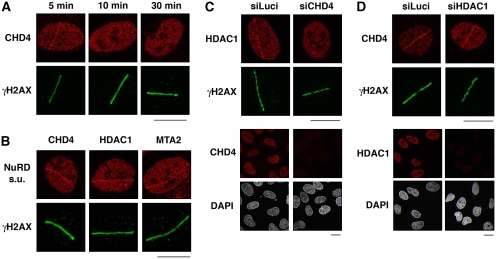
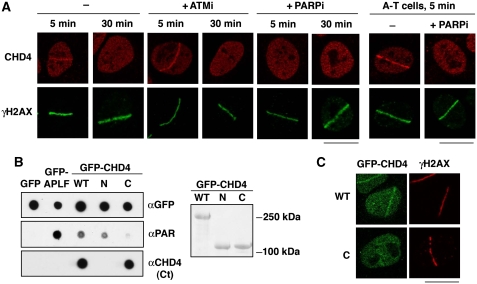
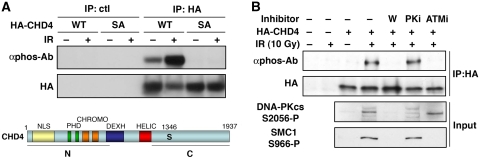
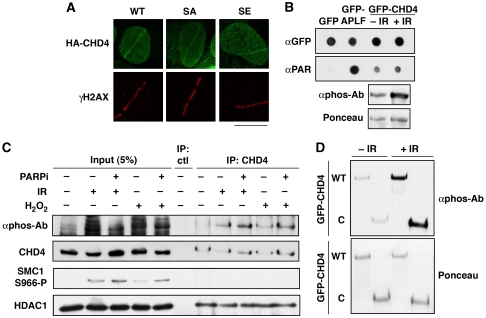
The chromatin remodelling factor chromodomain helicase DNA‐binding protein 4 (CHD4) is a catalytic subunit of the NuRD transcriptional repressor complex. Here, we reveal novel functions for CHD4 in the DNA‐damage response (DDR) and cell‐cycle control. We show that CHD4 mediates rapid poly(ADP‐ribose)‐dependent recruitment of the NuRD complex to DNA‐damage sites, and we identify CHD4 as a phosphorylation target for the apical DDR kinase ataxia‐telangiectasia mutated. Functionally, we show that CHD4 promotes repair of DNA double‐strand breaks and cell survival after DNA damage. In addition, we show that CHD4 acts as an important regulator of the G1/S cell‐cycle transition by controlling p53 deacetylation. These results provide new insights into how the chromatin remodelling complex NuRD contributes to maintaining genome stability. This paper adds to the emerging concept that chromatin remodelling contributes to DNA‐damage responses. CHD4, a known NuRD component, is identified as ATM target, localizes to DNA breaks and contributes to repair while associating with PARPylated factors.
Overview
The claims and statistics of this paper haven’t been checked yet.
Run the check — free, no account needed. It reads the open-access text and checks the sources it cites.
Integrity signals
Registry
Cites
Statistics
Figures
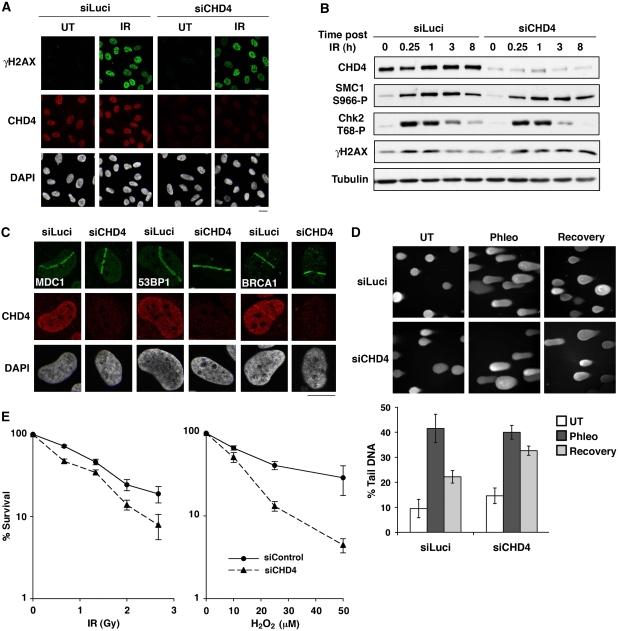
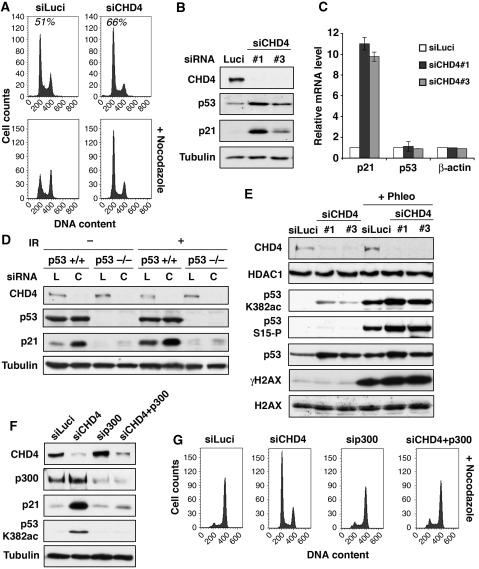
Verification
Claims the paper makes
The claims and statistics of this paper haven’t been checked yet.
Run the check — free, no account needed. It reads the open-access text and checks the sources it cites.
Claims other papers make about this one
Each is checked against this paper’s own text: does it say what the citing paper says it does?
The source backs part of the claim, not all of it — or backs it for a different population, condition or comparison.
In the citing paper
“Other repressive complexes, such as NuRD and histone deacetylases (HDACs) (43)(44)(45)(46), also transiently accumulate at DSBs, supporting this idea.”
From DNA double-strand breaks promote methylation of histone H3 on lysine 9 and transient formation of repressive chromatin (2014) · cites this paper as [43]
Experimental — accuracy not yet measuredThe source backs part of the claim, not all of it — or backs it for a different population, condition or comparison.
In the citing paper
“Thus, immediately after DNA damage, both euchromatin and heterochromatin domains have similar structural organization, including high density of H3K9me3 and the presence of repressive complexes, such as kap-1, HP1α, methyltransferases, HDACs, and CHD3/CHD4 remodeling ATPases (31,32,(43)(44)(45)(46)(47).”
From DNA double-strand breaks promote methylation of histone H3 on lysine 9 and transient formation of repressive chromatin (2014) · cites this paper as [43]
Experimental — accuracy not yet measured
Self-check
Percentages, sums and reported differences re-computed from the paper’s own numbers.
The self-check needs the paper’s full text.
Citations
Cites
Targeting the DNA repair defect in BRCA mutant cells as a therapeutic strategy
Farmer, H., McCabe, N., Lord, C. J., Tutt, A. N. J., Johnson, D. A., Richardson, T. B., Santarosa, M., Dillon, K. J., Hickson, I., Knights, C., et al. (2005) · Nature · doi:10.1038/nature03445 · Cited by 6,683
Self-citationThe DNA-damage response in human biology and disease
Jackson, S. P., & Bartek, J. (2009) · Nature · doi:10.1038/nature08467 · Cited by 6,092 · cited 3×
“In response to DNA damage, cells initiate a coordinated programme of events, termed the DNA-damage response (DDR), which is critical for maintenance of genome integrity and the prevention of ageing and tumourigenesis (Harper and Elledge, 2007; Jackson and Bartek, 2009).”
BackgroundSelf-citationDNA double-stranded breaks induce histone H2AX phosphorylation on serine 139
Rogakou, E. P., Pilch, D. R., Orr, A. H., Ivanova, V. S., & Bonner, W. M. (1998) · Journal of Biological Chemistry · doi:10.1074/jbc.273.10.5858 · Cited by 5,438 · cited 2×
“The work must be attributed back to the original author and commercial use is not permitted without specific permission.”
BackgroundBlinded by the Light: The Growing Complexity of p53
Vousden, K. H., & Prives, C. (2009) · Cell · doi:10.1016/j.cell.2009.04.037 · Cited by 3,163 · cited 2×
“The work must be attributed back to the original author and commercial use is not permitted without specific permission.”
BackgroundATM and ATR Substrate Analysis Reveals Extensive Protein Networks Responsive to DNA Damage
Matsuoka, S., Ballif, B. A., Smogorzewska, A., McDonald, E. R., Hurov, K. E., Luo, J., Bakalarski, C. E., Zhao, Z., Solimini, N., Lerenthal, Y., et al. (2007) · Science · doi:10.1126/science.1140321 · Cited by 3,075 · cited 5×
“Interestingly, proteomic screens in human cells have identified CHD4 as a target for DDR kinases (Matsuoka et al, 2007; Mu et al, 2007; Stokes et al, 2007).”
BackgroundMethodInfluentialThe biology of chromatin remodeling complexes.
Clapier, C. R., & Cairns, B. (2009) · Annual Review of Biochemistry · doi:10.1146/annurev.biochem.77.062706.153223 · Cited by 2,384 · cited 3×
“It is, therefore, possible that such factors will display synergistic and/or antagonistic functions in the regulation of chromatin compaction at DNA-damage sites, as happens in the context of transcription (Ramirez-Carrozzi et al, 2006; Clapier and Cairns, 2009).”
BackgroundAdvances in autism genetics: on the threshold of a new neurobiology
Abrahams, B. S., & Geschwind, D. H. (2008) · Nature Reviews Genetics · doi:10.1038/nrg2346 · Cited by 1,866
The DNA Damage Response: Ten Years After
Harper, J. W., & Elledge, S. J. (2007) · Molecular Cell · doi:10.1016/j.molcel.2007.11.015 · Cited by 1,705 · cited 3×
“In response to DNA damage, cells initiate a coordinated programme of events, termed the DNA-damage response (DDR), which is critical for maintenance of genome integrity and the prevention of ageing and tumourigenesis (Harper and Elledge, 2007; Jackson and Bartek, 2009).”
BackgroundKruse, J.-P., & Gu, W. (2009) · Cell · doi:10.1016/j.cell.2009.04.050 · Cited by 1,610 · cited 3×
“The work must be attributed back to the original author and commercial use is not permitted without specific permission.”
BackgroundPARP inhibition: PARP1 and beyond
Rouleau, M., Patel, A., Hendzel, M. J., Kaufmann, S. H., & Poirier, G. G. (2010) · Nature Reviews Cancer · doi:10.1038/nrc2812 · Cited by 1,298 · cited 1×
“…DNA nicks also activate poly(ADP-ribose) poly- merase (PARP) enzymes that modify target proteins with poly(ADP-ribose) chains (PAR chains) at DNA-damage sites, thereby stimulating the recruitment and/or activity of repair factors (Malanga and Althaus, 2005; Hakme et al, 2008; Rouleau et al, 2010).”
Background
Cited by
Sorted by citations
The DNA Damage Response: Making It Safe to Play with Knives
Ciccia, A., & Elledge, S. J. (2010) · Molecular Cell · doi:10.1016/j.molcel.2010.09.019 · Cited by 4,368
“…22, 2010 ª2010 Elsevier Inc. 181 182 Molecular Cell 40, October 22, 2010 ª2010 Elsevier Inc. recruitment of DNA repair and chromatin modifying complexes, such as polycomb and histone deacetylase (HDAC) complexes, at DNA damage sites (Polo et al., 2010; Schreiber et al., 2006; Chou et al., 2010).”
BackgroundThe multifaceted roles of PARP1 in DNA repair and chromatin remodelling
Ray Chaudhuri, A., & Nussenzweig, A. (2017) · Nature Reviews Molecular Cell Biology · doi:10.1038/nrm.2017.53 · Cited by 1,786
The ATM protein kinase: regulating the cellular response to genotoxic stress, and more
Shiloh, Y., & Ziv, Y. (2013) · Nature Reviews Molecular Cell Biology · doi:10.1038/nrm3546 · Cited by 1,649
Targeting the cancer epigenome for therapy
Jones, P. A., Issa, J. J., & Baylin, S. B. (2016) · Nature Reviews Genetics · doi:10.1038/nrg.2016.93 · Cited by 1,153
Dynamics of DNA damage response proteins at DNA breaks: a focus on protein modifications
Polo, S. E., & Jackson, S. P. (2011) · Genes & Development · doi:10.1101/gad.2021311 · Cited by 1,092
“PARylation at DNA breaks is also required for accrual of the chromatin remodeling factors ALC1 and CHD4 (Ahel et al. 2009; Gottschalk et al. 2009; Chou et al. 2010; Polo et al. 2010), the Polycomb histone-modifying complex (Chou et al. 2010), and the histone variant macroH2A (Timinszky et al. 2009).”
BackgroundSelf-citation
Metadata
- Authors
- Polo, S. E., Kaidi, A., Baskcomb, L., Galanty, Y., & Jackson, S. P.
- Affiliations
- University of Cambridge (GB)
- Corresponding author
- Jackson, Stephen P
- Venue
- The EMBO Journal
- Published
- 2010-08-06
- Volume
- 29
- Issue
- 18
- Pages
- 3130-3139
- ISSN
- 0261-4189 (ISSN-L)
- 1460-2075
- PMC
- PMC2944064
- OpenAlex
- W2020084014
- Cited by
- 374
- References
- 56
- Citations by year
- 2026: 13 · 2025: 14 · 2024: 20 · 2023: 17 · 2022: 26 · 2021: 17 · 2020: 22 · 2019: 18 · 2018: 18 · 2017: 35 · 2016: 24 · 2015: 17 · 2014: 31 · 2013: 34 · 2012: 31
- FWCI
- 13.30
- Type
- journal article
- Language
- en
- Open access
- hybrid
- doi.org
- Licence
- Locations
- The EMBO Journal (publishedVersion, cc-by-nc-sa)
- PubMed Central (publishedVersion, cc-by-nc-sa)
- PubMed (publishedVersion)
- Explore Bristol Research (submittedVersion)
- Funders
- Wellcome Trust
- Cancer Research UK (11224, A5290, A4361)
- European Commission (512113, 201630, LSHG-CT-2005-512113)
- Directorate for Biological Sciences
- Biotechnology and Biological Sciences Research Council
- Topics
- Life Sciences › Biochemistry, Genetics and Molecular Biology › Molecular Biology › DNA Repair Mechanisms
- Life Sciences › Biochemistry, Genetics and Molecular Biology › Molecular Biology › Chromatin Remodeling and Cancer
- Life Sciences › Biochemistry, Genetics and Molecular Biology › Molecular Biology › Genomics and Chromatin Dynamics
- Keywords
- CHD4, chromatin remodeling, NuRD complex, DNA damage response, cell cycle regulation, G1/S transition, p53 deacetylation, ATM phosphorylation, DNA double-strand break repair, poly(ADP-ribose), poly(ADP-ribose) polymerase, genome stability, transcriptional repressor
- MeSH terms
- Animals, Autoantigens, Cell Cycle, DNA Damage, DNA Helicases, DNA-Binding Proteins, Fluorescent Antibody Technique, Histones, Humans, Phosphorylation, Poly Adenosine Diphosphate Ribose, RNA, Messenger, Blotting, Western, Tumor Suppressor Protein p53, Protein Serine-Threonine Kinases, Mice, Knockout, Cell Cycle Proteins, Reverse Transcriptase Polymerase Chain Reaction, Tumor Suppressor Proteins, Chromatin Assembly and Disassembly, Immunoprecipitation, Mice, Mi-2 Nucleosome Remodeling and Deacetylase Complex, Ataxia Telangiectasia Mutated Proteins
About these checks
Registry, retraction, Cites and statistics results are computed, not judged, with one exception: a printed reference that no index lists is read once by a model before it counts as a citation error. Claims are extracted by a model and kept only when their quote appears verbatim in the text; each cited source is then checked, with a model’s help, for whether it says what the claim relies on. Those verdicts can be wrong — read the claim’s quote and the cited source before relying on one.
Statistics and arithmetic are recomputed, not judged.
Confidence bands are shown only for fields calibrated on our annotated test set. None is calibrated yet, so no band is shown.
What counts as a claim ›How we measure confidence ›How we check this ›
Are you an author, or do you see a problem with this page? Request a review
