

Human brain networks function in connectome-specific harmonic waves
Open accessThe DOI matches its Crossref record; 59 of the 59 references it cites were found in a registry or an index.
Abstract
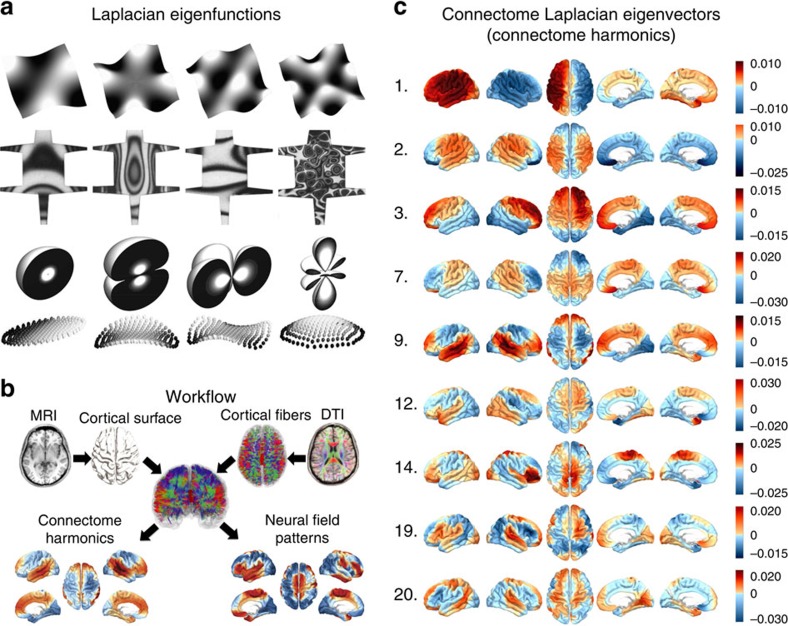
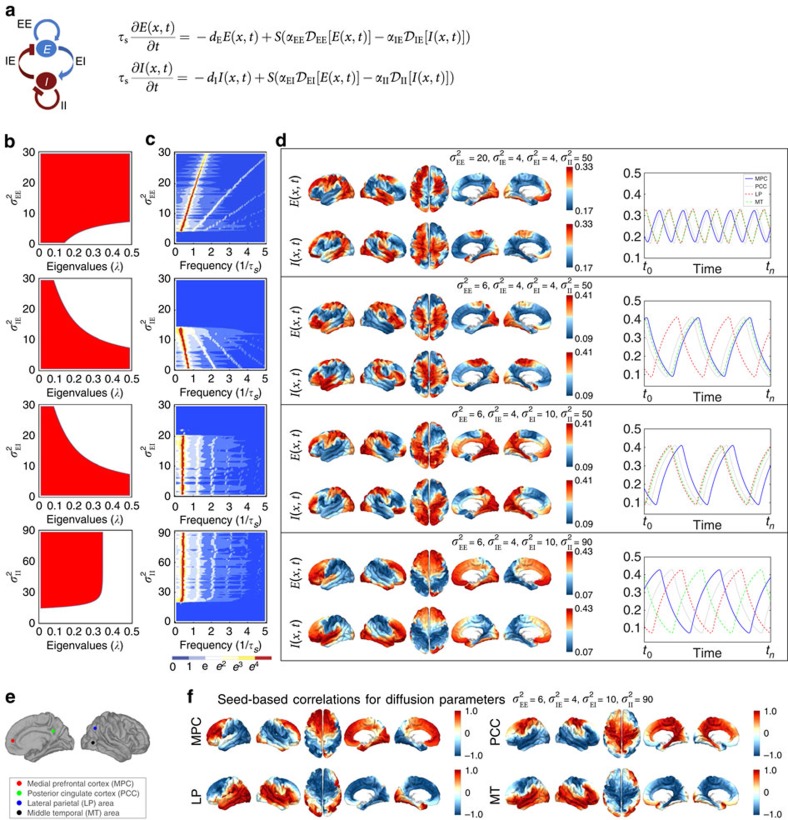
A key characteristic of human brain activity is coherent, spatially distributed oscillations forming behaviour-dependent brain networks. However, a fundamental principle underlying these networks remains unknown. Here we report that functional networks of the human brain are predicted by harmonic patterns, ubiquitous throughout nature, steered by the anatomy of the human cerebral cortex, the human connectome. We introduce a new technique extending the Fourier basis to the human connectome. In this new frequency-specific representation of cortical activity, that we call ‘connectome harmonics’, oscillatory networks of the human brain at rest match harmonic wave patterns of certain frequencies. We demonstrate a neural mechanism behind the self-organization of connectome harmonics with a continuous neural field model of excitatory–inhibitory interactions on the connectome. Remarkably, the critical relation between the neural field patterns and the delicate excitation–inhibition balance fits the neurophysiological changes observed during the loss and recovery of consciousness.
Overview
The claims and statistics of this paper haven’t been checked yet.
Free: it reads the open-access text and checks the first 5 claims that cite a source we can check. Create a free account to check every claim.
Integrity signals
Registry
Cites
Statistics
Figures



Verification
Claims the paper makes
The claims and statistics of this paper haven’t been checked yet.
Free: it reads the open-access text and checks the first 5 claims that cite a source we can check. Create a free account to check every claim.
Claims other papers make about this one
Each is checked against this paper’s own text: does it say what the citing paper says it does?
The source backs part of the claim, not all of it — or backs it for a different population, condition or comparison.
In the citing paper
“When this method was first introduced, Atasoy et al. (2016) compellingly demonstrated how reaction-diffusion simulations of spreading activation could generate resting state networks as stable modes—or standing waves—so recapitulating well-known patterns of neuronal organization with minimal assumptions.”
From An Integrated World Modeling Theory (IWMT) of Consciousness (2020) · cites this paper as Atasoy et al. (2016)
Experimental — accuracy not yet measured
Self-check
Percentages, sums and reported differences re-computed from the paper’s own numbers.
The self-check needs the paper’s full text.
Citations
Cites
Hodgkin, A. L., & Huxley, A. F. (1952) · The Journal of Physiology · doi:10.1113/jphysiol.1952.sp004764 · Cited by 23,191
The chemical basis of morphogenesis
Turing, A. M. (1952) · Philosophical Transactions of the Royal Society of London. Series B, Biological Sciences · doi:10.1098/rstb.1952.0012 · Cited by 11,733
The organization of the human cerebral cortex estimated by intrinsic functional connectivity
Thomas Yeo, B. T., Krienen, F. M., Sepulcre, J., Sabuncu, M. R., Lashkari, D., Hollinshead, M., Roffman, J. L., Smoller, J. W., Zöllei, L., Polimeni, J. R., et al. (2011) · Journal of Neurophysiology · doi:10.1152/jn.00338.2011 · Cited by 9,182
The human brain is intrinsically organized into dynamic, anticorrelated functional networks
Fox, M. D., Snyder, A. Z., Vincent, J. L., Corbetta, M., Van Essen, D. C., & Raichle, M. E. (2005) · Proceedings of the National Academy of Sciences · doi:10.1073/pnas.0504136102 · Cited by 8,553
The organization of the human cerebellum estimated by intrinsic functional connectivity
Buckner, R. L., Krienen, F. M., Castellanos, A., Diaz, J. C., & Yeo, B. T. T. (2011) · Journal of Neurophysiology · doi:10.1152/jn.00339.2011 · Cited by 7,304
Spontaneous fluctuations in brain activity observed with functional magnetic resonance imaging
Fox, M. D., & Raichle, M. E. (2007) · Nature Reviews Neuroscience · doi:10.1038/nrn2201 · Cited by 6,700
Neuronal Oscillations in Cortical Networks
Buzsáki, G., & Draguhn, A. (2004) · Science · doi:10.1126/science.1099745 · Cited by 6,576
Chung, F. (1996) · CBMS Regional Conference Series in Mathematics · doi:10.1090/cbms/092 · Cited by 5,524
Tracking whole-brain connectivity dynamics in the resting state
Allen, E. A., Damaraju, E., Plis, S. M., Erhardt, E. B., Eichele, T., & Calhoun, V. D. (2014) · Cerebral Cortex · doi:10.1093/cercor/bhs352 · Cited by 2,992
Dynamic functional connectivity: Promise, issues, and interpretations
Hutchison, R. M., Womelsdorf, T., Allen, E. A., Bandettini, P. A., Calhoun, V. D., Corbetta, M., Della Penna, S., Duyn, J. H., Glover, G. H., Gonzalez-Castillo, J., et al. (2013) · NeuroImage · doi:10.1016/j.neuroimage.2013.05.079 · Cited by 2,962
Research works printed but not linked: 1
- Lévy, B. Laplace-Beltrami eigenfunctions towards an algorithm that “understands” geometry. In Int. Conf. Shape Modeling and Applications, 2006.
Cited by
Items 301–378 of 378
Deep learning-based embedding of functional connectivity profiles for precision functional mapping
Tu, J. C., Kim, J., Lu, C., Luckett, P. H., Adeyemo, B., Shimony, J. S., Elison, J. T., Eggebrecht, A. T., & Wheelock, M. D. (2025) · Imaging Neuroscience · doi:10.1162/imag.a.129 · Cited by 6
“Additionally, unlike other factor analysis methods that explore harmonic modes/eigenmodes in the brain based on geometric anatomy ( Atasoy et al., 2016, 2018; Pang et al., 2023), the VAE latent space lacks interpretability.”
Cascades and convergence: Dynamic signal flow in a synapse-level brain network
Betzel, R. F., Puxeddu, M. G., Seguin, C., & Mišić, B. (2026) · PLOS complex systems. · doi:10.1371/journal.pcsy.0000091 · Cited by 4
RETRACTED: The Open Mind: A Phenomenology
Adler, J. (2017) · Open Journal of Philosophy · doi:10.4236/ojpp.2017.72009 · Cited by 2
“These transactional amplification processes, when represented in frequency-specific, DOI: 10.4236/ojpp.2021.112019 274 Open Journal of Philosophy harmonic wave patterns, as found in the 2016 study Exploring Neural Correlates of Consciousness with Connectome-specific Harmonic Waves (Atasoy et al., 2016) shows that: Spa…”
BackgroundResultInfluentialRetractedAutomated Parcellation of the Cortex Using Structural Connectome Harmonics
Taylor, H. P., Wu, Z., Wu, Y., Shen, D. G., Zhang, H., & Yap, P. (2019) · Lecture notes in computer science · doi:10.1007/978-3-030-32248-9_53 · Cited by 1
“Note that several important differences in the present model, including but not limited to superior sampling density of structural connectivity, the weighting strategy used to construct the graph, and the multi-layer graph formulation, all render our model distinct from that of [2].”
BackgroundResultInfluentialThe neural and cognitive architecture for learning from a small samplePreprint
Cortese, A., Martino, B. D., & Kawato, M. (2018) · arXiv (Cornell University) · doi:10.48550/arxiv.1810.02476 · Cited by 1
“Recent work has elegantly linked the brain’s structural connectivity (particularly the thalamo-cortical system) with neural activity patterns and dynamics, providing a formal basis for harmonic patterns of certain frequencies [61].”
A stylised view on structural and functional connectivity in dynamical processes in networksPreprint
Voutsa, V., Battaglia, D. A., Bracken, L. J., Brovelli, A., Costescu, J., Muñoz, M. D., Fath, B. D., Funk, A., Guirro, M., Hein, T. I. A., et al. (2021) · arXiv (Cornell University) · doi:10.48550/arxiv.2106.03523 · Cited by 1
Dimitriadis, S. I. (2023) · bioRxiv (Cold Spring Harbor Laboratory) · doi:10.1101/2023.05.31.543029 · Cited by 4
Blanco, R., Preti, M. G., Koba, C., Ville, D. V. D., & Crimi, A. (2024) · bioRxiv (Cold Spring Harbor Laboratory) · doi:10.1101/2024.04.27.591444 · Cited by 1
Al-Olofi, Y. M. (2025) · Research Square · doi:10.21203/rs.3.rs-8408024/v1 · Cited by 3
Cognition emerges from phase dynamics of intrinsic coordinationPreprint
Song, Y., Chen, J., Calhoun, V. D., & Iraji, A. (2026) · eLife · doi:10.64898/2026.03.26.714488 · Cited by 1
“The INF framework shares a conceptual foundation with recent eigenmode-based approaches, such as geometric eigenmodes [59] and connectome harmonics [60], in decomposing whole-brain activity into superpositions of large-scale basis patterns.”
Brain Resting State, Landauer Principle and Carnot CyclePreprint
Déli, É., Tozzi, A., & Jf, P. (2017) · viXra
Relational Basis of the Organism's Self-organization A Philosophical Discussion
Karaca, Ç. (2019) · PhilPapers (PhilPapers Foundation) · Cited by 2
SpectralWeight: a spectral graph wavelet framework for weight prediction of pork cutsPreprint
Masoumi, M., Marcoux, M., Maignel, L., & Pomar, C. (2020) · arXiv (Cornell University) · doi:10.48550/arxiv.2005.05406
“The power of spectral signatures is mainly due to the spectrum related to the natural frequencies and the associated eigenvectors that yield the wave pattern [12,2].”
The connectome spectrum as a canonical basis for a sparse representation of fast brain activityPreprint
Rué‐Queralt, J., Glomb, K., Pascucci, D., Tourbier, S., Carboni, M., Vulliémoz, S., Plomp, G., & Hagmann, P. (2021) · bioRxiv (Cold Spring Harbor Laboratory) · doi:10.1101/2021.03.03.433561 · Cited by 3
Welcoming Steven Lehar as a QRI Lineage
Gómez-Emilsson, A. (2021)
A Primer on the Symmetry Theory of Valence
Johnson, M. E. (2021)
Wang, Y., Ma, J., Meng, Q., Chen, X., & Du, C. (2021) · bioRxiv (Cold Spring Harbor Laboratory) · doi:10.1101/2021.10.11.464009
“equation , { , , } h j j j L j 1 n , with j being the corresponding eigenvalues of Lh, representing the frequencies of hSC [29-31].”
BackgroundSynchronization in Interacting Networks of Hodgkin–Huxley Neurons
Andreev, A. V., Александрович, М. В., Badarin, A., Grubov, V., & Hramov, A. E. (2022) · Bulletin of the Russian Academy of Sciences Physics · doi:10.3103/s1062873822020058
The Open Mind: A Phenomenology
Adler, J. (2021) · Open Journal of Philosophy · doi:10.4236/ojpp.2021.112019
(2019) · Elsevier eBooks · doi:10.1016/b978-0-12-816179-1.00042-6
Sennett, M. A., Beckett, B. C., & Theobald, D. L. (2023) · bioRxiv (Cold Spring Harbor Laboratory) · doi:10.1101/2023.02.22.529562
System Identification of Brain Wave Modes Using EEG
Griffith, T. D., Hubbard, J. E., & Balas, M. J. (2023) · Synthesis lectures on biomedical engineering · doi:10.1007/978-3-031-23529-0_3
Imputing missing electroencephalography data using graph signal processing
Weinstein, A. (2023) · International Symposium on Medical Information Processing and Analysis (SIPAIM) · doi:10.1117/12.2669735
“30 Using GSP, it is also possible to combine fMRI with diffusion MRI in a multilayer-graph framework that captures transient networks of spatio-temporal connectivity.”
BackgroundBai, W. (2023) · Applied Sciences · doi:10.3390/app13127130
Pohl, H., Sándor, P. S., Moisa, M., Ruff, C. C., Schoenen, J. E., Luechinger, R., Tuura, R., Riederer, F., Gantenbein, A. R., & Michels, L. (2023) · Scientific Reports · doi:10.1038/s41598-023-39659-5 · Cited by 1
“Thus, it might be more fruitful to analyse dynamic changes in cortical activity in patients and healthy controls and search for differing patterns with more advanced methods, e.g., connectome-harmonic decomposition 46,47 .”
BackgroundHuang, X., Gao, L., Xiao, J., Li, L., Shan, X., Chen, H., Chai, X. J., & Duan, X. (2024) · Biological Psychiatry Cognitive Neuroscience and Neuroimaging · doi:10.1016/j.bpsc.2024.03.003 · Cited by 3
Cai, H., Deng, R., Yang, D., Zhang, F., Wu, G., & Chen, J. (2024) · IEEE Journal of Biomedical and Health Informatics · doi:10.1109/jbhi.2024.3434394 · Cited by 1
“Importantly, harmonic waves are spatial expansions on a Fourier basis, in which spatial frequencies are highly consistent with the anatomical structure of the brain network [25].”
InfluentialPreti, M. G., & Ville, D. V. D. (2024) · IEEE International Symposium on Biomedical Imaging (ISBI) · doi:10.1109/isbi56570.2024.10635731
“A has N nodes representing brain The eigenvalues λ n on the diagonal of ΛΛΛ can be interpreted as spatial frequencies, and the eigenmodes u n on the columns of U as corresponding frequency components, also called structural harmonics [6] (with n as the number of spectral coefficients).”
BackgroundMethodIpnosi, suggestione, effetti placebo e nocebo: quale relazione?
Savron, G. (2024) · IPNOSI · doi:10.3280/ipn2024-001002
Jin, H., Abdelnour, F., Verma, P., Sipes, B. S., Nagarajan, S. S., & Raj, A. (2024) · Imaging Neuroscience · doi:10.1162/imag_a_00307 · Cited by 3
“This description is entirely consistent with prior studies using graph harmonics [23, 44, 35, 67, 68, 41, 40, 39], but in contrast to those studies, here we provide for the first time a fully frequency-resolved description of FC, at arbitrary frequency.”
BackgroundResultInfluentialJain, C., Sita, S. U. N., Sharma, A. K., & Bapi, R. S. (2024) · bioRxiv (Cold Spring Harbor Laboratory) · doi:10.1101/2024.09.07.611772
Xu, K., Haoxuan, L., Zhang, A., Sun, X., Zhao, Z., Zheng, D., Li, K., & Ye, J. (2024) · Research Square · doi:10.21203/rs.3.rs-4900687/v1
Prediction of Excitatory and Inhibitory Connections in the Human Brain Based on SDK-GAN
Dai, C., Yuan, Y., Huang, X., & Wang, Y. (2024) · International Conference on Signal Processing · doi:10.1109/icsp62129.2024.10846423
Altered Brain-Ventricle Coupling Modes Over Alzheimer’s Disease Progression Detected With fMRIPreprint
Campo, F. F., Brattico, E., Magalhães, V., Nigro, S. L., Tafuri, B., Logroscino, G., & Cabral, J. (2025) · Qeios · doi:10.32388/5fr501
\({O({k})}\)-Equivariant Dimensionality Reduction on Stiefel Manifolds
Lee, A. S., Lee, H., Perea, J. A., Schonsheck, N., & Weinstein, M. (2025) · SIAM Journal on Mathematics of Data Science · doi:10.1137/23m1603443 · Cited by 2
“As eigenvectors contain important information about these matrices [1, 6], it is intuitive to represent the set of top k eigenvectors as an orthonormal k -frame and thus as a point in the Stiefel manifold V k ( R N ).”
Zhang, X., Song, M., Jiang, W., Lu, Y., Chu, C., Li, W., Wang, H., Shi, W., Lan, Y., & Jiang, T. (2025) · Neuroscience Bulletin · doi:10.1007/s12264-025-01393-5 · Cited by 1
“The spectral decomposition of the functional connectivity matrix can reveal the primary patterns and characteristics of brain connectivity, enhancing the understanding of brain functional organization [45, 46].”
Graph-Theoretic Analysis of Human Brain Networks
Fornito, A. (2025) · Neuromethods · doi:10.1007/978-1-0716-4438-6_10 · Cited by 1
Chen, Z., & Wang, H. (2025) · Sensors · doi:10.3390/s25113540
“Thus, sinusoidal functions not only effectively capture the rhythmic nature of neural signals but also provide biological plausibility and interpretability in neural signal modeling [39,40].”
Abeywardena, K. G., Lefebvre, J., Valiante, T. A., & Draper, S. C. (2025) · PLOS complex systems. · doi:10.1371/journal.pcsy.0000057
Context-dependent structurally informed effective connectivity under psilocybinPreprint
Greaves, M. D., Barta, T., Novelli, L., Stoliker, D., & Razi, A. (2025) · bioRxiv (Cold Spring Harbor Laboratory) · doi:10.1101/2025.08.18.671000
Bolton, T. A. W., Schöttner, M., Patel, J. H., Fluhr, H., Alemán‐Gómez, Y., & Hagmann, P. (2025) · bioRxiv (Cold Spring Harbor Laboratory) · doi:10.1101/2025.08.20.671319 · Cited by 1
Guo, W., & Song, M. (2025) · IEEE International Conference on Image Processing and Computer Applications (ICIPCA) · doi:10.1109/icipca65645.2025.11138440
Tang, Z., Zhao, Y., Yang, Y., Liu, X., & Su, J. (2025) · Lecture notes in computer science · doi:10.1007/978-3-032-05162-2_12
Does Connectome Harmonic Analysis Pass the Spin Test?
Vock, R., Grigis, A., Dufumier, B., & Duchesnay, É. (2025) · Lecture notes in computer science · doi:10.1007/978-3-032-05162-2_27
Depression reduces structurally informed network flexibility in premanifest Huntington’s diseasePreprint
Barta, T., GradDipAdvPsych, Greaves, M. D., GradDipAdvPsych, Novelli, L., Glikmann‐Johnston, Y., & Razi, A. (2025) · bioRxiv (Cold Spring Harbor Laboratory) · doi:10.1101/2025.09.25.678149
“…examine correlations between nodal connectivity profiles(28,31) or employ harmonic decomposition to assess structural constraints on functional dynamics(33,34), these approaches cannot capture the directional causal interactions (i.e., effective connectivity) fundamental to network communication.”
Motallebi, S., Yazdanpanah, M. J., & Vahabie, A. (2025) · Systems Science & Control Engineering · doi:10.1080/21642583.2025.2587812
“…Izhikevich & Edelman, 2008), Conductance-based neural mass model (Gollo, Mirasso et al., 2014; Gollo, Zalesky et al., 2015), Neural Field model (Atasoy et al., 2016), FitzHugh-Nagume model (Messé, Hütt et al., 2015; Messé, Rudrauf, Benali et al., 2014), Wilson-Cowan oscillatory model (Deco et…”
Baron, G., Baggio, G., Facca, M., Benozzo, D., Chiuso, A., Zampieri, S., & Bertoldo, A. (2026) · iScience · doi:10.1101/2025.11.16.688716
“While Laplacian eigendecomposition of connectivity matrices has been widely applied to study structure– function coupling 5,37,7,24 , its extension to whole-brain EC has been lacking.”
InfluentialShu, K., Yang, P., Wang, T., Song, X., & Lei, B. (2025) · Annual International Conference of the IEEE Engineering in Medicine and Biology Society (EMBC) · doi:10.1109/embc58623.2025.11253645
“In this paper, we propose a novel multi-modal fusion approach for AD diagnosis that effectively integrates structural and functional MRI data while maintaining interpretability and incorporating prior knowledge[12, 13].”
Bootstrap-based statistical inference on the eigenvalues of weighted networks
Aalipur, B., & Qin, Y. (2025) · Statistics and Computing · doi:10.1007/s11222-025-10784-7 · Cited by 1
“A low-rank structure may represent a core, stable "backbone" of connectivity, while a high-rank structure, implying many significant eigenvalues, suggests a rich and diverse repertoire of functional motifs and processing pathways (Atasoy et al. 2016; Chaudhuri et al. 2015).”
A deformable attractor manifold organizes human resting-state brain dynamicsPreprint
Athanasiadis, A. P., Woodman, M., Hashemi, M., Triebkorn, P., Petkoski, S., & Jirsa, V. (2025) · bioRxiv (Cold Spring Harbor Laboratory) · doi:10.64898/2025.12.02.691788
“…originates from the fundamental excitability of individual neurons and constrained by the intricate anatomy and geometry of the cerebral cortex (Atasoy et al., 2016; Pang et al., 2023; Vohryzek et al., 2025); and temporal, as higher cognitive areas that are responsible for integrating complex…”
A mechanistic whole brain model to capture simultaneous EEG-fMRI data
Bandyopadhyay, A., Chakravarthy, V. S., & Roy, D. (2026) · Cerebral Cortex · doi:10.1093/cercor/bhag002
Li, Y., Dong, R., Liu, X., Yuan, Y., & Kong, Y. (2026) · Medical Image Analysis · doi:10.1016/j.media.2026.103993 · Cited by 1
LSD Relaxes Structural Constraints on Brain Dynamics: A Connectome Harmonic MEG StudyPreprint
Subramani, V., Pascarella, A., Brunel, J., Harel, Y., Muthukumaraswamy, S. D., Carhart-Harris, R. L., Jerbi, K., Lioi, G., & Farrugia, N. (2026) · bioRxiv (Cold Spring Harbor Laboratory) · doi:10.64898/2026.03.02.709138
Yue, S., Yang, R., Chen, J., Jiang, S., He, H., Yu, Y., Yu, S., Liu, L., Pu, L., Yao, G., et al. (2026) · Journal of Affective Disorders · doi:10.1016/j.jad.2026.121665
Resting-state dynamics in epilepsy : mechanistic insights from large-scale brain network modeling
Courtiol, J. (2020) · theses.fr (ABES) · doi:10.70675/0e102279zeb19z4f46zbf0ezbf7bdf9dd296
In search of invariants in electroencephalography signals for brain-computer interfaces
Xu, X. (2023) · theses.fr (ABES) · doi:10.70675/a10e24bbz2b86z4604z87e0zec83c09a8f17
Responsiveness and dynamics of asynchronous states and Gamma oscillations in cerebral cortex
Susin, E. (2021) · theses.fr (ABES) · doi:10.70675/45a9917bz0609z450azbd4bz82094b558df6
Inductive Graph Neural Networks for Passive Vision and Acoustic Monitoring
Prummel, W. (2024) · theses.fr (ABES) · doi:10.70675/4949fe39z2d37z4b7dza42cz1d26a43a5401
Premi, E., Bianchetti, G., Bracca, V., Campana, G., Gatti, E., Cao, T., Fornito, A., Cantoni, V., Bellini, S., Corbo, D., et al. (2026) · NeuroImage Clinical · doi:10.1016/j.nicl.2026.103994
“These eigenmodes form a spatially-ordered orthonormal basis that enables multiscale decomposition of cortical anatomy (Atasoy et al., 2016; Gabay and Robinson, 2017), analogous to a Fourier decomposition.”
Dolgikh, O. (2026) · Frontiers in Computational Neuroscience · doi:10.3389/fncom.2026.1813959
Conscious simultaneity with continuous motion: a measure-theoretic resolution of the hard problem
Sanfey, J. (2026) · Frontiers in Human Neuroscience · doi:10.3389/fnhum.2026.1809939
“…Gamma Hz associated with consciousness, but such evidence is undetectable by fMRI (functional magnetic resonance imaging) because of fMRI’s 5–7 s time lag (Glover, 2011), slow refresh rate (Atasoy et al., 2016), and incomplete correlation with neural electrical activity (Figley and Stroman, 2011).”
Unlocking shared-specific features of multi-modal brain graphs for accurate psychiatric diagnosis
Huang, Y., Chen, G., Wen, X., Wei, L., Zhang, H., & Shen, D. G. (2026) · Pattern Recognition · doi:10.1016/j.patcog.2026.113997
Beyond networks: Functional connectivity as eigenmode resonance
Cabral, J. M. S., & Sun, H. (2026) · Aperture Neuro · doi:10.52294/001c.162128 · Cited by 2
Kringelbach, M. L., & Deco, G. (2026) · bioRxiv (Cold Spring Harbor Laboratory) · doi:10.64898/2026.06.05.730423 · Cited by 3
“In fact, connectome harmonics are defined exactly as the eigenfunctions of the graph Laplacian of the connectome, with the Chladni and Helmholtz standing-wave reading and the statement that they form a connectome-specific Fourier basis (Atasoy et al., 2016, 2017, 2019).”
Dohnány, S., Jerotic, K., Orsenigo, D., Serra, E., Ali, H., Buhler, J., Liu, Z.-Q., Muta, K., Hata, J., Okano, H., et al. (2026) · bioRxiv (Cold Spring Harbor Laboratory) · doi:10.64898/2026.06.06.730576
“These changes were examined using three key markers: harmonic energy [3, 4, 12], gradient range [5], and hier-2 Figure 1.”
InfluentialAdaptive Gaussian graph-spectral filtering for scale-specific connectivity inference
Fotoohinasab, A., Ugonna, C., Calhoun, V. D., & Chen, N. (2026) · NeuroImage · doi:10.1016/j.neuroimage.2026.122055
Multiscale structural connectome eigenmodes constrain human brain functional dynamics
Xia, J., Yang, S., Niu, J., Huang, X., Li, J., Chen, H., Zeng, F., & Liao, W. (2026) · Communications Biology · doi:10.1038/s42003-026-10558-5 · Cited by 1
Has, A. C., Wertheimer, J. C., Wei, J., Xie, Y., Gonzales, M. M., Li, D., Dumitrașcu, O., Kremen, S. A., Tan, Z. S., Nelson, M. D., et al. (2026) · Brain and Behavior · doi:10.1002/brb3.71559
“A key challenge is mapping how the brain’s fixed structural wiring supports its vast functional dynamics—specif ically, which anatomical routes are most efficient for communication (Bullmore and Sporns 2009 ; Vohryzek et al. 2025 ; Breakspear 2017 ; Atasoy et al. 2016 ).”
Bolton, T., Sieler, M. S., Patel, J., Chan, M., van de Ville, D., & Hagmann, P. (2026) · bioRxiv · doi:10.64898/2026.07.19.739422
“Most studies derive connectome harmonics from an average or consensus structural connectome across participants, thereby providing a common spectral reference frame shared by all individuals 43–54 .”
InfluentialGlial syncytial control fields and the low-frequency resonome of the human brain
Santacana, A. B. (2026) · Frontiers in Human Neuroscience · doi:10.3389/fnhum.2026.1896291 · Cited by 1
An explicit functional-map framework for structure–function correspondence in brain connectivity
Lv, Z. W., Song, Z., Fu, S., Yu, H., & Guo, X. (2026) · Journal of Neural Engineering · doi:10.1088/1741-2552/ae9acb
“Spectral approaches constitute an important family of SC-informed FC models (Abdelnour et al 2014, Atasoy et al 2016, Becker et al 2018, Tewarie et al 2020).”
Shi, W., Chu, C., Li, W., Fan, L., Li, S., Cheng, L., Song, M., Wang, H., Dong, Z., Di, S., et al. (2026) · 中国科学通报:英文版 · doi:10.1016/j.scib.2026.08.060
A Multiscale Methodology for Mapping Human Neuroanatomy
Cao, T., Pang, J. C. S., & Fornito, A. (2026) · Methods in molecular biology · doi:10.1007/978-1-0716-5440-8_12
Generation-dependent electro-thermal dynamics in a hybrid physical neuron
de León-Zapata, R. D., de Léon-Lomelí, L. R., Flores-García, E., & Rojas-Chávez, H. (2026) · Nonlinear science. · doi:10.1016/j.nls.2026.100208
From neural propagation to conscious experience: A geometro-diffusion theory of consciousness
Estrada, E. (2026) · Journal of Theoretical Biology · doi:10.1016/j.jtbi.2026.112610 · Cited by 2
HAM-BGT: Harmonic-Aware Multimodal Brain Graph Transformer for Brain Disease Diagnosis
Xu, H., Feng, J., Zhang, D., Tian, Z., & Du, S. (2026) · Lecture notes in computer science · doi:10.1007/978-3-032-38239-9_25
Voxel-wise function-structure coupling with diffusion-weighted and functional MRI
Sairanen, V. (2026) · Aperture Neuro · doi:10.52294/001c.172225
Metadata
- Authors
- Atasoy, S., Donnelly, I., & Pearson, J.
- Affiliations
- UNSW Sydney (AU)
- Corresponding author
- Atasoy, Selen
- Venue
- Nature Communications
- Published
- 2016-01-21
- Volume
- 7
- Issue
- 1
- Pages
- 10340-10340
- ISSN
- 2041-1723 (ISSN-L)
- PMC
- PMC4735826
- OpenAlex
- W2267939148
- Cited by
- 381
- References
- 59
- Citations by year
- 2026: 38 · 2025: 50 · 2024: 40 · 2023: 55 · 2022: 39 · 2021: 50 · 2020: 39 · 2019: 25 · 2018: 18 · 2017: 19 · 2016: 8
- FWCI
- 14.85
- Type
- journal article
- Language
- en
- Open access
- gold
- doi.org
- Licence
- cc-by
- creativecommons.org/licenses/by/4.0 (tdm)
- creativecommons.org/licenses/by/4.0 (vor)
- Locations
- Nature Communications (publishedVersion, cc-by)
- PubMed Central (publishedVersion, cc-by)
- PubMed (publishedVersion)
- RePEc: Research Papers in Economics (submittedVersion)
- DOAJ (DOAJ: Directory of Open Access Journals) (submittedVersion, cc-by-sa)
- Funders
- National Institutes of Health (5u54mh091657-05)
- Australian Research Council (DP140101560)
- National Health and Medical Research Council (1049596, 1046198, 1024800, 1085404)
- National Institute of Mental Health (1U54 MH091657, U54-MH091657)
- Topics
- Life Sciences › Neuroscience › Cognitive Neuroscience › Neural dynamics and brain function
- Life Sciences › Neuroscience › Cognitive Neuroscience › Functional Brain Connectivity Studies
- Physical Sciences › Physics and Astronomy › Statistical and Nonlinear Physics › Nonlinear Dynamics and Pattern Formation
- Keywords
- human brain networks, functional connectivity, resting-state brain activity, neural field models, excitation-inhibition balance, self-organization, consciousness, cerebral cortex
- MeSH terms
- Adult, Brain, Brain Mapping, Female, Humans, Male, Nerve Net, Young Adult, Connectome
About these checks
Registry, retraction, Cites and statistics results are computed, not judged, with one exception: a printed reference that no index lists is read once by a model before it counts as a citation error. Claims are extracted by a model and kept only when their quote appears verbatim in the text; each cited source is then checked, with a model’s help, for whether it says what the claim relies on. Those verdicts can be wrong — read the claim’s quote and the cited source before relying on one.
Statistics and arithmetic are recomputed, not judged.
Confidence bands are shown only for fields calibrated on our annotated test set. None is calibrated yet, so no band is shown.
What counts as a claim ›How we measure confidence ›How we check this ›
Are you an author, or do you see a problem with this page? Request a review
Data sources
Bibliographic data: Semantic Scholar, OpenAlex, Crossref.
Contains information from the Semantic Scholar Academic Graph Datasets, made available under the ODC Attribution License (ODC-BY 1.0).
Semantic Scholar’s data is described in: Kinney, R., et al. (2023). The Semantic Scholar Open Data Platform. arXiv:2301.10140.
