

The DOI matches its Crossref record; 55 of the 55 references it cites were found in a registry or an index.
Quantum-chemical insights from deep tensor neural networks
Open accessAbstract
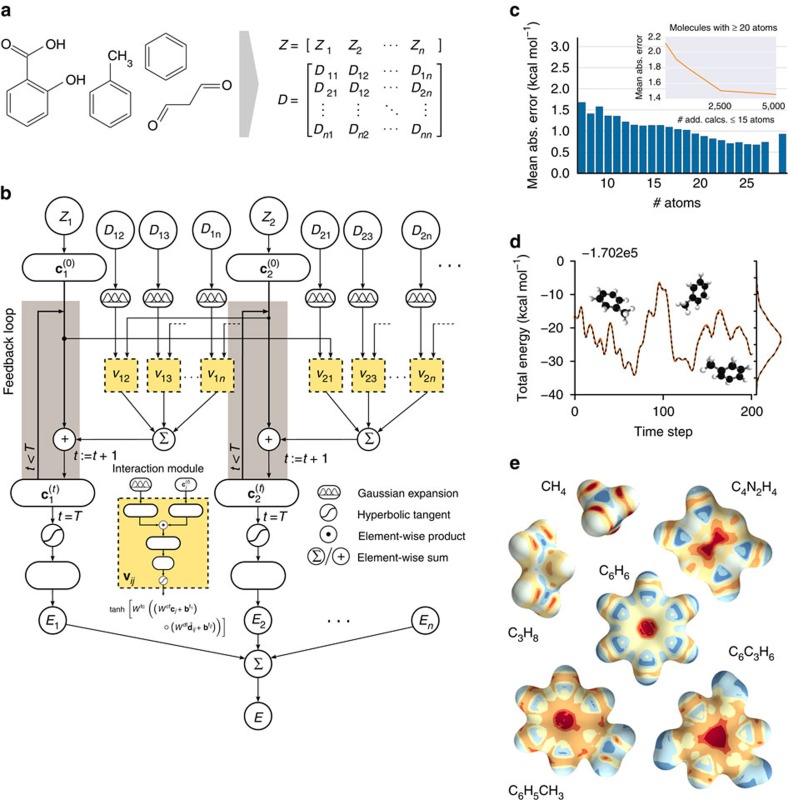
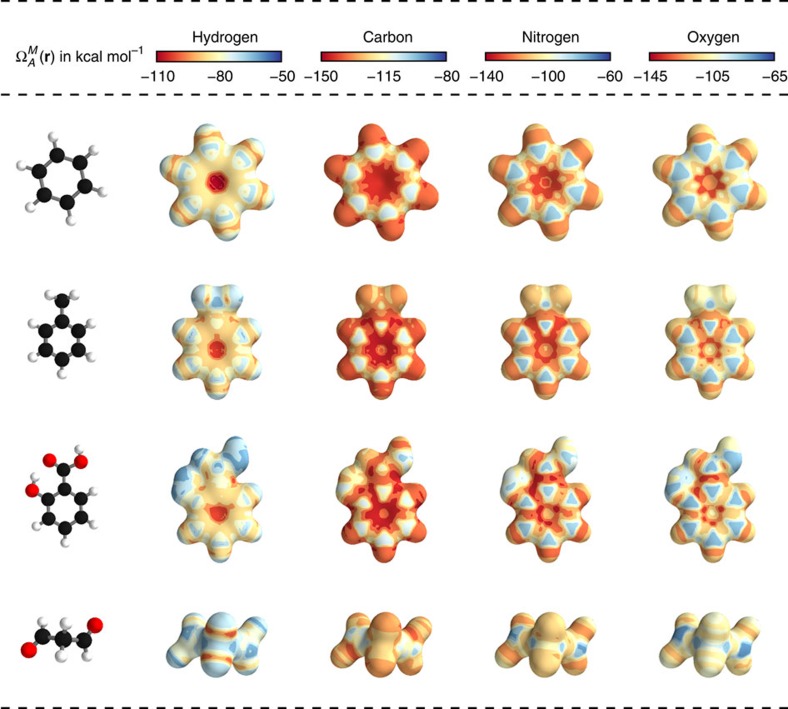
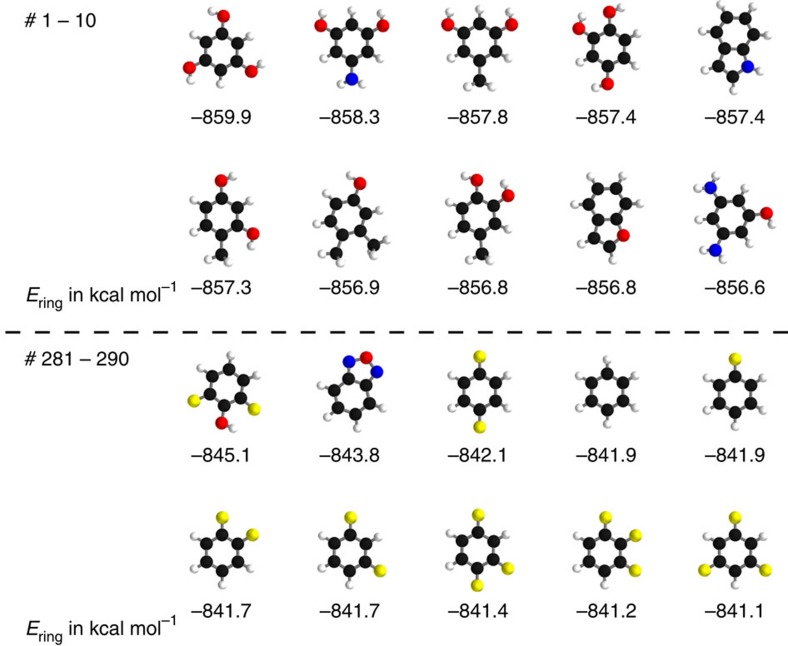
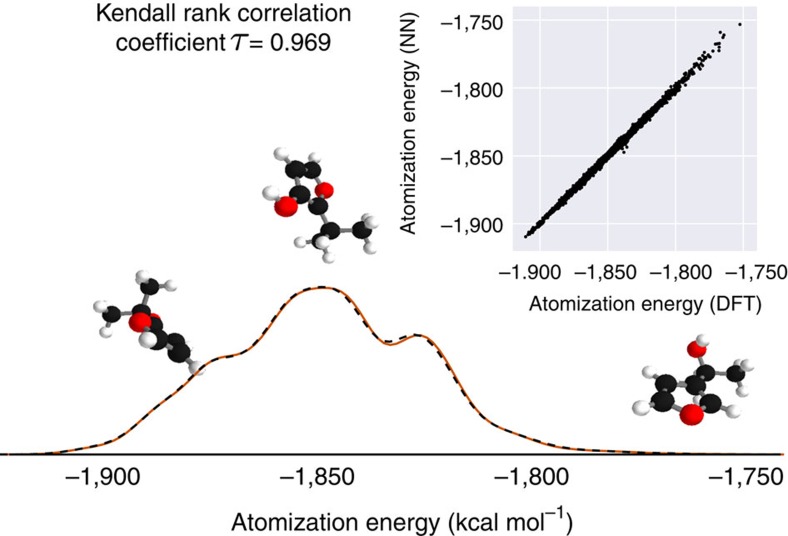
Learning from data has led to paradigm shifts in a multitude of disciplines, including web, text and image search, speech recognition, as well as bioinformatics. Can machine learning enable similar breakthroughs in understanding quantum many-body systems? Here we develop an efficient deep learning approach that enables spatially and chemically resolved insights into quantum-mechanical observables of molecular systems. We unify concepts from many-body Hamiltonians with purpose-designed deep tensor neural networks, which leads to size-extensive and uniformly accurate (1 kcal mol −1 ) predictions in compositional and configurational chemical space for molecules of intermediate size. As an example of chemical relevance, the model reveals a classification of aromatic rings with respect to their stability. Further applications of our model for predicting atomic energies and local chemical potentials in molecules, reliable isomer energies, and molecules with peculiar electronic structure demonstrate the potential of machine learning for revealing insights into complex quantum-chemical systems.
Overview
The claims and statistics of this paper haven’t been checked yet.
Run the check — free, no account needed. It reads the open-access text and checks the sources it cites.
Integrity signals
Registry
Cites
Statistics
Figures
Verification
Claims the paper makes
The claims and statistics of this paper haven’t been checked yet.
Run the check — free, no account needed. It reads the open-access text and checks the sources it cites.
Self-check
Percentages, sums and reported differences re-computed from the paper’s own numbers.
The self-check needs the paper’s full text.
Citations
Cites
Generalized Gradient Approximation Made Simple
Perdew, J. P., Burke, K., & Ernzerhof, M. (1996) · Physical Review Letters · doi:10.1103/physrevlett.77.3865 · Cited by 215,824
ImageNet classification with deep convolutional neural networks
Krizhevsky, A., Sutskever, I., & Hinton, G. E. (2017) · Communications of the ACM · doi:10.1145/3065386 · Cited by 112,155
Density-functional thermochemistry. III. The role of exact exchange
Becke, A. D. (1993) · The Journal of Chemical Physics · doi:10.1063/1.464913 · Cited by 103,767
Lee, C., Yang, W., & Parr, R. G. (1988) · Physical Review B · doi:10.1103/physrevb.37.785 · Cited by 100,874
LeCun, Y., Bengio, Y., & Hinton, G. (2015) · Nature · doi:10.1038/nature14539 · Cited by 84,126
Density-functional exchange-energy approximation with correct asymptotic behavior
Becke, A. D. (1988) · Physical Review A · doi:10.1103/physreva.38.3098 · Cited by 54,100
Hohenberg, P., & Kohn, W. (1964) · Physical Review · doi:10.1103/physrev.136.b864 · Cited by 53,541
Stephens, P. J., Devlin, F. J., Chabalowski, C. F., & Frisch, M. J. (1994) · The Journal of Physical Chemistry · doi:10.1021/j100096a001 · Cited by 23,329
Vosko, S. H., Wilk, L., & Nusair, M. (1980) · Canadian Journal of Physics · doi:10.1139/p80-159 · Cited by 20,807
(2010) · Cited by 14,134
Hinton, G., Deng, L., Yu, D., Dahl, G., Mohamed, A.-R., Jaitly, N., Senior, A., Vanhoucke, V., Nguyen, P., Sainath, T., et al. (2012) · IEEE Signal Processing Magazine · doi:10.1109/msp.2012.2205597 · Cited by 10,260
The graph neural network model
Scarselli, F., Gori, M., Tsoi, A. C., Hagenbuchner, M., & Monfardini, G. (2009) · IEEE Transactions on Neural Networks · doi:10.1109/tnn.2008.2005605 · Cited by 9,582
Recursive Deep Models for Semantic Compositionality Over a Sentiment Treebank
Socher, R., Perelygin, A., Wu, J., Chuang, J., Manning, C. D., Ng, A., & Potts, C. (2013) · Proceedings of the 2013 Conference on Empirical Methods in Natural Language Processing · doi:10.18653/v1/d13-1170 · Cited by 6,878
Rationale for mixing exact exchange with density functional approximations
Perdew, J. P., Ernzerhof, M., & Burke, K. (1996) · The Journal of Chemical Physics · doi:10.1063/1.472933 · Cited by 6,705
A unified architecture for natural language processing: deep neural networks with multitask learning
Collobert, R., & Weston, J. (2008) · Proceedings of the 25th international conference on Machine learning - ICML '08 · doi:10.1145/1390156.1390177 · Cited by 5,058
Generalized Neural-Network Representation of High-Dimensional Potential-Energy Surfaces
Behler, J., & Parrinello, M. (2007) · Physical Review Letters · doi:10.1103/physrevlett.98.146401 · Cited by 5,010
Towards the computational design of solid catalysts
Nørskov, J. K., Bligaard, T., Rossmeisl, J., & Christensen, C. H. (2009) · Nature Chemistry · doi:10.1038/nchem.121 · Cited by 4,161
Multi-column deep neural networks for image classification
Ciresan, D. C., Meier, U., & Schmidhuber, J. (2012) · IEEE Computer Society Conference on Computer Vision and Pattern Recognition/Proceedings - IEEE Computer Society Conference on Computer Vision and Pattern Recognition/Proceedings · doi:10.1109/cvpr.2012.6248110 · Cited by 3,880
Battery materials for ultrafast charging and discharging
Kang, B., & Ceder, G. (2009) · Nature · doi:10.1038/nature07853 · Cited by 3,485
Gaussian Approximation Potentials: The Accuracy of Quantum Mechanics, without the Electrons
Bartók, A. P., Payne, M. C., Kondor, R., & Csányi, G. (2010) · Physical Review Letters · doi:10.1103/physrevlett.104.136403 · Cited by 3,242
Pattern recognition and machine learning
(2007) · Choice Reviews Online · doi:10.5860/choice.44-5091 · Cited by 2,783
Convolutional Networks on Graphs for Learning Molecular Fingerprints
Duvenaud, D., Maclaurin, D., Aguilera-Iparraguirre, J., Gómez-Bombarelli, R., Hirzel, T., Aspuru-Guzik, A., & Adams, R. P. (2015) · arXiv · doi:10.48550/arxiv.1509.09292 · Cited by 2,628
On representing chemical environments
Bartók, A. P., Kondor, R., & Csányi, G. (2013) · Physical Review B · doi:10.1103/physrevb.87.184115 · Cited by 2,572
Fast and Accurate Modeling of Molecular Atomization Energies with Machine Learning
Rupp, M., Tkatchenko, A., Müller, K.-R., & von Lilienfeld, O. A. (2012) · Physical Review Letters · doi:10.1103/physrevlett.108.058301 · Cited by 2,312
Self-citationNeural Networks: Tricks of the Trade: Second Edition
(2012) · Lecture Notes in Computer Science · doi:10.1007/978-3-642-35289-8 · Cited by 2,116
Self-citationThe high-throughput highway to computational materials design
Curtarolo, S., Hart, G. L. W., Nardelli, M. B., Mingo, N., Sanvito, S., & Levy, O. (2013) · Nature Materials · doi:10.1038/nmat3568 · Cited by 2,053
Quantum chemistry structures and properties of 134 kilo molecules
Ramakrishnan, R., Dral, P. O., Rupp, M., & von Lilienfeld, O. A. (2014) · Scientific Data · doi:10.1038/sdata.2014.22 · Cited by 1,966
Atom-centered symmetry functions for constructing high-dimensional neural network potentials
Behler, J. (2011) · The Journal of Chemical Physics · doi:10.1063/1.3553717 · Cited by 1,663
Reasoning With Neural Tensor Networks for Knowledge Base Completion
Socher, R., Chen, D., Manning, C. D., & Ng, A. Y. (2013) · Cited by 1,656
The Handbook of brain theory and neural networks
(2003) · Choice Reviews Online · doi:10.5860/choice.41-0300 · Cited by 1,540
LeCun, Y., Bottou, L., Orr, G., & Müller, K. (2012) · Lecture notes in computer science · doi:10.1007/978-3-642-35289-8_3 · Cited by 1,268
Self-citationGenerating Text with Recurrent Neural Networks
Sutskever, I., Martens, J., & Hinton, G. E. (2011) · Cited by 1,266
Big Data of Materials Science: Critical Role of the Descriptor
Ghiringhelli, L. M., Vybiral, J., Levchenko, S. V., Draxl, C., & Scheffler, M. (2015) · Physical Review Letters · doi:10.1103/physrevlett.114.105503 · Cited by 920
Big Data Meets Quantum Chemistry Approximations: The Δ-Machine Learning Approach
Ramakrishnan, R., Dral, P. O., Rupp, M., & von Lilienfeld, O. A. (2015) · Journal of Chemical Theory and Computation · doi:10.1021/acs.jctc.5b00099 · Cited by 911
970 Million Druglike Small Molecules for Virtual Screening in the Chemical Universe Database GDB-13
Blum, L. C., & Reymond, J. (2009) · Journal of the American Chemical Society · doi:10.1021/ja902302h · Cited by 879
Hansen, K., Biegler, F., Ramakrishnan, R., Pronobis, W., von Lilienfeld, O. A., Müller, K.-R., & Tkatchenko, A. (2015) · The Journal of Physical Chemistry Letters · doi:10.1021/acs.jpclett.5b00831 · Cited by 815
Self-citationNeural network potential-energy surfaces in chemistry: a tool for large-scale simulations
Behler, J. (2011) · Physical Chemistry Chemical Physics · doi:10.1039/c1cp21668f · Cited by 781
Comparing molecules and solids across structural and alchemical space
De, S., Bartók, A. P., Csányi, G., & Ceriotti, M. (2016) · Physical Chemistry Chemical Physics · doi:10.1039/c6cp00415f · Cited by 778
Reymond, J.-L. (2015) · Accounts of Chemical Research · doi:10.1021/ar500432k · Cited by 720
Machine learning of molecular electronic properties in chemical compound space
Montavon, G., Rupp, M., Gobre, V., Vázquez‐Mayagoitia, Á., Hansen, K., Tkatchenko, A., Müller, K.-R., & von Lilienfeld, O. A. (2013) · New Journal of Physics · doi:10.1088/1367-2630/15/9/095003 · Cited by 683
Self-citationHachmann, J., Olivares‐Amaya, R., Atahan-Evrenk, Ş., Amador‐Bedolla, C., Sánchez‐Carrera, R. S., Gold‐Parker, A., Vogt-Maranto, L., Brockway, A. M., & Aspuru‐Guzik, A. (2011) · The Journal of Physical Chemistry Letters · doi:10.1021/jz200866s · Cited by 668
Mayavi: 3D Visualization of Scientific Data
Ramachandran, P., & Varoquaux, G. P. (2011) · Computing in Science & Engineering · doi:10.1109/mcse.2011.35 · Cited by 650
Finding Density Functionals with Machine Learning
Snyder, J. C., Rupp, M., Hansen, K., Müller, K., & Burke, K. (2012) · Physical Review Letters · doi:10.1103/physrevlett.108.253002 · Cited by 649
Self-citationAssessment and Validation of Machine Learning Methods for Predicting Molecular Atomization Energies
Hansen, K., Montavon, G., Biegler, F., Fazli, S., Rupp, M., Scheffler, M., von Lilienfeld, O. A., Tkatchenko, A., & Müller, K. (2013) · Journal of Chemical Theory and Computation · doi:10.1021/ct400195d · Cited by 612
Self-citationDeep Convolutional Neural Networks for Large-scale Speech Tasks
Sainath, T. N., Kingsbury, B. E. D., Saon, G., Soltau, H., Mohamed, A., Dahl, G. E., & Ramabhadran, B. (2014) · Neural Networks · doi:10.1016/j.neunet.2014.08.005 · Cited by 506
Schütt, K. T., Glawe, H., Brockherde, F., Sanna, A., Müller, K. R., & Gross, E. K. U. (2014) · Physical Review B · doi:10.1103/physrevb.89.205118 · Cited by 467
Self-citationMachine learning of molecular electronic properties in chemical compound space
Montavon, G., Rupp, M., Gobre, V. V., Vázquez‐Mayagoitia, Á., Hansen, K., Tkatchenko, A., Müller, K., & von Lilienfeld, O. A. (2013) · MPG.PuRe (Max Planck Society) · doi:10.3929/ethz-b-000071765 · Cited by 414
Self-citationFactored conditional restricted Boltzmann Machines for modeling motion style
Taylor, G. W., & Hinton, G. E. (2009) · International Conference on Machine Learning · doi:10.1145/1553374.1553505 · Cited by 362
What Is High-Throughput Virtual Screening? A Perspective from Organic Materials Discovery
Pyzer‐Knapp, E. O., Suh, C., Gómez‐Bombarelli, R., Aguilera‐Iparraguirre, J., & Aspuru‐Guzik, A. (2015) · Annual Review of Materials Research · doi:10.1146/annurev-matsci-070214-020823 · Cited by 307
Manzhos, S., & Carrington, T. (2006) · The Journal of Chemical Physics · doi:10.1063/1.2336223 · Cited by 257
von Lilienfeld, O. A. (2013) · International Journal of Quantum Chemistry · doi:10.1002/qua.24375 · Cited by 131
Manzhos, S., & Carrington, T. (2008) · The Journal of Chemical Physics · doi:10.1063/1.3021471 · Cited by 111
Kernel analysis of deep networks
Montavon, G., Braun, M. L., & Müller, K. (2011) · Cited by 97
Self-citationMalshe, M., Narulkar, R., Raff, L. M., Hagan, M., Bukkapatnam, S., Agrawal, P. M., & Komanduri, R. (2009) · The Journal of Chemical Physics · doi:10.1063/1.3124802 · Cited by 66
Quantum Energy Regression using Scattering TransformsPreprint
Hirn, M., Poilvert, N., & Mallat, S. (2015) · arXiv (Cornell University) · doi:10.48550/arxiv.1502.02077 · Cited by 29
Cited by
Sorted by citations
A Comprehensive Survey on Graph Neural Networks
Wu, Z., Pan, S., Chen, F., Long, G., Zhang, C., & Yu, P. S. (2021) · IEEE Transactions on Neural Networks and Learning Systems · doi:10.1109/tnnls.2020.2978386 · Cited by 11,000
Graph neural networks: A review of methods and applications
Zhou, J., Cui, G., Hu, S., Zhang, Z., Yang, C., Liu, Z., Wang, L., Li, C., & Sun, M. (2020) · AI Open · doi:10.1016/j.aiopen.2021.01.001 · Cited by 6,880
Deep learning and process understanding for data-driven Earth system science
Reichstein, M., Camps-Valls, G., Stevens, B., Jung, M., Denzler, J., Carvalhais, N., & Prabhat (2019) · Nature · doi:10.1038/s41586-019-0912-1 · Cited by 5,673
Neural Message Passing for Quantum ChemistryPreprint
Gilmer, J., Schoenholz, S. S., Riley, P. F., Vinyals, O., & Dahl, G. E. (2017) · arXiv (Cornell University) · doi:10.48550/arxiv.1704.01212 · Cited by 5,678
MoleculeNet: a benchmark for molecular machine learning
Wu, Z., Ramsundar, B., Feinberg, E. N., Gomes, J., Geniesse, C., Pappu, A. S., Leswing, K., & Pande, V. (2018) · Chemical Science · doi:10.1039/c7sc02664a · Cited by 3,107
Metadata
- Authors
- Schütt, K. T., Arbabzadah, F., Chmiela, S., Müller, K. R., & Tkatchenko, A.
- Affiliations
- Technische Universität Berlin (DE)
- Korea University (KR)
- University of Luxembourg (LU)
- Corresponding author
- Müller, Klaus R.
- Tkatchenko, Alexandre
- Venue
- Nature Communications
- Published
- 2017-01-09
- Volume
- 8
- Issue
- 1
- Pages
- 13890-13890
- ISSN
- 2041-1723 (ISSN-L)
- PMC
- PMC5228054
- OpenAlex
- W2527189750
- Cited by
- 1,445
- References
- 55
- Citations by year
- 2026: 89 · 2025: 155 · 2024: 167 · 2023: 170 · 2022: 147 · 2021: 182 · 2020: 213 · 2019: 164 · 2018: 126 · 2017: 29
- FWCI
- 61.66
- Type
- journal article
- Language
- en
- Open access
- gold
- doi.org
- Locations
- Nature Communications (publishedVersion, cc-by)
- PubMed Central (publishedVersion, cc-by)
- PubMed (publishedVersion)
- arXiv (Cornell University) (submittedVersion)
- MPG.PuRe (Max Planck Society) (submittedVersion, cc-by)
- RePEc: Research Papers in Economics (submittedVersion)
- DOAJ (DOAJ: Directory of Open Access Journals) (submittedVersion, cc-by-sa)
- Open Repository and Bibliography (University of Luxembourg) (submittedVersion, cc-by-nc-sa)
- arXiv (Cornell University)
- Funders
- National Science Foundation
- National Research Foundation (2012-005741)
- Deutsche Forschungsgemeinschaft (MU 987/20-1, MU 987/20)
- Bundesministerium für Bildung und Forschung (01 IS 14013 A)
- Banting and Best Diabetes Centre, University of Toronto (01IS14013A)
- Topics
- Physical Sciences › Materials Science › Materials Chemistry › Machine Learning in Materials Science
- Physical Sciences › Physics and Astronomy › Atomic and Molecular Physics, and Optics › Advanced Chemical Physics Studies
- Life Sciences › Pharmacology, Toxicology and Pharmaceutics › Drug Discovery › Computational Drug Discovery Methods
- Keywords
- many-body Hamiltonian, molecular energy prediction, local chemical potential, atomic energy, electronic structure, quantum many-body systems
About these checks
Registry, retraction, Cites and statistics results are computed, not judged, with one exception: a printed reference that no index lists is read once by a model before it counts as a citation error. Claims are extracted by a model and kept only when their quote appears verbatim in the text; each cited source is then checked, with a model’s help, for whether it says what the claim relies on. Those verdicts can be wrong — read the claim’s quote and the cited source before relying on one.
Statistics and arithmetic are recomputed, not judged.
Confidence bands are shown only for fields calibrated on our annotated test set. None is calibrated yet, so no band is shown.
What counts as a claim ›How we measure confidence ›How we check this ›
Are you an author, or do you see a problem with this page? Request a review
