

The DOI matches its Crossref record; 49 of the 49 references it cites were found in a registry or an index.
METRNL attenuates lipid-induced inflammation and insulin resistance via AMPK or PPARδ-dependent pathways in skeletal muscle of mice
Open accessAbstract
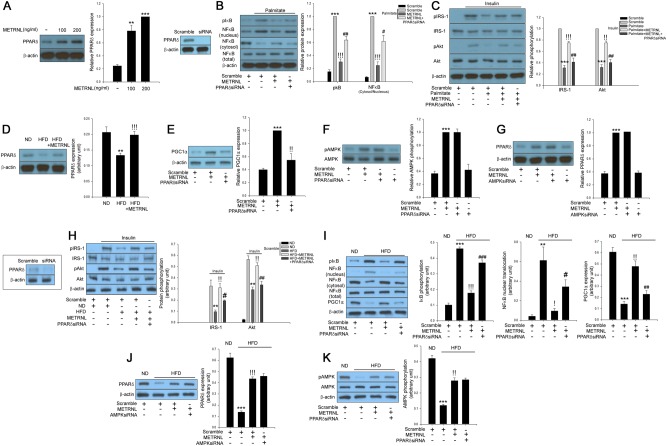
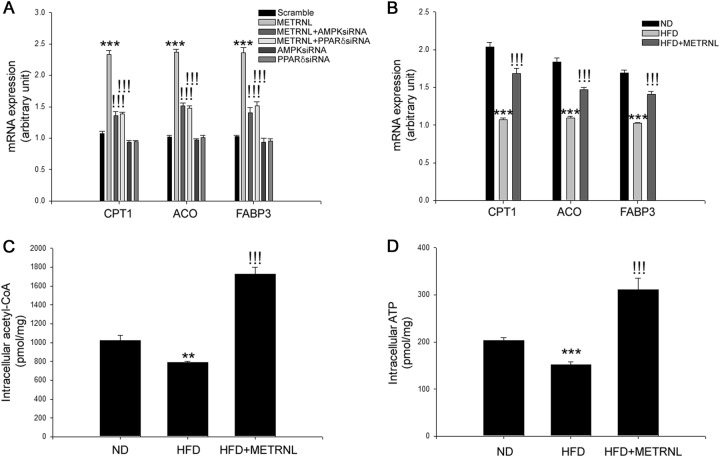
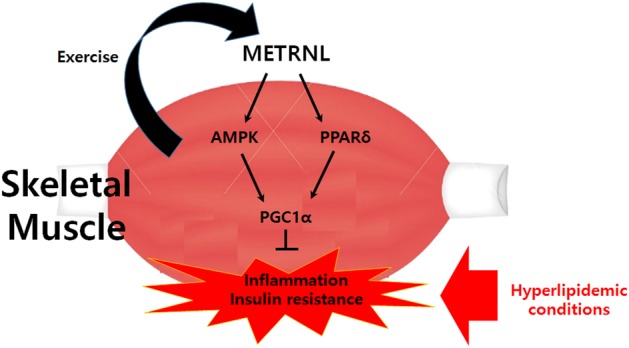
Physical activity has many beneficial effects on metabolic disorders, such as obesity, insulin resistance, and diabetes. Meteorin-like protein (METRNL), a novel secreted protein homologous to the neurotrophin Metrn, is induced after exercise in the skeletal muscle. Herein, we investigated the effects of METRNL on lipid-mediated inflammation and insulin resistance in skeletal muscle via AMP-activated protein kinase (AMPK) or peroxisome proliferator-activated receptor δ (PPARδ). Treatment with METRNL suppressed inflammatory markers, such as nuclear factor κB (NFκB) nuclear translocation, inhibitory κBα (IκBα) phosphorylation, interleukin-6 (IL-6) expression, and pro-inflammatory cytokines (such as TNFα and MCP-1). METRNL treatment also attenuated the impaired insulin response both in palmitate-treated differentiated C2C12 cells and the skeletal muscle of high-fat diet (HFD)-fed mice. Furthermore, METRNL administration rescued glucose intolerance and reduced HFD-induced body weight gain in mice; however, METRNL did not affect calorie intake. METRNL treatment increased AMPK phosphorylation and PPARδ expression both in differentiated C2C12 cells and mouse skeletal muscle. siRNA-mediated suppression of AMPK and PPARδ abrogated the suppressive effects of METRNL on palmitate-induced inflammation and insulin resistance. Moreover, METRNL augmented the mRNA expression of fatty acid oxidation-associated genes, such as carnitine palmitoyltransferase 1 (CPT1), acyl-CoA oxidase (ACO), and fatty acid binding protein 3 (FABP3). siRNAs for AMPK and PPARδ reversed these changes. In the current study, we report for the first time that METRNL alleviates inflammation and insulin resistance and induces fatty acid oxidation through AMPK or PPARδ-dependent signaling in skeletal muscle.
Overview
The claims and statistics of this paper haven’t been checked yet.
Run the check — free, no account needed. It reads the open-access text and checks the sources it cites.
Integrity signals
Registry
Cites
Statistics
Figures
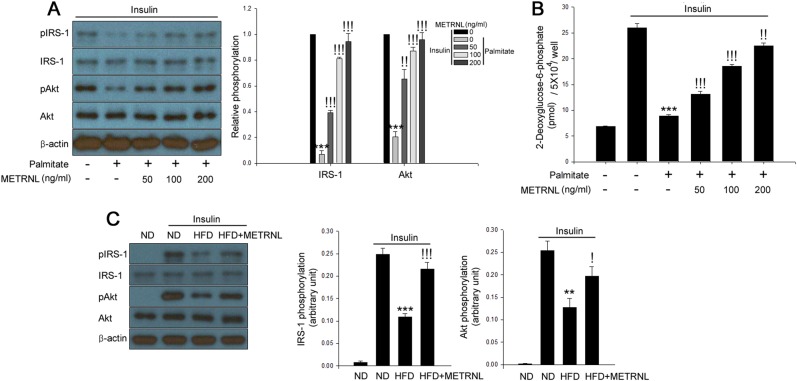
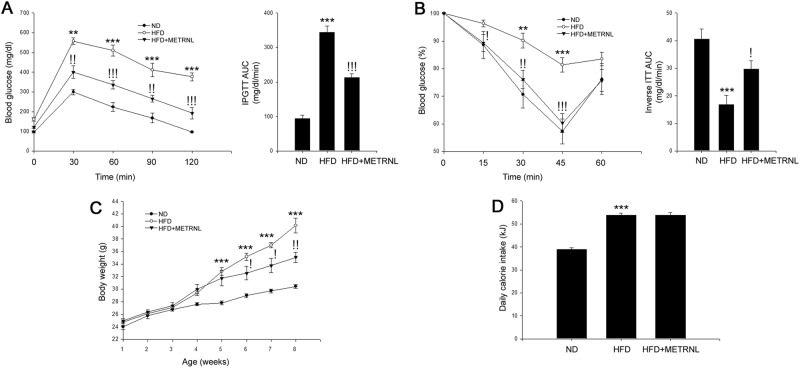
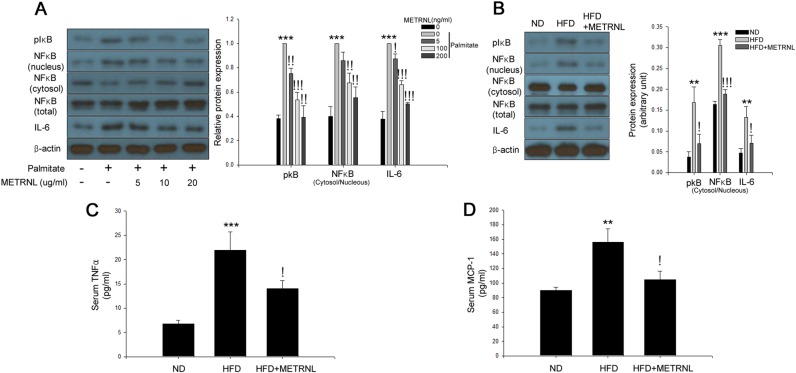
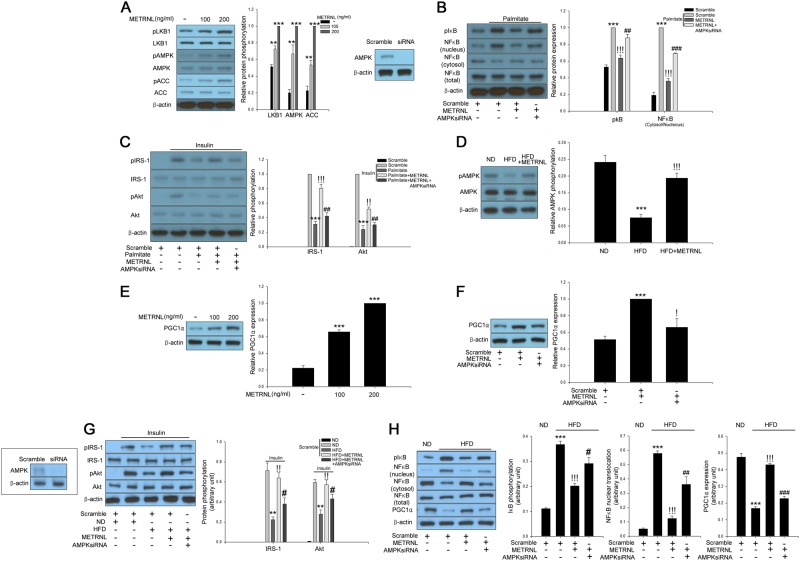
Verification
Claims the paper makes
The claims and statistics of this paper haven’t been checked yet.
Run the check — free, no account needed. It reads the open-access text and checks the sources it cites.
Claims other papers make about this one
Each is checked against this paper’s own text: does it say what the citing paper says it does?
The source backs part of the claim, not all of it — or backs it for a different population, condition or comparison.
In the citing paper
“Similarly, the myokines METRNL [100] and BAIBA [110] have proven to suppress TNF-α and other proinflammatory cytokines both in vitro and in vivo (5).”
From The Role of Exercise in the Interplay between Myokines, Hepatokines, Osteokines, Adipokines, and Modulation of Inflammation for Energy Substrate Redistribution and Fat Mass Loss: A Review (2020) · cites this paper as [100]
Experimental — accuracy not yet measuredThe cited source says what the claim attributes to it.
In the citing paper
“enhance oxidative metabolism in SkM and WAT “browning” [100]”
Self-check
Percentages, sums and reported differences re-computed from the paper’s own numbers.
The self-check needs the paper’s full text.
Citations
Cites
1 retracted
Activation of Protein Phosphatase 2A by Palmitate Inhibits AMP-activated Protein Kinase
Wu, Y., Song, P., Xu, J., Zhang, M., & Zou, M. (2007) · Journal of Biological Chemistry · doi:10.1074/jbc.m608310200 · Cited by 283
RetractedTLR4 links innate immunity and fatty acid-induced insulin resistance
Shi, H., Kokoeva, M. V., Inouye, K., Tzameli, I., Yin, H., & Flier, J. S. (2006) · Journal of Clinical Investigation · doi:10.1172/jci28898 · Cited by 3,690
The AMPK signalling pathway coordinates cell growth, autophagy and metabolism
Mihaylova, M. M., & Shaw, R. J. (2011) · Nature Cell Biology · doi:10.1038/ncb2329 · Cited by 2,923
AMP-activated protein kinase (AMPK) action in skeletal muscle via direct phosphorylation of PGC-1α
Jäger, S., Handschin, C., St.-Pierre, J., & Spiegelman, B. M. (2007) · Proceedings of the National Academy of Sciences · doi:10.1073/pnas.0705070104 · Cited by 2,491
Koves, T. R., Ussher, J. R., Noland, R. C., Slentz, D., Mosedale, M., Ilkayeva, O., Bain, J., Stevens, R., Dyck, J. R. B., Newgard, C. B., et al. (2008) · Cell Metabolism · doi:10.1016/j.cmet.2007.10.013 · Cited by 1,990
Kern, P. A., Ranganathan, S., Li, C., Wood, L., & Ranganathan, G. (2001) · American Journal of Physiology-Endocrinology and Metabolism · doi:10.1152/ajpendo.2001.280.5.e745 · Cited by 1,883
Role of Fatty Acids in the Pathogenesis of Insulin Resistance and NIDDM
Boden, G. (1997) · Diabetes · doi:10.2337/diab.46.1.3 · Cited by 1,728
AMPK and PPARδ Agonists Are Exercise Mimetics
Narkar, V. A., Downes, M., Yu, R. T., Embler, E., Wang, Y.-X., Banayo, E., Mihaylova, M. M., Nelson, M. C., Zou, Y., Juguilon, H., et al. (2008) · Cell · doi:10.1016/j.cell.2008.06.051 · Cited by 1,222
Vessby, B., Uusitupa, M., Hermansen, K., Riccardi, G., Rivellese, A. A., Tapsell, L. C., Nälsén, C., Berglund, L., Louheranta, A., Rasmussen, B. M., et al. (2001) · Diabetologia · doi:10.1007/s001250051620 · Cited by 1,119
The role of exercise and PGC1α in inflammation and chronic disease
Handschin, C., & Spiegelman, B. M. (2008) · Nature · doi:10.1038/nature07206 · Cited by 1,083
AMPK: An Emerging Drug Target for Diabetes and the Metabolic Syndrome
Zhang, B. B., Zhou, G., & Li, C. (2009) · Cell Metabolism · doi:10.1016/j.cmet.2009.03.012 · Cited by 1,042
Rao, R. R., Long, J. Z., White, J. P., Svensson, K. J., Lou, J., Lokurkar, I., Jedrychowski, M. P., Ruas, J. L., Wrann, C. D., Lo, J. C., et al. (2014) · Cell · doi:10.1016/j.cell.2014.03.065 · Cited by 973
AMPK, insulin resistance, and the metabolic syndrome
Ruderman, N. B., Carling, D., Prentki, M., & Cacicedo, J. M. (2013) · Journal of Clinical Investigation · doi:10.1172/jci67227 · Cited by 886
Salminen, A., Hyttinen, J. M. T., & Kaarniranta, K. (2011) · Journal of Molecular Medicine · doi:10.1007/s00109-011-0748-0 · Cited by 866
Tanaka, T., Yamamoto, J., Iwasaki, S., Asaba, H., Hamura, H., Ikeda, Y., Watanabe, M., Magoori, K., Ioka, R. X., Tachibana, K., et al. (2003) · Proceedings of the National Academy of Sciences · doi:10.1073/pnas.0306981100 · Cited by 832
Prevention of fat-induced insulin resistance by salicylate
Kim, J. K., Kim, Y.-J., Fillmore, J. J., Chen, Y., Moore, I., Lee, J., Yuan, M., Li, Z. W., Karin, M., Perret, P., et al. (2001) · Journal of Clinical Investigation · doi:10.1172/jci11559 · Cited by 737
A PGC-1α isoform induced by resistance training regulates skeletal muscle hypertrophy
Ruas, J. L., White, J. P., Rao, R. R., Kleiner, S., Brannan, K. T., Harrison, B. C., Greene, N. P., Wu, J., Estall, J. L., Irving, B. A., et al. (2012) · Cell · doi:10.1016/j.cell.2012.10.050 · Cited by 677
Tripathy, D., Mohanty, P., Dhindsa, S., Syed, T., Ghanim, H., Aljada, A., & Dandona, P. (2003) · Diabetes · doi:10.2337/diabetes.52.12.2882 · Cited by 667
PPAR : a dagger in the heart of the metabolic syndrome
Barish, G. D. (2006) · Journal of Clinical Investigation · doi:10.1172/jci27955 · Cited by 641
PPARδ regulates glucose metabolism and insulin sensitivity
Lee, C., Olson, P., Hevener, A. L., Mehl, I. R., Chong, L.-W., Olefsky, J. M., Gonzalez, F. J., Ham, J., Kang, H., Peters, J. M., et al. (2006) · Proceedings of the National Academy of Sciences · doi:10.1073/pnas.0511253103 · Cited by 495
AMPK activation increases fatty acid oxidation in skeletal muscle by activating PPARα and PGC-1
Lee, W. J., Kim, M., Park, H. S., Kim, H. S., Jeon, M. J., Oh, K. S., Koh, E. H., Won, J. C., Kim, M., Oh, G. T., et al. (2005) · Biochemical and Biophysical Research Communications · doi:10.1016/j.bbrc.2005.12.011 · Cited by 432
Skeletal muscle as an endocrine organ: PGC-1α, myokines and exercise
Schnyder, S., & Handschin, C. (2015) · Bone · doi:10.1016/j.bone.2015.02.008 · Cited by 419
Musi, N., Fujii, N., Hirshman, M. F., Ekberg, I., Fröberg, S., Ljungqvist, O., Thorell, A., & Goodyear, L. J. (2001) · Diabetes · doi:10.2337/diabetes.50.5.921 · Cited by 371
Boden, G. (2003) · Experimental and Clinical Endocrinology & Diabetes · doi:10.1055/s-2003-39781 · Cited by 348
Oleate Reverses Palmitate-induced Insulin Resistance and Inflammation in Skeletal Muscle Cells
Coll, T., Eyre, E., Rodríguez-Calvo, R., Palomer, X., Sánchez, R. M., Merlos, M., Laguna, J. C., & Vázquez-Carrera, M. (2008) · Journal of Biological Chemistry · doi:10.1074/jbc.m708700200 · Cited by 347
The role of PPARs in inflammation and immunity
Clark, R. B. (2002) · Journal of Leukocyte Biology · doi:10.1189/jlb.71.3.388 · Cited by 337
Insulin resistance and the metabolic syndrome
Landsberg, L. (2005) · Diabetologia · doi:10.1007/s00125-005-1818-z · Cited by 309
Development of insulin resistance in mice lacking PGC-1α in adipose tissues
Kleiner, S., Mepani, R. J., Laznik, D., Li, Y., Jurczak, M. J., Jornayvaz, F. R., Estall, J. L., Bhowmick, D. C., Shulman, G. I., & Spiegelman, B. M. (2012) · Proceedings of the National Academy of Sciences · doi:10.1073/pnas.1207287109 · Cited by 291
Bogardus, C., Ravussin, É., Robbins, D. C., Wolfe, R. R., Horton, E. S., & Sims, E. A. H. (1984) · Diabetes · doi:10.2337/diab.33.4.311 · Cited by 279
Free fatty acids, insulin resistance, and type 2 diabetes mellitus
Boden, G. (1999) · Proceedings of the Association of American Physicians · doi:10.1046/j.1525-1381.1999.99220.x · Cited by 246
Gong, P., Li, L., Liu, Y., Pu, J., Zhang, S., Yu, J., Zhao, J., & Liu, P. (2011) · Endocrinology · doi:10.1210/en.2010-1369 · Cited by 208
Redox implications of AMPK-mediated signal transduction beyond energetic clues
Cardaci, S., Filomeni, G., & Ciriolo, M. R. (2012) · Journal of Cell Science · doi:10.1242/jcs.095216 · Cited by 204
Adipocyte metrnl antagonizes insulin resistance through PPARγ signaling
Li, Z.-Y., Song, J., Zheng, S.-L., Fan, M.-B., Guan, Y.-F., Qu, Y., Xu, J., Wang, P., & Miao, C.-Y. (2015) · Diabetes · doi:10.2337/db15-0274 · Cited by 203
Metrnl: A secreted protein with new emerging functions
Zheng, S.-L., Li, Z.-Y., Song, J., Liu, J.-M., & Miao, C.-Y. (2016) · Acta Pharmacologica Sinica · doi:10.1038/aps.2016.9 · Cited by 190
Peroxisome proliferator-activated receptors as targets to treat non-alcoholic fatty liver disease
Souza-Mello, V. (2015) · World Journal of Hepatology · doi:10.4254/wjh.v7.i8.1012 · Cited by 182
PPARδ as a therapeutic target in metabolic disease
Reilly, S. M., & Lee, C.-H. (2008) · FEBS Letters · doi:10.1016/j.febslet.2007.11.040 · Cited by 164
METEORIN-LIKE is a cytokine associated with barrier tissues and alternatively activated macrophages
Ushach, I., Burkhardt, A. M., Martinez, C., Hevezi, P. A., Gerber, P. A., Buhren, B. A., Schrumpf, H., Valle‐Rios, R., Vazquez, M. I., Homey, B., et al. (2014) · Clinical Immunology · doi:10.1016/j.clim.2014.11.006 · Cited by 155
AMP‐activated protein kinase and muscle glucose uptake
Musi, N., & Goodyear, L. J. (2003) · Acta Physiologica Scandinavica · doi:10.1046/j.1365-201x.2003.01168.x · Cited by 149
PPARδ modulates lipopolysaccharide-induced TNFα inflammation signaling in cultured cardiomyocytes
Ding, G., Cheng, L., Qin, Q., Frontin, S., & Yang, Q. (2006) · Journal of Molecular and Cellular Cardiology · doi:10.1016/j.yjmcc.2006.03.422 · Cited by 141
Exploiting the anti-inflammatory effects of AMP-activated protein kinase activation
Salt, I. P., & Palmer, T. M. (2012) · Expert Opinion on Investigational Drugs · doi:10.1517/13543784.2012.696609 · Cited by 141
Krämer, D. K., Al-Khalili, L., Perrini, S., Skogsberg, J., Wretenberg, P., Kannisto, K., Wallberg-Henriksson, H., Ehrenborg, E., Zierath, J. R., & Krook, A. (2005) · Diabetes · doi:10.2337/diabetes.54.4.1157 · Cited by 132
Subfatin is a Novel Adipokine and Unlike Meteorin in Adipose and Brain Expression
Li, Z., Zheng, S., Wang, P., Xu, T., Guan, Y., Zhang, Y., & Miao, C. (2014) · CNS Neuroscience & Therapeutics · doi:10.1111/cns.12219 · Cited by 131
PPARδ, but not PPARα, activates PGC-1α gene transcription in muscle
Hondares, E., Pineda-Torra, I., Iglesias, R., Staels, B., Villarroya, F., & Giralt, M. (2007) · Biochemical and Biophysical Research Communications · doi:10.1016/j.bbrc.2007.01.092 · Cited by 120
Salvadó, L., Barroso, E., Gómez-Foix, A. M., Palomer, X., Michalik, L., Wahli, W., & Vázquez‐Carrera, M. (2014) · Diabetologia · doi:10.1007/s00125-014-3331-8 · Cited by 102
PPARbeta/delta ligands as modulators of the inflammatory response.
Kilgore, K. S., & Billin, A. N. (2008) · PubMed · Cited by 87
Bae, J. Y. (2018) · BioMed Research International · doi:10.1155/2018/6283932 · Cited by 77
The role of hyperglycemia in the induction of oxidative stress and inflammatory process.
Vidigal, F. D. C., Cocate, P. G., Pereira, L. G., & Alfenas, R. D. C. G. (2012) · PubMed · doi:10.3305/nh.2012.27.5.5917 · Cited by 64
Qin, Z., Zhang, M., Dai, Y., Wang, Y.-M., Zhu, G.-Z., Zhao, Y., Ji, C., Qiu, J., Cao, X.-G., & Guo, X. (2014) · Experimental Biology and Medicine · doi:10.1177/1535370214537746 · Cited by 16
Senn, J. J. (2010) · Journal of Biological Chemistry · doi:10.1074/jbc.a109.513304 · Cited by 8
Cited by
Sorted by citations
Energy metabolism in health and diseases
Liu, H., Wang, S., Wang, J., Guo, X., Song, Y., Fu, K., Gao, Z., Liu, D., He, W., & Yang, L. (2025) · Signal Transduction and Targeted Therapy · doi:10.1038/s41392-025-02141-x · Cited by 484
Entezari, M., Hashemi, D., Taheriazam, A., Zabolian, A., Mohammadi, S., Fakhri, F., Hashemi, M., Hushmandi, K., Ashrafizadeh, M., Zarrabi, A., et al. (2021) · Biomedicine & Pharmacotherapy · doi:10.1016/j.biopha.2021.112563 · Cited by 410
RetractedGonzalez-Gil, A. M., & Elizondo-Montemayor, L. (2020) · Nutrients · doi:10.3390/nu12061899 · Cited by 278
“It directly suppresses the secretion of TNF-α, MCP-1, and IL-6, while increasing IL-10 and the polarization to M2 and reducing β-cell apoptosis [230].”
BackgroundInfluentialLiu, J., Jia, S., Yang, Y., Piao, L., Wang, Z., Jin, Z., & Bai, L. (2022) · Biomedicine & Pharmacotherapy · doi:10.1016/j.biopha.2022.114118 · Cited by 176
Myokines mediate the cross talk between skeletal muscle and other organs
Chen, W., Wang, L., You, W., & Shan, T. (2021) · Journal of Cellular Physiology · doi:10.1002/jcp.30033 · Cited by 162
Metadata
- Authors
- Jung, T. W., Lee, S. H., Kim, H.-C., Bang, J. S., Abd El-Aty, A. M., Hacımüftüoğlu, A., Shin, Y. K., & Jeong, J. H.
- Affiliations
- Seoul National University Bundang Hospital (KR)
- Chung-Ang University (KR)
- Kangwon National University (KR)
- Sookmyung Women's University (KR)
- Atatürk University (TR)
- Corresponding author
- Shin, Yong Kyoo
- Jeong, Ji Hoon
- ORCID
- Venue
- Experimental & Molecular Medicine
- Published
- 2018-09
- Volume
- 50
- Issue
- 9
- Pages
- 1-11
- ISSN
- 1226-3613 (ISSN-L)
- 2092-6413
- PMC
- PMC6137187
- OpenAlex
- W2890380917
- Cited by
- 203
- References
- 49
- Citations by year
- 2026: 25 · 2025: 47 · 2024: 29 · 2023: 37 · 2022: 19 · 2021: 19 · 2020: 15 · 2019: 12
- FWCI
- 4.09
- Type
- journal article
- Language
- en
- Open access
- gold
- doi.org
- Licence
- Locations
- Experimental & Molecular Medicine (publishedVersion, cc-by)
- Europe PMC (PubMed Central) (publishedVersion, other-oa)
- PubMed Central (publishedVersion, cc-by)
- PubMed (publishedVersion)
- DOAJ (DOAJ: Directory of Open Access Journals) (submittedVersion, cc-by-sa)
- Greater South Information System
- Funders
- National Research Foundation of Korea (2016R1C1B2012674)
- Topics
- Life Sciences › Biochemistry, Genetics and Molecular Biology › Molecular Biology › Metabolism, Diabetes, and Cancer
- Life Sciences › Biochemistry, Genetics and Molecular Biology › Molecular Biology › Peroxisome Proliferator-Activated Receptors
- Health Sciences › Medicine › Endocrinology, Diabetes and Metabolism › Adipokines, Inflammation, and Metabolic Diseases
- Keywords
- Metrnl, meteorin-like protein, skeletal muscle, insulin resistance, AMPK, PPARδ, fatty acid oxidation, high-fat diet, impaired glucose tolerance, NF-κB signaling, interleukin-6, obesity
- MeSH terms
- Peroxisome Proliferator-Activated Receptor Gamma Coactivator 1-alpha, Animals, Cell Differentiation, Cell Line, Hyperlipidemias, Inflammation, Insulin Resistance, Lipids, Male, Mice, Inbred C57BL, Nerve Growth Factors, Signal Transduction, Muscle, Skeletal, Palmitic Acid, Muscle Cells, PPAR delta, AMP-Activated Protein Kinases, Diet, High-Fat, Endoplasmic Reticulum Stress
About these checks
Registry, retraction, Cites and statistics results are computed, not judged, with one exception: a printed reference that no index lists is read once by a model before it counts as a citation error. Claims are extracted by a model and kept only when their quote appears verbatim in the text; each cited source is then checked, with a model’s help, for whether it says what the claim relies on. Those verdicts can be wrong — read the claim’s quote and the cited source before relying on one.
Statistics and arithmetic are recomputed, not judged.
Confidence bands are shown only for fields calibrated on our annotated test set. None is calibrated yet, so no band is shown.
What counts as a claim ›How we measure confidence ›How we check this ›
Are you an author, or do you see a problem with this page? Request a review
