

The DOI matches its Crossref record; 171 of the 172 references it cites were found in a registry or an index.
Oral microbiome: possible harbinger for children’s health
Open accessAbstract
The human microbiome functions as an intricate and coordinated microbial network, residing throughout the mucosal surfaces of the skin, oral cavity, gastrointestinal tract, respiratory tract, and reproductive system. The oral microbiome encompasses a highly diverse microbiota, consisting of over 700 microorganisms, including bacteria, fungi, and viruses. As our understanding of the relationship between the oral microbiome and human health has evolved, we have identified a diverse array of oral and systemic diseases associated with this microbial community, including but not limited to caries, periodontal diseases, oral cancer, colorectal cancer, pancreatic cancer, and inflammatory bowel syndrome. The potential predictive relationship between the oral microbiota and these human diseases suggests that the oral cavity is an ideal site for disease diagnosis and development of rapid point-of-care tests. The oral cavity is easily accessible with a non-invasive collection of biological samples. We can envision a future where early life salivary diagnostic tools will be used to predict and prevent future disease via analyzing and shaping the infant’s oral microbiome. In this review, we present evidence for the establishment of the oral microbiome during early childhood, the capability of using childhood oral microbiome to predict future oral and systemic diseases, and the limitations of the current evidence.
Overview
The claims and statistics of this paper haven’t been checked yet.
Run the check — free, no account needed. It reads the open-access text and checks the sources it cites.
Integrity signals
Registry
Cites
Statistics
Figures
Verification
Claims the paper makes
The claims and statistics of this paper haven’t been checked yet.
Run the check — free, no account needed. It reads the open-access text and checks the sources it cites.
Claims other papers make about this one
Each is checked against this paper’s own text: does it say what the citing paper says it does?
In the citing paper
“The mucosal surfaces serve as the chief substrata available for microbial colonization in the infant oral cavity.141”
From The oral microbiome: Role of key organisms and complex networks in oral health and disease (2021) · cites this paper as [141]
In the citing paper
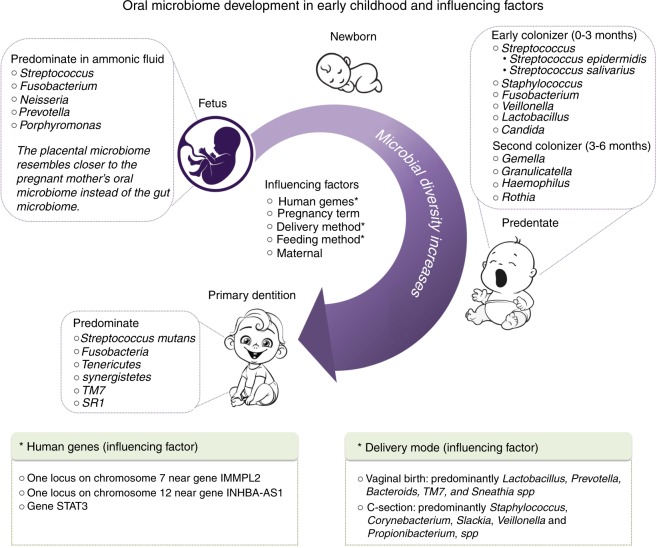
“Additional early colonizers, such as Gemella, Rothia, Granulicatella, and Haemophilus, present at 3‐6 months of age and increase in abundance with time.141, 142”
From The oral microbiome: Role of key organisms and complex networks in oral health and disease (2021) · cites this paper as [141]
Self-check
Percentages, sums and reported differences re-computed from the paper’s own numbers.
The self-check needs the paper’s full text.
Citations
Cites
Vos, T., Abajobir, A. A., Abate, K. H., Abbafati, C., Abbas, K. M., Abd-Allah, F., Abdulkader, R. S., Abdulle, A. M., Abebo, T. A., Abera, S. F., et al. (2017) · The Lancet · doi:10.1016/s0140-6736(17)32154-2 · Cited by 13,220
Structure, function and diversity of the healthy human microbiome
The Human Microbiome Project Consortium (2012) · Nature · doi:10.1038/nature11234 · Cited by 11,726
Human gut microbiome viewed across age and geography
Yatsunenko, T., Rey, F. E., Manary, M. J., Trehan, I., Dominguez-Bello, M. G., Contreras, M., Magris, M., Hidalgo, G., Baldassano, R. N., Anokhin, A. P., et al. (2012) · Nature · doi:10.1038/nature11053 · Cited by 7,815
Dominguez-Bello, M. G., Costello, E. K., Contreras, M., Magris, M., Hidalgo, G., Fierer, N., & Knight, R. (2010) · Proceedings of the National Academy of Sciences · doi:10.1073/pnas.1002601107 · Cited by 4,774
Sokol, H., Pigneur, B., Watterlot, L., Lakhdari, O., Bermúdez-Humarán, L. G., Gratadoux, J.-J., Blugeon, S., Bridonneau, C., Furet, J.-P., Corthier, G., et al. (2008) · Proceedings of the National Academy of Sciences · doi:10.1073/pnas.0804812105 · Cited by 4,413
Liu, L., Oza, S., Hogan, D., Chu, Y., Perin, J., Zhu, J., Lawn, J. E., Cousens, S., Mathers, C., & Black, R. E. (2016) · The Lancet · doi:10.1016/s0140-6736(16)31593-8 · Cited by 3,453
The human microbiome: at the interface of health and disease
Cho, I., & Blaser, M. J. (2012) · Nature Reviews Genetics · doi:10.1038/nrg3182 · Cited by 3,449
Dynamics and Stabilization of the Human Gut Microbiome during the First Year of Life
Bäckhed, F., Roswall, J., Peng, Y., Feng, Q., Jia, H., Kovatcheva-Datchary, P., Li, Y., Xia, Y., Xie, H., Zhong, H., et al. (2015) · Cell Host & Microbe · doi:10.1016/j.chom.2015.04.004 · Cited by 3,315
Bacterial Community Variation in Human Body Habitats Across Space and Time
Costello, E. K., Lauber, C. L., Hamady, M., Fierer, N., Gordon, J. I., & Knight, R. (2009) · Science · doi:10.1126/science.1177486 · Cited by 3,231
Development of the Human Infant Intestinal Microbiota
Palmer, C., Bik, E. M., DiGiulio, D. B., Relman, D. A., & Brown, P. O. (2007) · PLoS Biology · doi:10.1371/journal.pbio.0050177 · Cited by 2,877
Research works printed but not linked: 1
- Ierardo, G., Luzzi, V. & Polimeni, A. Obstructive Sleep Apnea Syndrome (OSAS): evaluation and treatment of odontostomatological problems. Med Lav. 108, 293–296 (2017).
Cited by
Sorted by citations
The oral microbiome: Role of key organisms and complex networks in oral health and disease
Sedghi, L., DiMassa, V., Harrington, A., Lynch, S. V., & Kapila, Y. L. (2021) · Periodontology 2000 · doi:10.1111/prd.12393 · Cited by 755
Oral microbiota in human systematic diseases
Peng, X., Cheng, L., You, Y., Tang, C., Ren, B., Li, Y., Xu, X., & Zhou, X. (2022) · International Journal of Oral Science · doi:10.1038/s41368-022-00163-7 · Cited by 707
Microbiota succession throughout life from the cradle to the grave
Martino, C., Dilmore, A. H., Burcham, Z. M., Metcalf, J. L., Jeste, D., & Knight, R. (2022) · Nature Reviews Microbiology · doi:10.1038/s41579-022-00768-z · Cited by 275
The Relationship Between Breast Milk Components and the Infant Gut Microbiota
Boudry, G., Charton, E., Huërou‐Luron, I. L., Ferret‐Bernard, S., Gall, S. L., Even, S., & Blat, S. (2021) · Frontiers in Nutrition · doi:10.3389/fnut.2021.629740 · Cited by 165
Oral microflora and pregnancy: a systematic review and meta-analysis
Jang, H., Patoine, A., Wu, T. T., Castillo, D. A., & Xiao, J. (2021) · Scientific Reports · doi:10.1038/s41598-021-96495-1 · Cited by 165
Self-citation
Metadata
- Authors
- Xiao, J., Fiscella, K. A., & Gill, S. R.
- Affiliations
- University of Rochester Medicine (US)
- Corresponding author
- Xiao, Jin
- Gill, Steven R.
- Venue
- International Journal of Oral Science
- Published
- 2020-04-30
- Volume
- 12
- Issue
- 1
- Pages
- 12-12
- ISSN
- 1674-2818 (ISSN-L)
- 2049-3169
- PMC
- PMC7190716
- OpenAlex
- W3022810381
- Cited by
- 223
- References
- 172
- Citations by year
- 2026: 27 · 2025: 40 · 2024: 39 · 2023: 41 · 2022: 44 · 2021: 26 · 2020: 6
- FWCI
- 4.79
- Type
- journal article
- Language
- en
- Open access
- gold
- doi.org
- Locations
- International Journal of Oral Science (publishedVersion, cc-by)
- PubMed Central (publishedVersion, cc-by)
- PubMed (publishedVersion)
- Funders
- U.S. Department of Health & Human Services | NIH | National Institute of Dental and Craniofacial Research (K23 DE027412)
- Topics
- Health Sciences › Dentistry › Periodontics › Oral microbiology and periodontitis research
- Life Sciences › Biochemistry, Genetics and Molecular Biology › Molecular Biology › Gut microbiota and health
- Health Sciences › Dentistry › General Dentistry › Dental Health and Care Utilization
- Keywords
- oral microbiota, early childhood, salivary diagnostics, disease prediction, oral diseases, systemic disease, dental caries, periodontal disease, oral cancer, colorectal cancer, pancreatic cancer, inflammatory bowel disease, point-of-care testing, infant oral microbiota
- MeSH terms
- Child Health, Child, Humans, Infant, Mouth, Microbiota
About these checks
Registry, retraction, Cites and statistics results are computed, not judged, with one exception: a printed reference that no index lists is read once by a model before it counts as a citation error. Claims are extracted by a model and kept only when their quote appears verbatim in the text; each cited source is then checked, with a model’s help, for whether it says what the claim relies on. Those verdicts can be wrong — read the claim’s quote and the cited source before relying on one.
Statistics and arithmetic are recomputed, not judged.
Confidence bands are shown only for fields calibrated on our annotated test set. None is calibrated yet, so no band is shown.
What counts as a claim ›How we measure confidence ›How we check this ›
Are you an author, or do you see a problem with this page? Request a review
