

The DOI matches its Crossref record; 9 of the 9 references it cites were found in a registry or an index.
Generation of multiphoton quantum states on silicon
Abstract
Multiphoton quantum states play a critical role in emerging quantum technologies and greatly improve our fundamental understanding of the quantum world. Integrated photonics is well recognized as an attractive technology offering great promise for the generation of photonic quantum states with high-brightness, tunability, stability, and scalability. Herein, we demonstrate the generation of multiphoton quantum states using a single-silicon nanophotonic waveguide. The detected four-photon rate reaches 0.34 Hz even with a low-pump power of 600 μW. This multiphoton quantum state is also qualified with multiphoton quantum interference, as well as quantum state tomography. For the generated four-photon states, the quantum interference visibilities are greater than 95%, and the fidelity is 0.78 ± 0.02. Furthermore, such a multiphoton quantum source is fully compatible with the on-chip processes of quantum manipulation, as well as quantum detection, which is helpful for the realization of large-scale quantum photonic integrated circuits (QPICs) and shows great potential for research in the area of multiphoton quantum science.
Overview
The claims and statistics of this paper haven’t been checked yet.
Run the check — free, no account needed. It reads the open-access text and checks the sources it cites.
Integrity signals
Registry
Cites
Statistics
Figures
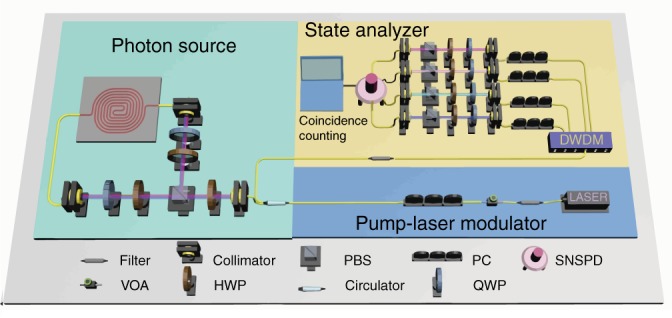
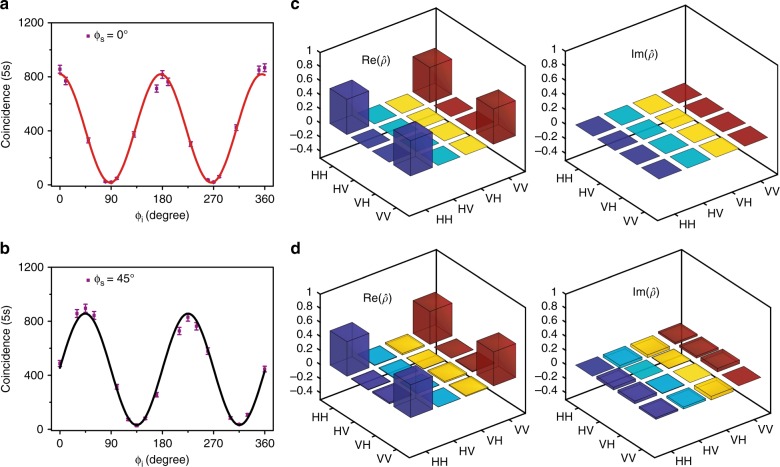
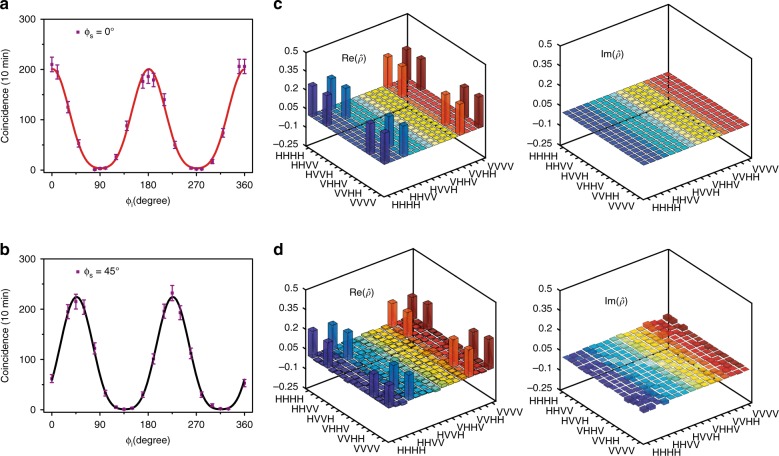
Verification
Claims the paper makes
The claims and statistics of this paper haven’t been checked yet.
Run the check — free, no account needed. It reads the open-access text and checks the sources it cites.
Claims other papers make about this one
Each is checked against this paper’s own text: does it say what the citing paper says it does?
The cited source doesn’t support the claim as written.
In the citing paper
“An integrated SNSPD atop of Si-waveguide, that can absorb and detect photons with >90% efficiency.”
From Integrated photonic quantum technologies (2020) · cites this paper as [26]
Checked by a reasoning model — may be wrong.
Experimental — accuracy not yet measuredThe source backs part of the claim, not all of it — or backs it for a different population, condition or comparison.
In the citing paper
“Fully integrated SNSPDs have been patterned atop GaAs [36], Si [26], and Si 3 N 4 [30] waveguides.”
From Integrated photonic quantum technologies (2020) · cites this paper as [26]
Experimental — accuracy not yet measuredIn the citing paper
“A breakthrough in 2012 showed evanescentlycoupled Si-waveguide SNSPDs with a 91% detection efficiency, 18ps jitter, and 50Hz dark count ( Fig.2g ) [26].”
From Integrated photonic quantum technologies (2020) · cites this paper as [26]
Self-check
Percentages, sums and reported differences re-computed from the paper’s own numbers.
The self-check needs the paper’s full text.
Citations
Cites
Kimble, H. J. (2008) · Nature · doi:10.1038/nature07127 · Cited by 6,023
Linear optical quantum computing with photonic qubits
Kok, P., Munro, W. J., Nemoto, K., Ralph, T. C., Dowling, J. P., & Milburn, G. J. (2007) · Reviews of Modern Physics · doi:10.1103/revmodphys.79.135 · Cited by 2,904
James, D. F. V., Kwiat, P. G., Munro, W. J., & White, A. G. (2001) · Physical Review A · doi:10.1103/physreva.64.052312 · Cited by 2,176
Multiphoton entanglement and interferometry
Pan, J.-W., Chen, Z.-B., Lu, C.-Y., Weinfurter, H., Zeilinger, A., & Żukowski, M. (2012) · Reviews of Modern Physics · doi:10.1103/revmodphys.84.777 · Cited by 1,410
Experimental one-way quantum computing
Walther, P., Resch, K. J., Rudolph, T., Schenck, E., Weinfurter, H., Vedral, V., Aspelmeyer, M., & Zeilinger, A. (2005) · Nature · doi:10.1038/nature03347 · Cited by 1,273
Aspuru-Guzik, A., & Walther, P. (2012) · Nature Physics · doi:10.1038/nphys2253 · Cited by 952
Generation of multiphoton entangled quantum states by means of integrated frequency combs
Reimer, C., Kues, M., Roztocki, P., Wetzel, B., Grazioso, F., Little, B. E., Chu, S. T., Johnston, T., Bromberg, Y., Caspani, L., et al. (2016) · Science · doi:10.1126/science.aad8532 · Cited by 841
On-chip detection of non-classical light by scalable integration of single-photon detectors
Najafi, F., Mower, J., Harris, N. C., Bellei, F., Dane, A., Lee, C., Hu, X., Kharel, P., Marsili, F., Assefa, S., et al. (2015) · Nature Communications · doi:10.1038/ncomms6873 · Cited by 330
Experimental verification of multipartite entanglement in quantum networks
McCutcheon, W., Pappa, A., Bell, B. A., McMillan, A., Chailloux, A., Lawson, T., Mafu, M., Markham, D., Diamanti, E., Kerenidis, I., et al. (2016) · Nature Communications · doi:10.1038/ncomms13251 · Cited by 137
Research works printed but not linked: 34
- Caspani, L. et al. Integrated sources of photon quantum states based on nonlinear optics. Light 6, e17100 (2017). · DOI
- Humphreys, P. C. et al. Linear optical quantum computing in a single spatial mode. Phys. Rev. Lett. 111, 150501 (2013). · DOI · Paper page
- Afek, I., Ambar, O. & Silberberg, Y. High-NOON states by mixing quantum and classical light. Science 328, 879–881 (2010). · DOI · Paper page
- Yao, X. C. et al. Observation of eight-photon entanglement. Nat. Photonics 6, 225–228 (2012). · DOI · Paper page
- Huang, Y. F. et al. Experimental generation of an eight-photon Greenberger–Horne–Zeilinger state. Nat. Commun. 2, 546 (2011). · DOI
- Wang, X. L. et al. Experimental ten-photon entanglement. Phys. Rev. Lett. 117, 210502 (2016). · DOI
- Matsuda, N. et al. A monolithically integrated polarization entangled photon pair source on a silicon chip. Sci. Rep. 2, 817 (2012). · DOI · Paper page
- Tanzilli, S. et al. On the genesis and evolution of integrated quantum optics. Laser Photonics Rev. 6, 115–143 (2012). · DOI · Paper page
- Takesue, H. et al. Generation of polarization entangled photon pairs using silicon wire waveguide. Opt. Express 16, 5721–5727 (2008). · DOI
- Harada, K. I. et al. Frequency and polarization characteristics of correlated photon-pair generation using a silicon wire waveguide. IEEE J. Sel. Top. Quantum Electron. 16, 325–331 (2010). · DOI
- Lim, H. C. et al. Stable source of high quality telecom-band polarization-entangled photon-pairs based on a single, pulse-pumped, short PPLN waveguide. Opt. Express 16, 12460–12468 (2008). · DOI
- Martin, A. et al. A polarization entangled photon-pair source based on a type-II PPLN waveguide emitting at a telecom wavelength. New J. Phys. 12, 103005 (2010). · DOI
- Suhara, T. et al. Quasi-phase-matched waveguide devices for generation of postselection-free polarization-entangled twin photons. IEEE Photonics Technol. Lett. 21, 1096–1098 (2009). · DOI
- Takesue, H. et al. Entanglement generation using silicon wire waveguide. Appl. Phys. Lett. 91, 201108 (2007). · DOI
- Harris, N. C. et al. Integrated source of spectrally filtered correlated photons for large-scale quantum photonic systems. Phys. Rev. X 4, 041047 (2014).
- Heeres, R. W., Kouwenhoven, L. P. & Zwiller, V. Quantum interference in plasmonic circuits. Nat. Nanotechnol. 8, 719–722 (2013). · DOI · Paper page
- Schuck, C. et al. Quantum interference in heterogeneous superconducting-photonic circuits on a silicon chip. Nat. Commun. 7, 10352 (2016). · DOI · Paper page
- Harada, K. I. et al. Indistinguishable photon pair generation using two independent silicon wire waveguides. New J. Phys. 13, 065005 (2011). · DOI
- Spring, J. B. et al. Chip-based array of near-identical, pure, heralded single-photon sources. Optica 4, 90–96 (2017). · DOI · Paper page
- Bogaerts, W. et al. Nanophotonic waveguides in silicon-on-insulator fabricated with CMOS technology. J. Light Technol. 23, 401–412 (2005). · DOI
- Li, Y. H. et al. On-chip multiplexed multiple entanglement sources in a single silicon nanowire. Phys. Rev. Appl. 7, 064005 (2017). · DOI
- Silverstone, J. W. et al. On-chip quantum interference between silicon photon-pair sources. Nat. Photonics 8, 104–108 (2014). · DOI · Paper page
- Silverstone, J. W. et al. Qubit entanglement between ring-resonator photon-pair sources on a silicon chip. Nat. Commun. 6, 7948 (2015). · DOI
- Wang, J. W. et al. Chip-to-chip quantum photonic interconnect by path-polarization interconversion. Optica 3, 407–413 (2016). · DOI · Paper page
- Wang, J. W. et al. Experimental quantum Hamiltonian learning. Nat. Phys. 13, 551–555 (2017). · DOI
- Paesani, S. et al. Experimental Bayesian quantum phase estimation on a silicon photonic chip. Phys. Rev. Lett. 118, 100503 (2017). · DOI
- Feng, L. T. et al. On-chip transverse-mode entangled photon pair source. npj Quantum Inf. 5, 2 (2019). · DOI
- Braunstein, S. L., Mann, A. & Revzen, M. Maximal violation of Bell inequalities for mixed states. Phys. Rev. Lett. 68, 3259–3261 (1992). · DOI
- Marchetti, R. et al. High-efficiency grating-couplers: demonstration of a new design strategy. Sci. Rep. 7, 16670 (2017). · DOI
- Matthews, J. C. F. et al. Manipulation of multiphoton entanglement in waveguide quantum circuits. Nat. Photonics 3, 346–350 (2009). · DOI · Paper page
- Fan, L. R. et al. Integrated optomechanical single-photon frequency shifter. Nat. Photonics 10, 766–770 (2016). · DOI
- Lukens, J. M. & Lougovski, P. Frequency-encoded photonic qubits for scalable quantum information processing. Optica 4, 8–16 (2017). · DOI · Paper page
- Lu, H. H. et al. Electro-optic frequency beam splitters and Tritters for high-fidelity photonic Quantum information processing. Phys. Rev. Lett. 120, 030502 (2018). · DOI
- Zhao, T. M. et al. Entangling different-color photons via time-resolved measurement and active feed forward. Phys. Rev. Lett. 112, 103602 (2014). · DOI · Paper page
Cited by
Sorted by citations
Integrated photonic quantum technologies
Wang, J., Sciarrino, F., Laing, A., & Thompson, M. G. (2020) · Nature Photonics · doi:10.1038/s41566-019-0532-1 · Cited by 1,576
Chip-to-chip quantum teleportation and multi-photon entanglement in silicon
Llewellyn, D., Ding, Y., Faruque, I. I., Paesani, S., Bacco, D., Santagati, R., Qian, Y.-J., Li, Y., Xiao, Y.-F., Huber, M., et al. (2020) · Nature Physics · doi:10.1038/s41567-019-0727-x · Cited by 331
Metadata
- Authors
- Zhang, M., Feng, L.-T., Zhou, Z.-Y., Chen, Y., Wu, H., Li, M., Gao, S.-M., Guo, G.-P., Guo, G.-C., Dai, D.-X., & Ren, X.-F.
- ORCID
- Ren, Xi-Feng
- Venue
- Light: Science & Applications
- Published
- 2019-05-01
- Volume
- 8
- Issue
- 1
- ISSN
- 2047-7538
- PMC
- PMC6491612
- Cited by
- 68
- References
- 9
- Language
- en
About these checks
Registry, retraction, Cites and statistics results are computed, not judged, with one exception: a printed reference that no index lists is read once by a model before it counts as a citation error. Claims are extracted by a model and kept only when their quote appears verbatim in the text; each cited source is then checked, with a model’s help, for whether it says what the claim relies on. Those verdicts can be wrong — read the claim’s quote and the cited source before relying on one.
Statistics and arithmetic are recomputed, not judged.
Confidence bands are shown only for fields calibrated on our annotated test set. None is calibrated yet, so no band is shown.
What counts as a claim ›How we measure confidence ›How we check this ›
Are you an author, or do you see a problem with this page? Request a review
