

Conceptualizing mental disorders as deviations from normative functioning
Open accessThe DOI matches its Crossref record; 45 of the 45 references it cites were found in a registry or an index.
Abstract
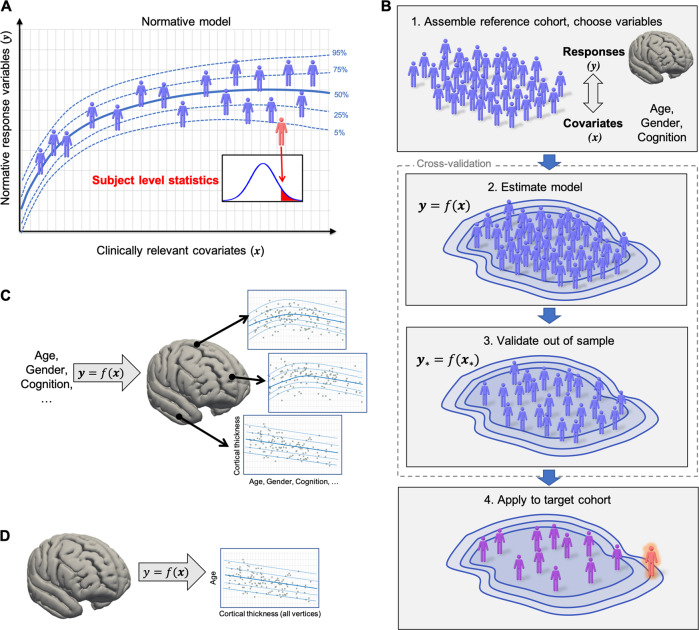
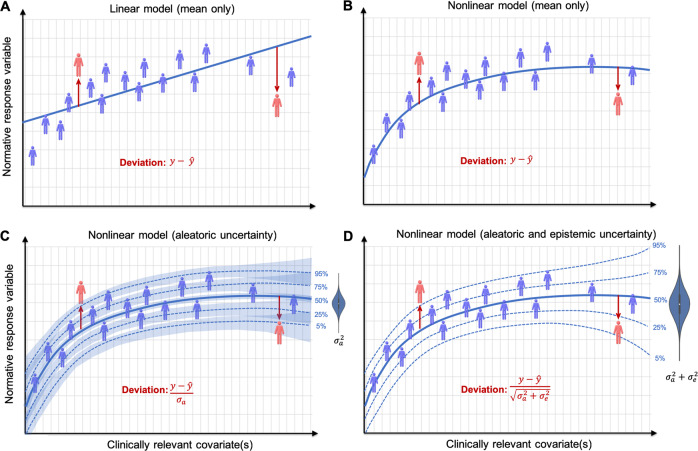
Normative models are a class of emerging statistical techniques useful for understanding the heterogeneous biology underlying psychiatric disorders at the level of the individual participant. Analogous to normative growth charts used in paediatric medicine for plotting child development in terms of height or weight as a function of age, normative models chart variation in clinical cohorts in terms of mappings between quantitative biological measures and clinically relevant variables. An emerging body of literature has demonstrated that such techniques are excellent tools for parsing the heterogeneity in clinical cohorts by providing statistical inferences at the level of the individual participant with respect to the normative range. Here, we provide a unifying review of the theory and application of normative modelling for understanding the biological and clinical heterogeneity underlying mental disorders. We first provide a statistically grounded yet non-technical overview of the conceptual underpinnings of normative modelling and propose a conceptual framework to link the many different methodological approaches that have been proposed for this purpose. We survey the literature employing these techniques, focusing principally on applications of normative modelling to quantitative neuroimaging-based biomarkers in psychiatry and, finally, we provide methodological considerations and recommendations to guide future applications of these techniques. We show that normative modelling provides a means by which the importance of modelling individual differences can be brought from theory to concrete data analysis procedures for understanding heterogeneous mental disorders and ultimately a promising route towards precision medicine in psychiatry.
Overview
The claims and statistics of this paper haven’t been checked yet.
Free: it reads the open-access text and checks the first 5 claims that cite a source we can check. Create a free account to check every claim.
Integrity signals
Registry
Cites
Statistics
Figures
Verification
Claims the paper makes
The claims and statistics of this paper haven’t been checked yet.
Free: it reads the open-access text and checks the first 5 claims that cite a source we can check. Create a free account to check every claim.
Claims other papers make about this one
Each is checked against this paper’s own text: does it say what the citing paper says it does?
The source backs part of the claim, not all of it — or backs it for a different population, condition or comparison.
In the citing paper
“A prerequisite for the application of growth charts in youth mental health is the availability of normative developmental data that comprise important domains of emerging psychopathology, such as cognition, emotion regulation, and sleep [92].”
From Towards a youth mental health paradigm: a perspective and roadmap (2023) · cites this paper as [92]
Experimental — accuracy not yet measuredThe source backs part of the claim, not all of it — or backs it for a different population, condition or comparison.
In the citing paper
“Newer hybrid models, such as normative modeling (19,59–61) or the functional random forest (FRF) (18,62), may overcome these limitations and enable new inferences from psychopathology studies.”
From Methods and challenges for assessing heterogeneity (2020) · cites this paper as [59]
Experimental — accuracy not yet measuredThe source backs part of the claim, not all of it — or backs it for a different population, condition or comparison.
In the citing paper
“Normative models (59) enable researchers to identify common (i.e., comorbid) mechanisms, identify potential subtypes or subfactors tied to an outcome of interest, and make pre- dictions on individual cases.”
From Methods and challenges for assessing heterogeneity (2020) · cites this paper as [59]
Experimental — accuracy not yet measuredThe cited source says what the claim attributes to it.
In the citing paper
“In this context, machine learning approaches have just recently embraced advances that allow the characterization of normative trajectories and parsing of the heterogeneity at the individual level 69 .”
From Candidate diagnostic biomarkers for neurodevelopmental disorders in children and adolescents: a systematic review (2023) · cites this paper as [69]
Self-check
Percentages, sums and reported differences re-computed from the paper’s own numbers.
The self-check needs the paper’s full text.
Citations
Cites
Insel, T., Cuthbert, B., Garvey, M., Heinssen, R., Pine, D. S., Quinn, K., Sanislow, C., & Wang, P. (2010) · American Journal of Psychiatry · doi:10.1176/appi.ajp.2010.09091379 · Cited by 7,067
The WU-Minn Human Connectome Project: An overview
Van Essen, D. C., Smith, S. M., Barch, D. M., Behrens, T. E. J., Yacoub, E., & Ugurbil, K. (2013) · NeuroImage · doi:10.1016/j.neuroimage.2013.05.041 · Cited by 5,651
Multimodal population brain imaging in the UK Biobank prospective epidemiological study
Miller, K. L., Alfaro-Almagro, F., Bangerter, N. K., Thomas, D. L., Yacoub, E., Xu, J., Bartsch, A. J., Jbabdi, S., Sotiropoulos, S. N., Andersson, J. L. R., et al. (2016) · Nature Neuroscience · doi:10.1038/nn.4393 · Cited by 2,020
Equifinality and multifinality in developmental psychopathology
Cicchetti, D., & Rogosch, F. A. (1996) · Development and Psychopathology · doi:10.1017/s0954579400007318 · Cited by 1,842
Kapur, S., Phillips, A. G., & Insel, T. R. (2012) · Molecular Psychiatry · doi:10.1038/mp.2012.105 · Cited by 980
The conception of the ABCD study: From substance use to a broad NIH collaboration
Volkow, N. D., Koob, G. F., Croyle, R. T., Bianchi, D. W., Gordon, J. A., Koroshetz, W. J., Pérez-Stable, E. J., Riley, W. T., Bloch, M. H., Conway, K., et al. (2018) · Developmental Cognitive Neuroscience · doi:10.1016/j.dcn.2017.10.002 · Cited by 970
Predicting Age Using Neuroimaging: Innovative Brain Ageing Biomarkers
Cole, J. H., & Franke, K. (2017) · Trends in Neurosciences · doi:10.1016/j.tins.2017.10.001 · Cited by 903
Insel, T. R., & Cuthbert, B. N. (2015) · Science · doi:10.1126/science.aab2358 · Cited by 840
Understanding heterogeneity in clinical cohorts using normative models: Beyond case-control studies
Marquand, A. F., Rezek, I., Buitelaar, J., & Beckmann, C. F. (2016) · Biological Psychiatry · doi:10.1016/j.biopsych.2015.12.023 · Cited by 683
Self-citationMapping the heterogeneous phenotype of schizophrenia and bipolar disorder using normative models
Wolfers, T., Doan, N. T., Kaufmann, T., Alnæs, D., Moberget, T., Agartz, I., Buitelaar, J. K., Ueland, T., Melle, I., Franke, B., et al. (2018) · JAMA Psychiatry · doi:10.1001/jamapsychiatry.2018.2467 · Cited by 508
Self-citationBorghi, E., de Onis, M., Garza, C., Van den Broeck, J., Frongillo, E. A., Grummer-Strawn, L., Van Buuren, S., Pan, H., Molinari, L., Martorell, R., et al. (2006) · Statistics in Medicine · doi:10.1002/sim.2227 · Cited by 450
Brain age and other bodily ‘ages’: implications for neuropsychiatry
Cole, J. H., Marioni, R. E., Harris, S. E., & Deary, I. J. (2019) · Molecular Psychiatry · doi:10.1038/s41380-018-0098-1 · Cited by 440
Studying individual differences in human adolescent brain development
Foulkes, L., & Blakemore, S.-J. (2018) · Nature Neuroscience · doi:10.1038/s41593-018-0078-4 · Cited by 413
Endophenotypes in the Genetic Analyses of Mental Disorders
Cannon, T. D., & Keller, M. C. (2006) · Annual Review of Clinical Psychology · doi:10.1146/annurev.clinpsy.2.022305.095232 · Cited by 399
Developmental timing and critical windows for the treatment of psychiatric disorders
Marín, O. (2016) · Nature Medicine · doi:10.1038/nm.4225 · Cited by 374
Statistical Challenges in “Big Data” Human Neuroimaging
Smith, S. M., & Nichols, T. E. (2018) · Neuron · doi:10.1016/j.neuron.2017.12.018 · Cited by 330
Longitudinal Growth Curves of Brain Function Underlying Inhibitory Control through Adolescence
Ordaz, S. J., Foran, W., Velanova, K., & Luna, B. (2013) · The Journal of Neuroscience · doi:10.1523/jneurosci.1741-13.2013 · Cited by 302
Interpreting and Utilising Intersubject Variability in Brain Function
Seghier, M. L., & Price, C. J. (2018) · Trends in Cognitive Sciences · doi:10.1016/j.tics.2018.03.003 · Cited by 291
Wolfers, T., Buitelaar, J. K., Beckmann, C. F., Franke, B., & Marquand, A. F. (2015) · Neuroscience & Biobehavioral Reviews · doi:10.1016/j.neubiorev.2015.08.001 · Cited by 290
Self-citationStatistical Significance of Clustering for High-Dimension, Low–Sample Size Data
Liu, Y., Hayes, D. N., Nobel, A., & Marron, J. S. (2008) · Journal of the American Statistical Association · doi:10.1198/016214508000000454 · Cited by 267
Marquand, A. F., Wolfers, T., Mennes, M., Buitelaar, J., & Beckmann, C. F. (2016) · Biological Psychiatry: Cognitive Neuroscience and Neuroimaging · doi:10.1016/j.bpsc.2016.04.002 · Cited by 263
Self-citationThe development of growth references and growth charts
Cole, T. J. (2012) · Annals of Human Biology · doi:10.3109/03014460.2012.694475 · Cited by 255
The Philadelphia Neurodevelopmental Cohort: constructing a deep phenotyping collaborative
Calkins, M. E., Merikangas, K. R., Moore, T. M., Burstein, M., Behr, M. A., Satterthwaite, T. D., Ruparel, K., Wolf, D. H., Roalf, D. R., Mentch, F. D., et al. (2015) · Journal of Child Psychology and Psychiatry · doi:10.1111/jcpp.12416 · Cited by 245
Neurocognitive Growth Charting in Psychosis Spectrum Youths
Gur, R. C., Calkins, M. E., Satterthwaite, T. D., Ruparel, K., Bilker, W. B., Moore, T. M., Savitt, A. P., Hakonarson, H., & Gur, R. E. (2014) · JAMA Psychiatry · doi:10.1001/jamapsychiatry.2013.4190 · Cited by 234
Imaging Patterns of Brain Development and their Relationship to Cognition
Erus, G., Battapady, H., Satterthwaite, T. D., Hakonarson, H., Gur, R. E., Davatzikos, C., & Gur, R. C. (2015) · Cerebral Cortex · doi:10.1093/cercor/bht425 · Cited by 226
Wolfers, T., Beckmann, C. F., Hoogman, M., Buitelaar, J. K., Franke, B., & Marquand, A. F. (2020) · Psychological Medicine · doi:10.1017/s0033291719000084 · Cited by 204
Self-citationDissecting the Heterogeneous Cortical Anatomy of Autism Spectrum Disorder Using Normative Models
Zabihi, M., Oldehinkel, M., Wolfers, T., Frouin, V., Goyard, D., Loth, E., Charman, T., Tillmann, J., Banaschewski, T., Dumas, G., et al. (2019) · Biological Psychiatry: Cognitive Neuroscience and Neuroimaging · doi:10.1016/j.bpsc.2018.11.013 · Cited by 201
Self-citationStratified medicine for mental disorders
Schumann, G., Binder, E. B., Holte, A., de Kloet, E. R., Oedegaard, K. J., Robbins, T. W., Walker-Tilley, T. R., Bitter, I., Brown, V. J., Buitelaar, J., et al. (2014) · European Neuropsychopharmacology · doi:10.1016/j.euroneuro.2013.09.010 · Cited by 186
Self-citationScarr, E., Millan, M. J., Bahn, S., Bertolino, A., Turck, C. W., Kapur, S., Möller, H.-J., & Dean, B. (2015) · International Journal of Neuropsychopharmacology · doi:10.1093/ijnp/pyv042 · Cited by 132
Fully-Automated Volumetric MRI with Normative Ranges: Translation to Clinical Practice
Brewer, J. B. (2009) · Behavioural Neurology · doi:10.1155/2009/616581 · Cited by 116
Kessler, D., Angstadt, M., & Sripada, C. (2016) · JAMA Psychiatry · doi:10.1001/jamapsychiatry.2016.0088 · Cited by 112
Abnormal Cortical Growth in Schizophrenia Targets Normative Modules of Synchronized Development
Alexander-Bloch, A. F., Reiss, P. T., Rapoport, J., McAdams, H., Giedd, J. N., Bullmore, E. T., & Gogtay, N. (2014) · Biological Psychiatry · doi:10.1016/j.biopsych.2014.02.010 · Cited by 110
Insel, T. R. (2014) · JAMA · doi:10.1001/jama.2014.1193 · Cited by 98
Fully-automated volumetric MRI with normative ranges: translation to clinical practice.
Brewer, J. (2009) · PubMed · doi:10.3233/ben-2009-0226 · Cited by 98
The Myth of Optimality in Clinical Neuroscience
Holmes, A. J., & Patrick, L. M. (2018) · Trends in Cognitive Sciences · doi:10.1016/j.tics.2017.12.006 · Cited by 86
Ziegler, G., Ridgway, G. R., Dahnke, R., & Gaser, C. (2014) · NeuroImage · doi:10.1016/j.neuroimage.2014.04.018 · Cited by 85
A spatio-temporal reference model of the aging brain
Huizinga, W., Poot, D. H. J., Vernooij, M. W., Roshchupkin, G. V., Bron, E. E., Ikram, M. A., Rueckert, D., Niessen, W. J., & Klein, S. (2017) · NeuroImage · doi:10.1016/j.neuroimage.2017.10.040 · Cited by 73
Lefebvre, A., Delorme, R., Delanoë, C., Amsellem, F., Beggiato, A., Germanaud, D., Bourgeron, T., Toro, R., & Dumas, G. (2018) · Frontiers in Neuroscience · doi:10.3389/fnins.2018.00662 · Cited by 58
Sansom, P. G., Ferro, C. A. T., Stephenson, D. B., Goddard, L., & Mason, S. J. (2016) · Journal of Climate · doi:10.1175/jcli-d-15-0868.1 · Cited by 38
Capturing heterogeneous group differences using mixture-of-experts: Application to a study of aging
Eavani, H., Hsieh, M.-K., An, Y., Erus, G., Beason‐Held, L. L., Resnick, S. M., & Davatzikos, C. A. (2015) · NeuroImage · doi:10.1016/j.neuroimage.2015.10.045 · Cited by 33
Bayesian nonparametric comorbidity analysis of psychiatric disordersPreprint
Ruiz, F. J. R., Valera, I., Blanco, C., & Pérez‐Cruz, F. (2014) · arXiv (Cornell University) · doi:10.5555/2627435.2638574 · Cited by 25
Normative Modeling of Neuroimaging Data Using Scalable Multi-task Gaussian Processes
Kia, S. M., & Marquand, A. F. (2018) · Lecture notes in computer science · doi:10.1007/978-3-030-00931-1_15 · Cited by 19
Self-citationKia, S. M., Beckmann, C. F., & Marquand, A. F. (2018) · arXiv (Cornell University) · doi:10.48550/arxiv.1808.00036 · Cited by 14
Self-citationModels of Disease SpectraPreprint
Rezek, I. A., & Beckmann, C. F. (2012) · arXiv (Cornell University) · doi:10.48550/arxiv.1207.4674 · Cited by 3
Self-citation
Research works printed but not linked: 3
- 21. Bethlehem R, Seidlitz J, Romero-Garcia R, Lombardo M. Using normative age modelling to isolate subsets of individuals with autism expressing highly age-atypical cortical thickness features. BioRxiv 2018:1–23.
- 33. Gal Y Uncertainty in deep learning 2016 Cambridge University of Cambridge
- 43. Kia SM, Marquand A. Neural processes mixed-effect models for deep normative modeling of clinical neuroimaging data. arXiv. 2018;1812.04998.
Cited by
Brain charts for the human lifespan
Bethlehem, R. A. I., Seidlitz, J., White, S. R., Vogel, J. W., Anderson, K. M., Adamson, C., Adler, S., Alexopoulos, G. S., Anagnostou, E., Areces-Gonzalez, A., et al. (2022) · Nature · doi:10.1038/s41586-022-04554-y · Cited by 1,794
Towards a youth mental health paradigm: a perspective and roadmap
Uhlhaas, P. J., Davey, C. G., Mehta, U. M., Shah, J., Torous, J., Allen, N. B., Avenevoli, S., Bella-Awusah, T., Chanen, A., Chen, E. Y. H., et al. (2023) · Molecular Psychiatry · doi:10.1038/s41380-023-02202-z · Cited by 318
The normative modeling framework for computational psychiatry
Rutherford, S., Kia, S. M., Wolfers, T., Fraza, C., Zabihi, M., Dinga, R., Berthet, P., Worker, A., Verdi, S., Ruhe, H. G., et al. (2022) · Nature Protocols · doi:10.1038/s41596-022-00696-5 · Cited by 274
Self-citationA canonical trajectory of executive function maturation from adolescence to adulthood
Tervo-Clemmens, B., Calabro, F. J., Parr, A. C., Fedor, J., Foran, W., & Luna, B. (2023) · Nature Communications · doi:10.1038/s41467-023-42540-8 · Cited by 241
“As in these and related fi elds 65 , large-scale reproducible normative templates of change can be leveraged to better understand risk factors or consequences of mental and physical health conditions related to executive function during adolescence and across a range of experimental conditions.”
Charting brain growth and aging at high spatial precision
Rutherford, S., Fraza, C., Dinga, R., Kia, S. M., Wolfers, T., Zabihi, M., Berthet, P., Worker, A., Verdi, S., Andrews, D., et al. (2022) · eLife · doi:10.7554/elife.72904 · Cited by 214
Self-citation
Metadata
- Authors
- Marquand, A. F., Kia, S. M., Zabihi, M., Wolfers, T., Buitelaar, J. K., & Beckmann, C. F.
- Affiliations
- Radboud University Nijmegen (NL)
- Venue
- Molecular Psychiatry
- Published
- 2019-06-14
- Volume
- 24
- Issue
- 10
- Pages
- 1415-1424
- ISSN
- 1359-4184 (ISSN-L)
- 1476-5578
- PMC
- PMC6756106
- OpenAlex
- W2952396505
- Cited by
- 433
- References
- 45
- Citations by year
- 2026: 81 · 2025: 87 · 2024: 69 · 2023: 51 · 2022: 58 · 2021: 53 · 2020: 22 · 2019: 11
- FWCI
- 4.56
- Type
- journal article
- Language
- en
- Update notices
- correction (2019-06-26)
- Open access
- hybrid
- doi.org
- Licence
- cc-by
- creativecommons.org/licenses/by/4.0 (tdm)
- creativecommons.org/licenses/by/4.0 (vor)
- Locations
- Molecular Psychiatry (publishedVersion, cc-by)
- PubMed Central (publishedVersion, cc-by)
- Research portal (Tilburg University) (publishedVersion, cc-by)
- PubMed (publishedVersion)
- Radboud Repository (Radboud University) (submittedVersion)
- Radboud Repository (Radboud University) (submittedVersion, other-oa)
- Data Archiving and Networked Services (DANS) (submittedVersion, cc-by)
- Research Portal (King's College London) (submittedVersion, other-oa)
- Funders
- Nederlandse Organisatie voor Wetenschappelijk Onderzoek (016.156.415)
- Wellcome Trust (098369/Z/12/Z)
- Topics
- Life Sciences › Neuroscience › Cognitive Neuroscience › Functional Brain Connectivity Studies
- Social Sciences › Psychology › Experimental and Cognitive Psychology › Mental Health Research Topics
- Social Sciences › Arts and Humanities › Philosophy › Mental Health and Psychiatry
- Keywords
- normative modeling, mental illness, individual differences, clinical heterogeneity, neuroimaging biomarkers, precision psychiatry, psychiatric biomarkers
- MeSH terms
- Mental Disorders, Humans, Psychiatry, Models, Statistical, Biomarkers, Precision Medicine
About these checks
Registry, retraction, Cites and statistics results are computed, not judged, with one exception: a printed reference that no index lists is read once by a model before it counts as a citation error. Claims are extracted by a model and kept only when their quote appears verbatim in the text; each cited source is then checked, with a model’s help, for whether it says what the claim relies on. Those verdicts can be wrong — read the claim’s quote and the cited source before relying on one.
Statistics and arithmetic are recomputed, not judged.
Confidence bands are shown only for fields calibrated on our annotated test set. None is calibrated yet, so no band is shown.
What counts as a claim ›How we measure confidence ›How we check this ›
Are you an author, or do you see a problem with this page? Request a review
Data sources
Bibliographic data: Semantic Scholar, OpenAlex, Crossref.
Contains information from the Semantic Scholar Academic Graph Datasets, made available under the ODC Attribution License (ODC-BY 1.0).
Semantic Scholar’s data is described in: Kinney, R., et al. (2023). The Semantic Scholar Open Data Platform. arXiv:2301.10140.
