

The DOI matches its Crossref record; 54 of the 55 references it cites were found in a registry or an index.
Intrinsic connectomes are a predictive biomarker of remission in major depressive disorder
Open accessAbstract
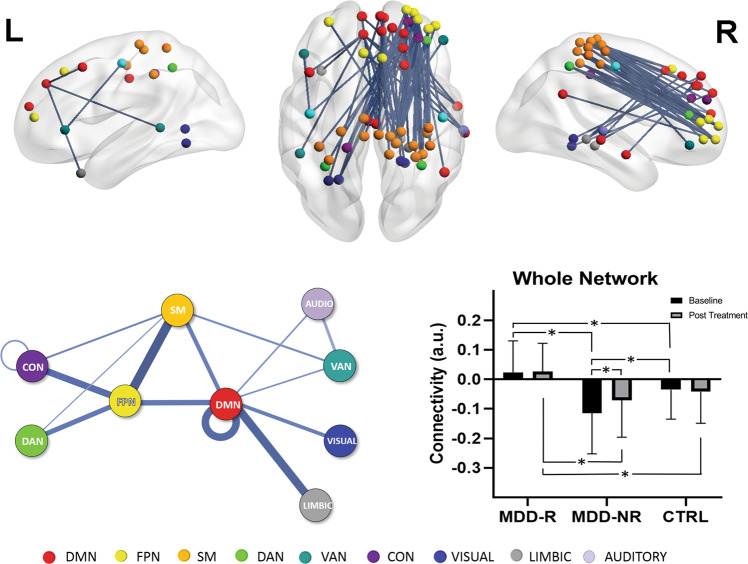
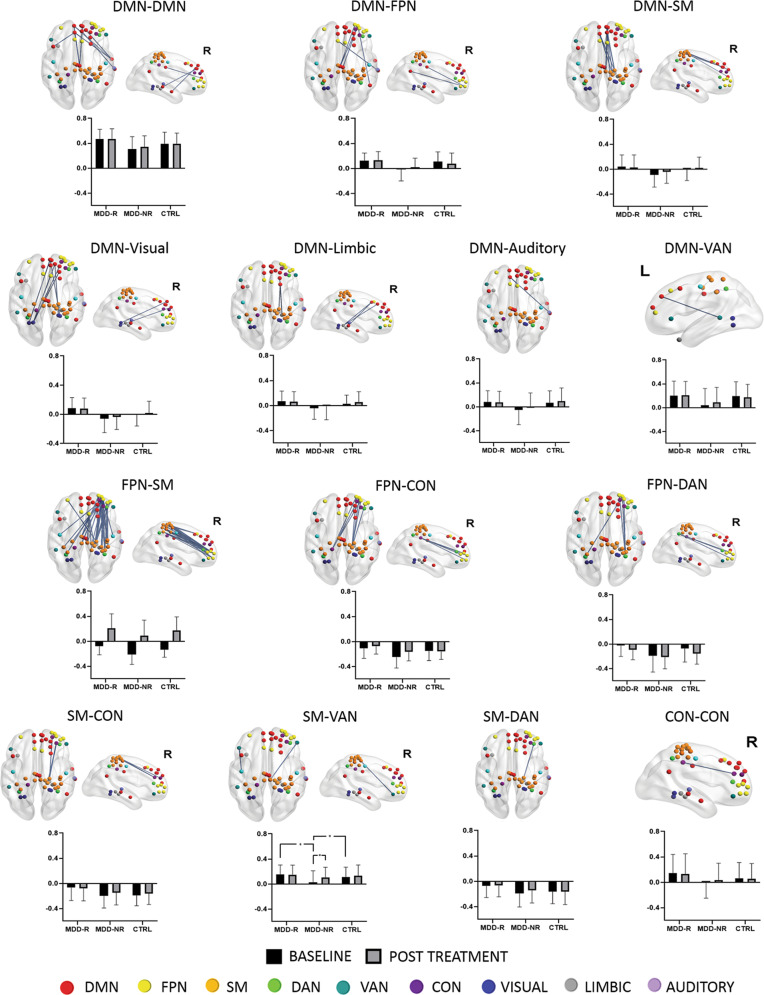
Although major depressive disorder (MDD) is associated with altered functional coupling between disparate neural networks, the degree to which such measures are ameliorated by antidepressant treatment is unclear. It is also unclear whether functional connectivity can be used as a predictive biomarker of treatment response. Here, we used whole-brain functional connectivity analysis to identify neural signatures of remission following antidepressant treatment, and to identify connectomic predictors of treatment response. 163 MDD and 62 healthy individuals underwent functional MRI during pre-treatment baseline and 8-week follow-up sessions. Patients were randomized to escitalopram, sertraline or venlafaxine-XR antidepressants and assessed at follow-up for remission. Baseline measures of intrinsic functional connectivity between each pair of 333 regions were analyzed to identify pre-treatment connectomic features that distinguish remitters from non-remitters. We then interrogated these connectomic differences to determine if they changed post-treatment, distinguished patients from controls, and were modulated by medication type. Irrespective of medication type, remitters were distinguished from non-remitters by greater connectivity within the default mode network (DMN); specifically, between the DMN, fronto-parietal and somatomotor networks, the DMN and visual, limbic, auditory and ventral attention networks, and between the fronto-parietal and somatomotor networks with cingulo-opercular and dorsal attention networks. This baseline hypo-connectivity for non-remitters also distinguished them from controls and increased following treatment. In contrast, connectivity for remitters was higher than controls at baseline and also following remission, suggesting a trait-like connectomic characteristic. Increased functional connectivity within and between large-scale intrinsic brain networks may characterize acute recovery with antidepressants in depression.
Overview
The claims and statistics of this paper haven’t been checked yet.
Run the check — free, no account needed. It reads the open-access text and checks the sources it cites.
Integrity signals
Registry
Cites
Statistics
Figures
Verification
Claims the paper makes
The claims and statistics of this paper haven’t been checked yet.
Run the check — free, no account needed. It reads the open-access text and checks the sources it cites.
Claims other papers make about this one
Each is checked against this paper’s own text: does it say what the citing paper says it does?
In the citing paper
“On the other hand, the decreased functional connectomes in areas of the DMN and LIM are considered to be related to anhedonia [62-68]”
From Mapping neurophysiological subtypes of major depressive disorder using normative models of the functional connectome (2023) · cites this paper as [68]
Self-check
Percentages, sums and reported differences re-computed from the paper’s own numbers.
The self-check needs the paper’s full text.
Citations
Cites
Hamilton, M. (1960) · Journal of Neurology, Neurosurgery & Psychiatry · doi:10.1136/jnnp.23.1.56 · Cited by 32,817 · cited 4×
“In short, the Mini-International Neuropsychiatric Interview [26], according to DSM-IV criteria, and a 17-item Hamilton Rating Scale for Depression (HRSD17) [27] score ≥16 confirmed the primary diagnosis of MDD.”
MethodInfluential(1998) · The Journal of Clinical Psychiatry · Cited by 19,139
Tzourio-Mazoyer, N., Landeau, B., Papathanassiou, D., Crivello, F., Etard, O., Delcroix, N., Mazoyer, B., & Joliot, M. (2002) · NeuroImage · doi:10.1006/nimg.2001.0978 · Cited by 16,319
A default mode of brain function
Raichle, M. E., MacLeod, A. M., Snyder, A. Z., Powers, W. J., Gusnard, D. A., & Shulman, G. L. (2001) · Proceedings of the National Academy of Sciences · doi:10.1073/pnas.98.2.676 · Cited by 12,190
(1998) · PubMed · Cited by 10,216
The human brain is intrinsically organized into dynamic, anticorrelated functional networks
Fox, M. D., Snyder, A. Z., Vincent, J. L., Corbetta, M., Van Essen, D. C., & Raichle, M. E. (2005) · Proceedings of the National Academy of Sciences · doi:10.1073/pnas.0504136102 · Cited by 8,553
Power, J. D., Barnes, K. A., Snyder, A. Z., Schlaggar, B. L., & Petersen, S. E. (2012) · NeuroImage · doi:10.1016/j.neuroimage.2011.10.018 · Cited by 7,429
(1995) · Cited by 6,909
Rush, A. J., Trivedi, M. H., Wisniewski, S. R., Nierenberg, A. A., Stewart, J. W., Warden, D., Niederehe, G., Thase, M. E., Lavori, P. W., Lebowitz, B. D., et al. (2006) · American Journal of Psychiatry · doi:10.1176/ajp.2006.163.11.1905 · Cited by 5,643 · cited 1×
“Antidepressant medications remain the first-line treatment for major depressive disorders (MDD) [1, 2], yet more than 50% of patients fail to achieve remission upon initial treatment [3, 4].”
BackgroundCorrespondence of the brain's functional architecture during activation and rest
Smith, S. M., Fox, P. T., Miller, K. L., Glahn, D. C., Fox, P. M., Mackay, C. E., Filippini, N., Watkins, K. E., Toro, R., Laird, A. R., et al. (2009) · Proceedings of the National Academy of Sciences · doi:10.1073/pnas.0905267106 · Cited by 5,150
Ferrari, A. J., Charlson, F. J., Norman, R. E., Patten, S. B., Freedman, G., Murray, C. J. L., Vos, T., & Whiteford, H. A. (2013) · PLoS Medicine · doi:10.1371/journal.pmed.1001547 · Cited by 3,115
Network-based statistic: identifying differences in brain networks
Zalesky, A., Fornito, A., & Bullmore, E. T. (2010) · NeuroImage · doi:10.1016/j.neuroimage.2010.06.041 · Cited by 2,750
Self-citationKaiser, R. H., Andrews-Hanna, J. R., Wager, T. D., & Pizzagalli, D. A. (2015) · JAMA Psychiatry · doi:10.1001/jamapsychiatry.2015.0071 · Cited by 2,281
The connectomics of brain disorders
Fornito, A., Zalesky, A., & Breakspear, M. (2015) · Nature Reviews Neuroscience · doi:10.1038/nrn3901 · Cited by 1,734
Self-citationIntrinsic and task-evoked network architectures of the human brain
Cole, M. W., Bassett, D. S., Power, J. D., Braver, T. S., & Petersen, S. E. (2014) · Neuron · doi:10.1016/j.neuron.2014.05.014 · Cited by 1,564
Generation and evaluation of a cortical area parcellation from resting-state correlations
Gordon, E. M., Laumann, T. O., Adeyemo, B., Huckins, J. F., Kelley, W. M., & Petersen, S. E. (2016) · Cerebral Cortex · doi:10.1093/cercor/bhu239 · Cited by 1,463
The human connectome: a complex network
Sporns, O. (2011) · Annals of the New York Academy of Sciences · doi:10.1111/j.1749-6632.2010.05888.x · Cited by 1,440
Whole-brain anatomical networks: does the choice of nodes matter?
Zalesky, A., Fornito, A., Harding, I. H., Cocchi, L., Yücel, M., Pantelis, C., & Bullmore, E. T. (2010) · NeuroImage · doi:10.1016/j.neuroimage.2009.12.027 · Cited by 1,169
Drevets, W. C. (2001) · Current Opinion in Neurobiology · doi:10.1016/s0959-4388(00)00203-8 · Cited by 1,146
Ciric, R., Wolf, D. H., Power, J. D., Roalf, D. R., Baum, G. L., Ruparel, K., Shinohara, R. T., Elliott, M. A., Eickhoff, S. B., Davatzikos, C., et al. (2017) · NeuroImage · doi:10.1016/j.neuroimage.2017.03.020 · Cited by 1,042
Parkes, L., Fulcher, B., Yücel, M., & Fornito, A. (2017) · NeuroImage · doi:10.1016/j.neuroimage.2017.12.073 · Cited by 830
Default mode network mechanisms of transcranial magnetic stimulation in depression
Liston, C., Chen, A. C., Zebley, B. D., Drysdale, A. T., Gordon, R., Leuchter, B., Voss, H. U., Casey, B. J., Etkin, A., & Dubin, M. J. (2014) · Biological Psychiatry · doi:10.1016/j.biopsych.2014.01.023 · Cited by 763
Parcellation‐dependent small‐world brain functional networks: A resting‐state fMRI study
Wang, J., Wang, L. Y., Zang, Y., Yang, H., Tang, H., Gong, Q., Chen, Z., Zhu, C., & Yong He, A. (2008) · Human Brain Mapping · doi:10.1002/hbm.20623 · Cited by 670
Fair, D. A., Schlaggar, B. L., Cohen, A. L., Miezin, F. M., Dosenbach, N. U. F., Wenger, K. K., Fox, M., Snyder, A. Z., Raichle, M. E., & Petersen, S. E. (2007) · NeuroImage · doi:10.1016/j.neuroimage.2006.11.051 · Cited by 615
Fornito, A., Harrison, B. J., Zalesky, A., & Simons, J. S. (2012) · Proceedings of the National Academy of Sciences · doi:10.1073/pnas.1204185109 · Cited by 555
Fales, C. L., Barch, D. M., Rundle, M. M., Mintun, M. A., Snyder, A. Z., Cohen, J. D., Mathews, J., & Sheline, Y. I. (2008) · Biological Psychiatry · doi:10.1016/j.biopsych.2007.06.012 · Cited by 517
Heller, A. S., Johnstone, T., Shackman, A. J., Light, S. N., Peterson, M. J., Kolden, G. G., Kalin, N. H., & Davidson, R. J. (2009) · Proceedings of the National Academy of Sciences · doi:10.1073/pnas.0910651106 · Cited by 444
Network scaling effects in graph analytic studies of human resting-state fMRI data
Fornito, A. (2010) · Frontiers in Systems Neuroscience · doi:10.3389/fnsys.2010.00022 · Cited by 439
Alexopoulos, G. S., Hoptman, M. J., Kanellopoulos, D., Murphy, C. F., Lim, K. O., & Gunning, F. M. (2012) · Journal of Affective Disorders · doi:10.1016/j.jad.2011.12.002 · Cited by 437
Dunlop, B. W., Rajendra, J. K., Craighead, W. E., Kelley, M. E., McGrath, C. L., Choi, K. S., Kinkead, B., Nemeroff, C. B., & Mayberg, H. S. (2017) · American Journal of Psychiatry · doi:10.1176/appi.ajp.2016.16050518 · Cited by 342 · cited 1×
“Few studies have examined whether pre-treatment intrinsic neural characteristics may pre-dispose an individual to respond to antidepressant medications [19, 20].”
BackgroundBrakowski, J., Spinelli, S., Doerig, N., Bosch, O. G., Manoliu, A., Holtforth, M. G., & Seifritz, E. (2017) · Journal of Psychiatric Research · doi:10.1016/j.jpsychires.2017.04.007 · Cited by 336
A Treatment-Resistant Default Mode Subnetwork in Major Depression
Li, B., Liu, L., Friston, K. J., Shen, H., Wang, L., Zeng, L.-L., & Hu, D. (2013) · Biological Psychiatry · doi:10.1016/j.biopsych.2012.11.007 · Cited by 333
Salomons, T. V., Dunlop, K., Kennedy, S. H., Flint, A., Geraci, J., Giacobbe, P., & Downar, J. (2014) · Neuropsychopharmacology · doi:10.1038/npp.2013.222 · Cited by 299
Antidepressants Normalize the Default Mode Network in Patients With Dysthymia
Posner, J., Hellerstein, D. J., Gat, I., Mechling, A., Klahr, K., Wang, Z., McGrath, P. J., Stewart, J. W., & Peterson, B. S. (2013) · JAMA Psychiatry · doi:10.1001/jamapsychiatry.2013.455 · Cited by 268
Anand, A., Li, Y., Wang, Y., Gardner, K., & Lowe, M. J. (2007) · The Journal of Neuropsychiatry and Clinical Neurosciences · doi:10.1176/appi.neuropsych.19.3.274 · Cited by 215
Williams, L. M., Rush, A. J., Koslow, S. H., Wisniewski, S. R., Cooper, N. J., Nemeroff, C. B., Schatzberg, A. F., & Gordon, E. (2011) · Trials · doi:10.1186/1745-6215-12-4 · Cited by 198
Williams, L. M., Korgaonkar, M. S., Song, Y. C., Paton, R., Eagles, S., Goldstein-Piekarski, A., Grieve, S. M., Harris, A. W. F., Usherwood, T., & Etkin, A. (2015) · Neuropsychopharmacology · doi:10.1038/npp.2015.89 · Cited by 195
Aizenstein, H. J., Butters, M. A., Wu, M., Mazurkewicz, L. M., Stenger, V. A., Gianaros, P. J., Becker, J. T., Reynolds, C. F., & Carter, C. S. (2009) · The American Journal of Geriatric Psychiatry · doi:10.1097/jgp.0b013e31817b60af · Cited by 187
Guo, W., Liu, F., Xue, Z., Xu, X., Wu, R., Ma, C., Wooderson, S. C., Tan, C., Sun, X., Chen, J., et al. (2012) · Progress in Neuro-Psychopharmacology and Biological Psychiatry · doi:10.1016/j.pnpbp.2012.01.011 · Cited by 182
Ma, C., Ding, J., Li, J., Guo, W., Long, Z., Liu, F., Gao, Q. C., Zeng, L., Zhao, J., & Chen, H. (2012) · PLoS ONE · doi:10.1371/journal.pone.0045263 · Cited by 167
Resting state functional connectivity and treatment response in late-life depression
Andreescu, C., Tudorascu, D. L., Butters, M. A., Tamburo, E., Patel, M., Price, J., Karp, J. F., Reynolds, C. F., & Aizenstein, H. (2013) · Psychiatry Research: Neuroimaging · doi:10.1016/j.pscychresns.2013.08.007 · Cited by 153
Saveanu, R., Etkin, A., Duchemin, A.-M., Goldstein-Piekarski, A., Gyurak, A., Debattista, C., Schatzberg, A. F., Sood, S., Day, C. V. A., Palmer, D. M., et al. (2015) · Journal of Psychiatric Research · doi:10.1016/j.jpsychires.2014.12.018 · Cited by 151
Diffusion tensor imaging predictors of treatment outcomes in major depressive disorder
Korgaonkar, M. S., Williams, L. M., Song, Y. J. C., Usherwood, T. P., & Grieve, S. M. (2014) · The British Journal of Psychiatry · doi:10.1192/bjp.bp.113.140376 · Cited by 147
Default-mode network connectivity and white matter burden in late-life depression
Wu, M., Andreescu, C., Butters, M. A., Tamburo, R., Reynolds, C. F., & Aizenstein, H. (2011) · Psychiatry Research: Neuroimaging · doi:10.1016/j.pscychresns.2011.04.003 · Cited by 140
Resting-State Connectivity Predictors of Response to Psychotherapy in Major Depressive Disorder
Crowther, A., Smoski, M. J., Minkel, J. D., Moore, T. M., Gibbs, D. E., Petty, C., Bizzell, J., Schiller, C. E., Sideris, J. H., Carl, H., et al. (2015) · Neuropsychopharmacology · doi:10.1038/npp.2015.12 · Cited by 139
Korgaonkar, M. S., Grieve, S. M., Etkin, A., Koslow, S. H., & Williams, L. M. (2013) · Neuropsychopharmacology · doi:10.1038/npp.2012.252 · Cited by 135
Gudayol‐Ferré, E., Peró, M., González‐Garrido, A. A., & Guàrdia‐Olmos, J. (2015) · Frontiers in Human Neuroscience · doi:10.3389/fnhum.2015.00582 · Cited by 135
Goldstein-Piekarski, A. N., Staveland, B. R., Ball, T. M., Yesavage, J., Korgaonkar, M. S., & Williams, L. M. (2018) · Translational Psychiatry · doi:10.1038/s41398-018-0100-3 · Cited by 108
Salience Network Functional Connectivity Predicts Placebo Effects in Major Depression
Sikora, M., Heffernan, J., Avery, E. T., Mickey, B. J., Zubieta, J.-K., & Peciña, M. (2016) · Biological Psychiatry: Cognitive Neuroscience and Neuroimaging · doi:10.1016/j.bpsc.2015.10.002 · Cited by 85
Korgaonkar, M. S., Ram, K., Williams, L. M., Gatt, J. M., & Grieve, S. M. (2014) · Human Brain Mapping · doi:10.1002/hbm.22446 · Cited by 74
First‑line pharmacotherapies for depression – what is the best choice?
Koenig, A. M., & Thase, M. E. (2009) · Polskie Archiwum Medycyny Wewnętrznej · doi:10.20452/pamw.743 · Cited by 69
Whitton, A. E., Webb, C. A., Dillon, D. G., Jürgen Kayser, A., Rutherford, A. V., Goer, F., D, M. F. M., McGrath, P. J., Weissman, M. M., Parsey, R. V., et al. (2018) · Biological Psychiatry · doi:10.1016/j.biopsych.2018.12.007 · Cited by 69
Grieve, S. M., Korgaonkar, M. S., Etkin, A., Harris, A., Koslow, S. H., Wisniewski, S., Schatzberg, A. F., Nemeroff, C. B., Gordon, E., & Williams, L. M. (2013) · Trials · doi:10.1186/1745-6215-14-224 · Cited by 44
Self-citation[Nightsweat collection for simple diagnosis of mucoviscidosis (author's transl)].
Gottschalk, B., Fabricius, E., & Pätzug, U. (1974) · PubMed · Cited by 3
Cited by
Sorted by citations
Xia, M., Liu, J., Mechelli, A., Sun, X., Ma, Q., Wang, X., Wei, D., Chen, Y., Liu, B., Huang, C., et al. (2022) · Molecular Psychiatry · doi:10.1038/s41380-022-01519-5 · Cited by 228
Mapping Neural Circuit Biotypes to Symptoms and Behavioral Dimensions of Depression and Anxiety
Goldstein‐Piekarski, A. N., Ball, T. M., Samara, Z., Staveland, B. R., Keller, A. S., Fleming, S. L., Grisanzio, K. A., Holt-Gosselin, B., Stetz, P. C., Ma, J., et al. (2021) · Biological Psychiatry · doi:10.1016/j.biopsych.2021.06.024 · Cited by 155
Sun, X., Sun, J., Lu, X., Dong, Q., Zhang, L., Wang, W., Liu, J., Ma, Q., Wang, X., Wei, D., et al. (2023) · Biological Psychiatry · doi:10.1016/j.biopsych.2023.05.021 · Cited by 129
Liang, S., Deng, W., Li, X., Greenshaw, A. J., Wang, Q., Li, M., Ma, X., Bai, T., Bo, Q., Cao, J., et al. (2020) · NeuroImage Clinical · doi:10.1016/j.nicl.2020.102514 · Cited by 115
Tozzi, L., Zhang, X., Chesnut, M., Holt-Gosselin, B., Ramirez, C. A., & Williams, L. M. (2021) · NeuroImage Clinical · doi:10.1016/j.nicl.2021.102570 · Cited by 117
Metadata
- Authors
- Korgaonkar, M. S., Goldstein-Piekarski, A. N., Fornito, A., & Williams, L. M.
- Affiliations
- The University of Sydney (AU)
- Monash University (AU)
- Corresponding author
- Korgaonkar, Mayuresh S.
- Williams, Leanne M.
- Venue
- Molecular Psychiatry
- Published
- 2019-11-06
- Volume
- 25
- Issue
- 7
- Pages
- 1537-1549
- ISSN
- 1359-4184 (ISSN-L)
- 1476-5578
- PMC
- PMC7303006
- OpenAlex
- W2986842001
- Cited by
- 163
- References
- 55
- Citations by year
- 2026: 15 · 2025: 23 · 2024: 32 · 2023: 26 · 2022: 32 · 2021: 18 · 2020: 16 · 2019: 1
- FWCI
- 9.74
- Type
- journal article
- Language
- en
- Open access
- hybrid
- doi.org
- Locations
- Molecular Psychiatry (publishedVersion, cc-by)
- PubMed Central (publishedVersion, cc-by)
- PubMed (publishedVersion)
- Funders
- Brain Resource Ltd, San Francisco & Sydney
- Brain Resource Ltd
- Topics
- Life Sciences › Neuroscience › Cognitive Neuroscience › Functional Brain Connectivity Studies
- Health Sciences › Medicine › Pharmacology (medical) › Treatment of Major Depression
- Social Sciences › Psychology › Experimental and Cognitive Psychology › Mental Health Research Topics
- Keywords
- major depressive disorder, remission, antidepressant response, functional connectivity, predictive biomarkers, default mode network, large-scale brain networks, escitalopram, sertraline, venlafaxine
- MeSH terms
- Venlafaxine Hydrochloride, Adult, Antidepressive Agents, Brain, Major Depressive Disorder, Female, Humans, Magnetic Resonance Imaging, Male, Neural Pathways, Remission Induction, Citalopram, Biomarkers, Sertraline, Young Adult, Connectome
About these checks
Registry, retraction, Cites and statistics results are computed, not judged, with one exception: a printed reference that no index lists is read once by a model before it counts as a citation error. Claims are extracted by a model and kept only when their quote appears verbatim in the text; each cited source is then checked, with a model’s help, for whether it says what the claim relies on. Those verdicts can be wrong — read the claim’s quote and the cited source before relying on one.
Statistics and arithmetic are recomputed, not judged.
Confidence bands are shown only for fields calibrated on our annotated test set. None is calibrated yet, so no band is shown.
What counts as a claim ›How we measure confidence ›How we check this ›
Are you an author, or do you see a problem with this page? Request a review
