

The DOI matches its Crossref record; 69 of the 70 references it cites were found in a registry or an index.
An epigenetic predictor of death captures multi-modal measures of brain health
Open accessPublished version of a preprint
Abstract
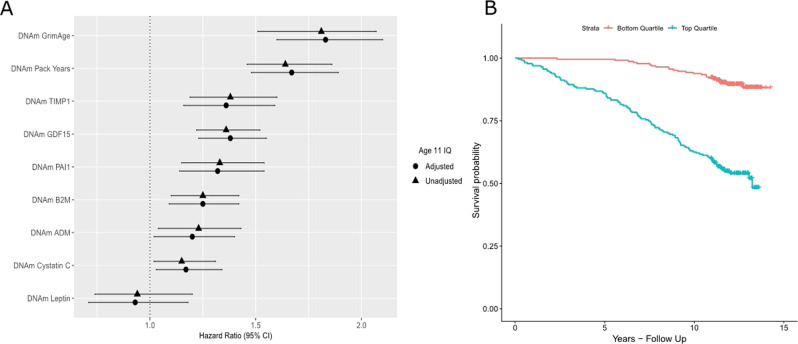
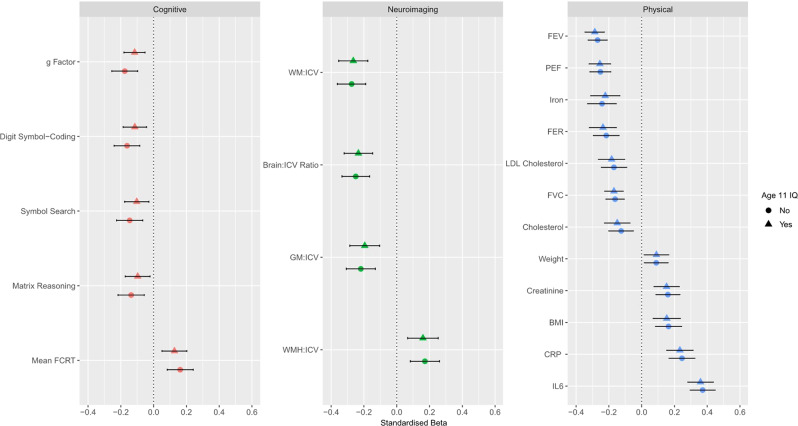
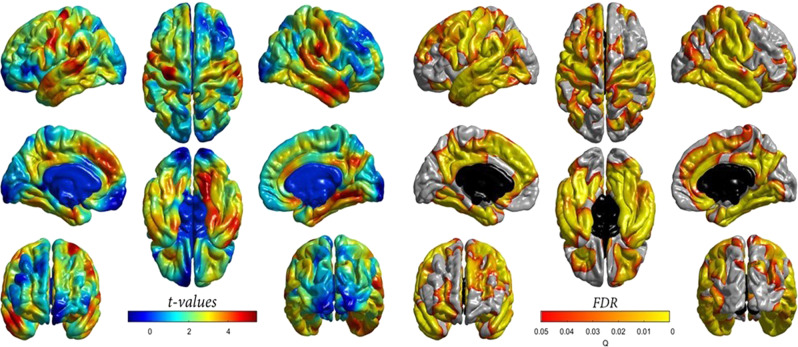
Individuals of the same chronological age exhibit disparate rates of biological ageing. Consequently, a number of methodologies have been proposed to determine biological age and primarily exploit variation at the level of DNA methylation (DNAm). A novel epigenetic clock, termed ‘DNAm GrimAge’ has outperformed its predecessors in predicting the risk of mortality as well as many age-related morbidities. However, the association between DNAm GrimAge and cognitive or neuroimaging phenotypes remains unknown. We explore these associations in the Lothian Birth Cohort 1936 ( n = 709, mean age 73 years). Higher DNAm GrimAge was strongly associated with all-cause mortality over the eighth decade (Hazard Ratio per standard deviation increase in GrimAge: 1.81, P < 2.0 × 10 −16 ). Higher DNAm GrimAge was associated with lower age 11 IQ ( β = −0.11), lower age 73 general cognitive ability ( β = −0.18), decreased brain volume ( β = −0.25) and increased brain white matter hyperintensities ( β = 0.17). There was tentative evidence for a longitudinal association between DNAm GrimAge and cognitive decline from age 70 to 79. Sixty-nine of 137 health- and brain-related phenotypes tested were significantly associated with GrimAge. Adjusting all models for childhood intelligence attenuated to non-significance a small number of associations (12/69 associations; 6 of which were cognitive traits), but not the association with general cognitive ability (33.9% attenuation). Higher DNAm GrimAge associates with lower cognitive ability and brain vascular lesions in older age, independently of early-life cognitive ability. This epigenetic predictor of mortality associates with different measures of brain health and may aid in the prediction of age-related cognitive decline.
Overview
The claims and statistics of this paper haven’t been checked yet.
Run the check — free, no account needed. It reads the open-access text and checks the sources it cites.
Integrity signals
Registry
Cites
Statistics
Figures
Verification
Claims the paper makes
The claims and statistics of this paper haven’t been checked yet.
Run the check — free, no account needed. It reads the open-access text and checks the sources it cites.
Claims other papers make about this one
Each is checked against this paper’s own text: does it say what the citing paper says it does?
The source backs part of the claim, not all of it — or backs it for a different population, condition or comparison.
In the citing paper
“The DNAm GrimAge clock shows consistently stronger associations with various measures of age-related dysfunction, including heart disease, frailty, and cognitive and physical decline, compared to other clocks47,48,50,64–72.”
From Measuring biological age using omics data (2022) · cites this paper as [70]
Experimental — accuracy not yet measured
Self-check
Percentages, sums and reported differences re-computed from the paper’s own numbers.
The self-check needs the paper’s full text.
Citations
Cites
Controlling the False Discovery Rate: A Practical and Powerful Approach to Multiple Testing
Benjamini, Y., & Hochberg, Y. (1995) · Journal of the Royal Statistical Society Series B: Statistical Methodology · doi:10.1111/j.2517-6161.1995.tb02031.x · Cited by 109,482
Fitting Linear Mixed-Effects Models Using lme4
Bates, D., Mächler, M., Bolker, B., & Walker, S. (2015) · Journal of Statistical Software · doi:10.18637/jss.v067.i01 · Cited by 86,835
Vos, T., Flaxman, A. D., Naghavi, M., Lozano, R., Michaud, C., Ezzati, M., Shibuya, K., Salomon, J. A., Abdalla, S., Aboyans, V., et al. (2012) · The Lancet · doi:10.1016/s0140-6736(12)61729-2 · Cited by 8,291
DNA methylation age of human tissues and cell types
Horvath, S. (2013) · Genome Biology · doi:10.1186/gb-2013-14-10-r115 · Cited by 7,075
Self-citationInflamm‐aging: An Evolutionary Perspective on Immunosenescence
FRANCESCHI, C., BONAFÈ, M., VALENSIN, S., OLIVIERI, F., DE LUCA, M., OTTAVIANI, E., & DE BENEDICTIS, G. (2000) · Annals of the New York Academy of Sciences · doi:10.1111/j.1749-6632.2000.tb06651.x · Cited by 5,358
Genome-wide methylation profiles reveal quantitative views of human aging rates
Hannum, G., Guinney, J., Zhao, L., Zhang, L., Hughes, G., Sadda, S., Klotzle, B., Bibikova, M., Fan, J.-B., Gao, Y., et al. (2013) · Molecular Cell · doi:10.1016/j.molcel.2012.10.016 · Cited by 4,270
An epigenetic biomarker of aging for lifespan and healthspan
(2018) · doi:10.1101/276162 · Cited by 3,675
An epigenetic biomarker of aging for lifespan and healthspan
Levine, M. E., Lu, A. T., Quach, A., Chen, B. H., Assimes, T. L., Bandinelli, S., Hou, L., Baccarelli, A. A., Stewart, J. D., Li, Y., et al. (2018) · Aging · doi:10.18632/aging.101414 · Cited by 3,675
Self-citationDNA methylation GrimAge strongly predicts lifespan and healthspan
Lu, A. T., Quach, A., Wilson, J. G., Reiner, A. P., Aviv, A., Raj, K., Hou, L., Baccarelli, A. A., Li, Y., Stewart, J. D., et al. (2019) · Aging · doi:10.18632/aging.101684 · Cited by 2,540
Self-citationDebette, S., & Markus, H. S. (2010) · BMJ · doi:10.1136/bmj.c3666 · Cited by 2,328
Research works printed but not linked: 2
- Horvath S. DNA methylation age of human tissues and cell types. Genome Biol. 2013;14:R115. · DOI · Paper page
- Deary IJ, Gow AJ, Taylor MD, Corley J, Brett C, Wilson V, et al. The Lothian Birth Cohort 1936: a study to examine influences on cognitive ageing from age 11 to age 70 and beyond. BMC Geriatr. 2007;7:28. · DOI
Cited by
Sorted by citations
Measuring biological age using omics data
Rutledge, J., Oh, H., & Wyss-Coray, T. (2022) · Nature Reviews Genetics · doi:10.1038/s41576-022-00511-7 · Cited by 570
McCrory, C., Fiorito, G., Hernandez, B., Polidoro, S., O’Halloran, A. M., Hever, A., Ni Cheallaigh, C., Lu, A. T., Horvath, S., Vineis, P., et al. (2021) · The Journals of Gerontology: Series A · doi:10.1093/gerona/glaa286 · Cited by 464
Self-citationValidation of biomarkers of aging
Moqri, M., Herzog, C., Poganik, J. R., Ying, K., Justice, J. N., Belsky, D. W., Higgins-Chen, A. T., Chen, B. H., Cohen, A. A., Fuellen, G., et al. (2024) · Nature Medicine · doi:10.1038/s41591-023-02784-9 · Cited by 361
Self-citationDNA methylation GrimAge version 2
Lu, A. T., Binder, A. M., Zhang, J., Yan, Q., Reiner, A. P., Cox, S. R., Corley, J., Harris, S. E., Kuo, P.-L., Moore, A. Z., et al. (2022) · Aging · doi:10.18632/aging.204434 · Cited by 216
Self-citationGenome-wide association studies identify 137 genetic loci for DNA methylation biomarkers of aging
McCartney, D. L., Min, J. L., Richmond, R. C., Lu, A. T.-H., Sobczyk, M., Davies, G., Broer, L., Guo, X., Jeong, A., Jung, J., et al. (2021) · Genome biology · doi:10.1186/s13059-021-02398-9 · Cited by 310
Self-citation
Metadata
- Authors
- Hillary, R. F., Stevenson, A. J., Cox, S. R., McCartney, D. L., Harris, S. E., Seeboth, A., Higham, J., Sproul, D., Taylor, A. M., Redmond, P., Corley, J., Pattie, A., Hernández, M. D. C. V., Muñoz-Maniega, S., Bastin, M. E., Wardlaw, J. M., Horvath, S., Ritchie, C. W., Spires-Jones, T. L., McIntosh, A. M., Evans, K. L., Deary, I. J., & Marioni, R. E.
- Affiliations
- University of Edinburgh (GB)
- Edinburgh Cancer Research (GB)
- UK Dementia Research Institute (GB)
- University of California, Los Angeles (US)
- Institute of Genetics and Cancer (GB)
- Corresponding author
- Marioni, Riccardo E.
- ORCID
- Venue
- Molecular Psychiatry
- Published
- 2019-12-03
- Volume
- 26
- Issue
- 8
- Pages
- 3806-3816
- ISSN
- 1359-4184 (ISSN-L)
- 1476-5578
- PMC
- PMC8550950
- OpenAlex
- W2993770134
- Cited by
- 139
- References
- 70
- Citations by year
- 2026: 16 · 2025: 26 · 2024: 14 · 2023: 26 · 2022: 22 · 2021: 21 · 2020: 14
- FWCI
- 4.72
- Type
- journal article
- Language
- en
- Open access
- hybrid
- doi.org
- Locations
- Molecular Psychiatry (publishedVersion, cc-by)
- bioRxiv (Cold Spring Harbor Laboratory) (acceptedVersion, cc-by)
- Europe PMC (PubMed Central) (publishedVersion, other-oa)
- PubMed Central (publishedVersion, cc-by)
- PubMed (publishedVersion)
- Lancaster EPrints (Lancaster University) (submittedVersion)
- Edinburgh Research Explorer (University of Edinburgh) (submittedVersion, cc-by)
- Funders
- Alzheimer's Research UK (ARUK-PG2017B-10.)
- Wellcome Trust (108890/Z/15/Z)
- Fondation Leducq
- U.S. Department of Health & Human Services | National Institutes of Health (R01AG054628)
- Topics
- Life Sciences › Biochemistry, Genetics and Molecular Biology › Molecular Biology › Epigenetics and DNA Methylation
- Health Sciences › Medicine › Psychiatry and Mental health › Dementia and Cognitive Impairment Research
- Life Sciences › Biochemistry, Genetics and Molecular Biology › Aging › Genetics, Aging, and Longevity in Model Organisms
- Keywords
- DNA methylation, epigenetic clocks, biological aging, mortality prediction, all-cause mortality, cognitive ability, child intelligence, brain volume, white matter hyperintensities, cognitive decline, Lothian Birth Cohort 1936, brain health
- MeSH terms
- Birth Cohort, Aged, Aging, Brain, Child, Humans, DNA Methylation, Epigenesis, Genetic, Epigenomics
About these checks
Registry, retraction, Cites and statistics results are computed, not judged, with one exception: a printed reference that no index lists is read once by a model before it counts as a citation error. Claims are extracted by a model and kept only when their quote appears verbatim in the text; each cited source is then checked, with a model’s help, for whether it says what the claim relies on. Those verdicts can be wrong — read the claim’s quote and the cited source before relying on one.
Statistics and arithmetic are recomputed, not judged.
Confidence bands are shown only for fields calibrated on our annotated test set. None is calibrated yet, so no band is shown.
What counts as a claim ›How we measure confidence ›How we check this ›
Are you an author, or do you see a problem with this page? Request a review
