

The DOI matches its Crossref record; 69 of the 70 references it cites were found in a registry or an index.
An epigenetic predictor of death captures multi-modal measures of brain health
Open accessPublished version of a preprint
Abstract
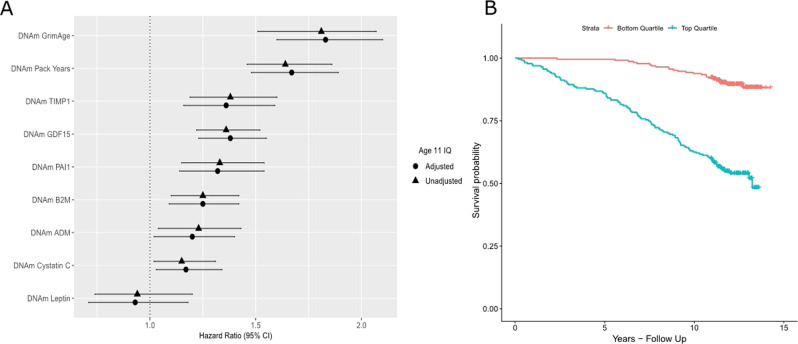
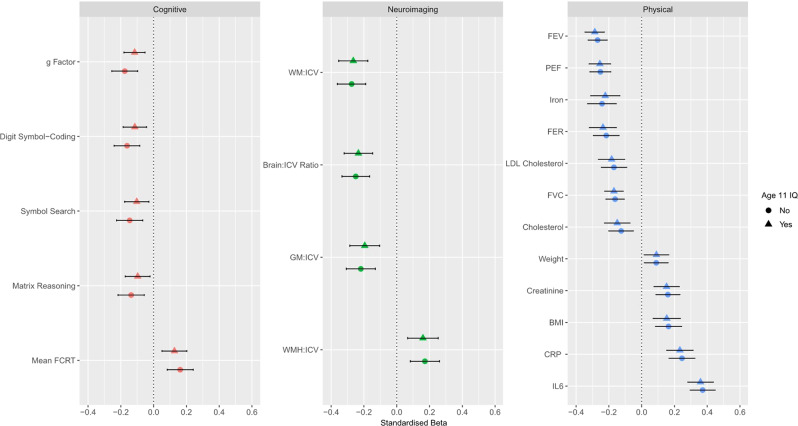
Individuals of the same chronological age exhibit disparate rates of biological ageing. Consequently, a number of methodologies have been proposed to determine biological age and primarily exploit variation at the level of DNA methylation (DNAm). A novel epigenetic clock, termed ‘DNAm GrimAge’ has outperformed its predecessors in predicting the risk of mortality as well as many age-related morbidities. However, the association between DNAm GrimAge and cognitive or neuroimaging phenotypes remains unknown. We explore these associations in the Lothian Birth Cohort 1936 ( n = 709, mean age 73 years). Higher DNAm GrimAge was strongly associated with all-cause mortality over the eighth decade (Hazard Ratio per standard deviation increase in GrimAge: 1.81, P < 2.0 × 10 −16 ). Higher DNAm GrimAge was associated with lower age 11 IQ ( β = −0.11), lower age 73 general cognitive ability ( β = −0.18), decreased brain volume ( β = −0.25) and increased brain white matter hyperintensities ( β = 0.17). There was tentative evidence for a longitudinal association between DNAm GrimAge and cognitive decline from age 70 to 79. Sixty-nine of 137 health- and brain-related phenotypes tested were significantly associated with GrimAge. Adjusting all models for childhood intelligence attenuated to non-significance a small number of associations (12/69 associations; 6 of which were cognitive traits), but not the association with general cognitive ability (33.9% attenuation). Higher DNAm GrimAge associates with lower cognitive ability and brain vascular lesions in older age, independently of early-life cognitive ability. This epigenetic predictor of mortality associates with different measures of brain health and may aid in the prediction of age-related cognitive decline.
Overview
The claims and statistics of this paper haven’t been checked yet.
Run the check — free, no account needed. It reads the open-access text and checks the sources it cites.
Integrity signals
Registry
Cites
Statistics
Figures
Verification
Claims the paper makes
The claims and statistics of this paper haven’t been checked yet.
Run the check — free, no account needed. It reads the open-access text and checks the sources it cites.
Claims other papers make about this one
Each is checked against this paper’s own text: does it say what the citing paper says it does?
The source backs part of the claim, not all of it — or backs it for a different population, condition or comparison.
In the citing paper
“The DNAm GrimAge clock shows consistently stronger associations with various measures of age-related dysfunction, including heart disease, frailty, and cognitive and physical decline, compared to other clocks47,48,50,64–72.”
From Measuring biological age using omics data (2022) · cites this paper as [70]
Experimental — accuracy not yet measured
Self-check
Percentages, sums and reported differences re-computed from the paper’s own numbers.
The self-check needs the paper’s full text.
Citations
Cites
Controlling the False Discovery Rate: A Practical and Powerful Approach to Multiple Testing
Benjamini, Y., & Hochberg, Y. (1995) · Journal of the Royal Statistical Society Series B: Statistical Methodology · doi:10.1111/j.2517-6161.1995.tb02031.x · Cited by 109,482
Fitting Linear Mixed-Effects Models Using lme4
Bates, D., Mächler, M., Bolker, B., & Walker, S. (2015) · Journal of Statistical Software · doi:10.18637/jss.v067.i01 · Cited by 86,835
Vos, T., Flaxman, A. D., Naghavi, M., Lozano, R., Michaud, C., Ezzati, M., Shibuya, K., Salomon, J. A., Abdalla, S., Aboyans, V., et al. (2012) · The Lancet · doi:10.1016/s0140-6736(12)61729-2 · Cited by 8,291
DNA methylation age of human tissues and cell types
Horvath, S. (2013) · Genome Biology · doi:10.1186/gb-2013-14-10-r115 · Cited by 7,075
Self-citationInflamm‐aging: An Evolutionary Perspective on Immunosenescence
FRANCESCHI, C., BONAFÈ, M., VALENSIN, S., OLIVIERI, F., DE LUCA, M., OTTAVIANI, E., & DE BENEDICTIS, G. (2000) · Annals of the New York Academy of Sciences · doi:10.1111/j.1749-6632.2000.tb06651.x · Cited by 5,358
Genome-wide methylation profiles reveal quantitative views of human aging rates
Hannum, G., Guinney, J., Zhao, L., Zhang, L., Hughes, G., Sadda, S., Klotzle, B., Bibikova, M., Fan, J.-B., Gao, Y., et al. (2013) · Molecular Cell · doi:10.1016/j.molcel.2012.10.016 · Cited by 4,270
An epigenetic biomarker of aging for lifespan and healthspan
(2018) · doi:10.1101/276162 · Cited by 3,675
An epigenetic biomarker of aging for lifespan and healthspan
Levine, M. E., Lu, A. T., Quach, A., Chen, B. H., Assimes, T. L., Bandinelli, S., Hou, L., Baccarelli, A. A., Stewart, J. D., Li, Y., et al. (2018) · Aging · doi:10.18632/aging.101414 · Cited by 3,675
Self-citationDNA methylation GrimAge strongly predicts lifespan and healthspan
Lu, A. T., Quach, A., Wilson, J. G., Reiner, A. P., Aviv, A., Raj, K., Hou, L., Baccarelli, A. A., Li, Y., Stewart, J. D., et al. (2019) · Aging · doi:10.18632/aging.101684 · Cited by 2,540
Self-citationDebette, S., & Markus, H. S. (2010) · BMJ · doi:10.1136/bmj.c3666 · Cited by 2,328
Research works printed but not linked: 2
- Horvath S. DNA methylation age of human tissues and cell types. Genome Biol. 2013;14:R115. · DOI · Paper page
- Deary IJ, Gow AJ, Taylor MD, Corley J, Brett C, Wilson V, et al. The Lothian Birth Cohort 1936: a study to examine influences on cognitive ageing from age 11 to age 70 and beyond. BMC Geriatr. 2007;7:28. · DOI
Cited by
Sorted by citations
Measuring biological age using omics data
Rutledge, J., Oh, H., & Wyss-Coray, T. (2022) · Nature Reviews Genetics · doi:10.1038/s41576-022-00511-7 · Cited by 570
McCrory, C., Fiorito, G., Hernandez, B., Polidoro, S., O’Halloran, A. M., Hever, A., Ni Cheallaigh, C., Lu, A. T., Horvath, S., Vineis, P., et al. (2021) · The Journals of Gerontology: Series A · doi:10.1093/gerona/glaa286 · Cited by 464
Self-citationValidation of biomarkers of aging
Moqri, M., Herzog, C., Poganik, J. R., Ying, K., Justice, J. N., Belsky, D. W., Higgins-Chen, A. T., Chen, B. H., Cohen, A. A., Fuellen, G., et al. (2024) · Nature Medicine · doi:10.1038/s41591-023-02784-9 · Cited by 361
Self-citationDNA methylation GrimAge version 2
Lu, A. T., Binder, A. M., Zhang, J., Yan, Q., Reiner, A. P., Cox, S. R., Corley, J., Harris, S. E., Kuo, P.-L., Moore, A. Z., et al. (2022) · Aging · doi:10.18632/aging.204434 · Cited by 216
Self-citationGenome-wide association studies identify 137 genetic loci for DNA methylation biomarkers of aging
McCartney, D. L., Min, J. L., Richmond, R. C., Lu, A. T.-H., Sobczyk, M., Davies, G., Broer, L., Guo, X., Jeong, A., Jung, J., et al. (2021) · Genome biology · doi:10.1186/s13059-021-02398-9 · Cited by 310
Self-citationHillary, R. F., Stevenson, A. J., McCartney, D. L., Campbell, A., Walker, R. M., Howard, D. M., Ritchie, C. W., Horvath, S., Hayward, C., McIntosh, A. M., et al. (2020) · Clinical Epigenetics · doi:10.1186/s13148-020-00905-6 · Cited by 209
Self-citationDNA methylation-based age clocks: From age prediction to age reversion
Noroozi, R., Ghafouri‐Fard, S., Pisarek, A., Rudnicka, J., Spólnicka, M., Branicki, W., Taheri, M. N., & Pośpiech, E. (2021) · Ageing Research Reviews · doi:10.1016/j.arr.2021.101314 · Cited by 171
DNA Methylation Clocks and Their Predictive Capacity for Aging Phenotypes and Healthspan
Bergsma, T., & Rogaeva, E. A. (2020) · Neuroscience Insights · doi:10.1177/2633105520942221 · Cited by 145
Genetic variation, brain, and intelligence differences
Deary, I. J., Cox, S. R., & Hill, W. D. (2022) · Molecular Psychiatry · doi:10.1038/s41380-021-01027-y · Cited by 137
Self-citationAn integrative study of five biological clocks in somatic and mental health
Jansen, R., Han, L. K., Verhoeven, J. E., Aberg, K. A., van den Oord, E. C., Milaneschi, Y., & Penninx, B. W. (2021) · eLife · doi:10.7554/elife.59479 · Cited by 127
Ammous, F., Zhao, W., Ratliff, S. M., Mosley, T. H., Bielak, L. F., Zhou, X., Peyser, P. A., Kardia, S. L. R., & Smith, J. A. (2021) · Clinical Epigenetics · doi:10.1186/s13148-021-01035-3 · Cited by 106
McCrory, C., Fiorito, G., O’Halloran, A. M., Polidoro, S., Vineis, P., & Kenny, R. A. (2021) · Psychoneuroendocrinology · doi:10.1016/j.psyneuen.2021.105643 · Cited by 96
Wang, C., Ni, W., Yao, Y., Just, A. C., Heiss, J. A., Wei, Y., Gao, X., Coull, B. A., Kosheleva, A., Baccarelli, A., et al. (2020) · EBioMedicine · doi:10.1016/j.ebiom.2020.103151 · Cited by 87
Aging biomarkers and the brain
Higgins‐Chen, A., Thrush, K., & Levine, M. E. (2021) · Seminars in Cell and Developmental Biology · doi:10.1016/j.semcdb.2021.01.003 · Cited by 85
Avila‐Rieger, J. F., Turney, I. C., Vonk, J. M. J., Esie, P., Šeblová, D., Weir, V. R., Belsky, D. W., & Manly, J. J. (2022) · Neurology · doi:10.1212/wnl.0000000000201032 · Cited by 62
Epigenetic aging as a biomarker of dementia and related outcomes: a systematic review
Zhou, A., Wu, Z., Phyo, A. Z. Z., Torres, D. S., Vishwanath, S., & Ryan, J. L. (2022) · Epigenomics · doi:10.2217/epi-2022-0209 · Cited by 61
DNA methylation trajectories and accelerated epigenetic aging in incident type 2 diabetes
Fraszczyk, E., Thio, C. H. L., Wackers, P. F. K., Dollé, M. E. T., Bloks, V. W., Hodemaekers, H. M., Picavet, H. S. J., Stynenbosch, M., Verschuren, W. M. M., Snieder, H., et al. (2022) · GeroScience · doi:10.1007/s11357-022-00626-z · Cited by 55
Accelerated aging in the brain, epigenetic aging in blood, and polygenic risk for schizophrenia
Teeuw, J., Ori, A. P. S., Brouwer, R. M., de Zwarte, S. M. C., Schnack, H. G., Pol, H. E. H., & Ophoff, R. A. (2021) · Schizophrenia Research · doi:10.1016/j.schres.2021.04.005 · Cited by 55
Pang, A. P. S., Higgins‐Chen, A., Comite, F., Raica, I., Arboleda, C., Went, H., Mendez, T. L., Schotsaert, M., Dwaraka, V. B., Smith, R. C., et al. (2022) · Frontiers in Genetics · doi:10.3389/fgene.2022.819749 · Cited by 53
Föhr, T., Waller, K. L., Viljanen, A., Sanchez, R., Ollikainen, M., Rantanen, T., Kaprio, J. A., & Sillanpää, E. (2021) · Clinical Epigenetics · doi:10.1186/s13148-021-01112-7 · Cited by 51
Boice, J. D., Quinn, B. M., Al‐Nabulsi, I., Ansari, A. J., Blake, P. K., Blattnig, S. R., Caffrey, E., Cohen, S. S., Golden, A. P., Held, K. D., et al. (2021) · International Journal of Radiation Biology · doi:10.1080/09553002.2021.1988183 · Cited by 49
Measuring healthy ageing: current and future tools
Silva, N., Rajado, A. T., Esteves, F., Brito, D. V. C., Apolónio, J. D., Roberto, V. P., Binnie, A., Araújo, I. M., Nóbrega, C., Bragança, J., et al. (2023) · Biogerontology · doi:10.1007/s10522-023-10041-2 · Cited by 51
Martins, D., Paduraru, M., & Paloyelis, Y. (2021) · British Journal of Pharmacology · doi:10.1111/bph.15451 · Cited by 42
Zheng, Y., Habes, M., Gonzales, M. M., Pomponio, R., Nasrallah, I. M., Khan, S. S., Vaughan, D. E., Davatzikos, C. A., Seshadri, S. S., Launer, L. J., et al. (2022) · Aging · doi:10.18632/aging.203918 · Cited by 42
Shadyab, A. H., McEvoy, L. K., Horvath, S., Whitsel, E. A., Rapp, S. R., Espeland, M. A., Resnick, S. M., Manson, J. E., Chen, J., Chen, B. H., et al. (2021) · The Journals of Gerontology Series A · doi:10.1093/gerona/glab245 · Cited by 39
Self-citationAssociations between alcohol use and accelerated biological ageing
Bøstrand, S. M. K., Vaher, K., de Nooij, L., Harris, M. A., Cole, J. H., Cox, S. R., Marioni, R. E., McCartney, D. L., Walker, R. M., McIntosh, A. M., et al. (2021) · Addiction Biology · doi:10.1111/adb.13100 · Cited by 45
Self-citationReed, R. G., Carroll, J., Marsland, A. L., & Manuck, S. B. (2022) · Aging · doi:10.18632/aging.204376 · Cited by 39
The use of DNA methylation clock in aging research
He, X., Liu, J., Liu, B., & Shi, J. (2020) · Experimental Biology and Medicine · doi:10.1177/1535370220968802 · Cited by 38
Nwanaji-Enwerem, J. C., Nwanaji-Enwerem, U., Van Der Laan, L., Galazka, J. M., Redeker, N. S., & Cardenas, A. (2020) · Cell Reports · doi:10.1016/j.celrep.2020.108406 · Cited by 36
Targeting epigenetics: A novel promise for Alzheimer’s disease treatment
Jeremic, D., Jiménez‐Díaz, L., & Navarro‐López, J. D. (2023) · Ageing Research Reviews · doi:10.1016/j.arr.2023.102003 · Cited by 36
The effects of bilingualism on hippocampal volume in ageing bilinguals
Voits, T., Robson, H., Rothman, J., & Pliatsikas, C. (2022) · Brain Structure and Function · doi:10.1007/s00429-021-02436-z · Cited by 40
Utility of DNA Methylation as a Biomarker in Aging and Alzheimer’s Disease
Milicic, L., Porter, T., Vacher, M. A., & Laws, S. M. (2023) · Journal of Alzheimer s Disease Reports · doi:10.3233/adr-220109 · Cited by 36
Accelerated Epigenetic Aging in Peripheral Blood does not Predict Dementia Risk
Fransquet, P., Lacaze, P. A., Saffery, R., Shah, R. C., Vryer, R., Murray, A. M., Woods, R. L., & Ryan, J. L. (2021) · Current Alzheimer Research · doi:10.2174/1567205018666210823100721 · Cited by 32
Quantification of Epigenetic Aging in Public Health
Kusters, C., & Horvath, S. (2024) · Annual Review of Public Health · doi:10.1146/annurev-publhealth-060222-015657 · Cited by 35
Self-citationNwanaji‐Enwerem, J. C., Colicino, E., Specht, A. J., Gao, X., Wang, C., Vokonas, P., Weisskopf, M. G., Boyer, E. W., Baccarelli, A., & Schwartz, J. D. (2020) · Environmental Research · doi:10.1016/j.envres.2020.109573 · Cited by 31
Li, X., Zhang, Y., Gao, X. Y., Holleczek, B., Schöttker, B., & Brenner, H. (2021) · EBioMedicine · doi:10.1016/j.ebiom.2021.103686 · Cited by 33
Milicic, L., Vacher, M. A., Porter, T., Doré, V., Burnham, S. C., Bourgeat, P., Shishegar, R., Doecke, J. D., Armstrong, N. J., Tankard, R. M., et al. (2022) · GeroScience · doi:10.1007/s11357-022-00558-8 · Cited by 33
The Cutting Edge of Epigenetic Clocks: In Search of Mechanisms Linking Aging and Mental Health
Harvanek, Z. M., Boks, M. P., Vinkers, C. H., & Higgins‐Chen, A. (2023) · Biological Psychiatry · doi:10.1016/j.biopsych.2023.02.001 · Cited by 33
Whitman, E. T., Ryan, C. P., Abraham, W. C., Addae, A., Corcoran, D. L., Elliott, M. L., Hogan, S., Ireland, D. R., Keenan, R. J., Knodt, A. R., et al. (2023) · Neurobiology of Aging · doi:10.1016/j.neurobiolaging.2024.01.008 · Cited by 36
Nutritional Epigenomics and Age-Related Disease
Amenyah, S., Ward, M., Strain, J., McNulty, H., Hughes, C., Dollin, C., Walsh, C. P., & Lees‐Murdock, D. J. (2020) · Current Developments in Nutrition · doi:10.1093/cdn/nzaa097 · Cited by 33
Li, J., Wang, W., Yang, Z., Qiu, L., Ren, Y., Wang, D., Li, M., Li, W., Gao, F., & Zhang, J. (2024) · Lipids in Health and Disease · doi:10.1186/s12944-024-02042-y · Cited by 34
Biological Age Acceleration and Motoric Cognitive Risk Syndrome
Sathyan, S., Ayers, E. I., Adhikari, D., Gao, T., Milman, S., Barzilai, N., & Verghese, J. (2023) · Annals of Neurology · doi:10.1002/ana.26624 · Cited by 24
Nwanaji‐Enwerem, J. C., Colicino, E., Gao, X., Wang, C., Vokonas, P., Boyer, E. W., Baccarelli, A., & Schwartz, J. D. (2020) · The Journals of Gerontology Series A · doi:10.1093/gerona/glaa257 · Cited by 23
The Effects of Lifetime Estrogen Exposure on Breast Epigenetic Age
Sehl, M. E., Henry, J. E., Storniolo, A. M., Horvath, S., & Ganz, P. A. (2021) · Cancer Epidemiology Biomarkers & Prevention · doi:10.1158/1055-9965.epi-20-1297 · Cited by 26
Self-citationO’Shea, D. M., Maynard, T. R., & Tremont, G. N. (2022) · The Journals of Gerontology Series A · doi:10.1093/gerona/glac133 · Cited by 23
Lima, C. N. D. C., Kovács, E. H. C., Mirza, S. A., Favero-Campbell, A. D., Díaz, A. P., Quevedo, J., Argue, B. M., Richards, J. G., Williams, A. J., Wemmie, J. A., et al. (2023) · Neuropsychopharmacology · doi:10.1038/s41386-023-01557-9 · Cited by 26
The lipidomic correlates of epigenetic aging across the adult lifespan: A population‐based study
Liu, D., Aziz, N. A., Landstra, E. N., & Breteler, M. M. B. (2023) · Aging Cell · doi:10.1111/acel.13934 · Cited by 23
Lynch, M. E., Arpawong, T. E., & Beam, C. R. (2023) · The Journals of Gerontology Series B · doi:10.1093/geronb/gbad128 · Cited by 24
Föhr, T., Törmäkangas, T., Lankila, H., Viljanen, A., Rantanen, T., Ollikainen, M., Kaprio, J. A., & Sillanpää, E. (2021) · The Journals of Gerontology Series A · doi:10.1093/gerona/glab270 · Cited by 28
Marečková, K., Pačínková, A., Mareček, R., Šebejová, L., Hollá, L. I., Klánová, J., Brázdil, M., & Nikolova, Y. S. (2023) · Frontiers in Aging Neuroscience · doi:10.3389/fnagi.2023.1215957 · Cited by 23
Epigenetic clocks derived from western samples differentially reflect Taiwanese health outcomes
Lin, W. (2023) · Frontiers in Genetics · doi:10.3389/fgene.2023.1089819 · Cited by 21
McMurran, C. E., Wang, Y., Mak, J. K. L., Karlsson, I., Tang, B., Ploner, A., Pedersen, N. L., & Hägg, S. (2023) · Brain · doi:10.1093/brain/awad252 · Cited by 21
Bonham, L. W., Sirkis, D. W., Pang, A. P. S., Sugrue, L. P., Santamaría‐García, H. A., Ibáñez, A. M., Miller, B. L., Yokoyama, J. S., Corley, M. J., & Initiative, A. D. N. (2025) · npj Dementia · doi:10.1038/s44400-025-00007-1 · Cited by 21
Data Resource Profile: Whole-Blood DNA Methylation Resource in Generation Scotland (MeGS)
Walker, R., McCartney, D., Carr, K., Barber, M., Shen, X.-Y., Campbell, A., Bernabeu, E., Aitken, E., Fawkes, A., Wrobel, N., et al. (2024) · medRxiv · doi:10.1093/ije/dyaf091 · Cited by 10
Self-citationAttitudes to ageing, biomarkers of ageing and mortality: the Lothian Birth Cohort 1936
McLachlan, K., Cole, J. H., Harris, S. E., Marioni, R. E., Deary, I. J., & Galé, C. R. (2020) · Journal of Epidemiology & Community Health · doi:10.1136/jech-2019-213462 · Cited by 19
Self-citationStevenson, A. J., McCartney, D. L., Shireby, G. L., Hillary, R. F., King, D., Tzioras, M., Wrobel, N., McCafferty, S., Murphy, L., McColl, B. W., et al. (2022) · European Journal of Neuroscience · doi:10.1111/ejn.15661 · Cited by 20
Self-citationLongitudinal study of traumatic-stress related cellular and cognitive aging
Wolf, E. J., Miller, M. W., Hawn, S. E., Zhao, X., Wallander, S., McCormick, B. A., Govan, C., Rasmusson, A. M., Stone, A., Schichman, S. A., et al. (2023) · Brain Behavior and Immunity · doi:10.1016/j.bbi.2023.11.009 · Cited by 20
Epigenetic ageing of the prefrontal cortex and cerebellum in humans and chimpanzees
Guevara, E. E., Hopkins, W. D., Hof, P. R., Ely, J. J., Bradley, B. J., & Sherwood, C. C. (2022) · Epigenetics · doi:10.1080/15592294.2022.2080993 · Cited by 17
Graves, A. J., Danoff, J. S., Kim, M., Brindley, S. R., Skyberg, A. M., Giamberardino, S. N., Lynch, M. E., Straka, B., Lillard, T. S., Gregory, S. G., et al. (2024) · Scientific Reports · doi:10.1038/s41598-024-60311-3 · Cited by 17
Hawn, S. E., Zhao, X., Sullivan, D. R., Logue, M. W., Fein‐Schaffer, D., Milberg, W., McGlinchey, R. E., Miller, M. W., & Wolf, E. J. (2022) · Translational Psychiatry · doi:10.1038/s41398-022-02164-w · Cited by 17
Genome-wide association studies identify 137 loci for DNA methylation biomarkers of ageingPreprint
McCartney, D. L., Min, J. L., Richmond, R. C., Lu, A. T.-H., Sobczyk, M., Davies, G., Broer, L., Guo, X., Jeong, A., Jung, J., et al. (2020) · bioRxiv (Cold Spring Harbor Laboratory) · doi:10.1101/2020.06.29.133702 · Cited by 16
Self-citationKim, B., Vasanthakumar, A., Li, Q. S., Nudelman, K. N. H., Risacher, S. L., Davis, J. W., Idler, K. B., Lee, J., Seo, S. W., Waring, J. F., et al. (2022) · Alzheimer s & Dementia Diagnosis Assessment & Disease Monitoring · doi:10.1002/dad2.12354 · Cited by 13
Guo, Y. P., Li, D., & Hu, Y. (2023) · American Journal of Clinical Nutrition · doi:10.1016/j.ajcnut.2023.05.004 · Cited by 13
Vyas, C. M., Sadreyev, R. I., Gatchel, J. R., Kang, J. H., Reynolds, C. F., Mischoulon, D., Chang, G., Hazra, A., Manson, J. E., Blacker, D., et al. (2023) · Journal of Alzheimer s Disease · doi:10.3233/jad-230093 · Cited by 13
Nguyen, S., McEvoy, L. K., Espeland, M. A., Whitsel, E. A., Lu, A. T.-H., Horvath, S., Manson, J. E., Rapp, S. R., & Shadyab, A. H. (2024) · Neurology · doi:10.1212/wnl.0000000000209534 · Cited by 13
Self-citationYan, Z., Guan, G., Jia, H., Li, H., Zhuoga, S., & Zheng, S. (2025) · Aging Clinical and Experimental Research · doi:10.1007/s40520-025-02971-3 · Cited by 16
Human Brain Cell‐Type‐Specific Aging Clocks Based on Single‐Nuclei Transcriptomics
Muralidharan, C., Zakar‐Polyák, E., Adami, A., Abbas, A. A., Sharma, Y., Garza, R., Johansson, J., Atacho, D. A. M., Renner, É., Palkovits, M., et al. (2025) · Advanced Science · doi:10.1002/advs.202506109 · Cited by 15
Hao, Y., Tian, W., Xie, B., Fu, X., Wang, S., & Yang, Y. (2024) · The Journal of Prevention of Alzheimer s Disease · doi:10.14283/jpad.2024.128 · Cited by 12
Serum lead, mercury, manganese, and copper and DNA methylation age among adults in Detroit, Michigan
Lodge, E. K., Dhingra, R., Martin, C. L., Fry, R. C., White, A. J., Ward-Caviness, C. K., Wani, A. H., Uddin, M., Wildman, D. E., Galea, S., et al. (2022) · Current Zoology · doi:10.1093/eep/dvac018 · Cited by 12
Epigenetic age acceleration predicts subject‐specific white matter degeneration in the human brain
Newman, B. T., Danoff, J. S., Lynch, M. E., Giamberardino, S. N., Gregory, S. G., Connelly, J. J., Druzgal, T. J., & Morris, J. P. (2024) · Aging Cell · doi:10.1111/acel.14426 · Cited by 10
Gampawar, P. G., Veeranki, S. P. K., Petrovic, K. E., Schmidt, R., & Schmidt, H. (2025) · Psychiatry and Clinical Neurosciences · doi:10.1111/pcn.13793 · Cited by 11
Ahmed, S., Gozal, D., & Khalyfa, A. (2025) · Sleep Medicine Reviews · doi:10.1016/j.smrv.2025.102170 · Cited by 12
Epigenetic Modifiers as Game Changers for Healthy Aging
Sharma, S., & Bhonde, R. R. (2023) · Rejuvenation Research · doi:10.1089/rej.2022.0059 · Cited by 10
McCrory, C., Fiorito, G., Hernández, B., Polidoro, S., O’Halloran, A. M., Hever, A. M., Cheallaigh, C. N., Lu, A. T.-H., Horvath, S., Vineis, P., et al. (2020) · bioRxiv (Cold Spring Harbor Laboratory) · doi:10.1101/2020.04.27.063164 · Cited by 10
Self-citationAssociations of Accelerated Biological Aging With Dementia and the Mediation Role of Brain Structure
Bo, Y., Sun, L., Hou, S., Zhang, F., Zhang, H., Feng, X., Zhuo, S., Feng, S., Chang, H., Zhang, X., et al. (2025) · Neurology · doi:10.1212/wnl.0000000000213616 · Cited by 9
Yannatos, I., Stites, S. D., Boen, C., Xie, S. X., Brown, R. T., & McMillan, C. T. (2023) · medRxiv · doi:10.1101/2023.09.29.23296351 · Cited by 9
PTSD and epigenetic aging: a longitudinal meta-analysis
Zhao, X., Katrinli, Ş., McCormick, B. M., Miller, M. W., Nugent, N. R., Wani, A. H., Zannas, A. S., Aiello, A. E., Baker, D. G., Boks, M. P., et al. (2025) · Psychological Medicine · doi:10.1017/s0033291725000558 · Cited by 9
Brooke, R. T., Köcher, T., Zauner, R., Gordevičius, J., Milčiūtė, M., Nowakowski, M., Haser, C., Blobel, T., Sieland, J., Langhoff, D., et al. (2025) · Aging Cell · doi:10.1111/acel.70182 · Cited by 9
Self-citationShinko, Y., Okazaki, S., Otsuka, I., Horai, T., Kim, S., Tanifuji, T., & Hishimoto, A. (2022) · Molecular Genetics & Genomic Medicine · doi:10.1002/mgg3.1876 · Cited by 6
Common DNA sequence variation influences epigenetic aging in African populationsPreprint
Meeks, G. L., Scelza, B., Asnake, H. M., Prall, S., Patin, E., Froment, A., Fagny, M., Quintana-Murci, L., Henn, B., & Gopalan, S. (2024) · bioRxiv · doi:10.1101/2024.08.26.608843 · Cited by 8
Verbal Fluency Selectively Predicts Survival in Old and Very Old Age
Ghisletta, P., Aichele, S., Gerstorf, D., Carollo, A., & Lindenberger, U. (2025) · Psychological Science · doi:10.1177/09567976241311923 · Cited by 7
O’Shea, D. M., & Galvin, J. E. (2023) · Journal of Alzheimer s Disease · doi:10.3233/jad-221145 · Cited by 7
Dalpé, G., Huerne, K., Dupras, C., Cheung, K., Palmour, N., Winkler, E. C., Alex, K., Mehlman, M. J., Holloway, J. W., Bunnik, E. M., et al. (2023) · Journal of Law and the Biosciences · doi:10.1093/jlb/lsad034 · Cited by 9
The Mediating Role of Biomarkers in the Association Between Subjective Aging and Episodic Memory
Stéphan, Y., Sutin, A. R., Luchetti, M., Aschwanden, D., & Terracciano, A. (2022) · The Journals of Gerontology Series B · doi:10.1093/geronb/gbac155 · Cited by 7
Association of blood cadmium levels with epigenetic age acceleration in U.S. adults aged > 50 years
Mi, P., Cao, X., Feng, H., & Wang, H. (2025) · Frontiers in Public Health · doi:10.3389/fpubh.2025.1504830 · Cited by 7
Kastberger, B., Winter, S., Brandstaetter, H., Biller, J., Wagner, W., & Plesnila, N. (2023) · Advanced Biology · doi:10.1002/adbi.202300439 · Cited by 6
Epigenetic age acceleration in peripheral blood correlates with brain-MRI age acceleration
Ferreira, P. S. B., van Dongen, J., den Braber, A., Boomsma, D. I., de Geus, E. J. C., & Ent, D. V. ‘. (2025) · Brain · doi:10.1093/brain/awaf069 · Cited by 8
Associations between methylation age and brain age in late adolescencePreprint
Sanders, F., Baltramonaityte, V., Donohoe, G. J., Davies, N. M., Dunn, E. C., Cecil, C. A. M., & Walton, E. (2022) · bioRxiv (Cold Spring Harbor Laboratory) · doi:10.1101/2022.09.08.506972 · Cited by 6
DNA Methylation in Aging and Alzheimer's Disease
Cheng, R., Shu, J., Chen, H., Li, M., Cheng, X., & Liu, L. (2024) · Human Brain · doi:10.37819/hb.3.2027 · Cited by 5
Pan, Y., Huang, Z., Sun, X., Anda‐Duran, I. D., Zhang, R., Chen, W., Li, C., Capuano, A. W., Yaffe, K. S., Zhao, J., et al. (2025) · npj Aging · doi:10.1038/s41514-025-00265-6 · Cited by 5
Drouin, S. M., Kuo, P., Blew, C., Duggan, M. R., Chen, D., Smith, H. M., Chen, J., Giorgio, K., Gómez, G., Moore, A. Z., et al. (2025) · Aging Cell · doi:10.1111/acel.70281 · Cited by 5
Self-citationFornage, M., Tarraf, W., Daviglus, M. L., DeCarli, C. S., González, K. A., Isasi, C. R., Kuwayama, S., Lamar, M., Levin, B. E., Parada, H., et al. (2025) · Clinical Epigenetics · doi:10.1186/s13148-025-01941-w · Cited by 6
O’Shea, D. M., Alaimo, H., Davis, J. D., Galvin, J. E., & Tremont, G. N. (2022) · Neurobiology of Aging · doi:10.1016/j.neurobiolaging.2022.12.011 · Cited by 5
GWAS of biological aging to find longevity genes in schizophrenia
Qian, J., Fischer, C. E., Burhan, A. M., Mak, M. S. B., Gerretsen, P., Kolla, N. J., Al-Chalabi, N., Chaudhary, Z., Qureshey, A., Bani‐Fatemi, A., et al. (2023) · European Archives of Psychiatry and Clinical Neuroscience · doi:10.1007/s00406-023-01622-w · Cited by 5
Felt, J. M., Harrington, K., Ram, N., O’Donnell, K. J., Sliwinski, M. J., Benson, L., Zhang, Z., Meaney, M. J., Putnam, F. W., Noll, J. G., et al. (2022) · The Journals of Gerontology Series B · doi:10.1093/geronb/gbac158 · Cited by 5
An epigenetic proxy of chronic inflammation outperforms serum levels as a biomarker of brain ageingPreprint
Conole, E., Stevenson, A. J., Green, C., Harris, S., Maniega, S. M., Valdés-Hernández, M. D. C., Harris, M., Bastin, M., Wardlaw, J., Deary, I., et al. (2020) · medRxiv · doi:10.1101/2020.10.08.20205245 · Cited by 7
Self-citationAssociations between alcohol use and accelerated biological ageingPreprint
Bøstrand, S. M. K., Vaher, K., de Nooij, L., Harris, M. A., Cole, J. H., Cox, S. R., Marioni, R. E., McCartney, D. L., Walker, R. M., McIntosh, A. M., et al. (2020) · medRxiv · doi:10.1101/2020.11.24.20237156 · Cited by 5
Self-citationWhitman, E. T., Ryan, C. P., Abraham, W. C., Addae, A., Corcoran, D. L., Elliott, M. L., Hogan, S., Ireland, D. R., Keenan, R. J., Knodt, A. R., et al. (2023) · medRxiv · doi:10.1101/2023.09.06.23295140 · Cited by 5
Sayer, M., Ng, D. Q., Trudeau, J., Chan, R. J., Acharya, M. M., Kober, K. M., & Chan, A. (2025) · Frontiers in Aging · doi:10.3389/fragi.2025.1667638 · Cited by 4
Ramirez, D., Povedano, E., García-Aguirre, A., & Lund, M. (2025) · Demography · doi:10.1215/00703370-11790645 · Cited by 4
Metadata
- Authors
- Hillary, R. F., Stevenson, A. J., Cox, S. R., McCartney, D. L., Harris, S. E., Seeboth, A., Higham, J., Sproul, D., Taylor, A. M., Redmond, P., Corley, J., Pattie, A., Hernández, M. D. C. V., Muñoz-Maniega, S., Bastin, M. E., Wardlaw, J. M., Horvath, S., Ritchie, C. W., Spires-Jones, T. L., McIntosh, A. M., Evans, K. L., Deary, I. J., & Marioni, R. E.
- Affiliations
- University of Edinburgh (GB)
- Edinburgh Cancer Research (GB)
- UK Dementia Research Institute (GB)
- University of California, Los Angeles (US)
- Institute of Genetics and Cancer (GB)
- Corresponding author
- Marioni, Riccardo E.
- ORCID
- Venue
- Molecular Psychiatry
- Published
- 2019-12-03
- Volume
- 26
- Issue
- 8
- Pages
- 3806-3816
- ISSN
- 1359-4184 (ISSN-L)
- 1476-5578
- PMC
- PMC8550950
- OpenAlex
- W2993770134
- Cited by
- 139
- References
- 70
- Citations by year
- 2026: 16 · 2025: 26 · 2024: 14 · 2023: 26 · 2022: 22 · 2021: 21 · 2020: 14
- FWCI
- 4.72
- Type
- journal article
- Language
- en
- Open access
- hybrid
- doi.org
- Locations
- Molecular Psychiatry (publishedVersion, cc-by)
- bioRxiv (Cold Spring Harbor Laboratory) (acceptedVersion, cc-by)
- Europe PMC (PubMed Central) (publishedVersion, other-oa)
- PubMed Central (publishedVersion, cc-by)
- PubMed (publishedVersion)
- Lancaster EPrints (Lancaster University) (submittedVersion)
- Edinburgh Research Explorer (University of Edinburgh) (submittedVersion, cc-by)
- Funders
- Alzheimer's Research UK (ARUK-PG2017B-10.)
- Wellcome Trust (108890/Z/15/Z)
- Fondation Leducq
- U.S. Department of Health & Human Services | National Institutes of Health (R01AG054628)
- Topics
- Life Sciences › Biochemistry, Genetics and Molecular Biology › Molecular Biology › Epigenetics and DNA Methylation
- Health Sciences › Medicine › Psychiatry and Mental health › Dementia and Cognitive Impairment Research
- Life Sciences › Biochemistry, Genetics and Molecular Biology › Aging › Genetics, Aging, and Longevity in Model Organisms
- Keywords
- DNA methylation, epigenetic clocks, biological aging, mortality prediction, all-cause mortality, cognitive ability, child intelligence, brain volume, white matter hyperintensities, cognitive decline, Lothian Birth Cohort 1936, brain health
- MeSH terms
- Birth Cohort, Aged, Aging, Brain, Child, Humans, DNA Methylation, Epigenesis, Genetic, Epigenomics
About these checks
Registry, retraction, Cites and statistics results are computed, not judged, with one exception: a printed reference that no index lists is read once by a model before it counts as a citation error. Claims are extracted by a model and kept only when their quote appears verbatim in the text; each cited source is then checked, with a model’s help, for whether it says what the claim relies on. Those verdicts can be wrong — read the claim’s quote and the cited source before relying on one.
Statistics and arithmetic are recomputed, not judged.
Confidence bands are shown only for fields calibrated on our annotated test set. None is calibrated yet, so no band is shown.
What counts as a claim ›How we measure confidence ›How we check this ›
Are you an author, or do you see a problem with this page? Request a review
