

Prognostic value of depression and anxiety on breast cancer recurrence and mortality: a systematic review and meta-analysis of 282,203 patients
Open accessThe DOI matches its Crossref record; 74 of the 74 references it cites were found in a registry or an index.
Abstract
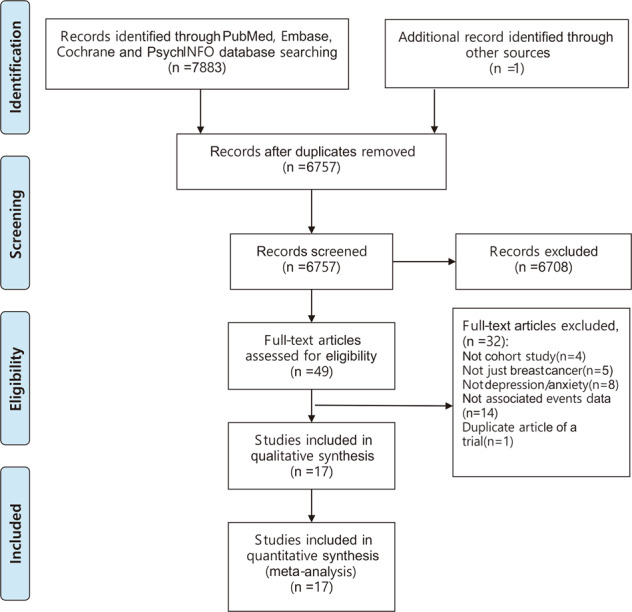
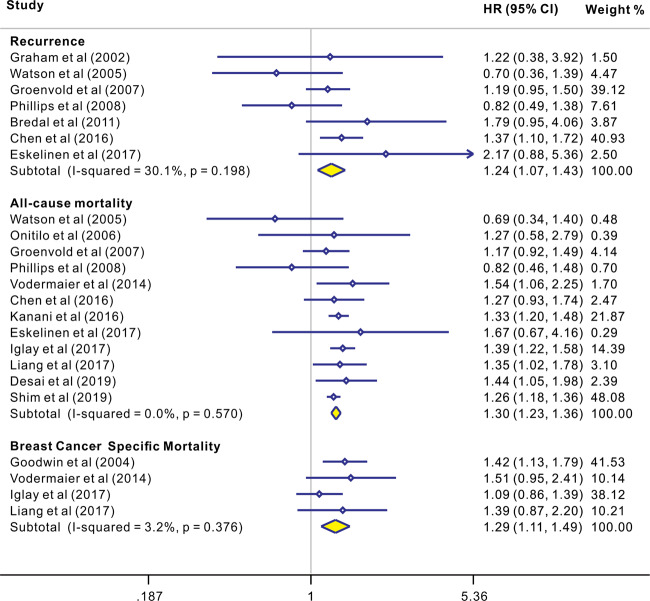
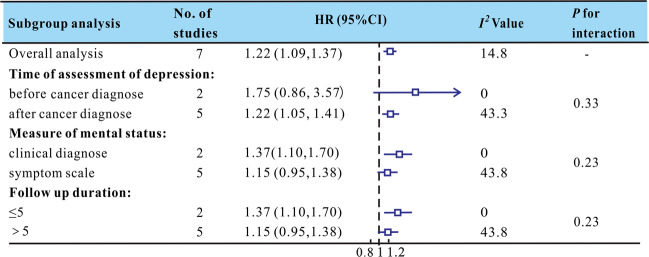
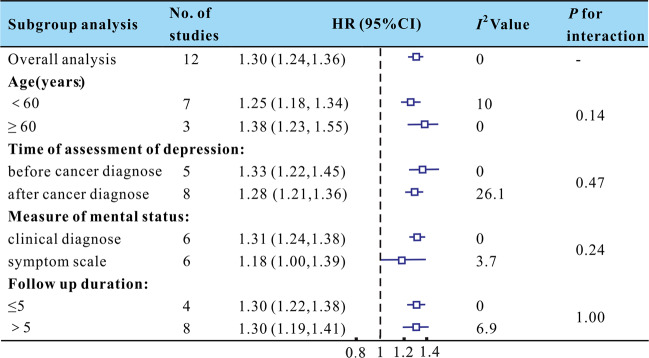
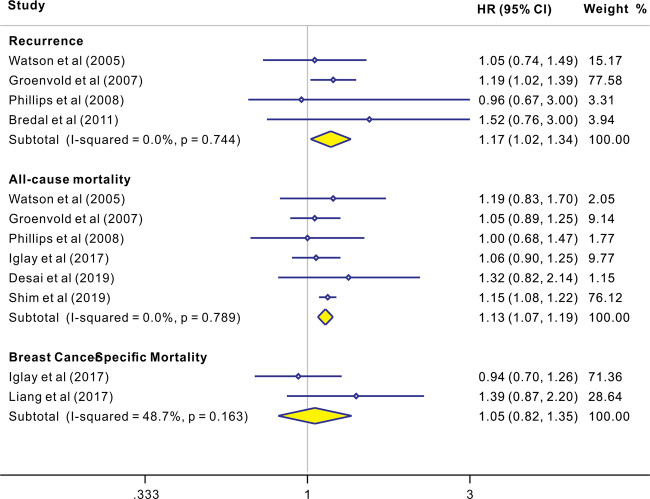
Depression and anxiety are common comorbidities in breast cancer patients. Whether depression and anxiety are associated with breast cancer progression or mortality is unclear. Herein, based on a systematic literature search, 17 eligible studies involving 282,203 breast cancer patients were included. The results showed that depression was associated with cancer recurrence [1.24 (1.07, 1.43)], all-cause mortality [1.30 (1.23, 1.36)], and cancer-specific mortality [1.29 (1.11, 1.49)]. However, anxiety was associated with recurrence [1.17 (1.02, 1.34)] and all-cause mortality [1.13 (1.07, 1.19)] but not with cancer-specific mortality [1.05 (0.82, 1.35)]. Comorbidity of depression and anxiety is associated with all-cause mortality [1.34 (1.24, 1.45)] and cancer-specific mortality [1.45 (1.11, 1.90)]. Subgroup analyses demonstrated that clinically diagnosed depression and anxiety, being female and of younger age (<60 years), and shorter follow-up duration (≤5 years) were related to a poorer prognosis. Our study highlights the critical role of depression/anxiety as an independent factor in predicting breast cancer recurrence and survival. Further research should focus on a favorable strategy that works best to improve outcomes among breast cancer patients with mental disorders.
Overview
The claims and statistics of this paper haven’t been checked yet.
Free: it reads the open-access text and checks the first 5 claims that cite a source we can check. Create a free account to check every claim.
Integrity signals
Registry
Cites
Statistics
Figures
Verification
Claims the paper makes
The claims and statistics of this paper haven’t been checked yet.
Free: it reads the open-access text and checks the first 5 claims that cite a source we can check. Create a free account to check every claim.
Claims other papers make about this one
Each is checked against this paper’s own text: does it say what the citing paper says it does?
The source backs part of the claim, not all of it — or backs it for a different population, condition or comparison.
In the citing paper
“Elevated anxiety predicts nonadherence to recommended therapies, [23][24][25] higher use and costs of medical care, [26][27][28] and possibly cancer recurrence.29”
From Management of Anxiety and Depression in Adult Survivors of Cancer: ASCO Guideline Update (2023) · cites this paper as [29]
Experimental — accuracy not yet measuredThe source backs part of the claim, not all of it — or backs it for a different population, condition or comparison.
In the citing paper
“Meta-analyses report an overall global prevalence of anxiety in BC patients at around 41.9%, with signifcantly higher rates in developing countries like Iran, where it reaches 65.5% [11,12].”
From Internet‐Based Telecare and Bibliotherapy Delivery of Acceptance and Commitment Therapy for Reducing Anxiety and Depression in Breast Cancer Patients: A Randomized Controlled Trial. (2026) · cites this paper as [12]
Experimental — accuracy not yet measured
Self-check
Percentages, sums and reported differences re-computed from the paper’s own numbers.
The self-check needs the paper’s full text.
Citations
Cites
1 retracted
Kamiya, A., Hayama, Y., Kato, S., Shimomura, A., Shimomura, T., Irie, K., Kaneko, R., Yanagawa, Y., Kobayashi, K., & Ochiya, T. (2019) · Nature Neuroscience · doi:10.1038/s41593-019-0430-3 · Cited by 288
RetractedBray, F., Ferlay, J., Soerjomataram, I., Siegel, R. L., Torre, L. A., & Jemal, A. (2018) · CA: A Cancer Journal for Clinicians · doi:10.3322/caac.21492 · Cited by 84,109
Measuring inconsistency in meta-analyses
Higgins, J. P. T., Thompson, S. G., Deeks, J. J., & Altman, D. G. (2003) · BMJ · doi:10.1136/bmj.327.7414.557 · Cited by 63,139
Bias in meta-analysis detected by a simple, graphical test
Egger, M., Smith, G. D., Schneider, M., & Minder, C. (1997) · BMJ · doi:10.1136/bmj.315.7109.629 · Cited by 56,722
Dermyshi, E., Wang, Y., Yan, C., Hong, W., Qiu, G., Gong, X., & Zhang, T. (2017) · Neonatology · doi:10.1159/000454668 · Cited by 24,451
Meta-analysis of Observational Studies in Epidemiology<SUBTITLE>A Proposal for Reporting</SUBTITLE>
Stroup, D. F. (2000) · JAMA · doi:10.1001/jama.283.15.2008 · Cited by 20,623
Stang, A. (2010) · European Journal of Epidemiology · doi:10.1007/s10654-010-9491-z · Cited by 17,396 · cited 1×
“All of the selected articles were examined in terms of quality based on the Newcastle–Ottawa Quality Assessment Scale for cohort studies [41].”
BackgroundRelation of tumor size, lymph node status, and survival in 24,740 breast cancer cases
Carter, C. L., Allen, C., & Henson, D. E. (1989) · Cancer · doi:10.1002/1097-0142(19890101)63:1<181::aid-cncr2820630129>3.0.co;2-h · Cited by 2,288
Nicholson, A., Kuper, H., & Hemingway, H. (2006) · European Heart Journal · doi:10.1093/eurheartj/ehl338 · Cited by 1,353 · cited 1×
“This variation was also found in previous similar meta-analyses of the association between depression in cardiac patients and prognosis [57, 60].”
ResultChronic stress promotes tumor growth and angiogenesis in a mouse model of ovarian carcinoma
Thaker, P. H., Han, L. Y., Kamat, A. A., Arevalo, J. M., Takahashi, R., Lu, C., Jennings, N. B., Armaiz-Pena, G., Bankson, J. A., Ravoori, M., et al. (2006) · Nature Medicine · doi:10.1038/nm1447 · Cited by 1,320
Self-citation
Cited by
Items 101–200 of 510
Mahdie, M., Rahaie, M., & Shateri, F. (2022) · Chemical Papers · doi:10.1007/s11696-022-02417-4 · Cited by 13
“The breast cancer is considered one of the most common cancers with high prevalence and mortality rates in women and one of the global health problems (Wang et al. 2020; Gao et al. 2020).”
BackgroundMental health outcomes in older breast cancer survivors: Five-year follow-up from the CLIMB study
Lemij, A. A., de Glas, N. A., Derks, M. G. M., Linthorst-Niers, E., Guicherit, O. R., van der Pol, C. C., Lans, T. E., van Dalen, T., Vulink, A. J. E., Merkus, J. W. S., et al. (2023) · European Journal of Cancer · doi:10.1016/j.ejca.2023.04.001 · Cited by 15
“Mental health is associated with quality of life and may even have implications for treatment adherence and survival [9,10].”
Depression and Anxiety - Risk Factors in the Evolution of Breast Cancer in Women
Schenker, R. A., Ciurea, M. E., Stovicek, P. O., Ciubară, A., Schenker, M., & Marinescu, I. P. (2022) · BRAIN BROAD RESEARCH IN ARTIFICIAL INTELLIGENCE AND NEUROSCIENCE · doi:10.18662/brain/13.1sup1/309 · Cited by 15
Social interaction in mice suppresses breast cancer progression via a corticoamygdala neural circuit
Wen, H., Xiong, S., Lou, Y.-X., Yang, S.-Z., Sun, L., Yi, Y.-L., Tang, B.-Q., Shu, Q., Wang, Z.-Q., Yan, X.-J., et al. (2025) · Neuron · doi:10.1016/j.neuron.2025.07.002 · Cited by 21
Self-citationLi, M., Xie, X., Xu, H., & Li, H. (2022) · Iranian Journal of Public Health · doi:10.18502/ijph.v51i9.10559 · Cited by 21
“Having breast cancer or receiving treatment has been seen as a traumatic experience to women due to its impacts on their self-image and sexual relationship, so most of the breast cancer patients have psychological reactions such as experience fatigue (4), depression (5), and/or anxiety (6) months to years after their…”
BackgroundMurri, M. B., Caruso, R., Christensen, A. P., Folesani, F., Nanni, M. G., & Grassi, L. G. (2022) · Journal of Psychosomatic Research · doi:10.1016/j.jpsychores.2022.111139 · Cited by 13
Crohn’s disease and breast cancer: a literature review of the mechanisms and treatment
Zhou, S., & Yu, J. (2023) · Internal and Emergency Medicine · doi:10.1007/s11739-023-03281-0 · Cited by 12
Cui, Y., Lü, W., Shao, T., Zhuo, Z., Wang, Y., & Zhang, W. (2023) · PLoS ONE · doi:10.1371/journal.pone.0291006 · Cited by 14
“Further, numerous studies have shown that MDD is more common after BC diagnosis and emphasize the importance of MDD in BC prognosis [46, 47].”
Cohen, M. W., Shamay, Y., Czamanski‐Cohen, J., Shulman, K., Rosenberg, S. K., Abu-Amna, M., Turgeman, I., Livshits, L. M., Birenboim, R., Dines, M., et al. (2023) · Cells · doi:10.3390/cells12202471 · Cited by 12
“Accordingly, meta-analyses have revealed that emotional distress can predict cancer recurrence and recurrence-free survival in various types of cancer [29,30].”
BackgroundInfluentialAnxiety and depression among cancer patients in Ethiopia: a systematic review and meta-analysis
Geremew, H., Abdisa, S., Mazengia, E. M., Tilahun, W. M., Haimanot, A. B., Tesfie, T. K., Lamesgen, A., Mengie, M. G., Endalew, B., Birhanu, M. Y., et al. (2024) · Frontiers in Psychiatry · doi:10.3389/fpsyt.2024.1341448 · Cited by 16
Verschoor, C. P., Theou, O., Ma, J., Montgomery, P., Mossey, S., Nangia, P., Saskin, R., & Savage, D. W. (2024) · BMC Geriatrics · doi:10.1186/s12877-024-04842-4 · Cited by 18
“…factors that are commonly considered in frailty indices, such as chronic conditions [22], obesity [23], inactivity [23] and mental illness [24], have all been associated with poor health outcomes in young women with cancer, whereas there is little evidence to suggest the same in young…”
BackgroundDong, Q., Wang, T., Bu, X., Chen, L., Zhong, F., & Liu, C. (2025) · Scientific Reports · doi:10.1038/s41598-025-99493-9 · Cited by 15
Depression and survival of breast cancer patients
Zhu, G., Li, J., Li, J., Wang, X., Dai, M.-H., & Chen, J.-Y. (2020) · Medicine · doi:10.1097/md.0000000000023399 · Cited by 13
Self-citationLiang, D., Jia, R., Yu, J., Wu, Z., Chen, C., & Lu, G. (2021) · Medicine · doi:10.1097/md.0000000000026332 · Cited by 13
Swainston, J., & Derakshan, N. (2021) · Mindfulness · doi:10.1007/s12671-021-01651-3 · Cited by 11
“In a recent metaanalysis (Wang et al., 2020), anxiety and depression independently predicted cancer recurrence and cancer-specific mortality in women with breast cancer, respectively, with depression associated with a 29% increase in the risk of breast cancerspecific mortality.”
BackgroundWu, Z., Kim, H. J., Lee, J., Chung, I. Y., Kim, J., Lee, S. B., Son, B., Kim, E. K., Jeong, J. H., Lee, H. J., et al. (2021) · Breast Cancer Research and Treatment · doi:10.1007/s10549-021-06428-9 · Cited by 14
Wang, Y., Liu, S., Zhang, Y., Zhu, G., Wang, H., Xu, B., Xie, Y., & Yang, S. (2023) · Frontiers in Pharmacology · doi:10.3389/fphar.2023.1019049 · Cited by 13
“Depression is one of the adverse factors in the recurrence and unfavorable evolution of BC (Wang et al., 2020; Schenker et al., 2022; Xu et al., 2022).”
BackgroundBeiner, C., Qureshi, M. M., Zhao, J., Hu, B. Y., Jimenez, R., & Hirsch, A. E. (2023) · International Journal of Radiation Oncology*Biology*Physics · doi:10.1016/j.ijrobp.2023.11.049 · Cited by 11
Mohammed, A., Melak, D., Bayou, F. D., Yasin, H., Zerga, A. A., Wagaye, B., Ayele, F. Y., Asfaw, A. H., Kebede, N., Mekonen, A. M., et al. (2024) · SAGE Open Medicine · doi:10.1177/20503121241226897 · Cited by 17
“17 It also impacts patient’s ability to cope with the burden of the disease and results in lower adherence to treatment, extended hospitalization and reduced quality of life.”
BackgroundBrick, R. S., Gallicchio, L. M., Mollica, M. A., Zaleta, A. K., Tonorezos, E. S., Jacobsen, P. B., Castro, K. M., & Miller, M. F. (2024) · Journal of Cancer Survivorship · doi:10.1007/s11764-024-01573-8 · Cited by 12
“…well-being were suggested by a recent meta-analysis which revealed that individuals with metastatic cancer who experience emotional well-being concerns, inclusive of anxiety or depressive symptoms, were at risk of lower treat-ment compliance and higher risk of cancer-specific mortal - ity [15].”
Li, N., Tong, H., Hou, W., Liu, Q., Xiang, F., Zhu, J., Xu, S., He, Z., & Wang, B. (2025) · Cancer Letters · doi:10.1016/j.canlet.2025.217589 · Cited by 15
Social support, social constraint, and psychological adjustment in patients with colorectal cancer
Ajmera, N. B., Doss, B. D., & Kim, Y. (2025) · Journal of Behavioral Medicine · doi:10.1007/s10865-025-00565-y · Cited by 12
“…of life (Chochinov, 2001; Smith, 2015), poor treat-ment adherence (DiMatteo & Haskard-Zolnierek, 2011; Manning & Bettencourt, 2011; Theofilou & Panagiotaki, 2012), cancer recurrence (Wang et al., 2020), and greater mortality (Pinquart & Duberstein, 2010; Satin et al., 2009; Wang et al., 2020).”
Herrero, L. G., Pollán, M., Martín, M., López‐Tarruella, S., Montealegre, M. C., & Casla-Barrio, S. (2022) · Supportive Care in Cancer · doi:10.1007/s00520-022-06993-9 · Cited by 16
Donofry, S. D., Lesnovskaya, A., Drake, J. A., Ripperger, H. S., Gilmore, A. D., Donahue, P. T., Crisafio, M. E., Grove, G., Gentry, A., Sereika, S. M., et al. (2022) · Frontiers in Human Neuroscience · doi:10.3389/fnhum.2022.848028 · Cited by 11
“, 2017), and increased risk for cancer recurrence and allcause mortality (Wang et al., 2020), highlighting the prognostic significance of psychological distress.”
BackgroundRethorst, C. D., Carmody, T. J., Argenbright, K. E., Mayes, T. L., Hamann, H. A., & Trivedi, M. H. (2023) · International Journal of Behavioral Nutrition and Physical Activity · doi:10.1186/s12966-023-01437-x · Cited by 12
Zhang, S., Song, H., Liu, Q., Zhao, M., Bai, X., Ding, Y., Chen, L., & Yin, H. (2024) · Journal of Clinical Nursing · doi:10.1111/jocn.17137 · Cited by 11
Heinrich, R., Schilling, G., Wojtyna, E., Arnold, D., Geisler, S. M., Kley, S., Grudzinski, P., Księżak, M., & Schoenfelder, T. (2024) · Psycho-Oncology · doi:10.1002/pon.70003 · Cited by 11
“Furthermore, distress is associated with anxiety and depression, impacting quality of life, and, if untreated, is associated with worse treatment outcomes [3–5].”
Elshafie, S., Zapata, L. V., Tackett, R. L., Zaghloul, I. Y., & Young, H. N. (2024) · Cancer Medicine · doi:10.1002/cam4.70548 · Cited by 10
Wei, Q., Li, M., Du, Q., Zhang, H., Liang, Y., Cheng, C., Mei, B., Yang, X., Fan, Y., Zhu, J., et al. (2025) · Journal of Clinical Anesthesia · doi:10.1016/j.jclinane.2025.111821 · Cited by 12
Self-citationLiu, J., Zheng, J.-Q., Yin, C., Tang, W.-P., & Zhang, J. (2023) · World Journal of Gastroenterology · doi:10.3748/wjg.v29.i46.6076 · Cited by 11
“Studies have focused on research topics such as breast cancer and depression[11,12], lung cancer and depression[13], and colorectal cancer and depression[14].”
Self-citationLi, C., Zhang, J., Pan, P., Zhang, J., Hou, X., Wang, Y., Chen, G., Muhammad, P., Reis, R. L., Ding, L., et al. (2024) · Advanced Science · doi:10.1002/advs.202400665 · Cited by 12
Self-citationJiang, J., Xu, J., Cai, L., Li, M., Niu, L., Hu, J., Sun, T., & Zheng, X. (2021) · BMC Psychiatry · doi:10.1186/s12888-021-03611-6 · Cited by 10
“It has been shown depression might be an critical factor for prognosis and breast cancer recurrence in patients with early breast cancer [44].”
BackgroundBarrieren der Inanspruchnahme psychoonkologischer Versorgung
Pichler, T., Herschbach, P., Frank, T., Mumm, F., & Dinkel, A. (2022) · Die Onkologie · doi:10.1007/s00761-022-01140-9 · Cited by 18
“Diese Belastungen beeinträchtigen die Lebensqualität der Patientinnenund Patienten, und sie können zudem die Therapieadhärenz [4] und Mortalität negativ beeinflussen [44].”
BackgroundPrevalence, risk factors and prognostic value of anxiety and depression in recurrent glioma patients
Liu, X., & Zhan, G. (2023) · Psychology Health & Medicine · doi:10.1080/13548506.2023.2221445 · Cited by 10
Polfer, E. M., Alici, Y., Baser, R. E., Healey, J. H., & Bartelstein, M. K. (2022) · Clinical Orthopaedics and Related Research · doi:10.1097/corr.0000000000002295 · Cited by 12
“Prior research has demonstrated that anxiety has been linked to higher complications in patients with prostate cancer [30] and to an increase in all-cause mortality in non–small cell lung cancer [40] and breast cancer [42].”
A meta-analysis of the association between post-traumatic stress disorder and cancer risk
Yang, J., & Jiang, W. (2023) · Frontiers in Psychiatry · doi:10.3389/fpsyt.2023.1281606 · Cited by 14
EORTC QLQ-C30 general population normative data for the United States
Rogge, A. A., Liegl, G., Snyder, C. F., Rose, M., & Nolte, S. (2024) · European Journal of Cancer · doi:10.1016/j.ejca.2024.114030 · Cited by 9
Xiao, Z., Cao, J., Wu, S., Zhou, T., Li, C., Duan, J., Yang, Z., & Xu, F. (2024) · CNS Neuroscience & Therapeutics · doi:10.1111/cns.14862 · Cited by 10
Zakaraya, E. A. Z. (2023) · Periodicals of Engineering and Natural Sciences (PEN) · doi:10.21533/pen.v11.i3.156 · Cited by 10
Cheng, L., Chen, Y., He, J., Cheng, X., Wang, Y., Lin, X., Huang, Z., Miao, X., & Xia, S. (2025) · Nutrients · doi:10.3390/nu17060957 · Cited by 12
“In addition, depression has been proven to be an independent predictor of breast cancer recurrence and survival [7].”
Molecular mechanisms and clinical value of the correlation between depression and cancer
Chen, Y., Lu, Y.-F., Chen, S., Liu, P., He, J., Jiang, L., & Zhang, J. (2025) · Medical Oncology · doi:10.1007/s12032-025-02763-9 · Cited by 14
“A 2020 systematic review and meta-analysis showed that depression was associated with recurrence, all-cause mortality, and cancer-specific mortality in breast cancer [18].”
Self-citationNakamura, Z. M., Damone, E. M., Herrick, H. P., Nyrop, K. A., Deal, A. M., Brenizer, A. T., & Muss, H. B. (2022) · Supportive Care in Cancer · doi:10.1007/s00520-022-06827-8 · Cited by 12
Li, R.-H., Peng, H.-L., Yeh, M.-H., & Lou, J. (2022) · Healthcare · doi:10.3390/healthcare10081388 · Cited by 11
“experienced due to struggles with highly challenging life circumstances and is usually negatively associated with depression, anxiety, and stress [4,5], which are also associated with poor breast cancer prognosis [6].”
BackgroundSoltani, Z., Parizad, N., Radfar, M., Alinejad, V., Arzanlo, M., & Haghighi, M. (2024) · BMC Psychiatry · doi:10.1186/s12888-024-05688-1 · Cited by 9
“Depression leads to social and psychological issues such as anxiety, fear of being in a group [7], social deprivation [8], increased mortality [9], feelings of worthlessness [10], suicide [1], sleep disorders, and high direct and social costs [11, 12].”
BackgroundNeurocognitive efficiency in breast cancer survivorship: A performance monitoring ERP study
Swainston, J., Louis, C. C., Moser, J. S., & Derakshan, N. (2021) · International Journal of Psychophysiology · doi:10.1016/j.ijpsycho.2021.06.013 · Cited by 13
“Given that breast cancer survivors are a high-risk population for clinical levels of emotional distress (Pitman et al., 2018; Wang et al., 2020), it is important to understand how cognitive-control related processes are affected by diagnosis and treatment.”
BackgroundRoberson, P. N. E., Cortez, G., Freeman, T., Lloyd, J. M., Tasman, J., & Woods, S. B. (2022) · Psycho-Oncology · doi:10.1002/pon.6035 · Cited by 6
Pang, X.-Y., Li, F., Dou, L., Tian, Y., & Zhang, Y. (2022) · Current Psychology · doi:10.1007/s12144-022-03155-2 · Cited by 14
“This psychological health problem interferences treatment and patient compliance, also affects hospitalization periods and survival time(Walker et al., 2020; Wang et al., 2020).”
BackgroundWei, Q., Chen, C., Zhu, J., Mei, B., & Liu, X. (2023) · BMJ Open · doi:10.1136/bmjopen-2023-075767 · Cited by 8
Miroševič, Š., Prins, J. B., Bešič, N., Borštnar, S., Smrdel, A. C. Š., Homar, V., Popovic, M. M., & Klemenc–Ketiš, Z. (2023) · Slovenian Journal of Public Health · doi:10.2478/sjph-2024-0008 · Cited by 9
“Depression and anxiety can complicate the recovery process (5), reduce quality of life (6), and impact cancer recurrence and survival (7).”
Fortin, J., Rudd, É., Trudel‐Fitzgerald, C., Cordova, M. J., Marin, M., & Brunet, A. (2024) · Psychology Health & Medicine · doi:10.1080/13548506.2024.2430796 · Cited by 12
“The medical variables may be more important in later phases of the disease trajectory (Z. Wang et al., 2020).”
InfluentialShi, H., Lee, K.-T., Chiu, C., Wang, J., Sun, D., & Lee, H. (2021) · Research Square · doi:10.21203/rs.3.rs-1062761/v1 · Cited by 8
Tsai, T. C., Lee, G. G., Ting, A., Antoni, M. H., Mendez, A. J., Carver, C. S., & Kim, Y. (2023) · Psychology and Health · doi:10.1080/08870446.2023.2238280 · Cited by 8
“Depressive symptoms have been associated with inadequate adherence to cancer treatment, poorer quality of life, and greater cancer mortality (Faller et al., 2013; Pitman et al., 2018; Sotelo et al., 2014; Wang et al., 2020).”
Association between malnutrition and anxiety in cancer patients—a retrospective study
Nardi, M., Catalini, A., Galiano, A., Santangelo, O. E., Pinto, E., Feltrin, A., Nucci, D., & Gianfredi, V. (2024) · Supportive Care in Cancer · doi:10.1007/s00520-024-08350-4 · Cited by 12
“In addition, previous research has found that the presence of depression and anxiety in cancer patients is an independent factor in predicting cancer recurrence and survival [37].”
Mao, Y., Li, J., Shi, R., Gao, L., Xu, A., & Wang, B. (2024) · Scientific Reports · doi:10.1038/s41598-024-78038-6 · Cited by 8
“accompanying BC not only diminish the immunity of BC patients, leading to tumor recurrence, metastasis, and deterioration 7,8 , but they also elevate the 5-year mortality rate 9 .”
BackgroundImpact of major depressive disorder on breast cancer outcomes: a national retrospective cohort study
Aboumrad, M., Joshu, C. E., & Visvanathan, K. (2024) · JNCI Journal of the National Cancer Institute · doi:10.1093/jnci/djae287 · Cited by 10
Risk factors for heightened COVID‐19‐Related anxiety among breast cancer patients
Shah, Y., Kjelstrom, S., Martinez, D., Leitenberger, A., Manasseh, D., Bollmann‐Jenkins, M., Partridge, A. H., Kaklamani, V., Chlebowski, R. T., Larson, S. L., et al. (2022) · Cancer Medicine · doi:10.1002/cam4.5184 · Cited by 12
Deshpande, A. J., Bhandarkar, A. R., Bobo, W. V., Bydon, M., Niazi, S. K., & McLaughlin, S. A. (2022) · The American Journal of Surgery · doi:10.1016/j.amjsurg.2022.12.019 · Cited by 8
Bouya, S., Barahoie, Z., & Kiani, F. (2021) · International Journal of Surgery Open · doi:10.1016/j.ijso.2021.100333 · Cited by 16
Prevalence, Risk Factors, and Prognostic Value of Anxiety and Depression in Acute Myeloid Leukemia
Zhong, T., Xu, D., & Li, W. (2024) · Acta Haematologica · doi:10.1159/000536457 · Cited by 8
Chen, J., Mei, C., Tan, Y., Yang, F., Yang, S., Wen, X., Peng, X., Lin, Y., & Li, D. (2024) · Chemical Engineering Journal · doi:10.1016/j.cej.2024.152997 · Cited by 8
Self-citationMechanisms of stress-attributed breast cancer incidence and progression
Reznik, E., & Torjani, A. (2024) · Cancer Causes & Control · doi:10.1007/s10552-024-01884-2 · Cited by 11
“…meta-analysis conducted by Wang et al. of 282,203 breast cancer patients found that depression was associated with cancer recurrence, all-cause mortality, and all-cause mortality, and that comorbid depression and anxiety were associated with all-cause mortality and cancer-specific mortality [25].”
Alaca, N., Karayazi, K. T., Arslan, D. Ç., Karakuş, M. B., & Uras, C. (2024) · Journal of the Pakistan Medical Association · doi:10.47391/jpma.10558 · Cited by 8
Dolgilevica, K., Grunfeld, E. A., & Derakhshan, N. (2025) · Current Oncology · doi:10.3390/curroncol32030150 · Cited by 11
“Some of the most common health issues experienced throughout survivorship include post-traumatic stress [2], depression and anxiety [3], fear of cancer recurrence [4], cancer-related cognitive impairment [5], fatigue and pain [6], osteoporosis [7], menopausal symptoms, such as hot flushes and night…”
Obispo, B., Bailleux, C., Cantos, B., Zamora, M. P., Jhawar, S. R., Varghese, J. S., Cabal‐Hierro, L., Luz, P., Berrocal-Almanza, L. C., & Xu, X. (2025) · Cancers · doi:10.3390/cancers17152506 · Cited by 9
“Depression is more strongly associated with a younger age at diagnosis, history of psychological disorder, substance abuse, poor social support, and lower socioeconomic status [69,107,108].”
Ge, M., Zhang, W., Zhang, W., Zhang, Z., Zeng, X., Deng, L., Wen, M., Lu, X., Shen, X., Li, Z., et al. (2025) · Journal of Advanced Research · doi:10.1016/j.jare.2025.11.001 · Cited by 11
van de Wal, D., den Hollander, D., Desar, I. M. E., Gelderblom, H. A. J., Oosten, A. W., Reyners, A. K. L., Steeghs, N., Husson, O., & van der Graaf, W. T. A. (2024) · International Journal of Clinical and Health Psychology · doi:10.1016/j.ijchp.2023.100434 · Cited by 11
“…anxiety, depression or FCR was associated with a diminished health-related quality of life (HRQoL), higher symptom burden (e.g., pain or nausea), poor treatment adherence, poorer prognosis and higher mortality (Arrieta et al., 2013; Carba-jal-L ´ opez et al., 2022; X. Wang et al., 2020, 2020b).”
BackgroundBroadbridge, E., & Venetis, M. K. (2024) · Cancer Medicine · doi:10.1002/cam4.70003 · Cited by 7
“5,6 It is critical that cancer care providers have the tools to understand and address the high prevalence of anxiety in breast cancer patients to meet the needs of this population.”
BackgroundPhysical Activity and Depression in Breast Cancer Patients: Mechanisms and Therapeutic Potential
Li, A., Zheng, X., Liu, D., Huang, R., Ge, H., Cheng, L. J., Zhang, M., & Cheng, H. (2025) · Current Oncology · doi:10.3390/curroncol32020077 · Cited by 8
Chapman, B., Grunfeld, E. A., & Derakshan, N. (2022) · Journal of Cancer Survivorship · doi:10.1007/s11764-022-01169-0 · Cited by 8
“[13] found depression to increase the risk of cancer-related mortality by up to 29% in women with breast cancer, our finding has important implications.”
BackgroundAnxiety and Depression in Patients with Breast Cancer: A Cross-sectional Study
Podvorica, E., Kraja, J., Rrustemi, N., Dugolli, X., & Hyseni, E. (2022) · Open Access Macedonian Journal of Medical Sciences · doi:10.3889/oamjms.2022.8310 · Cited by 8
“Anxiety and depression coexisting during cancer diagnosis and treatment are a source of major distress in breast cancer patients and have a negative impact on the prognosis, treatment adherence, survival rate, and quality of life [23].”
Backgroundİriağaç, Y., Çavdar, E., Karaboyun, K., Avcı, O., Tuna, N., & Seber, S. (2022) · Supportive Care in Cancer · doi:10.1007/s00520-021-06778-6 · Cited by 11
“Recent studies have revealed that increased anxiety leads to an increase in cancerrelated mortality in patients under 60 years of age [24].”
BackgroundPsychosocial Wellbeing among Patients with Breast Cancer during COVID-19
Maculaitis, M. C., Liu, X., Berk, A. R., Massa, A., Weiss, M. C., Kurosky, S. K., Li, B. C., & McRoy, L. (2023) · Current Oncology · doi:10.3390/curroncol30040294 · Cited by 8
“Additionally, a recent meta-analysis, which included 282,203 patients with BC, reported that depression and anxiety independently predicted all-cause mortality and cancer recurrence, respectively [17].”
BackgroundImpact of Beta Blockers on Breast Cancer Incidence and Prognosis
Yang, J., Zhang, S., & Jiang, W. (2023) · Clinical Breast Cancer · doi:10.1016/j.clbc.2023.05.014 · Cited by 9
Cai, Y., Jiang, L., Gao, Y., Yang, K., He, J., Li, N., & Tian, J. (2021) · Cancer Medicine · doi:10.1002/cam4.3898 · Cited by 14
“Guidelines we finally include must meet the following criteria: (1) Research types are published guidelines and (2) Containing recommendations on breast cancer screening are due to hereditary predisposition.”
BackgroundGiacomo, D. D., Guerra, F., Cannita, K., Profio, A. D., & Ranieri, J. (2021) · Current Oncology · doi:10.3390/curroncol28040224 · Cited by 6
“[21], the depression can predict progression of disease: the risk of cancer recurrence is associated with a 17% increase in depression signs, whereas the anxiety is associated with a 13% increase in risk of all-cause mortality.”
BackgroundGedfew, M., Getie, ፟., Akalu, T. Y., & Ayenew, T. (2024) · European Journal of Surgical Oncology · doi:10.1016/j.ejso.2024.108528 · Cited by 6
Su, X., Li, R., Zhang, Z., Lu, L., Wang, S., & Liu, T. (2025) · Journal of Ethnopharmacology · doi:10.1016/j.jep.2025.119477 · Cited by 8
Self-citationWang, S., Xia, W., Zhang, J., Wu, M., & Tian, L. (2025) · General Hospital Psychiatry · doi:10.1016/j.genhosppsych.2025.02.022 · Cited by 8
Self-citationde Souza, J. C. B., da Silveira, J., Fretta, T. D. B., Gil, P. R., & Guimarães, A. C. D. A. (2025) · Journal of Bodywork and Movement Therapies · doi:10.1016/j.jbmt.2025.03.004 · Cited by 11
Yao, P., Zhong, Y., & Wei, Z. (2025) · BMC Cancer · doi:10.1186/s12885-025-13578-2 · Cited by 6
“These findings are consistent with results from an earlier study [52].”
Li, P., Liang, M., Zhu, J., Chen, J., Xia, L., Jin, Z., Zhang, X., Zhang, S., Wang, Q., Liu, Z., et al. (2025) · Pharmacological Research · doi:10.1016/j.phrs.2025.107696 · Cited by 6
Self-citationThe Interplay of Chronic Stress and Cancer: Pathophysiology and Implications for Integrated Care
Talukdar, J., Megha, M., Choudhary, H., Bhatnagar, S., Pandit, A., Mishra, A. K., Karmakar, S., & Sharan, P. (2025) · Cancer Reports · doi:10.1002/cnr2.70143 · Cited by 18
“Chronic psychological stress triggers ER stress, potentially disrupting the connection between cancer stemness and stress [26, 177–179].”
Impact of Depression on Mortality in Patients with Pancreatic Cancer: A Systematic Review
Hein, M., & Bouchart, C. (2025) · Current Oncology · doi:10.3390/curroncol32090511 · Cited by 7
“…7.4% and 51.8%, depending on the studies included [41–45 47 ,48], consistently confirming that depression is more frequent in PC than in the general population or most other cancers cancers Similarly to other cancers [72–74], there is evidence of a negative impact of depression on prognosis in PC.”
InfluentialBrown, S. L., Fisher, P., Hope‐Stone, L., Heimann, H., Hussain, R. N., & Cherry, M. G. (2021) · Journal of Behavioral Medicine · doi:10.1007/s10865-021-00252-8 · Cited by 6
Perry, L. M., Peipert, J. D., Kircher, S. M., Cantoral, J., Penedo, F. J., & Garcia, S. F. (2023) · Journal of Patient-Reported Outcomes · doi:10.1186/s41687-023-00601-y · Cited by 6
“This is consistent with a large body of research underscoring the role of depression in the health and well-being of cancer survivors [27, 28].”
BackgroundResultErnst, J., Heyne, S., Mehnert-Theuerkauf, A., & Kuhnt, S. (2024) · Die Onkologie · doi:10.1007/s00761-024-01498-y · Cited by 6
Joulaei, H., Parhizkar, M., Fatemi, M., Afrashteh, S., Parhizkar, P., Akrami, M., & Foroozanfar, Z. (2024) · PubMed Central · doi:10.30476/ijcbnm.2023.99133.2289 · Cited by 15
“14, 15 Depression is thought to be the most common comorbidity in breast cancer survivors.”
BackgroundPorciello, G., Coluccia, S., Vitale, S., Palumbo, E., Luongo, A., Grimaldi, M., Pica, R., Prete, M., Calabrese, I., Cubisino, S., et al. (2024) · Cancers · doi:10.3390/cancers16142576 · Cited by 6
“…of BC patients can be negatively affected by the side effects of oncologic treatments on cognitive function, specifically anxiety, depression, fear of recurrence, psycho-physical stress, lack of concentration, memory loss, disease-related cognitive fog (“chemobrain”) and sleep disturbances [15–17].”
Wang, N., Sun, J. Y., Pang, T., Zheng, H., Liang, F., He, X., Tang, D., Yu, T., Xiong, J., & Chang, S. (2022) · Frontiers in Molecular Neuroscience · doi:10.3389/fnmol.2022.845212 · Cited by 7
“Furthermore, a meta-analysis found that depression was highly correlated with cancer recurrence and mortality (Wang et al., 2020).”
BackgroundSelf-citationGENDER FEATURES OF DEPRESSIVE AND ANXIOUS MANIFESTATIONS OF THE LUNG CANCER PATIENTS
Belov, O. O., Дроненко, В. Г., Rybinska, V. A., Tkach, A. A., & Shevchuk, T. V. (2022) · Wiadomości Lekarskie · doi:10.36740/wlek202202112 · Cited by 7
Yen, Y., Huang, C.-Y., Chan, H., Wang, Y.-Y., Changchien, T.-C., Wang, D., Lin, P., Chang, T.-T., & Chiu, Y.-W. (2022) · Journal of Personalized Medicine · doi:10.3390/jpm12081213 · Cited by 8
When cancer survivors are also caregivers: well-being of “dual-role” cancer survivors
Wang, Q., Wen, C., Jiang, C., Xie, H., Theodoropoulos, N., Li, Y., Zhang, Y., & Shapiro, C. L. (2022) · Journal of Cancer Survivorship · doi:10.1007/s11764-022-01265-1 · Cited by 8
“Cancer survivors often experience significant psychological stress including anxiety and depression [14], which could negatively affect treatment compliance, quality of life, and survival outcomes [15–17].”
Mao, Y., Shi, R., Gao, L.-M., Xu, A., Li, J.-N., Wang, B., & Wu, J. (2025) · World Journal of Clinical Oncology · doi:10.5306/wjco.v16.i4.102208 · Cited by 8
Predictive factors associated with death depression in women with breast cancer
Soleimani, M. A., Dalvand, N., Ranjbaran, M., Lehto, R. H., & Bahrami, N. (2020) · Death Studies · doi:10.1080/07481187.2020.1864682 · Cited by 7
“Breast cancer, the leading cancer among women globally, persists with both a high mortality rate and a high psychological toll among those affected (Jafari et al., 2018; Wang et al., 2020).”
BackgroundVala, M. M., Farahbakhsh, K., Bajestani, H. S., & Younesi, J. (2022) · Journal of Client-centered Nursing Care · doi:10.32598/jccnc.8.1.408.1 · Cited by 8
Harel, K., Czamanski‐Cohen, J., Cohen, M. W., & Weihs, K. L. (2023) · Research Square · doi:10.21203/rs.3.rs-3164706/v1 · Cited by 6
Machine learning-based ultrasound radiomics for predicting risk of recurrence in breast cancer
Fan, W., Cui, H., Wang, P., Zuo, X., Hu, N., Liu, X., Li, Q., Yang, X., Tian, J., & Zhang, L. (2025) · Frontiers in Oncology · doi:10.3389/fonc.2025.1542643 · Cited by 7
Lau, G. W. ‐., Deal, A. M., Page, A. B., Muss, H. B., & Nakamura, Z. M. (2025) · Psycho-Oncology · doi:10.1002/pon.70204 · Cited by 6
Harrison, V., Jones, K. E., & Hyde, C. A. C. (2025) · JMIR Cancer · doi:10.2196/70510 · Cited by 7
“Furthermore, 2 meta-analyses have found a predictive relationship between depression (and, to a lesser extent, anxiety) and mortality in cancer patients [19,20].”
Li, J., Yin, C., Ye, M., Kang, L., Zhu, J., & Huang, L. (2025) · Journal of Clinical Nursing · doi:10.1111/jocn.17841 · Cited by 8
Metadata
- Authors
- Wang, X., Wang, N., Zhong, L., Wang, S., Zheng, Y., Yang, B., Zhang, J., Lin, Y., & Wang, Z.
- Affiliations
- Guangzhou University of Chinese Medicine (CN)
- Corresponding author
- Wang, Zhiyu
- Venue
- Molecular Psychiatry
- Published
- 2020-08-20
- Volume
- 25
- Issue
- 12
- Pages
- 3186-3197
- ISSN
- 1359-4184 (ISSN-L)
- 1476-5578
- PMC
- PMC7714689
- OpenAlex
- W3057125992
- Cited by
- 512
- References
- 71
- Citations by year
- 2026: 90 · 2025: 118 · 2024: 116 · 2023: 82 · 2022: 73 · 2021: 31 · 2020: 2
- FWCI
- 7.80
- Type
- journal article
- Language
- en
- Open access
- hybrid
- doi.org
- Licence
- cc-by
- creativecommons.org/licenses/by/4.0 (tdm)
- creativecommons.org/licenses/by/4.0 (vor)
- Locations
- Molecular Psychiatry (publishedVersion, cc-by)
- PubMed Central (publishedVersion, cc-by)
- PubMed (publishedVersion)
- Funders
- Guangdong Provincial Hospital of Traditional Chinese Medicine (81873306, 81703764, 81703749, 20181132, 2018KZDXM022, 2016A030306025, YN2018MJ07, 201904010407, 2018A030310506, YN2018QJ08, 20182044, 2017B030314166, 2017A030310213, 81573651, A1-2606-19-111-009, A1-3002-16-111-003)
- National Natural Science Foundation of China (A1-3002-16-111-003, 2016A030306025, 81703749, 81703764, 81573651, 2018KZDXM022, 81873306, 20181132, YN2018QJ08, YN2018MJ07, 81973526, A1-2606-19-111-009, 201904010407, 2017A030310213, 2017B030314166, 20182044, 2018A030310506)
- Natural Science Foundation of Guangdong Province (A1-3002-16-111-003, 2017B030314166, 81573651, 2017A030310213, 2018KZDXM022, 81703749, 20181132, YN2018MJ07, A1-2606-19-111-009, YN2018QJ08, 81703764, 2016A030306025, 20182044, 2018A030310506, 201904010407, 81873306)
- Department of Education of Guangdong Province (A1-2606-19-111-009, 81703749, 2016A030306025, 2017A030310213, 81573651, A1-3002-16-111-003, 20181132, 2018KZDXM022, 2017B030314166, 20182044, YN2018QJ08, 2018A030310506, 81703764, 201904010407, YN2018MJ07, 81873306)
- Guangzhou University of Chinese Medicine (QNYC20190101)
- Guangzhou University
- Science and Technology Planning Project of Guangdong Province (2017B030314166)
- Topics
- Life Sciences › Biochemistry, Genetics and Molecular Biology › Cancer Research › Cancer, Stress, Anesthesia, and Immune Response
- Health Sciences › Medicine › Oncology › Cancer survivorship and care
- Health Sciences › Medicine › Cardiology and Cardiovascular Medicine › Cardiac Health and Mental Health
- Keywords
- breast cancer, depression, anxiety, tumor recurrence, cancer-specific mortality, all-cause mortality, prognosis, psychiatric comorbidity, psychological distress
- MeSH terms
- Anxiety, Breast Neoplasms, Depression, Female, Humans, Middle Aged, Neoplasm Recurrence, Local, Prognosis
About these checks
Registry, retraction, Cites and statistics results are computed, not judged, with one exception: a printed reference that no index lists is read once by a model before it counts as a citation error. Claims are extracted by a model and kept only when their quote appears verbatim in the text; each cited source is then checked, with a model’s help, for whether it says what the claim relies on. Those verdicts can be wrong — read the claim’s quote and the cited source before relying on one.
Statistics and arithmetic are recomputed, not judged.
Confidence bands are shown only for fields calibrated on our annotated test set. None is calibrated yet, so no band is shown.
What counts as a claim ›How we measure confidence ›How we check this ›
Are you an author, or do you see a problem with this page? Request a review
Data sources
Bibliographic data: Semantic Scholar, OpenAlex, Crossref.
Contains information from the Semantic Scholar Academic Graph Datasets, made available under the ODC Attribution License (ODC-BY 1.0).
Semantic Scholar’s data is described in: Kinney, R., et al. (2023). The Semantic Scholar Open Data Platform. arXiv:2301.10140.
