

Prognostic value of depression and anxiety on breast cancer recurrence and mortality: a systematic review and meta-analysis of 282,203 patients
Open accessThe DOI matches its Crossref record; 74 of the 74 references it cites were found in a registry or an index.
Abstract
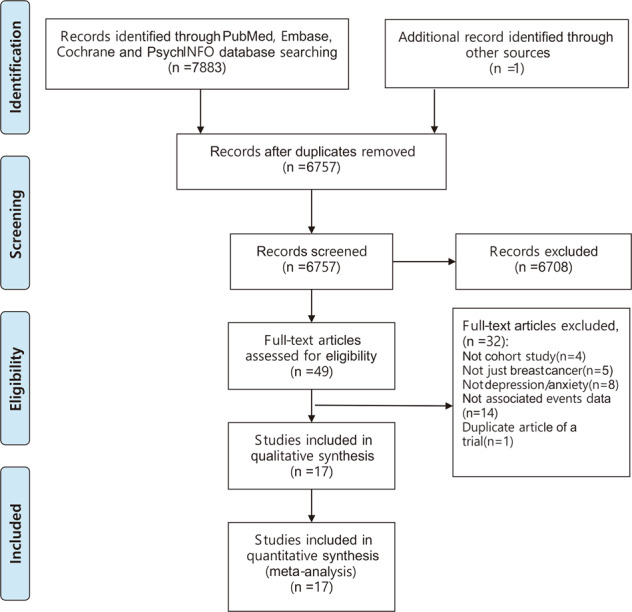
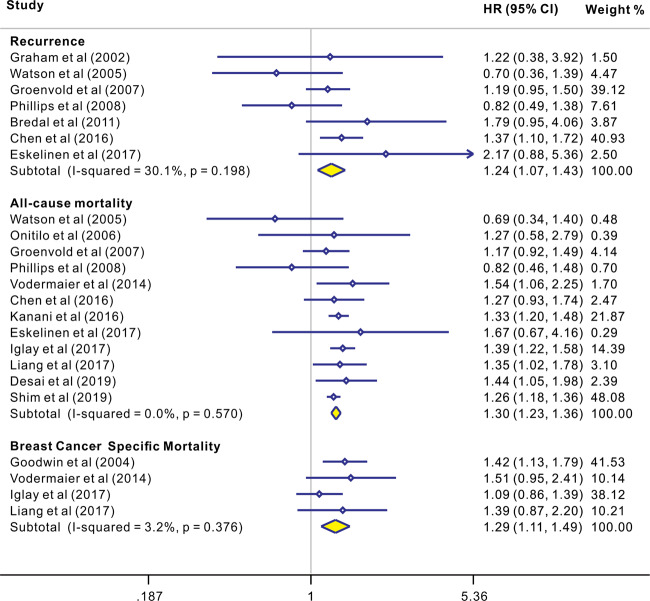
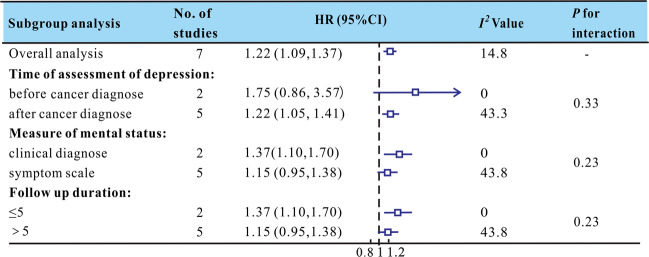
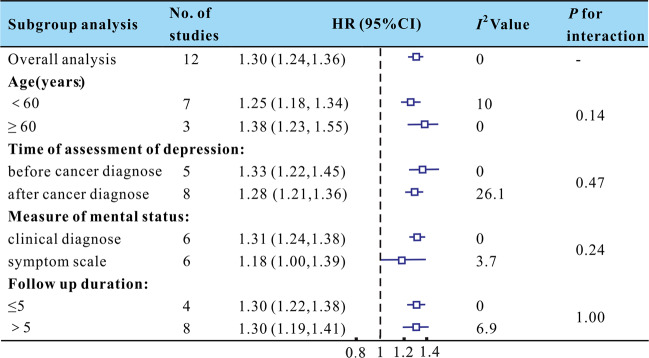
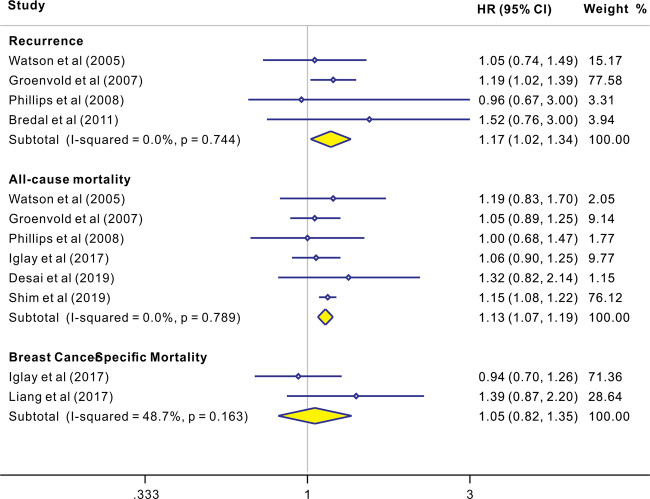
Depression and anxiety are common comorbidities in breast cancer patients. Whether depression and anxiety are associated with breast cancer progression or mortality is unclear. Herein, based on a systematic literature search, 17 eligible studies involving 282,203 breast cancer patients were included. The results showed that depression was associated with cancer recurrence [1.24 (1.07, 1.43)], all-cause mortality [1.30 (1.23, 1.36)], and cancer-specific mortality [1.29 (1.11, 1.49)]. However, anxiety was associated with recurrence [1.17 (1.02, 1.34)] and all-cause mortality [1.13 (1.07, 1.19)] but not with cancer-specific mortality [1.05 (0.82, 1.35)]. Comorbidity of depression and anxiety is associated with all-cause mortality [1.34 (1.24, 1.45)] and cancer-specific mortality [1.45 (1.11, 1.90)]. Subgroup analyses demonstrated that clinically diagnosed depression and anxiety, being female and of younger age (<60 years), and shorter follow-up duration (≤5 years) were related to a poorer prognosis. Our study highlights the critical role of depression/anxiety as an independent factor in predicting breast cancer recurrence and survival. Further research should focus on a favorable strategy that works best to improve outcomes among breast cancer patients with mental disorders.
Overview
The claims and statistics of this paper haven’t been checked yet.
Free: it reads the open-access text and checks the first 5 claims that cite a source we can check. Create a free account to check every claim.
Integrity signals
Registry
Cites
Statistics
Figures
Verification
Claims the paper makes
The claims and statistics of this paper haven’t been checked yet.
Free: it reads the open-access text and checks the first 5 claims that cite a source we can check. Create a free account to check every claim.
Claims other papers make about this one
Each is checked against this paper’s own text: does it say what the citing paper says it does?
The source backs part of the claim, not all of it — or backs it for a different population, condition or comparison.
In the citing paper
“Elevated anxiety predicts nonadherence to recommended therapies, [23][24][25] higher use and costs of medical care, [26][27][28] and possibly cancer recurrence.29”
From Management of Anxiety and Depression in Adult Survivors of Cancer: ASCO Guideline Update (2023) · cites this paper as [29]
Experimental — accuracy not yet measuredThe source backs part of the claim, not all of it — or backs it for a different population, condition or comparison.
In the citing paper
“Meta-analyses report an overall global prevalence of anxiety in BC patients at around 41.9%, with signifcantly higher rates in developing countries like Iran, where it reaches 65.5% [11,12].”
From Internet‐Based Telecare and Bibliotherapy Delivery of Acceptance and Commitment Therapy for Reducing Anxiety and Depression in Breast Cancer Patients: A Randomized Controlled Trial. (2026) · cites this paper as [12]
Experimental — accuracy not yet measured
Self-check
Percentages, sums and reported differences re-computed from the paper’s own numbers.
The self-check needs the paper’s full text.
Citations
Cites
1 retracted
Kamiya, A., Hayama, Y., Kato, S., Shimomura, A., Shimomura, T., Irie, K., Kaneko, R., Yanagawa, Y., Kobayashi, K., & Ochiya, T. (2019) · Nature Neuroscience · doi:10.1038/s41593-019-0430-3 · Cited by 288
RetractedBray, F., Ferlay, J., Soerjomataram, I., Siegel, R. L., Torre, L. A., & Jemal, A. (2018) · CA: A Cancer Journal for Clinicians · doi:10.3322/caac.21492 · Cited by 84,109
Measuring inconsistency in meta-analyses
Higgins, J. P. T., Thompson, S. G., Deeks, J. J., & Altman, D. G. (2003) · BMJ · doi:10.1136/bmj.327.7414.557 · Cited by 63,139
Bias in meta-analysis detected by a simple, graphical test
Egger, M., Smith, G. D., Schneider, M., & Minder, C. (1997) · BMJ · doi:10.1136/bmj.315.7109.629 · Cited by 56,722
Dermyshi, E., Wang, Y., Yan, C., Hong, W., Qiu, G., Gong, X., & Zhang, T. (2017) · Neonatology · doi:10.1159/000454668 · Cited by 24,451
Meta-analysis of Observational Studies in Epidemiology<SUBTITLE>A Proposal for Reporting</SUBTITLE>
Stroup, D. F. (2000) · JAMA · doi:10.1001/jama.283.15.2008 · Cited by 20,623
Stang, A. (2010) · European Journal of Epidemiology · doi:10.1007/s10654-010-9491-z · Cited by 17,396 · cited 1×
“All of the selected articles were examined in terms of quality based on the Newcastle–Ottawa Quality Assessment Scale for cohort studies [41].”
BackgroundRelation of tumor size, lymph node status, and survival in 24,740 breast cancer cases
Carter, C. L., Allen, C., & Henson, D. E. (1989) · Cancer · doi:10.1002/1097-0142(19890101)63:1<181::aid-cncr2820630129>3.0.co;2-h · Cited by 2,288
Nicholson, A., Kuper, H., & Hemingway, H. (2006) · European Heart Journal · doi:10.1093/eurheartj/ehl338 · Cited by 1,353 · cited 1×
“This variation was also found in previous similar meta-analyses of the association between depression in cardiac patients and prognosis [57, 60].”
ResultChronic stress promotes tumor growth and angiogenesis in a mouse model of ovarian carcinoma
Thaker, P. H., Han, L. Y., Kamat, A. A., Arevalo, J. M., Takahashi, R., Lu, C., Jennings, N. B., Armaiz-Pena, G., Bankson, J. A., Ravoori, M., et al. (2006) · Nature Medicine · doi:10.1038/nm1447 · Cited by 1,320
Self-citation
Cited by
Items 201–300 of 510
Cui, C., Liu, H., & Wang, L. (2025) · Cancer Management and Research · doi:10.2147/cmar.s537692 · Cited by 6
Hong, S., Yu, M., Zheng, Y., Wang, S., Zhang, J., Pan, B., Situ, H., Guo, L., Zhong, S., Chen, Y., et al. (2026) · Chinese Medicine · doi:10.1186/s13020-025-01283-y · Cited by 7
“It is noteworthy that comorbid depression can exacerbate breast cancer progression, with a 24% increased risk of recurrence and a 29% increased risk of breast cancer-specific mortality, respectively [7].”
Self-citationDepression, Anxiety and Quality of Life in Patients with Atopic Dermatitis and Psoriasis
Arnīte, A., Bondare-Ansberga, V., Reinberga, L., Hartmane, I., & Mikažāns, I. (2026) · Medicina · doi:10.3390/medicina62010164 · Cited by 5
Nursing Interventions for Symptom Management in Breast Cancer: A Systematic Review
Trisyani, Y., Nuraeni, A., Anna, A., Priambodo, A. P., & Sugiharto, F. (2026) · International Journal of Women s Health · doi:10.2147/ijwh.s573338 · Cited by 12
Microbiota-immune crosstalk underlying cancer-induced depression in patients with breast cancer
Li, Y., Zhu, B., Wu, X., Menge, L., Huang, S., & Wu, K. (2026) · Journal of Affective Disorders · doi:10.1016/j.jad.2026.121694 · Cited by 5
Almeida, S. S., Oliveira, M. A., Medeiros, R., Guerra, M. P., Pariante, C. M., & Fernandes, L. P. N. S. (2023) · PLoS ONE · doi:10.1371/journal.pone.0279344 · Cited by 11
“Depression has been associated with cancer recurrence, all-cause mortality, and cancer-specific mortality [78].”
BackgroundDa, C., Duan, Y., Ji, Z., Chen, J., Xia, H., Weng, Y., Zhou, T., Yuan, C., & Cai, T. (2024) · Supportive Care in Cancer · doi:10.1007/s00520-024-08513-3 · Cited by 9
“In patients with breast cancer, this is a recurring negative event [42].”
Zhang, D., Zhao, W., Yuan, L., Xu, Q., & Bi, H. (2024) · Journal of Pain and Symptom Management · doi:10.1016/j.jpainsymman.2024.10.022 · Cited by 6
Kenkhuis, M., Doorenbos, M., Mast, I. H., Aaronson, N. K., van Beurden, M., Bohus, M., Courneya, K. S., Daley, A., Galvao, D. A., Goedendorp, M. M., et al. (2025) · Supportive Care in Cancer · doi:10.1007/s00520-025-09646-9 · Cited by 12
“Symptoms of depression, which are feeling very sad, hopeless, or empty, and anxiety, which is worrying a lot or feeling scared about the future, can significantly impact treatment compliance, well-being, and even serve as predictors for cancer recurrence and mortality [4].”
Zhang, C., Wang, J., He, Y., Wang, K., Wang, C., Zhang, L., Wu, X., Liang, S., Wu, X., Wei, Y., et al. (2025) · Scientific Reports · doi:10.1038/s41598-025-09908-w · Cited by 5
Vishwakarma, G., Mehta, A., Saifi, M., Garg, D., & Paliwal, D. (2022) · Asian Pacific Journal of Cancer Prevention · doi:10.31557/apjcp.2022.23.7.2469 · Cited by 7
Mokrivala, M., Farahbakhsh, K., Bajestani, H. S., & Burujeni, J. Y. (2022) · Journal of Client-centered Nursing Care · doi:10.32598/jccnc.8.3.408.2 · Cited by 6
Avisar, A., Cohen, M. W., Aharon, A., Katz, R., & Bar‐Sela, G. (2023) · Journal of Psychosomatic Research · doi:10.1016/j.jpsychores.2023.111162 · Cited by 6
Experiencing anxiety in breast cancer survival: Does perceived emotional intelligence matter?
Ruíz-González, P., & Bozal, R. G. (2023) · Psycho-Oncology · doi:10.1002/pon.6140 · Cited by 7
“Thus, the presence of anxiety may be accentuated in BC women.(5) Specifically, Maass et al.”
BackgroundXia, L., Lai, J., Liu, X., Kong, F., Qiu, S., Hu, H., Zhu, S., & Cao, J. (2023) · Translational Cancer Research · doi:10.21037/tcr-23-368 · Cited by 8
“As we know, mood is an important factor influencing the development of breast cancer (20) .”
Bird, M. J., Li, G., MacNeil, A., Jiang, Y., de Groh, M., & Fuller‐Thomson, E. (2023) · Cancer Management and Research · doi:10.2147/cmar.s421675 · Cited by 6
“Cancer patients with depression are more vulnerable to many adverse outcomes when compared to cancer patients without depression, including decreased immune function,(6) lower quality of life,(7) increased emergency department use, longer hospitalizations,(8) and higher mortality.(9) Recent research has emphasized the…”
BackgroundMamczarz, J., Lane, M. V., & Merchenthaler, I. J. (2022) · Hormones and Behavior · doi:10.1016/j.yhbeh.2024.105524 · Cited by 5
Application of the OSNA Technique (One-Step Nucleic Acid Amplification Test) in Breast Cancer
Sychowski, G., Romanowicz, H., & Smolarz, B. (2025) · International Journal of Molecular Sciences · doi:10.3390/ijms26020656 · Cited by 5
Sturm, B., Lock, P. W., Kumar, D., Blokx, W. A. M., & van der Laak, J. A. W. M. (2025) · Journal of Pathology Informatics · doi:10.1016/j.jpi.2025.100448 · Cited by 5
Wang, J., Yue, Z., Bu, J., Quan, S., Guo, R., Wang, M., Shen, J.-D., Li, M., & Li, Y. (2025) · Medical Oncology · doi:10.1007/s12032-025-02919-7 · Cited by 4
“Depression is not only a common comorbidity in breast cancer patients but also contributes to tumor progression through sustained activation of the hypothalamic–pituitary–adrenal axis and the sympathetic nervous system [7–9].”
Senkyunolide H reverses depression-induced breast cancer progression by regulating CXCR2
Wu, Y., Cui, J., Chen, L., Chen, J., Huang, J., Yang, C., Liang, Y., Chen, Q., & Zuo, Q. (2025) · Natural Products and Bioprospecting · doi:10.1007/s13659-025-00543-6 · Cited by 5
“Similarly, increasing amounts of epidemiological evidence have demonstrated that negative emotional states, particularly depressive and anxiety disorders, are associated with elevated risks of both breast cancer incidence and mortality [3].”
Do, M., Evancho, A. M., & Tyler, W. J. (2025) · Scientific Reports · doi:10.1038/s41598-025-30600-6 · Cited by 5
“A large-scale analysis involving 282,203 breast cancer patients found that depression was associated with increased risks of cancer recurrence, all-cause mortality, and cancer-specific mortality 13 .”
Salabat, D., Toutounchian, S., Salabat, D., Babaei, A., Malekshahi, M., Barkhordar, M., & Salehi, Z. (2025) · BMC Cancer · doi:10.1186/s12885-025-15161-1 · Cited by 4
“Regarding pharmacologic management and using antidepressants, the findings are less consistent, with some studies even showing increased mortality in patients with breast cancer using SSRIs [68].”
Korecki, J. R., Ganz, P. A., Partridge, A. H., Wolff, A. C., Petersen, L., Crespi, C. M., & Bower, J. E. (2024) · JCO Oncology Practice · doi:10.1200/op.23.00617 · Cited by 5
Zhang, C., Wang, V., Sarrami, S. M., Reddy, P. D., & Cruz, C. D. L. (2024) · Aesthetic Surgery Journal · doi:10.1093/asj/sjae155 · Cited by 4
Zhang, D., Bi, H., & Zhao, W. (2024) · Journal of Cancer Survivorship · doi:10.1007/s11764-024-01712-1 · Cited by 5
Salmon, P. (2025) · Cambridge University Press eBooks · doi:10.1017/9781009343152 · Cited by 3
Wu, Y., Liang, Y., Cui, J., Chen, J., Huang, J., Yang, C., Zuo, Q., & Chen, Q. (2025) · Journal of Ethnopharmacology · doi:10.1016/j.jep.2025.120636 · Cited by 8
Shen, M., Ye, X., Chen, K., Lei, W., Huang, Y., Wang, J., Sun, J., & Lu, X. (2025) · Drug Design Development and Therapy · doi:10.2147/dddt.s540781 · Cited by 4
“4 Therefore, in addition to cancer management, the diagnosis and treatment should consider reducing physical and psychological stress experienced by these patients.”
Wong, S. S. S., Liu, T. W., & Ng, S. S. M. (2023) · European Journal of Oncology Nursing · doi:10.1016/j.ejon.2023.102399 · Cited by 6
Zhang, Y., He, Y., Pang, Y. K., Su, Z., Wang, Y., Zhou, Y., Lu, Y., Jiang, Y., Han, X., Song, L., et al. (2024) · BMC Psychology · doi:10.1186/s40359-024-01607-x · Cited by 6
“Depression is the primary mood symptom presented by diagnosed cancer patients and is significantly associated with cancer recurrence, all-cause mortality, and cancer-specific mortality in breast cancer patients [17].”
BackgroundCarriero, M. C., Leo, A., Lezzi, A., Lupo, R., Conte, L., Fanizzi, A., Massafra, R., Vitale, E., & Carriero, A. (2024) · Diseases · doi:10.3390/diseases12070141 · Cited by 5
Melink, Z., Lustberg, M. B., Schnell, P., Mezzanotte-Sharpe, J., & Orchard, T. (2024) · Breast Cancer Research and Treatment · doi:10.1007/s10549-024-07457-w · Cited by 7
“Depression and anxiety adversely affect cancer recurrence, survival, and mortality in both breast cancer and other cancer populations based on current meta-analysis [5, 6].”
BackgroundLi, A., Ge, H., Huang, R., Liu, D., Liu, S., Jia, Y., Chai, J., Zheng, X., Liu, L., Chen, G., et al. (2025) · American Journal of Cancer Research · doi:10.62347/pnhn9442 · Cited by 4
“A meta-analysis of depression and breast cancer mortality found that depression was associated with a 30% increase in the risk of all-cause mortality and a 29% increase in the risk of breast cancer-specific mortality [14].”
Pereira, M., Moreira, C. S., Izdebski, P., Dias, A. C. P., Nogueira‐Silva, C., & Pereira, M. G. (2022) · International Journal of Environmental Research and Public Health · doi:10.3390/ijerph19159260 · Cited by 5
“Considering that anxiety is an independent factor for predicting BC recurrence and survival [43], the results are clinically important as they highlight the importance of early intervention in anxiety.”
ResultLi, X., Zhang, Y., & Wang, Y. (2022) · Psychology Health & Medicine · doi:10.1080/13548506.2022.2115083 · Cited by 4
“Regarding the prognostic value of anxiety and depression in patients with cancer, it has been illustrated that depression is correlated with elevated recurrence and cancerous mortality in breast cancer patients (Wang et al., 2020).”
BackgroundXiao, X., Huang, S., Gan, C., Quan, X., Xiang, Y., & Zheng, B. (2023) · Nutrition and Cancer · doi:10.1080/01635581.2023.2186265 · Cited by 4
“Notably, approximately 44% of patients experience depressive symptoms at their first diagnosed, closely associated with surveil outcome in breast cancer (17,18).”
BackgroundChen, G. (2023) · Medicine · doi:10.1097/md.0000000000035157 · Cited by 6
“[5] Depression could result in decreased immune function and prolonged recovery time in patients with BC, seriously affecting the quality of life of patients.”
Lv, L., Zhao, J., WANG, X., XU, L., FAN, Y., WANG, C., Fan, H., & PEI, X. (2023) · Biocell · doi:10.32604/biocell.2023.030742 · Cited by 5
Self-citationMao, X., & Yang, S. (2025) · Frontiers in Nutrition · doi:10.3389/fnut.2025.1624047 · Cited by 3
Ribi, K., Cole, B. F., Fleming, G. F., Walley, B. A., Francis, P. A., Abdi, E. A., Burstein, H. J., Cheng, K. C., Chia, S., Dakhil, S. R., et al. (2025) · Cancer · doi:10.1002/cncr.70094 · Cited by 3
“Wang et al. 11 pointed out that mental distress (i.e., depression and anxiety) was still associated with a poorer prognosis after adjustment for the tumor - related variables from the studies included in their meta - analysis.”
Zhan, D., She, Y., Zhang, X., Zhang, J., Wang, S., Hong, S., Zheng, Y., Wang, N., & Wang, Z. (2025) · Research · doi:10.34133/research.0980 · Cited by 4
Self-citationLi, L., He, Y., Yang, X., & Liu, Y. (2025) · Frontiers in Public Health · doi:10.3389/fpubh.2025.1641075 · Cited by 7
Leung, C. K., Yu, A. P., Bernal, J. D. K., Recchia, F., Fong, D., Wong, S. H., Chan, D. K. C., Capio, C. M., Yu, C. C.-W., Wong, S. W. S., et al. (2025) · British Journal of Sports Medicine · doi:10.1136/bjsports-2025-110371 · Cited by 6
Zhou, B., Ma, H., Li, Y., He, T., Yao, X., Liu, B., Guo, J., Zhang, J., & Zhang, H. (2025) · Brain Behavior and Immunity · doi:10.1016/j.bbi.2025.106171 · Cited by 3
Self-citationDo, M., & Tyler, W. J. (2026) · Frontiers in Oncology · doi:10.3389/fonc.2026.1731999 · Cited by 5
Zhang, M., & Jin, W.-L. (2026) · Cancer Letters · doi:10.1016/j.canlet.2026.218351 · Cited by 4
Liang, H., Li, L., Huang, B., Jiang, R., Cheng, G., Hao, S., & Hao, S. (2024) · Frontiers in Bioscience-Landmark · doi:10.31083/j.fbl2904166 · Cited by 4
He, M., Chen, L., Wang, N., Ma, X., Wang, Y., Zhang, Y., Wang, L., & Zhao, B. (2024) · Clinical and Experimental Obstetrics & Gynecology · doi:10.31083/j.ceog5103055 · Cited by 3
“Due to the negative influence of cancer, women with breast cancer tend to be anxious, fearful, sensitive, and suspicious, may have low tolerance, and fear disease recurrence [19,20].”
BackgroundSelf-citationBao, C., Feng, Y., Huang, J., Wang, Z., Wang, X., Hou, Y., & He, C. (2024) · Clinical Rehabilitation · doi:10.1177/02692155241232399 · Cited by 5
“…include surgery, adjuvant chemotherapy and radiation therapy, which are crucial for improving survival rates 7,8 ; however, patients experience complications during and after treatment, including fatigue, 9 changes in body composition, 10 anxiety and depression 8,11 and decreased quality of life.”
Self-citationZeng, Y., Huang, R., Zhao, L., He, X., & Mao, S. (2024) · Journal of Cancer Research and Clinical Oncology · doi:10.1007/s00432-024-05813-3 · Cited by 5
“…including female gender, substance abuse, history of emotional disorders and other mental illnesses, lack of social support, lower Yixian Zeng and Ruixin Huang authors contributed equally to this work. socioeconomic status, and more advanced illness(Caruso et al. 2017b ; Wang et al. 2020a).”
BackgroundWang, T., Ma, H., Fan, Y., Guo, Y., Huang, L., & Chen, W. (2024) · ALPHA PSYCHIATRY · doi:10.5152/alphapsychiatry.2024.231222 · Cited by 3
“21 The aforementioned evidence suggests the important role of anxiety and depression in cancer populations and other studies have also found that anxiety and depression may be related to trait EI and QoL.”
BackgroundZhang, H., Zhu, Y., Zhu, G., & Yang, S. ‐. (2024) · Integrative Cancer Therapies · doi:10.1177/15347354241285435 · Cited by 3
“19,20 Analysis of the results of the evaluation scales related to PTSD also reveals that the health status, physical functioning, social functioning, daytime energy, mental health, and emotional competence of patients with cancer-caused PTSD are significantly affected.”
BackgroundDistress and inflammation are independently associated with cancer-related symptom severity
Lacourt, T. E., Tripathy, D., Swartz, M. C., LaVoy, E. C. P., & Heijnen, C. J. (2024) · Comprehensive Psychoneuroendocrinology · doi:10.1016/j.cpnec.2024.100269 · Cited by 4
“In addition, up to one-third of breast cancer patients suffer from depression [8,9], which has been linked to poorer survival rates [10].”
Advancements in Organ‐on‐a‐Chip Systems: Materials, Characterization, and Applications
Gunasekaran, B. M., Srinivasan, S., Ezhilan, M., Rajagopal, V., & Nesakumar, N. (2024) · ChemistrySelect · doi:10.1002/slct.202403611 · Cited by 5
Asmussen, F., Hjorth, C. F., Plana‐Ripoll, O., Mailhac, A. C., & Cronin-Fenton, D. P. (2024) · Cancer Epidemiology · doi:10.1016/j.canep.2024.102733 · Cited by 4
Brown, C., Orada, R. B., & Henderson, M. (2024) · Springer eBooks · doi:10.1007/978-3-031-72862-4_6 · Cited by 3
Tang, J., Guo, B., Zhong, C., Chi, J., Fu, J., Lai, J., Zhang, Y., Guo, Z., Deng, S., & Wu, Y. (2025) · BMC Cancer · doi:10.1186/s12885-024-13387-z · Cited by 3
Álvarez-Salvago, F., Atienzar‐Aroca, S., Pujol-Fuentes, C., Figueroa-Mayordomo, M., Molina-García, C., Gutiérrez-García, P., & Medina-Luque, J. (2025) · Cancers · doi:10.3390/cancers17091574 · Cited by 3
“Most studies focus on patients undergoing active treatment or in the early survivorship phase, often overlooking the persistent emotional burden that many LTBCSs continue to experience [7,44].”
Depression and Inflammation in Women With Breast Cancer: Risk and Resilience Factors
Korecki, J. R., Slavich, G. M., Ganz, P. A., Irwin, M. R., Cole, S. W., Crespi, C. M., & Bower, J. E. (2025) · Psychosomatic Medicine · doi:10.1097/psy.0000000000001398 · Cited by 4
Karveli, S., Karademas, E. C., Poulakaki, F., Antonopoulou, Z., Arkadopoulos, N. F., & Markopoulos, C. (2025) · Psycho-Oncology · doi:10.1002/pon.70196 · Cited by 6
“Identifying and addressing factors that contribute to the development of psychological symptoms in breast cancer patients is critical, as these symptoms are linked to adverse outcomes, such as risk of cancer recurrence and mortality [10], and an increased risk of unhealthy alcohol consumption [11].”
Tan, P.-X., Wu, L., Ma, S., Wei, S., Wang, T.-H., Wang, B., Fu, B., Yang, J.-S., Zhao, Q., Li, S., et al. (2025) · Frontiers in Immunology · doi:10.3389/fimmu.2025.1610267 · Cited by 4
Zimmaro, L. A., Sorice, K. A., Handorf, E. A., Daly, M. B., & Reese, J. B. (2022) · Patient Education and Counseling · doi:10.1016/j.pec.2022.02.004 · Cited by 3
Coping with Stress in Neoplastic Diseases
Olejniczak, D., Mularczyk-Tomczewska, P., Klimiuk, K. B., Olearczyk, A., Kielan, A. J., Staniszewska, A., & Osowiecka, K. (2022) · International Journal of Environmental Research and Public Health · doi:10.3390/ijerph19159675 · Cited by 3
“Anxiety as a second common psychiatric symptom was related to a 17% greater risk of cancer recurrence and 13% more risk of all-cause mortality [28].”
BackgroundRecent advances in tumors-on-chips
Dogan, E., Salemizadehparizi, F., Çeçen, B., & Miri, A. K. (2023) · Elsevier eBooks · doi:10.1016/b978-0-323-85671-3.00006-3 · Cited by 4
Hinnen, C., Hochstenbach, S., Mols, F., & Mertens, B. J. A. (2023) · British Journal of Clinical Psychology · doi:10.1111/bjc.12435 · Cited by 4
Bibliometric analysis of research on digestive system tumors and depression
Qu, Y., Nie, D., Song, Y., Cai, X., Gong, Y., Chen, S., Ye, J., & Li, J. (2024) · Frontiers in Psychology · doi:10.3389/fpsyg.2024.1414528 · Cited by 4
Anisman, H., & Kusnecov, A. W. (2022) · Elsevier eBooks · doi:10.1016/b978-0-323-91904-3.00017-3 · Cited by 3
Hague, K. E., Martinez, M. A., & Robbins, M. L. (2024) · Personal Relationships · doi:10.1111/pere.12558 · Cited by 3
“Psychological factors such as chronic stress, anxiety, and depression can also worsen breast cancer prognosis, (Wang et al., 2020) and extensive research has documented that SM women report higher levels of chronic stress than their heterosexual counter-parts (Hatzenbuehler et al., 2020; Meyer,…”
Ning, B., Huang, T., Liu, Y., & Wei, Y. (2024) · Heliyon · doi:10.1016/j.heliyon.2024.e34399 · Cited by 2
“Additionally, previous research has indicated that comorbid depression may be associated with poor prognosis and increased mortality in tumor patients [9 – 11].”
BackgroundDerakshan, N., Taylor, J., & Chapman, B. (2024) · Frontiers in Psychology · doi:10.3389/fpsyg.2024.1403114 · Cited by 2
Diagnostic Efficacy of Tumor Markers AFP, CA19-9, and CEA in Hepatocellular Carcinoma Patients
Tufael, Kar, A., Rashid, M. H. O., Sunny, A. R., Raposo, A., Islam, M. S., Hussain, M. A., Hussen, M. A., Han, H., Coutinho, H. D. M., et al. (2024) · Journal of Angiotherapy · doi:10.25163/angiotherapy.849513 · Cited by 26
Accinni, T., Maraone, A., Bonucci, A., D’Amato, A., Lavalle, C., Bersani, F. S., Severino, P., & Pasquini, M. (2024) · Frontiers in Psychiatry · doi:10.3389/fpsyt.2024.1355031 · Cited by 3
“…studies in patients with oncological diseases or with other chronic illnesses have shown that depressive symptoms and clinically-relevant demoralization were related to a poorer prognosis (13 – 16) and that demoralization, compared to depression, is associated with a higher suicide risk (17).”
BackgroundSun, X., Su, W., Yin, M., & Xia, L. (2024) · Frontiers in Psychology · doi:10.3389/fpsyg.2024.1408941 · Cited by 3
Efficacy of Antidepressants in Depression in Breast Cancer: A Systematic Review and Meta-analysis
Chikkamath, V. C., Kariyannavar, L., Rattehalli, R. D., & Pai, B. S. (2024) · Journal of Psychiatry Spectrum · doi:10.4103/jopsys.jopsys_37_24 · Cited by 2
Hinojo, C., Cantos, B., Antolín, S., Arqueros, C., Díaz-Redondo, T., González, I., Llabrés, E., Ramírez, J. A., Barral, M., Escudero, M., et al. (2024) · Clinical Breast Cancer · doi:10.1016/j.clbc.2024.12.016 · Cited by 2
Wang, Z., Hu, X., Xu, J., Zhou, J., Ou, X., & Chen, M. (2025) · Frontiers in Public Health · doi:10.3389/fpubh.2025.1533073 · Cited by 4
Self-citationYan, C., & Chu, Y. (2025) · Frontiers in Psychiatry · doi:10.3389/fpsyt.2025.1615271 · Cited by 3
Lynch, S., Pender, R., Ingram, C., Finnerty, C., Lowry, D., O’Meara, Y., & Brennan, D. J. (2025) · Cancer Medicine · doi:10.1002/cam4.71047 · Cited by 3
“A growing body of literature [7, 8] links psychological distress in the context of recurrence with diminished quality of life, impaired emotional well-being, accelerated disease progression and reduced survival.”
Tan, Y., Tang, M., Gu, Z., Liu, L., Wu, H. B. K., & Li, M. (2025) · Supportive Care in Cancer · doi:10.1007/s00520-025-09864-1 · Cited by 2
“BC patients suffered from depressive symptoms because of the diagnosis of cancer and related clinical treatment [4].”
Werle, S. P., da Silveira, J., & Guimarães, A. C. D. A. (2025) · Journal of Bodywork and Movement Therapies · doi:10.1016/j.jbmt.2025.08.030 · Cited by 3
Li, Z., Wang, Z., Yang, W., Li, Y., Li, Y., & Xu, E. (2025) · Journal of Ethnopharmacology · doi:10.1016/j.jep.2025.120670 · Cited by 3
Self-citationRoh, T., Verzwyvelt, L. A., Aggarwal, A., Satkunasivam, R., Hasan, N. T., Trisha, N. F., & Hall, C. R. (2025) · Frontiers in Public Health · doi:10.3389/fpubh.2025.1670698 · Cited by 3
Xiong, Y., Li, H., Yu, M., Li, J., & Ye, Z. (2025) · Measurement and Evaluations in Cancer Care · doi:10.1016/j.ymecc.2025.100021 · Cited by 2
Wang, Y., Qi, L., Li, Y., Fu, Q., Ma, H., & Li, L. (2025) · Discover Oncology · doi:10.1007/s12672-025-03737-z · Cited by 2
“A meta-analysis found a significant correlation between depression and higher rates of breast cancer recurrence, all-cause mortality, and cancer-specific mortality [22].”
Risk prediction models for depression in older adults with cancer
Murri, M. B., Sciavicco, G., Specchia, M., Marozzi, M., Muscettola, A., Zaccagnino, B., Kalcev, G., Atzeni, M., Madeddu, C., Sancassiani, F., et al. (2025) · BMC Psychiatry · doi:10.1186/s12888-025-07578-6 · Cited by 3
“While not all patients remain depressed after cancer diagnosis, those who do experience worse prognosis and may even display higher mortality rates [1, 18].”
Du, T., Tang, J., Zhang, H., Liu, Q., & Kong, Y. (2025) · The Breast · doi:10.1016/j.breast.2025.104678 · Cited by 4
“Epidemiologic results indicate that depression is associated with an increased risk of breast cancer [4].”
Kim, D., Lee, H. S., Jeon, S., Oh, J., & Yoon, C. I. (2026) · Epidemiology and Psychiatric Sciences · doi:10.1017/s2045796025100401 · Cited by 2
“Extensive research on women with breast cancer and their psychological distress following diagnosis and treatment has revealed that cancer-related distress should be addressed with proper understanding and adequate emotional support (Irvine et al. , 1991; Wang et al. , 2020).”
InfluentialPerceived stress and post-traumatic growth in breast cancer patients: a moderated mediation model
Cheng, L., Gao, H. Y., Zhou, Z., Li, S., Guo, K., Ye, P., Xu, X., & Zhang, J. (2026) · BMC Psychology · doi:10.1186/s40359-026-03971-2 · Cited by 2
“Cancer patients often face psychological issues such as depression and anxiety, which not only affect their quality of life but also may hurt treatment outcomes [11].”
Self-citationObserved tamoxifen drug interactions are dependent on both CYP2D6 phenotype and inhibitor potency
Keller, D., Medwid, S. J., Legan, R. M., Schwarz, U. I., & Kim, R. B. (2025) · Journal of Pharmacy and Pharmacology · doi:10.1093/jpp/rgaf132 · Cited by 2
Bognár, A. S., Sükös, D. A., Patoni, C., Szalai, E. Á., Teutsch, B., Veres, D. S., Hosszúfalusi, N., Erőss, B. M., Márta, K., & Hegyi, P. J. (2026) · PLoS ONE · doi:10.1371/journal.pone.0348435 · Cited by 2
“Previous studies [68–70] have highlighted the critical role of psychological factors on cancer recurrence and mortality in different types of cancer.”
Does Adjunctive Naturopathic Care Decrease Survival Rates in Breast Cancer Patients?
Block, K. I. (2021) · Integrative Cancer Therapies · doi:10.1177/15347354211058399 · Cited by 2
Quo vadis Psychoonkologie – neue Entwicklungen und wissenschaftliche Schwerpunkte
Zimmermann, T. (2023) · PiD - Psychotherapie im Dialog · doi:10.1055/a-1817-8733 · Cited by 2
“Psychosoziale Komorbiditäten und ein hohes Maß an krebsspezifischem Distress wirken sich negativ auf die Lebensqualität aus und könnten auch den Krankheitsverlauf und die Überlebensraten durch eine geringere Adhärenz, ein erhöhtes Suizidrisiko und mögliche Auswirkungen physiologischer Prozesse wie Stress negativ beein…”
BackgroundSun, W., Shen, J., Sun, R., Zhou, D., & Li, H. (2023) · Psychology Research and Behavior Management · doi:10.2147/prbm.s425055 · Cited by 2
“9%, respectively, and that the mortality risk of patients with breast cancer complicated when depression increased by 18–30%.(7,8,14,15) Depression is an independent predictor of poor breast cancer prognosis, although the results of investigations on patients with breast cancer suffering from anxiety are inconsistent.”
BackgroundChen, Y., Markowitz, J. C., Blanco, C., Hershman, D. L., Zhang, J. T., & Hellerstein, D. J. (2024) · Breast Cancer Research and Treatment · doi:10.1007/s10549-024-07250-9 · Cited by 2
“Moreover, depression impairs BC survival and prognosis [5], depression is associated with poorer oncotherapy adherence and a 24% increased risk of BC recurrence [6].”
Self-citationXu, Q., Qu, B., Li, L., & Chen, Y. (2024) · Frontiers in Public Health · doi:10.3389/fpubh.2024.1368017 · Cited by 3
Guo, L., Hong, S., Wang, X., Wang, S., Wang, N., Wei, X., Situ, H., & Wang, Z. (2024) · Breast Cancer Targets and Therapy · doi:10.2147/bctt.s462296 · Cited by 3
“33 Patients diagnosed with breast cancer often experience suboptimal sleep quality, including delayed sleep onset, early morning awakening, prolonged nocturnal waking periods, unrefreshing sleep, and daytime sleepiness.”
BackgroundSelf-citationThe Effect of Attentional Bias on Emotions in Patients with Breast Cancer
Han, B., Yan, J., Liu, J., Xiong, R., Teng, S., Du, H., Liu, C., Fan, H., Ji, L., Wang, M., et al. (2024) · International Journal of Behavioral Medicine · doi:10.1007/s12529-024-10311-4 · Cited by 3
“Furthermore, anxiety and depression are important factors in predicting breast cancer recurrence [9].”
Gebremariam, A., Addissie, A., Dereje, N., Assefa, M., & Jemal, A. (2024) · JCO Global Oncology · doi:10.1200/go.24.00235 · Cited by 3
de Oliveira, M. D. C., Siqueira, J. M., Santos, A. N., Lemos, E. B., Lemos, E. B., Soares, E. M., & Pimentel, G. D. (2024) · Personalized Medicine in Psychiatry · doi:10.1016/j.pmip.2024.100143 · Cited by 4
Metadata
- Authors
- Wang, X., Wang, N., Zhong, L., Wang, S., Zheng, Y., Yang, B., Zhang, J., Lin, Y., & Wang, Z.
- Affiliations
- Guangzhou University of Chinese Medicine (CN)
- Corresponding author
- Wang, Zhiyu
- Venue
- Molecular Psychiatry
- Published
- 2020-08-20
- Volume
- 25
- Issue
- 12
- Pages
- 3186-3197
- ISSN
- 1359-4184 (ISSN-L)
- 1476-5578
- PMC
- PMC7714689
- OpenAlex
- W3057125992
- Cited by
- 512
- References
- 71
- Citations by year
- 2026: 90 · 2025: 118 · 2024: 116 · 2023: 82 · 2022: 73 · 2021: 31 · 2020: 2
- FWCI
- 7.80
- Type
- journal article
- Language
- en
- Open access
- hybrid
- doi.org
- Licence
- cc-by
- creativecommons.org/licenses/by/4.0 (tdm)
- creativecommons.org/licenses/by/4.0 (vor)
- Locations
- Molecular Psychiatry (publishedVersion, cc-by)
- PubMed Central (publishedVersion, cc-by)
- PubMed (publishedVersion)
- Funders
- Guangdong Provincial Hospital of Traditional Chinese Medicine (81873306, 81703764, 81703749, 20181132, 2018KZDXM022, 2016A030306025, YN2018MJ07, 201904010407, 2018A030310506, YN2018QJ08, 20182044, 2017B030314166, 2017A030310213, 81573651, A1-2606-19-111-009, A1-3002-16-111-003)
- National Natural Science Foundation of China (A1-3002-16-111-003, 2016A030306025, 81703749, 81703764, 81573651, 2018KZDXM022, 81873306, 20181132, YN2018QJ08, YN2018MJ07, 81973526, A1-2606-19-111-009, 201904010407, 2017A030310213, 2017B030314166, 20182044, 2018A030310506)
- Natural Science Foundation of Guangdong Province (A1-3002-16-111-003, 2017B030314166, 81573651, 2017A030310213, 2018KZDXM022, 81703749, 20181132, YN2018MJ07, A1-2606-19-111-009, YN2018QJ08, 81703764, 2016A030306025, 20182044, 2018A030310506, 201904010407, 81873306)
- Department of Education of Guangdong Province (A1-2606-19-111-009, 81703749, 2016A030306025, 2017A030310213, 81573651, A1-3002-16-111-003, 20181132, 2018KZDXM022, 2017B030314166, 20182044, YN2018QJ08, 2018A030310506, 81703764, 201904010407, YN2018MJ07, 81873306)
- Guangzhou University of Chinese Medicine (QNYC20190101)
- Guangzhou University
- Science and Technology Planning Project of Guangdong Province (2017B030314166)
- Topics
- Life Sciences › Biochemistry, Genetics and Molecular Biology › Cancer Research › Cancer, Stress, Anesthesia, and Immune Response
- Health Sciences › Medicine › Oncology › Cancer survivorship and care
- Health Sciences › Medicine › Cardiology and Cardiovascular Medicine › Cardiac Health and Mental Health
- Keywords
- breast cancer, depression, anxiety, tumor recurrence, cancer-specific mortality, all-cause mortality, prognosis, psychiatric comorbidity, psychological distress
- MeSH terms
- Anxiety, Breast Neoplasms, Depression, Female, Humans, Middle Aged, Neoplasm Recurrence, Local, Prognosis
About these checks
Registry, retraction, Cites and statistics results are computed, not judged, with one exception: a printed reference that no index lists is read once by a model before it counts as a citation error. Claims are extracted by a model and kept only when their quote appears verbatim in the text; each cited source is then checked, with a model’s help, for whether it says what the claim relies on. Those verdicts can be wrong — read the claim’s quote and the cited source before relying on one.
Statistics and arithmetic are recomputed, not judged.
Confidence bands are shown only for fields calibrated on our annotated test set. None is calibrated yet, so no band is shown.
What counts as a claim ›How we measure confidence ›How we check this ›
Are you an author, or do you see a problem with this page? Request a review
Data sources
Bibliographic data: Semantic Scholar, OpenAlex, Crossref.
Contains information from the Semantic Scholar Academic Graph Datasets, made available under the ODC Attribution License (ODC-BY 1.0).
Semantic Scholar’s data is described in: Kinney, R., et al. (2023). The Semantic Scholar Open Data Platform. arXiv:2301.10140.
