

Augmentation therapy with minocycline in treatment-resistant depression patients with low-grade peripheral inflammation: results from a double-blind randomised clinical trial
Open accessThe DOI matches its Crossref record; 55 of the 56 references it cites were found in a registry or an index.
Abstract
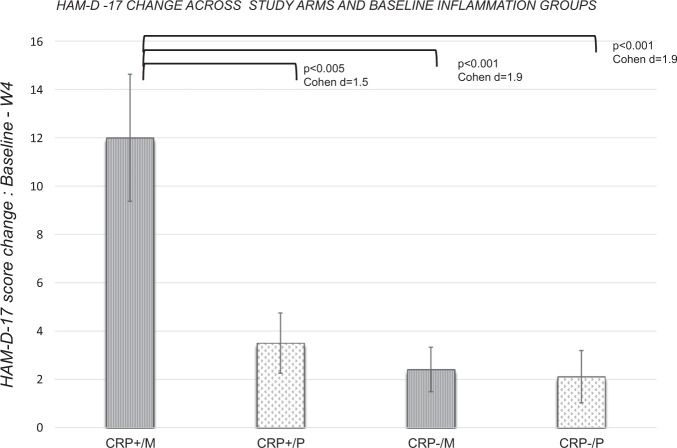
This study aimed to investigate the role of baseline levels of peripheral inflammation when testing the efficacy of antidepressant augmentation with minocycline in patients with treatment-resistant depression. We conducted a 4-week, placebo-controlled, randomised clinical trial of minocycline (200 mg/day) added to antidepressant treatment in 39 patients selected for elevated levels of serum C-reactive protein (CRP ≥ 1 mg/L), n = 18 randomised to minocycline (M) and n = 21 to placebo (P). The main outcome was the change in Hamilton Depression Rating Scale (HAM-D-17) score from baseline to week 4, expressed both as mean and as full or partial response, in the overall sample and after further stratification for baseline CRP≥3 mg/L. Secondary outcomes included changes in other clinical and inflammatory measures. Changes in HAM-D-17 scores and the proportion of partial responders did not differ between study arms. After stratification for CRP levels <3 mg/L (CRP−) or ≥3 mg/L (CRP+), CRP+/M patients showed the largest changes in HAM-D-17 scores (mean ± SD = 12.00 ± 6.45) compared with CRP-/M (2.42 ± 3.20, p < 0.001), CRP+/P (3.50 ± 4.34, p = 0.003) and CRP−/P (2.11 ± 3.26, p = 0.006) patients, and the largest proportion (83.3%, p = 0.04) of partial treatment response at week 4. The threshold point for baseline CRP to distinguish responders from non-responders to minocycline was 2.8 mg/L. Responders to minocycline had higher baseline IL-6 concentrations than non-responders (p = 0.03); IFNγ was significantly reduced after treatment with minocycline compared with placebo (p = 0.03). Our data show some evidence of efficacy of add-on treatment with minocycline in MDD patients but only in those with low-grade inflammation defined as CRP ≥3 mg/L.
Overview
The claims and statistics of this paper haven’t been checked yet.
Free: it reads the open-access text and checks the first 5 claims that cite a source we can check. Create a free account to check every claim.
Integrity signals
Registry
Cites
Statistics
Figures
Verification
Claims the paper makes
The claims and statistics of this paper haven’t been checked yet.
Free: it reads the open-access text and checks the first 5 claims that cite a source we can check. Create a free account to check every claim.
Claims other papers make about this one
Each is checked against this paper’s own text: does it say what the citing paper says it does?
The check wasn’t confident either way, so it gives no verdict — never disputed.
In the citing paper
“The extant evidence supporting lithium and thyroid hormone largely refers to their combination with TCAs and MAOIs in patients with partial response to these agents.”
From Treatment‐resistant depression: definition, prevalence, detection, management, and investigational interventions (2023) · cites this paper as [280]
Experimental — accuracy not yet measuredIn the citing paper
“Subsequent studies by Nettis and colleagues have reported elevated TSPO binding in treatment-resistant depression, and a meta-analysis by Enache and colleagues confirmed a significant overall elevation, particularly in more severe or treatment-resistant presentations [31, 32].”
From Neuroinflammation and depression: immune-brain interface mechanisms, biomarker stratification, and therapeutic strategies (2026) · cites this paper as [32]
In the citing paper
“Preliminary data in treatment-resistant depression with elevated inflammatory markers suggest antidepressant signals in biomarker-enriched populations, with effects most pronounced on anhedonia and fatigue [32].”
From Neuroinflammation and depression: immune-brain interface mechanisms, biomarker stratification, and therapeutic strategies (2026) · cites this paper as [32]
Self-check
Percentages, sums and reported differences re-computed from the paper’s own numbers.
The self-check needs the paper’s full text.
Citations
Cites
Hamilton, M. (1960) · Journal of Neurology, Neurosurgery & Psychiatry · doi:10.1136/jnnp.23.1.56 · Cited by 32,817
(1998) · The Journal of Clinical Psychiatry · Cited by 19,139
(1998) · PubMed · Cited by 10,216
The role of inflammation in depression: from evolutionary imperative to modern treatment target
Miller, A. H., & Raison, C. L. (2016) · Nature Reviews Immunology · doi:10.1038/nri.2015.5 · Cited by 3,942
The clinical global impressions scale: applying a research tool in clinical practice.
Busner, J., & Targum, S. D. (2007) · PubMed Central · Cited by 2,813
Jakobsen, J. C., Gluud, C., Wetterslev, J., & Winkel, P. (2017) · BMC Medical Research Methodology · doi:10.1186/s12874-017-0442-1 · Cited by 2,747
Antidepressant Drug Effects and Depression Severity: A Patient-Level Meta-analysis
Fournier, J. C., DeRubeis, R. J., Hollon, S. D., Dimidjian, S., Amsterdam, J. D., Shelton, R. C., & Fawcett, J. (2010) · JAMA · doi:10.1001/jama.2009.1943 · Cited by 2,009
Frank, E. (1991) · Archives of General Psychiatry · doi:10.1001/archpsyc.1991.01810330075011 · Cited by 1,959
Raison, C. L., Rutherford, R. E., Woolwine, B. J., Shuo, C., Schettler, P., Drake, D. F., Haroon, E., & Miller, A. H. (2013) · JAMA Psychiatry · doi:10.1001/2013.jamapsychiatry.4 · Cited by 1,617
Kennedy, S. H., Lam, R. W., McIntyre, R. S., Tourjman, S. V., Bhat, V., Blier, P., Hasnain, M., Jollant, F., Levitt, A. J., MacQueen, G. M., et al. (2016) · The Canadian Journal of Psychiatry · doi:10.1177/0706743716659417 · Cited by 1,181
Cited by
Major depressive disorder: hypothesis, mechanism, prevention and treatment
Cui, L., Li, S., Wang, S., Wu, X., Liu, Y., Yu, W., Wang, Y., Tang, Y., Xia, M., & Li, B. (2024) · Signal Transduction and Targeted Therapy · doi:10.1038/s41392-024-01738-y · Cited by 1,244
McIntyre, R. S., Alsuwaidan, M., Baune, B. T., Berk, M., Demyttenaere, K., Goldberg, J. F., Gorwood, P., Ho, R., Kasper, S., Kennedy, S. H., et al. (2023) · World Psychiatry · doi:10.1002/wps.21120 · Cited by 836
Self-citationZajkowska, Z., Gullett, N., Walsh, A., Zonca, V., Pedersen, G. A., Souza, L., Kieling, C., Fisher, H. L., Kohrt, B. A., & Mondelli, V. (2022) · Psychoneuroendocrinology · doi:10.1016/j.psyneuen.2021.105625 · Cited by 228
“Furthermore, the hyperactivation of the HPA axis leads to an increase in circulating inflammatory cytokines, which have been widely implicated in the pathogenesis of depression (Dowlati et al., 2010; Hiles et al., 2012; Liu et al., 2012; Nettis et al., 2021; Nikkheslat et al., 2020).”
Self-citationObesity and psychological distress
Steptoe, A., & Frank, P. (2023) · Philosophical Transactions of the Royal Society B Biological Sciences · doi:10.1098/rstb.2022.0225 · Cited by 193
“Furthermore, meta-analytic reviews of the potential anti-depressant role of immunoregulatory drugs in inflammation-related diseases suggest small to moderate effects of non-steroidal anti-inflammatory drugs and anti-cytokine-based drugs in alleviating depressive symptoms [71 – 74].”
BackgroundMithaiwala, M. N., Santana-Coelho, D., Porter, G. A., & O’Connor, J. C. (2021) · Cells · doi:10.3390/cells10061548 · Cited by 190
“For example, in a double-blind randomized clinical trial with treatment resistant depression patients, found augmentation of minocycline (a tetracycline antibacterial) to anti-depressants improved behavioral symptoms in patients with low grade inflammation [31].”
BackgroundYin, Y., Ju, T., Zeng, D., Duan, F., Zhu, Y., Liu, J., Li, Y., & Lu, W. (2024) · Pharmacological Research · doi:10.1016/j.phrs.2024.107322 · Cited by 179
Inflammatory mediators in major depression and bipolar disorder
Poletti, S., Mazza, M. G., & Benedetti, F. (2024) · Translational Psychiatry · doi:10.1038/s41398-024-02921-z · Cited by 163
Neurobiology and systems biology of stress resilience
Kalisch, R., Russo, S. J., & Müller, M. B. (2024) · Physiological Reviews · doi:10.1152/physrev.00042.2023 · Cited by 166
Donoso, F., Cryan, J. F., Olavarría‐Ramírez, L., Nolan, Y. M., & Clarke, G. (2023) · Clinical Pharmacology & Therapeutics · doi:10.1002/cpt.2581 · Cited by 142
Novel drug developmental strategies for treatment‐resistant depression
Borbély, É., Simon, M., Fuchs, E., Wiborg, O., Czéh, B., & Helyes, Z. (2022) · British Journal of Pharmacology · doi:10.1111/bph.15753 · Cited by 106
“The compound has a long half-life time (31–42 h) and shows no accumulation and food does not influence its plasma level (Nicholas et al., 2011).”
BackgroundSkorobogatov, K., De Picker, L., Verkerk, R., Coppens, V., Leboyer, M., Müller, N., & Morrens, M. (2021) · Frontiers in Immunology · doi:10.3389/fimmu.2021.716980 · Cited by 107
Althubaity, N., Schubert, J. J., Martins, D., Yousaf, T., Nettis, M. A., Mondelli, V., Pariante, C. M., Harrison, N. A., Bullmore, E. T., Dima, D., et al. (2021) · NeuroImage Clinical · doi:10.1016/j.nicl.2021.102926 · Cited by 126
Self-citationYe, Z., Kappelmann, N., Moser, S., Davey Smith, G., Burgess, S., Jones, P. B., & Khandaker, G. M. (2021) · eClinicalMedicine · doi:10.1016/j.eclinm.2021.100992 · Cited by 96
Noteworthy perspectives on microglia in neuropsychiatric disorders
Zhu, H., Guan, A., Liu, J., Li, P., Zhang, Z., & Wang, S. (2023) · Journal of Neuroinflammation · doi:10.1186/s12974-023-02901-y · Cited by 105
Réus, G. Z., Manosso, L. M., Quevedo, J., & Carvalho, A. F. (2023) · Neuroscience & Biobehavioral Reviews · doi:10.1016/j.neubiorev.2023.105425 · Cited by 103
Hellmann-Regen, J., Clemens, V., Grözinger, M., Kornhuber, J., Reif, A., Prvulovic, D., Goya-Maldonado, R., Wiltfang, J., Gruber, O., Schüle, C., et al. (2022) · JAMA Network Open · doi:10.1001/jamanetworkopen.2022.30367 · Cited by 100
“Participants had a median (range) duration of the present episode of 41 (6-952) weeks in the minocycline and 52 (4-624) weeks in the placebo group (Table 1).”
BackgroundAdvancing an Inflammatory Subtype of Major Depression
Miller, A. H. (2025) · American Journal of Psychiatry · doi:10.1176/appi.ajp.20250289 · Cited by 100
“Of note, when inflammatory biomarkers such as CRP or IL-6 have been used to stratify samples of patients with depression, as noted above, treatment effects have been observed for infliximab, minocycline, and levodopa, and especially for symptoms related to anhedonia (52, 54, 57, 68).”
Impaired regulatory T cell control of astroglial overdrive and microglial pruning in schizophrenia
Zuelli, F. M. D. G. C., & Deakin, J. F. W. (2021) · Neuroscience & Biobehavioral Reviews · doi:10.1016/j.neubiorev.2021.03.004 · Cited by 93
Microbiota-immune-brain interactions: A lifespan perspective
Ratsika, A., Cruz Pereira, J. S., Lynch, C. M. K., Clarke, G., & Cryan, J. F. (2023) · Current Opinion in Neurobiology · doi:10.1016/j.conb.2022.102652 · Cited by 74
Novel Pharmacological Approaches to the Treatment of Depression
Elias, E., Zhang, A. Y., & Manners, M. T. (2022) · Life · doi:10.3390/life12020196 · Cited by 90
Amasi-Hartoonian, N., Sforzini, L., Cattaneo, A., & Pariante, C. M. (2022) · Current Opinion in Endocrine and Metabolic Research · doi:10.1016/j.coemr.2022.100356 · Cited by 90
Self-citationCaldiroli, A., Capuzzi, E., Tagliabue, I., Capellazzi, M., Marcatili, M., Mucci, F., Colmegna, F., Clerici, M., Buoli, M., & Dakanalis, A. (2021) · International Journal of Molecular Sciences · doi:10.3390/ijms222313070 · Cited by 70
Dietch, D., Kerr‐Gaffney, J., Hockey, M., Marx, W., Ruusunen, A. A., Young, A. H., Berk, M., & Mondelli, V. (2023) · BJPsych Open · doi:10.1192/bjo.2023.36 · Cited by 86
Self-citationNikkheslat, N. (2021) · Brain, Behavior, & Immunity - Health · doi:10.1016/j.bbih.2021.100383 · Cited by 71
Self-citationNeuroinflammation in HIV-associated depression: evidence and future perspectives
Rakshasa-Loots, A. M., Whalley, H. C., Vera, J. H., & Cox, S. R. (2022) · Molecular Psychiatry · doi:10.1038/s41380-022-01619-2 · Cited by 83
“Conversely, administration of minocycline (an anti-inflammatory drug) attenuates depressive symptoms [162], and animal models indicate that minocycline achieves this by inhibiting microglial activation [163, 164].”
Neuroinflammatory basis of depression: learning from experimental models
Afridi, R., & Suk, K. (2021) · Frontiers in Cellular Neuroscience · doi:10.3389/fncel.2021.691067 · Cited by 82
Inflammation, stress and depression: An exploration of ketamine’s therapeutic profile
Johnston, J. N., Greenwald, M. S., Henter, I. D., Kraus, C., Mkrtchian, A., Clark, N. G., Park, L. T., Gold, P. W., Zarate, C. A., & Kadriu, B. (2023) · Drug Discovery Today · doi:10.1016/j.drudis.2023.103518 · Cited by 80
Panizzutti, B., Skvarc, D., Lin, S. C., Croce, S., Meehan, A., Bortolasci, C. C., Marx, W., Walker, A. J., Hasebe, K., Kavanagh, B. E., et al. (2023) · International Journal of Molecular Sciences · doi:10.3390/ijms24065250 · Cited by 75
“[49] suggested again that minocycline effects may be due to its anti-inflammatory properties, showing th t par icipants with high r erum l vels of Creactive protein (CRP) and IL-6 at baseline had a greater reduc ion on HAM-D-17 scores.”
BackgroundInfluentialSickness behaviour and depression: An updated model of peripheral-central immunity interactions
Turkheimer, F., Veronese, M., Mondelli, V., Cash, D., & Pariante, C. M. (2023) · Brain Behavior and Immunity · doi:10.1016/j.bbi.2023.03.031 · Cited by 73
“those with CRP plasma levels >3 mg/L showing the greatest symptomatic improvement (Nettis et al., 2021).”
BackgroundSelf-citationSex hormones and immune system: A possible interplay in affective disorders? A systematic review
Lombardo, G., Mondelli, V., Dazzan, P., & Pariante, C. M. (2021) · Journal of Affective Disorders · doi:10.1016/j.jad.2021.04.035 · Cited by 68
Self-citationMatrix Metalloproteinase-9 as an Important Contributor to the Pathophysiology of Depression
Li, H., Sheng, Z., Khan, S., Zhang, R., Liu, Y., Zhang, Y., Yong, V. W., & Xue, M. (2022) · Frontiers in Neurology · doi:10.3389/fneur.2022.861843 · Cited by 69
Miller, A. H., & Raison, C. L. (2023) · Molecular Psychiatry · doi:10.1038/s41380-022-01887-y · Cited by 67
“In addition, only a few studies have focused on patients as a function of their inflammatory status, and these have yielded more promising results [56, 57, 65, 66].”
Kappelmann, N., Czamara, D., Rost, N., Moser, S., Schmoll, V., Trastulla, L., Štochl, J., Lucae, S., CHARGE inflammation working group, Binder, E. B., et al. (2021) · Brain Behavior and Immunity · doi:10.1016/j.bbi.2021.03.024 · Cited by 68
Simon, M. S., Arteaga-Henríquez, G., Algendy, A. F., Siepmann, T., & Illigens, B. M. W. (2023) · Neuropsychiatric Disease and Treatment · doi:10.2147/ndt.s385117 · Cited by 66
“The benefit of patient stratification is also supported by recently published trials on minocycline and celecoxib.(20,34) An eminent shortcoming is that the trials summarized in the meta-analyses analyzed here included MDD patients regardless of their immune status or other known subtypes.”
ResultRimmerman, N., Verdiger, H., Goldenberg, H., Naggan, L., Robinson, E., Kozela, E., Gelb, S., Reshef, R., Ryan, K. M., Ayoun, L., et al. (2021) · Molecular Psychiatry · doi:10.1038/s41380-021-01338-0 · Cited by 64
Du, Y., Dou, Y., Wang, M., Wang, Y., Yan, Y., Fan, H., Fan, N., Yang, X., & Ma, X. (2024) · Frontiers in Psychiatry · doi:10.3389/fpsyt.2024.1407529 · Cited by 66
Silva, R. C., Pisanu, C., Maffioletti, E., Menesello, V., Bortolomasi, M., Gennarelli, M., Baune, B. T., Squassina, A., & Minelli, A. (2023) · European Neuropsychopharmacology · doi:10.1016/j.euroneuro.2023.07.012 · Cited by 61
The Mind Body Connection in Dermatologic Conditions: A Literature Review
Mar, K., & Rivers, J. K. (2023) · Journal of Cutaneous Medicine and Surgery · doi:10.1177/12034754231204295 · Cited by 61
“8,23 A recent clinical trial of minocycline and metronidazole have also shown positive effects in humans with depression and rats with anxious-depressive behavior, respectively, 24,25 while doxycycline has exhibited antidepressant effects in animal models of depression.”
BackgroundSforzini, L., Marizzoni, M., Bottanelli, C., Kunšteková, V., Zonca, V., Saleri, S., Kose, M., Lombardo, G., Mariani, N., Nettis, M. A., et al. (2024) · Molecular Psychiatry · doi:10.1038/s41380-024-02736-w · Cited by 61
Self-citationAdvancing precision psychiatry and targeted treatments: Insights from immunopsychiatry
Miller, A. H., Berk, M., Bloch, G., Briquet-Laugier, V., Brouillon, C., Cuthbert, B. N., Dantzer, R., Davis, M. C., Picker, L. D., Drevets, W. C., et al. (2025) · Brain Behavior and Immunity · doi:10.1016/j.bbi.2025.01.002 · Cited by 61
Self-citationGiollabhui, N. M., Slaney, C., Hemani, G., Foley, É. M., van der Most, P. J., Nolte, I. M., Snieder, H., Smith, G. D., Khandaker, G. M., & Hartman, C. A. (2025) · Translational Psychiatry · doi:10.1038/s41398-025-03372-w · Cited by 57
Anti-inflammatory medications for the treatment of mental disorders: A scoping review
Fitton, R., Sweetman, J., Heseltine-Carp, W., & van der Feltz-Cornelis, C. (2022) · Brain, Behavior, & Immunity - Health · doi:10.1016/j.bbih.2022.100518 · Cited by 53
Inflammation and Depression: A Public Health Perspective
Chu, A. L., Hickman, M., Steel, N., Jones, P. B., Smith, G. D., & Khandaker, G. M. (2021) · Brain Behavior and Immunity · doi:10.1016/j.bbi.2021.04.015 · Cited by 52
Should Inflammation Be a Specifier for Major Depression in the DSM-6 ?
Jha, M. K., Leboyer, M., Pariante, C. M., & Miller, A. H. (2025) · JAMA Psychiatry · doi:10.1001/jamapsychiatry.2025.0206 · Cited by 50
Self-citationGiollabhui, N. M. (2021) · Brain Behavior & Immunity - Health · doi:10.1016/j.bbih.2021.100278 · Cited by 47
“, 2015) and clinical trials continue to examine the efficacy of anti-inflammatory medications (Nettis et al., 2021).”
BackgroundThe (neuro)inflammatory system in anxiety disorders and PTSD: Potential treatment targets
Sah, A., & Singewald, N. (2025) · Pharmacology & Therapeutics · doi:10.1016/j.pharmthera.2025.108825 · Cited by 48
Antidepressant psychopharmacology: is inflammation a future target?
Benedetti, F., Zanardi, R., & Mazza, M. G. (2022) · International Clinical Psychopharmacology · doi:10.1097/yic.0000000000000403 · Cited by 45
Novel treatments for anorexia nervosa: Insights from neuroplasticity research
Keeler, J. L., Kan, C., Treasure, J. L., & Himmerich, H. (2023) · European Eating Disorders Review · doi:10.1002/erv.3039 · Cited by 45
Brick by Brick: Building a Transdiagnostic Understanding of Inflammation in Psychiatry
Thylur, D. S., & Goldsmith, D. R. (2022) · Harvard Review of Psychiatry · doi:10.1097/hrp.0000000000000326 · Cited by 45
Sforzini, L., Cattaneo, A., Ferrari, C., Turner, L., Mariani, N., Enache, D., Hastings, C. N. M., Lombardo, G., Nettis, M. A., Nikkheslat, N., et al. (2023) · Translational Psychiatry · doi:10.1038/s41398-023-02438-x · Cited by 44
“We have mentioned above that two studies [16, 17] found an antidepressant response to infliximab or to minocycline only in depressed people with CRP values above 3–5mg/L.”
ResultSelf-citationDalechek, D. E., Caes, L., McIntosh, G. L., & Phillips, A. C. (2024) · European Journal of Pain · doi:10.1002/ejp.2232 · Cited by 44
Tremblay, M.-È. (2021) · Brain, Behavior, & Immunity - Health · doi:10.1016/j.bbih.2021.100301 · Cited by 42
“…cells, astrocytes, oligodendrocytes, neurons, and endothelial cells, among other cell types in the brain (Hui et al., 2019; Mattei et al, 2014, 2017; Nettis et al., 2021; Sellgren et al., 2019; Tay et al., 2017a; Vecchiarelli et al., 2021)Crosses the blood-brain barrier Normalizes phagocytosis…”
BackgroundLeón‐Rodríguez, A., Fernández‐Arjona, M. D. M., Grondona, J. M., Pedraza, C., & López-Ávalos, M. D. (2022) · Scientific Reports · doi:10.1038/s41598-022-15617-5 · Cited by 42
Xu, Y., Liang, J., Sun, Y., Zhang, Y., Shan, F., Ge, J., & Xia, Q. (2023) · International Immunopharmacology · doi:10.1016/j.intimp.2023.110108 · Cited by 41
Savitz, J. B., Figueroa‐Hall, L. K., Teague, T. K., Yeh, H., Zheng, H., Kuplicki, R., Burrows, K., El-Sabbagh, N. S., Thomas, M., Ewers, I., et al. (2025) · American Journal of Psychiatry · doi:10.1176/appi.ajp.20240142 · Cited by 40
Ketamine – A New Antidepressant Drug with Anti-Inflammatory Properties
Jóźwiak-Bębenista, M., Sokołowska, P., Wiktorowska‐Owczarek, A., Kowalczyk, E., & Sienkiewicz, M. (2023) · Journal of Pharmacology and Experimental Therapeutics · doi:10.1124/jpet.123.001823 · Cited by 39
Lee, J., Lee, S.-B., Kim, D. W., Shin, N., Jeong, S.-J., Yang, C. H., & Son, C. (2021) · Science Advances · doi:10.1126/sciadv.abj3400 · Cited by 39
The role of inflammation in the pathogenesis of perinatal depression and offspring outcomes
Sawyer, K. M. (2021) · Brain Behavior & Immunity - Health · doi:10.1016/j.bbih.2021.100390 · Cited by 38
“The role of the immune system in the pathogenesis of depression is becoming increasingly important (Kohler et al., 2016; Dowlati et al., 2010; Pitharouli et al., 2021; Nettis et al., 2021).”
BackgroundNettis, M. A. (2021) · Brain Behavior & Immunity - Health · doi:10.1016/j.bbih.2021.100335 · Cited by 37
Self-citationNew Perspectives on Treatment of Depression in Coronary Heart Disease
Carney, R. M., & Freedland, K. E. (2023) · Psychosomatic Medicine · doi:10.1097/psy.0000000000001219 · Cited by 36
“Studies have found that patients with treatment-resistant depression who have elevated CRP levels show improvement in depression when treated with an anti-inflammatory agent, whereas those with low levels of CRP show no benefit (62,63).”
BackgroundHagenberg, J., BeCOME study group, OPTIMA Study Group, Brückl, T. M., Erhart, M., Kopf‐Beck, J., Ködel, M., Rehawi, G., Roeh, S., Sauer, S., et al. (2024) · Brain Behavior and Immunity · doi:10.1016/j.bbi.2024.09.013 · Cited by 36
“While there is some evidence for beneficial effects (K ¨ ohler-Forsberg et al., 2019; Nettis et al., 2021; Savitz et al., 2018), several other studies reported no discernible differences between patients treated with anti-inflammatory medication or those receiving placebos (Hellmann-Regen et al.,…”
Meta-analysis of molecular imaging of translocator protein in major depression
Eggerstorfer, B., Kim, J.-H., Cumming, P., Lanzenberger, R., & Gryglewski, G. (2022) · Frontiers in Molecular Neuroscience · doi:10.3389/fnmol.2022.981442 · Cited by 35
“On the other hand, findings of a recently published randomized clinical trial suggest that the easily available serum CRP levels could serve as a predictive biomarker to screen for MDD patients who might benefit from addon minocycline to antidepressant treatment (Nettis et al., 2021).”
BackgroundGiollabhui, N. M., Madison, A. A., Lydston, M., Quang, E. L., Miller, A. H., & Liu, R. T. (2025) · American Journal of Psychiatry · doi:10.1176/appi.ajp.20241115 · Cited by 38
Depression with immuno-metabolic dysregulation: Testing pragmatic criteria to stratify patients
Zwiep, J. C., Milaneschi, Y., Giltay, E. J., Vinkers, C. H., Penninx, B. W. J. H., & Lamers, F. (2024) · Brain Behavior and Immunity · doi:10.1016/j.bbi.2024.11.033 · Cited by 34
“Finally, since several studies have suggested the use of a CRP > 3 mg/L to stratify participants (Nettis et al., 2021; Baune et al., 2021; Suneson et al., 2024), we examined whether applying this cutoff of AES ≥ 6 + CRP > 3 mg/L would change the profile of our results.”
Zheng, Y., & Xu, L. (2025) · Frontiers in Immunology · doi:10.3389/fimmu.2025.1646740 · Cited by 35
Omega-3 fatty acids for inflamed depression – A match/mismatch study
Suneson, K., Veibäck, G. S., Lindahl, J., Tjernberg, J., Ståhl, D., Ventorp, S., Ängeby, F., Lundblad, K., Wolkowitz, O. M., & Lindqvist, D. (2024) · Brain Behavior and Immunity · doi:10.1016/j.bbi.2024.02.029 · Cited by 33
Picker, L. D., & Haarman, B. C. M. (2021) · European Journal of Nuclear Medicine and Molecular Imaging · doi:10.1007/s00259-021-05308-0 · Cited by 33
Microglia Sing the Prelude of Neuroinflammation-Associated Depression
Li, Q., Xie, Y., Lin, J., Li, M., Gu, Z., Xin, T., Zhang, Y., Lu, Q., Guo, Y., Xing, Y., et al. (2024) · Molecular Neurobiology · doi:10.1007/s12035-024-04575-w · Cited by 33
“The antibiotic minocycline is often tested as an antidepressant in animals [142, 143], and its antidepressant effects have been confirmed in clinical trials as an adjunctive therapy [144–146], and even in treatment-resistant depression [147–149].”
Almulla, A. F., & Maes, M. H. J. (2025) · CNS Drugs · doi:10.1007/s40263-025-01195-3 · Cited by 33
“Minocycline, another repurposed drug, demonstrated potential in treatment-resistant depression with high CRP levels and in SCZ by improving cognitive deficits and reducing proinflammatory cytokines [205, 206].”
Basal and LPS-stimulated inflammatory markers and the course of anxiety symptoms
van Eeden, W. A., Filali, E. E., van Hemert, A. M., Carlier, I. V. E., Penninx, B. W. J. H., Lamers, F., Schoevers, R. A., & Giltay, E. J. (2021) · Brain Behavior and Immunity · doi:10.1016/j.bbi.2021.09.001 · Cited by 34
“there is some evidence for efficacy of add-on treatment with minocycline for treatment resistant depression, but only among those with low-grade inflammation defined as CRP ≥3 mg/L (Nettis et al., 2021).”
Association between hs-CRP and depressive symptoms: a cross-sectional study
Ji, Y., Wang, J., Chen, H., Li, J., & Chen, M. (2024) · Frontiers in Psychiatry · doi:10.3389/fpsyt.2024.1339208 · Cited by 31
Lombardo, G., Nettis, M. A., Hastings, C. N. M., Zajkowska, Z., Mariani, N., Nikkheslat, N., Worrell, C., Enache, D., McLaughlin, A. P., Kose, M., et al. (2022) · Brain Behavior & Immunity - Health · doi:10.1016/j.bbih.2022.100561 · Cited by 32
“Several studies have investigated minocycline efficacy in depression and found that this compound shows efficacy in comparison with placebo in decreasing depressive symptoms, and that it is relatively well-tolerated (Rosenblat and McIntyre 2018; Nettis 2021).”
Self-citationZwiep, J. C., Bet, P. M., Rhebergen, D., Nurmohamed, M. T., Vinkers, C. H., Penninx, B. W. J. H., Milaneschi, Y., & Lamers, F. (2022) · Brain Behavior & Immunity - Health · doi:10.1016/j.bbih.2022.100585 · Cited by 32
Dellink, A., Vanderhaegen, G., Coppens, V., Ryan, K. M., McLoughlin, D. M., Kruse, J. L., van Exel, E. R., van Diermen, L., Belge, J.-B., Aarsland, T. I. M., et al. (2025) · Neuroscience & Biobehavioral Reviews · doi:10.1016/j.neubiorev.2025.106060 · Cited by 30
No increase in inflammation in late-life major depression screened to exclude physical illness
Prak, E. T. L., Brooks, T. G., Makhoul, W., Beer, J. C., Zhao, L., Girelli, T., Skarke, C., & Sheline, Y. I. (2022) · Translational Psychiatry · doi:10.1038/s41398-022-01883-4 · Cited by 30
“This was first suggested by Raison and collaborators [44], replicated by Nettis and collaborators [45], and reviewed by Branchi and collaborators [46].”
MethodEiff, B., Bullmore, E. T., Clatworthy, M. R., Fryer, T. D., Pariante, C. M., Mondelli, V., Maccioni, L., Hadjikhani, N. K., Loggia, M. L., Moskowitz, M. A., et al. (2024) · Brain · doi:10.1093/brain/awae343 · Cited by 28
“21,22 7-12 Microglia, the primary regulators of brain immune activity in both physiological and pathological conditions, play a pivotal role.”
Self-citationSu, W., Hu, T., & Jiang, C. (2023) · Current Neuropharmacology · doi:10.2174/1570159x21666230809112028 · Cited by 29
“Recently, Nettis et al. [150] conducted a 4-week clinical trial of 39 patients with elevated serum CRP levels (hs-CRP ≥ 1 mg/L) to test whether minocycline enhanced antidepressant efficacy in patients with TRD (HDRS score ≥ 14).”
BackgroundTinopanoids K-T, clerodane diterpenoids with anti-inflammatory activity from Tinospora crispa
Zhu, Y.-L., Deng, L., Dai, X.-Y., Song, J., Zhu, Y., Liu, T., Kong, X., Zhang, L., & Liao, H. (2023) · Bioorganic Chemistry · doi:10.1016/j.bioorg.2023.106812 · Cited by 28
Microbiota-Gut-Brain Axis in Psychiatry: Focus on Depressive Disorders
Wang, I.-C., Buffington, S. A., & Salas, R. (2024) · Current Epidemiology Reports · doi:10.1007/s40471-024-00349-z · Cited by 28
“Minocycline is one of the most common antibiotics used in patient treatments [103, 104]; however, it remains in limited use, being reserved for specific populations of depression patients like those with baseline low-grade inflammation [105].”
Shi, L., Xia, Z., Guo, J., Wang, L., Peng, Z., Qiu, D., Zhou, Y., Zhou, D., Kuang, L., & Qiu, T. (2023) · Journal of Affective Disorders · doi:10.1016/j.jad.2023.02.016 · Cited by 27
Forbes, M., O'Neil, A. E., Lane, M. M., Agustini, B., Myles, N., & Berk, M. (2021) · Drugs & Aging · doi:10.1007/s40266-021-00858-2 · Cited by 28
“Finally, minocycline is known to reduce inflammation and has been shown in adult populations to have some efficacy as an add-on treatment in patients with depression and lowgrade inflammation [176, 177].”
BackgroundZhu, Y.-L., Deng, L., Song, J., Zhu, Y. P., Yuan, R.-W., Fan, X.-Z., Zhou, H., Huang, Y.-S., Zhang, L., & Liao, H. (2022) · Organic Chemistry Frontiers · doi:10.1039/d2qo01437h · Cited by 26
Poggini, S., Banqueri, M., Albanese, N. C., Golia, M. T., Ibáñez, F. G., Limatola, C., Fuhrmann, M., Lalowski, M. M., Tremblay, M., Maggi, L., et al. (2022) · Behavioural Brain Research · doi:10.1016/j.bbr.2023.114295 · Cited by 26
Wessa, C., Janssens, J., Coppens, V., Abdellati, K. E., Vergaelen, E., van den Ameele, S., Baeken, C., Zeeuws, D., Milaneschi, Y., Lamers, F., et al. (2024) · Brain Behavior & Immunity - Health · doi:10.1016/j.bbih.2024.100871 · Cited by 26
“…Baune et al. (2021) and Simon et al. (2021), no evidence was found to support the efficacy of add-on CXB. Similarly, subsequent clinical trials investigating adjunctive MCO therapy in MDD have been conducted (total N = 228) (Attwells et al., 2021; Hell-mann-Regen et al., 2022; Nettis et al., 2021).”
BackgroundP2X7 Receptor-Related Genetic Mouse Models – Tools for Translational Research in Psychiatry
Urbina-Treviño, L., von Mücke-Heim, I.-A., & Deussing, J. M. (2022) · Frontiers in Neural Circuits · doi:10.3389/fncir.2022.876304 · Cited by 26
“Although it is known that antiinflammatory mechanisms are involved in the treatment response of depression, current therapies are still mainly “one fits all” approaches targeting monoaminergic pathways (van Buel et al., 2015; Otte et al., 2016; Wohleb et al., 2016; Kruse et al., 2018; Binder, 2020; Nettis et al., 2021…”
BackgroundSmiley, C. E., & Wood, S. K. (2022) · Pharmacology & Therapeutics · doi:10.1016/j.pharmthera.2022.108212 · Cited by 25
Increased inflammation in depression: a little in all, or a lot in a few?
Pariante, C. M. (2021) · American Journal of Psychiatry · doi:10.1176/appi.ajp.2021.21101043 · Cited by 24
Self-citationAdd-on probiotics for inflammatory depression – A double-blind randomized placebo-controlled trial
Veibäck, G. S., Lindahl, J., Suneson, K., Tjernberg, J., Ståhl, D., Landberg, R., Asp, M., Kjellberg, A., Falknäs, F., Sjöberg, K., et al. (2025) · Brain Behavior and Immunity · doi:10.1016/j.bbi.2025.06.002 · Cited by 25
Tyagi, R., & Bartley, C. M. (2025) · Biological Psychiatry · doi:10.1016/j.biopsych.2025.08.022 · Cited by 23
Prenatal and Childhood Immuno-Metabolic Risk Factors for Adult Depression and Psychosis
Kappelmann, N., Perry, B. I., & Khandaker, G. M. (2022) · Harvard Review of Psychiatry · doi:10.1097/hrp.0000000000000322 · Cited by 23
Dogaru, I.-A., Puiu, M. G., Manea, M., & Dionisie, V. (2022) · Brain Sciences · doi:10.3390/brainsci12101403 · Cited by 23
“In addition, higher IL-6 predicted better response, and interferon (IFN)γ was significantly lowered after the intervention, further supporting an anti-inflammatory role of minocycline in alleviating this disease [89].”
BackgroundNettis, M. A., Lombardo, G., Hastings, C. N. M., Zajkowska, Z., Mariani, N., Nikkheslat, N., Sforzini, L., Worrell, C., Begum, A., Brown, M., et al. (2023) · Journal of Psychopharmacology · doi:10.1177/02698811231173588 · Cited by 23
“Our own group (Nettis et al., 2021) found preliminary evidence of effectiveness of add-on treatment with minocycline in patients with treatment-resistant depression (TRD) and increased levels of peripheral inflammation.”
BackgroundMethodResultInfluentialSelf-citationMoriarity, D. P., Mengelkoch, S., & Slavich, G. M. (2023) · Brain Behavior and Immunity · doi:10.1016/j.bbi.2023.06.022 · Cited by 24
Kavakbasi, E., Sampson, E., Mills, N. T., Hori, H., Schwarte, K., Hohoff, C., Schubert, K. O., Clark, S. R., Fourrier, C., & Baune, B. T. (2023) · Journal of Neurochemistry · doi:10.1111/jnc.15946 · Cited by 23
Malhi, G. S., Bell, E., Stavdal, A., Wu, C., Naylor, A., & Kumari, V. (2026) · The Lancet · doi:10.1016/s0140-6736(26)00201-1 · Cited by 23
Current evidence on immune-driven depression
Wessa, C., Simon, M. C. P., & Picker, L. D. (2025) · Current Opinion in Psychiatry · doi:10.1097/yco.0000000000001047 · Cited by 21
Poggini, S., Bon, G. M., Golia, M. T., Albanese, N. C., Viglione, A., Poleggi, A., Limatola, C., Maggi, L., & Branchi, I. (2021) · Behavioural Brain Research · doi:10.1016/j.bbr.2021.113256 · Cited by 21
Tang, Y., Illes, P., Zhang, Y., Yin, H.-Y., & Rubini, P. (2022) · Current Neuropharmacology · doi:10.2174/1570159x20666220302152400 · Cited by 20
The P2X7 receptor in mood disorders: Emerging target in immunopsychiatry, from bench to bedside
von Mücke-Heim, I.-A., & Deussing, J. M. (2022) · Neuropharmacology · doi:10.1016/j.neuropharm.2022.109366 · Cited by 20
Immunological Biomarkers as Predictors of Treatment Response in Psychotic Disorders
Orbe, E. B., & Benros, M. E. (2023) · Journal of Personalized Medicine · doi:10.3390/jpm13091382 · Cited by 19
“…on depression was observed specifically within the subgroup of patients with baseline CRP > 3 mg/L and baseline IL-6 predicted treatment response [105], and a different study on minocycline in bipolar depression found that patients with elevated baseline IL-6 levels responded better to…”
Metadata
- Authors
- Nettis, M. A., Lombardo, G., Hastings, C., Zajkowska, Z., Mariani, N., Nikkheslat, N., Worrell, C., Enache, D., McLaughlin, A., Kose, M., Sforzini, L., Bogdanova, A., Cleare, A., Young, A. H., Pariante, C. M., & Mondelli, V.
- Affiliations
- National Health Service (GB)
- King's College London (GB)
- Corresponding author
- Mondelli, Valeria
- ORCID
- Venue
- Neuropsychopharmacology
- Published
- 2021-01-28
- Volume
- 46
- Issue
- 5
- Pages
- 939-948
- ISSN
- 0893-133X (ISSN-L)
- 1740-634X
- PMC
- PMC8096832
- OpenAlex
- W3119172333
- Cited by
- 235
- References
- 56
- Citations by year
- 2026: 28 · 2025: 38 · 2024: 37 · 2023: 49 · 2022: 42 · 2021: 40
- FWCI
- 24.50
- Type
- journal article
- Language
- en
- Open access
- hybrid
- doi.org
- Licence
- cc-by
- creativecommons.org/licenses/by/4.0 (tdm)
- creativecommons.org/licenses/by/4.0 (vor)
- Locations
- Neuropsychopharmacology (publishedVersion, cc-by)
- PubMed Central (publishedVersion, cc-by)
- PubMed (publishedVersion)
- Research Portal (King's College London) (submittedVersion, other-oa)
- Funders
- NIHR Biomedical Research Centre South London and Maudsley NHS Foundation Trust
- NIHR Biomedical Research Centre South London and Maudsley NHS Foundation Trust and KIng’s College London
- Topics
- Health Sciences › Medicine › Pharmacology (medical) › Treatment of Major Depression
- Life Sciences › Neuroscience › Biological Psychiatry › Tryptophan and brain disorders
- Life Sciences › Neuroscience › Behavioral Neuroscience › Stress Responses and Cortisol
- Keywords
- minocycline, treatment-resistant depression, antidepressant augmentation, C-reactive protein, peripheral inflammation, interleukin-6, interferon-gamma, inflammatory markers
- MeSH terms
- Depression, Double-Blind Method, Humans, Inflammation, Minocycline, Treatment Outcome, Depressive Disorder, Treatment-Resistant
About these checks
Registry, retraction, Cites and statistics results are computed, not judged, with one exception: a printed reference that no index lists is read once by a model before it counts as a citation error. Claims are extracted by a model and kept only when their quote appears verbatim in the text; each cited source is then checked, with a model’s help, for whether it says what the claim relies on. Those verdicts can be wrong — read the claim’s quote and the cited source before relying on one.
Statistics and arithmetic are recomputed, not judged.
Confidence bands are shown only for fields calibrated on our annotated test set. None is calibrated yet, so no band is shown.
What counts as a claim ›How we measure confidence ›How we check this ›
Are you an author, or do you see a problem with this page? Request a review
Data sources
Bibliographic data: Semantic Scholar, OpenAlex, Crossref.
Contains information from the Semantic Scholar Academic Graph Datasets, made available under the ODC Attribution License (ODC-BY 1.0).
Semantic Scholar’s data is described in: Kinney, R., et al. (2023). The Semantic Scholar Open Data Platform. arXiv:2301.10140.
