

Augmentation therapy with minocycline in treatment-resistant depression patients with low-grade peripheral inflammation: results from a double-blind randomised clinical trial
Open accessThe DOI matches its Crossref record; 55 of the 56 references it cites were found in a registry or an index.
Abstract
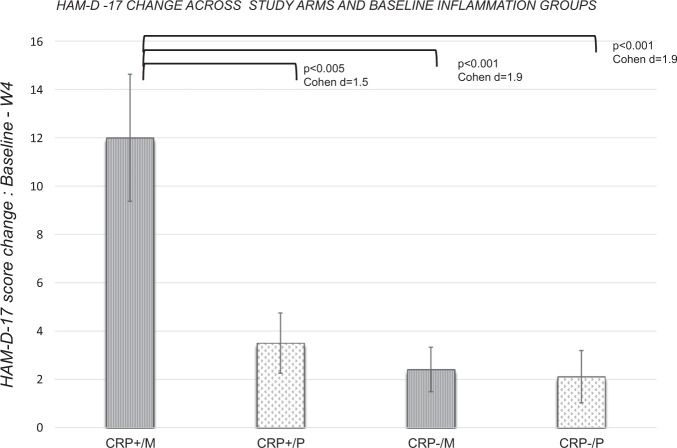
This study aimed to investigate the role of baseline levels of peripheral inflammation when testing the efficacy of antidepressant augmentation with minocycline in patients with treatment-resistant depression. We conducted a 4-week, placebo-controlled, randomised clinical trial of minocycline (200 mg/day) added to antidepressant treatment in 39 patients selected for elevated levels of serum C-reactive protein (CRP ≥ 1 mg/L), n = 18 randomised to minocycline (M) and n = 21 to placebo (P). The main outcome was the change in Hamilton Depression Rating Scale (HAM-D-17) score from baseline to week 4, expressed both as mean and as full or partial response, in the overall sample and after further stratification for baseline CRP≥3 mg/L. Secondary outcomes included changes in other clinical and inflammatory measures. Changes in HAM-D-17 scores and the proportion of partial responders did not differ between study arms. After stratification for CRP levels <3 mg/L (CRP−) or ≥3 mg/L (CRP+), CRP+/M patients showed the largest changes in HAM-D-17 scores (mean ± SD = 12.00 ± 6.45) compared with CRP-/M (2.42 ± 3.20, p < 0.001), CRP+/P (3.50 ± 4.34, p = 0.003) and CRP−/P (2.11 ± 3.26, p = 0.006) patients, and the largest proportion (83.3%, p = 0.04) of partial treatment response at week 4. The threshold point for baseline CRP to distinguish responders from non-responders to minocycline was 2.8 mg/L. Responders to minocycline had higher baseline IL-6 concentrations than non-responders (p = 0.03); IFNγ was significantly reduced after treatment with minocycline compared with placebo (p = 0.03). Our data show some evidence of efficacy of add-on treatment with minocycline in MDD patients but only in those with low-grade inflammation defined as CRP ≥3 mg/L.
Overview
The claims and statistics of this paper haven’t been checked yet.
Free: it reads the open-access text and checks the first 5 claims that cite a source we can check. Create a free account to check every claim.
Integrity signals
Registry
Cites
Statistics
Figures
Verification
Claims the paper makes
The claims and statistics of this paper haven’t been checked yet.
Free: it reads the open-access text and checks the first 5 claims that cite a source we can check. Create a free account to check every claim.
Claims other papers make about this one
Each is checked against this paper’s own text: does it say what the citing paper says it does?
The check wasn’t confident either way, so it gives no verdict — never disputed.
In the citing paper
“The extant evidence supporting lithium and thyroid hormone largely refers to their combination with TCAs and MAOIs in patients with partial response to these agents.”
From Treatment‐resistant depression: definition, prevalence, detection, management, and investigational interventions (2023) · cites this paper as [280]
Experimental — accuracy not yet measuredIn the citing paper
“Subsequent studies by Nettis and colleagues have reported elevated TSPO binding in treatment-resistant depression, and a meta-analysis by Enache and colleagues confirmed a significant overall elevation, particularly in more severe or treatment-resistant presentations [31, 32].”
From Neuroinflammation and depression: immune-brain interface mechanisms, biomarker stratification, and therapeutic strategies (2026) · cites this paper as [32]
In the citing paper
“Preliminary data in treatment-resistant depression with elevated inflammatory markers suggest antidepressant signals in biomarker-enriched populations, with effects most pronounced on anhedonia and fatigue [32].”
From Neuroinflammation and depression: immune-brain interface mechanisms, biomarker stratification, and therapeutic strategies (2026) · cites this paper as [32]
Self-check
Percentages, sums and reported differences re-computed from the paper’s own numbers.
The self-check needs the paper’s full text.
Citations
Cites
Hamilton, M. (1960) · Journal of Neurology, Neurosurgery & Psychiatry · doi:10.1136/jnnp.23.1.56 · Cited by 32,817
(1998) · The Journal of Clinical Psychiatry · Cited by 19,139
(1998) · PubMed · Cited by 10,216
The role of inflammation in depression: from evolutionary imperative to modern treatment target
Miller, A. H., & Raison, C. L. (2016) · Nature Reviews Immunology · doi:10.1038/nri.2015.5 · Cited by 3,942
The clinical global impressions scale: applying a research tool in clinical practice.
Busner, J., & Targum, S. D. (2007) · PubMed Central · Cited by 2,817
Jakobsen, J. C., Gluud, C., Wetterslev, J., & Winkel, P. (2017) · BMC Medical Research Methodology · doi:10.1186/s12874-017-0442-1 · Cited by 2,747
Antidepressant Drug Effects and Depression Severity: A Patient-Level Meta-analysis
Fournier, J. C., DeRubeis, R. J., Hollon, S. D., Dimidjian, S., Amsterdam, J. D., Shelton, R. C., & Fawcett, J. (2010) · JAMA · doi:10.1001/jama.2009.1943 · Cited by 2,009
Frank, E. (1991) · Archives of General Psychiatry · doi:10.1001/archpsyc.1991.01810330075011 · Cited by 1,959
Raison, C. L., Rutherford, R. E., Woolwine, B. J., Shuo, C., Schettler, P., Drake, D. F., Haroon, E., & Miller, A. H. (2013) · JAMA Psychiatry · doi:10.1001/2013.jamapsychiatry.4 · Cited by 1,617
Kennedy, S. H., Lam, R. W., McIntyre, R. S., Tourjman, S. V., Bhat, V., Blier, P., Hasnain, M., Jollant, F., Levitt, A. J., MacQueen, G. M., et al. (2016) · The Canadian Journal of Psychiatry · doi:10.1177/0706743716659417 · Cited by 1,181
Cited by
Items 101–200 of 253
Branchi, I., Viglione, A., Vai, B., Cirulli, F., Benedetti, F., & Poggini, S. (2023) · Neuroscience Applied · doi:10.1016/j.nsa.2023.103923 · Cited by 19
“Several ongoing clinical trials are further exploring this hypothesis (Arteaga-Henriquez et al., 2019; Fourrier et al., 2018; Nettis et al., 2021).”
InfluentialXia, J., Chen, M., Shao, H., Chen, H., Zhu, S., Zhao, M., Luo, W., Yang, J., & Wu, S. (2023) · Frontiers in Bioscience-Landmark · doi:10.31083/j.fbl2812356 · Cited by 19
Zeng, L., zhang, S., Liu, R., Wang, L., & Tan, Y. (2025) · International Journal of Microbiology · doi:10.1155/ijm/6750078 · Cited by 18
“An RCT found depressed patients with low-grade in fl ammation ( CRP ≥ 3 mg/L ) had a 2.5-point greater HAM-D reduction with 4-week minocycline versus placebo ( p = 0 03 ) [51].”
InfluentialInterleukin 6 as a Treatment Target for Depression: A Proof-of-Concept Randomized Clinical Trial
Foley, É. M., Turner, N. L., Margelyte, R., Jones, H. J., Kaşer, M., Lewis, G., Jones, P. B., & Khandaker, G. M. (2026) · JAMA Psychiatry · doi:10.1001/jamapsychiatry.2026.1053 · Cited by 18
Herniman, S. E., Wood, S. J., Khandaker, G. M., Dazzan, P., Pariante, C. M., Barnes, N. M., Krynicki, C. R., Nikkheslat, N., Vincent, R. C., Roberts, A., et al. (2023) · Translational Psychiatry · doi:10.1038/s41398-023-02570-8 · Cited by 18
“Early studies with the anti-in fl ammatory antibiotic, minocycline, produced promising results and bene fi ts have been reported in MDD [31].”
Self-citationQurashi, I., Chaudhry, I. B., Khoso, A. B., Husain, M. O., Hafeez, D., Kiran, T., Lane, S., Naqvi, H., Minhas, F. A., Nizami, A. T., et al. (2023) · Brain Behavior and Immunity · doi:10.1016/j.bbi.2023.10.025 · Cited by 18
“In-vivo imaging of the microglial marker protein TSPO using PET increasingly suggests that microglial inflammation occurs in depression rather than in schizophrenia and recent studies suggest minocycline has antidepressant efficacy (Upmark et al., 2021; Nettis et al., 2021).”
Microbiota-Gut-Brain Axis and Antidepressant Treatment
Lachmansingh, D. A., Lavelle, A., Cryan, J. F., & Clarke, G. A. (2023) · Current topics in behavioral neurosciences · doi:10.1007/7854_2023_449 · Cited by 18
Biomarkers of stress resilience: A review
Paribello, P., Branchi, I., Viglione, A., Mancini, G. F., Morena, M., Campolongo, P., & Manchia, M. (2024) · Neuroscience Applied · doi:10.1016/j.nsa.2024.104052 · Cited by 18
“Minocycline, an antibiotic with anti-inflammatory and neuro-protective effects, shows promise as an adjunctive treatment for depression (Dean et al., 2012; Miyaoka et al., 2012; Nettis et al., 2021; Pae et al., 2008; Soczynska et al., 2012).”
New frontiers in suicide vulnerability: immune system and sex hormones
Lombardo, G. (2021) · Brain Behavior & Immunity - Health · doi:10.1016/j.bbih.2021.100384 · Cited by 17
“Furthermore, TRD patients with higher baseline inflammatory levels (high sensitivity (hs)-CRP 3 mg/L) may benefit from add-on treatment with minocycline, an antibiotic with anti-inflammatory and anti-depressant properties (Rosenblat and McIntyre, 2018; Nettis et al., 2021).”
Self-citationProphylactic Minocycline for Delirium in Critically Ill Patients
Dal‐Pizzol, F., Coelho, A., Simon, C. S., Michels, M., Córneo, E. D. S., Jeremias, A., Damasio, D. D. C., & Ritter, C. (2023) · CHEST Journal · doi:10.1016/j.chest.2023.11.041 · Cited by 17
Towards a consensus roadmap for a new diagnostic framework for mental disorders
Kas, M. J., Hyman, S. E., Williams, L. M., Hidalgo‐Mazzei, D., Huys, Q. J. M., Hotopf, M. H., Cuthbert, B. N., Lewis, C. M., Picker, L. D., Lalousis, P. A., et al. (2024) · European Neuropsychopharmacology · doi:10.1016/j.euroneuro.2024.08.515 · Cited by 17
“The choice of hsCRP as a stratification tool to predict response to immune-targeted augmentation is validated by Proof of Concept studies (Nettis et al., 2021; Porcu et al., 2018; Raison et al., 2013) and its high utilisation potential in clinical practice, representing the first scalable Precision…”
BackgroundMethodMogali, S., Askalsky, P., Madera, G., Jones, J. D., & Comer, S. D. (2021) · Pharmacology Biochemistry and Behavior · doi:10.1016/j.pbb.2021.173241 · Cited by 17
Bloch, Y., Belmaker, R. H., Shvartzman, P., Romem, P., Bolotin, A., Bersudsky, Y., & Azab, A. N. (2021) · Scientific Reports · doi:10.1038/s41598-021-98245-9 · Cited by 17
Anti-Inflammatory Therapy as a Promising Target in Neuropsychiatric Disorders
Ballaz, S., & Bourin, M. (2023) · Advances in experimental medicine and biology · doi:10.1007/978-981-19-7376-5_20 · Cited by 17
Chapter 4. Psychoneuroendocrinology
Sforzini, L., Weston, F. I., & Pariante, C. M. (2024) · American Psychiatric Association Publishing eBooks · doi:10.1176/appi.books.9781615375523.as04 · Cited by 16
Self-citationEdmondson-Stait, A. J., Davyson, E., Shen, X., Adams, M. J., Khandaker, G. M., Miron, V. E., McIntosh, A. M., Lawrie, S. M., Kwong, A. S. F., & Whalley, H. C. (2025) · European Psychiatry · doi:10.1192/j.eurpsy.2025.7 · Cited by 16
“Other clinical trials on anti-inflammatory agents as adjunctive treatment for depression have resulted in mixed results [17 – 20], with effective treatment outcomes more commonly found when stratifying by baseline inflammatory markers [18, 19].”
Marco, R. D., Barritt, A. W., Cercignani, M., Cabbai, G., Colasanti, A., & Harrison, N. A. (2023) · Brain Behavior and Immunity · doi:10.1016/j.bbi.2023.04.010 · Cited by 16
“The mechanism through which minocycline exerts these beneficial effects on sickness behavior is not yet fully understood, though is believed to relate to inhibition of inflammation-induced microglial activation (Nettis, 2021).”
Mandal, G., Kirkpatrick, M., Alboni, S., Mariani, N., Pariante, C. M., & Borsini, A. (2024) · International Journal of Neuropsychopharmacology · doi:10.1093/ijnp/pyae041 · Cited by 15
“Indeed, patients with treatment-resistant depression and a higher inflammatory milieu have a better response to anti-inflammatory medications, including ketamine (Yang et al., 2019; Nettis et al., 2021).”
Self-citationQiu, Y., Duan, A., Yin, Z., Xie, M., Chen, Z., Sun, X., Wang, Z., & Zhang, X. (2023) · Frontiers in Psychiatry · doi:10.3389/fpsyt.2023.1139273 · Cited by 15
“also concluded that the antidepressant effect of minocycline was apparent at 4 weeks (18).”
BackgroundInfluentialSforzini, L. (2021) · Brain Behavior & Immunity - Health · doi:10.1016/j.bbih.2021.100331 · Cited by 15
“In a recent clinical trial, our group demonstrated that minocycline improved depressive symptoms in TRD patients, but only in those with at least low-grade peripheral inflammation (CRP≥3 mg/L) (Nettis et al., 2021).”
Self-citationMcLaughlin, A. P., Lambert, E. R., Milton, R., Mariani, N., Kose, M., Nikkheslat, N., Patsalos, O., Ferraro, L., Chamseddine, G., Panagiotopoulos, S., et al. (2023) · Psychological Medicine · doi:10.1017/s0033291723002283 · Cited by 14
Self-citationSun, R., Tang, M., Yang, D., Zhang, Y.-Y., Xu, Y.-H., Qiao, Y., Yu, B., Cao, S.-X., Wang, H., Huang, H.-Q., et al. (2024) · Progress in Neurobiology · doi:10.1016/j.pneurobio.2024.102614 · Cited by 14
“However, anti-inflammatory treatments may augment antidepressant effects in patients with higher baseline inflammation (Nettis et al., 2021; Raison et al., 2013), suggesting that anti-inflammatory treatment may be suitable for specific subgroups of MDD patients.”
BackgroundDrugs with glutamate-based mechanisms of action in psychiatry
Chrobak, A. A., & Siwek, M. (2024) · Pharmacological Reports · doi:10.1007/s43440-024-00656-8 · Cited by 15
“In a double-blinddouble-blind randomized clinical trial, it has been shown that minocycline responders presented increased serum concentration of Il-6 and low-grade inflammation defined as CRP ≥ 3 mg/l [52].”
InfluentialAkif, A., & Islam, M. R. (2026) · Comprehensive physiology · doi:10.1002/cph4.70100 · Cited by 14
“…agents and microbiota-targeted interventions appear more effective in subsets of patients with elevated baseline CRP or IL-6, whereas effects in unselected samples are modest and inconsistent (Raison et al. 2013; Nettis et al. 2021; Suneson et al. 2024; Söderberg Veibäck et al. 2025).”
Depression interacts with allostatic load to predict cognitive decline in middle age
Perlman, G., Cogo‐Moreira, H., Wu, C., Herrmann, N., & Swardfager, W. (2022) · Psychoneuroendocrinology · doi:10.1016/j.psyneuen.2022.105922 · Cited by 14
“The antibiotic minocycline, known to counteract microglial activation (Nettis, 2021), is currently under investigation as a depression treatment and it may be more effective in people with high baseline CRP levels (Nettis et al., 2021); however, there is minimal evidence for its efficacy on…”
Backgrounddos Santos, B. M., Pereira, G. C., Piton, E., Fialho, M. F. P., Becker, G., Carlotto, M. D. S., Camargo, L. F. M., Ramanzini, L. G., Oliveira, S. M., Trevisan, G., et al. (2022) · Behavioural Brain Research · doi:10.1016/j.bbr.2022.113815 · Cited by 14
The future of immunopsychiatry: Three milestones to clinical innovation
Picker, L. D. (2021) · Brain Behavior & Immunity - Health · doi:10.1016/j.bbih.2021.100314 · Cited by 13
“Creactive protein) (Nettis et al., 2021) Multi-arm/multi-stage trials(Husain et al.”
Jiang, L., Hao, J., Yang, X., Zhu, J., Wang, Y., Huang, Y., Sun, Y., Mao, Y., Ni, K., Gu, X., et al. (2022) · Neurochemical Research · doi:10.1007/s11064-022-03731-9 · Cited by 13
“Further, research into novel treatments for pain and mood disorders in clinical studies have shown that minocycline has potential as a critical therapeutic drug for pain-related mood disorders [37, 38].”
BackgroundAichholzer, M., Gangadin, S. S., Sommer, I. E., Wijkhuijs, A. J. M., de Witte, L. D., Kahn, R. S., Bahn, S., Drexhage, H. A., & Schiweck, C. (2022) · Brain Behavior & Immunity - Health · doi:10.1016/j.bbih.2022.100551 · Cited by 13
Noortgate, M. V. D., Eede, F. V. D., Coppens, V., Giltay, E. J., Picker, L. D., & Morrens, M. (2025) · Brain Behavior & Immunity - Health · doi:10.1016/j.bbih.2025.100965 · Cited by 12
Selective aryl hydrocarbon receptor modulators can act as antidepressants in obese female mice
Debler, R. A., Madison, C. A., Hillbrick, L., Gallegos, P. L., Safe, S. H., Chapkin, R. S., & Eitan, S. (2023) · Journal of Affective Disorders · doi:10.1016/j.jad.2023.04.044 · Cited by 12
Strawbridge, R., Izurieta, E., Day, E., Tee, H., Young, K., Tong, C. C. H. Y., Young, A. H., & Cleare, A. J. (2022) · Neuroscience Applied · doi:10.1016/j.nsa.2022.101014 · Cited by 12
“Suggestions that anti-in fl ammatory treatments can alleviate depression (Jones et al., 2020; Nettis et al., 2021) led to a systematic review examining whether people with dysregulated in fl ammation may respond better to treatments classi fi ed as anti-in fl ammatory (Yang et al., 2019): This previous…”
Self-citationSanadgol, N., Feriz, A. M., Lisboa, S. F. D. S., & Joca, S. R. L. (2023) · Life Sciences · doi:10.1016/j.lfs.2023.122025 · Cited by 11
Chandra, A., Miller, B. J., & Goldsmith, D. R. (2023) · Brain Behavior and Immunity · doi:10.1016/j.bbi.2023.08.001 · Cited by 11
Shamim, M. A., Manna, S., Dwivedi, P., Swami, M. K., Sahoo, S., Shukla, R. K. G., Srivastav, S., Thaper, K., Saravanan, A., Anil, A., et al. (2023) · Medicine · doi:10.1097/md.0000000000035937 · Cited by 11
“In both the outcomes of this study, [66] we answered the first 2 signaling questions under the third domain negatively.”
BackgroundMoriarity, D. P. (2021) · Brain Behavior & Immunity - Health · doi:10.1016/j.bbih.2021.100288 · Cited by 11
“Additionally, inflammation might be a viable adjunctive treatment target (Nettis et al., 2021).”
BackgroundInfluentialHasebe, K., Mohebbi, M., Gray, L. J., Walker, A. J., Bortolasci, C. C., Turner, A., Berk, M., Walder, K. R., Maes, M. H. J., Kanchanatawan, B., et al. (2021) · Acta Neuropsychiatrica · doi:10.1017/neu.2021.44 · Cited by 11
Bravi, B., Paolini, M., Maccario, M., Milano, C., Raffaelli, L., Melloni, E. M. T., Zanardi, R., Colombo, C., & Benedetti, F. (2024) · Psychiatry and Clinical Neurosciences · doi:10.1111/pcn.13764 · Cited by 10
Sæther, L. S., Ueland, T., Haatveit, B. C., Vaskinn, A., Flaaten, C. B., Mohn, C., Ormerod, M. B. E. G., Aukrust, P., Melle, I. S., Steen, N. E., et al. (2024) · Psychological Medicine · doi:10.1017/s003329172400206x · Cited by 10
Anti-inflammatories for depression: challenges and ASPIRations
Worrell, C., Baune, B. T., Benedetti, F., Cattaneo, A., Picker, L. D., Felger, J. C., Gold, S. M., Lamers, F., Leboyer, M., Lombardo, G., et al. (2025) · The Lancet Psychiatry · doi:10.1016/s2215-0366(25)00308-6 · Cited by 9
“For example, a CRP concentration above 3 mg/L predicts response to 4 weeks of minocycline 9 and 12 weeks of infliximab, especially in symptoms related to reward, 3 but does not predict response to 6 weeks of celecoxib 10 or 12 weeks of simvastatin, 7 assessed as changes in total depressive symptoms…”
Self-citationDalechek, D. E., Caes, L., McIntosh, G. L., & Phillips, A. C. (2023) · Scientific Reports · doi:10.1038/s41598-023-44874-1 · Cited by 9
“In terms of implications for future treatment, there is some support for additive therapy with anti-inflammatory medication for treatment-resistant depression; however, this was only true for patients with low-level inflammation (CRP ≥ 3 mg/L) 23–25 .”
BackgroundRecent advances in the psychopharmacology of major depressive disorder
Alexander, L., & Young, A. H. (2022) · BJPsych Advances · doi:10.1192/bja.2022.14 · Cited by 9
Self-citationIs the Neuroimmune System a Therapeutic Target for Opioid Use Disorder? A Systematic Review
Toloff, K., & Woodcock, E. A. (2022) · Medical Research Archives · doi:10.18103/mra.v10i8.2955 · Cited by 8
“Finally, there is some evidence that minocycline may exhibit some cognitive-and mood-enhancing properties, especially with repeated/daily dosing 99,101,102 , and thus, therapeutic benefits may be indirect and may not manifest immediately.”
BackgroundWalker, A. J., Mohebbi, M., Maes, M. H. J., Berk, M., Walder, K. R., Bortolasci, C. C., Liu, Z. S.-J., Ng, C. H., Ashton, M. M., Berk, L., et al. (2022) · Brain Behavior & Immunity - Health · doi:10.1016/j.bbih.2022.100581 · Cited by 8
“Within-groups mean increase in IL-8/CXCL8 was also significant for the minocycline treated group (Nettis et al., 2021).”
BackgroundInfluentialEarly life adversities, psychopathologies and novel pharmacological strategies
Cattaneo, A., Begni, V., Zonca, V., & Riva, M. A. (2024) · Pharmacology & Therapeutics · doi:10.1016/j.pharmthera.2024.108686 · Cited by 8
What can the psychoneuroimmunology of yoga teach us about depression's psychopathology?
Chiarpenello, C., & Brodmann, K. (2024) · Brain Behavior & Immunity - Health · doi:10.1016/j.bbih.2024.100877 · Cited by 8
“Studies investigating anti-inflammatory medications ’ efficacy in TRD found mixed results (Beckett and Niklison-Chirou ; Nettis et al., 2021; Miller and Pariante, 2020), possibly because of the multifactorial nature of inflammation and the complexity of its interactions with brain function…”
BackgroundResultTargeting TNIP1 as a new therapeutic avenue for major depressive disorder
Hung, Y.-Y., Tsai, C.-Y., Lee, C.-T., Fu, H., Chou, C., Yang, Y.-C., Chen, J., & Kang, H. (2025) · Brain Behavior and Immunity · doi:10.1016/j.bbi.2025.02.015 · Cited by 8
“…known for its broader anti-inflammatory properties and established effectiveness in treating MDD (Dean et al., 2017; Fitton et al., 2022; Husain et al., 2020; Nettis et al., 2021), was also reported to transform microglia phenotypes through modulation of TNFAIP3 expression (Gao et al., 2021).”
Setting national research priorities for difficult-to-treat depression in the UK between 2021-2026
Chapman, N., Browning, M. D., Baghurst, D., Hotopf, M. H., Willis, D., Haylock, S., Zakaria, S., Speechley, J., Withey, J. R., Brooks, E., et al. (2022) · Journal of Global Health · doi:10.7189/jogh.12.09004 · Cited by 8
MacKenzie, G., Subramaniam, S., Caldwell, L. J., Fitzgerald, D. C., Harrison, N. A., Hong, S. Y., Irani, S. R., Khandaker, G. M., Liston, A., Miron, V. E., et al. (2021) · Wellcome Open Research · doi:10.12688/wellcomeopenres.16997.1 · Cited by 9
Self-citationHigher Seasonal Variation of Systemic Inflammation in Bipolar Disorder
Dallaspezia, S., Cardaci, V., Mazza, M. G., LORENZO, R. D., Rovere, P. Q., Colombo, C., & Benedetti, F. (2024) · International Journal of Molecular Sciences · doi:10.3390/ijms25084310 · Cited by 8
“…celecoxib, low-dose interleukin 2) can boost antidepressant response in patients not responding to conventional monoaminergic antidepressants [22–25], possibly depending on the basal levels of inflammation or on other not-yet-studied predictive factors [23,26,27], and thus raising the…”
BackgroundMondelli, V., Cattaneo, A., Nikkheslat, N., Souza, L., Walsh, A. E. L., Zajkowska, Z., Zonca, V., Marizzoni, M., Fisher, H. L., Kohrt, B. A., et al. (2021) · Brain Behavior & Immunity - Health · doi:10.1016/j.bbih.2021.100396 · Cited by 7
“We will use the same technique and instrument used for measuring these cytokines in the baseline samples and already reported in detail in other publications (Enache et al., 2021; Nettis et al., 2021).”
MethodSelf-citationAnmella, G., Meehan, A., Ashton, M. M., Mohebbi, M., Fico, G., Ng, C. H., Maes, M. H. J., Berk, L., Prisco, M. D., Singh, A., et al. (2023) · Clinical Psychopharmacology and Neuroscience · doi:10.9758/cpn.23.1098 · Cited by 7
“One study [25] found that participants with elevated C-reactive protein (CRP) at base-line receiving minocycline showed significantly improved response in depressive symptoms at 4-week as well as higher interleukin (IL)-6 concentrations compared to those without elevated CRP [68].”
BackgroundMelink, Z., Lustberg, M. B., Schnell, P., Mezzanotte-Sharpe, J., & Orchard, T. (2024) · Breast Cancer Research and Treatment · doi:10.1007/s10549-024-07457-w · Cited by 7
“Interestingly, after stratifying the participants by C-Reactive Protein (CRP) level, they did find that minocycline attenuated depressive symptoms in the high inflammation group (CRP > 3 mg) [59].”
BackgroundResultInfluentialEfficacy of Minocycline in Depression: A Systematic Review and Meta-analysis
Huang, H., Zou, Z., & Chen, B. (2025) · Clinical Neuropharmacology · doi:10.1097/wnf.0000000000000618 · Cited by 5
Lessons From Clinical Trials of Immunomodulatory Drugs in Psychiatric Disorders
Pak, T. K., Haque, N., & Jha, M. K. (2025) · Biological Psychiatry · doi:10.1016/j.biopsych.2025.11.009 · Cited by 6
Radkowski, M., Kryczka, T., Szymańska, B., Berak, H., Horban, A., Pawłowski, T., Perlejewski, K., & Laskus, T. (2023) · International Journal of Molecular Sciences · doi:10.3390/ijms242015351 · Cited by 6
Repurposing Anti-inflammatory Agents for Mood Disorders: an Updated Review of Current Evidence
Kittur, M. E., Jones, B. D. M., Dai, N., Mahboob, M., & Husain, M. I. (2022) · Current Treatment Options in Psychiatry · doi:10.1007/s40501-022-00267-1 · Cited by 6
The Tale of Depression and Inflammation Unraveled: On Depression Measurement Levels and Next Steps
Lamers, F. (2022) · Biological Psychiatry · doi:10.1016/j.biopsych.2022.11.007 · Cited by 6
Felger, J. C. (2023) · Advances in neurobiology · doi:10.1007/978-3-031-21054-9_16 · Cited by 6
Is there a place for cellular therapy in depression?
do Prado‐Lima, P. A. S., Costa‐Ferro, Z. S. M., Souza, B. S. D. F., da Cruz, I. B. M., & Lab, B. (2021) · World Journal of Psychiatry · doi:10.5498/wjp.v11.i9.553 · Cited by 6
Lombardo, G., Belcastro, S., Mondelli, V., & Gianotti, L. (2023) · L Endocrinologo · doi:10.1007/s40619-023-01379-3 · Cited by 5
Self-citationImmune links in comorbid depression and psoriasis: A narrative mini-review and perspective
Lada, G. (2025) · Brain Behavior & Immunity - Health · doi:10.1016/j.bbih.2025.100949 · Cited by 5
Cuní‐López, C., Stewart, R., Okano, S., Redlich, G. L., Appleby, M. W., White, A. R., & Quek, H. (2025) · Scientific Reports · doi:10.1038/s41598-025-92593-6 · Cited by 5
“This 20% cut-off was chosen based on the results of a randomised controlled trial that showed an average 20% reduction of IFN-γ and IL-10 plasma levels in depression patients following treatment with minocycline for 4 weeks 21 .”
Pawłowski, T., Radkowski, M., Perlejewski, K., Szymańska, B., Berak, H., Horban, A., & Laskus, T. (2025) · PLoS ONE · doi:10.1371/journal.pone.0320221 · Cited by 5
“Furthermore, such drugs as celecoxib, which is cyclooxygen-ase 2 inhibitor, and tetracycline antibiotic minocycline, which is an inhibitor of microglial inflammatory activation, were found to have antidepressant effects [41,42].”
Moriarity, D. P., Perkins, E. R., & Joyner, K. J. (2025) · Biological Psychiatry · doi:10.1016/j.biopsych.2025.04.015 · Cited by 5
Shaik, A. A., Panthagani, P., Liu, X., Navarro, S., Garza, J., Aguilera, M., Sanchez, J., Gupta, K., Hamood, A. N., Reid, T. W., et al. (2025) · Journal of Pharmacology and Experimental Therapeutics · doi:10.1016/j.jpet.2025.103748 · Cited by 5
Premature aging in serious mental illness
Diniz, B. S., Fries, G. R., Kuo, C.-L., Xu, M., & Lenze, E. J. (2026) · Neuropsychopharmacology · doi:10.1038/s41386-026-02322-4 · Cited by 5
Biomarkers associated with treatment outcome in young people with depression: A systematic review
Zierotin, A., Mondelli, V., & Zajkowska, Z. (2024) · Neuroscience Applied · doi:10.1016/j.nsa.2024.104082 · Cited by 5
“This is in line with the recent findings from a clinical trial in adults, looking at minocycline as an add-on treatment to existing antidepressant medication, which showed that responders to minocycline had higher baseline IL-6 levels compared with non-responders (Nettis et al., 2021).”
Self-citationCorrelation Analysis between Serum NLRP1 Inflammasome and Depression in Acute Stage of Stroke
Li, S., Geng, K., Yang, L., Zhang, Y., Tao, X., Cai, J., Li, L., Luo, Z., Mahato, B., Liu, Y., et al. (2025) · NeuroImmunoModulation · doi:10.1159/000546439 · Cited by 5
Heseltine-Carp, W., Dale, V., van der Sluijs, J. V. E., & Feltz-Cornelis, C. M. V. D. (2022) · Journal of Psychiatric Research · doi:10.1016/j.jpsychires.2022.11.026 · Cited by 5
Caution is advised when interpreting subgroup analyses
Munkholm, K., & Paludan‐Müller, A. S. (2021) · Neuropsychopharmacology · doi:10.1038/s41386-021-01025-2 · Cited by 5
“In their randomized trial of augmentation therapy with minocycline for depression in patients considered treatment-resistant and with levels of serum C-reactive protein (CRP) ≥ 1mg/L, Nettis and colleagues found no effect of the treatment on their primary outcome, the change in Hamilton Depression Rating Scale (HAMD17…”
BackgroundTang, L., Gong, X., Wei, X., Tang, R., Ren, Y., Zhao, P., Xie, C., Cheng, W. D., Zhu, R., Tang, Y., et al. (2025) · Biological Psychiatry · doi:10.1016/j.biopsych.2025.10.004 · Cited by 4
Zhang, Y., Teng, M., He, W., Li, L., Zhang, Y., Wang, S., Wang, C., & Wang, D. (2026) · Advanced Science · doi:10.1002/advs.202517873 · Cited by 5
“Evidence indicates its therapeutic effects involve suppression of downstream inflammatory mediators, with enhanced benefits observed in patients exhibiting elevated inflammation [ 47 ].”
Chen, M.-H., Su, T., Lin, W.-C., Li, C., Wu, H.-J., Tsai, S., Bai, Y., Mao, W., & Tu, P. (2024) · Pharmacopsychiatry · doi:10.1055/a-2499-7207 · Cited by 4
“By contrast, Nettis et al. demonstrated that minocycline had antidepressant effects in patients with TRD with CRP levels of ≥ 3 mg/L [23].”
Li, G., Hu, L., Gu, X., Zhu, W., Zhen, X., & Sun, X. (2024) · Neurochemical Research · doi:10.1007/s11064-024-04111-1 · Cited by 4
Malys, M. K., & Mondelli, V. (2022) · Harvard Review of Psychiatry · doi:10.1097/hrp.0000000000000318 · Cited by 4
Self-citationUsing the Power of a Giant Wisely: Confirming Inflammation in Depression
Penninx, B. W. J. H. (2021) · American Journal of Psychiatry · doi:10.1176/appi.ajp.2021.21040332 · Cited by 4
Investigating the Antidepressant Mechanism of Acupuncture with a Focus on Mitochondrial Homeostasis
Wei, Y., Ma, Z., Xu, N., He, Y., Cao, M., & Wang, L. (2026) · International Journal of General Medicine · doi:10.2147/ijgm.s584012 · Cited by 3
Lindahl, J., Veibäck, G. S., Suneson, K., Blanking, W., Tjernberg, J., Ståhl, D., Wiman, Å., Ventorp, F., Erhardt, S., & Lindqvist, D. (2026) · Brain Behavior & Immunity - Health · doi:10.1016/j.bbih.2026.101221 · Cited by 5
“Previous studies have used hs-CRP cut-offs of either ≥ 1 mg/L (Jha et al., 2017; Nettis et al., 2021; Pan et al., 2022; Soderberg Veiback et al., 2025) or > 3 mg/L (Felger et al., 2020; Rapa-port et al., 2016; Suneson et al., 2023) to define low-grade inflammation in depression.”
Inflammation in treatment-resistant depression: From mechanisms to therapeutics
Wu, S., Gao, X., Zhou, Y., Lin, Z., Chen, C. H., Luo, J., Liu, X., Lin, L., 邵红伟, & Liu, S. (2026) · Brain Research Bulletin · doi:10.1016/j.brainresbull.2026.111953 · Cited by 3
Atypical Tetracyclines Promote Longevity and Ferroptotic Neuroprotection via Translation Attenuation
Clay, K. J., Sánchez-Alavez, M., Newman, I., Na, N., Espinoza, A. P. V., To, A., Saad, S., Cline, H. T., & Petrascheck, M. (2026) · Aging Cell · doi:10.1111/acel.70587 · Cited by 3
Rakshasa-Loots, A. M., Diteko, G., Dowell, N. G., Ronen, I., & Vera, J. H. (2025) · Brain and Neuroscience Advances · doi:10.1177/23982128251335792 · Cited by 3
“Conversely, anti-inflammatory medications can alleviate depressive symptoms (Cai et al., 2020; Nettis et al., 2021).”
Depression’s double hit: immune dysfunction and viral reactivation
Savitz, J. B. (2025) · Philosophical Transactions of the Royal Society B Biological Sciences · doi:10.1098/rstb.2024.0409 · Cited by 3
Can (immune and other) gene expression help us to treat depression?
Mariani, N. (2021) · Brain Behavior & Immunity - Health · doi:10.1016/j.bbih.2021.100323 · Cited by 3
“…is consistent with our research showing transient depressive symptoms following administration of a pro-in fl ammatory challenge (Nettis et al., 2020) improved antidepressant response by the anti-in fl ammatory, minocycline, in patients with high levels of in fl am-mation (Nettis et al., 2021).”
Self-citationYang, Y., Rong, J., Zhang, Y., Zhu, Y., Wang, X., Sha, S., Yao, J., Du, J., & Zhou, R. (2026) · Brain Behavior and Immunity · doi:10.1016/j.bbi.2026.106494 · Cited by 2
Trajectories of late-life depression: insights from molecular imaging
Holmes, S. E., & Smith, G. S. (2026) · Neuropsychopharmacology · doi:10.1038/s41386-026-02340-2 · Cited by 2
Su, B., Dong, W., Su, L., Ye, J., Yao, Q., Liu, M., Wu, J., & Du, K. (2026) · Pharmacological Research · doi:10.1016/j.phrs.2026.108344 · Cited by 2
Simon, M. S., Weidinger, E., Burger, B., Kisla, Y., Niedeggen, J., Thaler, P., Zaudig, M., Voderholzer, U., Schwarz, M., & Müller, N. (2023) · Journal of Affective Disorders Reports · doi:10.1016/j.jadr.2023.100464 · Cited by 2
Weston, F. I., Sforzini, L., Cattaneo, A., & Pariante, C. M. (2023) · Masterclass in neuroendocrinology · doi:10.1007/978-3-031-21358-8_6 · Cited by 2
Self-citationPedroso, G. H., de Machado, B. J. M., Pires, L. L., & da Costa, B. F. P. (2024) · Journal Archives of Health · doi:10.46919/archv5n3espec-491 · Cited by 2
Persister Intestinal Bacteria, Epigenetics and Major Depression
Vitetta, L., Bambling, M., & Strodl, E. S. (2025) · Frontiers in Bioscience-Landmark · doi:10.31083/fbl26837 · Cited by 2
“In a recent 4-week, placebo-controlled, randomised clinical trial of the antibiotic minocycline (200 mg/day) added to antidepressant treatment, the study showed evidence of efficacy of an add-on treatment for patients diagnosed with treatment resistant major depression [106].”
Psychiatry at the turn of the century and a vision for future developments
Oquendo, M. A., Barrigón, M. L., & Baca‐García, E. (2025) · International Review of Psychiatry · doi:10.1080/09540261.2025.2591200 · Cited by 2
“Trials of anti-inflammatory augmentation show benefit in inflammation-enriched sub-groups (Nettis et al., 2021).”
Xiu, J., Li, L., & Xu, Q. (2021) · Chinese Medical Sciences Journal · doi:10.24920/003954 · Cited by 2
“Preclinical and preliminary clinical studies have shown that minocycline has antidepressant effects.([14-28]) Minocycline is a tetracycline derivative with good permeability through the blood-brain barrier and exerts a variety of neuroprotective effects by inhibiting microglia activation.”
BackgroundMarcatili, M., Borgonovo, R., Cimminiello, N., Cornaggia, R. D., Casati, G., Pellicioli, C., Maggioni, L., Motta, F. L., Chiara, R., Ledda, L., et al. (2022) · Journal of Personalized Medicine · doi:10.3390/jpm12091524 · Cited by 2
Atividade física provoca impacto no sistema imune e melhora o prognóstico da depressão
Vilela, A. S. D. P., Fiuza, L. R. D. O., & Dellalibera-Joviliano, R. (2024) · Brazilian Journal of Health Review · doi:10.34119/bjhrv7n2-295 · Cited by 2
Huang, Y., Cen, H., Hu, X., Ma, C., Yu, B., Hao, J., Wang, M., & Zhang, J. (2023) · Research Square · doi:10.21203/rs.3.rs-3045327/v1 · Cited by 2
Transcriptomic activation of immune cell trafficking predicts antidepressant response to minocycline
Sforzini, L., Cillis, F. D., Marizzoni, M., Saleri, S., Kose, M., Lombardo, G., Mariani, N., Nettis, M. A., Nikkheslat, N., Worrell, C., et al. (2025) · Brain Behavior and Immunity · doi:10.1016/j.bbi.2026.106628 · Cited by 1
Self-citationMilaneschi, Y. (2025) · Springer eBooks · doi:10.1007/978-3-032-05630-6_9 · Cited by 1
Öngür, D., & Ford, J. M. (2025) · Springer eBooks · doi:10.1007/978-3-032-05630-6 · Cited by 1
Metadata
- Authors
- Nettis, M. A., Lombardo, G., Hastings, C., Zajkowska, Z., Mariani, N., Nikkheslat, N., Worrell, C., Enache, D., McLaughlin, A., Kose, M., Sforzini, L., Bogdanova, A., Cleare, A., Young, A. H., Pariante, C. M., & Mondelli, V.
- Affiliations
- National Health Service (GB)
- King's College London (GB)
- Corresponding author
- Mondelli, Valeria
- ORCID
- Venue
- Neuropsychopharmacology
- Published
- 2021-01-28
- Volume
- 46
- Issue
- 5
- Pages
- 939-948
- ISSN
- 0893-133X (ISSN-L)
- 1740-634X
- PMC
- PMC8096832
- OpenAlex
- W3119172333
- Cited by
- 235
- References
- 56
- Citations by year
- 2026: 28 · 2025: 38 · 2024: 37 · 2023: 49 · 2022: 42 · 2021: 40
- FWCI
- 24.50
- Type
- journal article
- Language
- en
- Open access
- hybrid
- doi.org
- Licence
- cc-by
- creativecommons.org/licenses/by/4.0 (tdm)
- creativecommons.org/licenses/by/4.0 (vor)
- Locations
- Neuropsychopharmacology (publishedVersion, cc-by)
- PubMed Central (publishedVersion, cc-by)
- PubMed (publishedVersion)
- Research Portal (King's College London) (submittedVersion, other-oa)
- Funders
- NIHR Biomedical Research Centre South London and Maudsley NHS Foundation Trust
- NIHR Biomedical Research Centre South London and Maudsley NHS Foundation Trust and KIng’s College London
- Topics
- Health Sciences › Medicine › Pharmacology (medical) › Treatment of Major Depression
- Life Sciences › Neuroscience › Biological Psychiatry › Tryptophan and brain disorders
- Life Sciences › Neuroscience › Behavioral Neuroscience › Stress Responses and Cortisol
- Keywords
- minocycline, treatment-resistant depression, antidepressant augmentation, C-reactive protein, peripheral inflammation, interleukin-6, interferon-gamma, inflammatory markers
- MeSH terms
- Depression, Double-Blind Method, Humans, Inflammation, Minocycline, Treatment Outcome, Depressive Disorder, Treatment-Resistant
About these checks
Registry, retraction, Cites and statistics results are computed, not judged, with one exception: a printed reference that no index lists is read once by a model before it counts as a citation error. Claims are extracted by a model and kept only when their quote appears verbatim in the text; each cited source is then checked, with a model’s help, for whether it says what the claim relies on. Those verdicts can be wrong — read the claim’s quote and the cited source before relying on one.
Statistics and arithmetic are recomputed, not judged.
Confidence bands are shown only for fields calibrated on our annotated test set. None is calibrated yet, so no band is shown.
What counts as a claim ›How we measure confidence ›How we check this ›
Are you an author, or do you see a problem with this page? Request a review
Data sources
Bibliographic data: Semantic Scholar, OpenAlex, Crossref.
Contains information from the Semantic Scholar Academic Graph Datasets, made available under the ODC Attribution License (ODC-BY 1.0).
Semantic Scholar’s data is described in: Kinney, R., et al. (2023). The Semantic Scholar Open Data Platform. arXiv:2301.10140.
