

Augmentation therapy with minocycline in treatment-resistant depression patients with low-grade peripheral inflammation: results from a double-blind randomised clinical trial
Open accessThe DOI matches its Crossref record; 55 of the 56 references it cites were found in a registry or an index.
Abstract
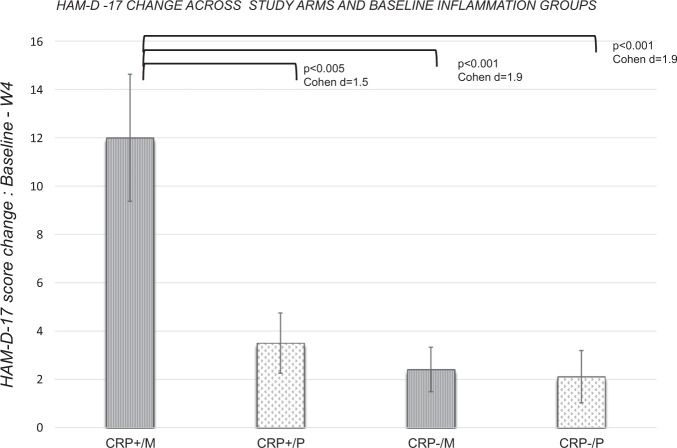
This study aimed to investigate the role of baseline levels of peripheral inflammation when testing the efficacy of antidepressant augmentation with minocycline in patients with treatment-resistant depression. We conducted a 4-week, placebo-controlled, randomised clinical trial of minocycline (200 mg/day) added to antidepressant treatment in 39 patients selected for elevated levels of serum C-reactive protein (CRP ≥ 1 mg/L), n = 18 randomised to minocycline (M) and n = 21 to placebo (P). The main outcome was the change in Hamilton Depression Rating Scale (HAM-D-17) score from baseline to week 4, expressed both as mean and as full or partial response, in the overall sample and after further stratification for baseline CRP≥3 mg/L. Secondary outcomes included changes in other clinical and inflammatory measures. Changes in HAM-D-17 scores and the proportion of partial responders did not differ between study arms. After stratification for CRP levels <3 mg/L (CRP−) or ≥3 mg/L (CRP+), CRP+/M patients showed the largest changes in HAM-D-17 scores (mean ± SD = 12.00 ± 6.45) compared with CRP-/M (2.42 ± 3.20, p < 0.001), CRP+/P (3.50 ± 4.34, p = 0.003) and CRP−/P (2.11 ± 3.26, p = 0.006) patients, and the largest proportion (83.3%, p = 0.04) of partial treatment response at week 4. The threshold point for baseline CRP to distinguish responders from non-responders to minocycline was 2.8 mg/L. Responders to minocycline had higher baseline IL-6 concentrations than non-responders (p = 0.03); IFNγ was significantly reduced after treatment with minocycline compared with placebo (p = 0.03). Our data show some evidence of efficacy of add-on treatment with minocycline in MDD patients but only in those with low-grade inflammation defined as CRP ≥3 mg/L.
Overview
The claims and statistics of this paper haven’t been checked yet.
Free: it reads the open-access text and checks the first 5 claims that cite a source we can check. Create a free account to check every claim.
Integrity signals
Registry
Cites
Statistics
Figures
Verification
Claims the paper makes
The claims and statistics of this paper haven’t been checked yet.
Free: it reads the open-access text and checks the first 5 claims that cite a source we can check. Create a free account to check every claim.
Claims other papers make about this one
Each is checked against this paper’s own text: does it say what the citing paper says it does?
The check wasn’t confident either way, so it gives no verdict — never disputed.
In the citing paper
“The extant evidence supporting lithium and thyroid hormone largely refers to their combination with TCAs and MAOIs in patients with partial response to these agents.”
From Treatment‐resistant depression: definition, prevalence, detection, management, and investigational interventions (2023) · cites this paper as [280]
Experimental — accuracy not yet measuredIn the citing paper
“Subsequent studies by Nettis and colleagues have reported elevated TSPO binding in treatment-resistant depression, and a meta-analysis by Enache and colleagues confirmed a significant overall elevation, particularly in more severe or treatment-resistant presentations [31, 32].”
From Neuroinflammation and depression: immune-brain interface mechanisms, biomarker stratification, and therapeutic strategies (2026) · cites this paper as [32]
In the citing paper
“Preliminary data in treatment-resistant depression with elevated inflammatory markers suggest antidepressant signals in biomarker-enriched populations, with effects most pronounced on anhedonia and fatigue [32].”
From Neuroinflammation and depression: immune-brain interface mechanisms, biomarker stratification, and therapeutic strategies (2026) · cites this paper as [32]
Self-check
Percentages, sums and reported differences re-computed from the paper’s own numbers.
The self-check needs the paper’s full text.
Citations
Cites
Hamilton, M. (1960) · Journal of Neurology, Neurosurgery & Psychiatry · doi:10.1136/jnnp.23.1.56 · Cited by 32,817
(1998) · The Journal of Clinical Psychiatry · Cited by 19,139
(1998) · PubMed · Cited by 10,216
The role of inflammation in depression: from evolutionary imperative to modern treatment target
Miller, A. H., & Raison, C. L. (2016) · Nature Reviews Immunology · doi:10.1038/nri.2015.5 · Cited by 3,942
The clinical global impressions scale: applying a research tool in clinical practice.
Busner, J., & Targum, S. D. (2007) · PubMed Central · Cited by 2,817
Jakobsen, J. C., Gluud, C., Wetterslev, J., & Winkel, P. (2017) · BMC Medical Research Methodology · doi:10.1186/s12874-017-0442-1 · Cited by 2,747
Antidepressant Drug Effects and Depression Severity: A Patient-Level Meta-analysis
Fournier, J. C., DeRubeis, R. J., Hollon, S. D., Dimidjian, S., Amsterdam, J. D., Shelton, R. C., & Fawcett, J. (2010) · JAMA · doi:10.1001/jama.2009.1943 · Cited by 2,009
Frank, E. (1991) · Archives of General Psychiatry · doi:10.1001/archpsyc.1991.01810330075011 · Cited by 1,959
Raison, C. L., Rutherford, R. E., Woolwine, B. J., Shuo, C., Schettler, P., Drake, D. F., Haroon, E., & Miller, A. H. (2013) · JAMA Psychiatry · doi:10.1001/2013.jamapsychiatry.4 · Cited by 1,617
Kennedy, S. H., Lam, R. W., McIntyre, R. S., Tourjman, S. V., Bhat, V., Blier, P., Hasnain, M., Jollant, F., Levitt, A. J., MacQueen, G. M., et al. (2016) · The Canadian Journal of Psychiatry · doi:10.1177/0706743716659417 · Cited by 1,181
Cited by
Items 201–253 of 253
Sforzini, L., & Pariante, C. M. (2025) · Biological Psychiatry Global Open Science · doi:10.1016/j.bpsgos.2025.100600 · Cited by 1
“Some evidence suggests that these treatments are most effective in https://doi.org/10.1016/j.bpsgos.2025.100600 individuals with higher levels of inflammation, for example with C-reactive protein (7,8).”
InfluentialSelf-citationGong, P., Wang, J., Long, H., Wenjuan, Y. A. N. G., Chen, X., Wang, J., Li, N., Chen, F., & Guo, Y. (2026) · Journal of Future Foods · doi:10.1016/j.jfutfo.2026.03.014 · Cited by 1
The Price of Protection: Evolutionary tradeoffs in inflammatory depression
Bindroo, A., & Savitz, J. B. (2026) · Brain Behavior and Immunity · doi:10.1016/j.bbi.2026.106577 · Cited by 1
New Antidepressant Development in the Treatment of Depression
Spiti, A., Caldirola, D., & Perna, G. (2026) · Advances in experimental medicine and biology · doi:10.1007/978-981-95-6872-7_23 · Cited by 2
Carminati, M., Tondello, M., Morana, C., Prato, M., & Zanardi, R. (2026) · Journal of Clinical Psychopharmacology · doi:10.1097/jcp.0000000000002190 · Cited by 1
Microglial advances in psychiatric disorders
de Jesus, J. R., Ribeiro, I. S., Pereira, M. V. S., Aquino, W. C. P., & Alfredo, L. H. M. (2026) · Advances in immunology · doi:10.1016/bs.ai.2026.04.007 · Cited by 1
Klettke, E. E., Holmes, M. D., Meyer, T. D., & Jones, G. H. (2023) · Personalized Medicine in Psychiatry · doi:10.1016/j.pmip.2023.100112 · Cited by 1
Cherevko, O., & Mudrenko, I. (2024) · Eastern Ukrainian Medical Journal · doi:10.21272/eumj.2024;12(1):11-22 · Cited by 1
Drug and Physical Treatments of Depression
Williams, R. C., & Cleare, A. J. (2024) · Cambridge University Press eBooks · doi:10.1017/9781911623861.006 · Cited by 3
Self-citationBo, Y., Chen, Y., Liang, H. Y., Zhao, F., Wu, M., Wang, Y., & Sha, R. (2025) · AI Med · doi:10.71423/aimed.20250103 · Cited by 1
RetractedInflammation and treatment resistance: Mechanisms and treatment implications
Miller, A. H., Lucido, M. J., Bekhbat, M., Mehta, N. D., Chen, X., Treadway, M. T., Felger, J. C., & Haroon, E. (2022) · Elsevier eBooks · doi:10.1016/b978-0-12-824067-0.00015-3 · Cited by 1
Adjunctive strategies for treatment-resistant depression
Thase, M. E. (2022) · Elsevier eBooks · doi:10.1016/b978-0-12-824067-0.00011-6 · Cited by 1
Bo, Y., Chen, Y., Liang, H. Y., Zhao, F., Wu, M., Wang, Y., & Sha, R. (2025) · OSF Preprints (OSF Preprints) · doi:10.31219/osf.io/v8m3e · Cited by 1
Moriarity, D. P., Perkins, E. R., & Joyner, K. J. (2025) · PsyArXiv (OSF Preprints) · doi:10.31234/osf.io/rjgaz_v2 · Cited by 1
Nettis, M. A., Pariante, C. M., & Mondelli, V. (2021) · Neuropsychopharmacology · doi:10.1038/s41386-021-01042-1
“We thank the authors for contacting us in advance of their letter to discuss our study [1], and we were happy to address all of their questions, including clarifying that indeed the subgroup analysis was not prespecified in the published protocol of the study.”
MethodSelf-citationHÍBRIDOS DA MODERNIDADE Registros da Natureza e da Sociedade Confundidos
Teixeira, O. A. (1998) · Cadernos de Ciência & Tecnologia · doi:10.35977/0104-1096.cct1998.v15.8941
Anti-Depression a Systematic Review of Analytical methods in PharmaceuticalsPreprint
Perumal, D., Krishnan, M., & K.S, L. (2022) · Authorea · doi:10.22541/au.165658161.19930674/v1
Minocycline‐induced hyperpigmentation in a patient on long‐term Nocardia suppressive treatment
Baqal, O. J., Masson, R., & Hardaway, B. (2022) · Transplant Infectious Disease · doi:10.1111/tid.13980
Neue und experimentelle medikamentöse Therapieverfahren
Mertens, L. J., Hart, X. M., Scharf, D., Spangemacher, M., & Gründer, G. (2022) · Springer eBooks · doi:10.1007/978-3-662-65734-8_11
Minocycline Attenuated Depressive-Like Phenotype in Sleep-Deprived Mice via its Antioxidant Effect
Eduviere, A. T., Kesiena, E. E., Otomewo, L. O., Akinluyi, E. T., Olayinka, J. N., & Daniel, C. U. (2023) · Malaysian Journal of Medicine and Health Sciences · doi:10.47836/mjmhs.19.3.38
“The effects observed in this research concur with previous studies that have posited that minocycline may improve mood and alleviate depression through its anti-inflammatory function (31) or inhibition of the nitric oxide pathway (32).”
ResultAnisman, H., Hayley, S. P., & Kusnecov, A. W. (2024) · Elsevier eBooks · doi:10.1016/b978-0-443-23565-8.00006-5
(2024) · Elsevier eBooks · doi:10.1016/b978-0-443-23565-8.09996-8
Inflammatory Mediators in Major Depression and Bipolar Disorder (Russian Translation)
Sara, P., de Gennaro, M. E., & Francesco, B. (2024) · Juvenis scientia · doi:10.32415/jscientia_2024_10_5_28-55
Whole body vibration alleviates depressive symptoms through its anti-inflammatory effects
Duan, Y., Xiong, L., Li, J., Jiang, J., Chen, Y., Zhou, J., & Li, T. (2025) · Medical Hypotheses · doi:10.1016/j.mehy.2025.111690
Neurobiology of suicidal behavior in males: concerning immune systems and blood hormones-III
Kundu, S. R., & Sarkar, J. (2025) · Elsevier eBooks · doi:10.1016/b978-0-443-33112-1.00005-7
Neurobiological signature in suicidal behavior: concerning immune systems and blood hormones-I
Kundu, S. R., & Sarkar, J. (2025) · Elsevier eBooks · doi:10.1016/b978-0-443-33112-1.00001-x
Severe Mental Illness as a Multisystem Metabolic Disorder From Brain to Body and Back Again
Pillinger, T., Ehrenreich, H., Freyberg, Z., Hahn, M., Mack, M., Milaneschi, Y., Perry, B. I., & Upthegrove, R. (2025) · Springer eBooks · doi:10.1007/978-3-032-05630-6_11
Aouizerate, B., & Capuron, L. (2023) · Société des Neurosciences · doi:10.60554/sn.v65i1.51
INVESTIGATING MINOCYCLINE AS A MODULATOR OF PERCEIVED STRESS AMONG CHRONICALLY-STRESSED ADULTS
Somers, M. (2024) · Carolina Digital Repository (University of North Carolina at Chapel Hill) · doi:10.17615/vv6m-s666
Querdasi, F. (2025) · eScholarship (California Digital Library)
Zerefos, I., Li, Z., & Napalinga, K. M. (2026) · Cureus · doi:10.7759/cureus.100862
Dahrendorff, J. (2025) · Digital Commons - University of South Florida (University of South Florida)
Genetic evidence for repurposing immunomodulatory drugs for major depressive disorderPreprint
Jesuthasan, J., ter Kuile, A., Roiser, J. P., Carvalho, L. A., Pitman, A., Chopade, S., Finan, C., Schmidt, A. F., & Pingault, J. (2026) · medRxiv · doi:10.64898/2026.02.07.26345798
Major depressive disorder as a driver of premature aging
Diniz, B. S., Nicol, G. E., & Lenze, E. J. (2026) · Geromedicine · doi:10.70401/geromedicine.2026.0015
Extracellular ATP in psychiatric disorders
von Mücke-Heim, I.-A., & Deussing, J. M. (2026) · Elsevier eBooks · doi:10.1016/b978-0-443-30250-3.00015-1
Rahimian, R., Hagenberg, J., Belliveau, C., Chen, R., Théberge, S., Fakhfouri, G., Wakid, M., Binder, E. B., Turecki, G., Arloth, J., et al. (2026) · Brain Behavior & Immunity - Health · doi:10.1016/j.bbih.2026.101245
“While there is some evidence for some beneficial effects (Hagenberg et al., 2025; K ¨ ohler-Forsberg et al., 2019; Nettis et al., 2021), most studies have failed to find a difference compared to placebo (Hellmann-Regen et al., 2022; Husain et al., 2020), even when stratified by CRP (Baune et al.,…”
Lee, J., Kang, J.-Y., Lee, W.-Y., Gu, J.-Y., Woo, T.-W., & Son, C.-G. (2026) · Translational Psychiatry · doi:10.1038/s41398-026-04092-5
“Unfortunately, the anti-in fl ammatory candidates for TRD have yielded largely disappointing results in RCTs, particularly with lack of microglia-speci fi city [16, 17].”
Neuroinflammation and treatment resistance in major depressive disorder
Miyata, S., Ishino, Y., & Shimizu, S. (2026) · Frontiers in Pharmacology · doi:10.3389/fphar.2026.1838472
“…demonstrated that individuals who do not respond to antidepressant treatment exhibit significantly higher levels of CRP and IL-6 than those who do respond, suggesting that inflammation may serve as a predictor of poor treatment outcomes rather than a general correlate of MDD (Nettis et al., 2021).”
Paribello, P., Isayeva, U., Lazzardi, S., Pinna, M. A., Contu, M., Meloni, A., Pisanu, C., Squassina, A., Baune, B. T., & Manchia, M. (2026) · Frontiers in Pharmacology · doi:10.3389/fphar.2026.1819237
“…in the qualitative analysis do not support a specific, clear benefit for this type of treatment (Hellmann-Regen et al., 2022; Raison et al., 2013; Nettis et al., 2021), with possible preliminary evidence suggesting the need to better stratify subjects for study inclusion based on their…”
Roy, S., Oană, B. M., Adams, G., Arvanitis, S., Ho, A., Gupta, A., Lopez, M., Clark, L., Kanbar, A., Aziz, A., et al. (2026) · Journal of Clinical and Basic Psychosomatics · doi:10.36922/jcbp025490093
Xu, Y., Huang, T., Wang, F., Zhou, N., Huang, X., Wu, C., Fei, Y., Li, N., Huang, R., Shao, Y., et al. (2026) · BMC Psychiatry · doi:10.1186/s12888-026-08327-z
“Within the Normal CRP Group, a High-Risk Group (3 mg/L ≤ CRP <5 mg/L) was further defined based on the cut-off of low-grade peripheral inflammation reported by Nettis et al. [38].”
Santerre, M., Shcherbik, N., & Sawaya, B. E. (2026) · Translational Psychiatry · doi:10.1038/s41398-026-04255-4
“Subsequent studies by Nettis and colleagues have reported elevated TSPO binding in treatment-resistant depression, and a meta-analysis by Enache and colleagues con fi rmed a signi fi cant overall elevation, particularly in more severe or treatment-resistant presentations [31, 32].”
Neurobiological correlates of treatment-resistant depression: implications for pharmacotherapy
Kot, J., Priadka, M., Ferensztajn‐Rochowiak, E., Kaliuzhna, O., Bienert, A., & Rybakowski, F. (2026) · Neuropsychiatria i Neuropsychologia · doi:10.5114/nan.2026.162406
Murimbechi, Z. (2026) · World Journal of Advanced Research and Reviews · doi:10.30574/wjarr.2026.31.2.2070
Baune, B. T. (2026) · Frontiers in Pharmacology · doi:10.3389/fphar.2026.1934360
“MINDEP enrolled 39 patients with TRD and CRP at least 1 mg/L; there was no overall group difference, while an unplanned CRP at least 3 mg/L subgroup contained only six minocycline-treated patients and should be interpreted cautiously (Nettis et al., 2021).”
Jiang, X., Li, P., & Xu, C. (2026) · Neuroscience & Biobehavioral Reviews · doi:10.1016/j.neubiorev.2026.106976
Kim, H. J., Kim, J.-H., Son, Y., Kim, J., & Hong, J. H. (2026) · Antioxidants · doi:10.3390/antiox15091195
Hashioka, S. (2026) · International Journal of Molecular Sciences · doi:10.3390/ijms27198533
“Exploratory subgroup analyses in the trial, including stratification by baseline CRP, also failed to identify an inflammation-defined subgroup with clear minocycline benefit [75], although an earlier small study implied possible efficacy in patients with low-grade inflammation [76].”
Nyland, J. J. A. O. L., Silva, A. E. A., Vianna, I. D. M., Shikanai, J. D. S., & Rocha, J. S. D. S. (2026) · Revista Científica Ipedss · doi:10.55703/27644006060403
Design priorities for clinical trials of immunotherapy in psychiatry: What, how, and for whom?
Foley, É. M., Treadway, M. T., Miller, A. H., & Khandaker, G. M. (2026) · Brain Behavior and Immunity · doi:10.1016/j.bbi.2026.107081
Precision psychiatry in depression treatment: mechanism-based subtyping
Picker, L. D., & Wessa, C. (2025) · doi:10.68739/g2z8ifmv
Hou, S., & Li, J. (2026) · Frontiers in Behavioral Neuroscience · doi:10.3389/fnbeh.2026.1968856
Treatment-Resistant Depression Is Not a Single Disorder
Macaluso, M. (2026) · Journal of Psychiatric Practice · doi:10.1097/pra.0000000000000965
Metadata
- Authors
- Nettis, M. A., Lombardo, G., Hastings, C., Zajkowska, Z., Mariani, N., Nikkheslat, N., Worrell, C., Enache, D., McLaughlin, A., Kose, M., Sforzini, L., Bogdanova, A., Cleare, A., Young, A. H., Pariante, C. M., & Mondelli, V.
- Affiliations
- National Health Service (GB)
- King's College London (GB)
- Corresponding author
- Mondelli, Valeria
- ORCID
- Venue
- Neuropsychopharmacology
- Published
- 2021-01-28
- Volume
- 46
- Issue
- 5
- Pages
- 939-948
- ISSN
- 0893-133X (ISSN-L)
- 1740-634X
- PMC
- PMC8096832
- OpenAlex
- W3119172333
- Cited by
- 235
- References
- 56
- Citations by year
- 2026: 28 · 2025: 38 · 2024: 37 · 2023: 49 · 2022: 42 · 2021: 40
- FWCI
- 24.50
- Type
- journal article
- Language
- en
- Open access
- hybrid
- doi.org
- Licence
- cc-by
- creativecommons.org/licenses/by/4.0 (tdm)
- creativecommons.org/licenses/by/4.0 (vor)
- Locations
- Neuropsychopharmacology (publishedVersion, cc-by)
- PubMed Central (publishedVersion, cc-by)
- PubMed (publishedVersion)
- Research Portal (King's College London) (submittedVersion, other-oa)
- Funders
- NIHR Biomedical Research Centre South London and Maudsley NHS Foundation Trust
- NIHR Biomedical Research Centre South London and Maudsley NHS Foundation Trust and KIng’s College London
- Topics
- Health Sciences › Medicine › Pharmacology (medical) › Treatment of Major Depression
- Life Sciences › Neuroscience › Biological Psychiatry › Tryptophan and brain disorders
- Life Sciences › Neuroscience › Behavioral Neuroscience › Stress Responses and Cortisol
- Keywords
- minocycline, treatment-resistant depression, antidepressant augmentation, C-reactive protein, peripheral inflammation, interleukin-6, interferon-gamma, inflammatory markers
- MeSH terms
- Depression, Double-Blind Method, Humans, Inflammation, Minocycline, Treatment Outcome, Depressive Disorder, Treatment-Resistant
About these checks
Registry, retraction, Cites and statistics results are computed, not judged, with one exception: a printed reference that no index lists is read once by a model before it counts as a citation error. Claims are extracted by a model and kept only when their quote appears verbatim in the text; each cited source is then checked, with a model’s help, for whether it says what the claim relies on. Those verdicts can be wrong — read the claim’s quote and the cited source before relying on one.
Statistics and arithmetic are recomputed, not judged.
Confidence bands are shown only for fields calibrated on our annotated test set. None is calibrated yet, so no band is shown.
What counts as a claim ›How we measure confidence ›How we check this ›
Are you an author, or do you see a problem with this page? Request a review
Data sources
Bibliographic data: Semantic Scholar, OpenAlex, Crossref.
Contains information from the Semantic Scholar Academic Graph Datasets, made available under the ODC Attribution License (ODC-BY 1.0).
Semantic Scholar’s data is described in: Kinney, R., et al. (2023). The Semantic Scholar Open Data Platform. arXiv:2301.10140.
