

Modulation of the antidepressant effects of ketamine by the mTORC1 inhibitor rapamycin
Open accessThe DOI matches its Crossref record; 47 of the 47 references it cites were found in a registry or an index.
Abstract
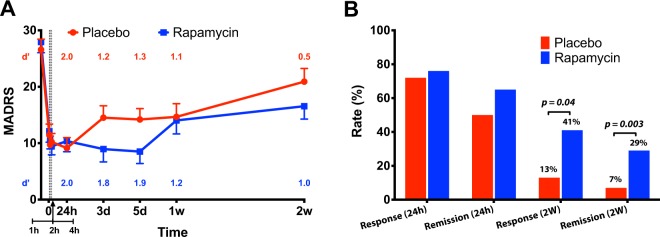
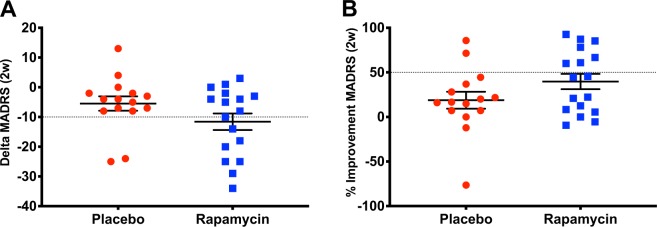
Twenty-four hours after administration, ketamine exerts rapid and robust antidepressant effects that are thought to be mediated by activation of the mechanistic target of rapamycin complex 1 (mTORC1). To test this hypothesis, depressed patients were pretreated with rapamycin, an mTORC1 inhibitor, prior to receiving ketamine. Twenty patients suffering a major depressive episode were randomized to pretreatment with oral rapamycin (6 mg) or placebo 2 h prior to the intravenous administration of ketamine 0.5 mg/kg in a double-blind cross-over design with treatment days separated by at least 2 weeks. Depression severity was assessed using Montgomery–Åsberg Depression Rating Scale (MADRS). Rapamycin pretreatment did not alter the antidepressant effects of ketamine at the 24-h timepoint. Over the subsequent 2-weeks, we found a significant treatment by time interaction ( F (8,245) = 2.02, p = 0.04), suggesting a prolongation of the antidepressant effects of ketamine by rapamycin. Two weeks following ketamine administration, we found higher response (41%) and remission rates (29%) following rapamycin + ketamine compared to placebo + ketamine (13%, p = 0.04, and 7%, p = 0.003, respectively). In summary, single dose rapamycin pretreatment failed to block the antidepressant effects of ketamine, but it prolonged ketamine’s antidepressant effects. This observation raises questions about the role of systemic vs. local blockade of mTORC1 in the antidepressant effects of ketamine, provides preliminary evidence that rapamycin may extend the benefits of ketamine, and thereby potentially sheds light on mechanisms that contribute to depression relapse after ketamine administration.
Overview
The claims and statistics of this paper haven’t been checked yet.
Free: it reads the open-access text and checks the first 5 claims that cite a source we can check. Create a free account to check every claim.
Integrity signals
Registry
Cites
Statistics
Figures
Verification
Claims the paper makes
The claims and statistics of this paper haven’t been checked yet.
Free: it reads the open-access text and checks the first 5 claims that cite a source we can check. Create a free account to check every claim.
Claims other papers make about this one
Each is checked against this paper’s own text: does it say what the citing paper says it does?
The source backs part of the claim, not all of it — or backs it for a different population, condition or comparison.
In the citing paper
“an effect that differed from its effect on depressive symptoms (n = 20) [93]”
From Ketamine in neuropsychiatric disorders: an update (2024) · cites this paper as [93]
Experimental — accuracy not yet measuredThe source backs part of the claim, not all of it — or backs it for a different population, condition or comparison.
In the citing paper
“calibrated AMPAR facilitation may help sustain prefrontal drive, preserve signal-to-noise, and extend remission without excessive excitatory load [380,381,382].”
From Synaptic Plasticity—Intrinsic Excitability and Antidepressant Discovery (2026) · cites this paper as [380]
Experimental — accuracy not yet measuredThe source backs part of the claim, not all of it — or backs it for a different population, condition or comparison.
In the citing paper
“This phosphorylation event activates multiple intracellular signaling cascades, including the mammalian target of rapamycin complex 1 (mTORC1), phosphoinositide 3-kinase (PI3K), phospholipase C gamma (PLCγ), and mitogen-activated protein kinase (MAPK) pathways [86,87].”
From Variations in BDNF and Their Role in the Neurotrophic Antidepressant Mechanisms of Ketamine and Esketamine: A Review (2024) · cites this paper as [86]
Experimental — accuracy not yet measuredThe cited source says what the claim attributes to it.
In the citing paper
“one result of BDNF-TrkB activation by ketamine is stimulation of mTORC signaling pathway [86,87]: this is critical for synaptic protein synthesis and new dendritic spine formation, processes that are fundamental to the sustained antidepressant effects of ketamine [58,60].”
From Variations in BDNF and Their Role in the Neurotrophic Antidepressant Mechanisms of Ketamine and Esketamine: A Review (2024) · cites this paper as [86]
In the citing paper
“First, contrary to preclinical observations, a recent randomized controlled trial (RCT) in humans demonstrated prolonged antidepressant responses to ketamine with coadministration of rapamycin (mTOR inhibitor) [79].”
From Pharmacotherapies Targeting GABA-Glutamate Neurotransmission for Treatment-Resistant Depression (2023) · cites this paper as [79]
Self-check
Percentages, sums and reported differences re-computed from the paper’s own numbers.
The self-check needs the paper’s full text.
Citations
Cites
Molecular Mechanisms of Depression: Perspectives on New Treatment Strategies
Lang, U. E., & Borgwardt, S. (2013) · Cellular Physiology and Biochemistry · doi:10.1159/000350094 · Cited by 8,475
Antidepressant effects of ketamine in depressed patients
Berman, R. M., Cappiello, A., Anand, A., Oren, D. A., Heninger, G. R., Charney, D. S., & Krystal, J. H. (2000) · Biological Psychiatry · doi:10.1016/s0006-3223(99)00230-9 · Cited by 3,856 · cited 3×
“Ketamine administration and monitoring was comparable to previous studies [1, 2, 30].”
BackgroundResultSelf-citationA randomized trial of an N-methyl-D-aspartate antagonist in treatment-resistant major depression.
Zarate, C. A., Singh, J. B., Carlson, P. J., Brutsche, N. E., Ameli, R., Luckenbaugh, D. A., Charney, D. S., & Manji, H. K. (2006) · Archives of General Psychiatry · doi:10.1001/archpsyc.63.8.856 · Cited by 3,766 · cited 4×
“Ketamine administration and monitoring was comparable to previous studies [1, 2, 30].”
BackgroundResultInfluentialmTOR-Dependent Synapse Formation Underlies the Rapid Antidepressant Effects of NMDA Antagonists
Li, N., Lee, B., Liu, R.-J., Banasr, M., Dwyer, J. M., Iwata, M., Li, X.-Y., Aghajanian, G., & Duman, R. S. (2010) · Science · doi:10.1126/science.1190287 · Cited by 2,881 · cited 3×
“First, this study failed to validate the prediction from preclinical studies [10, 16], in that rapamycin pretreatment did not reduce the acute antidepressant effects of ketamine at 24 h following treatment.”
BackgroundMethodResultSelf-citationNMDA receptor blockade at rest triggers rapid behavioural antidepressant responses
Autry, A. E., Adachi, M., Nosyreva, E., Na, E. S., Los, M. F., Cheng, P.-F., Kavalali, E. T., & Monteggia, L. M. (2011) · Nature · doi:10.1038/nature10130 · Cited by 1,926 · cited 3×
“(3) Acute single dose of rapamycin administered peripherally was shown to inhibit mTORC1 in the brain within 2 h of administration in rodents [15].”
BackgroundRaison, C. L., Rutherford, R. E., Woolwine, B. J., Shuo, C., Schettler, P., Drake, D. F., Haroon, E., & Miller, A. H. (2013) · JAMA Psychiatry · doi:10.1001/2013.jamapsychiatry.4 · Cited by 1,617 · cited 1×
“, no CRP or ESR effects), which was suggested to be necessary for successful monotherapy/add-on approaches [46].”
BackgroundMurrough, J. W., Iosifescu, D. V., Chang, L. C., Al Jurdi, R. K., Green, C. E., Perez, A. M., Iqbal, S., Pillemer, S., Foulkes, A., Shah, A., et al. (2013) · American Journal of Psychiatry · doi:10.1176/appi.ajp.2013.13030392 · Cited by 1,205 · cited 3×
“In contrast to parallel groups design [1, 43, 44], cross-over ketamine studies required smaller samples because of the robust effects of ketamine and the rapid relapse, leading to increased statistical power to detect significant within subject differences.”
BackgroundResultLi, N., Liu, R.-J., Dwyer, J. M., Banasr, M., Lee, B., Son, H., Li, X.-Y., Aghajanian, G., & Duman, R. S. (2011) · Biological Psychiatry · doi:10.1016/j.biopsych.2010.12.015 · Cited by 1,082 · cited 3×
“First, this study failed to validate the prediction from preclinical studies [10, 16], in that rapamycin pretreatment did not reduce the acute antidepressant effects of ketamine at 24 h following treatment.”
BackgroundMethodResultSelf-citationDiazgranados, N., Ibrahim, L., Brutsche, N. E., Newberg, A., Kronstein, P., Khalife, S., Kammerer, W. A., Quezado, Z., Luckenbaugh, D. A., Salvadore, G., et al. (2010) · Archives of General Psychiatry · doi:10.1001/archgenpsychiatry.2010.90 · Cited by 963 · cited 2×
“In fact, for the first 12 years following the discovery of the antidepressant effects of ketamine all controlled studies were mainly cross-over and smaller in size compared to the current study [2, 30, 41, 42].”
BackgroundResultKöhler, O., Benros, M. E., Nordentoft, M., Farkouh, M. E., Iyengar, R. L., Mors, O., & Krogh, J. (2014) · JAMA Psychiatry · doi:10.1001/jamapsychiatry.2014.1611 · Cited by 941 · cited 1×
“Therefore, an essential strength of the study is the use of combined therapy, instead of monotherapy or add-on approaches that were used in the past [19].”
BackgroundImmunoregulatory functions of mTOR inhibition
Thomson, A. W., Turnquist, H. R., & Raimondi, G. (2009) · Nature Reviews Immunology · doi:10.1038/nri2546 · Cited by 847 · cited 2×
“Furthermore, the immunosuppressive effect of rapamycin is an mTORC1-dependent process [27] and rapamycin was shown at therapeutic doses in humans to cross the brain blood barrier and to reduce the phosphorylation of S6 ribosomal protein in brain tissue [28, 29].”
BackgroundZarate, C. A., Brutsche, N. E., Ibrahim, L., Franco-Chaves, J., Diazgranados, N., Cravchik, A., Selter, J., Marquardt, C. A., Liberty, V., & Luckenbaugh, D. A. (2012) · Biological Psychiatry · doi:10.1016/j.biopsych.2011.12.010 · Cited by 811 · cited 2×
“In fact, for the first 12 years following the discovery of the antidepressant effects of ketamine all controlled studies were mainly cross-over and smaller in size compared to the current study [2, 30, 41, 42].”
BackgroundResultSustained rescue of prefrontal circuit dysfunction by antidepressant-induced spine formation
Moda-Sava, R. N., Murdock, M. H., Parekh, P. K., Fetcho, R. N., Huang, B. S., Huynh, T. N., Witztum, J., Shaver, D. C., Rosenthal, D. L., Alway, E. J., et al. (2019) · Science · doi:10.1126/science.aat8078 · Cited by 643 · cited 2×
“Finally, recent studies have shown plasticity-independent acute antidepressant effects [35] and other studies suggested that some of the clinical benefit of ketamine can be attributed to nonspecific effects of the treatment [36].”
BackgroundResultCloughesy, T. F., Yoshimoto, K., Nghiemphu, P., Brown, K., Dang, J., Zhu, S., Hsueh, T., Chen, Y., Wang, W., Youngkin, D., et al. (2008) · PLoS Medicine · doi:10.1371/journal.pmed.0050008 · Cited by 593 · cited 1×
“Furthermore, the immunosuppressive effect of rapamycin is an mTORC1-dependent process [27] and rapamycin was shown at therapeutic doses in humans to cross the brain blood barrier and to reduce the phosphorylation of S6 ribosomal protein in brain tissue [28, 29].”
BackgroundInflammation, glutamate, and glia: a trio of trouble in mood disorders
Haroon, E., Miller, A. H., & Sanacora, G. (2017) · Neuropsychopharmacology · doi:10.1038/npp.2016.199 · Cited by 584
Self-citationSingh, J. B., Fedgchin, M., Daly, E. J., De Boer, P., Cooper, K., Lim, P., Pinter, C., Murrough, J. W., Sanacora, G., Shelton, R. C., et al. (2016) · American Journal of Psychiatry · doi:10.1176/appi.ajp.2016.16010037 · Cited by 525 · cited 1×
“In contrast to parallel groups design [1, 43, 44], cross-over ketamine studies required smaller samples because of the robust effects of ketamine and the rapid relapse, leading to increased statistical power to detect significant within subject differences.”
ResultSelf-citationTargeting glutamate signalling in depression: progress and prospects
Murrough, J. W., Abdallah, C. G., & Mathew, S. J. (2017) · Nature Reviews Drug Discovery · doi:10.1038/nrd.2017.16 · Cited by 482
Self-citationWalker, A. K., Budac, D. P., Bisulco, S., Lee, A. W., Smith, R. A., Beenders, B., Kelley, K. W., & Dantzer, R. (2013) · Neuropsychopharmacology · doi:10.1038/npp.2013.71 · Cited by 432
Ketamine for Depression: Where Do We Go from Here?
aan het Rot, M., Zarate, C. A., Charney, D. S., & Mathew, S. J. (2012) · Biological Psychiatry · doi:10.1016/j.biopsych.2012.05.003 · Cited by 418
Zhou, W., Wang, N., Yang, C., Li, X.-M., Zhou, Z.-Q., & Yang, J.-J. (2014) · European Psychiatry · doi:10.1016/j.eurpsy.2013.10.005 · Cited by 390
Clinical Pharmacokinetics of Sirolimus
Mahalati, K., & Kahan, B. D. (2001) · Clinical Pharmacokinetics · doi:10.2165/00003088-200140080-00002 · Cited by 302 · cited 2×
“Furthermore, the immunosuppressive effect of rapamycin is an mTORC1-dependent process [27] and rapamycin was shown at therapeutic doses in humans to cross the brain blood barrier and to reduce the phosphorylation of S6 ribosomal protein in brain tissue [28, 29].”
BackgroundDefining remission by cut off score on the MADRS: selecting the optimal value
Hawley, C. J., Gale, T. M., & Sivakumaran, T. (2002) · Journal of Affective Disorders · doi:10.1016/s0165-0327(01)00451-7 · Cited by 266 · cited 1×
“Response was defined as 50% improvement, and remission was defined as MADRS < 10 [31].”
MethodKetamine has distinct electrophysiological and behavioral effects in depressed and healthy subjects
Nugent, A. C., Ballard, E. D., Gould, T. D., Park, L. T., Moaddel, R., Brutsche, N. E., & Zarate, C. A. (2019) · Molecular Psychiatry · doi:10.1038/s41380-018-0028-2 · Cited by 250 · cited 1×
“In contrast to parallel groups design [1, 43, 44], cross-over ketamine studies required smaller samples because of the robust effects of ketamine and the rapid relapse, leading to increased statistical power to detect significant within subject differences.”
ResultAntidepressants act by inducing autophagy controlled by sphingomyelin–ceramide
Gulbins, A., Schumacher, F., Becker, K. A., Wilker, B., Soddemann, M., Boldrin, F., Müller, C. P., Edwards, M. J., Goodman, M., Caldwell, C. C., et al. (2018) · Molecular Psychiatry · doi:10.1038/s41380-018-0090-9 · Cited by 230 · cited 1×
“Recent evidence implicates autophagy in the mechanisms of antidepressants [38].”
BackgroundAbdallah, C. G., Sanacora, G., Duman, R. S., & Krystal, J. H. (2018) · Pharmacology & Therapeutics · doi:10.1016/j.pharmthera.2018.05.010 · Cited by 219 · cited 1×
“This hypothesis presumes that the expression of the antidepressant effects of ketamine depends upon sustaining the newly made synapses [6, 37].”
BackgroundSelf-citationMajumder, S., Caccamo, A., Medina, D. X., Benavides, A. D., Javors, M. A., Kraig, E., Strong, R., Richardson, A., & Oddo, S. (2012) · Aging Cell · doi:10.1111/j.1474-9726.2011.00791.x · Cited by 203
Yang, C., Hu, Y.-M., Zhou, Z.-Q., Zhang, G.-F., & Yang, J.-J. (2013) · Upsala Journal of Medical Sciences · doi:10.3109/03009734.2012.724118 · Cited by 173
Ignácio, Z. M., Réus, G. Z., Arent, C. O., Abelaira, H. M., Pitcher, M. R., & Quevedo, J. (2016) · British Journal of Clinical Pharmacology · doi:10.1111/bcp.12845 · Cited by 172
The Neurobiology and Pharmacotherapy of Posttraumatic Stress Disorder
Abdallah, C. G., Averill, L. A., Akiki, T. J., Raza, M., Averill, C. L., Gomaa, H., Adikey, A., & Krystal, J. H. (2019) · Annual Review of Pharmacology and Toxicology · doi:10.1146/annurev-pharmtox-010818-021701 · Cited by 167 · cited 1×
“This hypothesis presumes that the expression of the antidepressant effects of ketamine depends upon sustaining the newly made synapses [6, 37].”
BackgroundSelf-citationTherapeutic Implications of Brain–Immune Interactions: Treatment in Translation
Miller, A. H., Haroon, E., & Felger, J. C. (2017) · Neuropsychopharmacology · doi:10.1038/npp.2016.167 · Cited by 152 · cited 1×
“Finally, the fact that the immune system is involved in both depression pathology as well as in resilience and depression recovery [45] creates a major challenge in the field, emphasizing the need to target a “sweet spot” that will oppose the negative effects of inflammation while avoiding the inhibition of its neuror…”
BackgroundMeta-analysis of short- and mid-term efficacy of ketamine in unipolar and bipolar depression
Romeo, B., Choucha, W., Fossati, P., & Rotge, J.-Y. (2015) · Psychiatry Research · doi:10.1016/j.psychres.2015.10.032 · Cited by 151
Cleary, C., Linde, J. A. S., Hiscock, K. M., Hadas, I., Belmaker, R. H., Agam, G., Flaisher-Grinberg, S., & Einat, H. (2008) · Brain Research Bulletin · doi:10.1016/j.brainresbull.2008.03.005 · Cited by 143 · cited 1×
“Moreover, rapamycin and other autophagy enhancers were previously shown to exert antidepressant-like effects in preclinical studies [39, 40]; although the effects of rapamycin were evident following repeated, but not acute administration [15, 39, 40].”
BackgroundMolecular Pharmacology and Neurobiology of Rapid-Acting Antidepressants
Gould, T. D., Zarate, C. A., & Thompson, S. M. (2019) · Annual Review of Pharmacology and Toxicology · doi:10.1146/annurev-pharmtox-010617-052811 · Cited by 133 · cited 1×
“Neuronal plasticity is thought to be critical in the pathology and treatment of depression, particularly in the mechanisms of rapid acting antidepressants [7].”
BackgroundThe Nucleus Accumbens and Ketamine Treatment in Major Depressive Disorder
Abdallah, C. G., Jackowski, A., Salas, R., Gupta, S., Sato, J. R., Mao, X., Coplan, J. D., Shungu, D. C., & Mathew, S. J. (2017) · Neuropsychopharmacology · doi:10.1038/npp.2017.49 · Cited by 123
Self-citationKetamine as a promising prototype for a new generation of rapid‐acting antidepressants
Abdallah, C. G., Averill, L. A., & Krystal, J. H. (2015) · Annals of the New York Academy of Sciences · doi:10.1111/nyas.12718 · Cited by 121
Self-citationMolecular basis for class side effects associated with PI3K/AKT/mTOR pathway inhibitors
Zhang, Y., Yan, H., Xu, Z., Yang, B., Luo, P., & He, Q. (2019) · Expert Opinion on Drug Metabolism & Toxicology · doi:10.1080/17425255.2019.1663169 · Cited by 99 · cited 1×
“Further, we limited exposure to rapamycin to a loading immunosuppressant dose, which was selected on the basis of being the highest dose one could administer without exposing subjects to a risk of side effects associated with higher doses [32].”
MethodAntidepressant action of ketamine via mTOR is mediated by inhibition of nitrergic Rheb degradation
Harraz, M. M., Tyagi, R., Cortés, P., & Snyder, S. H. (2016) · Molecular Psychiatry · doi:10.1038/mp.2015.211 · Cited by 95
Miller, A. H. (2013) · Neuropsychopharmacology · doi:10.1038/npp.2013.140 · Cited by 83
Serkova, N., Jacobsen, W., Niemann, C. U., Litt, L., Benet, L. Z., Leibfritz, D., & Christians, U. (2001) · British Journal of Pharmacology · doi:10.1038/sj.bjp.0704142 · Cited by 83
Kadriu, B., Gold, P. W., Luckenbaugh, D. A., Lener, M. S., Ballard, E. D., Niciu, M. J., Henter, I. D., Park, L. T., De Sousa, R. T., Yuan, P., et al. (2018) · Molecular Psychiatry · doi:10.1038/mp.2017.109 · Cited by 70
Mood-stabilizing effects of rapamycin and its analog temsirolimus: relevance to autophagy
Kara, N. Z., Flaisher-Grinberg, S., Anderson, G. W., Agam, G., & Einat, H. (2018) · Behavioural Pharmacology · doi:10.1097/fbp.0000000000000334 · Cited by 48 · cited 1×
“Moreover, rapamycin and other autophagy enhancers were previously shown to exert antidepressant-like effects in preclinical studies [39, 40]; although the effects of rapamycin were evident following repeated, but not acute administration [15, 39, 40].”
BackgroundThe positive effect on ketamine as a priming adjuvant in antidepressant treatment
Melo, A., Kokras, N., Dalla, C., Ferreira, C., Ventura-Silva, A. P., Sousa, N., & Pêgo, J. M. (2015) · Translational Psychiatry · doi:10.1038/tp.2015.66 · Cited by 41 · cited 1×
“Moreover, rodent and human evidence show region-specific neuroplasticity effects of ketamine consistent with increased synaptic connectivity in the PFC and hippocampus, but decreased synaptic connectivity in the nucleus accumbens (NAc) [33, 34].”
BackgroundGottschalk, S., Cummins, C. L., Leibfritz, D., Christians, U., Benet, L. Z., & Serkova, N. J. (2010) · NeuroToxicology · doi:10.1016/j.neuro.2010.10.006 · Cited by 41
Popp, S., Behl, B., Joshi, J. J., Lanz, T. A., Spedding, M., Schenker, E., Jay, T. M., Svenningsson, P., Caudal, D., Cunningham, J. I., et al. (2016) · F1000Research · doi:10.12688/f1000research.8236.1 · Cited by 35 · cited 1×
“Several preclinical studies have shown that ketamine administration increases mTORC1 signaling [10–13], but there are non-replications of this finding [14, 15].”
BackgroundSanacora, G. (2019) · American Journal of Psychiatry · doi:10.1176/appi.ajp.2018.18091061 · Cited by 28 · cited 1×
“Finally, recent studies have shown plasticity-independent acute antidepressant effects [35] and other studies suggested that some of the clinical benefit of ketamine can be attributed to nonspecific effects of the treatment [36].”
ResultSelf-citationdo Vale, E. M., Xavier, C. C., Nogueira, B. G., Campos, B. C., de Aquino, P. É. A., da Costa, R. O., Leal, L. K. A. M., Vasconcelos, S. M. M., Neves, K. R. T., & Viana, G. S. D. B. (2016) · Basic & Clinical Pharmacology & Toxicology · doi:10.1111/bcpt.12637 · Cited by 22 · cited 1×
“Because the anti-inflammatory effects of rapamycin might augment those of ketamine [22] and enhance treatment efficacy, we followed patients for 2 weeks after each ketamine dose.”
BackgroundLevy, E. I., Hanel, R. A., Tio, F. O., Garlick, D. S., Bailey, L. R., Cunningham, M. R., Williard, C. V., Sherman, D., Dooley, J. F., & Kopia, G. A. (2006) · Neurosurgery · doi:10.1227/01.neu.0000233777.46522.1e · Cited by 22
Cited by
McIntyre, R. S., Rosenblat, J. D., Nemeroff, C. B., Sanacora, G., Murrough, J. W., Berk, M., Brietzke, E., Dodd, S., Gorwood, P., Ho, R., et al. (2021) · American Journal of Psychiatry · doi:10.1176/appi.ajp.2020.20081251 · Cited by 731
Self-citationBrain-Derived Neurotrophic Factor Signaling in Depression and Antidepressant Action
Castrén, E., & Monteggia, L. M. (2021) · Biological Psychiatry · doi:10.1016/j.biopsych.2021.05.008 · Cited by 540
“More recently, a small clinical study administered rapamycin intravenously to patients and found that it did not block ketamine’s rapid antidepressant action but rather may augment the long-term effects (130).”
Neuroplasticity as a convergent mechanism of ketamine and classical psychedelics
Aleksandrova, L. R., & Phillips, A. G. (2021) · Trends in Pharmacological Sciences · doi:10.1016/j.tips.2021.08.003 · Cited by 276
Ketamine and rapid antidepressant action: New treatments and novel synaptic signaling mechanisms
Krystal, J. H., Kavalali, E. T., & Monteggia, L. M. (2024) · Neuropsychopharmacology · doi:10.1038/s41386-023-01629-w · Cited by 262
“This might help to explain why pretreatment with a low dose of rapamycin (6 mg, po) two hours prior to ketamine administration extended the duration of the antidepressant effects of ketamine rather than blocked them [125].”
BackgroundSelf-citationDe Gregorio, D., Aguilar-Valles, A., Preller, K. H., Heifets, B. D., Hibicke, M., Mitchell, J., & Gobbi, G. (2021) · The Journal of Neuroscience · doi:10.1523/jneurosci.1659-20.2020 · Cited by 259
“Concerning the mTORC1 pathway, for example, a recent clinical study demonstrated that peripheral coadministration of rapamycin to treatment-resistant MDD patients enhanced, rather than blocked, the antidepressant effect of ketamine (Abdallah et al., 2020), suggesting a more complex interaction between these drugs in h…”
Metadata
- Authors
- Abdallah, C. G., Averill, L. A., Gueorguieva, R., Goktas, S., Purohit, P., Ranganathan, M., Sherif, M., Ahn, K.-H., D’Souza, D. C., Formica, R., Southwick, S. M., Duman, R. S., Sanacora, G., & Krystal, J. H.
- Affiliations
- United States Department of Veterans Affairs (US)
- Yale University (US)
- Corresponding author
- Abdallah, Chadi G.
- ORCID
- Venue
- Neuropsychopharmacology
- Published
- 2020-02-24
- Volume
- 45
- Issue
- 6
- Pages
- 990-997
- ISSN
- 0893-133X (ISSN-L)
- 1740-634X
- PMC
- PMC7162891
- OpenAlex
- W3007521094
- Cited by
- 184
- References
- 47
- Citations by year
- 2026: 19 · 2025: 16 · 2024: 26 · 2023: 35 · 2022: 33 · 2021: 32 · 2020: 22
- FWCI
- 18.28
- Type
- journal article
- Language
- en
- Open access
- hybrid
- doi.org
- Licence
- cc-by
- creativecommons.org/licenses/by/4.0 (tdm)
- creativecommons.org/licenses/by/4.0 (vor)
- Locations
- Neuropsychopharmacology (publishedVersion, cc-by)
- PubMed Central (publishedVersion, cc-by)
- PubMed (publishedVersion)
- Funders
- U.S. Department of Health & Human Services | NIH | National Institute of Mental Health (MH101498)
- U.S. Department of Veterans Affairs (NA)
- Topics
- Health Sciences › Medicine › Pharmacology (medical) › Treatment of Major Depression
- Health Sciences › Medicine › Psychiatry and Mental health › Electroconvulsive Therapy Studies
- Life Sciences › Neuroscience › Biological Psychiatry › Tryptophan and brain disorders
- Keywords
- ketamine, rapamycin, mTORC1, antidepressant effects, major depressive disorder, depression remission, depression relapse, mTORC1 inhibition, rapid-acting antidepressants
- MeSH terms
- Mechanistic Target of Rapamycin Complex 1, Antidepressive Agents, Depressive Disorder, Major, Major Depressive Disorder, Humans, Ketamine, Treatment Outcome, Sirolimus
About these checks
Registry, retraction, Cites and statistics results are computed, not judged, with one exception: a printed reference that no index lists is read once by a model before it counts as a citation error. Claims are extracted by a model and kept only when their quote appears verbatim in the text; each cited source is then checked, with a model’s help, for whether it says what the claim relies on. Those verdicts can be wrong — read the claim’s quote and the cited source before relying on one.
Statistics and arithmetic are recomputed, not judged.
Confidence bands are shown only for fields calibrated on our annotated test set. None is calibrated yet, so no band is shown.
What counts as a claim ›How we measure confidence ›How we check this ›
Are you an author, or do you see a problem with this page? Request a review
Data sources
Bibliographic data: Semantic Scholar, OpenAlex, Crossref.
Contains information from the Semantic Scholar Academic Graph Datasets, made available under the ODC Attribution License (ODC-BY 1.0).
Semantic Scholar’s data is described in: Kinney, R., et al. (2023). The Semantic Scholar Open Data Platform. arXiv:2301.10140.
