

Twelve-month outcomes of a randomized trial of a moderate-carbohydrate versus very low-carbohydrate diet in overweight adults with type 2 diabetes mellitus or prediabetes
Open accessThe DOI matches its Crossref record; 20 of the 20 references it cites were found in a registry or an index.
Abstract
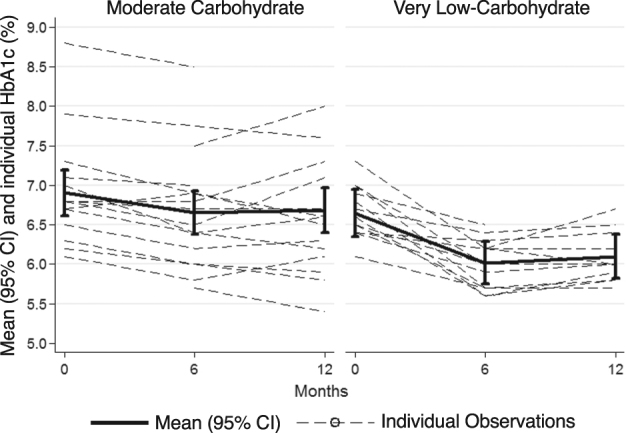
Dietary treatment is important in management of type 2 diabetes or prediabetes, but uncertainty exists about the optimal diet. We randomized adults (n = 34) with glycated hemoglobin (HbA1c) > 6.0% and elevated body weight (BMI > 25) to a very low-carbohydrate ketogenic (LCK) diet (n = 16) or a moderate-carbohydrate, calorie-restricted, low-fat (MCCR) diet (n = 18). All participa n ts were encouraged to be physically active, get sufficient sleep, and practice behavioral adherence strategies based on positive affect and mindful eating. At 12 months, participants in the LCK group had greater reductions in HbA1c levels (estimated marginal mean (EMM) at baseline = 6.6%, at 12 mos = 6.1%) than participants in MCCR group (EMM at baseline = 6.9%, at 12 mos = 6.7%), p = .007. Participants in the LCK group lost more weight (EMM at baseline = 99.9 kg, at 12 mos = 92.0 kg) than participants in the MCCR group (EMM at baseline = 97.5 kg, at 12 mos = 95.8 kg), p < .001. The LCK participants experienced larger reductions in diabetes-related medication use; of participants who took sulfonylureas or dipeptidyl peptidase-4 inhibitors at baseline, 6/10 in the LCK group discontinued these medications compared with 0/6 in the MCCR group (p = .005). In a 12-month trial, adults with elevated HbA1c and body weight assigned to an LCK diet had greater reductions in HbA1c, lost more weight, and reduced more medications than those instructed to follow an MCCR diet.
Overview
The claims and statistics of this paper haven’t been checked yet.
Free: it reads the open-access text and checks the first 5 claims that cite a source we can check. Create a free account to check every claim.
Integrity signals
Registry
Cites
Statistics
Figures
Verification
Claims the paper makes
The claims and statistics of this paper haven’t been checked yet.
Free: it reads the open-access text and checks the first 5 claims that cite a source we can check. Create a free account to check every claim.
Claims other papers make about this one
Each is checked against this paper’s own text: does it say what the citing paper says it does?
The cited source doesn’t support the claim as written.
In the citing paper
“More recent studies have indicated that weight loss is often similar to comparison diets in the long term, but low-carbohydrate diets may have advantages in reducing diabetic medication and reducing triglycerides, while increasing HDL cholesterol [51–53, 54••, 55, 56••].”
From Benefits of low carbohydrate diets: a settled question or still controversial? (2021) · cites this paper as [53]
Checked by a reasoning model — may be wrong.
Experimental — accuracy not yet measuredThe source backs part of the claim, not all of it — or backs it for a different population, condition or comparison.
In the citing paper
“Studies have demonstrated that a variety of eating plans, varying in macronutrient composition, can be used effectively and safely in the short term (1-2 years) to achieve weight loss in people with diabetes.”
From 5. Facilitating Positive Health Behaviors and Well-being to Improve Health Outcomes:Standards of Care in Diabetes—2023 (2023) · cites this paper as [121]
Experimental — accuracy not yet measuredThe source backs part of the claim, not all of it — or backs it for a different population, condition or comparison.
In the citing paper
“Weight reduction was also a goal in many low-carbohydrate studies, which further complicates evaluating the distinct contribution of the eating pattern (47,121,125,167).”
From 5. Facilitating Positive Health Behaviors and Well-being to Improve Health Outcomes:Standards of Care in Diabetes—2023 (2023) · cites this paper as [121]
Experimental — accuracy not yet measuredThe cited source says what the claim attributes to it.
In the citing paper
“Our meta-analysis for glycemic control incorporated 4 studies [27,28,30,34] that had intervention duration of at least 8 months or longer”
The cited source says what the claim attributes to it.
In the citing paper
“and a small randomized trial utilizing a ketogenic diet demonstrated improved weight and diabetes control at 1 year (24).”
4 more claims about this paper
Create a free account to see every claim other papers make about this one.
Self-check
Percentages, sums and reported differences re-computed from the paper’s own numbers.
The self-check needs the paper’s full text.
Citations
Cites
Use and Abuse of HOMA Modeling
Wallace, T. M., Levy, J. C., & Matthews, D. R. (2004) · Diabetes Care · doi:10.2337/diacare.27.6.1487 · Cited by 5,114
Low-Density Lipoprotein Subclass Patterns and Risk of Myocardial Infarction
Austin, M. A. (1988) · JAMA: The Journal of the American Medical Association · doi:10.1001/jama.1988.03410130125037 · Cited by 1,780
Subar, A. F., Kirkpatrick, S. I., Mittl, B., Zimmerman, T. P., Thompson, F. E., Bingley, C., Willis, G., Islam, N. G., Baranowski, T., McNutt, S., et al. (2012) · Journal of the Academy of Nutrition and Dietetics · doi:10.1016/j.jand.2012.04.016 · Cited by 934
Feinman, R. D., Pogozelski, W. K., Astrup, A., Bernstein, R. K., Fine, E. J., Westman, E. C., Accurso, A., Frassetto, L., Gower, B. A., McFarlane, S. I., et al. (2015) · Nutrition · doi:10.1016/j.nut.2014.06.011 · Cited by 912
Self-citationBoden, G., Sargrad, K., Homko, C., Mozzoli, M., & Stein, T. P. (2005) · Annals of Internal Medicine · doi:10.7326/0003-4819-142-6-200503150-00006 · Cited by 542
Westman, E. C., Yancy, W. S., Mavropoulos, J. C., Marquart, M., & McDuffie, J. R. (2008) · Nutrition & Metabolism · doi:10.1186/1743-7075-5-36 · Cited by 475
Carbohydrate Restriction has a More Favorable Impact on the Metabolic Syndrome than a Low Fat Diet
Volek, J. S., Phinney, S. D., Forsythe, C. E., Quann, E. E., Wood, R. J., Puglisi, M. J., Kraemer, W. J., Bibus, D. M., Fernandez, M. L., & Feinman, R. D. (2009) · Lipids · doi:10.1007/s11745-008-3274-2 · Cited by 397
Self-citationHigh Ratio of Triglycerides to HDL-Cholesterol Predicts Extensive Coronary Disease
Luz, P. L. D., Favarato, D., Junior, J. R. F.-N., Lemos, P., & Chagas, A. C. P. (2008) · Clinics · doi:10.1590/s1807-59322008000400003 · Cited by 385
Comparison of low- and high-carbohydrate diets for type 2 diabetes management: a randomized trial
Tay, J., Luscombe-Marsh, N. D., Thompson, C. H., Noakes, M., Buckley, J. D., Wittert, G. A., Yancy, W. S., & Brinkworth, G. D. (2015) · The American Journal of Clinical Nutrition · doi:10.3945/ajcn.115.112581 · Cited by 341
Effect of low-calorie versus low-carbohydrate ketogenic diet in type 2 diabetes
Hussain, T. A., Mathew, T. C., Dashti, A. A., Asfar, S., Al-Zaid, N., & Dashti, H. M. (2012) · Nutrition · doi:10.1016/j.nut.2012.01.016 · Cited by 329
Cited by
5. Lifestyle Management:Standards of Medical Care in Diabetes—2019
American Diabetes Association (2019) · Diabetes Care · doi:10.2337/dc19-s005 · Cited by 700
“This includes structured low-calorie meal plans that include meal replacements (72–74) and the Mediterranean eating pattern (75) as well as low-carbohydrate meal plans (62).”
BackgroundKetogenic Diets Alter the Gut Microbiome Resulting in Decreased Intestinal Th17 Cells
Ang, Q. Y., Alexander, M., Newman, J. C., Tian, Y., Cai, J., Upadhyay, V., Turnbaugh, J. A., Verdin, E., Hall, K. D., Leibel, R. L., et al. (2020) · Cell · doi:10.1016/j.cell.2020.04.027 · Cited by 569
Blonde, L., Umpierrez, G. E., Reddy, S. S., McGill, J. B., Berga, S. L., Bush, M., Chandrasekaran, S., DeFronzo, R. A., Einhorn, D., Galindo, R. J., et al. (2022) · Endocrine Practice · doi:10.1016/j.eprac.2022.08.002 · Cited by 507
American Diabetes Association Professional Practice Committee (2022) · Diabetes Care · doi:10.2337/dc22-s005 · Cited by 445
ElSayed, N. A., Aleppo, G., Aroda, V. R., Bannuru, R. R., Brown, F. M., Bruemmer, D., Collins, B. S., Hilliard, M. E., Isaacs, D., Johnson, E. L., et al. (2023) · Diabetes Care · doi:10.2337/dc23-s005 · Cited by 362
American Diabetes Association (2020) · Diabetes Care · doi:10.2337/dc20-s005 · Cited by 339
“This includes structured low-calorie meal plans with meal replacements (80,88,89) and the Mediterranean-style eating pattern (78), as well as low-carbohydrate meal plans (90).”
BackgroundAthinarayanan, S. J., Adams, R. N., Hallberg, S. J., McKenzie, A. L., Bhanpuri, N. H., Campbell, W. W., Volek, J. S., Phinney, S. D., & McCarter, J. P. (2019) · Frontiers in Endocrinology · doi:10.3389/fendo.2019.00348 · Cited by 324
“ketogenic diet demonstrated improved weight and diabetes control at one year (15).”
BackgroundSelf-citationAmerican Diabetes Association Professional Practice Committee, ElSayed, N. A., McCoy, R. G., Aleppo, G., Balapattabi, K., Beverly, E. A., Briggs Early, K., Bruemmer, D., Echouffo-Tcheugui, J. B., Eichorst, B., et al. (2025) · Diabetes Care · doi:10.2337/dc25-s005 · Cited by 305
American Diabetes Association (2021) · Diabetes Care · doi:10.2337/dc21-s005 · Cited by 299
“carbohydrate studies, which further complicates evaluating the distinct contribution of the eating pattern (40,99,103,116).”
BackgroundAmerican Diabetes Association Professional Practice Committee, ElSayed, N. A., Aleppo, G., Bannuru, R. R., Beverly, E. A., Bruemmer, D., Collins, B. S., Darville, A., Ekhlaspour, L., Hassanein, M., et al. (2024) · Diabetes Care · doi:10.2337/dc24-s005 · Cited by 285
Yuan, X., Wang, J., Yang, S., Gao, M., Cao, L., Li, X., Hong, D., Tian, S., & Sun, C. (2020) · Nutrition & Diabetes · doi:10.1038/s41387-020-00142-z · Cited by 240
Nutritional ketosis for weight management and reversal of metabolic syndrome
Gershuni, V. M., Yan, S. L., & Medici, V. (2018) · Current Nutrition Reports · doi:10.1007/s13668-018-0235-0 · Cited by 239
Watanabe, M., Tozzi, R., Risi, R., Tuccinardi, D., Mariani, S., Basciani, S., Spera, G., Lubrano, C., & Gnessi, L. (2020) · Obesity Reviews · doi:10.1111/obr.13024 · Cited by 215
The Potential Health Benefits of the Ketogenic Diet: A Narrative Review
Dowis, K., & Banga, S. (2021) · Nutrients · doi:10.3390/nu13051654 · Cited by 200
Choi, Y. J., Jeon, S.-M., & Shin, S. (2020) · Nutrients · doi:10.3390/nu12072005 · Cited by 193
“We combined data for other cardiovascular and renal risk markers, including SBP, DBP, CRP and SCr, reported in six studies [24,26,27,30,32,34].”
BackgroundMethodReversing Type 2 Diabetes: A Narrative Review of the Evidence
Hallberg, S. J., Gershuni, V. M., Hazbun, T. L., & Athinarayanan, S. J. (2019) · Nutrients · doi:10.3390/nu11040766 · Cited by 170
“In many trials where energy intake has been prescribed or weight loss has been equal, an advantage has been seen in glycemic control, weight, or both in the low-carbohydrate arm [86,91,107].”
BackgroundRSSDI-ESI clinical practice recommendations for the management of type 2 diabetes mellitus 2020
Madhu, S., Chawla, R., Makkar, B., Ghosh, S., Saboo, B., & Kalra, S. (2020) · Indian Journal of Endocrinology and Metabolism · doi:10.4103/ijem.ijem_225_20 · Cited by 167
“01) than participants on moderate-carbohydrate, calorie-restricted, low-fat diet.[122] • In a 24-week interventional study, a low-carbohydrate ketogenic diet in patients with T2DM favourably improved body weight, glycaemic and lipid profiles in patients with T2DM as compared with patients on a low calorie diet.”
BackgroundZhou, C., Wang, M., Liang, J., He, G., & Chen, N. (2022) · International Journal of Environmental Research and Public Health · doi:10.3390/ijerph191610429 · Cited by 151
“Saslow (2017a) [23] USA RCT 12 months Age: >18 years old; BMI: ≥ 25 kg/m2; T2DM (HbAc1 ≥ 6.”
Kelly, T., Unwin, D., & Finucane, F. (2020) · International Journal of Environmental Research and Public Health · doi:10.3390/ijerph17072557 · Cited by 128
“0%, those on a VLCKD compared to moderate carbohydrate reduction lost more weight, had greater reductions in HbA1c, and stopped diabetes medication at twelve months [79].”
BackgroundBajaj, M. S., McCoy, R. G., Balapattabi, K., Bannuru, R. R., Bellini, N. J., Bennett, A. K., Beverly, E. A., Early, K. B., ChallaSivaKanaka, S., Echouffo-Tcheugui, J. B., et al. (2025) · Diabetes Care · doi:10.2337/dc26-s005 · Cited by 282
Carbotoxicity—Noxious Effects of Carbohydrates
Kroemer, G., López-Otín, C., Madeo, F., & de Cabo, R. (2018) · Cell · doi:10.1016/j.cell.2018.07.044 · Cited by 117
Ortega, M. A., Fraile-Martínez, O., Naya, I., García-Honduvilla, N., Álvarez-Mon, M., Buján, J., Asúnsolo, Á., & de la Torre, B. (2020) · Nutrients · doi:10.3390/nu12092749 · Cited by 115
Ebbeling, C. B., Knapp, A., Johnson, A., Wong, J. M., Greco, K. F., Ma, C., Mora, S., & Ludwig, D. S. (2022) · The American Journal of Clinical Nutrition · doi:10.1093/ajcn/nqab287 · Cited by 104
“Low-carbohydrate diets, with saturated fat content far exceeding current guidelines, have become popular for diabetes management (7) based on preliminary evidence of efficacy (8, 9), albeit with concern for the potential of saturated fat to raise LDL cholesterol and consequently CVD risk.”
BackgroundThe Ketogenic Diet and Cardiovascular Diseases
Dyńka, D., Kowalcze, K., Charuta, A., & Paziewska, A. (2023) · Nutrients · doi:10.3390/nu15153368 · Cited by 135
Implementing a low-carbohydrate, ketogenic diet to manage type 2 diabetes mellitus
Westman, E. C., Tondt, J., Maguire, E., & Yancy, W. S. (2018) · Expert Review of Endocrinology & Metabolism · doi:10.1080/17446651.2018.1523713 · Cited by 95
Low-carbohydrate versus balanced-carbohydrate diets for reducing weight and cardiovascular risk
Naude, C. E., Brand, A., Schoonees, A., Nguyen, K. A., Chaplin, M., & Volmink, J. (2022) · Cochrane Database of Systematic Reviews · doi:10.1002/14651858.cd013334.pub2 · Cited by 91
Emerging Role of Hepatic Ketogenesis in Fatty Liver Disease
Mooli, R. G. R., & Ramakrishnan, S. K. (2022) · Frontiers in Physiology · doi:10.3389/fphys.2022.946474 · Cited by 95
“For example, patients subjected to a very-low calorie ketogenic diet showed increased serum cholesterol (Saslow et al., 2017) and liver function markers such as AST and ALT (Colica et al.”
BackgroundRafiullah, M., Musambil, M., & David, S. K. (2022) · Nutrition Reviews · doi:10.1093/nutrit/nuab040 · Cited by 86
Dietary strategies for remission of type 2 diabetes: A narrative review
Brown, A. C., McArdle, P., Taplin, J., Unwin, D., Unwin, J., Deakin, T., Wheatley, S. D., Murdoch, C., Malhotra, A., & Mellor, D. D. (2021) · Journal of Human Nutrition and Dietetics · doi:10.1111/jhn.12938 · Cited by 83
“%) between interventions delivering a total of 36 hours (73) compared with 46 hours (46) respectively.”
BackgroundEfficacy of Low-Carbohydrate Ketogenic Diet in the Treatment of Type 2 Diabetes
Dashti, H. M., Mathew, T. C., & Al-Zaid, N. S. (2020) · Medical Principles and Practice · doi:10.1159/000512142 · Cited by 90
The effects of popular diets on type 2 diabetes management
Chester, B., Babu, J. R., Greene, M. W., & Geetha, T. (2019) · Diabetes/Metabolism Research and Reviews · doi:10.1002/dmrr.3188 · Cited by 63
Effects of a Low-Carbohydrate Dietary Intervention on Hemoglobin A1c: A Randomized Clinical Trial
Dorans, K. S., Bazzano, L. A., Qi, L., He, H., Chen, J., Appel, L. J., Chen, C.-S., Hsieh, M.-H., Hu, F. B., Mills, K. T., et al. (2022) · JAMA Network Open · doi:10.1001/jamanetworkopen.2022.38645 · Cited by 58
Yu, Y., Ding, Y., Wang, S., & Jiang, L. (2025) · Metabolites · doi:10.3390/metabo15060397 · Cited by 81
“Similarly, a one-year intervention in overweight adults with T2DM or prediabetes showed that participants on an LCKD had greater reductions in HbA1c and required fewer diabetes medications than those on a moderate-carbohydrate diet [195].”
Alternative Dietary Patterns for Americans: Low-Carbohydrate Diets
Volek, J. S., Phinney, S. D., Krauss, R. M., Johnson, R. J., Saslow, L. R., Gower, B., Yancy, W. S., King, J. C., Hecht, F. M., Teicholz, N., et al. (2021) · Nutrients · doi:10.3390/nu13103299 · Cited by 57
Self-citationDiabetes mellitus type 2 in adults
Dedov, I. I., Shestakova, M. V., Mayorov, A. Y., Шамхалова, М. Ш., Sukhareva, O. Y., Galstyan, G. R., Tokmakova, A. Y., Nikonova, T. V., Surkova, E. V., Кононенко, И. В., et al. (2020) · Diabetes Mellitus · doi:10.14341/dm12507 · Cited by 69
Efficacy of Ketogenic Diets on Type 2 Diabetes: a Systematic Review
Tinguely, D., Gross, J., & Kosinski, C. (2021) · Current Diabetes Reports · doi:10.1007/s11892-021-01399-z · Cited by 65
Dyńka, D., Kowalcze, K., Ambrożkiewicz, F., & Paziewska, A. (2023) · Nutrients · doi:10.3390/nu15030500 · Cited by 58
Ayton, A. K., & Ibrahim, A. (2019) · Nutrition Reviews · doi:10.1093/nutrit/nuz089 · Cited by 59
“Recent studies have shown that a highfat, low-carbohydrate (HFLC) diet can be helpful in both type 1 and type 2 diabetes and can improve various metabolic parameters, including normalization of weight without the need to calorie count.(177,183,184) The use of carbohydrate restriction is not new in the”
BackgroundHallberg, S. J., Dockter, N. E., Kushner, J. A., & Athinarayanan, S. J. (2019) · Diabetes Obesity and Metabolism · doi:10.1111/dom.13736 · Cited by 56
“Of the 10 RCTs, all of which reported on glycaemic control, nine found that a low-carbohydrate diet resulted in a significant change from baseline to end of study(86,87,89,90,92-94,96); six also found a superior betweengroup reduction favouring the low-carbohydrate diet.(86,87,90,92,94,96) While some studies found tha…”
Low-Carbohydrate and Very-Low-Carbohydrate Diets in Patients With Diabetes
Merrill, J. D., Soliman, D., Kumar, N., Lim, S., Shariff, A. I., & Yancy, W. S. (2020) · Diabetes Spectrum · doi:10.2337/ds19-0070 · Cited by 49
Efficacy of Dietary and Supplementation Interventions for Individuals with Type 2 Diabetes
Lewgood, J., Oliveira, B., Korzepa, M., Forbes, S. C., Little, J. P., Breen, L., Bailie, R., & Candow, D. G. (2021) · Nutrients · doi:10.3390/nu13072378 · Cited by 58
Volek, J. S., Kackley, M. L., & Buga, A. (2024) · Current Nutrition Reports · doi:10.1007/s13668-024-00548-6 · Cited by 48
Jeziorek, M., Szuba, A., Sowicz, M., Adaszyńska, A., Kujawa, K., & Chachaj, A. (2023) · Nutrients · doi:10.3390/nu15112619 · Cited by 57
“The relationship between low carbohydrate diets and glucose and insulin control has been studied in both non-non-diabetes and diabetes patients [16,19,20,34,35].”
BackgroundAdherence to Low-Carbohydrate Diets in Patients with Diabetes: A Narrative Review
Kumar, N. K., Merrill, J. D., Carlson, S., German, J., & Yancy, W. S., Jr. (2022) · Diabetes Metabolic Syndrome and Obesity · doi:10.2147/dmso.s292742 · Cited by 51
Ahmed, S. R., Bellamkonda, S., Zilbermint, M., Wang, J., & Kalyani, R. R. (2020) · BMJ Open Diabetes Research & Care · doi:10.1136/bmjdrc-2019-000980 · Cited by 44
“22 Assuming that the same number of patients are in the LCHF and UC groups, at least 48 people were needed in each group to achieve a 80% power to reject the null hypothesis of equal mean A1C, assuming the population mean A1C difference is 0.7% at follow-up with an SD for both groups of 1.2% and…”
InfluentialParry‐Strong, A., Wright‐McNaughton, M., Weatherall, M., Hall, R. M., Coppell, K. J., Barthow, C., & Krebs, J. D. (2022) · Diabetes, Obesity and Metabolism · doi:10.1111/dom.14837 · Cited by 43
RSSDI-ESI Clinical Practice Recommendations for the Management of Type 2 Diabetes Mellitus 2020
Chawla, R., Madhu, S. V., Makkar, B. M., Ghosh, S. K., Saboo, B., Kalra, S., & On behalf of RSSDI-ESI Consensus Group (2020) · International Journal of Diabetes in Developing Countries · doi:10.1007/s13410-020-00819-2 · Cited by 61
Bonsembiante, L., Targher, G., & Maffeis, C. (2021) · Nutrients · doi:10.3390/nu13103344 · Cited by 70
Spigoni, V., Cinquegrani, G., Iannozzi, N. T., Frigeri, G., Maggiolo, G., Maggi, M., Parello, V., & Dei, A. (2022) · Frontiers in Endocrinology · doi:10.3389/fendo.2022.972890 · Cited by 45
“Of note, VLCKD consumption was also associated to a reduction in diabetes medication use compared to non-ketogenic control diet (83).”
BackgroundResultAdapting Medication for Type 2 Diabetes to a Low Carbohydrate Diet
Cucuzzella, M. T., Riley, K., & Isaacs, D. M. (2021) · Frontiers in Nutrition · doi:10.3389/fnut.2021.688540 · Cited by 47
“(21) (n = 16) Parallel-group randomized trial”
Reversal and Remission of T2DM – An Update for Practitioners
Shibib, L., Al-Qaisi, M., Ahmed, A., Miras, A. D., Nott, D., Pelling, M., Greenwald, S. E., & Guess, N. D. (2022) · Vascular Health and Risk Management · doi:10.2147/vhrm.s345810 · Cited by 48
Yost, O., DeJonckheere, M., Stonebraker, S., Ling, G., Buis, L., Pop-Busui, R., Kim, N., Mizokami-Stout, K., & Richardson, C. (2020) · JMIR Diabetes · doi:10.2196/21551 · Cited by 37
“Low-carbohydrate diets have shown positive effects for the prevention of prediabetes [6,7] and management of T2DM [8,9].”
Background(2020) · Canadian Journal of Diabetes · doi:10.1016/j.jcjd.2020.04.001 · Cited by 43
Zaki, H. A., Iftikhar, H., Bashir, K., Gad, H., Fahmy, A. S., & Elmoheen, A. M. (2022) · Cureus · doi:10.7759/cureus.25528 · Cited by 45
Wong, K., Raffray, M., Roy-Fleming, A., Blunden, S., & Brazeau, A.-S. (2021) · Canadian Journal of Diabetes · doi:10.1016/j.jcjd.2020.06.016 · Cited by 36
Low-Carbohydrate High-Fat Diet: A SWOC Analysis
Nuwaylati, D. A., Eldakhakhny, B. M., Bima, A. I. H., Sakr, H. F., & Elsamanoudy, A. Z. (2022) · Metabolites · doi:10.3390/metabo12111126 · Cited by 42
Genetic variants for personalised management of very low carbohydrate ketogenic diets
Aronica, L., Volek, J. S., Poff, A. M., & D’Agostino, D. P. (2020) · BMJ Nutrition Prevention & Health · doi:10.1136/bmjnph-2020-000167 · Cited by 39
Lei, L., Huang, J., Zhang, L., Hong, Y., Hui, S., & Yang, J. (2022) · Frontiers in Nutrition · doi:10.3389/fnut.2022.935234 · Cited by 35
“The research indicates that very low carbohydrate was related to better blood glucose control and greater weight loss (24), which means that the different content of carbohydrates in interventions may lead to heterogeneity.”
BackgroundZhao, H., Jin, H. Y., Xian, J., Zhang, Z., Shi, J., & Bai, X. (2022) · Nutrients · doi:10.3390/nu14194192 · Cited by 40
Ketogenic Diets for Body Weight Loss: A Comparison with Other Diets
Dyńka, D., Rodzeń, Ł., Rodzeń, M., Pacholak-Klimas, A., Ede, G., Sethi, S., Łojko, D., Bartoń, K., Berry, K., Deptuła, A., et al. (2025) · Nutrients · doi:10.3390/nu17060965 · Cited by 47
“This section reviews the potential of the carnivore diet to support weight loss, focusing on its potential effects on metabolic efficiency, nutrient density, and gut health relative to plant-based diets.”
Yancy, W. S., Crowley, M. J., Dar, M. S., Coffman, C. J., Jeffreys, A. S., Maciejewski, M. L., Voils, C. I., Bradley, A. B., & Edelman, D. (2020) · JAMA Internal Medicine · doi:10.1001/jamainternmed.2019.4802 · Cited by 33
Ketogenic diet and cancer: Fad or fabulous?
Mundi, M. S., Elfadil, O. M., Patel, I. K., Patel, J., & Hurt, R. T. (2021) · Journal of Parenteral and Enteral Nutrition · doi:10.1002/jpen.2226 · Cited by 35
Adherence to Low-Carbohydrate Diets in Patients with Diabetes: A Narrative Review
Kumar, N., Merrill, J. D., Carlson, S., German, J., & Yancy, W. S. (2022) · Dove Medical Press (Taylor and Francis Group) · Cited by 33
Li, S., Du, Y. N., Meireles, C. L., Sharma, K., Qi, L., Castillo, A., & Wang, J. (2023) · Nutrition and Diabetes · doi:10.1038/s41387-023-00246-2 · Cited by 36
“As shown in Table 3, dietary adherence measures used in the studies included self-reports ( n = 9) [28 – 37 , 41] and biomarkers such as ketone levels ( n = 10”
BackgroundMethodInfluentialBenefits of low carbohydrate diets: a settled question or still controversial?
Landry, M. J., Crimarco, A., & Gardner, C. D. (2021) · Current Obesity Reports · doi:10.1007/s13679-021-00451-z · Cited by 31
Morvaridzadeh, M., Zoubdane, N., Heshmati, J., Alami, M., Berrougui, H., & Khalil, A. (2024) · Nutrients · doi:10.3390/nu16050653 · Cited by 46
“Similar results were found in another study by Saslow et al. [203], while other studies found no difference between ketogenic diets and non-ketogenic diets in the case of HDL concentration [204].”
ResultChoi, J. H., Cho, Y. J., Kim, H., Ko, S., Chon, S., Kang, J., Kim, E. M., Kim, H. J., Kim, H. J., Song, K., et al. (2022) · Diabetes & Metabolism Journal · doi:10.4093/dmj.2022.0038 · Cited by 34
“However, patients with type 1 diabetes mellitus or a history of severe hypoglycemia, or patients using insulin or sulfonylureas at a higher risk of hypoglycemia were also excluded in several studies [38,45,51,59,67,74-78].”
BackgroundPrecision Medicine in Type 2 Diabetes Mellitus: Utility and Limitations
Galiero, R., Caturano, A., Vetrano, E., Monda, M., Marfella, R., Sardu, C., Salvatore, T., Rinaldi, L., & Sasso, F. C. (2023) · Diabetes Metabolic Syndrome and Obesity · doi:10.2147/dmso.s390752 · Cited by 42
Fanelli, S. M., Kelly, O. J., Krok-Schoen, J. L., & Taylor, C. A. (2021) · Nutrients · doi:10.3390/nu13082582 · Cited by 29
Choy, K. Y. C., & Louie, J. C. Y. (2023) · Diabetes & Metabolic Syndrome Clinical Research & Reviews · doi:10.1016/j.dsx.2023.102905 · Cited by 40
Firman, C., Mellor, D. D., Unwin, D., & Brown, A. C. (2023) · Diabetes Therapy · doi:10.1007/s13300-023-01492-4 · Cited by 33
“A study highlights [85] the importance of adequate lifestyle support from healthcare professionals when individuals embark on a ketogenic diet to improve diabetes management, with an increase of non-adherence and dropout rates when lifestyle support was stopped.”
BackgroundTian, W., Cao, S., Guan, Y., Zhang, Z., Liu, Q., Ju, J., Xi, R., & Bai, R. (2025) · Frontiers in Nutrition · doi:10.3389/fnut.2024.1516086 · Cited by 42
Li, S., Ding, L., & Xiao, X. (2021) · International Journal of Endocrinology · doi:10.1155/2021/8521756 · Cited by 31
“Trails used various carbohydrate restriction thresholds: 9 articles [24–35] used LCD (<130 g/day or 26% total energy), whereas another 3 articles [27, 29, 30] used very-low-carbohydrate diet (VLCD, 20–50 g/day or <10% of the 2000 kcal/day diet).”
MethodBeneficial Effects of the Ketogenic Diet in Metabolic Syndrome: A Systematic Review
Charlot, A., & Zoll, J. (2022) · Diabetology · doi:10.3390/diabetology3020020 · Cited by 37
“A total of 25 publications were excluded, due to the following reasons: no data on measures of interest (n = 6), BMI 30 (n = 1), article not available (n = 2), caloric restriction (n = 8), other diet or carbohydrate intake > 50 g per day (n = 5) and same cohort from another article (n = 4).”
BackgroundMethodResultInfluentialKetogenic diets in the management of type 1 diabetes: Safe or safety concern?
Buehler, L. A., Noe, D. R., Knapp, S., Isaacs, D. M., & Pantalone, K. M. (2021) · Cleveland Clinic Journal of Medicine · doi:10.3949/ccjm.88a.20121 · Cited by 33
“1,16,17 A key difference is that people with type 2 diabetes on a low-carbohydrate diet can usually completely stop bolus doses in addition to reducing basal insulin.”
Type 2 Diabetes Remission with Significant Weight Loss: Definition and Evidence-Based Interventions
Ko, J. H., & Kim, T. N. (2022) · Journal of Obesity & Metabolic Syndrome · doi:10.7570/jomes22001 · Cited by 31
Currenti, W., Losavio, F., Quiete, S., Alanazi, A. M., Messina, G., Polito, R., Ciolli, F., Zappalà, R. S., Galvano, F., & Cincione, R. I. (2023) · Nutrients · doi:10.3390/nu16010095 · Cited by 23
Leung, L. Y. L., Tam, H. L., & Ho, J. K.-M. (2025) · Clinical Nutrition · doi:10.1016/j.clnu.2025.01.017 · Cited by 32
Turton, J. L., Brinkworth, G. D., Field, R., Parker, H. M., & Rooney, K. B. (2019) · Diabetes Obesity and Metabolism · doi:10.1111/dom.13837 · Cited by 27
“Very-low-CHO diet protocols (0-50 g/d) tended to be described as ketogenic diets(19,20,25,31,36,43) and/or set goals to achieve nutritional ketosis as measured by blood ketones.(30,31,39) Proposed benefits of nutritional ketosis for T2D include decreased circulating glucose and insulin(41) and increased ketone signall…”
BackgroundAamri, K. S. A., Alrawahi, A. H., Busaidi, N. A., Githi, M. S. A., Jabri, K. A., Balushi, F. A., Ronquillo-Talara, R., Balushi, S. A., & Waly, M. I. (2022) · Clinical Nutrition ESPEN · doi:10.1016/j.clnesp.2022.02.110 · Cited by 27
Nicholas, A. P., Soto-Mota, A., Lambert, H., & Collins, A. L. (2021) · Journal of Nutritional Science · doi:10.1017/jns.2021.67 · Cited by 26
Adams, R. N., Athinarayanan, S. J., McKenzie, A. L., Hallberg, S. J., McCarter, J. P., Phinney, S. D., & Gonzalez, J. S. (2022) · Journal of Behavioral Medicine · doi:10.1007/s10865-021-00272-4 · Cited by 26
Self-citationAnguah, K., Syed-Abdul, M., Hu, Q., Jacome-Sosa, M., Heimowitz, C., Cox, V., & Parks, E. (2019) · Nutrients · doi:10.3390/nu12010052 · Cited by 21
“It is well recognized that low-CHO diets cause greater WL in the initial four weeks after adoption [20,21] and the duration of most past studies ranged from 12 weeks to two years.”
BackgroundSmith, E. S., Smith, H. A., Betts, J. A., Gonzalez, J. T., & Atkinson, G. (2020) · Obesity · doi:10.1002/oby.22968 · Cited by 20
“and so the study was excluded along with the remaining five papers for which no response was received (31-36).”
BackgroundResearch Progress on the GIP/GLP-1 Receptor Coagonist Tirzepatide, a Rising Star in Type 2 Diabetes
Ma, Z., Jin, K., Yue, M., Chen, X., & Chen, J. (2023) · Journal of Diabetes Research · doi:10.1155/2023/5891532 · Cited by 30
Ghasemi, P., Jafari, M., Jafari-Maskouni, S., Hosseini, S. A., Amiri, R., Hejazi, J., Chambari, M., Tavasolian, R., & Rahimlou, M. (2024) · Nutrition & Metabolism · doi:10.1186/s12986-024-00824-w · Cited by 25
“A meta-analysis of 25 trials [22, 35, 36, 38–43, 45, 46 , 48– 52,”
BackgroundInfluentialChoi, J. H., Cho, Y. J., Kim, H., Ko, S., Chon, S., Kang, J., Kim, K. K., Kim, H. J., Kim, H. J., Song, K., et al. (2022) · Clinical Hypertension · doi:10.1186/s40885-022-00207-4 · Cited by 24
“In 15 studies, 100% of the participants had diabetes [29–31, 45–48, 51, 56, 59, 62, 65, 68, 74–78, 80, 96] and 50% or more had diabetes in two studies [38, 67].”
The road ahead of dietary restriction on anti-aging: focusing on personalized nutrition
Duan, H., Li, J., Yu, L., & Fan, L. (2022) · Critical Reviews in Food Science and Nutrition · doi:10.1080/10408398.2022.2110034 · Cited by 22
“Clinical tests have shown that overweight adults with type 2 diabetes are suited to a low-carbohydrate (< 26% of total energy) diet, rather than a moderate (26-45% of total energy) or high-carbohydrate (> 45% of total energy) diet (Sainsbury et al. 2018; Saslow et al. 2017).”
BackgroundStruik, N. A., Brinkworth, G. D., Thompson, C. H., Buckley, J. D., Wittert, G., & Luscombe-Marsh, N. D. (2020) · The Journal of Nutrition · doi:10.1093/jn/nxz344 · Cited by 19
Pinsawas, B., Surawit, A., Mongkolsucharitkul, P., Pongkunakorn, T., Suta, S., Manosan, T., Ophakas, S., Pumeiam, S., Sranacharoenpong, K., & Mayurasakorn, K. (2024) · Journal of Nutrition · doi:10.1016/j.tjnut.2024.08.027 · Cited by 21
Zyla, K., Walton, D. A., Plafker, K. S., Kovats, S., Georgescu, C., Brush, R. S., Tytanic, M., Agbaga, M., & Plafker, S. M. (2023) · Frontiers in Neurology · doi:10.3389/fneur.2023.1113954 · Cited by 19
“Nutritional ketosis has been used since the 1920s to treat children with drug-refractory seizures (27, 28), and KDs have gained popularity for weight loss and as an anti-diabetic strategy because the diet suppresses hunger and reduces energy intake (29-31).”
Gudan, A., Skonieczna‐Żydecka, K., Palma, J., Drozd, A., & Stachowska, E. (2022) · Roczniki Państwowego Zakładu Higieny · doi:10.32394/rpzh.2022.0196 · Cited by 19
Medication safety education in nursing research: Text network analysis and topic modeling
Park, J., & Han, A. Y. (2022) · Nurse Education Today · doi:10.1016/j.nedt.2022.105674 · Cited by 25
Chen, X., Su, H., Kunii, D., Kudou, K., Zhang, Y., Zhao, Y. Y., Zhang, D., Xing, Y., Teng, J., Nie, Z., et al. (2020) · Diabetes Therapy · doi:10.1007/s13300-020-00906-x · Cited by 19
Pondel, N., Liśkiewicz, D., & Liśkiewicz, A. (2020) · Postępy Biochemii · doi:10.18388/pb.2020_342 · Cited by 34
Galali, Y., Zebari, S. M. S., Jabbar, A. A., Balaky, H. H., Sadee, B. A., & Hassanzadeh, H. (2024) · Food Science & Nutrition · doi:10.1002/fsn3.3873 · Cited by 17
“…observed in the first 70 days (Hallberg et al., 2018 ), or from 7.5% to 5.9% after 15 months (Webster et al., 2019 ), or from 6.6 to 6.1 for 12 months (Saslow, Daubenmier, et al., 2017 ) or from 7.2% to 6.3% for low carb ver - sus 7.4% to 6.3% for high carb ( p .001) ( Wycherley et al., 2016 ).”
BackgroundInfluentialLugones-Sánchez, C., Recio-Rodriguez, J. I., Menéndez-Suárez, M., Saz‐Lara, A., Ramírez‐Manent, J. I., Sánchez-Calavera, M. A., Gómez-Sánchez, L., Rodríguez‐Sánchez, E., García-Ortiz, L., & Evident 3 Investigators Group (2022) · Nutrients · doi:10.3390/nu14020270 · Cited by 21
“With the aim of promoting healthier lifestyles and reducing obesity, several studies have evaluated the effectiveness of nutritional interventions based on restricting the intake of calories, carbohydrates and fats in overweight populations, obtaining some beneficial results, such as weight loss [13,14], and improving…”
BackgroundNutritional strategies for intervention of diabetes and improvement of β-cell function
Wei, S., Li, C., Wang, Z., & Chen, Y. (2023) · Bioscience Reports · doi:10.1042/bsr20222151 · Cited by 19
Opposite effects of low-carbohydrate high-fat diet on metabolism in humans and mice
Cai, L., Xia, X., Gu, Y., Hu, L., Li, C., Ma, X., & Yin, J. (2023) · Lipids in Health and Disease · doi:10.1186/s12944-023-01956-3 · Cited by 18
“Previous studies on LCDs have primarily focused on comparing them to moderate carbohydrate diets (about 30–50% carbohydrate) [27–29] or low-fat diets [7, 30].”
BackgroundYou, Y., Huang, Y., Wang, X., Ni, H., Ma, Q., Ran, H., Cai, J., Lin, X., Luo, T., Wu, C., et al. (2024) · Clinical Nutrition · doi:10.1016/j.clnu.2024.04.029 · Cited by 15
Metadata
- Authors
- Saslow, L. R., Daubenmier, J. J., Moskowitz, J. T., Kim, S., Murphy, E. J., Phinney, S. D., Ploutz-Snyder, R., Goldman, V., Cox, R. M., Mason, A. E., Moran, P., & Hecht, F. M.
- Affiliations
- University of Michigan (US)
- San Francisco State University (US)
- Northwestern University (US)
- University of California, San Francisco (US)
- UCSF Benioff Children's Hospital (US)
- Corresponding author
- Saslow, Laura R.
- ORCID
- Venue
- Nutrition & Diabetes
- Published
- 2017-12-21
- Volume
- 7
- Issue
- 12
- Pages
- 304-304
- ISSN
- 2044-4052 (ISSN-L)
- PMC
- PMC5865541
- OpenAlex
- W2775510470
- Cited by
- 241
- References
- 20
- Citations by year
- 2026: 12 · 2025: 30 · 2024: 30 · 2023: 25 · 2022: 51 · 2021: 27 · 2020: 35 · 2019: 21 · 2018: 9
- FWCI
- 13.15
- Type
- journal article
- Language
- en
- Open access
- gold
- doi.org
- Licence
- cc-by
- creativecommons.org/licenses/by/4.0 (tdm)
- creativecommons.org/licenses/by/4.0 (vor)
- Locations
- Nutrition and Diabetes (publishedVersion, cc-by)
- PubMed Central (publishedVersion, cc-by)
- PubMed (publishedVersion)
- DOAJ (DOAJ: Directory of Open Access Journals) (submittedVersion)
- eScholarship (California Digital Library) (submittedVersion)
- Funders
- Mount Zion Health Fund
- National Institutes of Health
- National Heart, Lung, and Blood Institute (K23HL133442)
- National Institute of Mental Health (K24MH093225, MH093225)
- National Institute of Diabetes and Digestive and Kidney Diseases (DK107456, P30DK098722, K01DK107456, P30DK092926)
- National Center for Complementary and Integrative Health (K24AT007827, T32AT003997)
- Topics
- Health Sciences › Medicine › Physiology (medical) › Diet and metabolism studies
- Health Sciences › Medicine › Physiology (medical) › Dietary Effects on Health
- Health Sciences › Medicine › Endocrinology, Diabetes and Metabolism › Diabetes Management and Research
- Keywords
- type 2 diabetes, prediabetes, overweight adults, HbA1c, weight loss, diabetes medication reduction, dietary intervention, mindful eating, sulfonylureas, DPP-4 inhibitors
- MeSH terms
- Adolescent, Adult, Blood Glucose, Cholesterol, Diabetes Mellitus, Type 2, Dietary Carbohydrates, Female, Glycated Hemoglobin, Humans, Male, Middle Aged, Obesity, Prediabetic State, Weight Loss, Treatment Outcome, Diet, Carbohydrate-Restricted, Diet, Ketogenic, Young Adult
About these checks
Registry, retraction, Cites and statistics results are computed, not judged, with one exception: a printed reference that no index lists is read once by a model before it counts as a citation error. Claims are extracted by a model and kept only when their quote appears verbatim in the text; each cited source is then checked, with a model’s help, for whether it says what the claim relies on. Those verdicts can be wrong — read the claim’s quote and the cited source before relying on one.
Statistics and arithmetic are recomputed, not judged.
Confidence bands are shown only for fields calibrated on our annotated test set. None is calibrated yet, so no band is shown.
What counts as a claim ›How we measure confidence ›How we check this ›
Are you an author, or do you see a problem with this page? Request a review
Data sources
Bibliographic data: Semantic Scholar, OpenAlex, Crossref.
Contains information from the Semantic Scholar Academic Graph Datasets, made available under the ODC Attribution License (ODC-BY 1.0).
Semantic Scholar’s data is described in: Kinney, R., et al. (2023). The Semantic Scholar Open Data Platform. arXiv:2301.10140.
