

Absence of a sexual dimorphism in postprandial glucose metabolism after administration of a balanced mixed meal in healthy young volunteers
Open accessThe DOI matches its Crossref record; 36 of the 36 references it cites were found in a registry or an index.
Abstract
Background/Objectives: A different ability to regulate glucose homeostasis between men and women may contribute to their difference in diabetes prevalence and in its predisposing conditions. Data on this issue are controversial because of heterogeneous protocols and insufficient control of confounders affecting glucose metabolism like age, body composition, and physical activity level. To clarify this issue, we compared among sexes the postprandial glucose metabolism after the administration of a balanced mixed meal normalized to daily energy expenditure. Subjects/Methods: Thirty-six healthy young volunteers (18 men and 18 women; age, 23.9 ± 2.8 years; BMI, 21.9 ± 1.7 kg/m 2) were recruited for the experiment. After overnight fast, subjects consumed a mixed meal providing 40% of daily energy expenditure (60% carbohydrates, 25% lipids, 15% proteins) estimated multiplying resting energy expenditure, obtained by Harris & Benedict equation, for the corresponding physical activity level. Blood was sampled at 0, 10, 20, 30, 45, 60, 90, 120, and 180 min and serum concentrations of glucose, insulin, and C-peptide were measured. Results: Fasting serum glucose concentrations were lower in women than in men, while fasting insulin and C-peptide concentrations did not differ between sexes. Linear mixed models did not show any significant effect of sex and sex # time interaction on postprandial serum glucose, insulin, and C-peptide concentrations. The comparison of areas under the curve between the sexes revealed similar glycemic, insulinemic, and C-peptide postprandial responses between men and women. Conclusions: Our results do not support the hypothesis of a sexual dimorphism in the regulation of carbohydrate metabolism in young when a mixed meal normalized on individual daily energy expenditure is ingested.
Overview
The claims and statistics of this paper haven’t been checked yet.
Free: it reads the open-access text and checks the first 5 claims that cite a source we can check. Create a free account to check every claim.
Integrity signals
Registry
Cites
Statistics
Figures
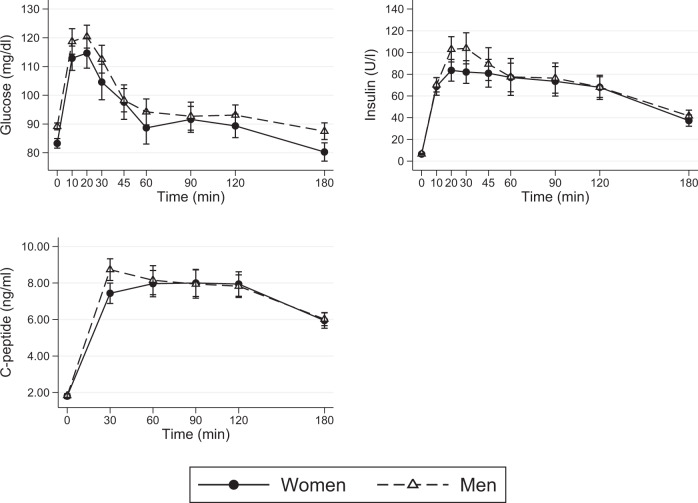
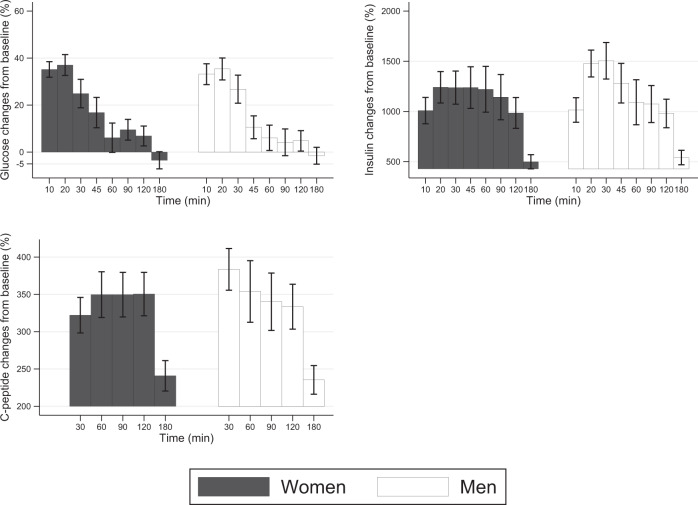
Verification
Claims the paper makes
The claims and statistics of this paper haven’t been checked yet.
Free: it reads the open-access text and checks the first 5 claims that cite a source we can check. Create a free account to check every claim.
Claims other papers make about this one
Each is checked against this paper’s own text: does it say what the citing paper says it does?
The source backs part of the claim, not all of it — or backs it for a different population, condition or comparison.
In the citing paper
“Physical activity increases energy expenditure and alters substrate utilization based on the intensity and duration (32, 160).”
From Sex differences in the metabolism of glucose and fatty acids by adipose tissue and skeletal muscle in humans (2025) · cites this paper as [160]
Experimental — accuracy not yet measuredThe check wasn’t confident either way, so it gives no verdict — never disputed.
In the citing paper
“During moderate levels of exercise (25-65% of peak oxygen uptake – V̇O2 peak), the primary energy source is fatty acid oxidation, including circulating FFA, fatty acids derived from plasma VLDL-TG, and imTG (160–162).”
From Sex differences in the metabolism of glucose and fatty acids by adipose tissue and skeletal muscle in humans (2025) · cites this paper as [160]
Experimental — accuracy not yet measuredThe check wasn’t confident either way, so it gives no verdict — never disputed.
In the citing paper
“During greater intensity exercise carbohydrate (plasma glucose and skeletal muscle glycogen) oxidation more selectively increases to meet energy demand (Figure 7) (160).”
From Sex differences in the metabolism of glucose and fatty acids by adipose tissue and skeletal muscle in humans (2025) · cites this paper as [160]
Experimental — accuracy not yet measuredThe check wasn’t confident either way, so it gives no verdict — never disputed.
In the citing paper
“At exercise intensities below 60% V̇O2peak, the primary energy source is fatty acid oxidation (160, 186).”
From Sex differences in the metabolism of glucose and fatty acids by adipose tissue and skeletal muscle in humans (2025) · cites this paper as [160]
Experimental — accuracy not yet measuredThe check wasn’t confident either way, so it gives no verdict — never disputed.
In the citing paper
“Prolonged exercise is more related to the greater contribution of fat as an energy substrate (160).”
From Sex differences in the metabolism of glucose and fatty acids by adipose tissue and skeletal muscle in humans (2025) · cites this paper as [160]
Experimental — accuracy not yet measured
1 more claim about this paper
Create a free account to see every claim other papers make about this one.
Self-check
Percentages, sums and reported differences re-computed from the paper’s own numbers.
The self-check needs the paper’s full text.
Citations
Cites
International physical activity questionnaire: 12-country reliability and validity
CRAIG, C. L., MARSHALL, A. L., SJ??STR??M, M., BAUMAN, A. E., BOOTH, M. L., AINSWORTH, B. E., PRATT, M., EKELUND, U., YNGVE, A., SALLIS, J. F., et al. (2003) · Medicine & Science in Sports & Exercise · doi:10.1249/01.mss.0000078924.61453.fb · Cited by 21,619 · cited 1×
“Subjects were asked to complete the IPAQ questionnaire to assess their level of physical activity [21].”
MethodSaeedi, P., Petersohn, I., Salpea, P., Malanda, B., Karuranga, S., Unwin, N., Colagiuri, S., Guariguata, L., Motala, A. A., Ogurtsova, K., et al. (2019) · Diabetes Research and Clinical Practice · doi:10.1016/j.diabres.2019.107843 · Cited by 10,792
IDF Diabetes Atlas: Global estimates of diabetes prevalence for 2017 and projections for 2045
Cho, N. H., Shaw, J. E., Karuranga, S., Huang, Y., da Rocha Fernandes, J. D., Ohlrogge, A. W., & Malanda, B. (2018) · Diabetes Research and Clinical Practice · doi:10.1016/j.diabres.2018.02.023 · Cited by 7,283 · cited 1×
“According to recent estimates, the global prevalence of diabetes is higher in men than in women [3].”
BackgroundIDF Diabetes Atlas: Global estimates for the prevalence of diabetes for 2015 and 2040
Ogurtsova, K., da Rocha Fernandes, J. D., Huang, Y., Linnenkamp, U., Guariguata, L., Cho, N. H., Cavan, D., Shaw, J. E., & Makaroff, L. E. (2017) · Diabetes Research and Clinical Practice · doi:10.1016/j.diabres.2017.03.024 · Cited by 6,966
Durnin, J. V. G. A., & Womersley, J. (1974) · British Journal of Nutrition · doi:10.1079/bjn19740060 · Cited by 6,343 · cited 1×
“Body density and fat mass were then estimated by the Durnin and Womersley equation [24] and by the Siri’s formula [25], respectively.”
MethodBody composition from fluid spaces and density: analysis of methods. 1961.
Siri, W. E. (1993) · PubMed · Cited by 2,573
Visceral and ectopic fat, atherosclerosis, and cardiometabolic disease: a position statement
Neeland, I. J., Ross, R., Després, J.-P., Matsuzawa, Y., Yamashita, S., Shai, I., Seidell, J., Magni, P., Santos, R. D., Arsenault, B., et al. (2019) · The Lancet Diabetes & Endocrinology · doi:10.1016/s2213-8587(19)30084-1 · Cited by 1,603 · cited 1×
“On the other hand, women have a higher proportion of body fat in the gluteal-femoral region, whereas men tend to store fat in the abdominal region [16], a known risk factor for insulin resistance and the metabolic syndrome [17].”
BackgroundAge- and sex-specific prevalences of diabetes and impaired glucose regulation in 13 European cohorts
The DECODE Study Group (2003) · Diabetes Care · doi:10.2337/diacare.26.1.61 · Cited by 608
Exercise and Insulin Sensitivity: A Review
Borghouts, L. B., & Keizer, H. A. (2000) · International Journal of Sports Medicine · doi:10.1055/s-2000-8847 · Cited by 597 · cited 1×
“Physical activity may be a further a confounder with beneficial effect on insulin sensitivity and glucose uptake [19, 20].”
BackgroundSex Differences in Body Composition
Bredella, M. A. (2017) · Advances in Experimental Medicine and Biology · doi:10.1007/978-3-319-70178-3_2 · Cited by 523 · cited 1×
“It is well-known that, compared to men with same age, women have generally lower skeletal muscle mass and higher adipose tissue mass [15] and this may predispose women to a lower insulin sensitivity and glucose uptake compared to men.”
BackgroundAge- and Sex-Specific Prevalence of Diabetes and Impaired Glucose Regulation in 11 Asian Cohorts
the DECODA Study Group (2003) · Diabetes Care · doi:10.2337/diacare.26.6.1770 · Cited by 396
Gender and Sex Differences in Adipose Tissue
Chang, E., Varghese, M., & Singer, K. (2018) · Current Diabetes Reports · doi:10.1007/s11892-018-1031-3 · Cited by 382 · cited 1×
“On the other hand, women have a higher proportion of body fat in the gluteal-femoral region, whereas men tend to store fat in the abdominal region [16], a known risk factor for insulin resistance and the metabolic syndrome [17].”
BackgroundGender differences in glucose homeostasis and diabetes
Mauvais-Jarvis, F. (2018) · Physiology & Behavior · doi:10.1016/j.physbeh.2017.08.016 · Cited by 377 · cited 2×
“An additional limitation is that we did not consider the concentration of sex hormones, which are known to influence glucose metabolism [9].”
BackgroundThe physiology of endocrine systems with ageing
van den Beld, A. W., Kaufman, J.-M., Zillikens, M. C., Lamberts, S. W. J., Egan, J. M., & van der Lely, A. J. (2018) · The Lancet Diabetes & Endocrinology · doi:10.1016/s2213-8587(18)30026-3 · Cited by 349 · cited 1×
“It is also known that glucose homeostasis is affected by age [18].”
BackgroundEffects of Age and Sex on Postprandial Glucose Metabolism
Basu, R., Dalla Man, C., Campioni, M., Basu, A., Klee, G., Toffolo, G., Cobelli, C., & Rizza, R. A. (2006) · Diabetes · doi:10.2337/db05-1692 · Cited by 334
Prevalences of Diabetes and Impaired Glucose Regulation in a Danish Population
Glümer, C., Jørgensen, T., & Borch-Johnsen, K. (2003) · Diabetes Care · doi:10.2337/diacare.26.8.2335 · Cited by 279
The contribution of sonography to the measurement of intra‐abdominal fat
Armellini, F., Zamboni, M., Rigo, L., Todesco, T., Bosello, O., Bergamo‐Andreis, I. A., & Procacci, C. (1990) · Journal of Clinical Ultrasound · doi:10.1002/jcu.1870180707 · Cited by 234
Hilawe, E. H., Yatsuya, H., Kawaguchi, L., & Aoyama, A. (2013) · Bulletin of the World Health Organization · doi:10.2471/blt.12.113415 · Cited by 169
Yki‐Järvinen, H. (1984) · Metabolism · doi:10.1016/0026-0495(84)90229-4 · Cited by 164
Sicree, R. A., Zimmet, P. Z., Dunstan, D. W., Cameron, A. J., Welborn, T. A., & Shaw, J. E. (2008) · Diabetic Medicine · doi:10.1111/j.1464-5491.2007.02362.x · Cited by 155 · cited 4×
“The reason for this may be that taller individuals have more skeletal muscle mass for glucose uptake and disposal [28].”
BackgroundResultInfluentialFærch, K., Borch‐Johnsen, K., Vaag, A. A., Jørgensen, T., & Witte, D. R. (2010) · Diabetologia · doi:10.1007/s00125-010-1673-4 · Cited by 149
Williams, J. W., Zimmet, P. Z., Shaw, J. E., De Courten, M. P., Cameron, A. J., Chitson, P., Tuomilehto, J., & Alberti, K. G. M. M. (2003) · Diabetic Medicine · doi:10.1046/j.1464-5491.2003.01059.x · Cited by 148
Influence of BMI and Gender on Postprandial Hormone Responses
Carroll, J. F., Kaiser, K. A., Franks, S. F., Deere, C., & Caffrey, J. L. (2007) · Obesity · doi:10.1038/oby.2007.355 · Cited by 101 · cited 1×
“We are aware of one study using an ad libitum caloric intake protocol, where subjects were asked to drink as much as possible of a liquid meal [12].”
MethodSex differences in carbohydrate metabolism
Tarnopolsky, M. A., & Ruby, B. C. (2001) · Current Opinion in Clinical Nutrition and Metabolic Care · doi:10.1097/00075197-200111000-00010 · Cited by 83 · cited 1×
“If confirmed, this would have important implications for nutritional strategies for diabetes prevention and management [10, 11].”
BackgroundBertoli, S., Leone, A., Vignati, L., Spadafranca, A., Bedogni, G., Vanzulli, A., Rodeschini, E., & Battezzati, A. (2015) · Nutrition Journal · doi:10.1186/s12937-015-0120-2 · Cited by 65
Self-citationExercise and Insulin Resistance
Whillier, S. (2020) · Advances in experimental medicine and biology · doi:10.1007/978-981-15-1792-1_9 · Cited by 65 · cited 1×
“Physical activity may be a further a confounder with beneficial effect on insulin sensitivity and glucose uptake [19, 20].”
BackgroundSex differences in the control of glucose homeostasis
Blaak, E. (2008) · Current Opinion in Clinical Nutrition and Metabolic Care · doi:10.1097/mco.0b013e32830467d3 · Cited by 61 · cited 1×
“If confirmed, this would have important implications for nutritional strategies for diabetes prevention and management [10, 11].”
BackgroundHorie, I., Abiru, N., Eto, M., Sako, A., Akeshima, J., Nakao, T., Nakashima, Y., Niri, T., Ito, A., Nozaki, A., et al. (2018) · Journal of Diabetes Investigation · doi:10.1111/jdi.12829 · Cited by 59
Ferrara, C. M., Goldberg, A. P., Nicklas, B. J., Sorkin, J. D., & Ryan, A. S. (2008) · Applied Physiology, Nutrition, and Metabolism · doi:10.1139/h08-062 · Cited by 53
The female 'insulin advantage' in a biracial cohort: results from the Miami Community Health Study.
Donahue, R. P., Prineas, R. J., Donahue, R. A. D., Bean, J. A., & Skyler, J. S. (1996) · PubMed · Cited by 47
Men Are from Mars, Women Are from Venus: Sex Differences in Insulin Action and Secretion
Basu, A., Dube, S., & Basu, R. (2017) · Advances in Experimental Medicine and Biology · doi:10.1007/978-3-319-70178-3_4 · Cited by 38 · cited 1×
“Moreover, postprandial insulin and C-peptide concentrations were higher in young women than in young men, despite the concentrations of these hormone did not differ in fasting state, and the authors suggested that young women had impaired insulin action compared to young men [33].”
ResultBedogni, G., Bertoli, S., Leone, A., Amicis, R. S. D., Lucchetti, E., Agosti, F., Marazzi, N., Battezzati, A., & Sartório, A. (2017) · Clinical Nutrition · doi:10.1016/j.clnu.2017.11.011 · Cited by 35
Self-citationGender Differences in Insulin-Stimulated Glucose Utilization Among African-Americans
Falkner, B., Hulman, S., & Kushner, H. (1994) · American Journal of Hypertension · doi:10.1093/ajh/7.11.948 · Cited by 34 · cited 1×
“Several studies using the hyperinsulinemic euglycaemic clamp technique have observed that whole-body insulin-mediated glucose uptake (M) is generally lower in women than in men [31, 34, 35].”
ResultSex Differences in Glucose and Fatty Acid Metabolism in Asians Who Are Nonobese
Chan, Z., Chooi, Y. C., Ding, C., Choo, J., Sadananthan, S. A., Michael, N., Velan, S. S., Leow, M. K., & Magkos, F. (2019) · The Journal of Clinical Endocrinology & Metabolism · doi:10.1210/jc.2018-01421 · Cited by 34 · cited 1×
“Other studies have assessed the sex differences in the postprandial glycemic response by administering a mixed meal with a fixed amount of carbohydrates [13] or a mixed meal normalized on body weight [14].”
BackgroundGender differences in the insulin‐like growth factor axis response to a glucose load
Flanagan, D. E., Holt, R. I. G., Owens, P. C., Cockington, R. J., Moore, V. M., Robinson, J. S., Godsland, I. F., & Phillips, D. I. W. (2006) · Acta Physiologica · doi:10.1111/j.1748-1716.2006.01581.x · Cited by 32
Falkner, B. E., Sherif, K., & Kushner, H. (2000) · PubMed · Cited by 16
Cited by
Sex Differences in Energy Metabolism: A Female-Oriented Discussion
Sanchez, B. N., Volek, J. S., Kraemer, W. J., Sáenz, C., & Maresh, C. M. (2024) · Sports Medicine · doi:10.1007/s40279-024-02063-8 · Cited by 46
“In some studies, females have been reported to have lower basal glucose concentrations than men [2–5], but others report a non-significant difference between the sexes [6].”
Costa, D. N., Santosa, S., & Jensen, M. D. (2025) · Physiological Reviews · doi:10.1152/physrev.00008.2024 · Cited by 34
Vitale, M., Costabile, G., Bergia, R. E., Hjorth, T., Campbell, W. W., Landberg, R., Riccardi, G., & Giacco, R. (2023) · Clinical Nutrition · doi:10.1016/j.clnu.2023.08.016 · Cited by 33
Leone, A., Amicis, R. S. D., Pellizzari, M., Bertoli, S., Ravella, S., & Battezzati, A. (2022) · Biology of Sex Differences · doi:10.1186/s13293-022-00434-2 · Cited by 24
“However, we recently found that men and women had the same glycemic, insulinemic, and C-peptidemic response by administering the same meal protocol presented in this study [34].”
MethodSelf-citationMulargia, L. I., Lemmens, E., Chatonidi, G., Torre, D. L., Gebruers, K., Wouters, A. G. B., Delcour, J. A., & Verbeke, K. (2025) · LWT · doi:10.1016/j.lwt.2025.117503 · Cited by 5
Metadata
- Authors
- Leone, A., De Amicis, R., Bertoli, S., Spadafranca, A., De Carlo, G., & Battezzati, A.
- Affiliations
- University of Milan (IT)
- Corresponding author
- Leone, Alessandro
- Venue
- Nutrition & Diabetes
- Published
- 2022-02-02
- Volume
- 12
- Issue
- 1
- Pages
- 6-6
- ISSN
- 2044-4052 (ISSN-L)
- PMC
- PMC8807706
- OpenAlex
- W4210434754
- Cited by
- 16
- References
- 36
- Citations by year
- 2026: 5 · 2025: 2 · 2024: 4 · 2023: 3 · 2022: 2
- FWCI
- 2.04
- Type
- journal article
- Language
- en
- Open access
- gold
- doi.org
- Licence
- cc-by
- creativecommons.org/licenses/by/4.0 (tdm)
- creativecommons.org/licenses/by/4.0 (vor)
- Locations
- Nutrition and Diabetes (publishedVersion, cc-by)
- PubMed Central (publishedVersion, cc-by)
- PubMed (publishedVersion)
- Archivio Istituzionale della Ricerca (Universita Degli Studi Di Milano) (submittedVersion, other-oa)
- DOAJ (DOAJ: Directory of Open Access Journals) (submittedVersion, cc-by-sa)
- Funders
- Università degli Studi di Milano
- Topics
- Health Sciences › Medicine › Endocrinology, Diabetes and Metabolism › Diabetes, Cardiovascular Risks, and Lipoproteins
- Health Sciences › Medicine › Endocrinology, Diabetes and Metabolism › Pancreatic function and diabetes
- Health Sciences › Medicine › Endocrinology, Diabetes and Metabolism › Diet, Metabolism, and Disease
- Keywords
- sexual dimorphism, postprandial glucose metabolism, mixed meal, glucose homeostasis, insulin response, C-peptide, sex differences, diabetes risk, carbohydrate metabolism, energy expenditure, young adults
- MeSH terms
- Adult, Blood Glucose, Dietary Carbohydrates, Female, Glucose, Humans, Insulin, Male, Sex Characteristics, Cross-Over Studies, Postprandial Period, Carbohydrate Metabolism, Young Adult, Healthy Volunteers
About these checks
Registry, retraction, Cites and statistics results are computed, not judged, with one exception: a printed reference that no index lists is read once by a model before it counts as a citation error. Claims are extracted by a model and kept only when their quote appears verbatim in the text; each cited source is then checked, with a model’s help, for whether it says what the claim relies on. Those verdicts can be wrong — read the claim’s quote and the cited source before relying on one.
Statistics and arithmetic are recomputed, not judged.
Confidence bands are shown only for fields calibrated on our annotated test set. None is calibrated yet, so no band is shown.
What counts as a claim ›How we measure confidence ›How we check this ›
Are you an author, or do you see a problem with this page? Request a review
Data sources
Bibliographic data: Semantic Scholar, OpenAlex, Crossref.
Contains information from the Semantic Scholar Academic Graph Datasets, made available under the ODC Attribution License (ODC-BY 1.0).
Semantic Scholar’s data is described in: Kinney, R., et al. (2023). The Semantic Scholar Open Data Platform. arXiv:2301.10140.
