

Acetylation promotes BCAT2 degradation to suppress BCAA catabolism and pancreatic cancer growth
Open accessThe DOI matches its Crossref record; 37 of the 37 references it cites were found in a registry or an index.
Abstract
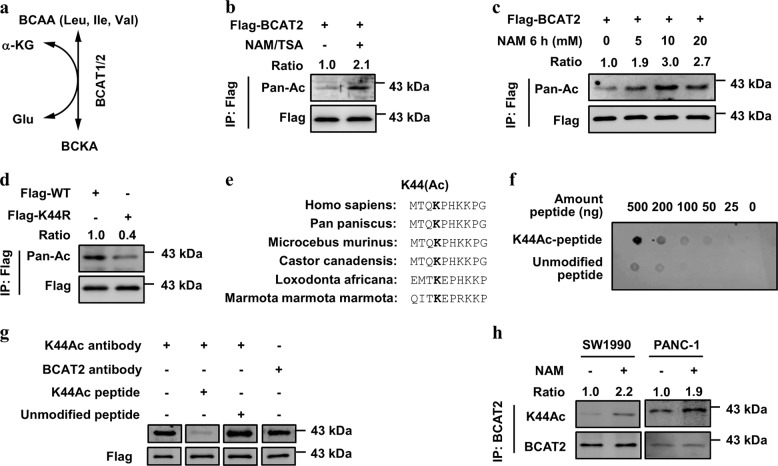
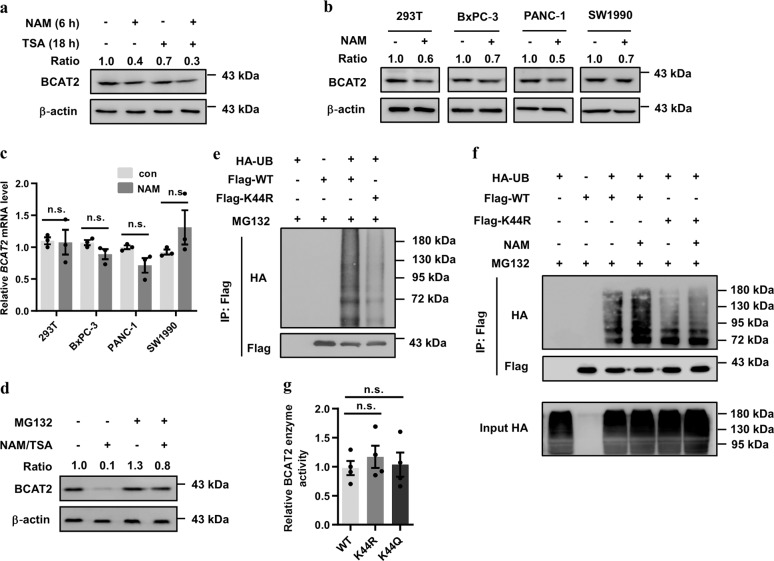
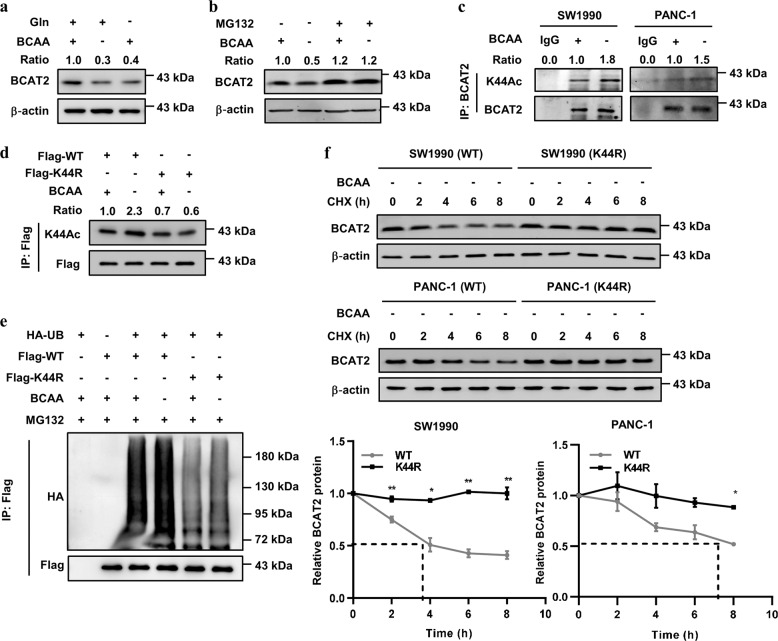
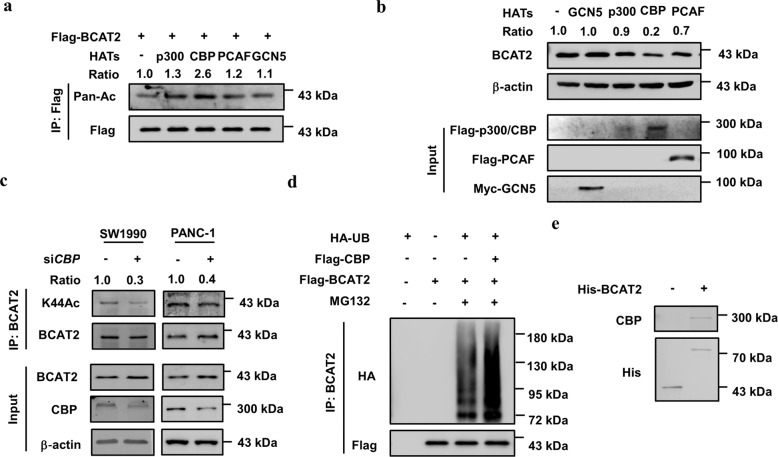
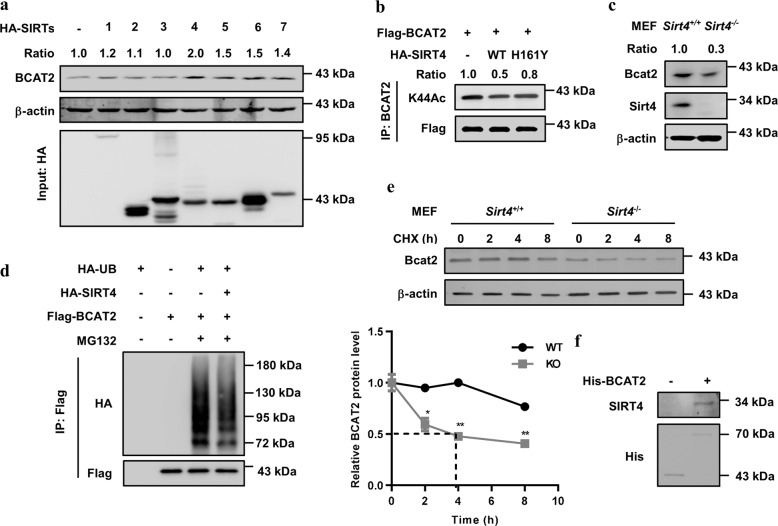
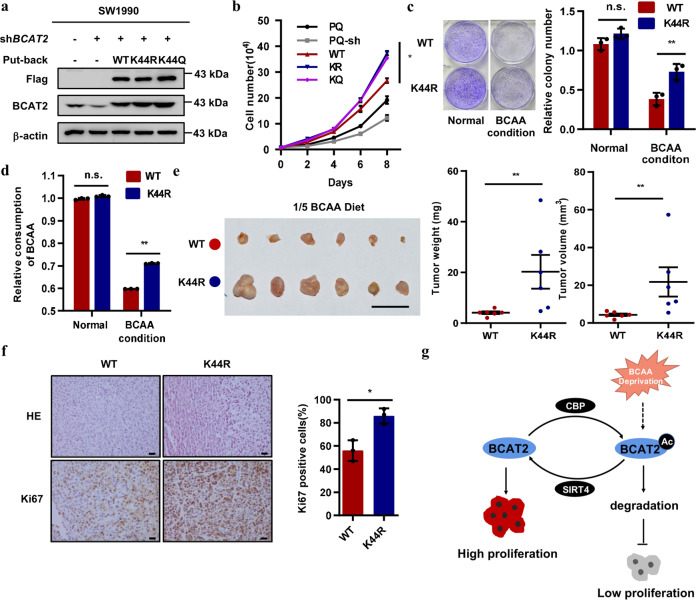
Pancreatic ductal adenocarcinoma (PDAC) is well-known for inefficient early diagnosis, with most patients diagnosed at advanced stages. Increasing evidence indicates that elevated plasma levels of branched-chain amino acids (BCAAs) are associated with an increased risk of pancreatic cancer. Branched-chain amino acid transaminase 2 (BCAT2) is an important enzyme in BCAA catabolism that reversibly catalyzes the initial step of BCAA degradation to branched-chain acyl-CoA. Here, we show that BCAT2 is acetylated at lysine 44 (K44), an evolutionarily conserved residue. BCAT2 acetylation leads to its degradation through the ubiquitin–proteasome pathway and is stimulated in response to BCAA deprivation. cAMP-responsive element-binding (CREB)-binding protein (CBP) and SIRT4 are the acetyltransferase and deacetylase for BCAT2, respectively. CBP and SIRT4 bind to BCAT2 and control the K44 acetylation level in response to BCAA availability. More importantly, the K44R mutant promotes BCAA catabolism, cell proliferation, and pancreatic tumor growth. Collectively, the data from our study reveal a previously unknown regulatory mechanism of BCAT2 in PDAC and provide a potential therapeutic target for PDAC treatment.
Overview
The claims and statistics of this paper haven’t been checked yet.
Free: it reads the open-access text and checks the first 5 claims that cite a source we can check. Create a free account to check every claim.
Integrity signals
Registry
Cites
Statistics
Figures
Verification
Claims the paper makes
The claims and statistics of this paper haven’t been checked yet.
Free: it reads the open-access text and checks the first 5 claims that cite a source we can check. Create a free account to check every claim.
Claims other papers make about this one
Each is checked against this paper’s own text: does it say what the citing paper says it does?
The source backs part of the claim, not all of it — or backs it for a different population, condition or comparison.
In the citing paper
“acetyl-deficient BCAT2 mutants better support pancreatic cancer cell growth and BCAA uptake in both in vitro and in mouse models under BCAA-deprived conditions [66].”
From Acetylation: a new target for protein degradation in cancer (2025) · cites this paper as [66]
Experimental — accuracy not yet measuredThe cited source says what the claim attributes to it.
In the citing paper
“Under BCAA-deprived conditions, BCAT2 becomes acetylated at K44 and displays a remarkably decreased half-life (Figure 2D) [66].”
From Acetylation: a new target for protein degradation in cancer (2025) · cites this paper as [66]
Self-check
Percentages, sums and reported differences re-computed from the paper’s own numbers.
The self-check needs the paper’s full text.
Citations
Cites
Siegel, R. L., Miller, K. D., & Jemal, A. (2018) · CA: A Cancer Journal for Clinicians · doi:10.3322/caac.21442 · Cited by 16,579
Lysine acetylation targets protein complexes and co-regulates major cellular functions
Choudhary, C., Kumar, C., Gnad, F., Nielsen, M. L., Rehman, M., Walther, T. C., Olsen, J. V., & Mann, M. (2009) · Science · doi:10.1126/science.1175371 · Cited by 4,040 · cited 1×
“RESULTS BCAT2 is acetylated mainly at lysine 44 Previous mass spectrometry data indicated that BCAT2 is a potential acetylated protein.(15,16) To confirm this modification, we transfected Flag-BCAT2 into HEK293T cells and detected the acetylation level of BCAT2 by western blotting using a pan-specific anti-acetylated…”
BackgroundNewgard, C. B., An, J., Bain, J. R., Muehlbauer, M. J., Stevens, R. D., Lien, L. F., Haqq, A. M., Shah, S. H., Arlotto, M., Slentz, C. A., et al. (2009) · Cell Metabolism · doi:10.1016/j.cmet.2009.02.002 · Cited by 3,165
Bidirectional Transport of Amino Acids Regulates mTOR and Autophagy
Nicklin, P., Bergman, P., Zhang, B., Triantafellow, E., Wang, H., Nyfeler, B., Yang, H., Hild, M., Kung, C., Wilson, C., et al. (2009) · Cell · doi:10.1016/j.cell.2008.11.044 · Cited by 1,798
Self-citationAcetylation and deacetylation of non-histone proteins
Glozak, M. A., Sengupta, N., Zhang, X., & Seto, E. (2005) · Gene · doi:10.1016/j.gene.2005.09.010 · Cited by 1,584
Cancer metabolism: a therapeutic perspective
Martinez-Outschoorn, U. E., Peiris-Pagés, M., Pestell, R. G., Sotgia, F., & Lisanti, M. P. (2017) · Nature Reviews Clinical Oncology · doi:10.1038/nrclinonc.2016.60 · Cited by 1,505
Sirt5 Is a NAD-Dependent Protein Lysine Demalonylase and Desuccinylase
Du, J., Zhou, Y., Su, X., Yu, J. J., Khan, S., Jiang, H., Kim, J., Woo, J., Kim, J. H., Choi, B. H., et al. (2011) · Science · doi:10.1126/science.1207861 · Cited by 1,429
Mammalian Sir2 homolog SIRT3 regulates global mitochondrial lysine acetylation
Lombard, D. B., Alt, F. W., Cheng, H.-L., Bunkenborg, J., Streeper, R. S., Mostoslavsky, R., Kim, J., Yancopoulos, G., Valenzuela, D., Murphy, A., et al. (2007) · Molecular and Cellular Biology · doi:10.1128/mcb.01636-07 · Cited by 1,216
Interplay between lipids and branched-chain amino acids in development of insulin resistance
Newgard, C. B. (2012) · Cell Metabolism · doi:10.1016/j.cmet.2012.01.024 · Cited by 1,080
The first identification of lysine malonylation substrates and its regulatory enzyme
Peng, C., Lu, Z., Xie, Z., Cheng, Z., Chen, Y., Tan, M., Luo, H., Zhang, Y., He, W., Yang, K., et al. (2011) · Molecular & Cellular Proteomics · doi:10.1074/mcp.m111.012658 · Cited by 751
Self-citation
Cited by
Items 101–133 of 133
Ikeda, K., Takahashi, M., Aburaya, S., Harada, D., Ikeda, M., Kitagawa, Y., Soma, Y., Izumi, Y., Bamba, T., & Furuse, M. (2021) · Biochemistry and Biophysics Reports · doi:10.1016/j.bbrep.2021.101097 · Cited by 3
“Similarly, acetyl-CoA enzymatically activity of BCAT and other metabolic enzymes by acetylation [10].”
BackgroundLi, X., Liu, K., Li, L., Yan, S., Yang, Y., Yang, Y., Yang, J., Zou, L., Li, W., Li, G., et al. (2025) · Cancer Letters · doi:10.1016/j.canlet.2025.218208 · Cited by 3
Self-citationBranched-chain amino acid transaminases as promising targets in tumor therapy
Zhang, W., Shen, J., Ding, X., Liu, H., Wang, X., & Feng, D. (2026) · Frontiers in Cell and Developmental Biology · doi:10.3389/fcell.2026.1712076 · Cited by 3
“…or pharmacological inhibition combined with a BCAA-restricted diet significantly suppresses pancreatic intraepithelial neoplasia (PanIN) development, reduces PDAC cell proliferation, and prolongs the survival of murine models (Li et al., 2020; Lei et al., 2020; Zhu et al., 2020; Li et al., 2022).”
InfluentialLin, Z.-T., Chen, Y.-C., You, L.-S., Yuan-zhao, W., Wang, X.-Y., & Chi, L.-J. (2026) · Frontiers in Immunology · doi:10.3389/fimmu.2026.1838771 · Cited by 3
Post‐Translational Modifications in Pancreatic Cancer: Mechanisms to Clinical Applications
Zhang, G., Zhu, W., Zhao, Y., Cheng, Y., & Zhou, W. (2026) · Journal of Gastroenterology and Hepatology · doi:10.1111/jgh.70441 · Cited by 2
[A Review of Metabolic Stress and Development of Pancreatic Cancer].
Li, J., Lei, M., Lei, Q., & Yin, M. (2021) · 四川大学学报:医学版 · doi:10.12182/20210160502 · Cited by 3
Self-citationRole of branched chain amino acid metabolism on aging
Wang, Z., Yu, S., Du, X., Yan, X., & Xin, Y. (2025) · Biogerontology · doi:10.1007/s10522-025-10309-9 · Cited by 2
“…of BCAT2 via the ubiquitin–proteasome pathway, eventually decreasing the metabolic flux of BCAAs in PDAC and inhibiting tumor cell proliferation (Lei et al. 2020; Li et al. 2020), on the other hand, USP1 deubiquitinates the K229 site of BCAT2, and the presence of BCAAs enhances USP1 protein…”
Cai, A., Portengen, L., Ertaylan, G., Legler, J., Vermeulen, R. C. H., Lenters, V. C., & Rémy, S. (2023) · International Journal of Molecular Sciences · doi:10.3390/ijms24087607 · Cited by 2
“Branched-chain amino acids (BCAAs) are associated with the progression of obesity-related metabolic disorders [23]; additionally, BCAA catabolism is suggested to play a role in the pathogenesis of metabolic disturbances, and BCAT2 is an important enzyme that catalyzes the initial step of BCAA catabolism [24,25].”
BackgroundHuang, H., Liu, X., Chen, X., Tang, X., Qiu, H., Yu, H., Jin, G., & Lan, L. (2026) · Cancer & Metabolism · doi:10.1186/s40170-026-00436-3 · Cited by 1
“Meanwhile, acetylation of BCAT2 and its degradation process, regulated by CREB-binding protein (CBP) and sirtuin 4 (SIRT4), have also been identified [8].”
Qin, Y., Xue, K., Xu, Y., Pan, H., Chai, W., Sun, L., Liu, X., Li, J., Cao, Y., Li, J., et al. (2026) · Cell Death and Disease · doi:10.1038/s41419-026-08989-3 · Cited by 1
Self-citationBCAA metabolism promotes lung cancer tumorigenesis by enhancing cholesterol biosynthesis
Ma, H., Zhang, E., Cai, J., Hang, D., Ma, X., Yang, Y., Zhu, M., Sun, Q., Huang, J., Zhang, J., et al. (2026) · Cell Reports · doi:10.1016/j.celrep.2026.117641 · Cited by 1
Exercise suppresses IP6K3 to modulate BCAA metabolism and ferroptosis in MASLD
Li, Z., Xu, F.-F., Zhao, Y., Shen, C.-R., Song, X. L., Xu, Y.-P., Guo, H., Fu, J., Tao, X.-Y., Ren, J. T., et al. (2026) · Cellular & Molecular Biology Letters · doi:10.1186/s11658-026-00981-1 · Cited by 1
“5), the enzyme responsible for the critical initial step of BCAA catabolism [14], we sought to determine whether BCAT2 is the functional mediator of IP6K3’s effects.”
Gong, X., Gu, L., Yang, D., He, Y., Li, Q., Qin, H., & Wang, Y. (2025) · eLife · doi:10.7554/elife.100923.2 · Cited by 1
Self-citationEffect of Branched-Chain Alpha-Keto Acid Dehydrogenase Depletion on Myotube Protein Metabolism
Madu, G. (2020) · YorkSpace (York University) · Cited by 1
Gong, X., Gu, L., Yang, D., He, Y., Li, Q., Qin, H., & Wang, Y. (2024) · eLife · doi:10.7554/elife.100923.1
Self-citationWen, S., 林贤超, Luo, W., Pan, Y., Liao, F., Wang, Z., Zhan, B., Feng, J., & Huang, H. (2024) · Figshare · doi:10.6084/m9.figshare.26708126
Wen, S., 林贤超, Luo, W., Pan, Y., Liao, F., Wang, Z., Zhan, B., Feng, J., & Huang, H. (2024) · Figshare · doi:10.6084/m9.figshare.25632961
Wen, S., 林贤超, Luo, W., Pan, Y., Liao, F., Wang, Z., Zhan, B., Feng, J., & Huang, H. (2024) · Figshare · doi:10.6084/m9.figshare.25633035
Wen, S., 林贤超, Luo, W., Pan, Y., Liao, F., Wang, Z., Zhan, B., Feng, J., & Huang, H. (2024) · Figshare · doi:10.6084/m9.figshare.26708138
Wen, S., 林贤超, Luo, W., Pan, Y., Liao, F., Wang, Z., Zhan, B., Feng, J., & Huang, H. (2024) · Figshare · doi:10.6084/m9.figshare.26708132
Wen, S., 林贤超, Luo, W., Pan, Y., Liao, F., Wang, Z., Zhan, B., Feng, J., & Huang, H. (2024) · Figshare · doi:10.6084/m9.figshare.26708129
Wen, S., 林贤超, Luo, W., Pan, Y., Liao, F., Wang, Z., Zhan, B., Feng, J., & Huang, H. (2024) · Figshare · doi:10.6084/m9.figshare.26708135
Zhu, H., Chen, M., Li, Q., Cui, S., Jiang, C., Ye, X., Hou, S., Zhang, J., Huang, X., & Cao, M. (2026) · Clinical and Experimental Medicine · doi:10.1007/s10238-026-02053-2
Mu, Y., Wang, Y., Sun, J., Xu, N., JianFeng, Z. H. O. U., Liu, S., Fu, S., Tao, Y., Lu, J., & Li, L. (2026) · Scientia Sinica Vitae · doi:10.1360/ssv-2025-0330
Self-citationChen, J., Ding, B., Tiantian, X., Ding, C., 刘建华, Huang, S., Chenguang, H., Jun, M., Yi-fan, J., Xie, H., et al. (2026) · Cancer Letters · doi:10.1016/j.canlet.2026.218604
NAA10 and BTRC drive CREBRF degradation in endoplasmic reticulum stress and renal tubular injury
Fang, S., Ning, J., Huang, J. Q., & Chen, Y. (2026) · Journal of Diabetes Investigation · doi:10.1111/jdi.70338
Sun, J., Gong, X., Zheng, J., Ni, N., & Liu, C. (2026) · Nutrition · doi:10.1016/j.nut.2026.113297
Qian, J., Wang, F., Zhou, L., & Zhou, Q. (2026) · Discover Oncology · doi:10.1007/s12672-026-05527-7
“Intriguingly, while elevated systemic or local BCAA levels have been reported to impede initiation and metastatic seeding in breast cancer [8], they conversely impose a heightened risk of driving PDAC progression [12, 13].”
InfluentialRole of post-translational modifications in cancer metabolic reprogramming
Yuan, Y., Guo, Z., Xie, J., Zhou, J., Gao, S., & Ma, Y. (2026) · Genes & Diseases · doi:10.1016/j.gendis.2026.102372
MTAP loss upregulates BCAT1 in pancreatic cancer and drives branched-chain amino acid dependency
Sheng, Y., Duan, L., Liu, Q., Zhang, Y., Chang, Y., Yan, J., Tan, H., Wang, Z., Xiao, Y., He, Y., et al. (2026) · Cell Reports · doi:10.1016/j.celrep.2026.118046
Self-citationChrzanowski, J., Graboń, W., Buchajska, K., & Cudnoch-Jędrzejewska, A. (2026) · Frontiers in Physiology · doi:10.3389/fphys.2026.1943433
Zhenxiang, W., Tongguan, T., Ying, C., Yan, Z., Meng, Q., Huihui, S., Xu, Y., & Xu, S. (2026) · Oncogene · doi:10.1038/s41388-026-03965-9
Spatial and Metabolic Dimensions of Immunosuppression in the Solid Tumor Microenvironment
(2026) · Frontiers research topics · doi:10.3389/978-2-8325-8993-9
Metadata
- Authors
- Lei, M.-Z., Li, X.-X., Zhang, Y., Li, J.-T., Zhang, F., Wang, Y.-P., Yin, M., Qu, J., & Lei, Q.-Y.
- Affiliations
- Shanghai Medical College of Fudan University (CN)
- Corresponding author
- Qu, Jia
- Lei, Qun-Ying
- Venue
- Signal Transduction and Targeted Therapy
- Published
- 2020-05-29
- Volume
- 5
- Issue
- 1
- Pages
- 70-70
- ISSN
- 2059-3635 (ISSN-L)
- PMC
- PMC7256045
- OpenAlex
- W3031710066
- Cited by
- 129
- References
- 37
- Citations by year
- 2026: 19 · 2025: 25 · 2024: 26 · 2023: 29 · 2022: 13 · 2021: 15 · 2020: 2
- FWCI
- 5.05
- Type
- journal article
- Language
- en
- Open access
- gold
- doi.org
- Licence
- cc-by
- creativecommons.org/licenses/by/4.0 (tdm)
- creativecommons.org/licenses/by/4.0 (vor)
- Locations
- Signal Transduction and Targeted Therapy (publishedVersion, cc-by)
- PubMed Central (publishedVersion, cc-by)
- PubMed (publishedVersion)
- Funders
- National Natural Science Foundation of China (81802745, 81790253, 81790250, 91959202)
- Shanghai Municipal Education Commission (N173606)
- Topics
- Life Sciences › Biochemistry, Genetics and Molecular Biology › Cancer Research › Cancer, Lipids, and Metabolism
- Health Sciences › Medicine › Oncology › Pancreatic and Hepatic Oncology Research
- Life Sciences › Biochemistry, Genetics and Molecular Biology › Biochemistry › Amino Acid Enzymes and Metabolism
- Keywords
- BCAT2, lysine acetylation, pancreatic ductal adenocarcinoma, branched-chain amino acids, BCAA catabolism, protein degradation, ubiquitin-proteasome system, CBP, SIRT4, tumor growth, therapeutic target
- MeSH terms
- Acetylation, Amino Acids, Branched-Chain, Transaminases, Humans, Neoplasm Proteins, Pancreatic Neoplasms, Pregnancy Proteins, Minor Histocompatibility Antigens, Cell Line, Tumor, HEK293 Cells, Proteolysis
About these checks
Registry, retraction, Cites and statistics results are computed, not judged, with one exception: a printed reference that no index lists is read once by a model before it counts as a citation error. Claims are extracted by a model and kept only when their quote appears verbatim in the text; each cited source is then checked, with a model’s help, for whether it says what the claim relies on. Those verdicts can be wrong — read the claim’s quote and the cited source before relying on one.
Statistics and arithmetic are recomputed, not judged.
Confidence bands are shown only for fields calibrated on our annotated test set. None is calibrated yet, so no band is shown.
What counts as a claim ›How we measure confidence ›How we check this ›
Are you an author, or do you see a problem with this page? Request a review
Data sources
Bibliographic data: Semantic Scholar, OpenAlex, Crossref.
Contains information from the Semantic Scholar Academic Graph Datasets, made available under the ODC Attribution License (ODC-BY 1.0).
Semantic Scholar’s data is described in: Kinney, R., et al. (2023). The Semantic Scholar Open Data Platform. arXiv:2301.10140.
