

Acetylation promotes BCAT2 degradation to suppress BCAA catabolism and pancreatic cancer growth
Open accessThe DOI matches its Crossref record; 37 of the 37 references it cites were found in a registry or an index.
Abstract
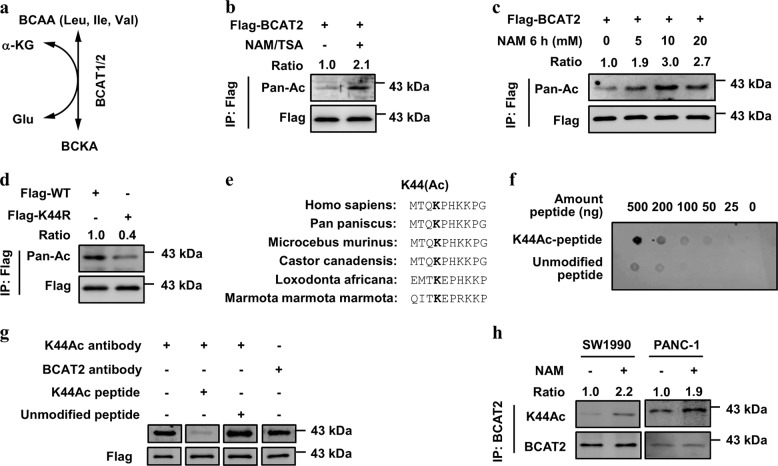
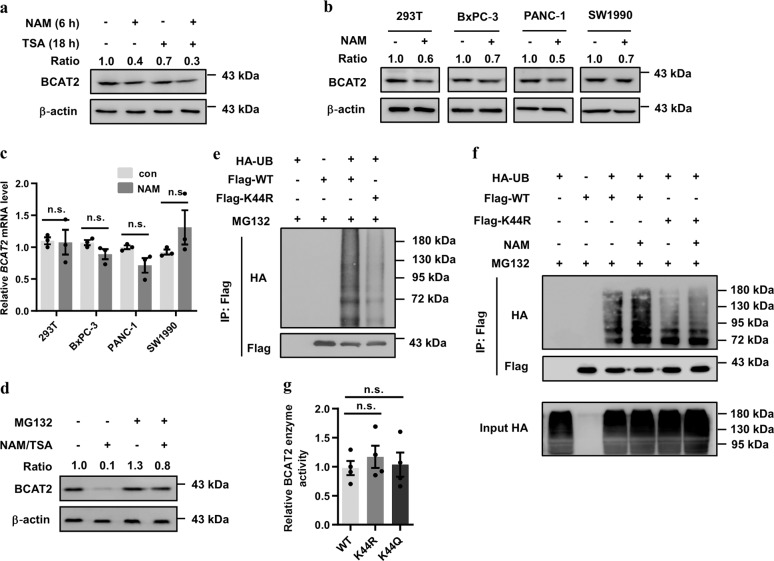
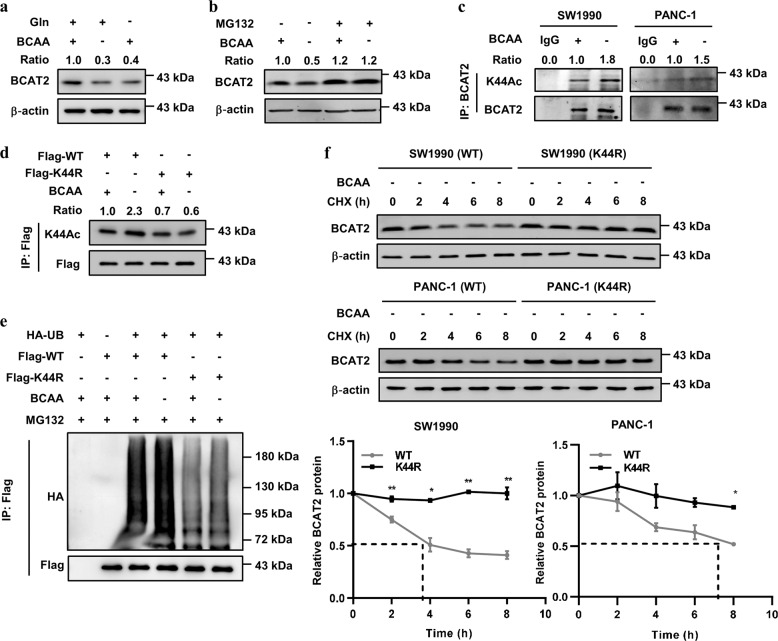
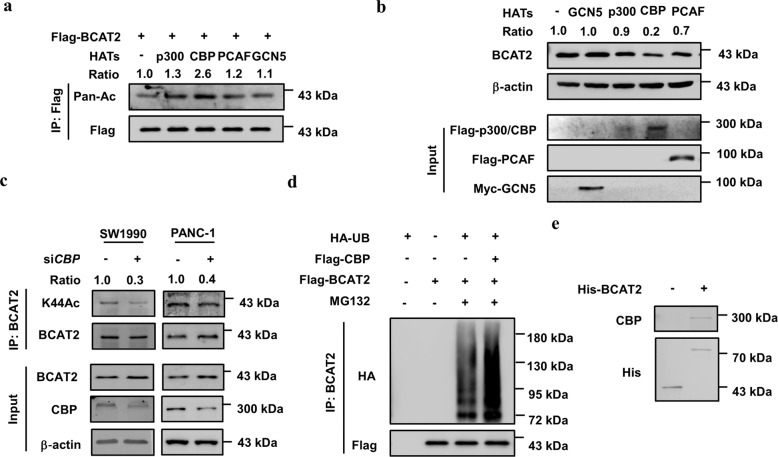
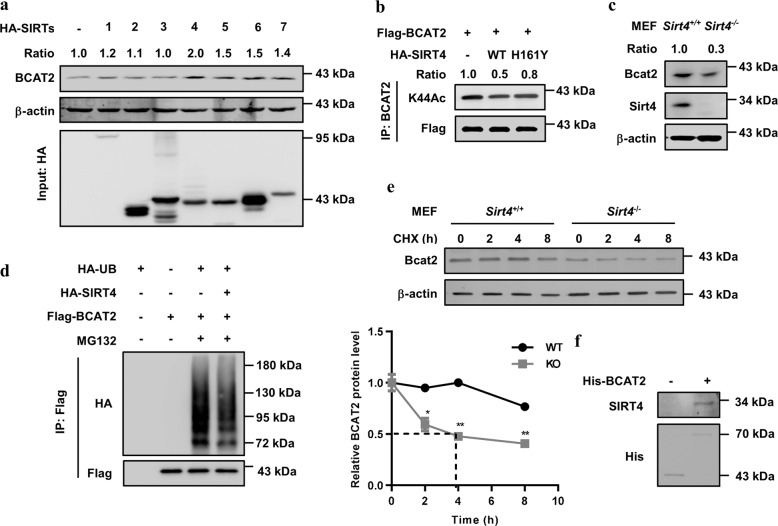
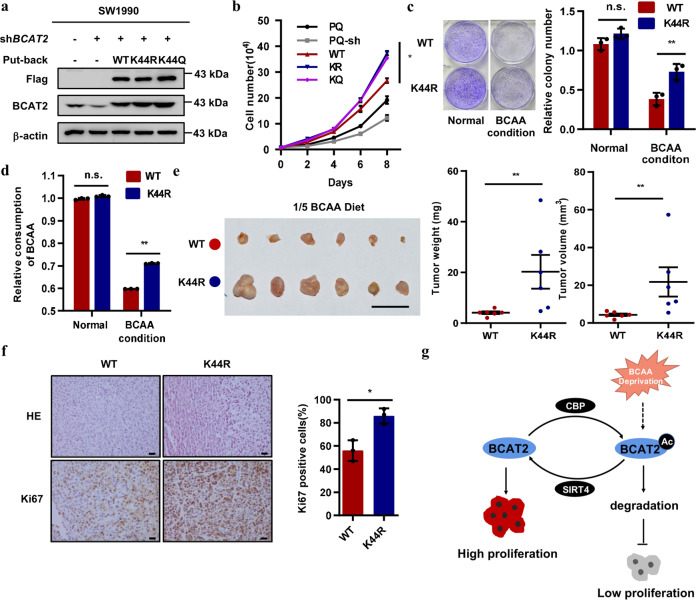
Pancreatic ductal adenocarcinoma (PDAC) is well-known for inefficient early diagnosis, with most patients diagnosed at advanced stages. Increasing evidence indicates that elevated plasma levels of branched-chain amino acids (BCAAs) are associated with an increased risk of pancreatic cancer. Branched-chain amino acid transaminase 2 (BCAT2) is an important enzyme in BCAA catabolism that reversibly catalyzes the initial step of BCAA degradation to branched-chain acyl-CoA. Here, we show that BCAT2 is acetylated at lysine 44 (K44), an evolutionarily conserved residue. BCAT2 acetylation leads to its degradation through the ubiquitin–proteasome pathway and is stimulated in response to BCAA deprivation. cAMP-responsive element-binding (CREB)-binding protein (CBP) and SIRT4 are the acetyltransferase and deacetylase for BCAT2, respectively. CBP and SIRT4 bind to BCAT2 and control the K44 acetylation level in response to BCAA availability. More importantly, the K44R mutant promotes BCAA catabolism, cell proliferation, and pancreatic tumor growth. Collectively, the data from our study reveal a previously unknown regulatory mechanism of BCAT2 in PDAC and provide a potential therapeutic target for PDAC treatment.
Overview
The claims and statistics of this paper haven’t been checked yet.
Free: it reads the open-access text and checks the first 5 claims that cite a source we can check. Create a free account to check every claim.
Integrity signals
Registry
Cites
Statistics
Figures
Verification
Claims the paper makes
The claims and statistics of this paper haven’t been checked yet.
Free: it reads the open-access text and checks the first 5 claims that cite a source we can check. Create a free account to check every claim.
Claims other papers make about this one
Each is checked against this paper’s own text: does it say what the citing paper says it does?
The source backs part of the claim, not all of it — or backs it for a different population, condition or comparison.
In the citing paper
“acetyl-deficient BCAT2 mutants better support pancreatic cancer cell growth and BCAA uptake in both in vitro and in mouse models under BCAA-deprived conditions [66].”
From Acetylation: a new target for protein degradation in cancer (2025) · cites this paper as [66]
Experimental — accuracy not yet measuredThe cited source says what the claim attributes to it.
In the citing paper
“Under BCAA-deprived conditions, BCAT2 becomes acetylated at K44 and displays a remarkably decreased half-life (Figure 2D) [66].”
From Acetylation: a new target for protein degradation in cancer (2025) · cites this paper as [66]
Self-check
Percentages, sums and reported differences re-computed from the paper’s own numbers.
The self-check needs the paper’s full text.
Citations
Cites
Siegel, R. L., Miller, K. D., & Jemal, A. (2018) · CA: A Cancer Journal for Clinicians · doi:10.3322/caac.21442 · Cited by 16,579
Lysine acetylation targets protein complexes and co-regulates major cellular functions
Choudhary, C., Kumar, C., Gnad, F., Nielsen, M. L., Rehman, M., Walther, T. C., Olsen, J. V., & Mann, M. (2009) · Science · doi:10.1126/science.1175371 · Cited by 4,040 · cited 1×
“RESULTS BCAT2 is acetylated mainly at lysine 44 Previous mass spectrometry data indicated that BCAT2 is a potential acetylated protein.(15,16) To confirm this modification, we transfected Flag-BCAT2 into HEK293T cells and detected the acetylation level of BCAT2 by western blotting using a pan-specific anti-acetylated…”
BackgroundNewgard, C. B., An, J., Bain, J. R., Muehlbauer, M. J., Stevens, R. D., Lien, L. F., Haqq, A. M., Shah, S. H., Arlotto, M., Slentz, C. A., et al. (2009) · Cell Metabolism · doi:10.1016/j.cmet.2009.02.002 · Cited by 3,165
Bidirectional Transport of Amino Acids Regulates mTOR and Autophagy
Nicklin, P., Bergman, P., Zhang, B., Triantafellow, E., Wang, H., Nyfeler, B., Yang, H., Hild, M., Kung, C., Wilson, C., et al. (2009) · Cell · doi:10.1016/j.cell.2008.11.044 · Cited by 1,798
Self-citationAcetylation and deacetylation of non-histone proteins
Glozak, M. A., Sengupta, N., Zhang, X., & Seto, E. (2005) · Gene · doi:10.1016/j.gene.2005.09.010 · Cited by 1,584
Cancer metabolism: a therapeutic perspective
Martinez-Outschoorn, U. E., Peiris-Pagés, M., Pestell, R. G., Sotgia, F., & Lisanti, M. P. (2017) · Nature Reviews Clinical Oncology · doi:10.1038/nrclinonc.2016.60 · Cited by 1,505
Sirt5 Is a NAD-Dependent Protein Lysine Demalonylase and Desuccinylase
Du, J., Zhou, Y., Su, X., Yu, J. J., Khan, S., Jiang, H., Kim, J., Woo, J., Kim, J. H., Choi, B. H., et al. (2011) · Science · doi:10.1126/science.1207861 · Cited by 1,429
Mammalian Sir2 homolog SIRT3 regulates global mitochondrial lysine acetylation
Lombard, D. B., Alt, F. W., Cheng, H.-L., Bunkenborg, J., Streeper, R. S., Mostoslavsky, R., Kim, J., Yancopoulos, G., Valenzuela, D., Murphy, A., et al. (2007) · Molecular and Cellular Biology · doi:10.1128/mcb.01636-07 · Cited by 1,216
Interplay between lipids and branched-chain amino acids in development of insulin resistance
Newgard, C. B. (2012) · Cell Metabolism · doi:10.1016/j.cmet.2012.01.024 · Cited by 1,080
The first identification of lysine malonylation substrates and its regulatory enzyme
Peng, C., Lu, Z., Xie, Z., Cheng, Z., Chen, Y., Tan, M., Luo, H., Zhang, Y., He, W., Yang, K., et al. (2011) · Molecular & Cellular Proteomics · doi:10.1074/mcp.m111.012658 · Cited by 751
Self-citationNeinast, M., Murashige, D., & Arany, Z. (2019) · Annual Review of Physiology · doi:10.1146/annurev-physiol-020518-114455 · Cited by 714
Mayers, J. R., Wu, C., Clish, C. B., Kraft, P., Torrence, M. E., Fiske, B. P., Yuan, C., Bao, Y., Townsend, M. K., Tworoger, S. S., et al. (2014) · Nature Medicine · doi:10.1038/nm.3686 · Cited by 649
Lv, L., Li, D., Zhao, D., Lin, R., Chu, Y., Zhang, H., Zha, Z., Liu, Y., Li, Z., Xu, Y., et al. (2011) · Molecular Cell · doi:10.1016/j.molcel.2011.04.025 · Cited by 610
Self-citationTissue of origin dictates branched-chain amino acid metabolism in mutant Kras -driven cancers
Mayers, J. R., Torrence, M. E., Danai, L. V., Papagiannakopoulos, T., Davidson, S. M., Bauer, M. R., Lau, A. N., Ji, B. W., Dixit, P. D., Hosios, A. M., et al. (2016) · Science · doi:10.1126/science.aaf5171 · Cited by 582
BCAT1 promotes cell proliferation through amino acid catabolism in gliomas carrying wild-type IDH1
Tönjes, M., Barbus, S., Park, Y. J., Wang, W., Schlotter, M., Lindroth, A. M., Pleier, S. V., Bai, A. H. C., Karra, D., Piro, R. M., et al. (2013) · Nature Medicine · doi:10.1038/nm.3217 · Cited by 486
Acetyl-Phosphate Is a Critical Determinant of Lysine Acetylation in E. coli
Weinert, B. T., Iesmantavicius, V., Wagner, S. A., Schölz, C., Gummesson, B., Beli, P., Nyström, T., & Choudhary, C. (2013) · Molecular Cell · doi:10.1016/j.molcel.2013.06.003 · Cited by 439 · cited 1×
“RESULTS BCAT2 is acetylated mainly at lysine 44 Previous mass spectrometry data indicated that BCAT2 is a potential acetylated protein.(15,16) To confirm this modification, we transfected Flag-BCAT2 into HEK293T cells and detected the acetylation level of BCAT2 by western blotting using a pan-specific anti-acetylated…”
BackgroundLi, T., Zhang, Z., Kolwicz, S. C., Abell, L., Roe, N. D., Kim, M., Zhou, B., Cao, Y., Ritterhoff, J., Gu, H., et al. (2017) · Cell Metabolism · doi:10.1016/j.cmet.2016.11.005 · Cited by 401
Cancer progression by reprogrammed BCAA metabolism in myeloid leukaemia
Hattori, A., Tsunoda, M., Konuma, T., Kobayashi, M., Nagy, T., Glushka, J., Tayyari, F., McSkimming, D., Kannan, N., Tojo, A., et al. (2017) · Nature · doi:10.1038/nature22314 · Cited by 401
Laurent, G., German, N. J., Saha, A. K., de Boer, V. C. J., Davies, M., Koves, T. R., Dephoure, N., Fischer, F., Boanca, G., Vaitheesvaran, B., et al. (2013) · Molecular Cell · doi:10.1016/j.molcel.2013.05.012 · Cited by 391
BCAT1 restricts αKG levels in AML stem cells leading to IDHmut-like DNA hypermethylation
Raffel, S., Falcone, M., Kneisel, N., Hansson, J., Wang, W., Lutz, C., Bullinger, L., Poschet, G., Nonnenmacher, Y., Barnert, A., et al. (2017) · Nature · doi:10.1038/nature24294 · Cited by 354
Zhao, D., Zou, S.-W., Liu, Y., Zhou, X., Mo, Y., Wang, P., Xu, Y.-H., Dong, B., Xiong, Y., Lei, Q.-Y., et al. (2013) · Cancer Cell · doi:10.1016/j.ccr.2013.02.005 · Cited by 345
Self-citationWang, Y.-P., Zhou, L.-S., Zhao, Y.-Z., Wang, S.-W., Chen, L.-L., Liu, L.-X., Ling, Z.-Q., Hu, F.-J., Sun, Y.-P., Zhang, J.-Y., et al. (2014) · The EMBO Journal · doi:10.1002/embj.201387224 · Cited by 318
Self-citationChemical Studies of Histone Acetylation
Gershey, E. L., Vidali, G., & Allfrey, V. G. (1968) · Journal of Biological Chemistry · doi:10.1016/s0021-9258(18)91985-x · Cited by 306
Ericksen, R. E., Lim, S. L., McDonnell, E., Shuen, W. H., Vadiveloo, M., White, P. J., Ding, Z., Kwok, R., Lee, P., Radda, G. K., et al. (2019) · Cell Metabolism · doi:10.1016/j.cmet.2018.12.020 · Cited by 295
Branched-chain amino acid metabolism in cancer
Ananieva, E. A., & Wilkinson, A. C. (2018) · Current Opinion in Clinical Nutrition & Metabolic Care · doi:10.1097/mco.0000000000000430 · Cited by 291
Genomic deletion of malic enzyme 2 confers collateral lethality in pancreatic cancer
Dey, P., Baddour, J., Muller, F., Wu, C. C., Wang, H., Liao, W.-T., Lan, Z., Chen, A., Gutschner, T., Kang, Y., et al. (2017) · Nature · doi:10.1038/nature21052 · Cited by 264
Self-citationRegulation of Gluconeogenesis by Krüppel-like Factor 15
Gray, S., Wang, B., Orihuela, Y., Hong, E.-G., Fisch, S., Haldar, S., Cline, G. W., Kim, J. K., Peroni, O. D., Kahn, B. B., et al. (2007) · Cell Metabolism · doi:10.1016/j.cmet.2007.03.002 · Cited by 246
SHMT2 Desuccinylation by SIRT5 Drives Cancer Cell Proliferation
Yang, X., Wang, Z., Li, X., Liu, B., Liu, M., Liu, L., Chen, S., Ren, M., Wang, Y., Yu, M., et al. (2018) · Cancer Research · doi:10.1158/0008-5472.can-17-1912 · Cited by 232
Self-citationAcetylation of Mitochondrial Proteins in the Heart: The Role of SIRT3
Parodi-Rullán, R. M., Chapa-Dubocq, X. R., & Javadov, S. (2018) · Frontiers in Physiology · doi:10.3389/fphys.2018.01094 · Cited by 166
Zhou, L. S., Wang, Y., Yang, Y., et al. (2020) · Carolina Digital Repository (University of North Carolina at Chapel Hill) · doi:10.17615/0crd-8n84 · Cited by 164
Self-citationHall, T. R., Wallin, R., Reinhart, G. D., & Hutson, S. M. (1993) · Journal of Biological Chemistry · doi:10.1016/s0021-9258(18)53663-2 · Cited by 147
SIRT4 interacts with OPA1 and regulates mitochondrial quality control and mitophagy
Lang, A., Anand, R., Altinoluk-Hambüchen, S., Ezzahoini, H., Stefanski, A., Iram, A., Bergmann, L., Urbach, J., Böhler, P., Hänsel, J., et al. (2017) · Aging · doi:10.18632/aging.101307 · Cited by 143
Zheng, Y., Hu, W., Chen, B., Grahn, T. H. M., Zhao, Y., Bao, H., Zhu, Y., & Zhang, Q. (2016) · Liver International · doi:10.1111/liv.13178 · Cited by 122
Katagiri, R., Goto, A., Nakagawa, T., Nishiumi, S., Kobayashi, T., Hidaka, A., Budhathoki, S., Yamaji, T., Sawada, N., Shimazu, T., et al. (2018) · Gastroenterology · doi:10.1053/j.gastro.2018.07.033 · Cited by 88
Acetylation of MAT IIα represses tumour cell growth and is decreased in human hepatocellular cancer
Yang, H.-B., Xu, Y.-Y., Zhao, X.-N., Zou, S.-W., Zhang, Y., Zhang, M., Li, J.-T., Ren, F., Wang, L.-Y., & Lei, Q.-Y. (2015) · Nature Communications · doi:10.1038/ncomms7973 · Cited by 65
Self-citationA continuous 96-well plate spectrophotometric assay for branched-chain amino acid aminotransferases
Cooper, A. J. L., Conway, M., & Hutson, S. M. (2002) · Analytical Biochemistry · doi:10.1016/s0003-2697(02)00243-9 · Cited by 42
Acetylation-dependent function of human single-stranded DNA binding protein 1
Wu, Y., Chen, H., Lu, J., Zhang, M., Zhang, R., Duan, T., Wang, X., Huang, J., & Kang, T. (2015) · Nucleic Acids Research · doi:10.1093/nar/gkv707 · Cited by 26
Cited by
Metabolic reprogramming and epigenetic modifications on the path to cancer
Sun, L., Zhang, H., & Gao, P. (2022) · Protein & Cell · doi:10.1007/s13238-021-00846-7 · Cited by 770
“This PTM modulation of BCAT2 promotes its degradation and suppresses BCAA catabolism and pancreatic cancer progression (Lei et al., 2020).”
BackgroundAmino acid metabolism in health and disease
Ling, Z.-N., Jiang, Y.-F., Ru, J.-N., Lu, J.-H., Ding, B., & Wu, J. (2023) · Signal Transduction and Targeted Therapy · doi:10.1038/s41392-023-01569-3 · Cited by 545
“53 In addition, KRAS and USP1 can also regulate the expression of BCAT2 in PDAC through the ubiquitin-proteasome pathway: KRAS can stabilize the expression of BCAT2 in PDAC by inhibiting the ubiquitination of BCAT2 by spleen tyrosine kinase (SYK) and E3 ubiquitination ligase TRIM21, 54 while USP1…”
BackgroundZhong, Q., Xiao, X., Qiu, Y., Xu, Z., Chen, C., Chong, B., Zhao, X., Hai, S., Li, S., An, Z., et al. (2023) · MedComm · doi:10.1002/mco2.261 · Cited by 442
Yang, L., Chu, Z., Liu, M., Zou, Q., Li, J., Liu, Q., Wang, Y., Wang, T., Xiang, J., & Wang, B. (2023) · Journal of Hematology & Oncology · doi:10.1186/s13045-023-01453-1 · Cited by 352
Self-citationMann, G., Mora, S., Madu, G., & Adegoke, O. A. J. (2021) · Frontiers in Physiology · doi:10.3389/fphys.2021.702826 · Cited by 261
Metadata
- Authors
- Lei, M.-Z., Li, X.-X., Zhang, Y., Li, J.-T., Zhang, F., Wang, Y.-P., Yin, M., Qu, J., & Lei, Q.-Y.
- Affiliations
- Shanghai Medical College of Fudan University (CN)
- Corresponding author
- Qu, Jia
- Lei, Qun-Ying
- Venue
- Signal Transduction and Targeted Therapy
- Published
- 2020-05-29
- Volume
- 5
- Issue
- 1
- Pages
- 70-70
- ISSN
- 2059-3635 (ISSN-L)
- PMC
- PMC7256045
- OpenAlex
- W3031710066
- Cited by
- 129
- References
- 37
- Citations by year
- 2026: 19 · 2025: 25 · 2024: 26 · 2023: 29 · 2022: 13 · 2021: 15 · 2020: 2
- FWCI
- 5.05
- Type
- journal article
- Language
- en
- Open access
- gold
- doi.org
- Licence
- cc-by
- creativecommons.org/licenses/by/4.0 (tdm)
- creativecommons.org/licenses/by/4.0 (vor)
- Locations
- Signal Transduction and Targeted Therapy (publishedVersion, cc-by)
- PubMed Central (publishedVersion, cc-by)
- PubMed (publishedVersion)
- Funders
- National Natural Science Foundation of China (81802745, 81790253, 81790250, 91959202)
- Shanghai Municipal Education Commission (N173606)
- Topics
- Life Sciences › Biochemistry, Genetics and Molecular Biology › Cancer Research › Cancer, Lipids, and Metabolism
- Health Sciences › Medicine › Oncology › Pancreatic and Hepatic Oncology Research
- Life Sciences › Biochemistry, Genetics and Molecular Biology › Biochemistry › Amino Acid Enzymes and Metabolism
- Keywords
- BCAT2, lysine acetylation, pancreatic ductal adenocarcinoma, branched-chain amino acids, BCAA catabolism, protein degradation, ubiquitin-proteasome system, CBP, SIRT4, tumor growth, therapeutic target
- MeSH terms
- Acetylation, Amino Acids, Branched-Chain, Transaminases, Humans, Neoplasm Proteins, Pancreatic Neoplasms, Pregnancy Proteins, Minor Histocompatibility Antigens, Cell Line, Tumor, HEK293 Cells, Proteolysis
About these checks
Registry, retraction, Cites and statistics results are computed, not judged, with one exception: a printed reference that no index lists is read once by a model before it counts as a citation error. Claims are extracted by a model and kept only when their quote appears verbatim in the text; each cited source is then checked, with a model’s help, for whether it says what the claim relies on. Those verdicts can be wrong — read the claim’s quote and the cited source before relying on one.
Statistics and arithmetic are recomputed, not judged.
Confidence bands are shown only for fields calibrated on our annotated test set. None is calibrated yet, so no band is shown.
What counts as a claim ›How we measure confidence ›How we check this ›
Are you an author, or do you see a problem with this page? Request a review
Data sources
Bibliographic data: Semantic Scholar, OpenAlex, Crossref.
Contains information from the Semantic Scholar Academic Graph Datasets, made available under the ODC Attribution License (ODC-BY 1.0).
Semantic Scholar’s data is described in: Kinney, R., et al. (2023). The Semantic Scholar Open Data Platform. arXiv:2301.10140.
