

Inflammation and aging: signaling pathways and intervention therapies
Open accessThe DOI matches its Crossref record; 476 of the 479 references it cites were found in a registry or an index; 215 of the 287 sources its claims cite were checked for support.
Abstract
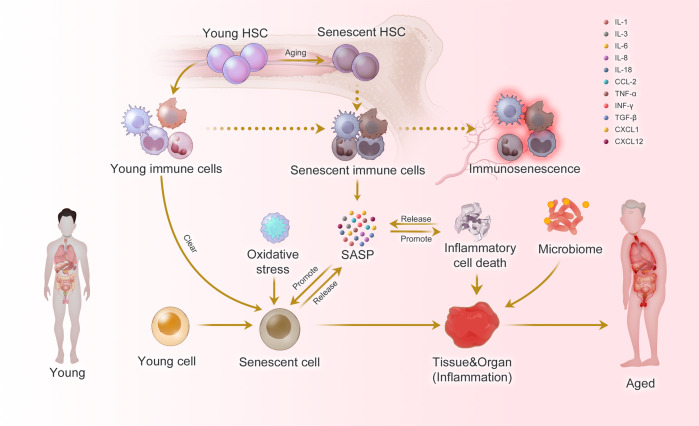
Aging is characterized by systemic chronic inflammation, which is accompanied by cellular senescence, immunosenescence, organ dysfunction, and age-related diseases. Given the multidimensional complexity of aging, there is an urgent need for a systematic organization of inflammaging through dimensionality reduction. Factors secreted by senescent cells, known as the senescence-associated secretory phenotype (SASP), promote chronic inflammation and can induce senescence in normal cells. At the same time, chronic inflammation accelerates the senescence of immune cells, resulting in weakened immune function and an inability to clear senescent cells and inflammatory factors, which creates a vicious cycle of inflammation and senescence. Persistently elevated inflammation levels in organs such as the bone marrow, liver, and lungs cannot be eliminated in time, leading to organ damage and aging-related diseases. Therefore, inflammation has been recognized as an endogenous factor in aging, and the elimination of inflammation could be a potential strategy for anti-aging. Here we discuss inflammaging at the molecular, cellular, organ, and disease levels, and review current aging models, the implications of cutting-edge single cell technologies, as well as anti-aging strategies. Since preventing and alleviating aging-related diseases and improving the overall quality of life are the ultimate goals of aging research, our review highlights the critical features and potential mechanisms of inflammation and aging, along with the latest developments and future directions in aging research, providing a theoretical foundation for novel and practical anti-aging strategies.
Overview
CoChat Summary
## TL;DR
This review argues that inflammaging—a chronic, systemic inflammatory state—is tightly intertwined with cellular senescence, immunosenescence, organ dysfunction, and age-related disease. It synthesizes signaling pathways, aging models, single-cell technologies, and intervention strategies, emphasizing anti-inflammatory approaches, senolytics, stem cell therapy, and organ transplantation.
## Key findings
- The paper describes a “vicious cycle” in which senescent cells secrete SASP factors that promote chronic inflammation, while chronic inflammation accelerates immune-cell senescence and weakens clearance of senescent cells and inflammatory factors.
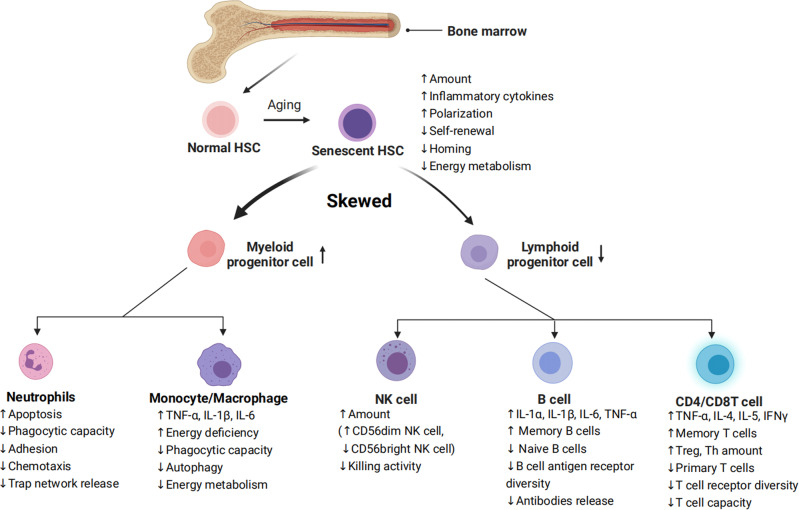
- It highlights reported age-related immune changes across cell types, including decreased circulating naive CD8 T cells as a consistent marker of immunosenescence in healthy older adults, reduced NK-cell cytotoxicity, and age-associated shifts in HSC differentiation toward myeloid lineages.
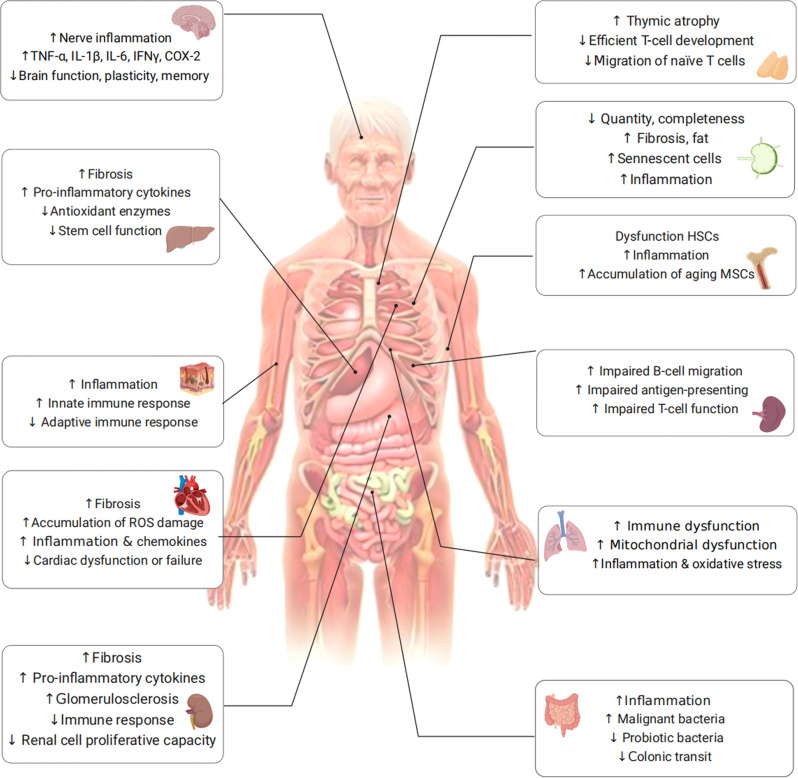
- The review links inflammaging to organ-level decline in the bone marrow, thymus, spleen, lymph nodes, brain, heart, kidney, liver, skin, lung, and gut, with examples such as age-related thymic degeneration reducing new T-cell output and aged bone marrow impairing HSC function.
- For intervention, it notes that the first senolytic combination, dasatinib plus quercetin, increased 6-minute walking distance by an average of 21.5 meters in the first human trial, but other outcomes did not change significantly and long-term efficacy remains insufficiently supported.
## Methods
- Narrative review of inflammaging across molecular, cellular, organ, and disease levels, with sections on signaling pathways, classical aging models, single-cell technology, and intervention strategies.
- No new experimental sample or cohort is reported in the paper itself; instead, it synthesizes findings from prior mouse, human, and cell-line studies cited throughout the text.
- The main approach is qualitative integration of published evidence, including examples from in vitro senescence models, in vivo mouse models, centenarian studies, and emerging single-cell/multi-omics work.
## Limitations
- The paper explicitly notes that the exact causality between inflammation and aging remains unresolved and “deserves further studies” for effective intervention.
- It also states that PANoptosis has no direct evidence yet linking it to aging, so any connection is speculative.
- Evident from the text: this is a broad review rather than a primary study, so many conclusions are synthesized from heterogeneous prior studies rather than tested in one unified dataset.
Model-written summary. Check it against the paper before relying on it.
Integrity signals
Registry
Cites
Statistics
Figures
Verification
Claims the paper makes
140 Valid · 17 Not valid · 39 Not checked · 40 Own results and interpretations
Some cited sources support this claim and some don’t — read each source’s verdict below.
In the paper
“At the same time, inflammation promotes oxidation through inflammatory mediators.205,206”
§ Inflammation and aging: signaling pathways and intervention therapies > Mechanisms of inflammaging > Triggers of inflammaging
What the sources say
- Disputedcites [205] Furman D Expression of specific inflammasome gene modules stratifies older individuals into two extreme clinical and immunological states Nat. Med. 2017 23 174 184 10.1038/nm.4267 28092664 PMC5320935 sourceExperimental — accuracy not yet measured
The Discussion describes the opposite causal direction: oxidative stress triggers an inflammatory response, including production of inflammatory cytokines. The Results attribute chronic oxidative stress to possible mitochondrial metabolic reprogramming, not to inflammatory mediators. Page numbers are unavailable in our copy. (LLM, conf=0.82)
Checked by a reasoning model — may be wrong.
- Partly supportedcites [206] Furman D Chronic inflammation in the etiology of disease across the life span Nat. Med. 2019 25 1822 1832 10.1038/s41591-019-0675-0 31806905 PMC7147972 sourceExperimental — accuracy not yet measured
The ‘Systemic chronic inflammation and non-communicable disease risk’ section says systemic chronic inflammation can damage tissues by inducing oxidative stress. That supports the inflammation-to-oxidation link, but the passage does not say that inflammatory mediators are the mechanism. (LLM, conf=0.85)
plainstates a cause- Asserted: passes — The authors put it forward as true.
- Checkable: passes — It can be checked against evidence.
- Load-bearing: passes — The paper’s conclusions depend on it.
- Based: passes — The paper gives a reason why it holds.
- Disputed
At least one cited source doesn’t support this claim or points to a different paper, and none confirmed it — see the verdicts below.
In the paper
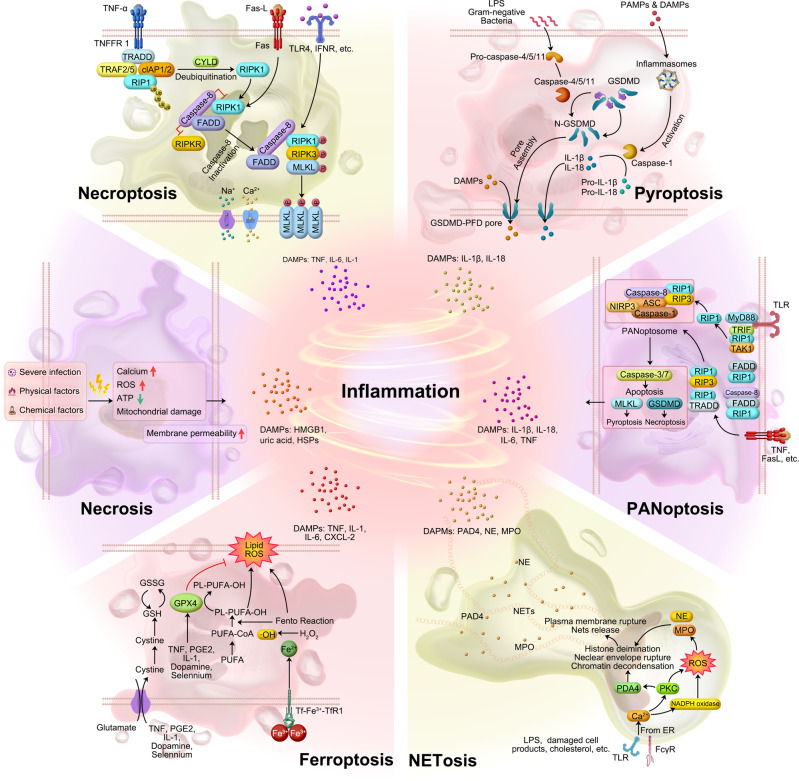
“Senescent neutrophils exhibit several distinct characteristics during NETosis, including a reduced capacity to release NETs, instability in the quality of formed NETs, and decreased activity of DNA degrading enzymes (DNases) within NETs.”
§ Inflammation and aging: signaling pathways and intervention therapies > Mechanisms of inflammaging > Inflammatory cell death
What the sources say
- Disputedcites [269] Sabbatini M Aging hampers neutrophil extracellular traps (NETs) efficacy Aging Clin. Exp. Res. 2022 34 2345 2353 10.1007/s40520-022-02201-0 35920993 PMC9637667 sourceExperimental — accuracy not yet measured
The Results and Discussion report that neutrophils from elderly subjects produced more NETs than those from adults after LPS stimulation, contrary to the unqualified claim of reduced release. The Introduction and Discussion note reduced NET production in other studies using different stimulation conditions, but distinguish those findings from this paper’s results. (LLM, conf=0.87)
Checked by a reasoning model — may be wrong.
plainstates a cause- Asserted: passes — The authors put it forward as true.
- Checkable: passes — It can be checked against evidence.
- Load-bearing: unclear — It is unclear whether the paper’s conclusions depend on it.
- Based: passes — The paper gives a reason why it holds.
- Disputed
The cited sources support only part of this claim — read each source’s verdict below.
In the paper
“However, in the aging heart, macrophages recruited to the site of infarction exhibit a pro-inflammatory M1 phenotype initially, but subsequently transition to an anti-inflammatory M2 phenotype after myocardial infarction (MI).”
§ Inflammation and aging: signaling pathways and intervention therapies > Inflammaging at the organ level > Sterile organs
What the sources say
- Partly supportedcites [143] Ma Y Mouton AJ Lindsey ML Cardiac macrophage biology in the steady-state heart, the aging heart, and following myocardial infarction Transl. Res. 2018 191 15 28 10.1016/j.trsl.2017.10.001 29106912 PMC5846093 sourceExperimental — accuracy not yet measured
The Abstract and “Macrophages in the MI Heart—Macrophage phenotypes” describe an early M1 and later M2 pattern after infarction. But the paper treats aging-heart macrophages separately and does not establish that this post-MI pattern occurs specifically in aging hearts. Its “Macrophage polarization mechanisms” section also says whether individual macrophages convert in vivo remains uncertain. Page numbers are unavailable in our copy. (LLM, conf=0.88)
plainstates a cause- Asserted: passes — The authors put it forward as true.
- Checkable: passes — It can be checked against evidence.
- Load-bearing: unclear — It is unclear whether the paper’s conclusions depend on it.
- Based: passes — The paper gives a reason why it holds.
- Partly supported
Every source the paper cites for this claim was checked and supports it.
In the paper
“This phenotypic switch promotes angiogenesis and scar formation, aiding in the recovery process.143”
§ Inflammation and aging: signaling pathways and intervention therapies > Inflammaging at the organ level > Sterile organs
What the sources say
- Supportedcites [143] Ma Y Mouton AJ Lindsey ML Cardiac macrophage biology in the steady-state heart, the aging heart, and following myocardial infarction Transl. Res. 2018 191 15 28 10.1016/j.trsl.2017.10.001 29106912 PMC5846093 source
The “Macrophage phenotypes” section says that M2 macrophages facilitate neoangiogenesis and scar repair, and that shifting the M1/M2 balance improves myocardial repair and function after MI. This supports the cited sentence’s account of angiogenesis, scar formation, and recovery. (LLM, conf=0.92)
plainstates a cause- Asserted: passes — The authors put it forward as true.
- Checkable: passes — It can be checked against evidence.
- Load-bearing: unclear — It is unclear whether the paper’s conclusions depend on it.
- Based: passes — The paper gives a reason why it holds.
- Supported
The cited sources that could be checked couldn’t confirm or dispute this claim.
In the paper
“Senescence of HSCs is the basis of immunosenescence. Senescent HSC differentiate into various types of dysfunctional immune cells, driving immunosenescence.16”
§ Inflammation and aging: signaling pathways and intervention therapies > Inflammaging at the cellular level > Hematopoietic stem cells (HSCs)
What the sources say
- Could not verifycites [16] Liggett LA Sankaran VG Unraveling Hematopoiesis through the Lens of Genomics Cell 2020 182 1384 1400 10.1016/j.cell.2020.08.030 32946781 PMC7508400 sourceExperimental — accuracy not yet measured
The Clonal hematopoiesis section describes age-related changes in HSC numbers and clonal expansion, but does not link HSC senescence to immunosenescence. A search for immunosenescence and dysfunctional immune cells found no passage establishing that proposed mechanism; the Outstanding Questions section also notes that some older people retain ostensibly normal hematopoiesis. (LLM, conf=0.72)
plainstates a cause- Asserted: passes — The authors put it forward as true.
- Checkable: passes — It can be checked against evidence.
- Load-bearing: unclear — It is unclear whether the paper’s conclusions depend on it.
- Based: passes — The paper gives a reason why it holds.
- Could not verify
95 more claims · 66 with their cited sources checked
Create a free account to see all 236 claims and every source verdict.
- It may state two separate claims as one. 111
- Probably not a substantial claim. 41
- Borderline: one of the tests for a substantial claim is unclear. 1
Claims other papers make about this one
Each is checked against this paper’s own text: does it say what the citing paper says it does?
The cited source says what the claim attributes to it.
In the citing paper
“Inflammation is implicated in various pathways and processes associated with ageing, including immunosenescence, oxidative stress, metabolic dysregulation, cellular senescence, and other critical events of the ageing process.37”
From Antiageing strategy for neurodegenerative diseases: from mechanisms to clinical advances (2025) · cites this paper as [37]
In the citing paper
“These frameworks suggest that the pathophysiology of AD is characterized by phosphorylated tau accumulation and propagation,31 heightened inflammatory responses, dysregulation of oxidative stress (related to mitochondrial dysfunction),37 alongside a gradual decline in cholinergic function.38”
From Antiageing strategy for neurodegenerative diseases: from mechanisms to clinical advances (2025) · cites this paper as [37]
In the citing paper
“exercise can reduce inflammation levels, which is a contributing factor to the ageing process.37”
From Antiageing strategy for neurodegenerative diseases: from mechanisms to clinical advances (2025) · cites this paper as [37]
Citations
Cites
Reduction in the incidence of type 2 diabetes with lifestyle intervention or metformin
(2002) · New England Journal of Medicine · doi:10.1056/nejmoa012512 · Cited by 19,011
Diversity of the Human Intestinal Microbial Flora
Eckburg, P. B., Bik, E. M., Bernstein, C. N., Purdom, E., Dethlefsen, L., Sargent, M., Gill, S. R., Nelson, K. E., & Relman, D. A. (2005) · Science · doi:10.1126/science.1110591 · Cited by 7,913
Mizgerd, J. P., Kubo, H., Kutkoski, G. J., Bhagwan, S. D., Scharffetter-Kochanek, K., Beaudet, A. L., & Doerschuk, C. M. (1997) · The Journal of Experimental Medicine · doi:10.1084/jem.186.8.1357 · Cited by 7,306
Chronic inflammation in the etiology of disease across the life span
Furman, D., Campisi, J., Verdin, E., Carrera-Bastos, P., Targ, S., Franceschi, C., Ferrucci, L., Gilroy, D. W., Fasano, A., Miller, G. W., et al. (2019) · Nature Medicine · doi:10.1038/s41591-019-0675-0 · Cited by 4,915
NLRP3 inflammasomes are required for atherogenesis and activated by cholesterol crystals
Duewell, P., Kono, H., Rayner, K. J., Sirois, C. M., Vladimer, G., Bauernfeind, F. G., Abela, G. S., Franchi, L., Nuñez, G., Schnurr, M., et al. (2010) · Nature · doi:10.1038/nature08938 · Cited by 4,026
Mortality Associated With Influenza and Respiratory Syncytial Virus in the United States
Thompson, W. W., Shay, D. K., Weintraub, E., Brammer, L., Cox, N., Anderson, L. J., & Fukuda, K. (2003) · JAMA · doi:10.1001/jama.289.2.179 · Cited by 3,673
Inflammaging: a new immune–metabolic viewpoint for age-related diseases
Franceschi, C., Garagnani, P., Parini, P., Giuliani, C., & Santoro, A. (2018) · Nature Reviews Endocrinology · doi:10.1038/s41574-018-0059-4 · Cited by 3,586
Sies, H., Berndt, C., & Jones, D. P. (2017) · Annual Review of Biochemistry · doi:10.1146/annurev-biochem-061516-045037 · Cited by 3,520
Gut microbiota composition correlates with diet and health in the elderly
Claesson, M. J., Jeffery, I. B., Conde, S., Power, S. E., O’Connor, E. M., Cusack, S., Harris, H. M. B., Coakley, M., Lakshminarayanan, B., O’Sullivan, O., et al. (2012) · Nature · doi:10.1038/nature11319 · Cited by 3,314 · cited 1×
“Older adults (>65 years) exhibit reduced microbiota diversity compared to adults, along with greater inter-individual variation in microbiota composition.(182) This is characterized by diminished populations of beneficial bacteria such as Bifidobacterium, Bacillus, E.”
BackgroundCellular Senescence: Defining a Path Forward
Gorgoulis, V., Adams, P. D., Alimonti, A., Bennett, D. C., Bischof, O., Bishop, C., Campisi, J., Collado, M., Evangelou, K., Ferbeyre, G., et al. (2019) · Cell · doi:10.1016/j.cell.2019.10.005 · Cited by 3,225 · cited 1×
“net).(371) On the other hand, other technologies, such as machine learning which integrates multi-modal and multidimensional big data, are also important to address the complexity of aging problems (Table 4).”
Background
Cited by
Items 1,001–1,100 of 1,410
Lima, V. P., Lavandoski, P., Maurmann, R. M., et al. (2023) · bioRxiv (Cold Spring Harbor Laboratory) · doi:10.1101/2023.07.20.549793
“In this sense, inflammation and oxidative stress form an interdependent phenotype whose apex is the accumulation of DNA damage 36,37 .”
Тkachuk, S. S., Ткачук, О. В., Denysenko, O. I., & Sorokhan, V. D. (2024) · Clinical & experimental pathology · doi:10.24061/1727-4338.xxii.4.86.2023.05
Bruins, A., Keeley, J., Uhley, V. E., Anyadike, K., & Kemp, K. L. (2024) · Nutrients · doi:10.3390/nu16040556
“While ethnic disparities in immune response related to obesity were discerned, caution is warranted, as the strength of these differences may require further exploration.”
BackgroundA Membrane Lipid Signature Unravels the Dynamic Landscape of Group 1 ILCsPreprint
Frey, H. C., Sun, X., Oudeif, F., Corona, D. L., He, Z., Won, T., Schultz, T. L., Carruthers, V., Laouar, A., & Laouar, Y. (2024) · bioRxiv · doi:10.1101/2024.04.17.589821
“Given that aging introduces qualitative alterations in the microenvironment 77 , we focused on how these shifts affect NK-to-ILC1 plasticity within the aging SGs, postulating that the transformed milieu of an aged setting might lead to distinct plasticity outcomes.”
BackgroundProteolytic system parameters in the brain of rats with hyperhomocysteinemia
Synelnyk, T., Raksha, N., Kostiuk, O., Oi, K., Rymsha, S., Korol, V., Korol, A. P., Bernyk, O., & Maievskyi, O. (2024) · Journal of Biological Research - Bollettino della Società Italiana di Biologia Sperimentale · doi:10.4081/jbr.2024.12232
wang, Y.-X., Wang, L., Chen, H., Yang, B., zhang, G.-F., Wang, J., Fei, W., Cai, J., Ruan, B., Liu, Z., et al. (2024) · Research Square · doi:10.21203/rs.3.rs-4143931/v1
Self-citationThe efficacy of pumpkin (Cucurbita sp.) on inflammaging
Novianri, C., & Wahyuniari, I. A. I. (2023) · Indonesia Journal of Biomedical Science · doi:10.15562/ijbs.v17i2.482
Al-Hassinah, S., Al-Daihan, S., Alahmadi, M., Alghamdi, S., Almulhim, R., Obeid, D. A., Arabi, Y. M., Alswaji, A. A., Aldriwesh, M. G., & Alghoribi, M. F. (2024) · Microorganisms · doi:10.3390/microorganisms12051022
Lai, K. O., Tham, N., Fairley, L. H., Naik, R. R., Wang, Y., Langley, S. R., & Barron, A. M. (2024) · bioRxiv (Cold Spring Harbor Laboratory) · doi:10.1101/2024.06.19.598824
Self-citationBiomarkers Prediction and Immune Landscape in Covid-19 and “Brain Fog”Preprint
Wu, X., Wang, B., Xie, C., Xu, Q., Wu, Q., Zhang, L., & Zhao, Y. (2024) · SSRN Electronic Journal · doi:10.2139/ssrn.4897774
Lyakhovitsky, K., Damiani, G. B., Mimouni, D., et al. (2024) · Research Square · doi:10.21203/rs.3.rs-4772917/v1
Hidaka, Y., Hashimoto, M., Suehiro, T., Fukuhara, R., Ishikawa, T., Tsunoda, N., Koyama, A., Honda, K., Miyagawa, Y., Yoshiura, K., et al. (2024) · medRxiv · doi:10.1101/2024.08.13.24311800
Aging: Disease or “natural” process? A glimpse from regenerative medicine
Lugo, F. S., Barrameda, N. I., Hernández, I. C., Valverde, C. A. V., Ventura‐Carmenate, Y., & Jimenez, R. A. R. (2024) · Revista Española de Geriatría y Gerontología · doi:10.1016/j.regg.2024.101543
Bortel, P., Martínez‐Val, A., Hagn, G., Skos, L., Olsen, J. V., & Gerner, C. (2024) · bioRxiv (Cold Spring Harbor Laboratory) · doi:10.1101/2024.10.11.617591
MESENCHYMAL STEM CELLS AND FIBROBLASTS IN AGE-RELATED REMODELING OF THE MUSCULOSKELETAL SYSTEM
Плехова, Н. Г., Андреевна, Н. П., & Shumatov, V. B. (2024) · Bulletin Biomedicine and sociology · doi:10.26787/nydha-2618-8783-2024-9-3-33-43
Pukhalskaia, T. V., Yrakova, T. R., Bogdanova, D. A., & Demidov, O. N. (2024) · Biochemistry (Moscow) · doi:10.31857/s0320972524050058
Zheng, J. (2024) · Research Square · doi:10.21203/rs.3.rs-5277463/v1
Zhang, D., Liu, M., Chen, X., et al. (2024) · SSRN Electronic Journal · doi:10.2139/ssrn.5016774
Prummel, K. D., Woods, K., Kholmatov, M. M., Schmitt, E. C., Vlachou, E. P., Poschmann, G., Stühler, K., Wehner, R., Schmitz, M., Winter, S., et al. (2024) · bioRxiv (Cold Spring Harbor Laboratory) · doi:10.1101/2024.11.27.625734
The Inflammatory Response in Geriatric Patients
Onur, B., Gülmez, A., & Demirbaş, H. B. (2024) · Online Türk Sağlık Bilimleri Dergisi · doi:10.26453/otjhs.1473888
Benvenuti, L., D’Antongiovanni, V., Salvo, C. D., Valdiserra, G., Masi, S., Mengozzi, A., Duranti, E., Pellegrini, C., Fornai, M., & Antonioli, L. (2024) · Nutrition and Healthy Aging · doi:10.1177/24519502241305503
“2,3 In this context, pro-in fl ammatory cytokines such as interleukin (IL)-1 β , IL-6, tumor necrosis factor (TNF), IFN-γ , and IL-1RA have been shown to play a pivotal role since they can encourage the expansion of clones of the hematopoietic/immune system depending on the spread of in fl ammatory…”
Targeting IL-11: A New Approach to Curing Cancer, Slowing Aging and Promoting Longevity
Svanishvili, G. (2024) · Premier journal of science. · doi:10.70389/pjs.100044
Biosynthesized Selenium-hydroxytyrosol nanoparticles attenuate hepatocellular carcinoma in ratsPreprint
Tawfik, R. T., El-Azeem, E. M. A., El-Sonbaty, S. M., & Ibrahim, E. A. (2025) · Research Square · doi:10.21203/rs.3.rs-5726485/v1
Elkordy, E. A. (2025) · Journal of Microscopy and Ultrastructure · doi:10.4103/jmau.jmau_133_24 · Cited by 4
dong, Q., dong, Q., Liu, Z., Shi, W., Pu, S., Xu, S., Li, D.-Q., Zhou, Z., & Wu, Q. (2025) · SSRN Electronic Journal · doi:10.2139/ssrn.5105034
NEUTROPHIL ELASTASE AS A PREDICTIVE BIOMARKER FOR POST-STROKE INFECTIONPreprint
Díaz-Benito, B., Calleja, P., Alzamora, L., Ruiz, A., Martínez‐Salio, A., Ostos, F., Gutiérrez-Sánchez, M., García‐Culebras, A., Moro, M. Á., Moraga, A., et al. (2025) · medRxiv · doi:10.1101/2025.02.04.25321701 · Cited by 1
Mechanism and significance of cell senescence induced by viral infection
Chang, Y., Wu, X., Deng, L., Wang, S., & Mao, G. (2025) · Journal of Zhejiang University (Medical Sciences) · doi:10.3724/zdxbyxb-2024-0213 · Cited by 1
Mediterranean Diet and Biomarkers in At-Risk Groups
García-Gavilán, J. F., & Paz‐Graniel, I. (2025) · Springer eBooks · doi:10.1007/978-3-031-32047-7_83-1
Li, Y., Yang, Y., Xia, D., et al. (2025) · SSRN Electronic Journal · doi:10.2139/ssrn.5132056
Endophytic fungi and age-related diseases: Potential for geriatric therapeutics
Karmakar, R., Kumar, S., Tripathi, V. S., Sharma, P. K., Kumar, R., & Sharma, R. (2025) · Elsevier eBooks · doi:10.1016/b978-0-443-31484-1.00014-1
Rigamonti, A. E., Bollati, V., Albetti, B., Caroli, D., Bondesan, A., Grugni, G., Cella, S. G., & Sartório, A. (2025) · Journal of Clinical Medicine · doi:10.3390/jcm14051470 · Cited by 1
Crespo, R., & Hereñú, C. B. (2025) · Neural Regeneration Research · doi:10.4103/nrr.nrr-d-24-01595
“Common mechanisms underlying neuronal degeneration include the reactivity of astrocytes and microglial cells, which produce proinflammatory cytokines, degradation markers, mitochondrial energy deficit, and oxidative stress (Li et al., 2023).”
Zhang, X., Qiyun, F., Chuqiao, L., Anqi, J., Zhenzhen, W., Qiong, D., Yu, P., & Wang, C. L. (2025) · Frontiers in Neuroscience · doi:10.3389/fnins.2025.1542224 · Cited by 1
“For instance, a study has shown that alterations in the sympathetic and parasympathetic branches can influence tumor growth, metastasis, and patient outcomes in malignancies (Wang et al., 2024; Li et al., 2023).”
Effect of ibuprofen on the submandibular salivary gland in rats: Histological and biochemical study
Hussary, B. N. A., Saleh, O. W., & Ameen, O. M. (2024) · Regulatory Mechanisms in Biosystems · doi:10.15421/0224109
Tawfik, R. T., El-Azeem, E. M. A., El-Sonbaty, S. M., & Ibrahim, E. A. (2025) · Naunyn-Schmiedeberg s Archives of Pharmacology · doi:10.1007/s00210-025-04034-w · Cited by 1
“These cytokines, including tumor necrosis factor-alpha (TNF-α), interleukin-1 beta (IL-1β), and interleukin-6 (IL-6), play a central role in driving inflammation and pathological changes in the liver (Li et al. 2023a).”
Xu, D., Yi, W., Fu, H., Chen, T., Yu, J., Zhi, Y., Lin, J., & Xu, Z. (2025) · Research Square · doi:10.21203/rs.3.rs-6316187/v1
Serum Klotho protein level in patients with thyroid dysfunction
Abdullah, N. A. A.-H., & Hassan, E. A. (2025) · Irish Journal of Medical Science (1971 -) · doi:10.1007/s11845-025-03937-0
Brain cancer: Current and new drug delivery systems
Naik, G. A. R. R., Roy, A. A., Dhas, N. L., Mutalik, S., Tıwarı, R., Tiwari, G., & Kudarha, R. R. (2025) · Elsevier eBooks · doi:10.1016/b978-0-443-29168-5.00021-0 · Cited by 2
THE EFFECT OF BREATHING EXERCISES ON THE VENTILATION FUNCTION OF THE LUNGS IN ELDERLY PEOPLE
Asanov, E. O., Dyba, A., Shatilo, V. B., et al. (2025) · Fìzìologìčnij žurnal · doi:10.15407/fz71.02.011
Pierdoná, V., Lavandoski, P., Maurmann, R. M., Borges, G. A., Mombach, J. C. M., Guma, F. T. C. R., & Barbé‐Tuana, F. M. (2025) · Aging Medicine · doi:10.1002/agm2.70020
Dosanjh, L. H., Franklin, C., Castro, Y., Goosby, B. J., Conway, F. N., Champagne, F. A., Parra, L. A., Goldbach, J. T., & Kipke, M. D. (2025) · Social Science & Medicine · doi:10.1016/j.socscimed.2025.118119 · Cited by 2
“Research has established that low-grade, chronic inflammation is strongly associated with aging and it is considered to be a hallmark of the aging process itself (Campisi et al., 2019; Franceschi et al., 2000; Li et al., 2023).”
Han, M., Liu, Q., Yang, L., Li, J., Wang, Q., Zhang, Y.-M., Guo, J.-Q., Zeng, L.-T., Qi, R., & Cai, J. (2025) · Free Radical Biology and Medicine · doi:10.1016/j.freeradbiomed.2025.04.039 · Cited by 1
Sentyabreva, A. V., Diatroptova, M. A., Miroshnichenko, E. A., Gerasimov, A. D., & Kosyreva, A. M. (2025) · Bulletin of Experimental Biology and Medicine · doi:10.1007/s10517-025-06392-0 · Cited by 1
“[6].”
A Unified Metric of Human Immune Health?
Baird, T., & Sansom, S. N. (2025) · Transplantation · doi:10.1097/tp.0000000000005378
Avaliação do Risco de Sarcopenia em Pessoas Vivendo com a Síndrome da Imunodeficiência Humana
Fortunato, V. A. L., Alves, P. G. D. A., Lopes, J. E., et al. (2025) · Saúde Coletiva (Barueri) · doi:10.36489/saudecoletiva.2015v15i95p15496-15507
Epigenetics of Aging and Epigenetic Modifications of Aging-Associated Diseases
Ramesh, T., Singh, R., & Barage, S. H. (2025) · IGI Global eBooks · doi:10.4018/979-8-3693-9730-5.ch007
Pollak, C., & Blumen, H. M. (2025) · doi:10.2196/preprints.77955
Šoša, I. (2025) · Pharmaceuticals · doi:10.3390/ph18060787
George, G., Rowley, M., Coolen, A. C. C., et al. (2025) · ESMO Real World Data and Digital Oncology · doi:10.1016/j.esmorw.2025.100156
“15 CRP and haptoglobin are markers of in fl ammation, and chronic in fl ammation is a known cancer risk factor, contributing to the fact that the likelihood of developing PCa increases with age.”
Impact of viruses and retrotransposons on genetic instability and aging
Lysakova, E. V., Burak, M. Y., Navrotsky, M., & Александрович, Р. С. (2025) · Russian Journal of Infection and Immunity · doi:10.15789/2220-7619-iov-17834
RETRACTED ARTICLE: Transcriptional characterization of sepsis in a LPS porcine model
Neill, R. G.-R. (2025) · Molecular Genetics and Genomics · doi:10.1007/s00438-025-02261-7 · Cited by 1
RetractedSaul, D., Batmaz, O. M., Raude, P., Leidig, V., Wang, X., & Kosinsky, R. L. (2025) · RNA technologies · doi:10.1007/978-3-031-91072-2_1
Paraskeva, M. A., Rogers, N. M., Hu, X., & Rogers, N. M. (2025) · Transplantation · doi:10.1097/tp.0000000000005428
Multiple roles for a mitochondrial enzyme
Tang, X., & Qiu, H. (2025) · eLife · doi:10.7554/elife.107882
Current epidemiology of deaths for disseminated intravascular coagulation
Mattiuzzi, C., & Lippi, G. (2025) · Blood Coagulation & Fibrinolysis · doi:10.1097/mbc.0000000000001369
Hančinová, V. (2025) · Neurologie pro praxi · doi:10.36290/neu.2025.015
MITOCHONDRIAL THERAPIES IN AGING AND AGE-RELATED DISEASES
Borysova, O. (2025) · Anti-Aging Eastern Europe · doi:10.56543/aaeeu.2025.4.2.02
Chen, Y., Peng, X., Chen, Y., Chen, L., Yin, X., Jiang, W., Chen, B., & Tang, Y. (2025) · European Journal of Obstetrics & Gynecology and Reproductive Biology · doi:10.1016/j.ejogrb.2025.114595
Deep and Quantitative Proteomic Profiling of Low Volume Mouse Serum Across the LifespanPreprint
Basisty, N., Dey, A. K., Olinger, B., et al. (2025) · Research Square · doi:10.21203/rs.3.rs-7179817/v1
“Cellular senescence and inflammation are key hallmarks of aging that have previously been associated with aging and various age-associated clinical phenotypes in humans [31, 40].”
Lei, J., Feng, T., Tian, T., Zhuang, Z., Zhang, G., Liu, Y., Yang, Z., Wang, Y., Zhang, X., Sun, W., et al. (2025) · Frontiers in Nutrition · doi:10.3389/fnut.2025.1573199 · Cited by 2
“This chronic inflammation is a core characteristic of frailty, accelerating cellular aging, impairing metabolic function, and diminishing the body’s ability to cope with stressors (23, 24).”
Self-citationImmunosenescence and Mucosal Vaccination in the Elderly Patients
Srivastava, P., Singh, S., Tomar, D. S., Sharma, S., & Sharma, A. (2025) · BENTHAM SCIENCE PUBLISHERS eBooks · doi:10.2174/9789815324570125010011
Antipsychotics Lower Peripheral Markers of Inflammation in Drug-naïve Early Psychosis: A Pilot StudyPreprint
Šafářová, N., Kolenič, M., Tašková, I., et al. (2025) · medRxiv · doi:10.1101/2025.08.07.25333214
A 3D Human Neuron‐on‐Chip Platform to Monitor Neuronal Injury Responses
Tang, R., Latchoumane, C.-F. V., Chopra, A., Sarkar, M. M., Kim, C., Gonsalves, N., Wu, H., Sentmanat, J. C., Liu, A., Mhatre‐Winters, I., et al. (2026) · Advanced Healthcare Materials · doi:10.1002/adhm.202503457
Bangar, N. S., Anand Ganapathy, A., Al‐Anazi, K. M., Farah, M. A., Hailan, W. A. Q., Frolov, A., Roy, B., Vaidya, A., Kumaran, A., & Tupe, R. S. (2025) · Natural Product Communications · doi:10.1177/1934578x251363375 · Cited by 2
“18 The study by Li et al, (2023) showed the increased serum levels of pro-in fl ammatory cytokines, such as interleukin 1, 6, 8 (IL-1, IL-6, IL-8) and, tumour necrosis factor α (TNF-α ) in aged individuals.”
InfluentialCellular Senescence in Multiple Sclerosis (MS)
Dahiya, R., Dahiya, S., Siddique, R., Thapa, R., Bhat, A. A., Hussain, M. S., Singh, T. G., Singh, S. K., Gupta, S., Deb, P. K., et al. (2025) · Springer eBooks · doi:10.1007/978-981-96-8873-9_11 · Cited by 1
Dietary nutrition and neurological disorders: a review
Li, F., Feng, Z., Li, J., Ma, L., Li, M., Li, S., Liu, S., & Tang, C. (2025) · Food Science and Human Wellness · doi:10.26599/fshw.2025.9250714
Importance of radiation-related cognitive decline in older adults who receive cranial radiation
Lew, F. H., Figuracion, K. C., Fogh, S. E., Sheppard, D. P., Tseng, Y. D., Halasz, L. M., Graber, J. J., Emerson, S., Lo, S. S.-M., & Hardy, S. J. (2025) · Expert Review of Anticancer Therapy · doi:10.1080/14737140.2025.2555472
“Expressions of various genes involved with neuronal plasticity are also altered [48,49].”
IRF8 deficiency causes anxiety-like behavior in a sex-dependent mannerPreprint
Zhu, S., Saeki, K., Karlsson, R., Abebe, D. T., & Ozato, K. (2025) · bioRxiv (Cold Spring Harbor Laboratory) · doi:10.1101/2025.09.02.673764
“Increased ROS production leads to prolonged oxidative stress, a pathological hallmark of neuroinflammatory and neurodegenerative diseases and aging 73 .”
Chairunisa, F., Takehara, S., Nohno, K., & Ogawa, H. (2025) · Journal of International Society of Preventive and Community Dentistry · doi:10.4103/jispcd.jispcd_86_25
“[22] As the global population ages, identifying biomarkers such as AST and understanding associated risk factors for early detection and monitoring health deterioration becomes important.”
Xu, K., Maydanchik, N., Kang, B., Chen, J., Chen, Q., Xu, G., Tasaki, S., Bennett, D. A., & Chen, L. (2025) · PLoS Genetics · doi:10.1371/journal.pgen.1011819
Infusion of blood from young and old mice modulates amyloid pathology
Pizarro, M., Gomez‐Gutierrez, R., Caviedes, A., Valdes, C., Woehlbier, U., Vargas, C., Hernández, M., Duran-Aniotz, C. A., & Morales, R. (2025) · Aging · doi:10.18632/aging.206319 · Cited by 1
“These processes and their effectors have been extensively studied [71].”
Thai, T. T. D., Wellman, S. M., Suematsu, N., Padilla, C. G., Tung, T.-H., Sridhar, S., Cambi, F., & Kozai, T. D. Y. (2025) · bioRxiv (Cold Spring Harbor Laboratory) · doi:10.1101/2025.09.17.676336
Older age as an independent risk factor for recurrence in stage II cutaneous melanoma
Brancaccio, G., Moscarella, E., Scharf, C., et al. (2025) · Journal of the American Academy of Dermatology · doi:10.1016/j.jaad.2025.09.062
Nishimoto, J., Deguchi, N., Hatanaka, S., Shida, T., Ohta, T., Kojima, N., Shirobe, M., Motokawa, K., Hirano, H., Okamura, T., et al. (2025) · Archives of Gerontology and Geriatrics · doi:10.1016/j.archger.2025.106035 · Cited by 2
Nogimori, T., & Yamamoto, T. (2025) · Uirusu · doi:10.2222/jsv.75.47
Roumiani, P. H., Yaghoubi, M., Nozari, F., Taheri, M., Tabatabaei, M. S. H. Z., Ahmadi, Z., Azarboo, A., Eskandari, R., Khadembashiri, M. A., & Khadembashiri, M. M. (2025) · BMC Cardiovascular Disorders · doi:10.1186/s12872-025-05116-6
“Moreover, dysfunction of the aging immune system and a decrease in estrogen signaling in postmenopausal women, which weaken the immune response, could possibly explain the increase in the incidence rate [42, 43].”
Hu, L., Li, Y., Li, S., Wu, C., Wang, Z., Zhang, J., Huang, C., & Zhang, J. (2025) · Journal of Food Measurement & Characterization · doi:10.1007/s11694-025-03573-3
Patel, T., Schwarz, R. J., Riege, K., Varshavsky, M., Kestler, H. A., Kaplan, T., Hoffmann, S., & van Bömmel, A. (2025) · bioRxiv (Cold Spring Harbor Laboratory) · doi:10.1101/2025.10.07.680024
Ortega‐Ribera, M., Joshi, R., Guixé‐Muntet, S., Brezáni, V., Nagesh, P. T., Brezani, V., Patel, A., Zhuang, Y., Babuta, M., Gracia‐Sancho, J., et al. (2025) · JHEP Reports · doi:10.1016/j.jhepr.2025.101603
“4 Moreover, the immune system influences the rate of aging of multiple organs/systems, including cardio-vascular and musculoskeletal systems, raising a person’s mortality risk beyond existing chronic disease, age, or sex.”
Santos, D. B., Rodrigues, D. C. D. N., de Almeida, A. A. C., Amorim, V. R., Silva, J. D. N., Porto, J. C. S., Acha, B. T., dos Reis, A. C., Zalewski, S., de Camargo, J. G. S., et al. (2025) · Journal of Ethnopharmacology · doi:10.1016/j.jep.2025.120728
Zheng, X., Gong, H., Zhang, R., Wang, J., Cai, G., & Chen, X. (2025) · Nutrition Research · doi:10.1016/j.nutres.2025.09.010
Sun, Z., Huang, R., Chen, J., Song, Y., Sun, Z., Zhang, L., Shi, H., Mu, R., Wang, Y., Huang, J., et al. (2025) · Frontiers in Microbiology · doi:10.3389/fmicb.2025.1684165 · Cited by 2
Self-citationCat-PIPpred: Pro-Inflammatory Peptide Predictor Integrating CatBoost and Cross-Modal Feature Fusion
Zheng, J., Qin, X., & Yao, Y. (2025) · International Journal of Molecular Sciences · doi:10.3390/ijms262110484 · Cited by 1
Li, L. M., Kodosaki, E., Xu, C., et al. (2025) · medRxiv · doi:10.1101/2025.10.27.25338886
Association Between Walking Speed and Arthritis Risk: Evidence from Five International Aging CohortsPreprint
Li, H., Zhang, Y., Luo, J. T., Hua, M., Wu, Y., & Dong, H. (2025) · Research Square · doi:10.21203/rs.3.rs-7751077/v1
Shi, L., Niu, X., Zhang, K., Stein, K., Heine, H., Hammel, J. U., Bruchhaus, I., Krauss‐Etschmann, S., Bossen, J., & Roeder, T. (2025) · bioRxiv (Cold Spring Harbor Laboratory) · doi:10.1101/2025.10.30.685523
Inflammation and Brain Ageing: Anti-inflammatory Nutraceuticals
Kaushik, M., Parameshwar, K., Rajput, D., Pamu, S., & Potdar, M. B. (2025) · Nutritional neurosciences · doi:10.1007/978-981-95-2790-8_6 · Cited by 1
Orton, C. J., Hopkins, Z. H., Trump, B., et al. (2025) · JCR Journal of Clinical Rheumatology · doi:10.1097/rhu.0000000000002288
Molla, A. (2025) · American Journal of Biomedical and Life Sciences · doi:10.11648/j.ajbls.20251305.12
Associations of chronic inflammatory diseases with brain health: a prospective cohort studyPreprint
Han, F., Zhang, R., Fan, Y., Mao, Y., Chen, Z., Huang, Z., & Zhu, Y. (2025) · Research Square · doi:10.21203/rs.3.rs-7893606/v1
Chen, L., Yang, T., Zhang, Z., Yang, Y., Long, S., Wang, M., & Zeng, H. (2025) · Scientific Reports · doi:10.1038/s41598-025-23412-1 · Cited by 2
“Factors secreted by senescent cells, known as the SASP, promote inflamm-aging 74 .”
Causal effects of immune cell populations on biological aging: a Mendelian randomization study
Fu, J., Wu, W. L., & Shen, S. (2025) · Biogerontology · doi:10.1007/s10522-025-10354-4
“Recent evidence highlights inflammation and cellular senescence as key accelerators of aging (Li et al. 2023; Liu 2022), with immune cells emerging as central regulators of these processes (Kale et al. 2020; Li et al. 2020; Martínez de Toda et al. 2021).”
Editorial: The heme oxygenase system in immunity
Costa, D. L., Bruscia, E. M., & Willis, D. (2025) · Frontiers in Immunology · doi:10.3389/fimmu.2025.1740080
Xing, B., Yu, J., Liu, Y., Gao, Q., Chen, X., He, S., Ping, F., Xu, L., Li, W., Zhang, H., et al. (2025) · Biological Trace Element Research · doi:10.1007/s12011-025-04915-4
Leptocaramine from Hypecoum erectum inhibits inflammatory responses via CSF2-NF-κB signaling pathway
Yuan, H., Wang, H., Wang, C., Shen, J., Jiang, X., Fu, X., Du, X., Peng, J., Xiang, M., Zhou, J., et al. (2025) · International Immunopharmacology · doi:10.1016/j.intimp.2025.115855
Nasal Mucosa‐Derived Extracellular Vesicles as a Systemic Antiaging Intervention
Shi, W., Bian, L., Yu, M., Wang, J., Gao, M., Shen, L., Zhang, X. L., Huang, Z., Tang, H., Lv, L., et al. (2025) · Advanced Science · doi:10.1002/advs.202511372
Age-Related Transcriptomic Changes in the Vermiform Appendix
Quien, D., Korać-Prlić, J., Vilović, K., Pogorelić, Z., Borić, M., Barčot, O., & Degoricija, M. (2025) · International Journal of Molecular Sciences · doi:10.3390/ijms262311399 · Cited by 2
“KEGG pathway analysis revealed upregulation of TNF and IL17 and MAPK signaling pathways in addition to downregulation of phospholipase D signaling, processes directly linked to “inflammaging” and cellular senescence [98–100].”
Yan, H., Li, Y., Liu, Z., Zhou, T., Liu, K., Xiong, L. H., & Huang, F. (2025) · Medicine · doi:10.1097/md.0000000000045541
“[54] In SAR, the accumulation of senescent muscle cells drives chronic inflammation and muscle wasting.”
Metadata
- Authors
- Li, X., Li, C., Zhang, W., Wang, Y., Qian, P., & Huang, H.
- Affiliations
- First Affiliated Hospital Zhejiang University (CN)
- Zhejiang University-University of Edinburgh Institute (CN)
- Corresponding author
- Qian, Pengxu
- Huang, He
- Venue
- Signal Transduction and Targeted Therapy
- Published
- 2023-06-08
- Volume
- 8
- Issue
- 1
- Pages
- 239-239
- ISSN
- 2059-3635 (ISSN-L)
- PMC
- PMC10248351
- OpenAlex
- W4379966446
- Semantic Scholar
- 03e8f6a34adfe5506c86edea58c1c55ce12b0141
- Cited by
- 1,443
- References
- 479
- Citations by year
- 2026: 496 · 2025: 592 · 2024: 322 · 2023: 32
- FWCI
- 51.26
- Type
- journal article
- Language
- en
- Open access
- gold
- doi.org
- Licence
- cc-by
- creativecommons.org/licenses/by/4.0 (tdm)
- creativecommons.org/licenses/by/4.0 (vor)
- Locations
- Signal Transduction and Targeted Therapy (publishedVersion, cc-by)
- PubMed Central (publishedVersion, cc-by)
- PubMed (publishedVersion)
- DOAJ (DOAJ: Directory of Open Access Journals) (submittedVersion, cc-by-sa)
- Funders
- National Natural Science Foundation of China (81900176, 92268117, 82130003, 82222003, 82161138028, 82222003, 92268117)
- National Key Research and Development Program of China (2022YFA1103500)
- Topics
- Life Sciences › Biochemistry, Genetics and Molecular Biology › Cell Biology › Telomeres, Telomerase, and Senescence
- Life Sciences › Biochemistry, Genetics and Molecular Biology › Aging › Genetics, Aging, and Longevity in Model Organisms
- Life Sciences › Biochemistry, Genetics and Molecular Biology › Molecular Biology › Inflammasome and immune disorders
- Keywords
- inflammaging, aging, chronic inflammation, cellular senescence, immunosenescence, senescence-associated secretory phenotype, senolytics, anti-aging strategies, age-related diseases, organ dysfunction, single-cell technologies, aging models, signaling pathways
- MeSH terms
- Humans, Inflammation, Quality of Life, Signal Transduction, Cellular Senescence
About these checks
Registry, retraction, Cites and statistics results are computed, not judged, with one exception: a printed reference that no index lists is read once by a model before it counts as a citation error. Claims are extracted by a model and kept only when their quote appears verbatim in the text; each cited source is then checked, with a model’s help, for whether it says what the claim relies on. Those verdicts can be wrong — read the claim’s quote and the cited source before relying on one.
The claim verdicts this report counts are experimental: their accuracy is not yet measured.
A language model drew the claims from the paper on 2026-10-10, under version 3 of the claim definition (model deepseek-v4.1-flash, prompt extract-v3).
A second model labelled each claim on 2026-10-10 (model jev-1.13-20260917, definition revision gold-guideline-v0.2).
Cited sources are checked with a language model’s help (gpt-6-sol).
Statistics and arithmetic are recomputed, not judged.
Confidence bands are shown only for fields calibrated on our annotated test set. None is calibrated yet, so no band is shown.
What counts as a claim ›How we measure confidence ›How we check this ›
Are you an author, or do you see a problem with this page? Request a review
Data sources
Bibliographic data: Semantic Scholar, OpenAlex, Crossref.
Contains information from the Semantic Scholar Academic Graph Datasets, made available under the ODC Attribution License (ODC-BY 1.0).
Semantic Scholar’s data is described in: Kinney, R., et al. (2023). The Semantic Scholar Open Data Platform. arXiv:2301.10140.
