

Inflammation and aging: signaling pathways and intervention therapies
Open accessThe DOI matches its Crossref record; 476 of the 479 references it cites were found in a registry or an index; 215 of the 287 sources its claims cite were checked for support.
Abstract
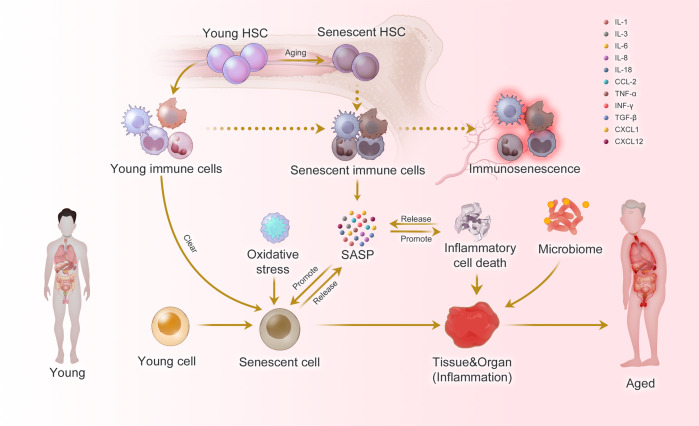
Aging is characterized by systemic chronic inflammation, which is accompanied by cellular senescence, immunosenescence, organ dysfunction, and age-related diseases. Given the multidimensional complexity of aging, there is an urgent need for a systematic organization of inflammaging through dimensionality reduction. Factors secreted by senescent cells, known as the senescence-associated secretory phenotype (SASP), promote chronic inflammation and can induce senescence in normal cells. At the same time, chronic inflammation accelerates the senescence of immune cells, resulting in weakened immune function and an inability to clear senescent cells and inflammatory factors, which creates a vicious cycle of inflammation and senescence. Persistently elevated inflammation levels in organs such as the bone marrow, liver, and lungs cannot be eliminated in time, leading to organ damage and aging-related diseases. Therefore, inflammation has been recognized as an endogenous factor in aging, and the elimination of inflammation could be a potential strategy for anti-aging. Here we discuss inflammaging at the molecular, cellular, organ, and disease levels, and review current aging models, the implications of cutting-edge single cell technologies, as well as anti-aging strategies. Since preventing and alleviating aging-related diseases and improving the overall quality of life are the ultimate goals of aging research, our review highlights the critical features and potential mechanisms of inflammation and aging, along with the latest developments and future directions in aging research, providing a theoretical foundation for novel and practical anti-aging strategies.
Overview
CoChat Summary
## TL;DR
This review argues that inflammaging—a chronic, systemic inflammatory state—is tightly intertwined with cellular senescence, immunosenescence, organ dysfunction, and age-related disease. It synthesizes signaling pathways, aging models, single-cell technologies, and intervention strategies, emphasizing anti-inflammatory approaches, senolytics, stem cell therapy, and organ transplantation.
## Key findings
- The paper describes a “vicious cycle” in which senescent cells secrete SASP factors that promote chronic inflammation, while chronic inflammation accelerates immune-cell senescence and weakens clearance of senescent cells and inflammatory factors.
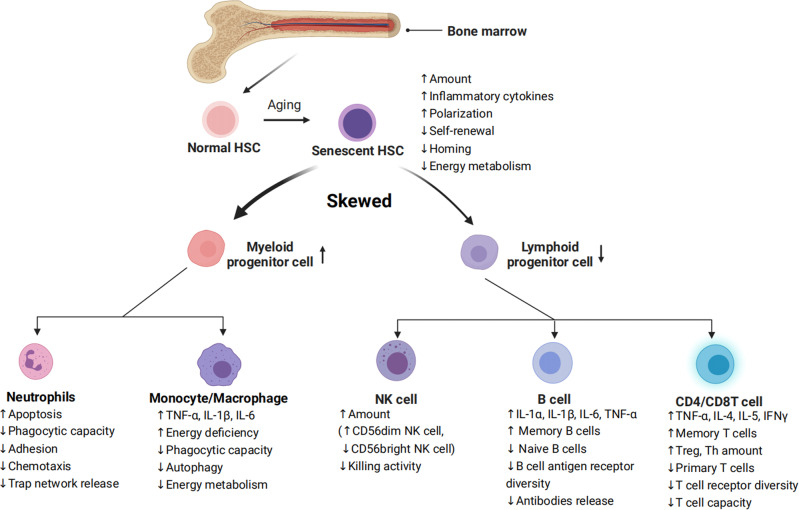
- It highlights reported age-related immune changes across cell types, including decreased circulating naive CD8 T cells as a consistent marker of immunosenescence in healthy older adults, reduced NK-cell cytotoxicity, and age-associated shifts in HSC differentiation toward myeloid lineages.
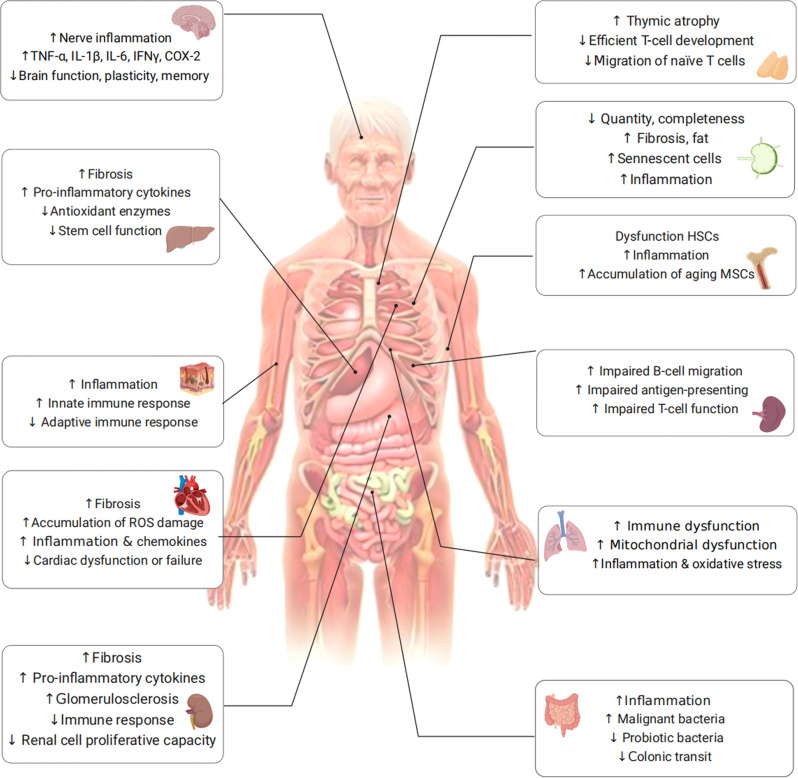
- The review links inflammaging to organ-level decline in the bone marrow, thymus, spleen, lymph nodes, brain, heart, kidney, liver, skin, lung, and gut, with examples such as age-related thymic degeneration reducing new T-cell output and aged bone marrow impairing HSC function.
- For intervention, it notes that the first senolytic combination, dasatinib plus quercetin, increased 6-minute walking distance by an average of 21.5 meters in the first human trial, but other outcomes did not change significantly and long-term efficacy remains insufficiently supported.
## Methods
- Narrative review of inflammaging across molecular, cellular, organ, and disease levels, with sections on signaling pathways, classical aging models, single-cell technology, and intervention strategies.
- No new experimental sample or cohort is reported in the paper itself; instead, it synthesizes findings from prior mouse, human, and cell-line studies cited throughout the text.
- The main approach is qualitative integration of published evidence, including examples from in vitro senescence models, in vivo mouse models, centenarian studies, and emerging single-cell/multi-omics work.
## Limitations
- The paper explicitly notes that the exact causality between inflammation and aging remains unresolved and “deserves further studies” for effective intervention.
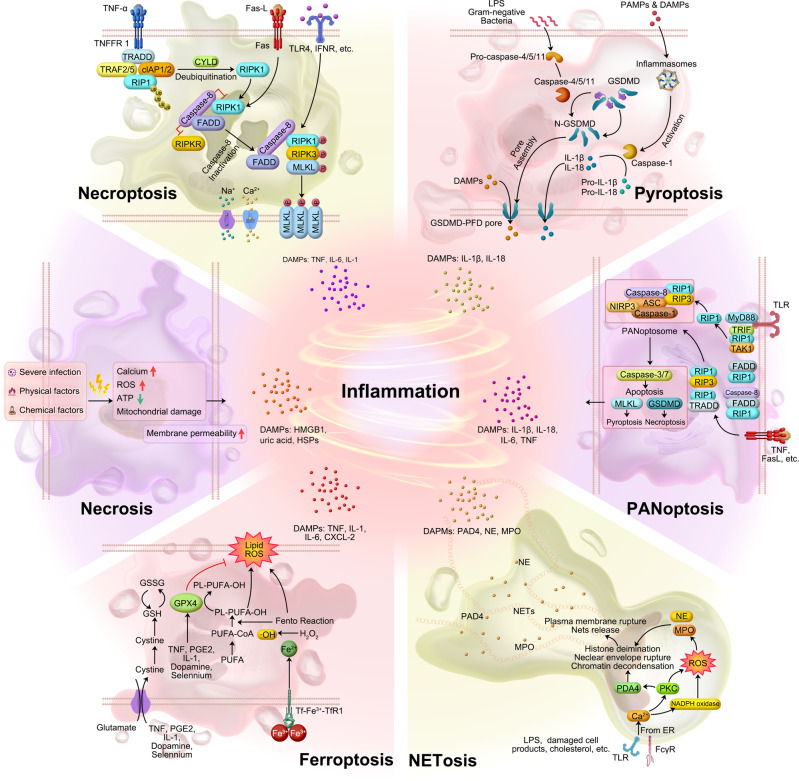
- It also states that PANoptosis has no direct evidence yet linking it to aging, so any connection is speculative.
- Evident from the text: this is a broad review rather than a primary study, so many conclusions are synthesized from heterogeneous prior studies rather than tested in one unified dataset.
Model-written summary. Check it against the paper before relying on it.
Integrity signals
Registry
Cites
Statistics
Figures
Verification
Claims the paper makes
140 Valid · 17 Not valid · 39 Not checked · 40 Own results and interpretations
Some cited sources support this claim and some don’t — read each source’s verdict below.
In the paper
“At the same time, inflammation promotes oxidation through inflammatory mediators.205,206”
§ Inflammation and aging: signaling pathways and intervention therapies > Mechanisms of inflammaging > Triggers of inflammaging
What the sources say
- Disputedcites [205] Furman D Expression of specific inflammasome gene modules stratifies older individuals into two extreme clinical and immunological states Nat. Med. 2017 23 174 184 10.1038/nm.4267 28092664 PMC5320935 sourceExperimental — accuracy not yet measured
The Discussion describes the opposite causal direction: oxidative stress triggers an inflammatory response, including production of inflammatory cytokines. The Results attribute chronic oxidative stress to possible mitochondrial metabolic reprogramming, not to inflammatory mediators. Page numbers are unavailable in our copy. (LLM, conf=0.82)
Checked by a reasoning model — may be wrong.
- Partly supportedcites [206] Furman D Chronic inflammation in the etiology of disease across the life span Nat. Med. 2019 25 1822 1832 10.1038/s41591-019-0675-0 31806905 PMC7147972 sourceExperimental — accuracy not yet measured
The ‘Systemic chronic inflammation and non-communicable disease risk’ section says systemic chronic inflammation can damage tissues by inducing oxidative stress. That supports the inflammation-to-oxidation link, but the passage does not say that inflammatory mediators are the mechanism. (LLM, conf=0.85)
plainstates a cause- Asserted: passes — The authors put it forward as true.
- Checkable: passes — It can be checked against evidence.
- Load-bearing: passes — The paper’s conclusions depend on it.
- Based: passes — The paper gives a reason why it holds.
- Disputed
At least one cited source doesn’t support this claim or points to a different paper, and none confirmed it — see the verdicts below.
In the paper
“Senescent neutrophils exhibit several distinct characteristics during NETosis, including a reduced capacity to release NETs, instability in the quality of formed NETs, and decreased activity of DNA degrading enzymes (DNases) within NETs.”
§ Inflammation and aging: signaling pathways and intervention therapies > Mechanisms of inflammaging > Inflammatory cell death
What the sources say
- Disputedcites [269] Sabbatini M Aging hampers neutrophil extracellular traps (NETs) efficacy Aging Clin. Exp. Res. 2022 34 2345 2353 10.1007/s40520-022-02201-0 35920993 PMC9637667 sourceExperimental — accuracy not yet measured
The Results and Discussion report that neutrophils from elderly subjects produced more NETs than those from adults after LPS stimulation, contrary to the unqualified claim of reduced release. The Introduction and Discussion note reduced NET production in other studies using different stimulation conditions, but distinguish those findings from this paper’s results. (LLM, conf=0.87)
Checked by a reasoning model — may be wrong.
plainstates a cause- Asserted: passes — The authors put it forward as true.
- Checkable: passes — It can be checked against evidence.
- Load-bearing: unclear — It is unclear whether the paper’s conclusions depend on it.
- Based: passes — The paper gives a reason why it holds.
- Disputed
The cited sources support only part of this claim — read each source’s verdict below.
In the paper
“However, in the aging heart, macrophages recruited to the site of infarction exhibit a pro-inflammatory M1 phenotype initially, but subsequently transition to an anti-inflammatory M2 phenotype after myocardial infarction (MI).”
§ Inflammation and aging: signaling pathways and intervention therapies > Inflammaging at the organ level > Sterile organs
What the sources say
- Partly supportedcites [143] Ma Y Mouton AJ Lindsey ML Cardiac macrophage biology in the steady-state heart, the aging heart, and following myocardial infarction Transl. Res. 2018 191 15 28 10.1016/j.trsl.2017.10.001 29106912 PMC5846093 sourceExperimental — accuracy not yet measured
The Abstract and “Macrophages in the MI Heart—Macrophage phenotypes” describe an early M1 and later M2 pattern after infarction. But the paper treats aging-heart macrophages separately and does not establish that this post-MI pattern occurs specifically in aging hearts. Its “Macrophage polarization mechanisms” section also says whether individual macrophages convert in vivo remains uncertain. Page numbers are unavailable in our copy. (LLM, conf=0.88)
plainstates a cause- Asserted: passes — The authors put it forward as true.
- Checkable: passes — It can be checked against evidence.
- Load-bearing: unclear — It is unclear whether the paper’s conclusions depend on it.
- Based: passes — The paper gives a reason why it holds.
- Partly supported
Every source the paper cites for this claim was checked and supports it.
In the paper
“This phenotypic switch promotes angiogenesis and scar formation, aiding in the recovery process.143”
§ Inflammation and aging: signaling pathways and intervention therapies > Inflammaging at the organ level > Sterile organs
What the sources say
- Supportedcites [143] Ma Y Mouton AJ Lindsey ML Cardiac macrophage biology in the steady-state heart, the aging heart, and following myocardial infarction Transl. Res. 2018 191 15 28 10.1016/j.trsl.2017.10.001 29106912 PMC5846093 source
The “Macrophage phenotypes” section says that M2 macrophages facilitate neoangiogenesis and scar repair, and that shifting the M1/M2 balance improves myocardial repair and function after MI. This supports the cited sentence’s account of angiogenesis, scar formation, and recovery. (LLM, conf=0.92)
plainstates a cause- Asserted: passes — The authors put it forward as true.
- Checkable: passes — It can be checked against evidence.
- Load-bearing: unclear — It is unclear whether the paper’s conclusions depend on it.
- Based: passes — The paper gives a reason why it holds.
- Supported
The cited sources that could be checked couldn’t confirm or dispute this claim.
In the paper
“Senescence of HSCs is the basis of immunosenescence. Senescent HSC differentiate into various types of dysfunctional immune cells, driving immunosenescence.16”
§ Inflammation and aging: signaling pathways and intervention therapies > Inflammaging at the cellular level > Hematopoietic stem cells (HSCs)
What the sources say
- Could not verifycites [16] Liggett LA Sankaran VG Unraveling Hematopoiesis through the Lens of Genomics Cell 2020 182 1384 1400 10.1016/j.cell.2020.08.030 32946781 PMC7508400 sourceExperimental — accuracy not yet measured
The Clonal hematopoiesis section describes age-related changes in HSC numbers and clonal expansion, but does not link HSC senescence to immunosenescence. A search for immunosenescence and dysfunctional immune cells found no passage establishing that proposed mechanism; the Outstanding Questions section also notes that some older people retain ostensibly normal hematopoiesis. (LLM, conf=0.72)
plainstates a cause- Asserted: passes — The authors put it forward as true.
- Checkable: passes — It can be checked against evidence.
- Load-bearing: unclear — It is unclear whether the paper’s conclusions depend on it.
- Based: passes — The paper gives a reason why it holds.
- Could not verify
95 more claims · 66 with their cited sources checked
Create a free account to see all 236 claims and every source verdict.
- It may state two separate claims as one. 111
- Probably not a substantial claim. 41
- Borderline: one of the tests for a substantial claim is unclear. 1
Claims other papers make about this one
Each is checked against this paper’s own text: does it say what the citing paper says it does?
The cited source says what the claim attributes to it.
In the citing paper
“Inflammation is implicated in various pathways and processes associated with ageing, including immunosenescence, oxidative stress, metabolic dysregulation, cellular senescence, and other critical events of the ageing process.37”
From Antiageing strategy for neurodegenerative diseases: from mechanisms to clinical advances (2025) · cites this paper as [37]
In the citing paper
“These frameworks suggest that the pathophysiology of AD is characterized by phosphorylated tau accumulation and propagation,31 heightened inflammatory responses, dysregulation of oxidative stress (related to mitochondrial dysfunction),37 alongside a gradual decline in cholinergic function.38”
From Antiageing strategy for neurodegenerative diseases: from mechanisms to clinical advances (2025) · cites this paper as [37]
In the citing paper
“exercise can reduce inflammation levels, which is a contributing factor to the ageing process.37”
From Antiageing strategy for neurodegenerative diseases: from mechanisms to clinical advances (2025) · cites this paper as [37]
Citations
Cites
Reduction in the incidence of type 2 diabetes with lifestyle intervention or metformin
(2002) · New England Journal of Medicine · doi:10.1056/nejmoa012512 · Cited by 19,011
Diversity of the Human Intestinal Microbial Flora
Eckburg, P. B., Bik, E. M., Bernstein, C. N., Purdom, E., Dethlefsen, L., Sargent, M., Gill, S. R., Nelson, K. E., & Relman, D. A. (2005) · Science · doi:10.1126/science.1110591 · Cited by 7,913
Mizgerd, J. P., Kubo, H., Kutkoski, G. J., Bhagwan, S. D., Scharffetter-Kochanek, K., Beaudet, A. L., & Doerschuk, C. M. (1997) · The Journal of Experimental Medicine · doi:10.1084/jem.186.8.1357 · Cited by 7,306
Chronic inflammation in the etiology of disease across the life span
Furman, D., Campisi, J., Verdin, E., Carrera-Bastos, P., Targ, S., Franceschi, C., Ferrucci, L., Gilroy, D. W., Fasano, A., Miller, G. W., et al. (2019) · Nature Medicine · doi:10.1038/s41591-019-0675-0 · Cited by 4,915
NLRP3 inflammasomes are required for atherogenesis and activated by cholesterol crystals
Duewell, P., Kono, H., Rayner, K. J., Sirois, C. M., Vladimer, G., Bauernfeind, F. G., Abela, G. S., Franchi, L., Nuñez, G., Schnurr, M., et al. (2010) · Nature · doi:10.1038/nature08938 · Cited by 4,026
Mortality Associated With Influenza and Respiratory Syncytial Virus in the United States
Thompson, W. W., Shay, D. K., Weintraub, E., Brammer, L., Cox, N., Anderson, L. J., & Fukuda, K. (2003) · JAMA · doi:10.1001/jama.289.2.179 · Cited by 3,673
Inflammaging: a new immune–metabolic viewpoint for age-related diseases
Franceschi, C., Garagnani, P., Parini, P., Giuliani, C., & Santoro, A. (2018) · Nature Reviews Endocrinology · doi:10.1038/s41574-018-0059-4 · Cited by 3,586
Sies, H., Berndt, C., & Jones, D. P. (2017) · Annual Review of Biochemistry · doi:10.1146/annurev-biochem-061516-045037 · Cited by 3,520
Gut microbiota composition correlates with diet and health in the elderly
Claesson, M. J., Jeffery, I. B., Conde, S., Power, S. E., O’Connor, E. M., Cusack, S., Harris, H. M. B., Coakley, M., Lakshminarayanan, B., O’Sullivan, O., et al. (2012) · Nature · doi:10.1038/nature11319 · Cited by 3,314 · cited 1×
“Older adults (>65 years) exhibit reduced microbiota diversity compared to adults, along with greater inter-individual variation in microbiota composition.(182) This is characterized by diminished populations of beneficial bacteria such as Bifidobacterium, Bacillus, E.”
BackgroundCellular Senescence: Defining a Path Forward
Gorgoulis, V., Adams, P. D., Alimonti, A., Bennett, D. C., Bischof, O., Bishop, C., Campisi, J., Collado, M., Evangelou, K., Ferbeyre, G., et al. (2019) · Cell · doi:10.1016/j.cell.2019.10.005 · Cited by 3,225 · cited 1×
“net).(371) On the other hand, other technologies, such as machine learning which integrates multi-modal and multidimensional big data, are also important to address the complexity of aging problems (Table 4).”
Background
Cited by
Items 1,101–1,200 of 1,410
Inflammation, immunity, and intermittent fasting: modulating age-related inflammatory processes
Sasikumar, S., Tamatta, R., & Upadhya, R. (2025) · Elsevier eBooks · doi:10.1016/b978-0-443-30060-8.00009-1
Santos, F. M., Ramírez-Carracedo, R., Ciordia, S., Clavaín, L., Hernández-Fonseca, J. P., Jouve, B. M., Bodega, G., Ramírez, R., Ruiz‐Torres, M. P., López-Granero, C., et al. (2025) · bioRxiv (Cold Spring Harbor Laboratory) · doi:10.1101/2025.11.25.690417
Chinnathambi, S., Suresh, S., Velmurugan, G., & Mishra, A. (2025) · Advances in immunology · doi:10.1016/bs.ai.2025.11.004
Transposable elements in aging: From biomarkers to effectors
Fuentes-Iglesias, A., García-Vílchez, R., & Guallar, D. (2025) · Advances in genetics · doi:10.1016/bs.adgen.2025.11.001 · Cited by 1
Trade-offs between CCUS deployment and health co-benefits in China’s carbon neutrality
Zhang, Z., Liu, Z., & Fang, K. (2025) · Transactions in Energy and Sustainability · doi:10.1177/29768632251397734
“…as aging populations typically exhibit higher prevalence of chronic conditions (e.g. hypertension, diabetes, cardiovascular diseases) and weakened immune function, which collectively amplify their sensitivity to long-term PM 2.5 exposure (Chanda et al., 2024; Hu et al., 2023; Li et al., 2023).”
InfluentialLima, B. S., Rosa‐Neto, P., Phillips, N. A., BORRIE, M. J., Roncero, C. T., Lahiri, D., Dori, D., Eintracht, S., & Chertkow, H. M. (2025) · Journal of Alzheimer s Disease · doi:10.1177/13872877251401611 · Cited by 1
Determining the age of single cells using scMLEAgePreprint
Hu, C., & Pellegrini, M. A. (2025) · bioRxiv (Cold Spring Harbor Laboratory) · doi:10.64898/2025.12.04.692166
“…methods we used to identify age associated genes across multiple cell types found immune-related S100 family genes ( S100A6, S100A8, and S100A9 ) and many other antimicrobial factors, consistent with prior studies showing that aging is accompanied by persistent activation of immune responses [32].”
Żurański, W., Gąsior, M., & Hudzik, B. (2025) · Annales Academiae Medicae Silesiensis · doi:10.18794/aams/209784 · Cited by 1
“Aging is attributed to a persistent, mild inflammatory condition affecting the whole body [42].”
Liu, T., He, Z., Li, Y., Wei, X., Yao, X., Chen, W., Li, J., Li, F., & Bai, B. (2025) · bioRxiv (Cold Spring Harbor Laboratory) · doi:10.64898/2025.12.09.693305
ARMH4 accelerates aging by maintaining a positive-feedback growth signaling circuit
Fang, Y., Wang, B., Guo, Q., Lv, J., Li, J., Wang, J., Guo, N., Bai, Y., Xu, A., Ma, X., et al. (2025) · Nature Communications · doi:10.1038/s41467-025-67505-x
Blood aging: From definition and mechanisms to clinical practice
Yin, Q., Zhang, Y., Yi, X., Li, J., Dai, Y., & Jin, F. (2025) · Mechanisms of Ageing and Development · doi:10.1016/j.mad.2025.112144
Chen, Y., Cao, Q., Sun, J., Zhang, N., Zhang, S., Wang, Y., Zeng, B., Qiu, J., Sun, G., Qin, B., et al. (2025) · Diabetology & Metabolic Syndrome · doi:10.1186/s13098-025-02066-z · Cited by 2
“Among various contributing factors, visceral fat accumulation is increasingly recognized as a key driver of insulin resistance, chronic low-grade inflammation, endothelial dysfunction, and atherosclerosis progression [2–4].”
Self-citationLigocki, A. P., Sorets, A. G., Abdulrahman, A. M., Francini, N., Park, J. C., Lee, J. H., Ford, W. T., Lyons, S. M., Fritsch, E. L., Lamantia, Z. E., et al. (2026) · Molecular Therapy · doi:10.1016/j.ymthe.2026.06.028
“32 Building on our distribution data showing minimal changes in delivery of L2-siRNA in the aged brain, we next sought to examine gene silencing activity under aged and young conditions.”
Shen, X., Li, M., Li, Y., JIANG, Y., Niu, K., Zhang, S., Lu, X., Zhang, R., Zhao, Z., Zhou, L., et al. (2024) · Figshare · doi:10.6084/m9.figshare.26704443
Shen, X., Li, M., Li, Y., JIANG, Y., Niu, K., Zhang, S., Lu, X., Zhang, R., Zhao, Z., Zhou, L., et al. (2024) · Figshare · doi:10.6084/m9.figshare.26704437
Shen, X., Li, M., Li, Y., JIANG, Y., Niu, K., Zhang, S., Lu, X., Zhang, R., Zhao, Z., Zhou, L., et al. (2024) · Figshare · doi:10.6084/m9.figshare.26704440
Shi, Y., Zhao, L., Wang, J., Liu, X., Bai, Y., Cong, H., & Li, X. (2024) · Figshare · doi:10.6084/m9.figshare.26752903
Self-citationShi, Y., Zhao, L., Wang, J., Liu, X., Bai, Y., Cong, H., & Li, X. (2024) · Figshare · doi:10.6084/m9.figshare.26752906
Self-citationHuman Longevity: Bringing Radical Disruptive Ideas into Light
Tiwary, V., Kovvali, B., Umair, M. B., & Peleg, S. (2025) · Springer eBooks · doi:10.1007/978-3-031-93623-4_7
Zhao, B., Liang, Z., Zhao, X., & Dai, X. (2025) · Frontiers in Medicine · doi:10.3389/fmed.2025.1617556
SUMO protease Pira induces autophagy-related cell death during Drosophila development
Gan, T., Su, Q., Zhang, Y., Zhao, L., & Su, Y. (2025) · Genetics · doi:10.1093/genetics/iyaf277
Molzemi, S., Rezvani, M., Zamani, S., & Salehi, M. (2026) · Polymer Bulletin · doi:10.1007/s00289-025-06253-w
“In hemostatic hydrogels, where the emphasis is on acute bleeding cessation and biocompatibility, cytokine profiling (e.g., IL-6, TNF-α, IL-1β) is not mandatory but would enhance understanding of secondary immunomodulatory effects [ 80].”
Verboven, R., Verstraelen, P., Loose, N. D., Ott, J., Hanning, N., Winter, B. Y. D., Timmermans, J.-P., & Vos, W. H. D. (2026) · Biogerontology · doi:10.1007/s10522-026-10385-5 · Cited by 1
“Simultaneously, aging fosters a chronic inflammatory state (López-Otín et al. 2023; Li et al. 2023).”
Brain irradiation drives remote liver changes via senescence-independent mechanisms
Jiang, Y., Voshart, D. C., Gustinelli, A., Scholma, A. C., Hageman, E., Nazario, L. R., Brouwer, U., Demaria, M., Coppes, R. P., & Barazzuol, L. (2026) · Radiotherapy and Oncology · doi:10.1016/j.radonc.2026.111373
Dissociation of Diffusion and Perfusion Responses After Intracerebral HemorrhagePreprint
Yang, X., Li, Y., Bibic, A., & Wei, Z. (2026) · bioRxiv (Cold Spring Harbor Laboratory) · doi:10.64898/2026.01.09.698716
“Systemic inflammatory signaling [19] and altered autonomic regulation [20] etc. can contribute to bilateral physiological perturbations following ICH.”
Contribution of Phenotypic Age Acceleration and Body Mass Index to Psoriasis Risk in US Adults
Lin, Y., Huang, X., Yuan-li, M., Liang, J., Zhao, W., & Liu, W. (2026) · Experimental Dermatology · doi:10.1111/exd.70210
“Previous studies have established that psoriasis development is associated with several key risk factors, including glycolipid metabolism disorders, inflammatory stress, and immune dysregulation [24–26].”
Potency of Rambutan (Nephelium lappaceum L.) Peel Extract to Overcome Skin Aging
Jasaputra, D. K., Kim, Y. H., Wargasetia, T. L., Widowati, W., Herdiman, H., Romdhon, A. N. F., & Distya, A. P. (2026) · Natural Resources for Human Health · doi:10.53365/nrfhh/213306
“It was observed that LPS exposure significantly elevated IL-6, COX-2, NO, IL-1 β , TNF-α , PGE-2, and iNOS levels in RAW 264.7 cells relative to the negative control.”
InfluentialYan, L. E., Yang, J., Shen, X., & Lü, H. (2026) · Research Square · doi:10.21203/rs.3.rs-8471120/v1
Xu, Y., Li, J., Gao, S., Huang, Y., Zhang, Q., Ding, H., Zhang, S., Shen, S., & Xu, Z. (2026) · Frontiers in Cellular and Infection Microbiology · doi:10.3389/fcimb.2025.1738028
Zhang, X., Guo, Y., Zhang, S., & Wang, Y. (2026) · Elsevier eBooks · doi:10.1016/b978-0-443-40423-8.00012-9
Self-citationWang, E., Wang, Y., Xu, Z., Zhang, Z., Jiang, Y., & Zhao, C. (2026) · Food Reviews International · doi:10.1080/87559129.2026.2613707
“[3] Inflammatory mediators produced locally play a key role in promoting the senescence-associated secretory phenotype (SASP) and driving pathological progression.”
Self-citationGu, M., Zhu, M., Cai, J., Ding, Q., Hu, W., Hu, Q., Zhang, H., Zhu, X., & Zhu, Y. Z. (2026) · European Journal of Medicinal Chemistry · doi:10.1016/j.ejmech.2026.118572 · Cited by 1
The extent of myeloid skewing in blood is a biomarker of biological aging in mice and humansPreprint
Niemann, J., Stahl, S., Sakk, V., Perez-Correa, J.-F., Wagner, W., Jaensch, A., Rothenbacher, D., Zheng, Y., Mulaw, M. A., Geiger, H., et al. (2026) · bioRxiv (Cold Spring Harbor Laboratory) · doi:10.64898/2026.01.20.700344
“There is a prevailing consensus in the literature that suggests that inflammation is a central driver of the aging process 12,15 .”
Fermented Red Ginseng Restores Age-Associated Insulin Homeostasis and Gut Microbiome Balance in Mice
Lee, D., Liu, J., Lamichhane, G., Swayze, A., Zhang, G., Kim, T. Y., Egan, J. M., & Kim, Y. (2026) · Biology · doi:10.3390/biology15030211 · Cited by 2
“Age-related chronic inflammation, so-called inflammaging, exacerbates ATK dysfunction and increases the secretion of proinflammatory cytokines (e.g., TNF-α , IL-1 β , and IL-6) [30,38].”
Crosstalk between the renin–angiotensin system and the dopaminergic system in inflammation
Conte, O., Bruna‐Haupt, E., Pinto, F. D. T., & Gironacci, M. M. (2026) · Current Opinion in Physiology · doi:10.1016/j.cophys.2026.100905
Jurek, J. M., Jakimowicz, Z., Su, R., Shi, K., & Qin, Y. (2026) · Gastrointestinal Disorders · doi:10.3390/gidisord8010008
“These systemic alterations impair immune resilience which also affects the gut-associated lymphoid tissue (GALT) involved in maintaining mucosal homeostasis, antigen sampling, immunoglobulin A (IgA) production, and localized immune surveillance at the intestinal surface [40,41].”
InfluentialThe Aging Blood: Cellular Origins, Circulating Drivers, and Therapeutic Potential
He, H., & Wang, J. (2026) · Aging and Cancer · doi:10.1002/aac2.70016
“These cells produce elevated levels of inflammatory cytokines—including IL-6, TNF-α , and IFN-γ —and contribute to the maintenance of a chronic low-grade inflammatory environment characteristic of inflammaging [ 42 ].”
InfluentialPalmieri, A., Schiavoni, I., Olivetta, E., Leone, P., Fallucca, A., Muglia, A., Carfì, A., Paola, A. D., Onder, G., & Fedele, G. (2026) · Pathogens · doi:10.3390/pathogens15020139
“These virus-specific signatures may be further modulated by age-related changes in immune function, such as immunosenescence and inflammaging, leading to chronic inflammation and long-term damage [18–21].”
Maia, M. D. S. M., Paula-Vieira, R. H. R., Ramos-Gomes, N. V., Melamed, D., Silva-Reis, A., Wolpp, E. T. R., Silva, N., Carvalho, W. S. F., Lancha, A. H., Bella, Y. F., et al. (2026) · Journal of the American Nutrition Association · doi:10.1080/27697061.2026.2615981 · Cited by 5
Wu, X., Man, S., Huang, H., Xue, L., Lin, Y., & Xia, L. (2026) · Medicine · doi:10.1097/md.0000000000042253
“Given that chronic inflammation and immune dysfunction are key drivers of frailty, and anemia is a major factor affecting quality of life, [24–26] these findings further validate the positive effects of family-based warm care in reducing frailty and enhancing patient outcomes.”
Self-citationCai, J., Zhang, J., Ning, Y., Zhang, J., Xu, T., Liu, M., Wang, K., & Chen, H. (2026) · Aging Cell · doi:10.1111/acel.70400
“Current anti-aging strategies, including senescent cell removal, stem cell therapy, and organ transplantation, are closely linked to anti-inflammatory mechanisms (Li et al. 2023).”
Yu, L., Yan, F., Xu, J., Wu, T., Cao, J., Zhang, Y., Qi, J., Wang, L., Zhou, M., & Yin, P. (2026) · Archives of Gerontology and Geriatrics · doi:10.1016/j.archger.2026.106162
Chen, S., Liu, T., Chen, J., Yin, S., Ran, J., Zhang, W., Zhang, W., Zhang, J., Li, C., Wang, X., et al. (2026) · Emerging Microbes & Infections · doi:10.1080/22221751.2026.2627067 · Cited by 1
“Chronic inflammation accelerates the senescence of immune cells, leading to impaired immune function and a reduced capacity to clear senescent cells and inflammatory mediators [13].”
Self-citationWu, E., Du, K., Thomas, T., Shin, C., Jiang, J., Navidzadeh, J., Hasan, N., Yao, J., Zhang, M., Sahel, J., et al. (2026) · Research Square · doi:10.21203/rs.3.rs-8396983/v1
“7–9 Given these mechanistic similarities, emerging evidence suggests bidirectional associations between AMD and certain cancers.”
Inflammatory potential of the diet and self-rated quality of life in Italian adults
Giampieri, F., Godos, J., Caruso, G., Olvera-Moreira, M. A., Furnari, F., Mauro, A. D., Azpíroz, I. D., Zambrano-Villacres, R., Frias-Toral, E., Galvano, F., et al. (2026) · Frontiers in Nutrition · doi:10.3389/fnut.2026.1744444
“This inflammatory process is characterized by consistently elevated levels of pro-inflammatory mediators and cytokines, which contribute over time to the progressive deterioration of biological systems (6).”
Rahaman, K. A., Kim, M.-J., Jung, Y., Kang, S., & Han, H. (2026) · Bioactive Materials · doi:10.1016/j.bioactmat.2026.01.035 · Cited by 2
Habieb, M. E., Abdou, F. Y., Mohamed, M. A. E. H., & Hawas, A. M. (2026) · Journal of Biochemical and Molecular Toxicology · doi:10.1002/jbt.70736
Unveiling the lncRNA cargo of extracellular vesicles: A new language of aging communication
Yan, M., Zhu, S., Li, J., & Han, J. J. (2026) · Ageing and Cancer Research & Treatment · doi:10.70401/acrt.2026.0011
Okuno, Y., Rogers, R., & Loizides, A. (2026) · Springer eBooks · doi:10.1007/978-3-032-17250-1_2
How molecular mechanisms of aging drive Alzheimer's disease pathology
Chang, J., Liu, T., Cheng, X., & Wei, J. (2026) · Cellular Signalling · doi:10.1016/j.cellsig.2026.112426
Kikuchi, K., Murakami, Y., Sato, H., Yamashita, R., Saya, Y., Uchino, R., Sugita, T., Shinkai, Y., 高原, 佑., Shingaki, K., et al. (2026) · Journal of Cosmetic Dermatology · doi:10.1111/jocd.70707
“Inflammation is regarded as a major cause of accelerated skin aging [10, 35], and the skin changes seen in subjects compared with HCs may have reflected the fact that their skin is continually inflamed.”
Marniquet, I., Dupont-Viratelle, J., Crespo, F., Séré, A., Layé, S., & Delpech, J.-C. (2026) · Neuroscience Applied · doi:10.1016/j.nsa.2026.106989
“As aging is associated with a chronic low grade inflammation in the whole body (Li et al., 2023a), it could have been of interest to test whether the D-gal treatment could induce an impaired response to peripheral LPS-induced inflammation, absent in the balanced n-6/n-3 PUFAs animals.”
李, 文. (2026) · Advances in Clinical Medicine · doi:10.12677/acm.2026.162690
Wang, J., Wang, J., Zhou, J., Xie, J., Zhao, S., Zhang, T., Chen, Y., Ying, Y., Xin, X., Xu, X., et al. (2026) · Chemical Engineering Journal · doi:10.1016/j.cej.2026.174117
Agac, A., Ludlow, M., Knittler, M.-C., Osterhaus, A. D. M. E., Rimmelzwaan, G. F., & Meineke, R. (2026) · npj Viruses · doi:10.1038/s44298-026-00173-w · Cited by 2
Feldkamp, J. D., Schmitt, N., Özayral, S., & Frick, M. (2026) · Cancers · doi:10.3390/cancers18040644 · Cited by 1
“Specifically, this can lead to a skew of myloid cells over lymphoid cells [81], a phenomenon also seen as an effect of cancer therapies [65].”
Yuan, Y., Wang, J., Zhang, Y., Yu, Y., Shi, W., Chen, S., Kuang, Y., & Feng, L. (2026) · Frontiers in Immunology · doi:10.3389/fimmu.2026.1738384 · Cited by 1
“Furthermore, the chemokines within the SASP actively recruit in fl ammatory immune cells, such as monocytes and lymphocytes, from the circulation into the vessel wall, perpetuating a cycle of chronic, low-grade in fl ammation known as “ in fl ammaging ” (13).”
Zhang, M., Jiang, L., Wang, Q., & Meng, J. (2026) · Population Health Management · doi:10.1177/19427891261416128
Curcumin and Resveratrol for Healthy Longevity
Elmas, C., & Gezer, C. (2026) · Healthy ageing and longevity · doi:10.1007/978-3-032-11608-6_22
Antiaging products from marine sponges and their symbiotic microbes
Rowaiye, A. B., Eze, D. U., Okoli, J. C., Akingbade, T. O., Folarin, A. A., Ezennubia, K. P., & Ibeanu, G. C. (2026) · Elsevier eBooks · doi:10.1016/b978-0-443-43836-3.00013-6
Neuropeptide Y deficiency in the bone marrow drives hematopoietic stem and progenitor cell agingPreprint
Kamble, D., Ropa, J. P., Kamocka, M. M., Qi, Y., Imperiale, N. R., & Singh, P. (2026) · bioRxiv (Cold Spring Harbor Laboratory) · doi:10.64898/2026.02.20.706987
“In older individuals, increased production of inflammatory cytokines (33) by monocytes and macrophages (18, 34, 35) leads to chronic inflammation, which likely contributes to myeloid-biased lineage differentiation.”
Aging-Related Changes in the Injury Response of the Peripheral Nervous System
Cen, Y.-Y., Wang, M.-Y., Song, Q., Gao, X.-L., Zhou, C., Li, C.-J., Liu, F., Zhang, Y.-Y., & Shen, J. (2026) · Neuroscience Bulletin · doi:10.1007/s12264-025-01564-4 · Cited by 2
“Moreover, the accumulation of senescent cells (SCs, fibroblasts) within the microenvironment creates a persistent inflammatory state through the secretion of the senescence-associated secretory phenotype (SASP) [157].”
Self-citationZhu, L., Cui, J., Li, P., Shan, W., Wang, Q., Lei, W., Zhou, H., Sun, Y., & Yi, W. (2026) · Inflammation · doi:10.1007/s10753-026-02464-z · Cited by 1
Lai, S., Zhang, L., Yu, J., Wu, M., Peng, G., Zong, G., Ma, H., Yuan, C., Chen, H., & Luo, B. (2026) · medRxiv · doi:10.64898/2026.02.23.26346925
Takahama, S., Nogimori, T., Tanaka, A., Nishiyama, A., Iwami, S., Abe, K., Nishihira, J., & Yamamoto, T. (2026) · Journal of Nutrition · doi:10.1016/j.tjnut.2026.101431
Kong, Z., Liu, Y., Chen, H., Guo, H., Zeng, Z., Liu, Z., & Liu, Q. (2026) · Scientific Reports · doi:10.1038/s41598-026-40400-1 · Cited by 1
Xie, C., Zhao, Y., Wang, B., He, T., Chen, J., & Wu, X. (2026) · Virus Research · doi:10.1016/j.virusres.2026.199707 · Cited by 1
“Emerging evidence suggests a time-dependent attenuation of COVID-19-associated cognitive deficits during the pandemic (Li et al., 2023).”
Longworth, S., & Panayiotou, B. (2026) · Journal of Aging and Health · doi:10.1177/08982643261423579
Involvement of microglial aging in neurodegenerative diseases: a focus on Parkinson’s disease
Ballotto, L., Kaur, G., Bubacco, L., Civiero, L., & Greggio, E. (2026) · Elsevier eBooks · doi:10.1016/b978-0-443-27340-7.00006-1 · Cited by 1
Zhang, Z., Jiang, Y., Su, S., Wang, L., & Bian, D. (2026) · BMJ Open · doi:10.1136/bmjopen-2025-113455
“The primary objective is to ascertain whether n-3 PUFA supplementation exerts an influence on the microbiological characteristics of Bacteroidetes, Firmic-utes and short-chain fatty acid-producing bacteria, and to explore potential associations with enhancements in muscle health.”
Taherian, S. F., Shakery, A., Eslamian, G., Tadayon, N., Ardehali, S. H., Zand, H., Ghorbani, A., Shimi, G., Sohouli, M. H., & Behtaj, D. (2026) · Nutrire · doi:10.1186/s41110-026-00440-z
“Certain senescent cells can develop senescence-associated secretory phenotype (SASP), which comprises cytokines, chemokines, and tissue-destroying proteases [5].”
Brandt, A., Staltner, R., Baumann, A., Burger, K., Jelleschitz, J., Prada, P. O., Höhn, A., Kopp, F. B., Mayneris‐Perxachs, J., Fernández‐Real, J. M., et al. (2026) · Cellular & Molecular Biology Letters · doi:10.1186/s11658-026-00881-4 · Cited by 1
“Aging is associated with systemic chronic inflammation (also referred to as “inflam-maging”) and cellular senescence, contributing to liver decline even in the absence of disease-dependent triggers (e.g., overweight, insulin resistance, viruses) [18, 49].”
Integrative Proteomic and Metabolomic Signatures of Accelerated PhenoAge in the UK BiobankPreprint
Bloch, K., & de Magalhães, J. P. (2026) · medRxiv · doi:10.64898/2026.03.02.26347435
Ujas, T. A., Tavakoli, N. S., Yanev, P. G., Torres, V. O., Turchan-Cholewo, J. T., Kong, X., Plautz, E. J., Bachstetter, A. D., Monson, N. L., Volk, L. J., et al. (2026) · bioRxiv (Cold Spring Harbor Laboratory) · doi:10.64898/2026.03.02.709034 · Cited by 1
“25,26 These have been linked to worse neurological recovery and altered synaptic plasticity after ischemic injury.”
Dual roles of immunosenescence in cancer immunotherapy
Yu, Y., Sun, L., & Fan, J. (2026) · Frontiers in Immunology · doi:10.3389/fimmu.2026.1779141 · Cited by 1
“Their metabolic dysfunction and impaired immune activity collectively underlie the promotion of tumor development (30, 98).”
Teng, Y., Samra, E. B., Girardeau‐Hubert, S., Betts, R. J., Juchaux, F., Marat, X., Fallou, B., Zhong, L., Vecchi, R. D., Huang, N., et al. (2026) · Frontiers in Cell and Developmental Biology · doi:10.3389/fcell.2026.1784998
“…cytokines (e.g., IL-6, IL-1 β , TNF-α ) which are also representative senescence-associated secretory phenotype (SASP) components in cell senescence (Li et al., 2023), while increasing the expression of anti-inflammatory cytokines (e.g., IL-10) to facilitate skin repair (Janockova et al., 2021;…”
Zhou, C., Tao, J., Zhang, J., Yu, Y.-F., Ouyang, X., Li, R.-H., Deng, X.-S., Li, M., Qing, J., Liu, H.-P., et al. (2026) · International Immunopharmacology · doi:10.1016/j.intimp.2026.116487 · Cited by 2
Chronic exposure to interleukin-10 drives inflammaging and accelerated tissue senescencePreprint
Saraiva, M., Martins, A., Santos, R. F., Faria, I., Castro, J. P., Gonçalves, R., Sousa-Soares, C., Cardoso, M. S., Lima, T., Silva, E. D., et al. (2026) · Research Square · doi:10.21203/rs.3.rs-8603195/v1
Pu, H., Wang, H., Gao, J., Chang, Y., Jiang, H., Yu, X., & Zhu, Y. (2026) · Natural Product Communications · doi:10.1177/1934578x261433094
Bai, T., Yang, Y., Luo, S., Chen, L., & Lai, H. (2026) · European journal of medical research · doi:10.1186/s40001-026-04226-x
Multifacet Roles of Cellular Senescence in Cancer: Mechanisms and Therapeutic Implications
Mao, H., Liu, W., Su, Y., Ma, Y., Zhao, X., & Lu, Y. (2026) · MedComm – Oncology · doi:10.1002/mog2.70060 · Cited by 1
Qin, Y., Han, X., Xia, M., et al. (2026) · Clinical and Applied Thrombosis/Hemostasis · doi:10.1177/10760296261428819
Zhou, K., Shi, B., Shi, F., Chen, L., Yuan, J., & Xue, Z. (2026) · BMC Geriatrics · doi:10.1186/s12877-026-07332-x · Cited by 2
“Chronic inflammation and sarcopenia caused by weakness may coexist with cerebrovascular pathology or neurodegeneration, leading to delayed motor response and impaired posture control [36, 41, 42].”
Mitochondria and cancer prevention
Taghizadeh‐Hesary, F., & Akbari, H. (2026) · Elsevier eBooks · doi:10.1016/b978-0-443-40535-8.00016-8
Next-generation sequencing: overview and application to systemic cancer and brain tumors
Newton, H. B., & Pinho, M. (2026) · Elsevier eBooks · doi:10.1016/b978-0-443-27356-8.00067-x
Huang, K., & Ren, J. P. (2026) · The Journal of Cardiovascular Aging · doi:10.20517/jca.2025.33
Awwad, A. E., El-Shiekh, R. A., Rasheed, D. M., Ramadan, N. M., Hassan, Y. F., Eltanany, B., Pont, L., Benavente, F., Elgayed, S. H., & Khalifa, H. (2026) · Journal of Agriculture and Food Research · doi:10.1016/j.jafr.2026.102867 · Cited by 1
Kletzien, H., Nguyen, N.-A., Jena, S. G., et al. (2026) · bioRxiv (Cold Spring Harbor Laboratory) · doi:10.64898/2026.03.20.713236
Stem Cells in Aging and Anti-Aging
Bai, Z., & Li, Z. (2026) · Stem Cell Reviews and Reports · doi:10.1007/s12015-026-11093-w
Balogun, O. S., Osinowo, A. O., Lawal, A., et al. (2026) · Journal of Clinical Sciences · doi:10.4103/jcls.jcls_188_25
Liu, Z., Peng, Y., Hou, J., Zhang, G., & 王晋东 (2026) · Frontiers in Cell and Developmental Biology · doi:10.3389/fcell.2026.1727398 · Cited by 2
Associations Between Cannabis Use and Inflammatory Biomarkers Among People with HIV
Ruderman, S. A., Delaney, J. A., Crothers, K. A., Attia, E. F., Whitney, B. M., Napravnik, S., Bamford, L. P., Saag, M. S., Moore, R. D., Mayer, K. H., et al. (2026) · Cannabis and Cannabinoid Research · doi:10.1177/25785125261437619
Yang, Y., Hu, X., Pan, Y., Ji, W., Liu, T., & Zheng, X. (2026) · Scientific Reports · doi:10.1038/s41598-026-44793-x · Cited by 1
Zhang, G., Song, B., Huang, X., & Shi, J. (2026) · Inflammation Research · doi:10.1007/s00011-026-02229-2
Wu, L., Si, Q., Zhou, B., Che, Y., Liu, Y., Zhao, Y., Zhang, X., Shi, G., Hao, B., Yu, S., et al. (2026) · Journal of Ginseng Research · doi:10.1016/j.jgr.2026.101026 · Cited by 1
“As the central metabolic hub [2], the liver is susceptible to multiple pathological alterations during senescence, including dysregulated lipid metabolism [3], inflammation [4], and fibrosis [5], all of which critically compromise general health [6].”
Aging as a modulator of multiple sclerosis pathophysiology
Djuretić, J. (2026) · Srpski medicinski casopis Lekarske komore · doi:10.5937/smclk7-64495
Staging concept for aging management: Definition, mechanism, and coping strategies
Wang, Z., Liu, S. S., Du, S., Cui, X., Chao, B., Liu, M., & Wu, M. (2026) · View · doi:10.1002/viw.20250201
Zhang, X.-F., Lv, G., An, S.-J., Yang, X.-R., Wen-zhao, G., Yu, C.-Y., & Zhu, C.-H. (2026) · World Journal of Gastrointestinal Oncology · doi:10.4251/wjgo.v18.i4.117815
Beers, D. R., Lin, Y., Thonhoff, J. R., Thome, A. D., Faridar, A., Zhao, W., Wen, S., & Appel, S. H. (2026) · Annals of Clinical and Translational Neurology · doi:10.1002/acn3.70381 · Cited by 1
“The present study was consistent with the observation that the older the age of the patient with ALS, the shorter the survival, possibly related to the increased inflammatory milieu normally present with aging; ALS-mediated pro-inflammatory responses may enhance this toxic pathophysiology [47].”
Deciphering the impact of perturbations in developmental hematopoiesis
Sommer, A. (2024) · theses.fr (ABES) · doi:10.70675/10ab0f8az3243z40b8z8d8ezdccd2af897af
Metadata
- Authors
- Li, X., Li, C., Zhang, W., Wang, Y., Qian, P., & Huang, H.
- Affiliations
- First Affiliated Hospital Zhejiang University (CN)
- Zhejiang University-University of Edinburgh Institute (CN)
- Corresponding author
- Qian, Pengxu
- Huang, He
- Venue
- Signal Transduction and Targeted Therapy
- Published
- 2023-06-08
- Volume
- 8
- Issue
- 1
- Pages
- 239-239
- ISSN
- 2059-3635 (ISSN-L)
- PMC
- PMC10248351
- OpenAlex
- W4379966446
- Semantic Scholar
- 03e8f6a34adfe5506c86edea58c1c55ce12b0141
- Cited by
- 1,443
- References
- 479
- Citations by year
- 2026: 496 · 2025: 592 · 2024: 322 · 2023: 32
- FWCI
- 51.26
- Type
- journal article
- Language
- en
- Open access
- gold
- doi.org
- Licence
- cc-by
- creativecommons.org/licenses/by/4.0 (tdm)
- creativecommons.org/licenses/by/4.0 (vor)
- Locations
- Signal Transduction and Targeted Therapy (publishedVersion, cc-by)
- PubMed Central (publishedVersion, cc-by)
- PubMed (publishedVersion)
- DOAJ (DOAJ: Directory of Open Access Journals) (submittedVersion, cc-by-sa)
- Funders
- National Natural Science Foundation of China (81900176, 92268117, 82130003, 82222003, 82161138028, 82222003, 92268117)
- National Key Research and Development Program of China (2022YFA1103500)
- Topics
- Life Sciences › Biochemistry, Genetics and Molecular Biology › Cell Biology › Telomeres, Telomerase, and Senescence
- Life Sciences › Biochemistry, Genetics and Molecular Biology › Aging › Genetics, Aging, and Longevity in Model Organisms
- Life Sciences › Biochemistry, Genetics and Molecular Biology › Molecular Biology › Inflammasome and immune disorders
- Keywords
- inflammaging, aging, chronic inflammation, cellular senescence, immunosenescence, senescence-associated secretory phenotype, senolytics, anti-aging strategies, age-related diseases, organ dysfunction, single-cell technologies, aging models, signaling pathways
- MeSH terms
- Humans, Inflammation, Quality of Life, Signal Transduction, Cellular Senescence
About these checks
Registry, retraction, Cites and statistics results are computed, not judged, with one exception: a printed reference that no index lists is read once by a model before it counts as a citation error. Claims are extracted by a model and kept only when their quote appears verbatim in the text; each cited source is then checked, with a model’s help, for whether it says what the claim relies on. Those verdicts can be wrong — read the claim’s quote and the cited source before relying on one.
The claim verdicts this report counts are experimental: their accuracy is not yet measured.
A language model drew the claims from the paper on 2026-10-10, under version 3 of the claim definition (model deepseek-v4.1-flash, prompt extract-v3).
A second model labelled each claim on 2026-10-10 (model jev-1.13-20260917, definition revision gold-guideline-v0.2).
Cited sources are checked with a language model’s help (gpt-6-sol).
Statistics and arithmetic are recomputed, not judged.
Confidence bands are shown only for fields calibrated on our annotated test set. None is calibrated yet, so no band is shown.
What counts as a claim ›How we measure confidence ›How we check this ›
Are you an author, or do you see a problem with this page? Request a review
Data sources
Bibliographic data: Semantic Scholar, OpenAlex, Crossref.
Contains information from the Semantic Scholar Academic Graph Datasets, made available under the ODC Attribution License (ODC-BY 1.0).
Semantic Scholar’s data is described in: Kinney, R., et al. (2023). The Semantic Scholar Open Data Platform. arXiv:2301.10140.
