

Inflammation and aging: signaling pathways and intervention therapies
Open accessThe DOI matches its Crossref record; 476 of the 479 references it cites were found in a registry or an index; 215 of the 287 sources its claims cite were checked for support.
Abstract
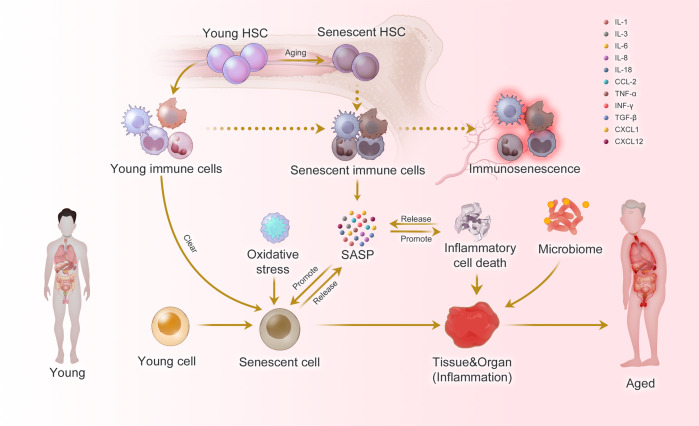
Aging is characterized by systemic chronic inflammation, which is accompanied by cellular senescence, immunosenescence, organ dysfunction, and age-related diseases. Given the multidimensional complexity of aging, there is an urgent need for a systematic organization of inflammaging through dimensionality reduction. Factors secreted by senescent cells, known as the senescence-associated secretory phenotype (SASP), promote chronic inflammation and can induce senescence in normal cells. At the same time, chronic inflammation accelerates the senescence of immune cells, resulting in weakened immune function and an inability to clear senescent cells and inflammatory factors, which creates a vicious cycle of inflammation and senescence. Persistently elevated inflammation levels in organs such as the bone marrow, liver, and lungs cannot be eliminated in time, leading to organ damage and aging-related diseases. Therefore, inflammation has been recognized as an endogenous factor in aging, and the elimination of inflammation could be a potential strategy for anti-aging. Here we discuss inflammaging at the molecular, cellular, organ, and disease levels, and review current aging models, the implications of cutting-edge single cell technologies, as well as anti-aging strategies. Since preventing and alleviating aging-related diseases and improving the overall quality of life are the ultimate goals of aging research, our review highlights the critical features and potential mechanisms of inflammation and aging, along with the latest developments and future directions in aging research, providing a theoretical foundation for novel and practical anti-aging strategies.
Overview
CoChat Summary
## TL;DR
This review argues that inflammaging—a chronic, systemic inflammatory state—is tightly intertwined with cellular senescence, immunosenescence, organ dysfunction, and age-related disease. It synthesizes signaling pathways, aging models, single-cell technologies, and intervention strategies, emphasizing anti-inflammatory approaches, senolytics, stem cell therapy, and organ transplantation.
## Key findings
- The paper describes a “vicious cycle” in which senescent cells secrete SASP factors that promote chronic inflammation, while chronic inflammation accelerates immune-cell senescence and weakens clearance of senescent cells and inflammatory factors.
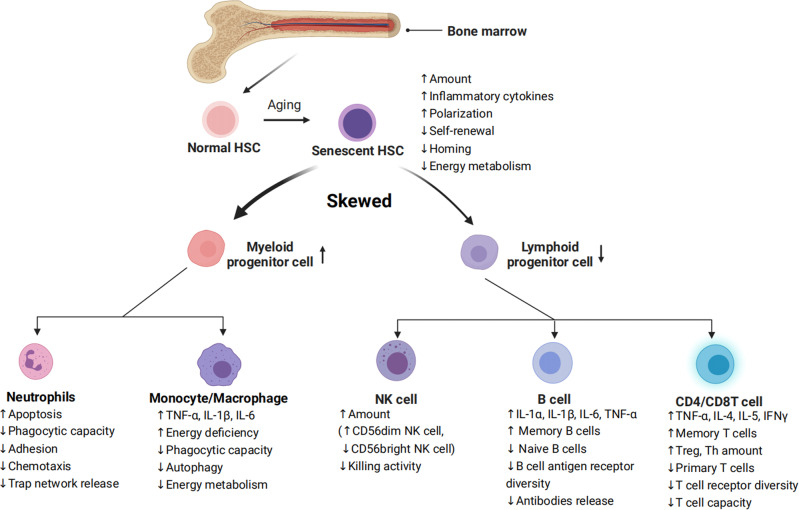
- It highlights reported age-related immune changes across cell types, including decreased circulating naive CD8 T cells as a consistent marker of immunosenescence in healthy older adults, reduced NK-cell cytotoxicity, and age-associated shifts in HSC differentiation toward myeloid lineages.
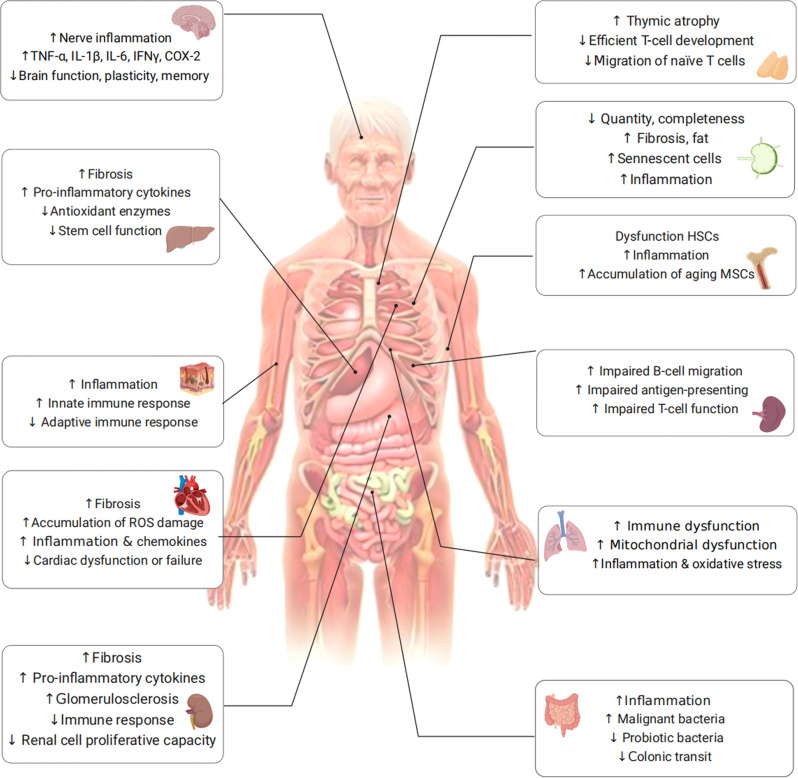
- The review links inflammaging to organ-level decline in the bone marrow, thymus, spleen, lymph nodes, brain, heart, kidney, liver, skin, lung, and gut, with examples such as age-related thymic degeneration reducing new T-cell output and aged bone marrow impairing HSC function.
- For intervention, it notes that the first senolytic combination, dasatinib plus quercetin, increased 6-minute walking distance by an average of 21.5 meters in the first human trial, but other outcomes did not change significantly and long-term efficacy remains insufficiently supported.
## Methods
- Narrative review of inflammaging across molecular, cellular, organ, and disease levels, with sections on signaling pathways, classical aging models, single-cell technology, and intervention strategies.
- No new experimental sample or cohort is reported in the paper itself; instead, it synthesizes findings from prior mouse, human, and cell-line studies cited throughout the text.
- The main approach is qualitative integration of published evidence, including examples from in vitro senescence models, in vivo mouse models, centenarian studies, and emerging single-cell/multi-omics work.
## Limitations
- The paper explicitly notes that the exact causality between inflammation and aging remains unresolved and “deserves further studies” for effective intervention.
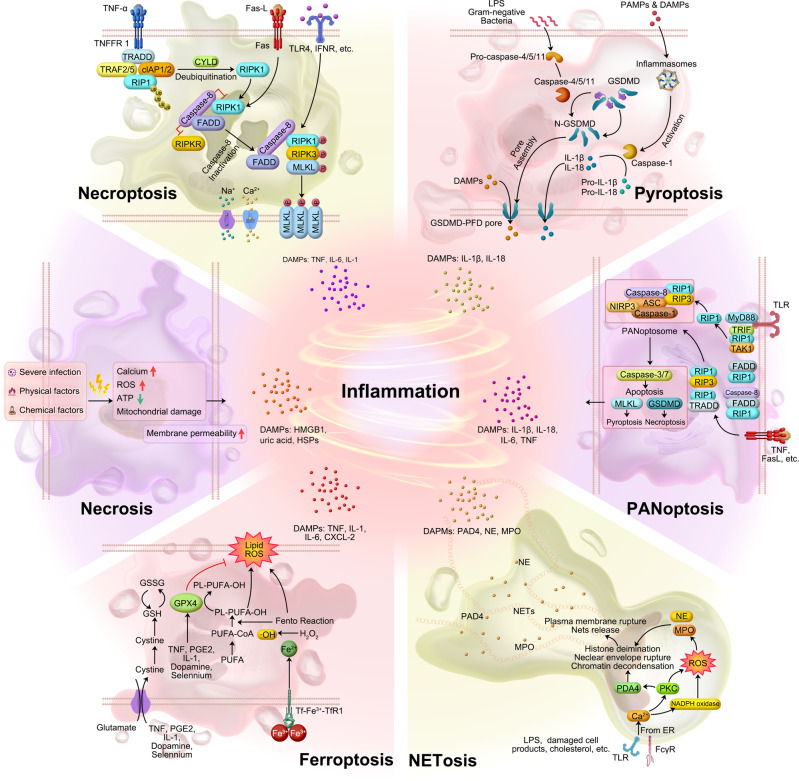
- It also states that PANoptosis has no direct evidence yet linking it to aging, so any connection is speculative.
- Evident from the text: this is a broad review rather than a primary study, so many conclusions are synthesized from heterogeneous prior studies rather than tested in one unified dataset.
Model-written summary. Check it against the paper before relying on it.
Integrity signals
Registry
Cites
Statistics
Figures
Verification
Claims the paper makes
140 Valid · 17 Not valid · 39 Not checked · 40 Own results and interpretations
Some cited sources support this claim and some don’t — read each source’s verdict below.
In the paper
“At the same time, inflammation promotes oxidation through inflammatory mediators.205,206”
§ Inflammation and aging: signaling pathways and intervention therapies > Mechanisms of inflammaging > Triggers of inflammaging
What the sources say
- Disputedcites [205] Furman D Expression of specific inflammasome gene modules stratifies older individuals into two extreme clinical and immunological states Nat. Med. 2017 23 174 184 10.1038/nm.4267 28092664 PMC5320935 sourceExperimental — accuracy not yet measured
The Discussion describes the opposite causal direction: oxidative stress triggers an inflammatory response, including production of inflammatory cytokines. The Results attribute chronic oxidative stress to possible mitochondrial metabolic reprogramming, not to inflammatory mediators. Page numbers are unavailable in our copy. (LLM, conf=0.82)
Checked by a reasoning model — may be wrong.
- Partly supportedcites [206] Furman D Chronic inflammation in the etiology of disease across the life span Nat. Med. 2019 25 1822 1832 10.1038/s41591-019-0675-0 31806905 PMC7147972 sourceExperimental — accuracy not yet measured
The ‘Systemic chronic inflammation and non-communicable disease risk’ section says systemic chronic inflammation can damage tissues by inducing oxidative stress. That supports the inflammation-to-oxidation link, but the passage does not say that inflammatory mediators are the mechanism. (LLM, conf=0.85)
plainstates a cause- Asserted: passes — The authors put it forward as true.
- Checkable: passes — It can be checked against evidence.
- Load-bearing: passes — The paper’s conclusions depend on it.
- Based: passes — The paper gives a reason why it holds.
- Disputed
At least one cited source doesn’t support this claim or points to a different paper, and none confirmed it — see the verdicts below.
In the paper
“Senescent neutrophils exhibit several distinct characteristics during NETosis, including a reduced capacity to release NETs, instability in the quality of formed NETs, and decreased activity of DNA degrading enzymes (DNases) within NETs.”
§ Inflammation and aging: signaling pathways and intervention therapies > Mechanisms of inflammaging > Inflammatory cell death
What the sources say
- Disputedcites [269] Sabbatini M Aging hampers neutrophil extracellular traps (NETs) efficacy Aging Clin. Exp. Res. 2022 34 2345 2353 10.1007/s40520-022-02201-0 35920993 PMC9637667 sourceExperimental — accuracy not yet measured
The Results and Discussion report that neutrophils from elderly subjects produced more NETs than those from adults after LPS stimulation, contrary to the unqualified claim of reduced release. The Introduction and Discussion note reduced NET production in other studies using different stimulation conditions, but distinguish those findings from this paper’s results. (LLM, conf=0.87)
Checked by a reasoning model — may be wrong.
plainstates a cause- Asserted: passes — The authors put it forward as true.
- Checkable: passes — It can be checked against evidence.
- Load-bearing: unclear — It is unclear whether the paper’s conclusions depend on it.
- Based: passes — The paper gives a reason why it holds.
- Disputed
The cited sources support only part of this claim — read each source’s verdict below.
In the paper
“However, in the aging heart, macrophages recruited to the site of infarction exhibit a pro-inflammatory M1 phenotype initially, but subsequently transition to an anti-inflammatory M2 phenotype after myocardial infarction (MI).”
§ Inflammation and aging: signaling pathways and intervention therapies > Inflammaging at the organ level > Sterile organs
What the sources say
- Partly supportedcites [143] Ma Y Mouton AJ Lindsey ML Cardiac macrophage biology in the steady-state heart, the aging heart, and following myocardial infarction Transl. Res. 2018 191 15 28 10.1016/j.trsl.2017.10.001 29106912 PMC5846093 sourceExperimental — accuracy not yet measured
The Abstract and “Macrophages in the MI Heart—Macrophage phenotypes” describe an early M1 and later M2 pattern after infarction. But the paper treats aging-heart macrophages separately and does not establish that this post-MI pattern occurs specifically in aging hearts. Its “Macrophage polarization mechanisms” section also says whether individual macrophages convert in vivo remains uncertain. Page numbers are unavailable in our copy. (LLM, conf=0.88)
plainstates a cause- Asserted: passes — The authors put it forward as true.
- Checkable: passes — It can be checked against evidence.
- Load-bearing: unclear — It is unclear whether the paper’s conclusions depend on it.
- Based: passes — The paper gives a reason why it holds.
- Partly supported
Every source the paper cites for this claim was checked and supports it.
In the paper
“This phenotypic switch promotes angiogenesis and scar formation, aiding in the recovery process.143”
§ Inflammation and aging: signaling pathways and intervention therapies > Inflammaging at the organ level > Sterile organs
What the sources say
- Supportedcites [143] Ma Y Mouton AJ Lindsey ML Cardiac macrophage biology in the steady-state heart, the aging heart, and following myocardial infarction Transl. Res. 2018 191 15 28 10.1016/j.trsl.2017.10.001 29106912 PMC5846093 source
The “Macrophage phenotypes” section says that M2 macrophages facilitate neoangiogenesis and scar repair, and that shifting the M1/M2 balance improves myocardial repair and function after MI. This supports the cited sentence’s account of angiogenesis, scar formation, and recovery. (LLM, conf=0.92)
plainstates a cause- Asserted: passes — The authors put it forward as true.
- Checkable: passes — It can be checked against evidence.
- Load-bearing: unclear — It is unclear whether the paper’s conclusions depend on it.
- Based: passes — The paper gives a reason why it holds.
- Supported
The cited sources that could be checked couldn’t confirm or dispute this claim.
In the paper
“Senescence of HSCs is the basis of immunosenescence. Senescent HSC differentiate into various types of dysfunctional immune cells, driving immunosenescence.16”
§ Inflammation and aging: signaling pathways and intervention therapies > Inflammaging at the cellular level > Hematopoietic stem cells (HSCs)
What the sources say
- Could not verifycites [16] Liggett LA Sankaran VG Unraveling Hematopoiesis through the Lens of Genomics Cell 2020 182 1384 1400 10.1016/j.cell.2020.08.030 32946781 PMC7508400 sourceExperimental — accuracy not yet measured
The Clonal hematopoiesis section describes age-related changes in HSC numbers and clonal expansion, but does not link HSC senescence to immunosenescence. A search for immunosenescence and dysfunctional immune cells found no passage establishing that proposed mechanism; the Outstanding Questions section also notes that some older people retain ostensibly normal hematopoiesis. (LLM, conf=0.72)
plainstates a cause- Asserted: passes — The authors put it forward as true.
- Checkable: passes — It can be checked against evidence.
- Load-bearing: unclear — It is unclear whether the paper’s conclusions depend on it.
- Based: passes — The paper gives a reason why it holds.
- Could not verify
95 more claims · 66 with their cited sources checked
Create a free account to see all 236 claims and every source verdict.
- It may state two separate claims as one. 111
- Probably not a substantial claim. 41
- Borderline: one of the tests for a substantial claim is unclear. 1
Claims other papers make about this one
Each is checked against this paper’s own text: does it say what the citing paper says it does?
The cited source says what the claim attributes to it.
In the citing paper
“Inflammation is implicated in various pathways and processes associated with ageing, including immunosenescence, oxidative stress, metabolic dysregulation, cellular senescence, and other critical events of the ageing process.37”
From Antiageing strategy for neurodegenerative diseases: from mechanisms to clinical advances (2025) · cites this paper as [37]
In the citing paper
“These frameworks suggest that the pathophysiology of AD is characterized by phosphorylated tau accumulation and propagation,31 heightened inflammatory responses, dysregulation of oxidative stress (related to mitochondrial dysfunction),37 alongside a gradual decline in cholinergic function.38”
From Antiageing strategy for neurodegenerative diseases: from mechanisms to clinical advances (2025) · cites this paper as [37]
In the citing paper
“exercise can reduce inflammation levels, which is a contributing factor to the ageing process.37”
From Antiageing strategy for neurodegenerative diseases: from mechanisms to clinical advances (2025) · cites this paper as [37]
Citations
Cites
Reduction in the incidence of type 2 diabetes with lifestyle intervention or metformin
(2002) · New England Journal of Medicine · doi:10.1056/nejmoa012512 · Cited by 19,011
Diversity of the Human Intestinal Microbial Flora
Eckburg, P. B., Bik, E. M., Bernstein, C. N., Purdom, E., Dethlefsen, L., Sargent, M., Gill, S. R., Nelson, K. E., & Relman, D. A. (2005) · Science · doi:10.1126/science.1110591 · Cited by 7,913
Mizgerd, J. P., Kubo, H., Kutkoski, G. J., Bhagwan, S. D., Scharffetter-Kochanek, K., Beaudet, A. L., & Doerschuk, C. M. (1997) · The Journal of Experimental Medicine · doi:10.1084/jem.186.8.1357 · Cited by 7,306
Chronic inflammation in the etiology of disease across the life span
Furman, D., Campisi, J., Verdin, E., Carrera-Bastos, P., Targ, S., Franceschi, C., Ferrucci, L., Gilroy, D. W., Fasano, A., Miller, G. W., et al. (2019) · Nature Medicine · doi:10.1038/s41591-019-0675-0 · Cited by 4,915
NLRP3 inflammasomes are required for atherogenesis and activated by cholesterol crystals
Duewell, P., Kono, H., Rayner, K. J., Sirois, C. M., Vladimer, G., Bauernfeind, F. G., Abela, G. S., Franchi, L., Nuñez, G., Schnurr, M., et al. (2010) · Nature · doi:10.1038/nature08938 · Cited by 4,026
Mortality Associated With Influenza and Respiratory Syncytial Virus in the United States
Thompson, W. W., Shay, D. K., Weintraub, E., Brammer, L., Cox, N., Anderson, L. J., & Fukuda, K. (2003) · JAMA · doi:10.1001/jama.289.2.179 · Cited by 3,673
Inflammaging: a new immune–metabolic viewpoint for age-related diseases
Franceschi, C., Garagnani, P., Parini, P., Giuliani, C., & Santoro, A. (2018) · Nature Reviews Endocrinology · doi:10.1038/s41574-018-0059-4 · Cited by 3,586
Sies, H., Berndt, C., & Jones, D. P. (2017) · Annual Review of Biochemistry · doi:10.1146/annurev-biochem-061516-045037 · Cited by 3,520
Gut microbiota composition correlates with diet and health in the elderly
Claesson, M. J., Jeffery, I. B., Conde, S., Power, S. E., O’Connor, E. M., Cusack, S., Harris, H. M. B., Coakley, M., Lakshminarayanan, B., O’Sullivan, O., et al. (2012) · Nature · doi:10.1038/nature11319 · Cited by 3,314 · cited 1×
“Older adults (>65 years) exhibit reduced microbiota diversity compared to adults, along with greater inter-individual variation in microbiota composition.(182) This is characterized by diminished populations of beneficial bacteria such as Bifidobacterium, Bacillus, E.”
BackgroundCellular Senescence: Defining a Path Forward
Gorgoulis, V., Adams, P. D., Alimonti, A., Bennett, D. C., Bischof, O., Bishop, C., Campisi, J., Collado, M., Evangelou, K., Ferbeyre, G., et al. (2019) · Cell · doi:10.1016/j.cell.2019.10.005 · Cited by 3,225 · cited 1×
“net).(371) On the other hand, other technologies, such as machine learning which integrates multi-modal and multidimensional big data, are also important to address the complexity of aging problems (Table 4).”
Background
Cited by
Items 901–1,000 of 1,410
Xu, Y., Zhao, H., Gao, Y., Zhao, L. H., Han, J., Li, R., Wu, Z., JunKang, Z. H. A. O., & Zhang, L. (2026) · Mediators of Inflammation · doi:10.1155/mi/9987170 · Cited by 2
“…in response to CXCL1, but the expression of CXCR2 in senescent neutrophils is downregulated, resulting in abnormal migration function, not only reduces the anti-in fl ammatory effect, but also causes damage to the non-in fl ammatory site [47], and low albumin levels weaken the in fl ammatory site.”
Li, J., Ying, R., Luo, J., Guo, X., & Zhang, M. (2026) · PLoS ONE · doi:10.1371/journal.pone.0340976 · Cited by 1
Targeting immunometabolism in cancer through pharmacological and lifestyle interventions
Tan, R. J. Y., Liu, Y., Chen, W., Liang, Y., & Ling, G. S. (2026) · PLoS Biology · doi:10.1371/journal.pbio.3003617 · Cited by 3
“Inflammaging is highly associated with immunosenescence, whereby senescent immune cells secrete SASP, further causing suboptimal functionality of the immune system in a positive feedback manner [64].”
Alkawamleh, D. H., Madkour, M. I., Kalam, F., Abdelrahim, D. N., Abdallah, H. W., & Faris, M. E. (2026) · Frontiers in Nutrition · doi:10.3389/fnut.2026.1736969 · Cited by 6
“By contrast, long-lived memory T cells, regulatory T cells, and alternatively activated (M2) macrophages depend more heavily on oxidative phosphorylation and FAO for sustained activity and anti-inflammatory signalling (30, 31).”
Impact of chitosan oligosaccharide on microbiota-metabolite-immune axis in natural aging
Liu, W., Shi, P., Xiao, Y., Yang, X., & Tian, B. (2026) · Frontiers in Nutrition · doi:10.3389/fnut.2025.1722269 · Cited by 1
“Among these dimensions, chronic low-grade inflammation amplifies cumulative molecular and cellular damage, escalating risk for degenerative and metabolic disease states (4, 5).”
Safety and efficacy of B-cell therapy in older people with multiple sclerosis
Montague, T., Kang, Y., Thomas, K. J., Simpson, N. B., Miller, C., Chatterton, S., Fontes-Villalba, A. A., & Parratt, J. D. E. (2026) · Frontiers in Immunology · doi:10.3389/fimmu.2025.1699550 · Cited by 1
Cao, Y., Xu, C., Liu, Y., Shi, B., Li, X., Li, J., Zhang, B., Zhang, Z., Dai, S., Sun, Q., et al. (2026) · iScience · doi:10.1016/j.isci.2026.114840 · Cited by 1
Self-citationLv, J., Fan, Q., Zhe, J., Jiang, S., Zhang, Z., Wang, H., Qin, J., Cheng, J., Wang, L., & Bao, W. (2026) · Science China Life Sciences · doi:10.1007/s11427-024-3060-0 · Cited by 4
Yang, K., Hu, Y., Ma, C., Wang, J., Wang, Y., Han, X., Lv, J., Zhang, X., & Yunliang, C. (2026) · Scientific Reports · doi:10.1038/s41598-026-38559-8 · Cited by 1
“T lymphocytes (T cells) are key effectors of adaptive immunity, orchestrating cell-mediated responses against pathogens and preventing infectious, neoplastic, and autoimmune diseases 12,13 .”
Self-citationSui, D., Liu, F., Zheng, L., Yu, S., Ding, Z., Ren, X., Gao, J., Wang, W., & Yang, L. (2026) · Critical Reviews in Oncology/Hematology · doi:10.1016/j.critrevonc.2026.105182 · Cited by 3
The role of dietary fat intake in muscle decline: a new perspective based on comprehensive evidence
Wu, T., Xia, J., Feng, Z., Wang, Y., Wang, J. P., Liao, W., & Sun, G. (2026) · Food Bioscience · doi:10.1016/j.fbio.2026.108400 · Cited by 1
Self-citationLi, Z., Wei, S., Fu, G., Liu, R., Zhang, S., Liu, W., Pan, T., Zhang, Y., & Wen, X. (2026) · Phytomedicine · doi:10.1016/j.phymed.2026.157941 · Cited by 1
Lee, E.-H., Park, J., Kwon, H., Park, S., & Han, P. (2026) · Experimental & Molecular Medicine · doi:10.1038/s12276-026-01641-2 · Cited by 2
“Brain aging involves various molecular and cellular alterations, including oxidative stress 1,2 , epigenetic dysregulation of gene expression 3,4 , and elevated levels of in fl ammatory factors 5,6 .”
Ashdown, C. P., Sikder, A., Kaimis, A. G., Chan, M. E., Sheridan, B. S., & Rubin, C. T. (2026) · Scientific Reports · doi:10.1038/s41598-026-40154-w · Cited by 1
Antipsychotics lower peripheral markers of inflammation in drug-naïve early psychosis: a pilot study
Šafářová, N., Kolenič, M., Tašková, I., Čapek, V., Fürstová, P., & Španiel, F. (2026) · Frontiers in Psychiatry · doi:10.3389/fpsyt.2026.1769162 · Cited by 2
Komaravolu, R. K., Chatterjee, N., Kumar, S., Allen, J. L., Durant, C. P., Wu, R., Valentin-Guillama, G. A., McSkimming, C. C., Drago, F., Taylor, A. M., et al. (2026) · Frontiers in Immunology · doi:10.3389/fimmu.2026.1749366 · Cited by 1
Targeted therapies in lung cancer: personalizing treatment across the age spectrum
Xu, Y., Chen, F., Zhang, H., & Wang, X. (2026) · Frontiers in Oncology · doi:10.3389/fonc.2026.1743620 · Cited by 1
“At the cellular level, aging lungs exhibit heightened activation of in fl ammatory pathways, including NF k B, p38 MAPK, and interferon-gamma signaling, alongside increased NLRP3 in fl ammasome activity (73).”
Shim, J., Bishehsari, F., Mahdavinia, M., Zeitzer, J. M., Fleisch, E., & Barata, F. (2026) · npj Aging · doi:10.1038/s41514-026-00349-x · Cited by 5
González-Melgoza, L. L., Méndez-García, A., Ruiz, I. V., Rodríguez, A. G., Samanta, D., Duttaroy, A. K., & Paul, S. (2026) · Ageing Research Reviews · doi:10.1016/j.arr.2026.103094 · Cited by 5
Escobar-Cervantes, C., Vázquez-Martínez, C., Gómez-Senent, S., Henriquez-Linares, A. E., & Fasero, M. (2026) · Journal of Clinical Medicine · doi:10.3390/jcm15052083 · Cited by 2
Jin, Y., Lu, K., & Yang, Y. (2026) · Antioxidants · doi:10.3390/antiox15030353 · Cited by 1
“Both conditions lead to an imbalance in the immune system that leads to infection susceptibility, inadequate vaccine responses, frailty, and other age-related disorders [3].”
Fayad, C., Mussalo, L., Afonin, A., Lampinen, R., Hakkarainen, H., Hensel, A.-K., Yahfoufi, K., Behzadpour, D., Penttilä, E., Koivisto, A. M., et al. (2026) · The Science of The Total Environment · doi:10.1016/j.scitotenv.2026.181661 · Cited by 1
Epigenetic dynamics of cellular senescence: From mechanistic insights to precision senotherapy
Hu, X., Lai, W., Liu, M., & Wang, B. (2026) · Chinese Medical Journal · doi:10.1097/cm9.0000000000004042 · Cited by 2
“[73] This chronic and sterile inflammatory state (termed inflammaging) derived from the SASP is thought to result in premature aging, promoting age-associated functional decline and chronic diseases.”
Sunita, B., Liu, Y., Zheng, H., Su, Y., Liu, M., Xu, L., Alouk, I., Liu, Z., & Lou, W. (2026) · Foods · doi:10.3390/foods15061096 · Cited by 1
“In response to infection, tissue damage, or stress, inflammation serves as an essential defense mechanism that involves the coordinated regulation of multiple immune cell populations and complex signaling pathways [1].”
Kim, S.-Y., Kim, N., Kim, U., Lee, J., Lee, H., Choi, J., Heo, J., Oh, D., & Shin, H. Y. (2026) · Biomedicine & Pharmacotherapy · doi:10.1016/j.biopha.2026.119253 · Cited by 1
Ekumi, K. M., Johnston, M. J., Murphy, M. P., Rakoczy, S. G., Painter, T., & Brown‐Borg, H. M. (2026) · NAR Molecular Medicine · doi:10.1093/narmme/ugag018 · Cited by 1
“Aging is associated with alterations in inflammatory and metabolic pathways that can coordinate tissue structural and functional changes [ 35 , 36 , 38 –40 , 43 , 130 ].”
Inflammaging and oral diseases: New sights from pathology to therapeutic consideration
Yang, T., Liu, D., & Hu, M. (2026) · Translational dental research. · doi:10.1016/j.tdr.2026.100079 · Cited by 3
Liu, S., Yang, Q., Liu, H., He, Z., Tang, X., Yang, Y., Lin, Y., & Luo, E. (2026) · Chemical Engineering Journal · doi:10.1016/j.cej.2026.175445 · Cited by 4
Humaloja, L., Marttila, S., Raitoharju, E., Mononen, N., Jalkanen, S., Salmi, M., Kähönen, M. A. P., Raitakari, O. T., Lehtimäki, T. J., & Mishra, P. P. (2026) · Scientific Reports · doi:10.1038/s41598-026-46275-6 · Cited by 3
“However, whether inflammation causes aging or aging drives inflammation remains unclear 12 .”
Wang, N., Wang, C., Wang, X., Meng, Y., Cui, S., Zhao, K., Jia, Y., & Kong, F. (2026) · Biochimica et Biophysica Acta (BBA) - Reviews on Cancer · doi:10.1016/j.bbcan.2026.189587 · Cited by 2
Age-Related Neurovascular Dysfunction in the Retina and Potential Pathogenic Mechanisms
Wu, Y., Cao, Q., & Liu, Q. (2026) · Investigative Ophthalmology & Visual Science · doi:10.1167/iovs.67.4.16 · Cited by 2
“229 232 Supplementation with NAD + precursors represents a relatively direct intervention strategy.”
The immune system as a guardian of health: micronutrient support and lifelong protection
Mantantzis, K., Pierre, A., & Calder, P. C. (2026) · Frontiers in Nutrition · doi:10.3389/fnut.2026.1802025 · Cited by 2
“In this context, the capacity of the immune system to continually modulate and compensate for the impact of these chronic exposures decisively shapes subsequent immune trajectories (34).”
Weiss, B., Miranda, D., Arrazati, D., Cao, R., Chen, J., Liu, Y., Brown, D., & Marshall, G. (2026) · Drug Design Development and Therapy · doi:10.2147/dddt.s594895 · Cited by 2
A systematic review of the association between phase angle and cognitive function among older adults
Wang, L., Ho, M., Minamizaki, M., Kanoya, Y., & Zeng, D. (2026) · GeroScience · doi:10.1007/s11357-026-02250-7 · Cited by 2
Type-1 interferons associated with microglial-mediated neuroinflammation in Alzheimer’s disease
Shippy, D. C., Sande, M. L., & Ulland, T. K. (2026) · Journal of Neuroinflammation · doi:10.1186/s12974-026-03828-w · Cited by 4
“Age-related inflammation is accompanied by immunosenescence, cellular senescence, organ dysfunction, and the development of age-related diseases [64].”
Novel RNA transcript signatures for accurate age prediction using RNA profiling
Chen, A., Zhao, J., Yang, F., Liu, Y., Xuan, Y., Liao, M., Lu, Y., Xing, Y., Zhang, S., & Li, C. (2026) · International Journal of Legal Medicine · doi:10.1007/s00414-026-03799-w · Cited by 2
Self-citationAshraf, M., Boivin, W. A., Nguyen‐Van‐Tam, J. S., Nolan, T. M., Stein, A. N., & Russell, C. A. (2026) · Expert Review of Vaccines · doi:10.1080/14760584.2026.2667732 · Cited by 2
Biological markers of aging across the menopause transition: current evidence
Castaneda, R., Uddenberg, E. R., Andrade, M. D. H., Meek, J. L., Frankhouser, K. N., Faubion, S. S., Chini, E. N., LeBrasseur, N. K., Brar, P., & SHUFELT, C. L. (2026) · Menopause The Journal of The North American Menopause Society · doi:10.1097/gme.0000000000002802 · Cited by 2
Tang, Y., Wu, Z., Zhao, H., et al. (2026) · International Journal of Pharmaceutics · doi:10.1016/j.ijpharm.2026.126963 · Cited by 1
Self-citationJiang, F., Dong, B., Wang, Y., & Xiong, Y. (2026) · International Journal of Molecular Sciences · doi:10.3390/ijms27104322 · Cited by 3
“…immunosenescence disrupts bone homeostasis by establishing a pro-inflammatory microenvironment within bone marrow, a state intimately linked to “inflammaging”—a chronic, low-grade inflammation driven by senescent immune cells that forms a self-reinforcing vicious cycle with immunosenescence [9,10].”
Self-citationDecoding human longevity: Genetic and molecular insights from accelerated to successful ageing
Cattaneo, M., Carnevali, S., Madeddu, P. R., & Puca, A. A. (2026) · Ageing Research Reviews · doi:10.1016/j.arr.2026.103176 · Cited by 2
Elastin production by mRNA technology for rejuvenation of aged skin
Shi, Y., Lou, Z., Chen, Y., Xu, J., Zhang, Z., Zhang, Z., Gao, Y., Wang, Y., & You, J. (2026) · Journal of Controlled Release · doi:10.1016/j.jconrel.2026.115033 · Cited by 1
Self-citationChen, J., Li, J., Yin, X., Fu, Z., Chen, X., & Zhang, C.-Y. (2026) · Immunity & Inflammation · doi:10.1007/s44466-026-00042-4 · Cited by 2
“This creates self-reinforcing loops with interleukin-6 (IL-6) that drive immune senescence and increase susceptibility to cancer and metabolic disorders [106, 107, 128].”
Manni, E., Al‐kuraishy, H. M., Shokr, M. M., & Batiha, G. E. (2026) · Metabolic Brain Disease · doi:10.1007/s11011-026-01874-0 · Cited by 4
“Brain aging is not something that happens alone, but rather it is a part of a systemic aging process that features the accumulation of senescent cells and chronic, low, grade inflammation in the peripheral tissues (Li et al. 2023).”
The epigenetic control of inflammaging in skeletal muscle and adipose tissue
de Melo, D. G., Rodrigues, V. C. D. C., Pereira, G. J. D. S., Fernandes, C. J. D. C., & de Moura, L. P. (2026) · Mechanisms of Ageing and Development · doi:10.1016/j.mad.2026.112205 · Cited by 2
Sun, M., Li, D., Wang, L., He, Y., Hu, Y., Yang, M., Luo, Z., Miao, X., Yu, S., Hua, M., et al. (2026) · Frontiers in Microbiology · doi:10.3389/fmicb.2026.1809542 · Cited by 2
“The release of SASPs marks the initiation of systemic chronic inflammation, which propels cells into a senescent state (Li et al., 2023).”
TA-TMA and GVHD are distinct consequences of endothelial injury: a MIDAS consortium study
Hahn, T., Zhao, Q., Miller, E. G., Elder, P., Langenberg, L., Luebbering, N., Abdullah, S., Neidemire-Colley, L. M., Holtan, S. G., Cataland, S. R., et al. (2026) · Blood Advances · doi:10.1182/bloodadvances.2026019747 · Cited by 2
Liu, C., Zhu, Z., Lin, H., Bush, W. S., Jenq, R. R., Cominelli, F., Pillai, J. A., Haines, J. L., Zhu, X., Xu, R., et al. (2026) · Frontiers in Molecular Biosciences · doi:10.3389/fmolb.2026.1735332 · Cited by 2
“Shared features such as cholesterol dysregulation (Varma et al., 2021; Nunes et al., 2022), mitochondrial dysfunction (Dewanjee et al., 2022; Amorim et al., 2022), depression (Dafsari and Jessen, 2020; Zenebe et al., 2021 Li et al., 2023; Bowirrat, 2022; Knox et al., 2022).”
Structural and cellular mechanisms of mucus plugging in the larger airways
Hu, Z., Yang, L., Ma, Y., Chen, J., & Liu, X. (2026) · Chinese Medical Journal - Pulmonary and Critical Care Medicine · doi:10.1016/j.pccm.2026.05.001 · Cited by 2
Epigenetic Gene Networks Governing Immune State Transitions Across the Lifespan
Al-Ewaidat, O. A., & Naffaa, M. M. (2026) · Immunology · doi:10.1111/imm.70161 · Cited by 2
Mechanobiology of inflammation: Pulling the strings of innate immunity
Maniak, M. K., Jenkins, S. J., & Hansen, C. G. (2026) · The Journal of Experimental Medicine · doi:10.1084/jem.20252269 · Cited by 5
Shi, N., & Li, X. (2026) · Frontiers in Aging · doi:10.3389/fragi.2026.1830839 · Cited by 1
“Aged tissues often exhibit persistent, low-grade sterile inflammation, which contributes to functional decline and increases susceptibility to age-related diseases (Li et al., 2023).”
Self-citationYuan, J., Li, F., Chen, J., Yu, S., Zhou, Y., Song, C., Fu, Z., & Liu, Y. (2026) · Molecular Biology Reports · doi:10.1007/s11033-026-12224-9 · Cited by 1
“On the other hand, NETs may suppress the expression of osteoblast-related factors, including Runx2, β-catenin, and BMP2, reduce the differentiation potential of osteoblast precursor cells, and promote osteoblast apopto - sis, thereby disrupting bone metabolic homeostasis [ 13 ].”
Asif, S., Mitchell, J. W., & Gillette, M. U. (2026) · International Journal of Molecular Sciences · doi:10.3390/ijms27135729 · Cited by 1
“This is a product of the NF-kB pathway and NLRP3 activation within vascular cells, with profound implications [135,136].”
Ganguly, P. (2026) · Biomedicines · doi:10.3390/biomedicines14071486 · Cited by 1
“Among these, cellular senescence and inflammaging have been closely linked with several ARDs [16–18].”
Multi-omics profiling reveals systemic rejuvenation of the aged kidney through senolytic therapy
Chen, S., Zhang, C., Cang, P., Guo, W., Xiao, L., He, Y., Su, Q., Ouyang, S., Zha, J., Maimaitirexiati, G., et al. (2026) · npj Regenerative Medicine · doi:10.1038/s41536-026-00490-x · Cited by 2
“Theintimatelinkbetweencellularsenescenceandachronic,low-grade in fl ammatory state, often termed “ in fl ammaging ” , forms a pivotal axis in aging 43,44 .”
Cellular Senescence and Aging: Mechanisms, Disease Convergence, and Therapeutic Frontiers
Cai, G., Ren, J., Wang, L., Wu, Y., Wang, H., Cao, X., Shang, H., Hou, X., Wang, Y., Xue, H., et al. (2026) · MedComm · doi:10.1002/mco2.70827 · Cited by 2
“Both the free radical theory and the oxidative-inflammation theory identify ROS as primary mediators of cellular aging [ 75, 76 ].”
Self-citationNi, Z., Xie, J., Zhang, Z., Zhang, K., Ding, J., Chang, M., Su, Y., Zhang, Y., Yao, M., Wang, C., et al. (2026) · iMeta · doi:10.1002/imt2.70148 · Cited by 2
Self-citationCheng, W.-T., Lin, M.-S., Chan, T., Wu, C., & Shieh, C. (2026) · Frontiers in Immunology · doi:10.3389/fimmu.2026.1848916 · Cited by 2
Berger, M. M., Blaauw, R., D’Amelio, P., Ehrhart, N. P., Gombart, A. F., Gramlich, L. M., Kressig, R. W., & Calder, P. C. (2026) · GeroScience · doi:10.1007/s11357-026-02402-9 · Cited by 1
“Low-grade inflammation increases with age (inflammageing) increasing risk of conditions that contribute to unhealthy ageing [22, 23].”
Kryczyk‐Poprawa, A., Rząsa-Duran, E., Varga, J. T., Ceglédi, A., Zábó, V., Fazekas‐Pongor, V., Major, D., Csípő, T., Szappanos, Á., Lipécz, Á., et al. (2026) · Nutrients · doi:10.3390/nu18152478 · Cited by 4
Vaccines for the Prevention of COVID-19 in Older Adults
Olagunju, O. J., Oyebanji, O. A., Mylonakis, E. E., & Canaday, D. H. (2026) · Clinics in Geriatric Medicine · doi:10.1016/j.cger.2025.09.003 · Cited by 1
Zhang, X., Yin, T., Cheng, Y., 常英新, Guo, Z., Liu, J., Shi, J., Tan, K., Yang, J., Guo, L., et al. (2026) · Ageing Research Reviews · doi:10.1016/j.arr.2026.103318 · Cited by 1
Decoding regulators of gut aging in nonhuman primates
(2024) · Nature Aging · doi:10.1038/s43587-024-00577-4 · Cited by 1
Mbatha, N. A., Mushebenge, A. G.-A., & Khathi, A. (2024) · Physiologia · doi:10.3390/physiologia4020009 · Cited by 3
“…This process is intensifi ed by positive feedback loops that drive the accumulation of inflammation and organ damage, leading to further inflammation and an even higher risk of aging-related diseases [30]. inflammation in organs, leading to organ damage and an increased risk of age-related diseases.”
BackgroundAdvances in anti-aging research of urine-derived stem cells
Zhong, X., Suo, H., Lu, Z.-K., Liu, Z.-K., Liu, Z., Wang, C., Li, C., Zhang, J., Liu, J., & Sun, J. (2024) · New cell · doi:10.61958/ncyq8589 · Cited by 1
Self-citationThe role of phagocytic cells in aging: insights from vertebrate and invertebrate models
Driesschaert, B., Mergan, L., Lucci, C., Simon, C., Santos, D., Groef, L. D., & Temmerman, L. (2024) · Biogerontology · doi:10.1007/s10522-024-10131-9 · Cited by 3
“The development and numbers of another phagocytic cell type, the neutrophils, do not seem to be systematically altered in aging (Li et al. 2023).”
Ma, Z., Chai, Z., Yang, H., Zhang, X., Zhao, H., Luo, X., Zhong, J., & Wu, Z. (2024) · Frontiers in Veterinary Science · doi:10.3389/fvets.2024.1448587 · Cited by 1
“During aging, individuals experience muscle mass loss, increased chronic inflammation, and cellular senescence (34), factors that may influence FTO gene expression.”
BackgroundGomes, A. T. P. C., Mendes, K., Ferrito, C., Andrade, F., Neves‐Amado, J., Resende, A., Santos, P., Manso, D., Almeida, A., Vollrath, A. A., et al. (2024) · Frontiers in Public Health · doi:10.3389/fpubh.2024.1432044 · Cited by 3
“It has been reported that older population is more vulnerable to infections, and chronic conditions, such as cardiovascular disease, diabetes, physical disability, and cognitive decline, resulting in increased mortality, and morbidity (31, 32).”
BackgroundElderly-onset Familial Mediterranean Fever Carrying MEFV Exon 10 Variants in a Japanese Patient
Fujita, Y., Ogawa, S., Sumichika, Y., et al. (2024) · Internal Medicine · doi:10.2169/internalmedicine.4463-24 · Cited by 1
“Furthermore, aging is characterized by chronic systemic inflammation (29).”
Nazari, A. R., Gresseau, L., Habelrih, T., Zia, A., Lahaie, I., Er‐Reguyeg, Y., Côté, F., Annabi, B., Rivard, A., Chemtob, S., et al. (2024) · Biomedicines · doi:10.3390/biomedicines12122669 · Cited by 1
“These changes contribute to age-related disorders that apply not only to vascular degeneration, but also inflammation and cancer [17].”
Alsaggaf, I., Freitas, A. A., & Wan, C. (2024) · NAR Genomics and Bioinformatics · doi:10.1093/nargab/lqae153 · Cited by 3
Chronobiological Aspects of Aging, Neurodegeneration, and Inflammation
Banerjee, S., Das, S., Halder, N., Bisht, S., Talukdar, A., & Ray, S. (2024) · Progress in inflammation research · doi:10.1007/978-3-031-74744-1_8 · Cited by 1
Chen, Y., Yen, C., Lee, C. H., et al. (2025) · Aging · doi:10.18632/aging.206217 · Cited by 1
“Chronic systemic inflammation is a key aging-related phenotypes [21].”
Lu, W., Gong, Y., Liu, L., Zhang, Y., Tian, X., & Liu, H. (2025) · Frontiers in Aging · doi:10.3389/fragi.2025.1502746 · Cited by 2
T Cell Aging: An Important Target for Perioperative Immunomodulation
Lan, H., Xu, S., Li, H., Guo, R., Feng, Z., & Wang, Y. (2025) · Clinical Interventions in Aging · doi:10.2147/cia.s519438
“104 It has been reported that general anesthesia lead to mitochondrial dysfunction by altering mitochondrial morphology and distribution, increasing mitochondrial ROS production, mitochondria-mediated regulation of cell death pathways, and mitochondria’s ability to clear misfolded proteins.”
Self-citationDeussom, P. M., Ewonkem, M. B., Enang, B. E., II, Kamdem, M. H. K., Mbock, M. A., Fotsing, M. C. D., Ndinteh, D. T., Njayou, F. N., & Toze, F. A. A. (2025) · Royal Society Open Science · doi:10.1098/rsos.241413
“A significant portion of the elderly population suffers from multiple chronic illnesses—such as cardiovascular diseases, respiratory conditions, autoimmune disorders, diabetes, cancer and neuro logical disorders—where inflammation plays a critical role in both development and progression [1,2].”
Biology, Genetics and Molecular Aspects of Aging: An Update
Elakkiya, M. R., Mohandas, K., Sureshkumar, T., & Saraswathy, C. D. B. (2025) · IGI Global eBooks · doi:10.4018/979-8-3693-9730-5.ch002 · Cited by 1
Age-dependent integration of cortical progenitors transplanted at CSF-neurogenic niche interface
Pothayee, N., Greene, G., Jahanipour, J., Jie, H., Tao-Cheng, J.-H., Petrus, E., Maric, D., & Koretsky, A. P. (2025) · Frontiers in Cell and Developmental Biology · doi:10.3389/fcell.2025.1577045 · Cited by 1
“Many factors in the aged brain might impact the ability of the host to innervate the new tissue including reduced plasticity and increased neuroinflammation (Ownby, 2010; Li et al., 2023; Burke andBarnes,2006).”
Engineered Anti‐Senescence Trachea With Post‐Transplanted Regenerative Homeostasis
Pan, Z., Tang, H., Wang, L., Bai, Q., Chen, Y., Cao, R., Lin, W., Wang, L., Hu, Y., Zhao, G., et al. (2025) · Advanced Science · doi:10.1002/advs.202507186 · Cited by 2
Wang, A., Ren, M., Sun, H., Xie, Z., An, T., Wang, H., Wang, C., & Lin, Z. (2025) · Acta cardiologica. Supplementum · doi:10.1080/00015385.2025.2548160 · Cited by 1
“This can be caused by the close correlation between age and inflammation [26].”
RETRACTED: Exploration of wound‐related complications post‐kidney transplantation
Sun, H., Liu, K., Peng, Z., & Liu, S. (2023) · International Wound Journal · doi:10.1111/iwj.14578
“26,27 Furthermore, it is worth noting that there is a notable disparity in the incidence of complications among individuals who receive kidneys from living donors as opposed to those who receive kidneys from deceased donors.”
BackgroundRetractedEditorial: Cardiovascular inflammaging: basic and translational aspects
Barcena, M. L., Aslam, M., & Ladilov, Y. V. (2024) · Frontiers in Cardiovascular Medicine · doi:10.3389/fcvm.2024.1385683 · Cited by 2
cGAS-STING is responsible for aging of telomerase deficient zebrafishPreprint
Şerifoğlu, N., Allavena, G., Lopes-Bastos, B., Marzullo, M., Bousounis, P., Trompouki, E., & Ferreira, M. G. (2024) · bioRxiv (Cold Spring Harbor Laboratory) · doi:10.1101/2024.03.11.584360 · Cited by 1
Inflammaging: Significance and intervention.
Ahmad, R. (2024) · PubMed Central · Cited by 1
Hyphae and HealthspanPreprint
Chambers, P. W. (2024) · Qeios · doi:10.32388/yzhinh.2 · Cited by 1
Wang, H., Kazaleh, M., Gioscia‐Ryan, R. A., Millar, J. K., Temprano‐Sagrera, G., Wood, S. C., den Bergh, F. V., Blin, M. G., Wragg, K. M., Luna, A., et al. (2024) · bioRxiv (Cold Spring Harbor Laboratory) · doi:10.1101/2024.10.30.621201 · Cited by 1
Jang, H. J., Urrutia, G., Ørskov, A. D., Kim, H. J., Nelson, S. A., Nguyen, A. V., Lee, H., Burgos, R. S., Johnson, B. K., Wegener, M., et al. (2024) · bioRxiv (Cold Spring Harbor Laboratory) · doi:10.1101/2024.11.08.622670 · Cited by 1
Comprehensive multi-omics profiling of a healthy human cohortPreprint
de Visser, C., Niehues, A., Najdekr, L., Tóth, R., Nazarov, P. V., Vrbková, J., Stanková, J., Ekberg, S., Conde, E., Ghimire, B. R., et al. (2024) · bioRxiv (Cold Spring Harbor Laboratory) · doi:10.1101/2024.11.07.622407 · Cited by 3
“Additionally, the mRNA-seq and proteomics feature weights were enriched in aging-associated pathways, including chemokine signaling 13 , cytokine activity 14 , and JAK-STAT signaling 15,16 .”
BMAL1 and YAP cooperate to hijack enhancers and promote inflammation in the aged epidermisPreprint
Bonjoch, J., Solá, P., Reina, Ó., Mortimer, T., Miroshnikova, Y. A., Wickström, S. A., Attolini, C. S., Álvarez, L., Benitah, S. A., & Solanas, G. (2025) · bioRxiv (Cold Spring Harbor Laboratory) · doi:10.1101/2025.04.22.649967 · Cited by 1
The First to Fall: Fast Motor Units as the Hidden Trigger of Human AgingPreprint
Ruggia, T. (2025) · OSF Preprints (OSF Preprints) · doi:10.31219/osf.io/hw8v7_v1 · Cited by 1
Modeling Immunosenescence on-a-chip: a platform for cancer vaccine efficacy assessmentPreprint
Maity, S., Najafabadi, A. H., Kawakita, S., Khorsandi, D., Yilgor, C., Jewell, C., Mohaghegh, N., Dokmeci, M. R., Khademhosseini, A., & Jucaud, V. (2025) · bioRxiv (Cold Spring Harbor Laboratory) · doi:10.1101/2025.05.14.654059 · Cited by 1
EYKTHYR reveals transcriptional regulators of spatial gene programsPreprint
Krieger, S., Haber, E., & Ma, J. (2025) · bioRxiv (Cold Spring Harbor Laboratory) · doi:10.1101/2025.05.19.654884 · Cited by 2
Dey, A. K., Olinger, B., Boroumand, M., Fernández, M. E., Study of Longitudinal Aging in Mice (SLAM) Investigators, de Cabo, R., Camandola, S., Price, N. L., de Cabo, R., & Basisty, N. (2026) · Nature Aging · doi:10.1101/2025.06.24.661372 · Cited by 4
Decoding menopause-induced tissue fibrosis using pan-tissue network inferencePreprint
Iijima, H., Yamashita, A., Galloway, J. L., Vo, N. N., Choi, H. S., & Ambrosio, F. (2025) · bioRxiv (Cold Spring Harbor Laboratory) · doi:10.1101/2025.07.03.663094 · Cited by 1
Ranjbaran, A., Kalita, C., Wei, J., Davis, K. M., Bruinsma, J., Mair-Meijers, H. E., Garlicki, G., Alazizi, A., Petriello, M. C., Jiang, Y., et al. (2025) · bioRxiv (Cold Spring Harbor Laboratory) · doi:10.1101/2025.10.14.682318 · Cited by 1
Markov, N., Hosseini, A., Fettrelet, T., Oberson, K., Brichkina, A. I., Yousefi, S., Bourquin, C., & Simon, H. (2025) · bioRxiv (Cold Spring Harbor Laboratory) · doi:10.1101/2025.11.01.686039 · Cited by 4
“…injection, which induces classical M1-like macrophage polarization; (2) IL-4 complex (IL-4c) i.p. injection, composed of IL-4 and anti–IL-4 antibody, which promotes M2-like polarization and (3) low-grade, age-associated inflammation, representing a chronic physiological inflammatory state(43–45).”
The antiviral Interferon pathway drives astrocyte aging and motor declinePreprint
Labarta-Bajo, L., Thanawalla, A., Gutierrez, I. L., Soe, S. M. L., Chick, B. Y., Andritsogianni, I., Metanat, S., Hargreaves, D. C., Kaech, S. M., Azim, E., et al. (2025) · bioRxiv (Cold Spring Harbor Laboratory) · doi:10.1101/2025.11.12.688147 · Cited by 2
Cellular Aging Signatures in the Plasma Proteome Record Human Health and DiseasePreprint
Ding, D. Y., Bot, V. A., Chen, K. S.-M., Groves, J. W., Pálovics, R., Masuda, D., Farinas, A., Oh, H. S., Wagner, V., Lu, N., et al. (2026) · bioRxiv (Cold Spring Harbor Laboratory) · doi:10.64898/2026.02.10.704909 · Cited by 3
La represión contra el liberalismo desde el Tribunal Diocesano de Cuenca (1823-1830)
Pérez, J. R. (2003) · Dialnet (Universidad de la Rioja)
Metadata
- Authors
- Li, X., Li, C., Zhang, W., Wang, Y., Qian, P., & Huang, H.
- Affiliations
- First Affiliated Hospital Zhejiang University (CN)
- Zhejiang University-University of Edinburgh Institute (CN)
- Corresponding author
- Qian, Pengxu
- Huang, He
- Venue
- Signal Transduction and Targeted Therapy
- Published
- 2023-06-08
- Volume
- 8
- Issue
- 1
- Pages
- 239-239
- ISSN
- 2059-3635 (ISSN-L)
- PMC
- PMC10248351
- OpenAlex
- W4379966446
- Semantic Scholar
- 03e8f6a34adfe5506c86edea58c1c55ce12b0141
- Cited by
- 1,443
- References
- 479
- Citations by year
- 2026: 496 · 2025: 592 · 2024: 322 · 2023: 32
- FWCI
- 51.26
- Type
- journal article
- Language
- en
- Open access
- gold
- doi.org
- Licence
- cc-by
- creativecommons.org/licenses/by/4.0 (tdm)
- creativecommons.org/licenses/by/4.0 (vor)
- Locations
- Signal Transduction and Targeted Therapy (publishedVersion, cc-by)
- PubMed Central (publishedVersion, cc-by)
- PubMed (publishedVersion)
- DOAJ (DOAJ: Directory of Open Access Journals) (submittedVersion, cc-by-sa)
- Funders
- National Natural Science Foundation of China (81900176, 92268117, 82130003, 82222003, 82161138028, 82222003, 92268117)
- National Key Research and Development Program of China (2022YFA1103500)
- Topics
- Life Sciences › Biochemistry, Genetics and Molecular Biology › Cell Biology › Telomeres, Telomerase, and Senescence
- Life Sciences › Biochemistry, Genetics and Molecular Biology › Aging › Genetics, Aging, and Longevity in Model Organisms
- Life Sciences › Biochemistry, Genetics and Molecular Biology › Molecular Biology › Inflammasome and immune disorders
- Keywords
- inflammaging, aging, chronic inflammation, cellular senescence, immunosenescence, senescence-associated secretory phenotype, senolytics, anti-aging strategies, age-related diseases, organ dysfunction, single-cell technologies, aging models, signaling pathways
- MeSH terms
- Humans, Inflammation, Quality of Life, Signal Transduction, Cellular Senescence
About these checks
Registry, retraction, Cites and statistics results are computed, not judged, with one exception: a printed reference that no index lists is read once by a model before it counts as a citation error. Claims are extracted by a model and kept only when their quote appears verbatim in the text; each cited source is then checked, with a model’s help, for whether it says what the claim relies on. Those verdicts can be wrong — read the claim’s quote and the cited source before relying on one.
The claim verdicts this report counts are experimental: their accuracy is not yet measured.
A language model drew the claims from the paper on 2026-10-10, under version 3 of the claim definition (model deepseek-v4.1-flash, prompt extract-v3).
A second model labelled each claim on 2026-10-10 (model jev-1.13-20260917, definition revision gold-guideline-v0.2).
Cited sources are checked with a language model’s help (gpt-6-sol).
Statistics and arithmetic are recomputed, not judged.
Confidence bands are shown only for fields calibrated on our annotated test set. None is calibrated yet, so no band is shown.
What counts as a claim ›How we measure confidence ›How we check this ›
Are you an author, or do you see a problem with this page? Request a review
Data sources
Bibliographic data: Semantic Scholar, OpenAlex, Crossref.
Contains information from the Semantic Scholar Academic Graph Datasets, made available under the ODC Attribution License (ODC-BY 1.0).
Semantic Scholar’s data is described in: Kinney, R., et al. (2023). The Semantic Scholar Open Data Platform. arXiv:2301.10140.
