

Inflammation and aging: signaling pathways and intervention therapies
Open accessThe DOI matches its Crossref record; 476 of the 479 references it cites were found in a registry or an index; 215 of the 287 sources its claims cite were checked for support.
Abstract
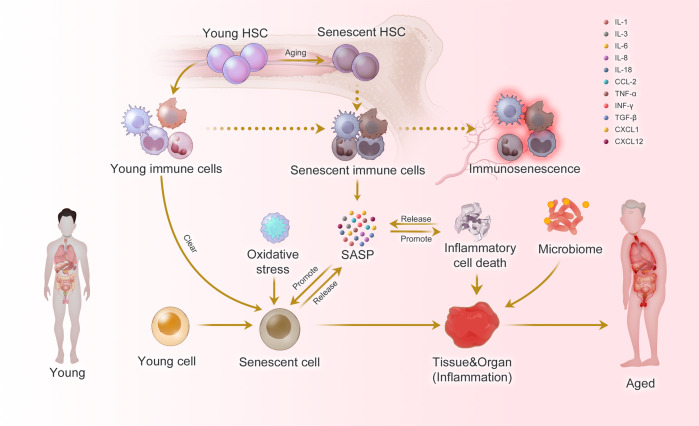
Aging is characterized by systemic chronic inflammation, which is accompanied by cellular senescence, immunosenescence, organ dysfunction, and age-related diseases. Given the multidimensional complexity of aging, there is an urgent need for a systematic organization of inflammaging through dimensionality reduction. Factors secreted by senescent cells, known as the senescence-associated secretory phenotype (SASP), promote chronic inflammation and can induce senescence in normal cells. At the same time, chronic inflammation accelerates the senescence of immune cells, resulting in weakened immune function and an inability to clear senescent cells and inflammatory factors, which creates a vicious cycle of inflammation and senescence. Persistently elevated inflammation levels in organs such as the bone marrow, liver, and lungs cannot be eliminated in time, leading to organ damage and aging-related diseases. Therefore, inflammation has been recognized as an endogenous factor in aging, and the elimination of inflammation could be a potential strategy for anti-aging. Here we discuss inflammaging at the molecular, cellular, organ, and disease levels, and review current aging models, the implications of cutting-edge single cell technologies, as well as anti-aging strategies. Since preventing and alleviating aging-related diseases and improving the overall quality of life are the ultimate goals of aging research, our review highlights the critical features and potential mechanisms of inflammation and aging, along with the latest developments and future directions in aging research, providing a theoretical foundation for novel and practical anti-aging strategies.
Overview
CoChat Summary
## TL;DR
This review argues that inflammaging—a chronic, systemic inflammatory state—is tightly intertwined with cellular senescence, immunosenescence, organ dysfunction, and age-related disease. It synthesizes signaling pathways, aging models, single-cell technologies, and intervention strategies, emphasizing anti-inflammatory approaches, senolytics, stem cell therapy, and organ transplantation.
## Key findings
- The paper describes a “vicious cycle” in which senescent cells secrete SASP factors that promote chronic inflammation, while chronic inflammation accelerates immune-cell senescence and weakens clearance of senescent cells and inflammatory factors.
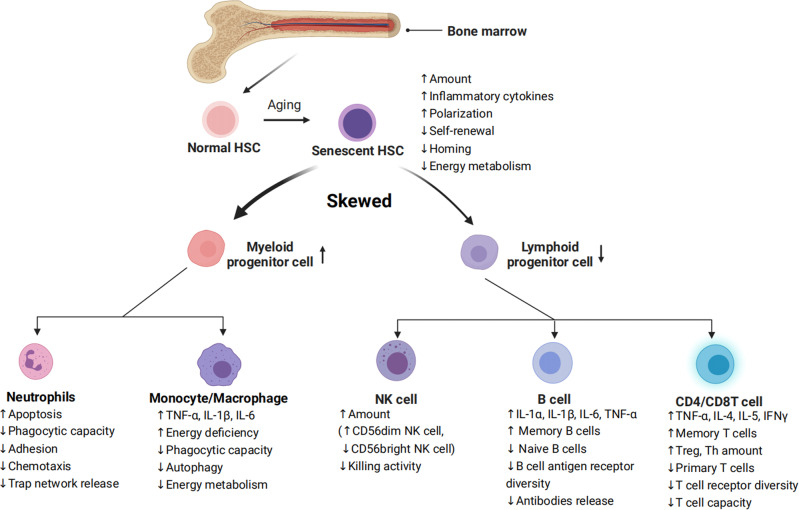
- It highlights reported age-related immune changes across cell types, including decreased circulating naive CD8 T cells as a consistent marker of immunosenescence in healthy older adults, reduced NK-cell cytotoxicity, and age-associated shifts in HSC differentiation toward myeloid lineages.
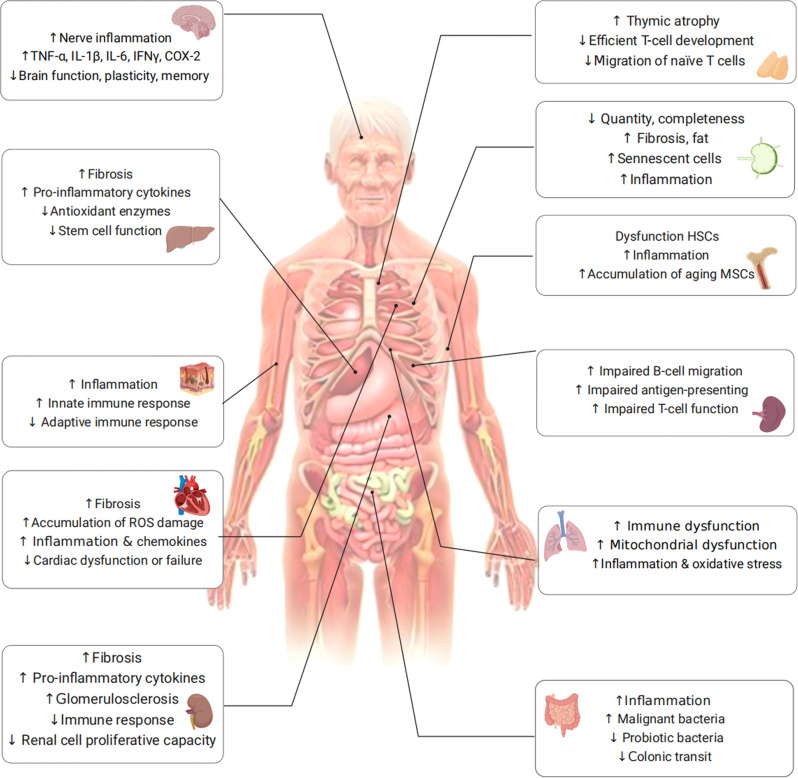
- The review links inflammaging to organ-level decline in the bone marrow, thymus, spleen, lymph nodes, brain, heart, kidney, liver, skin, lung, and gut, with examples such as age-related thymic degeneration reducing new T-cell output and aged bone marrow impairing HSC function.
- For intervention, it notes that the first senolytic combination, dasatinib plus quercetin, increased 6-minute walking distance by an average of 21.5 meters in the first human trial, but other outcomes did not change significantly and long-term efficacy remains insufficiently supported.
## Methods
- Narrative review of inflammaging across molecular, cellular, organ, and disease levels, with sections on signaling pathways, classical aging models, single-cell technology, and intervention strategies.
- No new experimental sample or cohort is reported in the paper itself; instead, it synthesizes findings from prior mouse, human, and cell-line studies cited throughout the text.
- The main approach is qualitative integration of published evidence, including examples from in vitro senescence models, in vivo mouse models, centenarian studies, and emerging single-cell/multi-omics work.
## Limitations
- The paper explicitly notes that the exact causality between inflammation and aging remains unresolved and “deserves further studies” for effective intervention.
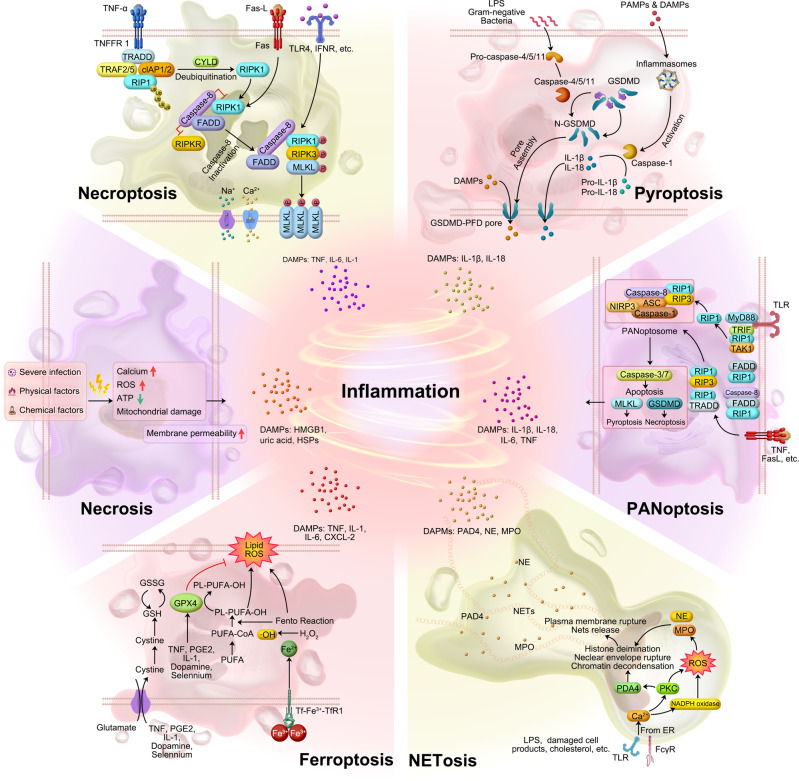
- It also states that PANoptosis has no direct evidence yet linking it to aging, so any connection is speculative.
- Evident from the text: this is a broad review rather than a primary study, so many conclusions are synthesized from heterogeneous prior studies rather than tested in one unified dataset.
Model-written summary. Check it against the paper before relying on it.
Integrity signals
Registry
Cites
Statistics
Figures
Verification
Claims the paper makes
140 Valid · 17 Not valid · 39 Not checked · 40 Own results and interpretations
Some cited sources support this claim and some don’t — read each source’s verdict below.
In the paper
“At the same time, inflammation promotes oxidation through inflammatory mediators.205,206”
§ Inflammation and aging: signaling pathways and intervention therapies > Mechanisms of inflammaging > Triggers of inflammaging
What the sources say
- Disputedcites [205] Furman D Expression of specific inflammasome gene modules stratifies older individuals into two extreme clinical and immunological states Nat. Med. 2017 23 174 184 10.1038/nm.4267 28092664 PMC5320935 sourceExperimental — accuracy not yet measured
The Discussion describes the opposite causal direction: oxidative stress triggers an inflammatory response, including production of inflammatory cytokines. The Results attribute chronic oxidative stress to possible mitochondrial metabolic reprogramming, not to inflammatory mediators. Page numbers are unavailable in our copy. (LLM, conf=0.82)
Checked by a reasoning model — may be wrong.
- Partly supportedcites [206] Furman D Chronic inflammation in the etiology of disease across the life span Nat. Med. 2019 25 1822 1832 10.1038/s41591-019-0675-0 31806905 PMC7147972 sourceExperimental — accuracy not yet measured
The ‘Systemic chronic inflammation and non-communicable disease risk’ section says systemic chronic inflammation can damage tissues by inducing oxidative stress. That supports the inflammation-to-oxidation link, but the passage does not say that inflammatory mediators are the mechanism. (LLM, conf=0.85)
plainstates a cause- Asserted: passes — The authors put it forward as true.
- Checkable: passes — It can be checked against evidence.
- Load-bearing: passes — The paper’s conclusions depend on it.
- Based: passes — The paper gives a reason why it holds.
- Disputed
At least one cited source doesn’t support this claim or points to a different paper, and none confirmed it — see the verdicts below.
In the paper
“Senescent neutrophils exhibit several distinct characteristics during NETosis, including a reduced capacity to release NETs, instability in the quality of formed NETs, and decreased activity of DNA degrading enzymes (DNases) within NETs.”
§ Inflammation and aging: signaling pathways and intervention therapies > Mechanisms of inflammaging > Inflammatory cell death
What the sources say
- Disputedcites [269] Sabbatini M Aging hampers neutrophil extracellular traps (NETs) efficacy Aging Clin. Exp. Res. 2022 34 2345 2353 10.1007/s40520-022-02201-0 35920993 PMC9637667 sourceExperimental — accuracy not yet measured
The Results and Discussion report that neutrophils from elderly subjects produced more NETs than those from adults after LPS stimulation, contrary to the unqualified claim of reduced release. The Introduction and Discussion note reduced NET production in other studies using different stimulation conditions, but distinguish those findings from this paper’s results. (LLM, conf=0.87)
Checked by a reasoning model — may be wrong.
plainstates a cause- Asserted: passes — The authors put it forward as true.
- Checkable: passes — It can be checked against evidence.
- Load-bearing: unclear — It is unclear whether the paper’s conclusions depend on it.
- Based: passes — The paper gives a reason why it holds.
- Disputed
The cited sources support only part of this claim — read each source’s verdict below.
In the paper
“However, in the aging heart, macrophages recruited to the site of infarction exhibit a pro-inflammatory M1 phenotype initially, but subsequently transition to an anti-inflammatory M2 phenotype after myocardial infarction (MI).”
§ Inflammation and aging: signaling pathways and intervention therapies > Inflammaging at the organ level > Sterile organs
What the sources say
- Partly supportedcites [143] Ma Y Mouton AJ Lindsey ML Cardiac macrophage biology in the steady-state heart, the aging heart, and following myocardial infarction Transl. Res. 2018 191 15 28 10.1016/j.trsl.2017.10.001 29106912 PMC5846093 sourceExperimental — accuracy not yet measured
The Abstract and “Macrophages in the MI Heart—Macrophage phenotypes” describe an early M1 and later M2 pattern after infarction. But the paper treats aging-heart macrophages separately and does not establish that this post-MI pattern occurs specifically in aging hearts. Its “Macrophage polarization mechanisms” section also says whether individual macrophages convert in vivo remains uncertain. Page numbers are unavailable in our copy. (LLM, conf=0.88)
plainstates a cause- Asserted: passes — The authors put it forward as true.
- Checkable: passes — It can be checked against evidence.
- Load-bearing: unclear — It is unclear whether the paper’s conclusions depend on it.
- Based: passes — The paper gives a reason why it holds.
- Partly supported
Every source the paper cites for this claim was checked and supports it.
In the paper
“This phenotypic switch promotes angiogenesis and scar formation, aiding in the recovery process.143”
§ Inflammation and aging: signaling pathways and intervention therapies > Inflammaging at the organ level > Sterile organs
What the sources say
- Supportedcites [143] Ma Y Mouton AJ Lindsey ML Cardiac macrophage biology in the steady-state heart, the aging heart, and following myocardial infarction Transl. Res. 2018 191 15 28 10.1016/j.trsl.2017.10.001 29106912 PMC5846093 source
The “Macrophage phenotypes” section says that M2 macrophages facilitate neoangiogenesis and scar repair, and that shifting the M1/M2 balance improves myocardial repair and function after MI. This supports the cited sentence’s account of angiogenesis, scar formation, and recovery. (LLM, conf=0.92)
plainstates a cause- Asserted: passes — The authors put it forward as true.
- Checkable: passes — It can be checked against evidence.
- Load-bearing: unclear — It is unclear whether the paper’s conclusions depend on it.
- Based: passes — The paper gives a reason why it holds.
- Supported
The cited sources that could be checked couldn’t confirm or dispute this claim.
In the paper
“Senescence of HSCs is the basis of immunosenescence. Senescent HSC differentiate into various types of dysfunctional immune cells, driving immunosenescence.16”
§ Inflammation and aging: signaling pathways and intervention therapies > Inflammaging at the cellular level > Hematopoietic stem cells (HSCs)
What the sources say
- Could not verifycites [16] Liggett LA Sankaran VG Unraveling Hematopoiesis through the Lens of Genomics Cell 2020 182 1384 1400 10.1016/j.cell.2020.08.030 32946781 PMC7508400 sourceExperimental — accuracy not yet measured
The Clonal hematopoiesis section describes age-related changes in HSC numbers and clonal expansion, but does not link HSC senescence to immunosenescence. A search for immunosenescence and dysfunctional immune cells found no passage establishing that proposed mechanism; the Outstanding Questions section also notes that some older people retain ostensibly normal hematopoiesis. (LLM, conf=0.72)
plainstates a cause- Asserted: passes — The authors put it forward as true.
- Checkable: passes — It can be checked against evidence.
- Load-bearing: unclear — It is unclear whether the paper’s conclusions depend on it.
- Based: passes — The paper gives a reason why it holds.
- Could not verify
95 more claims · 66 with their cited sources checked
Create a free account to see all 236 claims and every source verdict.
- It may state two separate claims as one. 111
- Probably not a substantial claim. 41
- Borderline: one of the tests for a substantial claim is unclear. 1
Claims other papers make about this one
Each is checked against this paper’s own text: does it say what the citing paper says it does?
The cited source says what the claim attributes to it.
In the citing paper
“Inflammation is implicated in various pathways and processes associated with ageing, including immunosenescence, oxidative stress, metabolic dysregulation, cellular senescence, and other critical events of the ageing process.37”
From Antiageing strategy for neurodegenerative diseases: from mechanisms to clinical advances (2025) · cites this paper as [37]
In the citing paper
“These frameworks suggest that the pathophysiology of AD is characterized by phosphorylated tau accumulation and propagation,31 heightened inflammatory responses, dysregulation of oxidative stress (related to mitochondrial dysfunction),37 alongside a gradual decline in cholinergic function.38”
From Antiageing strategy for neurodegenerative diseases: from mechanisms to clinical advances (2025) · cites this paper as [37]
In the citing paper
“exercise can reduce inflammation levels, which is a contributing factor to the ageing process.37”
From Antiageing strategy for neurodegenerative diseases: from mechanisms to clinical advances (2025) · cites this paper as [37]
Citations
Cites
Reduction in the incidence of type 2 diabetes with lifestyle intervention or metformin
(2002) · New England Journal of Medicine · doi:10.1056/nejmoa012512 · Cited by 19,011
Diversity of the Human Intestinal Microbial Flora
Eckburg, P. B., Bik, E. M., Bernstein, C. N., Purdom, E., Dethlefsen, L., Sargent, M., Gill, S. R., Nelson, K. E., & Relman, D. A. (2005) · Science · doi:10.1126/science.1110591 · Cited by 7,913
Mizgerd, J. P., Kubo, H., Kutkoski, G. J., Bhagwan, S. D., Scharffetter-Kochanek, K., Beaudet, A. L., & Doerschuk, C. M. (1997) · The Journal of Experimental Medicine · doi:10.1084/jem.186.8.1357 · Cited by 7,306
Chronic inflammation in the etiology of disease across the life span
Furman, D., Campisi, J., Verdin, E., Carrera-Bastos, P., Targ, S., Franceschi, C., Ferrucci, L., Gilroy, D. W., Fasano, A., Miller, G. W., et al. (2019) · Nature Medicine · doi:10.1038/s41591-019-0675-0 · Cited by 4,915
NLRP3 inflammasomes are required for atherogenesis and activated by cholesterol crystals
Duewell, P., Kono, H., Rayner, K. J., Sirois, C. M., Vladimer, G., Bauernfeind, F. G., Abela, G. S., Franchi, L., Nuñez, G., Schnurr, M., et al. (2010) · Nature · doi:10.1038/nature08938 · Cited by 4,026
Mortality Associated With Influenza and Respiratory Syncytial Virus in the United States
Thompson, W. W., Shay, D. K., Weintraub, E., Brammer, L., Cox, N., Anderson, L. J., & Fukuda, K. (2003) · JAMA · doi:10.1001/jama.289.2.179 · Cited by 3,673
Inflammaging: a new immune–metabolic viewpoint for age-related diseases
Franceschi, C., Garagnani, P., Parini, P., Giuliani, C., & Santoro, A. (2018) · Nature Reviews Endocrinology · doi:10.1038/s41574-018-0059-4 · Cited by 3,586
Sies, H., Berndt, C., & Jones, D. P. (2017) · Annual Review of Biochemistry · doi:10.1146/annurev-biochem-061516-045037 · Cited by 3,520
Gut microbiota composition correlates with diet and health in the elderly
Claesson, M. J., Jeffery, I. B., Conde, S., Power, S. E., O’Connor, E. M., Cusack, S., Harris, H. M. B., Coakley, M., Lakshminarayanan, B., O’Sullivan, O., et al. (2012) · Nature · doi:10.1038/nature11319 · Cited by 3,314 · cited 1×
“Older adults (>65 years) exhibit reduced microbiota diversity compared to adults, along with greater inter-individual variation in microbiota composition.(182) This is characterized by diminished populations of beneficial bacteria such as Bifidobacterium, Bacillus, E.”
BackgroundCellular Senescence: Defining a Path Forward
Gorgoulis, V., Adams, P. D., Alimonti, A., Bennett, D. C., Bischof, O., Bishop, C., Campisi, J., Collado, M., Evangelou, K., Ferbeyre, G., et al. (2019) · Cell · doi:10.1016/j.cell.2019.10.005 · Cited by 3,225 · cited 1×
“net).(371) On the other hand, other technologies, such as machine learning which integrates multi-modal and multidimensional big data, are also important to address the complexity of aging problems (Table 4).”
Background
Cited by
Items 501–600 of 1,410
Chen, Y., Zeng, X., Gong, X., Chen, Y., Zhang, X., & Luo, S. (2025) · International Journal of Biological Macromolecules · doi:10.1016/j.ijbiomac.2025.149519 · Cited by 11
From Elixirs to Geroscience: A Historical and Molecular Perspective on Anti-Aging Medicine
Nicoletti, G. R. P., Mangano, K., Nicoletti, F., & Cavalli, E. (2025) · Molecules · doi:10.3390/molecules30244728 · Cited by 9
“Together, these cytokines form the so-called “cytokine signature” of aging, with systemic levels of IL-6, TNF-α , and IL-1 β serving as reliable predictors of functional decline and reduced healthspan [103,104].”
Garza, V. A. A. (2025) · ASCE MAGAZINE · doi:10.70577/asce.v4i4.559 · Cited by 6
Cacciatore, S., Calvani, R., Prokopidis, K., Schlögl, M., Russo, A., Tosato, M., Anton, S. D., Leeuwenburgh, C., Batsis, J. A., Marzetti, E., et al. (2026) · Experimental Gerontology · doi:10.1016/j.exger.2026.113026 · Cited by 7
Zhi, Y., Xie, S., & Sun, Y. (2026) · Frontiers in Nutrition · doi:10.3389/fnut.2025.1680349 · Cited by 8
Renkawitz, J., Yesin, A., Kroll, J., Cabral, A. T., D’Annunzio, S., & Thiam, H. R. (2026) · Nucleus · doi:10.1080/19491034.2025.2590843 · Cited by 10
Preventing ovarian aging: from redox-targeted strategies to extracellular vesicle-based therapies
Rapini, C. C. S., Rojo-Fleming, C. C., Berardino, C. D., Peserico, A., Capacchietti, G., Tosi, U., Bernabò, N., Mattioli, M., & Barboni, B. (2026) · Frontiers in Aging · doi:10.3389/fragi.2026.1707614 · Cited by 12
“In contrast, the Nrf2 pathway serves a protective role by activating antioxidant response elements (ARE) and upregulating genes encoding antioxidant enzymes (Li X. et al., 2023).”
InfluentialSong, Z., Hu, H., Zhang, W., Zheng, X., Liang, L., Zhao, B., Song, G., Li, J., Li, S., Wen, Y., et al. (2026) · Nature Aging · doi:10.1038/s43587-026-01087-1 · Cited by 7
Self-citationSenescent cells in systemic aging: SASP heterogeneity, immune escape, and endocrine modulation
Qoura, L. A., Churov, A. V., Maltseva, O. N., Ерусланова, К. А., & Zeng, G. (2026) · Biogerontology · doi:10.1007/s10522-026-10449-6 · Cited by 12
“Furthermore, the chronic secretion of SASP-associated factors fosters a persistent, low-grade inflammatory milieu, known as inflammaging (Dugan et al. 2023; Li et al. 2023b).”
InfluentialRegulatory T cells: master orchestrators of immune tolerance and tissue homeostasis
Bluestone, J. A., Levings, M. K., Ramsdell, F. J., Rudensky, A. Y., Tang, Q., & Trzonkowski, P. (2026) · Frontiers in Science · doi:10.3389/fsci.2026.1792210 · Cited by 10
Anti‐aging and rejuvenating effects and mechanism of Dead Sea water in skin
Yan, X., Bao, X., Cheng, S., Ba, Q., Chang, J., Zhou, K., & Yan, X. (2024) · International Journal of Cosmetic Science · doi:10.1111/ics.12931 · Cited by 6
“Skin aging is a complex and heterogeneous process that is influenced by genetically determined intrinsic factors and accelerated by cumulative exposure to extrinsic stressors [1, 2].”
BackgroundPersonalized Research on the Aging Face—A Narrative History
Hînganu, M. V., Cucu, R. P., & Hînganu, D. (2024) · Journal of Personalized Medicine · doi:10.3390/jpm14040343 · Cited by 9
“These studies investigate the background inflammatory disease Such studies offer the promise of genetic modification that can help keep organisms healthy while promoting longevity. related to obesity and also to aging phenomena [54].”
BackgroundZhang, W., Lin, M., Jia, D., Zhang, Q., Zhang, D., Gu, Y., Peng, Q., & Zheng, S. (2024) · Food Bioscience · doi:10.1016/j.fbio.2024.104432 · Cited by 8
Self-citationXie, Q., Shu, X., Liu, T., Chen, L., & Luo, L. (2024) · Molecular Nutrition & Food Research · doi:10.1002/mnfr.202400297 · Cited by 8
Jia, M., Yuan, W., Chen, Y., Wang, Y., Shang, L., & Han, S. (2024) · Immunity Inflammation and Disease · doi:10.1002/iid3.1358 · Cited by 6
Self-citationLow serum Metrnl levels are associated with increased risk of sarcopenia in the older adults
Wang, Z., Li, Y., Yan, J.-J., Wang, Q., Zhao, C., Lu, X., Shen, Z., Xu, J., & Gao, W. Q. (2024) · European Geriatric Medicine · doi:10.1007/s41999-024-01074-y · Cited by 9
Zhang, M., Zhang, R., Kong, Y., Li, J., Wang, G., Wu, D., Wu, M., & Lan, H. (2024) · International Immunopharmacology · doi:10.1016/j.intimp.2024.113471 · Cited by 6
Ishihara, S., Kayes, M. I., Makino, H., Matsuda, H., Kumagai, A., Hayashi, Y., Ferdaus, S. A., Kawakita, E., Koya, D., & Kanasaki, K. (2025) · Journal of Diabetes Investigation · doi:10.1111/jdi.14397 · Cited by 9
“PK activation in fl uences cellular metabolism, oxidative stress, and in fl ammatory responses, all of which are closely related to the aging process 18,19 .”
Sureshbabu, A., Smirnova, E., Tuong, D. T. C., Vinod, S., Chin, S., Moniruzzaman, M., Senthil, K., Lee, D. I., Karthikeyan, A., & Min, T. (2025) · Drug Development Research · doi:10.1002/ddr.70058 · Cited by 8
“The interplay of multiple factors (i.e, Immune cells, cytokines, environment, and microbiome dysbiosis) leads to the complexity of skin inflammation (Cho et al. 2012; Li et al. 2023; Pfisterer et al. 2021).”
Metzler, L. A. P., Metzger, J. M., Gerred, K., Emborg, M. E., & Kapoor, A. (2025) · Experimental Gerontology · doi:10.1016/j.exger.2025.112736 · Cited by 10
“In adults, GFAP levels have consistently been higher in female patients with AD (Abbas et al., 2023), traumatic brain injury (Sass et al., 2021), and Parkinson's disease (Li et al., 2023).”
Seasonal influenza vaccination: Overcoming immunosenescence with enhanced vaccines
Boivin, W. A., Loeb, M. B., Openshaw, P., Ashraf, M., & Pawelec, G. (2025) · Vaccine X · doi:10.1016/j.jvacx.2025.100662 · Cited by 10
Sundaram, V. G., Esser, K. L., Schwartz, L., Chen, L. M., Mercer, N. P., Lezak, B. A., Gould, H. P., Kaplan, D. J., & Strauss, E. J. (2025) · The American Journal of Sports Medicine · doi:10.1177/03635465251339490 · Cited by 7
“10,19,24,33,35 Previous studies have explored this phenomenon in relation to fractures and bone healing, although not as extensively in cartilage injury.”
Kunat-Budzyńska, M., Staniszewska, P., Olszewski, K., Cytryńska, M., & Strachecka, A. (2025) · International Journal of Molecular Sciences · doi:10.3390/ijms26157294 · Cited by 6
“At the same time, chronic inflammation accelerates the aging of immune cells, leading to weakened immune function and an inability to clear senescent cells and inflammatory factors, creating a vicious cycle of inflammation and aging [2–4].”
PSGL-1, a Strategic Biomarker for Pathological Conditions in HIV Infection: A Hypothesis Review
Zaongo, S. D., & Chen, Y. (2023) · Viruses · doi:10.3390/v15112197 · Cited by 7
“Similar to BMI (overweight/obese), advancing age is also associated with a proinflamma-tory state [110].”
BackgroundAdvances in microbial decorations and its applications in drug delivery
He, T., Zhao, Z., Luo, Z., Jia, W. P., Zhang, J., Zhao, Y., Xiao, W., Ming, Z., & Chen, K. (2023) · Acta Materia Medica · doi:10.15212/amm-2023-0036 · Cited by 10
“Therefore, changing a person’s microbiome may improve such diseases [92, 93].”
BackgroundDanga, A. K., Kour, S., Kumari, A., & Rath, P. C. (2024) · Biogerontology · doi:10.1007/s10522-023-10088-1 · Cited by 7
Tchouto, M. N., Bucher, C. H., Meß, A.-K., Haas, S. F., Schmidt‐Bleek, K., Duda, G. N., Beule, D., & Milek, M. (2025) · Frontiers in Immunology · doi:10.3389/fimmu.2025.1511902 · Cited by 5
Ullah, A., Singla, R. K., Cao, D., Chen, B., & Shen, B. (2025) · Genes & Diseases · doi:10.1016/j.gendis.2025.101606 · Cited by 12
Shi, X., Wang, Y., Yang, F., Yi, Y., Hu, Q., Xie, T., Li, B., & Ma, K. (2025) · BMC Public Health · doi:10.1186/s12889-025-22374-3 · Cited by 8
Self-citationTesticular aging: mechanism, management and future therapy
Zhou, J., & Dong, Q. (2025) · Experimental Cell Research · doi:10.1016/j.yexcr.2025.114603 · Cited by 6
Pharmacological frontiers in senescence: Transforming senescence with drug repurposing
Shahzadi, A., Özyazgan, S., & Çakatay, U. (2025) · Advances in pharmacology · doi:10.1016/bs.apha.2025.02.010 · Cited by 7
Adipose Factor ANGPTL4: Its Role in Aging Mechanisms and Associated Diseases
Wang, X., Chang, H.-C., Gu, X., Zhang, Y., & Bao, Z. (2025) · Clinical Interventions in Aging · doi:10.2147/cia.s522049 · Cited by 8
“140 Clinical studies have indicated that the inflammatory marker CRP can be used to predict plasma levels of ANGPTL4 in individuals, with inflammatory triggers leading to increased expression of ANGPTL4 in macrophages.”
Alterations in mitochondria and cellular senescence in aged sEH null female kidneys
Yousef, A., Fang, L., Heidari, M., Huang, A., Kondraciuk, P., Yee, K. A., Mengel, M., & Seubert, J. M. (2025) · GeroScience · doi:10.1007/s11357-025-01814-3 · Cited by 8
“…the current study, we present key components of the SASP and the primary regulatory pathways activated in senescent cells, including IL-1β, caspase-1, MCP-1, CD68, and interferons, which are closely linked to heightened chronic inflammation and the progression of aging-related conditions [44, 85].”
Research progress on blood therapy for anti-aging
Liu, S., Wang, S., Dong, Y., Yang, S., & Yao, C. (2025) · Journal of Advanced Research · doi:10.1016/j.jare.2025.07.039 · Cited by 6
“The function of blood cells also declines with age, including the oxygen-carrying capacity of red blood cells (RBCs) [13] and the phagocytic capacity of neutrophils [14].”
Dijck, E. V., Laere, S. V., Logie, E., Timmermans, S., Fransén, E., Ibrahim, J., Kendall, T. J., Fallowfield, J. A., Mateiu, L. M., Libert, C., et al. (2025) · Clinical Epigenetics · doi:10.1186/s13148-025-01945-6 · Cited by 13
Metabolomic insights into late-life depression: a systematic review
Gao, Y., Hu, J.-Z., Wen, Z.-P., Dong, T., Du, X.-Z., Liu, Z., & Liu, S. (2025) · BMC Geriatrics · doi:10.1186/s12877-025-06256-2 · Cited by 7
“LLD is often accompanied by chronic inflammatory states, and TKP dysregulation appears to be particularly significant in LLD compared to younger-onset depression [49].”
Ji, X., Li, L., Jiao, Y., & Cheng, H. (2025) · Scientific Reports · doi:10.1038/s41598-025-15370-5 · Cited by 6
Chen, J., Xu, Y., Yu, H., Liu, Y., Miao, G., Han, Y., Zheng, L., Cai, Z., Zhou, Z., Chen, J., et al. (2025) · Theranostics · doi:10.7150/thno.118958 · Cited by 6
“Senescent cells that possess highly metabolic activities can secrete pro-inflammatory factors, termed SASP, to promote chronic inflammation, which in turn drives healthy cells into the senescence process [40].”
Self-citationLi, J., Rong, M., Liu, C., & Lu, L. (2025) · ACS Nano · doi:10.1021/acsnano.5c05124 · Cited by 8
Exploring the Therapeutic Potential of Bupleurum in Medical Treatment: A Comprehensive Overview
Tian, Y., Guo, J., Jiang, X., Lu, H., Xie, J., Zhang, F., Du, Z., & Hao, E. (2025) · Pharmaceuticals · doi:10.3390/ph18091331 · Cited by 6
“Aging is a complex natural phenomenon [99] characterized by systemic chronic inflammation, accompanied by cellular senescence, immunosenescence, organ dysfunction, and age-related diseases [100,101].”
Cui, Y. (2025) · Brain Behavior and Immunity · doi:10.1016/j.bbi.2025.106106 · Cited by 6
Xu, Y., Han, T., Wu, Y., Liu, H., Hou, K., An, Z., Li, Y., Zhu, C., Wang, S., & Wei, J. (2025) · Neuroscience Bulletin · doi:10.1007/s12264-025-01505-1 · Cited by 5
“In addition to pathological factors, aging is a significant contributor to the heightened inflammatory response in PD [9, 10].”
Insights Into Stria Vascular Function, Stria Immunity, and Age-Related Hearing Loss
Shi, X. (2025) · Journal of the Association for Research in Otolaryngology · doi:10.1007/s10162-025-01010-2 · Cited by 8
“These factors drive cell damage and senescence in aging tissues [94].”
Deng, Y., He, X., Peng, J., Pan, Y., Luo, Y., Ruan, Y., Hou, J., Jiang, B., Li, X., Liang, X., et al. (2025) · Cell Death and Disease · doi:10.1038/s41419-025-08007-y · Cited by 8
Self-citationMi, S., Nakashima, H., & Nakashima, K. (2025) · Epigenomes · doi:10.3390/epigenomes9040038 · Cited by 8
“Suppression of neuroinflammation is increasingly recognized as an effective anti-aging strategy [151].”
Yao, J., Wu, Y., Xu, L., Wang, X., Zhang, J. K., Chen, H., Shao, Y. X., Cong, S., Li, J., Cai, D., et al. (2025) · The American Journal of Sports Medicine · doi:10.1177/03635465251383161 · Cited by 8
“Recently, Li et al 23 discovered that senescent cells secrete factors known as senescence-associated secretory phenotypes (SASPs), which can trigger chronic inflammation, weaken immune function, and accelerate the aging of normal cells.”
Liu, M., Yu, Z., He, Z., Zhou, Z., Liu, J., Liu, L., Wu, X., Li, J., Huang, Y., Xiang, L., et al. (2025) · Science Advances · doi:10.1126/sciadv.adz4847 · Cited by 7
“Senescent cells can have a profound paracrine effect, contributing to chronic inflammation and age-related diseases, including cardiac pathologies ( 21 , 22 ).”
The impact of cellular senescence on aging skeletal muscle
Kamal, M. J., Bevington, R. T., Johnson, A., & Parise, G. (2025) · Frontiers in Cell and Developmental Biology · doi:10.3389/fcell.2025.1719279 · Cited by 8
“Furthermore, the SASP causes the rise of chemokine and cytokine levels in the cellular microenvironment, contributing to the chronic state of inflammation present in advanced age (Li et al., 2023).”
Zhao, Y., Chen, P., Zhang, Y., Huo, S., Yu, D., Zeng, X., & Zhang, W. (2025) · Frontiers in Neuroscience · doi:10.3389/fnins.2025.1654796 · Cited by 9
Self-citationYang, Z., Peng, Y., Zang, J., Wang, J., Wang, Z., Zhang, G.-M., Sun, J., Chen, H., Xie, Y., Peng, X., et al. (2025) · ACS Nano · doi:10.1021/acsnano.5c18165 · Cited by 10
Self-citationZhou, P., Zhang, Y., Zhang, H., Zhao, P., Guo, Y., Zhao, G., Chu, Y., Ge, D., Liu, R., & Gu, J. (2026) · Cell Reports Medicine · doi:10.1016/j.xcrm.2025.102532 · Cited by 12
“8,10,15 18 Targeting senescent immune cells or alleviating immune senescence can enhance the efficacy of anti-tumor treatments.”
Xu, Y., Zhao, B., Li, F., Song, S., Liu, J., Liu, Z., Wang, Y., Ji, J., Liu, Z., Zhou, W., et al. (2026) · International Immunopharmacology · doi:10.1016/j.intimp.2025.116155 · Cited by 6
Self-citationLiu, K., Li, G., Liang, X., Wang, C., Zhu, N., Fu, X., Zhang, Y., Liu, C., & Yang, J. (2026) · Bioactive Materials · doi:10.1016/j.bioactmat.2025.12.036 · Cited by 9
“At the cellular level, senescence manifests as endothelial dysfunction, the senescence-associated secretory phenotype (SASP), and dysregulation of pathways like p53 [7 – 9].”
Age-driven dysbiosis: gut microbiota in the pathogenesis and treatment of aging disorders
Kopalli, S. R., Wankhede, N. L., Rahangdale, S. R., Sammeta, S. S., Aglawe, M. M., Koppula, S., Taksande, B. G., Upaganlawar, A., Umekar, M. J., & Kale, M. B. (2026) · Biogerontology · doi:10.1007/s10522-026-10389-1 · Cited by 7
“This section delves into how alterations in gut microbiota composition and function can influence these pathways, ultimately impacting brain function and health during aging(Alsegiani and Shah 2022).”
Xiang, C., Lu, J., Wang, X., Zhang, X., Zhang, D.-Q., & Li, J. (2026) · Spectrochimica Acta Part A Molecular and Biomolecular Spectroscopy · doi:10.1016/j.saa.2026.127547 · Cited by 5
Shanker, P. R., & Dorajoo, R. (2026) · International Journal of Molecular Sciences · doi:10.3390/ijms27031613 · Cited by 5
“A growing body of research suggests that ageing biology and LLD involve overlapping biological dysfunctions [9–11].”
Imaging-based organ-specific aging clock predicts human diseases and mortality
Ren, P., Su, W., You, J., Liang, Y., Gong, W., Zhang, W., Zhou, Z., Dai, F., Hou, X., Liu, W., et al. (2026) · npj Digital Medicine · doi:10.1038/s41746-026-02488-7 · Cited by 9
“Meanwhile, for most organs, higher expression of proteins related to immune response was associated with accelerating organ aging, recapturing that low-grade and chronic damage resulting from increased in fl ammation levels is a hallmark of aging 38,39 .”
Self-citationMaintaining and regaining episodic memory in Alzheimer disease: a circuit-based perspective
Düzel, E., & Kreutz, M. R. (2026) · Nature Reviews Neurology · doi:10.1038/s41582-026-01189-9 · Cited by 9
“Synaptic dysfunction is also related to glial function and is intimately linked to chronic sterile neuroinflammation, which is a hallmark of ageing and is more pronounced in AD 126,127 .”
The microbiome-gerogene axis: a new frontier in precision geromedicine
Bautista, J., & López‐Cortés, A. (2026) · Frontiers in Aging · doi:10.3389/fragi.2026.1794192 · Cited by 6
Association between serum Klotho levels and hypothyroidism in older adults: NHANES 2007–2012
Wang, Y., Hu, B., & Yang, S. (2024) · Scientific Reports · doi:10.1038/s41598-024-62297-4 · Cited by 6
Self-citationLiang, B., Huang, Z., Cheng, L., et al. (2024) · Analytica Chimica Acta · doi:10.1016/j.aca.2024.343504 · Cited by 5
Nakamura, J., Yamamoto, T., Takabatake, Y., Namba‐Hamano, T., Takahashi, A., Matsuda, J., Minami, S., Sakai, S., Yonishi, H., Maeda, S., et al. (2024) · JCI Insight · doi:10.1172/jci.insight.184451 · Cited by 11
“First, senescent epithelial cells, which consist predominantly of PTECs and distal tubular epithelial cells in the aging kidney (84), escape from efferocytosis (85) and secrete SASP factors, leading to chronic inflammation and renal dysfunction (86).”
Inflammaging Markers in the Extremely Cold Climate: A Case Study of Yakutian Population
Kalyakulina, A., Yusipov, I., Kondakova, E., Sivtseva, T. M., Николаевна, З. Р., Semenov, S., Klimova, T., Петровна, А. Е., Trukhanov, A., Franceschi, C., et al. (2024) · International Journal of Molecular Sciences · doi:10.3390/ijms252413741 · Cited by 6
Dietary emulsifier Polysorbate 80-induced lipotoxicity promotes intestinal senescence
He, L., Zhang, L., Meng, F., Wei, J., Chen, F., Qin, S., Jin, G., & Cao, H. (2025) · Food Research International · doi:10.1016/j.foodres.2025.116165 · Cited by 7
Huang, L. J., Song, L., Hao, C., Xu, C., Kuang, H., & Qu, A. (2024) · Nano Research · doi:10.26599/nr.2025.94907467 · Cited by 6
Yang, C., Xu, Y. J., Gong, F., Li, S., Huang, Z., Huang, Z., Wang, M., Li, H., & Huang, H. (2025) · Frontiers in Pharmacology · doi:10.3389/fphar.2025.1565451 · Cited by 5
Self-citationLu, Y., Chen, S., Yao, R., Chen, F., Wang, Y., Yuan, Z., Lu, D., Ren, H., Wang, X., Lin, B., et al. (2025) · Mediators of Inflammation · doi:10.1155/mi/5707884 · Cited by 6
“The cohort consisted of older adults, characterized by systemic chronic in fl ammation, providing a unique pro fi le of plasma in fl ammation-related proteins [18].”
Self-citationNaffaa, M. M., & Al-Ewaidat, O. A. (2025) · Exploration of Medicine · doi:10.37349/emed.2025.1001314 · Cited by 7
Trophic factors and essential oils as potential neuromodulators of Renin-Angiotensin system
Crespo, R., Angulo, S., Nigro, L., Bartolozzi, R., & Hereñú, C. B. (2025) · Brain Research · doi:10.1016/j.brainres.2025.149777 · Cited by 5
SATB1, senescence and senescence‐related diseases
Qi, W., Bai, J., Wang, R., Zeng, X., & Zhang, L. (2024) · Journal of Cellular Physiology · doi:10.1002/jcp.31327 · Cited by 6
Zhao, H., Yao, Y., Zong, C., et al. (2024) · Annals of Medicine · doi:10.1080/07853890.2024.2396072 · Cited by 5
“…cells and pro-inflammatory factors, thus increasing the level of inflammation, which will eventually lead to stroke if a vicious circle is formed [30]. the correlation observed in the non-smoking patients seems challenging to explain, possibly due to sample size limitations or other confounding…”
BackgroundYang, D., Lai, A., Davies, A., Janssen, A. F. J., Ellis, M. O., & Larrieu, D. (2024) · Life Science Alliance · doi:10.26508/lsa.202402745 · Cited by 5
“Acquisition of microscopy images was performed with the Stellaris 5 confocal laser scanning microscope using the 40X oil immersion objective lens (Leica HC PLA APO, 1.3 NA).”
InfluentialYu, G., Wang, Z., Gong, A., Fu, X., Chen, N., Zhou, D., Li, Y., Liu, Z., & Tong, X. (2024) · Antioxidants · doi:10.3390/antiox13121515 · Cited by 6
Singh, G., Ronald Darwin, C., Panda, K. C., Afzal, S. A., Katiyar, S., Dhakar, R. C., & Mani, S. (2024) · Journal of Biomaterials Science Polymer Edition · doi:10.1080/09205063.2024.2445376 · Cited by 7
Study of immunosenescence in the occurrence and immunotherapy of gastrointestinal malignancies
Dong, D., Xue, Y., Liu, H., Xu, J., Guo, J., Guo, W., Li, X., Wang, F., Zhang, D., Liu, K., et al. (2025) · Seminars in Cancer Biology · doi:10.1016/j.semcancer.2025.01.007 · Cited by 9
Self-citationKaur, K., & Jewett, A. (2025) · Aging · doi:10.18632/aging.206226 · Cited by 7
“Decreased NK cell number and function were found to be associated with increased susceptibility to infection, cancer, autoimmune diseases, coronary heart diseases, liver fibrosis, and neurodegenerative diseases in elderly people [8, 14–17].”
“Thin endometrium” at single-cell resolution
Zhang, X., Lv, H., Weng, Q., Jiang, P., Dai, C., Zhao, G., & Hu, Y. (2025) · American Journal of Obstetrics and Gynecology · doi:10.1016/j.ajog.2024.10.002 · Cited by 8
Robby, A. I., Jiang, S., Jin, E., & Park, S. Y. (2025) · Analytica Chimica Acta · doi:10.1016/j.aca.2025.344139 · Cited by 6
Treatment of a genetic liver disease in mice through transient prime editor expressionPreprint
Rothgangl, T., Ioannidi, E. I., Weber, Y., Tálas, A., Böck, D., Matsushita, M., Villiger, E. A., Schmidheini, L., Moon, J., Lin, P. J. C., et al. (2024) · bioRxiv (Cold Spring Harbor Laboratory) · doi:10.1101/2024.01.22.575834 · Cited by 5
Αlpha-Synuclein Induced Immune Response Triggers Parkinson’s Disease-Like SymptomsPreprint
Parkinson, R. G., Xu, T., Martin, J., Xian, Z., Ziko, I., Pettitt, J. A., RCom-H’Cheo-Forgues, A., Buckland, R. L., Gordon, S. L., Parish, C. R., et al. (2024) · bioRxiv (Cold Spring Harbor Laboratory) · doi:10.1101/2024.05.27.596130 · Cited by 9
Fisher, A., Fisher, L., & Srikusalanukul, W. (2024) · Journal of Clinical Medicine · doi:10.3390/jcm13133969 · Cited by 6
“Among recommended drugs with the potential ability to counteract inflammatory cytokines are also metformin, aspirin, ibuprofen, rapamycin, sartuins, and statins [19].”
BackgroundZhao, M., Ouyang, Y., Mei, J., & Liu, H. (2024) · Microbiology Spectrum · doi:10.1128/spectrum.01554-24 · Cited by 7
Macêdo, A. P. A., Neto, I. V. D. S., Antonio, G. C. F., Gaspar, R. C., de Lima, R. D., Dias, L. M., Vieira, R. F. L., Muñoz, V. R., Brunelli, D. T., da Silva, A. S. R., et al. (2025) · Nutrition · doi:10.1016/j.nut.2025.112691 · Cited by 5
From Brain to Skin: Neurocosmetics Pave the Way into a No-Cosmetics Future
Ghalamghash, S., & Ghalamghash, R. (2025) · Regenerative Engineering and Translational Medicine · doi:10.1007/s40883-025-00390-4 · Cited by 5
Voros, C., Varthaliti, A., Mavrogianni, D., Athanasiou, D., Athanasiou, A. I., Athanasiou, A. V., Papahliou, A.-M., Zografos, C. G., Topalis, V., Kondili, P., et al. (2025) · Biomedicines · doi:10.3390/biomedicines13040784 · Cited by 8
“Inflammatory mediators such as IL-6 and TNF-α can cause fibrotic alterations in reproductive tissues, leading to stiffness and diminished elasticity [42].”
Anti‑atherosclerotic effect of aged garlic extract: Mode of action and therapeutic benefits (Review)
Miki, S., Takashima, M., & Suzuki, J. (2025) · Experimental and Therapeutic Medicine · doi:10.3892/etm.2025.12854 · Cited by 4
“Chronic inflammation associated with obesity and aging is characterized by persistent and prolonged low‑grade inflammation, often triggered by DAMPs released from dead cells (41,42).”
Norton, S. A., Gorelik, A. J., Paul, S. E., Johnson, E. C., Baranger, D. A. A., Siudzinski, J. L., Li, Z. A., Bondy, E., Modi, H., Karcher, N. R., et al. (2024) · Brain Behavior and Immunity · doi:10.1016/j.bbi.2025.04.012 · Cited by 4
Impacts of Radiation on Metabolism and Vascular Cell Senescence
Abe, J., Chau, K., Mojiri, A., Wang, G., Oikawa, M., Samanthapudi, V. S. K., Osborn, A. M., Ostos-Mendoza, K. C., Mariscal-Reyes, K. N., Mathur, T., et al. (2025) · Antioxidants and Redox Signaling · doi:10.1089/ars.2024.0741 · Cited by 4
“This chronic SASP activity fosters the accumulation of senescent cells and drives persistent vascular in fl ammation, contributing to CVD progression and EC dysfunction (Darby et al., 2005; Li et al., 2023; Tchkonia et al., 2013) (Fig.”
Xia, Z., Liu, W., Zeng, F., Kang, S., Li, J., Xu, W., Tang, P., Zheng, X., Li, D., Yang, X., et al. (2025) · Cosmetics · doi:10.3390/cosmetics12020085 · Cited by 4
“For example, the SASP secreted by senescent skin cells can disrupt the skin microenvironment, exacerbate inflammation, impair epidermal barrier function, and accelerate the aging of fibroblasts [13,14].”
Self-citationKim, J.-H., Park, K.-W., Jeong, B.-G., Park, J.-K., Jang, H.-Y., Oh, Y.-S., Choi, J.-Y., & Kang, K.-Y. (2025) · Plants · doi:10.3390/plants14111712 · Cited by 6
“Also, it is known that UV irradiation stimulates the immunosuppression responses to cellular senescence with increased inflammation levels within the body [7].”
Spinal Cord Injury and Ageing: The Role of Chronic Neuroinflammation
Wang, T., Zhang, Z., Liu, J., Zhang, L., Ni, Q., Sun, B., & Sun, J. (2025) · Aging and Disease · doi:10.14336/ad.2025.10630 · Cited by 9
“Studies have shown that aging promotes the accumulation of "age-associated B cells", which not only secrete pro-inflammatory cytokines such as TNF-α and IFN - γ but may also disrupt normal immune regulation [85, 86].”
de Mendonça, L. B., Lenz, G., & Filippi‐Chiela, E. C. (2025) · Biochemical Society Transactions · doi:10.1042/bst20253054 · Cited by 5
Lee, Y., Cho, S.-H., Yoon, H., Kim, J., & Kim, J. (2025) · Stem Cell Reviews and Reports · doi:10.1007/s12015-025-10961-1 · Cited by 4
“In this context, the cooperative actions of SC-EVs and secretory proteins are expected to regulate the spread of aging characteristics within and between different tissues [132].”
Chronic inflammation and cognitive frailty in older adults: A narrative review
Jiang, Q., Li, J., Zhao, S., Lin, Y., Li, N., Wu, C., Tian, W., Qi, G., Shi, L., & Chen, L. (2025) · Experimental Gerontology · doi:10.1016/j.exger.2025.112875 · Cited by 15
Liu, W., Yin, M., & Li, H. (2025) · Frontiers in Public Health · doi:10.3389/fpubh.2025.1623679 · Cited by 4
Gebhardt, K., Hebecker, A., Sommer, N., Ringseis, R., Eder, K., Huber, M., Raifer, H., Krüger, K., & Weyh, C. (2025) · Journal of Cellular Physiology · doi:10.1002/jcp.70096 · Cited by 5
“In particular, a nutritious diet, regular physical activity, and maintaining good mental health can significantly delay the aging process (X. Li et al. 2023).”
Li, J., Li, Q., Kong, X., Wang, G., Li, C., Li, Z., Li, X., Sun, P., Ding, T., & Deng, Y. (2025) · Food Quality and Safety · doi:10.1093/fqsafe/fyaf050 · Cited by 5
Self-citationBi, H., Wang, Z., Sheng, H., Shang, M., Hu, J., Guo, C., Wan, D., Li, F., Yue, Q., Su, Q., et al. (2025) · Small · doi:10.1002/smll.202508861 · Cited by 4
Carrera‐Bastos, P., Muskiet, M. H. A., Ordóñez, F. M., Pruimboom, L., Lucía, A., Luque, R. M., & Muskiet, F. A. J. (2025) · Reviews in Endocrine and Metabolic Disorders · doi:10.1007/s11154-025-09996-z · Cited by 8
The drug discovery and therapeutic nano-strategies targeting cellular senescence
Wang, Y., Liu, M., Chen, X., Wang, S., Li, J., Sun, Y., Zheng, X., Zhang, J.-X., & Li, H. (2025) · Materials Today Bio · doi:10.1016/j.mtbio.2025.102480 · Cited by 13
Self-citation
Metadata
- Authors
- Li, X., Li, C., Zhang, W., Wang, Y., Qian, P., & Huang, H.
- Affiliations
- First Affiliated Hospital Zhejiang University (CN)
- Zhejiang University-University of Edinburgh Institute (CN)
- Corresponding author
- Qian, Pengxu
- Huang, He
- Venue
- Signal Transduction and Targeted Therapy
- Published
- 2023-06-08
- Volume
- 8
- Issue
- 1
- Pages
- 239-239
- ISSN
- 2059-3635 (ISSN-L)
- PMC
- PMC10248351
- OpenAlex
- W4379966446
- Semantic Scholar
- 03e8f6a34adfe5506c86edea58c1c55ce12b0141
- Cited by
- 1,443
- References
- 479
- Citations by year
- 2026: 496 · 2025: 592 · 2024: 322 · 2023: 32
- FWCI
- 51.26
- Type
- journal article
- Language
- en
- Open access
- gold
- doi.org
- Licence
- cc-by
- creativecommons.org/licenses/by/4.0 (tdm)
- creativecommons.org/licenses/by/4.0 (vor)
- Locations
- Signal Transduction and Targeted Therapy (publishedVersion, cc-by)
- PubMed Central (publishedVersion, cc-by)
- PubMed (publishedVersion)
- DOAJ (DOAJ: Directory of Open Access Journals) (submittedVersion, cc-by-sa)
- Funders
- National Natural Science Foundation of China (81900176, 92268117, 82130003, 82222003, 82161138028, 82222003, 92268117)
- National Key Research and Development Program of China (2022YFA1103500)
- Topics
- Life Sciences › Biochemistry, Genetics and Molecular Biology › Cell Biology › Telomeres, Telomerase, and Senescence
- Life Sciences › Biochemistry, Genetics and Molecular Biology › Aging › Genetics, Aging, and Longevity in Model Organisms
- Life Sciences › Biochemistry, Genetics and Molecular Biology › Molecular Biology › Inflammasome and immune disorders
- Keywords
- inflammaging, aging, chronic inflammation, cellular senescence, immunosenescence, senescence-associated secretory phenotype, senolytics, anti-aging strategies, age-related diseases, organ dysfunction, single-cell technologies, aging models, signaling pathways
- MeSH terms
- Humans, Inflammation, Quality of Life, Signal Transduction, Cellular Senescence
About these checks
Registry, retraction, Cites and statistics results are computed, not judged, with one exception: a printed reference that no index lists is read once by a model before it counts as a citation error. Claims are extracted by a model and kept only when their quote appears verbatim in the text; each cited source is then checked, with a model’s help, for whether it says what the claim relies on. Those verdicts can be wrong — read the claim’s quote and the cited source before relying on one.
The claim verdicts this report counts are experimental: their accuracy is not yet measured.
A language model drew the claims from the paper on 2026-10-10, under version 3 of the claim definition (model deepseek-v4.1-flash, prompt extract-v3).
A second model labelled each claim on 2026-10-10 (model jev-1.13-20260917, definition revision gold-guideline-v0.2).
Cited sources are checked with a language model’s help (gpt-6-sol).
Statistics and arithmetic are recomputed, not judged.
Confidence bands are shown only for fields calibrated on our annotated test set. None is calibrated yet, so no band is shown.
What counts as a claim ›How we measure confidence ›How we check this ›
Are you an author, or do you see a problem with this page? Request a review
Data sources
Bibliographic data: Semantic Scholar, OpenAlex, Crossref.
Contains information from the Semantic Scholar Academic Graph Datasets, made available under the ODC Attribution License (ODC-BY 1.0).
Semantic Scholar’s data is described in: Kinney, R., et al. (2023). The Semantic Scholar Open Data Platform. arXiv:2301.10140.
