

Prebiotic attenuation of olanzapine-induced weight gain in rats: analysis of central and peripheral biomarkers and gut microbiota
Open accessThe DOI matches its Crossref record; 64 of the 64 references it cites were found in a registry or an index.
Abstract
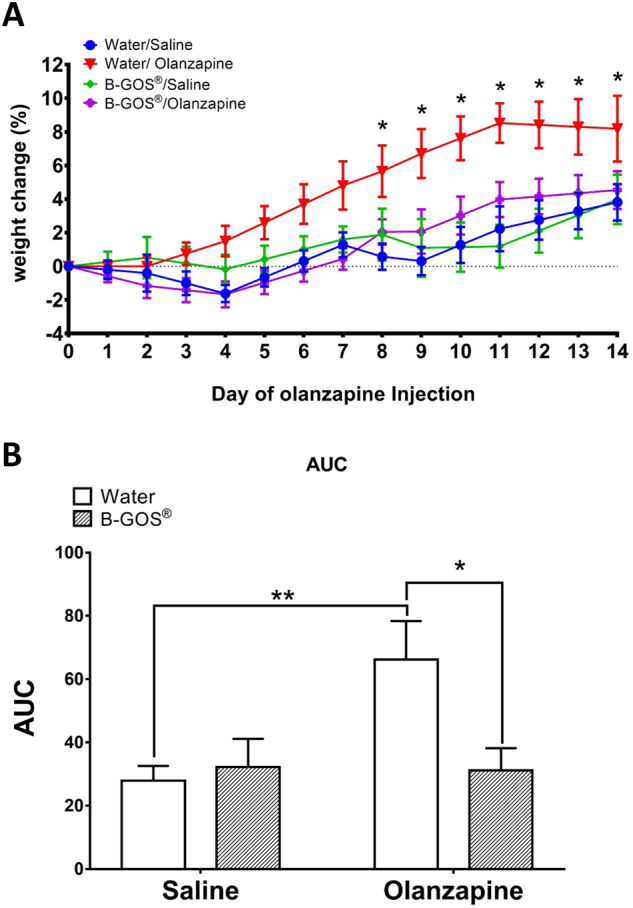
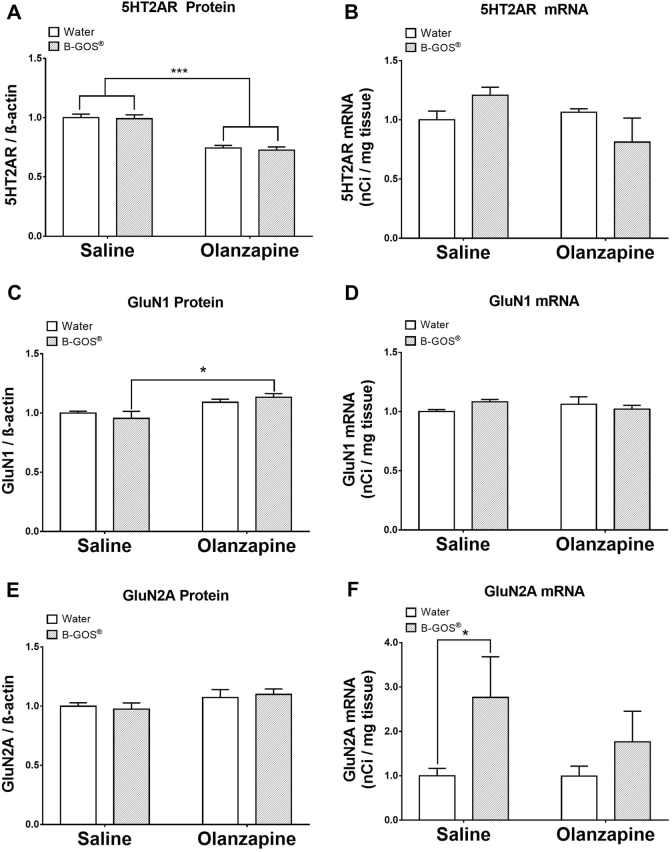
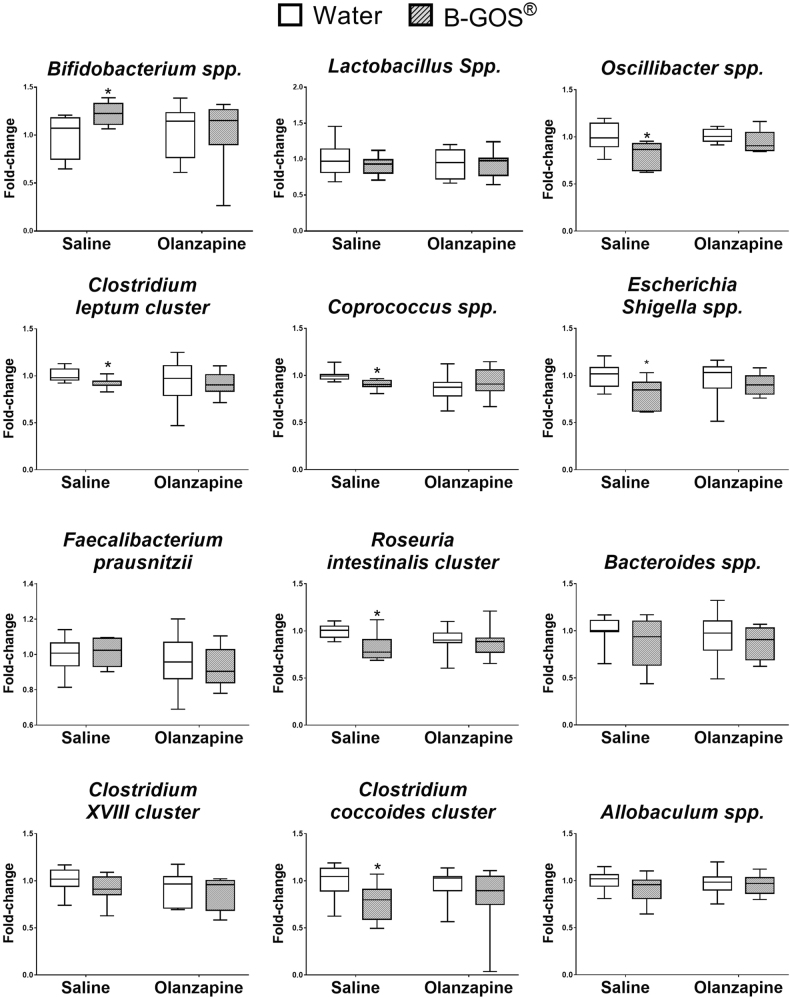
Abstract Olanzapine is an effective antipsychotic drug but since it causes significant weight gain, it is not well tolerated by psychosis patients. The prebiotic, B-GOS®, attenuates metabolic dysfunction in obese subjects, and in rodents, alters central NMDA receptors and may affect serotonin receptors that are relevant in psychosis. We have determined whether B-GOS®influenced olanzapine-associated weight gain and central NMDA and serotonin receptors. Circulating acetate, IL-1β, IL-8 and TNFα, liver acetyl-CoA carboxylase (ACC), white adipose tissue (WAT) acetate receptor GPR43, and specific faecal bacteria genera were also measured to provide mechanistic information. Adult female Sprague-Dawley rats were administered a B-GOS®(0.5 g/kg/day) solution or water for 21 days, and received a single, daily, intraperitoneal injection of olanzapine or saline on days 8–21. The intake of B-GOS®significantly attenuated olanzapine-induced weight gain without altering frontal cortex 5-HT2AR blockade. Cortical GluN1 levels were elevated by olanzapine in the presence of B-GOS®. Plasma acetate concentrations increased following B-GOS®or olanzapine administration alone, but reduced when prebiotic and drug were administered in combination. This pattern was paralleled by hepatic ACC mRNA expression. The abundance of WAT GPR43 mRNA was reduced by olanzapine, only in the absence of B-GOS®. Co-administration of B-GOS®and olanzapine also elevated plasma TNFα, which is reported to influence lipid metabolism. Finally, B-GOS®elevated faecalBifidobacteriumspp. and reduced some bacteria in the Firmicutes phylum, whilst olanzapine treatment either alone or with B-GOS®, was without effect. These data suggest that inclusion of B-GOS®as an adjunct to olanzapine treatment in schizophrenia may prevent weight gain and have benefits on cognitive function in psychosis. The role of acetate in these effects requires further investigation.
Overview
The claims and statistics of this paper haven’t been checked yet.
Free: it reads the open-access text and checks the first 5 claims that cite a source we can check. Create a free account to check every claim.
Integrity signals
Registry
Cites
Statistics
Figures
Verification
Claims the paper makes
The claims and statistics of this paper haven’t been checked yet.
Free: it reads the open-access text and checks the first 5 claims that cite a source we can check. Create a free account to check every claim.
Claims other papers make about this one
Each is checked against this paper’s own text: does it say what the citing paper says it does?
The source backs part of the claim, not all of it — or backs it for a different population, condition or comparison.
In the citing paper
“This is in line with animal studies on antipsychotics whereby chronic administration of olanzapine and risperidone affects the gut microbiota composition (Davey et al., 2013;Davey et al., 2012;Kao et al., 2018;Morgan et al., 2014).”
From The Microbiota-Gut-Brain Axis (2019) · cites this paper as Kao et al., 2018
Experimental — accuracy not yet measuredIn the citing paper
“Kao et al. [189,190] demonstrated no significant effects of olanzapine administration on the gut microbiota in rats.”
From The Role of Microbiota-Gut-Brain Axis in Neuropsychiatric and Neurological Disorders (2021) · cites this paper as [190]
In the citing paper
“In rats, administration of the B-GOS® prebiotic formulation improved cognitive flexibility [201] and attenuated the olanzapine-induced weight gain [190].”
From The Role of Microbiota-Gut-Brain Axis in Neuropsychiatric and Neurological Disorders (2021) · cites this paper as [190]
In the citing paper
“Prebiotic administration concurrently with olanzapine can reduce the antipsychoticinduced weight gain in rodents (Kao et al., 2018).”
From Gut reactions: Breaking down xenobiotic–microbiome interactions (2019) · cites this paper as Kao et al., 2018
Self-check
Percentages, sums and reported differences re-computed from the paper’s own numbers.
The self-check needs the paper’s full text.
Citations
Cites
Analysis of Relative Gene Expression Data Using Real-Time Quantitative PCR and the 2−ΔΔCT Method
Livak, K. J., & Schmittgen, T. D. (2001) · Methods · doi:10.1006/meth.2001.1262 · Cited by 180,860
A core gut microbiome in obese and lean twins
Turnbaugh, P. J., Hamady, M., Yatsunenko, T., Cantarel, B. L., Duncan, A., Ley, R. E., Sogin, M. L., Jones, W. J., Roe, B. A., Affourtit, J. P., et al. (2009) · Nature · doi:10.1038/nature07540 · Cited by 7,823
den Besten, G., van Eunen, K., Groen, A. K., Venema, K., Reijngoud, D.-J., & Bakker, B. M. (2013) · Journal of Lipid Research · doi:10.1194/jlr.r036012 · Cited by 5,048
Mutation of the mouse klotho gene leads to a syndrome resembling ageing
Kuro-o, M., Matsumura, Y., Aizawa, H., Kawaguchi, H., Suga, T., Utsugi, T., Ohyama, Y., Kurabayashi, M., Kaname, T., Kume, E., et al. (1997) · Nature · doi:10.1038/36285 · Cited by 3,837
Morris, R. G. M., Anderson, E., Lynch, G. S., & Baudry, M. (1986) · Nature · doi:10.1038/319774a0 · Cited by 3,640
Recent advances in the phencyclidine model of schizophrenia
(1991) · American Journal of Psychiatry · doi:10.1176/ajp.148.10.1301 · Cited by 2,904
Colonic Health: Fermentation and Short Chain Fatty Acids
Wong, J. M. W., de Souza, R., Kendall, C. W. C., Emam, A., & Jenkins, D. J. A. (2006) · Journal of Clinical Gastroenterology · doi:10.1097/00004836-200603000-00015 · Cited by 2,739
Mechanisms underlying the resistance to diet-induced obesity in germ-free mice
Bäckhed, F., Manchester, J. K., Semenkovich, C. F., & Gordon, J. I. (2007) · Proceedings of the National Academy of Sciences · doi:10.1073/pnas.0605374104 · Cited by 2,615
Antipsychotic-induced weight gain: a comprehensive research synthesis
Allison, D. B., Mentore, J. L., Heo, M., Chandler, L. P., Cappelleri, J. C., Infante, M. C., & Weiden, P. J. (1999) · American Journal of Psychiatry · doi:10.1176/ajp.156.11.1686 · Cited by 2,382
Inflammation: the link between insulin resistance, obesity and diabetes
Dandona, P. (2004) · Trends in Immunology · doi:10.1016/j.it.2003.10.013 · Cited by 2,170
Dietary intervention impact on gut microbial gene richness
Cotillard, A., Kennedy, S. P., Kong, L. C., Prifti, E., Pons, N., Le Chatelier, E., Almeida, M., Quinquis, B., Levenez, F., Galleron, N., et al. (2013) · Nature · doi:10.1038/nature12480 · Cited by 1,832
The short-chain fatty acid acetate reduces appetite via a central homeostatic mechanism
Frost, G., Sleeth, M. L., Sahuri-Arisoylu, M., Lizarbe, B., Cerdan, S., Brody, L., Anastasovska, J., Ghourab, S., Hankir, M., Zhang, S., et al. (2014) · Nature Communications · doi:10.1038/ncomms4611 · Cited by 1,771
Acetate mediates a microbiome–brain–β-cell axis to promote metabolic syndrome
Perry, R. J., Peng, L., Barry, N. A., Cline, G. W., Zhang, D., Cardone, R. L., Petersen, K. F., Kibbey, R. G., Goodman, A. L., & Shulman, G. I. (2016) · Nature · doi:10.1038/nature18309 · Cited by 1,299
Pro-inflammatory cytokines and adipose tissue
Coppack, S. W. (2001) · Proceedings of the Nutrition Society · doi:10.1079/pns2001110 · Cited by 1,006
Burokas, A., Arboleya, S., Moloney, R. D., Peterson, V. L., Murphy, K., Clarke, G., Stanton, C., Dinan, T. G., & Cryan, J. F. (2017) · Biological Psychiatry · doi:10.1016/j.biopsych.2016.12.031 · Cited by 952
Reduced hippocampal LTP and spatial learning in mice lacking NMDA receptor ε1 subunit
Sakimura, K., Kutsuwada, T., Ito, I., Manabe, T., Takayama, C., Kushiya, E., Yagi, T., Aizawa, S., Inoue, Y., Sugiyama, H., et al. (1995) · Nature · doi:10.1038/373151a0 · Cited by 859
Kadooka, Y., Sato, M., Imaizumi, K., Ogawa, A., Ikuyama, K., Akai, Y., Okano, M., Kagoshima, M., & Tsuchida, T. (2010) · European Journal of Clinical Nutrition · doi:10.1038/ejcn.2010.19 · Cited by 700
Lu, Y., Fan, C., Li, P., Lu, Y., Chang, X., & Qi, K. (2016) · Scientific Reports · doi:10.1038/srep37589 · Cited by 638
Davis, S., Butcher, S., & Morris, R. (1992) · The Journal of Neuroscience · doi:10.1523/jneurosci.12-01-00021.1992 · Cited by 539
Almost All Antipsychotics Result in Weight Gain: A Meta-Analysis
Bak, M., Fransen, A., Janssen, J., van Os, J., & Drukker, M. (2014) · PLoS ONE · doi:10.1371/journal.pone.0094112 · Cited by 490
Kapur, S., VanderSpek, S. C., Brownlee, B. A., & Nobrega, J. N. (2003) · The Journal of Pharmacology and Experimental Therapeutics · doi:10.1124/jpet.102.046987 · Cited by 479
Vulevic, J., Drakoularakou, A., Yaqoob, P., Tzortzis, G., & Gibson, G. R. (2008) · The American Journal of Clinical Nutrition · doi:10.3945/ajcn.2008.26242 · Cited by 451
NMDA Receptor and Schizophrenia: A Brief History
Coyle, J. T. (2012) · Schizophrenia Bulletin · doi:10.1093/schbul/sbs076 · Cited by 410
The role of serotonin receptors in the action of atypical antipsychotic drugs
Meltzer, H., & Massey, B. (2011) · Current Opinion in Pharmacology · doi:10.1016/j.coph.2011.02.007 · Cited by 381
Savignac, H. M., Corona, G., Mills, H., Chen, L., Spencer, J. P. E., Tzortzis, G., & Burnet, P. W. J. (2013) · Neurochemistry International · doi:10.1016/j.neuint.2013.10.006 · Cited by 377
Self-citationOlanzapine versus other atypical antipsychotics for schizophrenia
Komossa, K., Rummel-Kluge, C., Hunger, H., Schmid, F., Schwarz, S., Duggan, L., Kissling, W., & Leucht, S. (2010) · Cochrane Database of Systematic Reviews · doi:10.1002/14651858.cd006654.pub2 · Cited by 365
Vulevic, J., Juric, A., Tzortzis, G., & Gibson, G. R. (2013) · The Journal of Nutrition · doi:10.3945/jn.112.166132 · Cited by 349
Davey, K. J., O’Mahony, S. M., Schellekens, H., O’Sullivan, O., Bienenstock, J., Cotter, P. D., Dinan, T. G., & Cryan, J. F. (2012) · Psychopharmacology · doi:10.1007/s00213-011-2555-2 · Cited by 275
Larsen, J. R., Vedtofte, L., Jakobsen, M. S. L., Jespersen, H. R., Jakobsen, M. I., Svensson, C. K., Koyuncu, K., Schjerning, O., Oturai, P. S., Kjaer, A., et al. (2017) · JAMA Psychiatry · doi:10.1001/jamapsychiatry.2017.1220 · Cited by 250
RATZONI, G., GOTHELF, D., BRAND-GOTHELF, A., REIDMAN, J., KIKINZON, L., GAL, G., PHILLIP, M., APTER, A., & WEIZMAN, R. (2002) · Journal of the American Academy of Child & Adolescent Psychiatry · doi:10.1097/00004583-200203000-00014 · Cited by 237
Davey, K. J., Cotter, P. D., O'Sullivan, O., Crispie, F., Dinan, T. G., Cryan, J. F., & O'Mahony, S. M. (2013) · Translational Psychiatry · doi:10.1038/tp.2013.83 · Cited by 236
Altered synaptophysin expression as a marker of synaptic pathology in schizophrenia
Eastwood, S. L., Burnet, P. W. J., & Harrison, P. J. (1995) · Neuroscience · doi:10.1016/0306-4522(94)00586-t · Cited by 223
Self-citationSavignac, H. M., Couch, Y., Stratford, M., Bannerman, D. M., Tzortzis, G., Anthony, D. C., & Burnet, P. W. J. (2016) · Brain, Behavior, and Immunity · doi:10.1016/j.bbi.2015.10.007 · Cited by 223
Self-citationThe antipsychotic olanzapine interacts with the gut microbiome to cause weight gain in mouse
Morgan, A. P., Crowley, J. J., Nonneman, R. J., Quackenbush, C. R., Miller, C. N., Ryan, A. K., Bogue, M. A., Paredes, S. H., Yourstone, S., Carroll, I. M., et al. (2014) · PLoS ONE · doi:10.1371/journal.pone.0115225 · Cited by 197
Bahr, S. M., Tyler, B. C., Wooldridge, N., Butcher, B. D., Burns, T. L., Teesch, L. M., Oltman, C. L., Azcarate-Peril, M. A., Kirby, J. R., & Calarge, C. A. (2015) · Translational Psychiatry · doi:10.1038/tp.2015.135 · Cited by 197
Tumour necrosis factor alpha: a key regulator of adipose tissue mass
Warne, J. (2003) · Journal of Endocrinology · doi:10.1677/joe.0.1770351 · Cited by 176
Kluge, M., Schuld, A., Schacht, A., Himmerich, H., Dalal, M. A., Wehmeier, P. M., Hinze-Selch, D., Kraus, T., Dittmann, R. W., & Pollmächer, T. (2009) · Psychoneuroendocrinology · doi:10.1016/j.psyneuen.2008.08.016 · Cited by 146
Bahr, S. M., Weidemann, B. J., Castro, A. N., Walsh, J. W., deLeon, O., Burnett, C. M. L., Pearson, N. A., Murry, D. J., Grobe, J. L., & Kirby, J. R. (2015) · EBioMedicine · doi:10.1016/j.ebiom.2015.10.018 · Cited by 143
Hsu, T. M., Noble, E. E., Liu, C. M., Cortella, A. M., Konanur, V. R., Suarez, A. N., Reiner, D. J., Hahn, J. D., Hayes, M. R., & Kanoski, S. E. (2018) · Molecular Psychiatry · doi:10.1038/mp.2017.91 · Cited by 122
Interleukins and tumor necrosis factor as inhibitors of food intake
Langhans, W., & Hrupka, B. (1999) · Neuropeptides · doi:10.1054/npep.1999.0048 · Cited by 120
Takeuchi, H., Suzuki, T., Remington, G., Bies, R. R., Abe, T., Graff-Guerrero, A., Watanabe, K., Mimura, M., & Uchida, H. (2013) · Schizophrenia Bulletin · doi:10.1093/schbul/sbt090 · Cited by 114
Grimaldi, R., Cela, D., Swann, J. R., Vulevic, J., Gibson, G. R., Tzortzis, G., & Costabile, A. (2017) · FEMS Microbiology Ecology · doi:10.1093/femsec/fiw233 · Cited by 109
Anderberg, R. H., Richard, J. E., Eerola, K., López-Ferreras, L., Banke, E., Hansson, C., Nissbrandt, H., Berqquist, F., Gribble, F. M., Reimann, F., et al. (2017) · Diabetes · doi:10.2337/db16-0755 · Cited by 99
Gronier, B., Savignac, H. M., Di Miceli, M., Idriss, S. M., Tzortzis, G., Anthony, D., & Burnet, P. W. J. (2018) · European Neuropsychopharmacology · doi:10.1016/j.euroneuro.2017.11.001 · Cited by 91
Self-citationTarazi, F. I., Baldessarini, R. J., Kula, N. S., & Zhang, K. (2003) · Journal of Pharmacology and Experimental Therapeutics · doi:10.1124/jpet.103.052597 · Cited by 82
Lambert, J. E., Parnell, J. A., Eksteen, B., Raman, M., Bomhof, M. R., Rioux, K. P., Madsen, K. L., & Reimer, R. A. (2015) · BMC Gastroenterology · doi:10.1186/s12876-015-0400-5 · Cited by 72
Weight Gain, Obesity, and Psychotropic Prescribing
Nihalani, N. D., Schwartz, T. L., Siddiqui, U. A., & Megna, J. L. (2011) · Journal of Obesity · doi:10.1155/2011/893629 · Cited by 71
Overduin, J., Schoterman, M. H. C., Calame, W., Schonewille, A. J., & Ten Bruggencate, S. J. M. (2013) · British Journal of Nutrition · doi:10.1017/s0007114512003066 · Cited by 70
Fumagalli, F., Frasca, A., Racagni, G., & Riva, M. A. (2008) · Molecular Pharmacology · doi:10.1124/mol.107.043786 · Cited by 69
Lykkegaard, K., Larsen, P. J., Vrang, N., Bock, C., Bock, T. G., & Knudsen, L. B. (2008) · Schizophrenia Research · doi:10.1016/j.schres.2008.05.011 · Cited by 59
Skrede, S., Martins, L., Berge, R. K., Steen, V. M., López, M., & Fernø, J. (2014) · The International Journal of Neuropsychopharmacology · doi:10.1017/s1461145713000862 · Cited by 53
Sarma, S. M., Khare, P., Jagtap, S., Singh, D. P., Baboota, R. K., Podili, K., Boparai, R. K., Kaur, J., Bhutani, K. K., Bishnoi, M., et al. (2017) · Food & Function · doi:10.1039/c6fo01467d · Cited by 51
Morel, F. B., Oozeer, R., Piloquet, H., Moyon, T., Pagniez, A., Knol, J., Darmaun, D., & Michel, C. (2014) · Nutrition · doi:10.1016/j.nut.2014.09.011 · Cited by 49
Modelling olanzapine-induced weight gain in rats
van der Zwaal, E. M., Janhunen, S. K., la Fleur, S. E., & Adan, R. A. H. (2013) · The International Journal of Neuropsychopharmacology · doi:10.1017/s146114571300093x · Cited by 46
Grimaldi, R., Swann, J. R., Vulevic, J., Gibson, G. R., & Costabile, A. (2016) · British Journal of Nutrition · doi:10.1017/s0007114516002269 · Cited by 45
Fernø, J., Ersland, K. M., Duus, I. H., González‐García, I., Fossan, K. O., Berge, R. K., Steen, V. M., & Skrede, S. (2015) · European Neuropsychopharmacology · doi:10.1016/j.euroneuro.2015.03.002 · Cited by 43
Krzystanek, M., Bogus, K., Pałasz, A., Krzystanek, E., Worthington, J. J., & Wiaderkiewicz, R. (2015) · Pharmacological Reports · doi:10.1016/j.pharep.2015.01.017 · Cited by 35
Han, M., Huang, X., du Bois, T. M., & Deng, C. (2009) · Neuroscience · doi:10.1016/j.neuroscience.2009.09.041 · Cited by 35
Fedder-Semmes, K. N., & Sabo, S. L. (2015) · Biomolecules · doi:10.3390/biom5043448 · Cited by 34
Lian, J., Pan, B., & Deng, C. (2016) · Pharmacological Reports · doi:10.1016/j.pharep.2016.06.003 · Cited by 20
Singh, S., Choudhury, A., Gusain, P., Parvez, S., Palit, G., Shukla, S., & Ganguly, S. (2016) · Psychopharmacology · doi:10.1007/s00213-016-4213-1 · Cited by 18
Antipsychotic medications and extreme weight gain in two health systems
Arterburn, D. E., Wood, G. C., Theis, M. K., Westbrook, E. O., Anau, J., Rukstalis, M. R., Boscarino, J. A., Daar, Z. S., & Gerhard, G. S. (2015) · Obesity Research & Clinical Practice · doi:10.1016/j.orcp.2015.08.012 · Cited by 15
Krzystanek, M., Bogus, K., Pałasz, A., Wiaderkiewicz, A., Filipczyk, Ł., Rojczyk, E., Worthington, J. J., & Wiaderkiewicz, R. (2016) · Pharmacological Reports · doi:10.1016/j.pharep.2016.05.009 · Cited by 10
Role of NMDA receptor upon [14C]acetate uptake into intact rat brain
Hirose, S., Momosaki, S., Hosoi, R., Abe, K., Gee, A. D., & Inoue, O. (2009) · Annals of Nuclear Medicine · doi:10.1007/s12149-008-0216-2 · Cited by 7
Cited by
Cryan, J. F., O'Riordan, K. J., Cowan, C. S. M., Sandhu, K. V., Bastiaanssen, T. F. S., Boehme, M., Codagnone, M. G., Cussotto, S., Fulling, C., Golubeva, A. V., et al. (2019) · Physiological Reviews · doi:10.1152/physrev.00018.2018 · Cited by 5,286
The role of short-chain fatty acids in microbiota–gut–brain communication
Dalile, B., Van Oudenhove, L., Vervliet, B., & Verbeke, K. (2019) · Nature Reviews Gastroenterology & Hepatology · doi:10.1038/s41575-019-0157-3 · Cited by 3,357
The Role of Microbiota-Gut-Brain Axis in Neuropsychiatric and Neurological Disorders
Socała, K., Doboszewska, U., Szopa, A., Serefko, A., Włodarczyk, M., Zielińska, A., Poleszak, E., Fichna, J., & Wlaź, P. (2021) · Pharmacological Research · doi:10.1016/j.phrs.2021.105840 · Cited by 857
Gut microbes and metabolites as modulators of blood-brain barrier integrity and brain health
Parker, A., Fonseca, S., & Carding, S. R. (2020) · Gut Microbes · doi:10.1080/19490976.2019.1638722 · Cited by 702
“In healthy mice, supplementation with long-chain FOS or short-chain GOS, which promote the growth of beneficial species such as Bifidobacteria,(172) decreased anxiety-related behaviors and increased social behavior.(179) Few studies investigating the benefit of prebiotics on human brain function have been published to…”
BackgroundMicrobiota-Gut-Brain Axis: New Therapeutic Opportunities
Long-Smith, C., O'Riordan, K. J., Clarke, G., Stanton, C., Dinan, T. G., & Cryan, J. F. (2020) · Annual Review of Pharmacology and Toxicology · doi:10.1146/annurev-pharmtox-010919-023628 · Cited by 419
Metadata
- Authors
- Kao, A. C.-C., Spitzer, S., Anthony, D. C., Lennox, B., & Burnet, P. W. J.
- Affiliations
- University of Oxford (GB)
- Corresponding author
- Burnet, Philip W. J.
- Venue
- Translational Psychiatry
- Published
- 2018-03-15
- Volume
- 8
- Issue
- 1
- Pages
- 66-66
- ISSN
- 2158-3188 (ISSN-L)
- PMC
- PMC5852210
- OpenAlex
- W2792991637
- Cited by
- 128
- References
- 64
- Citations by year
- 2026: 9 · 2025: 10 · 2024: 14 · 2023: 10 · 2022: 14 · 2021: 17 · 2020: 26 · 2019: 18 · 2018: 9
- FWCI
- 14.48
- Type
- journal article
- Language
- en
- Open access
- gold
- doi.org
- Licence
- cc-by
- creativecommons.org/licenses/by/4.0 (tdm)
- creativecommons.org/licenses/by/4.0 (vor)
- Locations
- Translational Psychiatry (publishedVersion, cc-by)
- PubMed Central (publishedVersion, cc-by)
- PubMed (publishedVersion)
- DOAJ (DOAJ: Directory of Open Access Journals) (submittedVersion)
- Funders
- Directorate for Biological Sciences
- Biotechnology and Biological Sciences Research Council (BB/N010035/1)
- Topics
- Health Sciences › Nursing › Nutrition and Dietetics › Microbial Metabolites in Food Biotechnology
- Life Sciences › Biochemistry, Genetics and Molecular Biology › Molecular Biology › Gut microbiota and health
- Health Sciences › Medicine › Psychiatry and Mental health › Schizophrenia research and treatment
- Keywords
- olanzapine, weight gain, prebiotics, gut microbiota, NMDA receptor, serotonin receptors, acetate, acetyl-CoA carboxylase, GPR43, white adipose tissue, TNF-α, Bifidobacterium, schizophrenia, antipsychotic adverse effects, GluN1
- MeSH terms
- Gastrointestinal Microbiome, Olanzapine, Animals, Cerebral Cortex, Feces, Female, Receptors, Serotonin, Antipsychotic Agents, Biomarkers, Weight Gain, Receptors, N-Methyl-D-Aspartate, Rats, Sprague-Dawley, Prebiotics
About these checks
Registry, retraction, Cites and statistics results are computed, not judged, with one exception: a printed reference that no index lists is read once by a model before it counts as a citation error. Claims are extracted by a model and kept only when their quote appears verbatim in the text; each cited source is then checked, with a model’s help, for whether it says what the claim relies on. Those verdicts can be wrong — read the claim’s quote and the cited source before relying on one.
Statistics and arithmetic are recomputed, not judged.
Confidence bands are shown only for fields calibrated on our annotated test set. None is calibrated yet, so no band is shown.
What counts as a claim ›How we measure confidence ›How we check this ›
Are you an author, or do you see a problem with this page? Request a review
Data sources
Bibliographic data: Semantic Scholar, OpenAlex, Crossref.
Contains information from the Semantic Scholar Academic Graph Datasets, made available under the ODC Attribution License (ODC-BY 1.0).
Semantic Scholar’s data is described in: Kinney, R., et al. (2023). The Semantic Scholar Open Data Platform. arXiv:2301.10140.
