

GWAS on family history of Alzheimer’s disease
Open accessPublished version of a preprint
The DOI matches its Crossref record; 58 of the 58 references it cites were found in a registry or an index.
Abstract
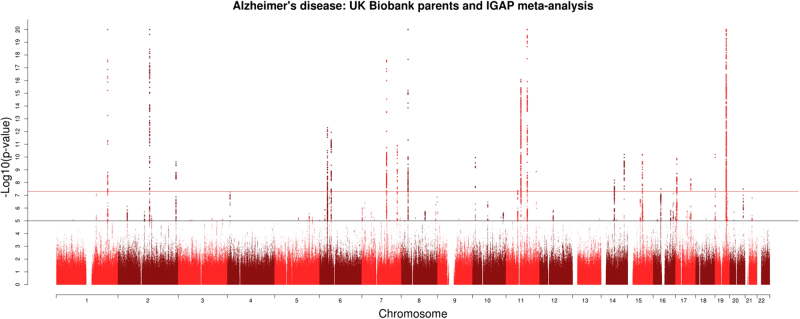
Alzheimer’s disease (AD) is a public health priority for the 21st century. Risk reduction currently revolves around lifestyle changes with much research trying to elucidate the biological underpinnings. We show that self-report of parental history of Alzheimer’s dementia for case ascertainment in a genome-wide association study of 314,278 participants from UK Biobank (27,696 maternal cases, 14,338 paternal cases) is a valid proxy for an AD genetic study. After meta-analysing with published consortium data ( n = 74,046 with 25,580 cases across the discovery and replication analyses), three new AD-associated loci ( P < 5 × 10 −8 ) are identified. These contain genes relevant for AD and neurodegeneration: ADAM10 , BCKDK/KAT8 and ACE . Novel gene-based loci include drug targets such as VKORC1 (warfarin dose). We report evidence that the association of SNPs in the TOMM40 gene with AD is potentially mediated by both gene expression and DNA methylation in the prefrontal cortex. However, it is likely that multiple variants are affecting the trait and gene methylation/expression. Our discovered loci may help to elucidate the biological mechanisms underlying AD and, as they contain genes that are drug targets for other diseases and disorders, warrant further exploration for potential precision medicine applications.
Overview
The claims and statistics of this paper haven’t been checked yet.
Free: it reads the open-access text and checks the first 5 claims that cite a source we can check. Create a free account to check every claim.
Integrity signals
Registry
Cites
Statistics
Figures
Verification
Claims the paper makes
The claims and statistics of this paper haven’t been checked yet.
Free: it reads the open-access text and checks the first 5 claims that cite a source we can check. Create a free account to check every claim.
Claims other papers make about this one
Each is checked against this paper’s own text: does it say what the citing paper says it does?
The source backs part of the claim, not all of it — or backs it for a different population, condition or comparison.
In the citing paper
“the basis of the observed association between age of dementia onset and these variants in TSPAN14 and TSPAN10 (both with a deleterious correlation) may result from disruption of a protective role of ADAM10.”
From Genetic associations with age at dementia onset in the PSEN1 E280A Colombian kindred (2023) · cites this paper as [27]
Experimental — accuracy not yet measuredThe source backs part of the claim, not all of it — or backs it for a different population, condition or comparison.
In the citing paper
“Several genesassoci-ated with AD incidence (APOE, CLU, ABCA7, SORL1, INPP5D, and PLCG2)(Jansen et al., 2019; Kunkle et al., 2019; Marioni et al., 2018) also function in lipid transport or signaling.”
From Alzheimer’s Patient Microglia Exhibit Enhanced Aging and Unique Transcriptional Activation (2020) · cites this paper as Marioni et al., 2018
Experimental — accuracy not yet measuredThe source backs part of the claim, not all of it — or backs it for a different population, condition or comparison.
In the citing paper
“non-coding mutations also modulate AD risk [4–6], likely through modifying gene expression.”
From Association of SPI1 haplotypes with altered SPI1 gene expression and Alzheimer’s disease risk (2022) · cites this paper as [6]
Experimental — accuracy not yet measuredThe source backs part of the claim, not all of it — or backs it for a different population, condition or comparison.
In the citing paper
“PLCG2 polymorphisms are associated with both reduced and increased risk of Alzheimer’s disease (AD) and with longevity.”
From Multi-omics analyses reveal novel effects of PLCγ2 deficiency in the mouse brain (2023) · cites this paper as [6]
Experimental — accuracy not yet measuredThe source backs part of the claim, not all of it — or backs it for a different population, condition or comparison.
In the citing paper
“other rare PLCG2 variants, such as M28L (rs61749044) that confers a modest increased risk of AD (OR ≈ 1.16) [1, 4, 7–13]”
From PLCγ2 deficiency compromises systemic immune tolerance and erodes myelin homeostasis while enhancing oxidative metabolism in the mouse brain (2026) · cites this paper as [10]
Experimental — accuracy not yet measured
20 more claims about this paper
Create a free account to see every claim other papers make about this one.
Self-check
Percentages, sums and reported differences re-computed from the paper’s own numbers.
The self-check needs the paper’s full text.
Citations
Cites
Sudlow, C., Gallacher, J., Allen, N., Beral, V., Burton, P., Danesh, J., Downey, P., Elliott, P., Green, J., Landray, M., et al. (2015) · PLOS Medicine · doi:10.1371/journal.pmed.1001779 · Cited by 12,728 · cited 13×
“There was complete sign-concordance between UK Biobank and IGAP for all 21 SNPs (Supplementary Table 4).”
BackgroundInfluentialA map of human genome variation from population-scale sequencing.
The 1000 Genomes Project Consortium (2010) · Nature · doi:10.1038/nature09534 · Cited by 7,877
Dementia prevention, intervention, and care
Livingston, G., Sommerlad, A., Orgeta, V., Costafreda, S. G., Huntley, J., Ames, D., Ballard, C., Banerjee, S., Burns, A., Cohen-Mansfield, J., et al. (2017) · The Lancet · doi:10.1016/s0140-6736(17)31363-6 · Cited by 6,072
LD Score regression distinguishes confounding from polygenicity in genome-wide association studies
Schizophrenia Working Group of the Psychiatric Genomics Consortium, Bulik-Sullivan, B. K., Loh, P.-R., Finucane, H. K., Ripke, S., Yang, J., Patterson, N., Daly, M. J., Price, A. L., & Neale, B. M. (2015) · Nature Genetics · doi:10.1038/ng.3211 · Cited by 5,559 · cited 2×
“…as 314,278 + 74,046 = 388,324) were included along with expression Quantitative Trait Loci (QTL) summary output from the Common Mind Consortium, which contains data on >600 dorsolateral prefrontal cortex samples, and DNA methylation QTL summary output on 258 prefrontal cortex samples (age >13) 18 .”
MethodSelf-citationMETAL: fast and efficient meta-analysis of genomewide association scans
Willer, C. J., Li, Y., & Abecasis, G. R. (2010) · Bioinformatics · doi:10.1093/bioinformatics/btq340 · Cited by 5,205
Genetic studies of body mass index yield new insights for obesity biology
Study, T. L. C., Locke, A. E., The ADIPOGen Consortium, The AGEN-BMI Working Group, The CARDIOGRAMplusC4D Consortium, The CKDGen Consortium, The, G. L. G. C., The, I. C. B. P., The MAGIC Investigators, The MuTHER Consortium, et al. (2015) · Nature · doi:10.1038/nature14177 · Cited by 4,534
Self-citationCommon SNPs explain a large proportion of the heritability for human height
Yang, J., Benyamin, B., McEvoy, B. P., Gordon, S., Henders, A. K., Nyholt, D. R., Madden, P. A., Heath, A. C., Martin, N. G., Montgomery, G. W., et al. (2010) · Nature Genetics · doi:10.1038/ng.608 · Cited by 4,446
Self-citationMeta-Analysis of 74,046 Individuals Identifies 11 New Susceptibility Loci for Alzheimer’s Disease
(EADI), E. A. D. I., Lambert, J.-C., (GERAD), G. A. E. R. I. A. D., Alzheimer's Disease Genetic Consortium (ADGC), (CHARGE), C. F. H. A. A. R. I. G. E., Ibrahim-Verbaas, C. A., Harold, D., Naj, A. C., Sims, R., Bellenguez, C., et al. (2013) · Nature Genetics · doi:10.1038/ng.2802 · Cited by 4,336 · cited 1×
“Downstream quality control steps conducted for the current analysis included removing (1) those with nonBritish ancestry based on both self-report and a principal components analysis, (2) outliers based on heterozygosity and missingness, (3) individuals with sex chromosome configurations that were neither XX nor XY, (…”
MethodSelf-citationAn atlas of genetic correlations across human diseases and traits
ReproGen Consortium, Bulik-Sullivan, B., Psychiatric Genomics Consortium, Genetic Consortium for Anorexia Nervosa of the Wellcome Trust Case Control Consortium 3, Finucane, H. K., Anttila, V., Gusev, A., Day, F. R., Loh, P.-R., Duncan, L., et al. (2015) · Nature Genetics · doi:10.1038/ng.3406 · Cited by 4,255 · cited 1×
“Linkage disequilibrium score (LDSC) regression was used to estimate the genetic correlation between the maternal and paternal AD GWAS results and to test for residual confounding in the meta-analysis by examining the LDSC intercept 12,13 .”
MethodFunctional mapping and annotation of genetic associations with FUMA
Watanabe, K., Taskesen, E., van Bochoven, A., & Posthuma, D. (2017) · Nature Communications · doi:10.1038/s41467-017-01261-5 · Cited by 4,083 · cited 1×
“The number of independent loci from the meta-analysis was determined by using the default settings in FUMA 14 .”
Method
Cited by
Items 201–300 of 588
Jacobs, T., Jacobson, S. R., Fortea, J., Berger, J. S., Vedvyas, A., Marsh, K., He, T., Gutiérrez‐Jiménez, E., Fillmore, N. R., Gonzalez, M., et al. (2024) · Immunity & Ageing · doi:10.1186/s12979-024-00435-2 · Cited by 31
Tasaki, S., Gaiteri, C., Petyuk, V., Blizinsky, K. D., Jager, P. L. D., Buchman, A. S., & Bennett, D. A. (2019) · Translational Psychiatry · doi:10.1038/s41398-019-0577-4 · Cited by 22
Harrison, J. R., Foley, S. F., Baker, E. A., Bracher‐Smith, M., Holmans, P., Stergiakouli, E., Linden, D. E. J., Caseras, X., Jones, D. K., & Escott‐Price, V. (2023) · Brain Communications · doi:10.1093/braincomms/fcad229 · Cited by 23
Molecular subtyping of Alzheimer’s disease with consensus non-negative matrix factorization
Zheng, C., & Xu, R. (2021) · PLoS ONE · doi:10.1371/journal.pone.0250278 · Cited by 24
Genetic associations with age at dementia onset in the PSEN1 E280A Colombian kindred
Cochran, J. N., Acosta‐Uribe, J., Esposito, B. T., Madrigal, L., Aguillón, D., Giraldo, M. M., Taylor, J. W., Bradley, J., Fulton‐Howard, B., Andrews, S. J., et al. (2023) · Alzheimer's & Dementia · doi:10.1002/alz.13021 · Cited by 21
Self-citationEpigenome‐wide analyses identify DNA methylation signatures of dementia risk
Walker, R. M., Bermingham, M. L., Vaher, K., Morris, S. W., Clarke, T., Bretherick, A. D., Zeng, Y., Amador, C., Rawlik, K., Pandya, K., et al. (2020) · Alzheimer s & Dementia Diagnosis Assessment & Disease Monitoring · doi:10.1002/dad2.12078 · Cited by 23
Self-citationPathways linking Alzheimer’s disease risk genes expressed highly in microglia
Hodges, A. K., Piers, T. M., Collier, D., Cousins, O., & Pocock, J. M. (2021) · Neuroimmunology and Neuroinflammation · doi:10.20517/2347-8659.2020.60 · Cited by 21
“Where associations are SNP-based, SNP-to-gene mapping was performed using the L2G (Locus-to-Gene) score in Open Targets Genetics (OTG) from an index GWAS study if the locus was included([195]) or from other papers where the same locus was identified([190,192,194,196]).”
Beebe-Wang, N., Çelik, S., Weinberger, E., Sturmfels, P., Jager, P. L. D., Mostafavi, S., & Lee, S. (2021) · Nature Communications · doi:10.1038/s41467-021-25680-7 · Cited by 22
Huang, J., Tao, Q., Ang, T. F. A., Farrell, J. J., Zhu, C., Wang, Y., Stein, T. D., Lunetta, K. L., Massaro, J. M., Mez, J., et al. (2022) · Translational Psychiatry · doi:10.1038/s41398-022-02281-6 · Cited by 21
“In addition, we excluded those controls who had a family history of AD or dementia because most UKBB participants did not undergo a formal neuropsychological examination and consensus diagnosis evaluation; thus, dementia in this group of subjects, who are considered in some studies as “proxy” AD cases [10, 19], is lik…”
BackgroundAlzheimer’s disease is an inherent, natural part of human brain aging: an integrated perspective
Ferrer, I. (2022) · Free Neuropathology · doi:10.17879/freeneuropathology-2022-3806 · Cited by 30
Genetic Complexities of Cerebral Small Vessel Disease, Blood Pressure, and Dementia
Sargurupremraj, M., Soumaré, A., Bis, J. C., Surakka, I. L., Jürgenson, T., Joly, P., Knol, M. J., Wang, R., Yang, Q., Satizábal, C. L., et al. (2024) · JAMA Network Open · doi:10.1001/jamanetworkopen.2024.12824 · Cited by 27
Hatcher, C., Relton, C. L., Gaunt, T. R., & Richardson, T. G. (2019) · Translational Psychiatry · doi:10.1038/s41398-019-0437-2 · Cited by 21
DNA Methylation Signatures of Breastfeeding in Buccal Cells Collected in Mid-Childhood
Odintsova, V. V., Hagenbeek, F. A., Suderman, M. J., Caramaschi, D., van Beijsterveldt, C. E. M., Kallsen, N. A., Ehli, E. A., Davies, Sukhikh, G. T., Fanos, V., et al. (2019) · Nutrients · doi:10.3390/nu11112804 · Cited by 19
“In GWASs, SNPs on chromosome 14: 103823243–104186876 have been linked to amino acids levels as biomarkers of metabolic disorders [104] and other blood metabolites [105], and some disease and addictions including multisite chronic pain [106], metabolite changes in chronic kidney disease [107], bipolar disorder [108], a…”
BackgroundEnhancing α-secretase Processing for Alzheimer’s Disease—A View on SFRP1
Tang, B. L. (2020) · Brain Sciences · doi:10.3390/brainsci10020122 · Cited by 23
Soheili‐Nezhad, S., Jahanshad, N., Guelfi, S., Khosrowabadi, R., Saykin, A. J., Thompson, P. M., Beckmann, C. F., Sprooten, E., Zarei, M., & Neuroimaging, T. A. D. (2020) · Human Brain Mapping · doi:10.1002/hbm.25083 · Cited by 23
“We performed a fixed-effect meta-analysis on the maternal and paternal SNP effect sizes and obtained genome-wide variants associated with history of AD in parents, similar to the recent AD-by-proxy approach (Jansen et al., 2019; Marioni et al., 2018).”
MethodSocial Isolation, Social Interaction, and Alzheimer’s Disease: A Mendelian Randomization Study
Shen, L.-X., Yang, Y.-X., Kuo, K., Li, H.-Q., Chen, S.-D., Chen, K.-L., Dong, Q., Tan, L., & Yu, J.-T. (2021) · Journal of Alzheimer's Disease · doi:10.3233/jad-201442 · Cited by 21
“We also drew on another large famous GWAS sum-mary statistics datasets conducted by Marioni et al. from U.K. Biobank and International Genomics of Alzheimer’s project (IGAP) [15].”
Liu, D., Wang, Y., Jing, H., Meng, Q., & Yang, J. (2021) · Epigenetics · doi:10.1080/15592294.2021.1959735 · Cited by 23
“In our study, some of the causal genes identified in our network SMR, including KAT8, BCKDK, FCER1G, and PILRA, were reported to be associated with Alzheimer’s dementia [6,7,38,39].”
BackgroundSelf-citationA missense variant in SHARPIN mediates Alzheimer’s disease-specific brain damages
Park, J. Y., Lee, D., Lee, J. J., Gim, J., Gunasekaran, T. I., Choi, K. Y., Kang, S., Do, A. R., Jo, J., Park, J., et al. (2021) · Translational Psychiatry · doi:10.1038/s41398-021-01680-5 · Cited by 21
“DISCUSSION Previous GWAS have identified many GWS loci for AD risk with GWS, but they have not been consistently replicated [7, 8, 15, 18, 41, 42].”
BackgroundHuang, S.-Y., Yang, Y.-X., Zhang, Y.-R., Kuo, K., Li, H.-Q., Shen, X.-N., Chen, S.-D., Chen, K.-L., Dong, Q., Tan, L., et al. (2022) · Journal of Alzheimer s Disease · doi:10.3233/jad-220050 · Cited by 23
“An array of 314,278 participants with available AD information on at least one parent were meta-analyzed in this analysis, including 27,696 cases of maternal AD, 14,338 cases of paternal AD, and 272,244 controls [19].”
Mole, J. P., Fasano, F., Evans, J., Sims, R., Hamilton, D. A., Kidd, E., & Metzler-Baddeley, C. (2020) · Neurobiology of Aging · doi:10.1016/j.neurobiolaging.2020.06.014 · Cited by 20
Couvy‐Duchesne, B., Frouin, V., Bouteloup, V., Koussis, N. C., Sidorenko, J., Jiang, J., Wink, A. M., Lorenzini, L., Barkhof, F., Trollor, J. N., et al. (2025) · Human Brain Mapping · doi:10.1002/hbm.70089 · Cited by 26
Self-citationAlzheimer’s disease and age-related macular degeneration: Shared and distinct immune mechanisms
Butovsky, O., & Rosenzweig, N. (2025) · Immunity · doi:10.1016/j.immuni.2025.04.013 · Cited by 22
Genetic profiles of familial late-onset Alzheimer's disease in China: The Shanghai FLOAD study
Xie, X., Zhao, Q., Huang, Q., Dammer, E. B., Chen, S., Ren, R., & Wang, G. (2021) · Genes & Diseases · doi:10.1016/j.gendis.2021.05.001 · Cited by 21
Muto, V., Koshmanova, E., Ghaemmaghami, P., Jaspar, M., Meyer, C., Elansary, M., Egroo, M. V., Chylinski, D., Berthomier, C., Brandewinder, M., et al. (2020) · SLEEP · doi:10.1093/sleep/zsaa137 · Cited by 32
Self-citationCrawford, K., Leonenko, G., Baker, E. A., Grozeva, D., Lan-Leung, B., Holmans, P., Williams, J. H., O’Donovan, M. C., Escott‐Price, V., & Ivanov, D. K. (2022) · Molecular Psychiatry · doi:10.1038/s41380-022-01926-8 · Cited by 24
“Furthermore, in temporal cortex, higher AD PRS was associated with increased gene-expression of 52 out of 75 AD GWAS associated genes [14,28,29,30,31,32] (Fisher's exact test p=2.79 ´ 10 -04 ; 10319 up and 11071 down-regulated among all genes).”
BackgroundInfluentialGamache, J., Gingerich, D., Shwab, E. K., Barrera, J., Garrett, M. E., Hume, C., Crawford, G. E., Ashley-Koch, A. E., & Chiba-Falek, O. (2023) · Cell & Bioscience · doi:10.1186/s13578-023-01120-5 · Cited by 20
Alzheimer’s Disease Genetics: A Dampened Microglial Response?
Chatila, Z. K., & Bradshaw, E. M. (2021) · The Neuroscientist · doi:10.1177/10738584211024531 · Cited by 25
D’Oliveira Albanus, R., Finan, G. M., Brase, L., Sweeney, N., Kim, T. Y., Chen, S., Ryoo, Y., Park, J., Guo, Q., Iyer, A. K., et al. (2025) · Science Translational Medicine · doi:10.1126/scitranslmed.adx0027 · Cited by 19
Papadakis, K. A., Doufexi, A., Kalamaki, M. S., Bourazanas, E., & Lymperaki, E. (2025) · Journal of Personalized Medicine · doi:10.3390/jpm15080384 · Cited by 23
“The significance of these immune cells is emphasized by alterations or polymorphisms in numerous genes expressed by microglia and other myeloid cells [12–14].”
DNA methylation QTL analysis identifies new regulators of human longevity
Szymczak, S., Dose, J., Torres, G. G., Heinsen, F., Venkatesh, G., Datlinger, P., Nygaard, M., Mengel‐From, J., Flachsbart, F., Klapper, W., et al. (2020) · Human Molecular Genetics · doi:10.1093/hmg/ddaa033 · Cited by 20
“SNP alleles in PVRL2 have also been previously reported in the context of longevity (47) and AD (59, 60); however, both the results from our Immunochip and from the Danish longevity sample (Table 2) indicate that the reported associations may mainly be driven by APOE and TOMM40, respectively.”
BackgroundResultSun, Y., Zhou, D., Rahman, M. R., Zhu, J., Ghoneim, D. H., Cox, N. J., Beach, T. G., Wu, C., Gamazon, E. R., & Wu, L. (2021) · Human Molecular Genetics · doi:10.1093/hmg/ddab229 · Cited by 20
Genetic Insights into Alzheimer's Disease
Latimer, C. S., Lucot, K. L., Keene, C. D., Cholerton, B., & Montine, T. J. (2021) · Annual Review of Pathology Mechanisms of Disease · doi:10.1146/annurev-pathmechdis-012419-032551 · Cited by 21
“’s (38) findings that the genetic architecture of LOAD is more highly positively correlated with a maternal family history of AD than for paternal AD (genetic correlation = 0.”
BackgroundPowerful gene-based testing by integrating long-range chromatin interactions and knockoff genotypes
Ma, S., Dalgleish, J. L. T., Lee, J., Wang, C., Liu, L., Gill, R., Buxbaum, J. D., Chung, W. K., Aschard, H., Silverman, E. K., et al. (2021) · Proceedings of the National Academy of Sciences · doi:10.1073/pnas.2105191118 · Cited by 19
Survey of deep learning techniques for disease prediction based on omics data
Yu, X., Zhou, S., Zou, H., Wang, Q., Liu, C., Zang, M., & Liu, T. (2022) · Human Gene · doi:10.1016/j.humgen.2022.201140 · Cited by 19
Blood‐based multivariate methylation risk score for cognitive impairment and dementia
Koetsier, J., Cavill, R., Reijnders, R. A., Harvey, J., Homann, J., Kouhsar, M. P., Deckers, K., Köhler, S., Eijssen, L., van den Hove, D., et al. (2024) · Alzheimer s & Dementia · doi:10.1002/alz.14061 · Cited by 18
“51 Non-clumped cis-mQTLs with P 1e-5 associated with the contributing MPSs to the best-performing MMRS model, were extracted from the GoDMC database.”
Kulminski, A. M., Initiative, A. D. N., Jain‐Washburn, E., Loiko, E., Loika, Y., Feng, F., & Culminskaya, I. V. (2022) · Aging · doi:10.18632/aging.204384 · Cited by 19
Association of DNMT3b gene variants with sporadic Parkinson's disease in a Chinese Han population
Chen, X. '., Xiao, Y., Wei, L., Wu, Y., Lu, J., Guo, W., Huang, S., Zhou, M., Mo, M., Li, Z., et al. (2017) · The Journal of Gene Medicine · doi:10.1002/jgm.2991 · Cited by 21
Coleman, J. R. I., Purves, K. L., Davis, K. A. S., Rayner, C., Choi, S. W., Hübel, C., Gaspar, H. A., Kan, C., der Auwera, S. V., Adams, M. J., et al. (2018) · bioRxiv (Cold Spring Harbor Laboratory) · doi:10.1101/247353 · Cited by 20
Self-citationSomatic Mutations and Alzheimer’s Disease
Downey, J. S., Lam, J. C. K., Li, V. O. K., & Gozes, I. (2022) · Journal of Alzheimer s Disease · doi:10.3233/jad-220643 · Cited by 20
“This 4-exon gene maps to chromosome 19 and has been strongly linked to AD in genome wide association studies (GWAS) [44, 110, 111], with the APOE isoforms reported to be an additive risk factor for AD among women,inthepresenceofPM 2 .”
Nazarian, A., Yashin, A. I., & Kulminski, A. M. (2020) · Journal of Clinical Medicine · doi:10.3390/jcm9051489 · Cited by 18
“Comparing our findings with those detected in other SMR-based analyses of AD [24,25] revealed that TOMM40, which had significant probes in brain-specific analyses under all five plans of our study, was epigenetically associated with AD in a previous study [24].”
BackgroundResultProbability of Alzheimer’s disease based on common and rare genetic variants
Escott‐Price, V., & Schmidt, K. M. (2021) · Alzheimer s Research & Therapy · doi:10.1186/s13195-021-00884-7 · Cited by 19
Pan, G., King, A. E., Wu, F., Simpson, S., Woodhouse, A., Phipps, A., & Vickers, J. C. (2021) · Ageing Research Reviews · doi:10.1016/j.arr.2021.101402 · Cited by 20
Rosenthal, S. B., Wang, H., Shi, D., Liu, C., Abagyan, R. A., McEvoy, L. K., & Chen, C. (2022) · PLoS Computational Biology · doi:10.1371/journal.pcbi.1009903 · Cited by 20
ADAMTS4 is involved in the production of the Alzheimer disease amyloid biomarker APP669-711
Matsuzaki, M., Yokoyama, M., Yoshizawa, Y., Kaneko, N., Naito, H., Kobayashi, H., Korenaga, A., Sekiya, S., Ikemura, K., Opoku, G., et al. (2023) · Molecular Psychiatry · doi:10.1038/s41380-023-01946-y · Cited by 17
“Recent genomewide association studies demonstrated that the intergenic variant rs4575098 located near the ADAMTS4 gene is associated with AD [33, 40].”
Xicota, L., Cosentino, S., Vardarajan, B. N., Mayeux, R. P., Perls, T. T., Andersen, S. L., Zmuda, J. M., Thyagarajan, B., Yashin, A. I., Wojczynski, M. K., et al. (2024) · Alzheimer s & Dementia · doi:10.1002/alz.13718 · Cited by 14
A unified model of dementias and age‐related neurodegeneration
Fossel, M. (2020) · Alzheimer s & Dementia · doi:10.1002/alz.12012 · Cited by 17
Murcia, J. D. G., Weinert, A., Freitas, C. M. T., Arens, D. K., Ferrel, M., Grose, J. H., Ridge, P. G., Wilson, E., Kauwe, J. S. K., & Weber, K. S. (2020) · Scientific Reports · doi:10.1038/s41598-020-64755-1 · Cited by 17
Han, S., Shin, J., Jung, H., Ryu, J., Minassie, H., Nho, K., Koh, I., & Lee, Y. (2021) · npj Systems Biology and Applications · doi:10.1038/s41540-021-00177-7 · Cited by 16
Liu, H., Initiative, A. D. N., Lutz, M. W., & Luo, S. (2021) · Journal of Alzheimer s Disease · doi:10.3233/jad-210700 · Cited by 19
“32) [5, 6, 9, 21, 22].”
Lutz, M. W., & Chiba‐Falek, O. (2022) · Alzheimer s & Dementia Translational Research & Clinical Interventions · doi:10.1002/trc2.12244 · Cited by 15
Boosting of tau protein aggregation by CD40 and CD48 gene expression in Alzheimer's disease
Kim, S., Lim, K., Yang, S., & Joo, J. (2022) · The FASEB Journal · doi:10.1096/fj.202201197r · Cited by 19
Pervasive biases in proxy GWAS based on parental history of Alzheimer’s diseasePreprint
Wu, Y., Sun, Z., Zheng, Q., Miao, J., Dorn, S., Mukherjee, S., Fletcher, J. M., & Lu, Q. (2023) · bioRxiv (Cold Spring Harbor Laboratory) · doi:10.1101/2023.10.13.562272 · Cited by 16
“Following Marioni et al. 2018, we excluded parents younger than 65 and added parental age as a covariate in GWAX( 5 ); following Jansen et al. 2019, we constructed a continuous GWAX phenotype using parental AD status, their age, and AD prevalence( 6 ) ( Methods ).”
InfluentialAPOE-ε4-related differences in left thalamic microstructure in cognitively healthy adults
Mole, J. P., Fasano, F., Evans, J., Sims, R., Kidd, E., Aggleton, J. P., & Metzler-Baddeley, C. (2020) · Scientific Reports · doi:10.1038/s41598-020-75992-9 · Cited by 15
Bao, J., Wen, J., Wen, Z., Yang, S., Cui, Y., Yang, Z., Erus, G., Saykin, A. J., Long, Q., Davatzikos, C. A., et al. (2023) · NeuroImage · doi:10.1016/j.neuroimage.2023.120346 · Cited by 17
“This suggests that the self-reported measure of parental AD is an accurate proxy for clinical diagnosis, validating the use of AD-by-proxy (Marioni et al., 2018).”
MethodInfluentialPramanik, S., Harini Devi, M., Chakrabarty, S., Paylar, B., Pradhan, A., Thaker, M., Ayyadhury, S., Manavalan, A., Olsson, P., Pramanik, G., et al. (2024) · Neuroscience & Biobehavioral Reviews · doi:10.1016/j.neubiorev.2024.105834 · Cited by 20
Soyal, S. M., Kwik, M., Kalev, O., Lenz, S., Zara, G., Strasser, P., Patsch, W., & Weis, S. (2020) · Molecular Genetics & Genomic Medicine · doi:10.1002/mgg3.1317 · Cited by 17
“Interestingly, an integrated analysis of GWAS data along with expression and methylation quantitative trait loci (QTL) data revealed associations of AD with TOMM40 that likely was mediated by effects on its expression and methylation (Marioni et al., 2018).”
BackgroundMa, C., Hunt, J. B., Kovalenko, A., Liang, H., Selenica, M. B., Orr, M. B., Zhang, B., Gensel, J. C., Feola, D. J., Gordon, M. N., et al. (2021) · Frontiers in Immunology · doi:10.3389/fimmu.2021.628156 · Cited by 23
Molecular Biological Aspects of Depressive Disorders: A Modern View
Ushakova, V. M., Morozova, A. Y., Reznik, A. M., Kostyuk, G. P., & Chekhonin, V. P. (2020) · Molecular Biology · doi:10.1134/s0026893320050118 · Cited by 17
Wishart, C. L., Spiteri, A. G., Locatelli, G., & King, N. J. C. (2022) · Glia · doi:10.1002/glia.24314 · Cited by 16
Missing lnc(RNAs) in Alzheimer’s Disease?
Policarpo, R., & d’Ydewalle, C. V. O. (2021) · Genes · doi:10.3390/genes13010039 · Cited by 15
Ruffini, N., Klingenberg, S., Heese, R., Schweiger, S., & Gerber, S. (2022) · Frontiers in Aging Neuroscience · doi:10.3389/fnagi.2022.866886 · Cited by 17
Ling, Y., Yuan, S., Huang, X., Tan, S., Cheng, H., Xu, A., & Lyu, J. (2023) · The Journals of Gerontology Series A · doi:10.1093/gerona/glad266 · Cited by 17
“Researchers selected 29 specific single nucleotide polymorphisms (SNPs) associated with AD from previous genome-wide association studies (GWAS) (19,30,31).”
BackgroundThe circulating proteome and brain health: Mendelian randomisation and cross-sectional analyses
Walker, R. M., Chong, M., Perrot, N., Pigeyre, M., Gadd, D. A., Stolicyn, A., Shi, L., Campbell, A., Shen, X., Whalley, H. C., et al. (2024) · Translational Psychiatry · doi:10.1038/s41398-024-02915-x · Cited by 15
“The availability of approved drugs targeting our identi fi ed proteins raises the possibility of drug repurposing for novel therapeutic interventions to prevent cognitive decline, stroke, and intracranial aneurysm.”
BackgroundGhose, U., Sproviero, W., Winchester, L. M., Amin, N., Zhu, T., Newby, D., Ulm, B. S., Papathanasiou, A., Shi, L., Liu, Q., et al. (2024) · Briefings in Bioinformatics · doi:10.1093/bib/bbae704 · Cited by 16
“The parental histories of dementia were defined according to a previous study on family history of AD [20].”
McGuirl, M. R., Smith, S. P., Sandstede, B., & Ramachandran, S. (2020) · Genetics · doi:10.1534/genetics.120.303096 · Cited by 17
Lopes, K. P., Snijders, G. J. L., Humphrey, J., de Witte, L. D., & Raj, T. (2021) · Alzheimer s & Dementia · doi:10.1002/alz.050942 · Cited by 18
Moreno, J., Lanau, A. V., Madrigal, L., Pineda, A. Y. B., Hernandez, J. V., Campo, O., Soto-Ospina, A., Marín, P. A., Rishishwar, L., Norris, E. T., et al. (2022) · PLoS ONE · doi:10.1371/journal.pone.0269955 · Cited by 15
“, reported seven additional genome-wide significant loci (ADAM10, BCKDK/KAT8, ACE, TREML2, SPPL2A, IL-34, PLCG2) on over 500,000 individuals from Great Britain [26].”
BackgroundSingh, S. K., Kumar, A., Singh, R. B., Ghosh, P., & Bajad, N. G. (2022) · Current Topics in Medicinal Chemistry · doi:10.2174/1568026623666221026091010 · Cited by 20
Li, J., Li, J., Shen, L. H., Tang, B., & Guo, J. (2022) · Gut · doi:10.1136/gutjnl-2022-327860 · Cited by 16
Alzheimer’s disease cortical morphological phenotypes are associated with TOMM40′523-APOE haplotypes
Honea, R. A., Hunt, S. L., Lepping, R. J., Vidoni, E. D., Morris, J. K., Watts, A. S., Michaelis, E. K., Burns, J. M., & Swerdlow, R. H. (2023) · Neurobiology of Aging · doi:10.1016/j.neurobiolaging.2023.09.001 · Cited by 12
The broken Alzheimer’s disease genome
Roque, C. G., Phatnani, H. P., & Hengst, U. (2024) · Cell Genomics · doi:10.1016/j.xgen.2024.100555 · Cited by 15
Omnibus proteome-wide association study identifies 43 risk genes for Alzheimer disease dementia
Hu, T., Parrish, R. L., Dai, Q., Buchman, A. S., Tasaki, S., Bennett, D. A. A., Seyfried, N. T., Epstein, M. P., & Yang, J. (2024) · The American Journal of Human Genetics · doi:10.1016/j.ajhg.2024.07.001 · Cited by 16
Self-citationİş, Ö., Min, Y., Wang, X., Oatman, S. R., Daniel, A. A., & Ertekin‐Taner, N. (2024) · Glia · doi:10.1002/glia.24652 · Cited by 16
Timofeeva, A. M., Aulova, K. S., & Nevinsky, G. A. (2025) · Brain Sciences · doi:10.3390/brainsci15050486 · Cited by 17
Dynamic neuro-immune regulation of psychiatric risk loci in human neurons
Townsley, K. G., Lee, S. H., Williams, S., Cartwright, S., Cohen, S., Sen, A., Jia, M., Young, H. E., Dobbyn, L., Deans, M., et al. (2026) · Nature Communications · doi:10.1038/s41467-026-77114-x · Cited by 18
“A Lenti-MPRA 129 library was designed by statistical fi ne-mapping of ten GWAS: (Alzheimer ’ s disease (AD) 67 , attention de fi cit hyper-activity disorder (ADHD) 68 , anorexia nervosa(AN) 69 , autism spectrum disorder (ASD) 3 , bipolar disorder (BIP) 70 , major depressive disorder (MDD) 71 ,…”
Genetic risk for Alzheimer’s disease influences neuropathology via multiple biological pathways
Hannon, E. J., Shireby, G. L., Brookes, K. J., Attems, J., Sims, R., Cairns, N. J., Love, S., Thomas, A. J., Morgan, K., Francis, P. T., et al. (2020) · Brain Communications · doi:10.1093/braincomms/fcaa167 · Cited by 17
“Genome-wide association studies (GWAS) in large sample cohorts (Lambert et al., 2013; Marioni et al., 2018; Jansen et al., 2019; Kunkle et al., 2019) have identified additional variants in more than 40 regions of the genome which individually confer subtler effects on risk, but cumulatively account for a large proport…”
Barrera, J., Song, L., Safi, A., Yun, Y., Garrett, M. E., Gamache, J., Premasinghe, I., Sprague, D., Chipman, D., Li, J., et al. (2021) · Molecular Neurodegeneration · doi:10.1186/s13024-021-00481-0 · Cited by 15
“Data quality control We characterized the quality of all ATAC-seq datasets by the following metrics, based on ENCODE suggestions78 https://genome.ucsc.edu/ENCODE/analysis.html (Table S1): (1) total numbers of reads, (2) numbers of reads trimmed by cutadapt, (3) total bases entering cutadapt, (4) quality-trimmed bases…”
BackgroundInfluentialLiu, H., Zhang, Y., Hu, Y., Zhang, H., Wang, T., Han, Z., Gao, S., Wang, L., & Liu, G. (2021) · Genes & Nutrition · doi:10.1186/s12263-021-00700-9 · Cited by 17
“However, not all UK Biobank participants could exactly discriminate AD from other dementia sub-types, because of different presentations and genetic architectures [19, 41].”
BackgroundMethodInfluentialRenal function and neurodegenerative diseases : a two-sample Mendelian randomization study
Liu, X., Ou, Y., Ma, Y., Huang, L., Zhang, W., & Tan, L. (2023) · Neurological Research · doi:10.1080/01616412.2022.2158640 · Cited by 14
“Summary data of those with a family history of AD were extracted from the UKB GWAS, including a paternal family history of AD (14,338 cases with diagnosed AD and 245,941 controls) and a maternal family history of AD (27,696 cases with diagnosed AD and 260,980 controls) [18].”
MethodAckley, S. F., Zimmerman, S. C., Flatt, J. D., Riley, A. R., Sevelius, J. M., & Duchowny, K. A. (2023) · Proceedings of the National Academy of Sciences · doi:10.1073/pnas.2218700120 · Cited by 17
An Integrated Molecular Atlas of Alzheimer’s Disease
Wörheide, M. A., Krumsiek, J., Nataf, S., Nho, K., Greenwood, A. K., Wu, T., Huynh, K., Weinisch, P., Römisch-Margl, W., Lehner, N., et al. (2021) · medRxiv · doi:10.1101/2021.09.14.21263565 · Cited by 13
“CLU is strongly associated with disease status, AD-by-proxy [24] and age of disease onset.”
BackgroundGomez, A. R., Byun, H. R., Wu, S., Muhammad, A. K. M. G., Ikbariyeh, J., Chen, J., Muro, A., Li, L., Bernstein, K. E., Ainsworth, R., et al. (2025) · Nature Aging · doi:10.1038/s43587-025-00879-1 · Cited by 13
APOE and Alzheimer's disease and related dementias risk among 12,221 Hispanics/Latinos
Barral, S., Yang, Z., Phillips, N., Barber, R. C., Brickman, A. M., Honig, L. S., Cieza, B., Reyes‐Dumeyer, D., Mayeux, R. P., Rajabli, F., et al. (2025) · Alzheimer s & Dementia · doi:10.1002/alz.70138 · Cited by 17
Jang, B., Kailash, B. P., Tokolyi, A., Dredge, W. H., Ravi, A., Jung, S., Naito, T., Kim, B., Kim, M. S., Cho, M., et al. (2026) · Nature Genetics · doi:10.1038/s41588-026-02541-x · Cited by 40
Borbye‐Lorenzen, N., Zhu, Z., Agerbo, E., Albiñana, C., Benros, M. E., Bian, B., Børglum, A. D., Bulik, C. M., Debost, J.-C., Grove, J., et al. (2023) · Cell Genomics · doi:10.1016/j.xgen.2023.100457 · Cited by 15
Self-citationWirths, O., Lehnen, C., Fricke, M., Talucci, I., Klafki, H., Morgado, B., Lehmann, S., Münch, C., Liepold, T., Wiltfang, J., et al. (2024) · Neuropathology and Applied Neurobiology · doi:10.1111/nan.12991 · Cited by 15
“Of note, large-scale genome-wide association studies identified ADAMTS4 as a potential novel AD risk locus [16, 17].”
BackgroundParrish, R. L., Buchman, A. S., Tasaki, S., Wang, Y., Avey, D. R., Xu, J., Jager, P. L. D., Bennett, D. A. A., Epstein, M. P., & Yang, J. (2024) · Nature Communications · doi:10.1038/s41467-024-50983-w · Cited by 15
“We found that one of these independent risk genes, HLA-DRA , was a known GWAS 22,26 risk gene and was also previously observed as a TWAS risk gene 21 .”
BackgroundInfluentialSelf-citationGilchrist, L., Spargo, T. P., Green, R., Coleman, J. R. I., Howard, D. M., Thorp, J. G., Adey, B. N., Lord, J., Davies, H. L., Mundy, J., et al. (2025) · Nature Mental Health · doi:10.1038/s44220-024-00369-0 · Cited by 15
“We obtained summary statistics from previous large-scale GWAS for clinical 9 and broad 10 depression, and six AD GWASs (three with clinical + proxy case/control ascertainment 13–15 , one with proxy-only 31 and two with clinical-only 12,37 ).”
InfluentialKulminski, A. M., Philipp, I., Loika, Y., He, L., & Culminskaya, I. V. (2021) · Alzheimer s & Dementia · doi:10.1002/alz.12413 · Cited by 12
Rare variant aggregation in 148,508 exomes identifies genes associated with proxy dementia
Wightman, D. P., Savage, J. E., de Leeuw, C., Jansen, I. E., & Posthuma, D. (2023) · Scientific Reports · doi:10.1038/s41598-023-29108-8 · Cited by 12
Time to really share real-world data?
Graham, S., McDonald, L., Wasiak, R., Lees, M., & Ramagopalan, S. V. (2018) · F1000Research · doi:10.12688/f1000research.15517.1 · Cited by 14
Andrews, S. J., McFall, G. P., Booth, A., Dixon, R. A., & Anstey, K. J. (2019) · Journal of Alzheimer s Disease · doi:10.3233/jad-190342 · Cited by 15
“The initial screen did not include the 16 novel loci identified by Marioni et al. [28], Janssen et al. [29], and Kunkle et al. [30] ( ADAM10, KAT8, ACE, ADAMTS4, HESX1, CLNK, CNTAP2, APH1B, ABI3, ALPK2 , ACO74212.”
Li, Q. S., Tian, C., Hinds, D. A., & Seabrook, G. R. (2020) · PLoS ONE · doi:10.1371/journal.pone.0241552 · Cited by 13
Wang, H., Devadoss, D., Nair, M., Chand, H. S., & Lakshmana, M. K. (2022) · Frontiers in Cellular Neuroscience · doi:10.3389/fncel.2022.954071 · Cited by 14
“With three new GWAS studies published in 2018 and 2019, the number of genome-wide risk loci for AD increased to 40 (Marioni et al., 2018; Jansen et al., 2019; Kunkle et al., 2019).”
BackgroundGenetic variability in response to Aβ deposition influences Alzheimer’s risk
Salih, D. A., Bayram, S., Guelfi, M. S., Reynolds, R., Shoai, M., Ryten, M., Brenton, J., Zhang, D., Matarin, M., Botia, J., et al. (2018) · bioRxiv (Cold Spring Harbor Laboratory) · doi:10.1101/437657 · Cited by 12
SingleBrain: A Meta-Analysis of Single-Nucleus eQTLs Linking Genetic Risk to Brain Disorders
Jang, B., Kailash, B., Tokolyi, A., Cuddleston, W. H., Ravi, A., Jung, S.-H., Naito, T., Kim, B., Kim, M. S., Cho, M., et al. (2025) · doi:10.1101/2025.03.06.25323424 · Cited by 11
Systems biology of Alzheimer’s Disease: a scoping review of key pathways and mechanisms
Bice, P. J., Nho, K. T., Ertekin‐Taner, N., & Saykin, A. J. (2026) · Molecular Neurodegeneration · doi:10.1186/s13024-026-00934-4 · Cited by 18
“Further expansion of AD risk loci came from proxy-based approaches, such as the work by Marioni et al. [301], which leveraged parental family history of AD to increase statistical power.”
The influence of 17q21.31 and APOE genetic ancestry on neurodegenerative disease risk
Harerimana, N. V., Goate, A., & Bowles, K. R. (2022) · Frontiers in Aging Neuroscience · doi:10.3389/fnagi.2022.1021918 · Cited by 13
Self-citationWickstead, E. S. (2023) · Biomedicines · doi:10.3390/biomedicines11082240 · Cited by 11
“ABCA1 rs1800978 [63] ABCA7 rs12151021, rs3752231, rs3752246, rs4147929 [63,64,69–71] ABI3 rs616338 [63] ACE rs4277405, rs6504163 [63,64] ADAM10 rs442495, rs593742 [65,69,71] ADAM17 rs72777026 [63] ADAMTS1 rs2830489, rs2830500 [63,71] ALPK2 rs76726049 [65] ANKH rs112403360 [63] APH1B rs117618017 [63–65] APOE rs429358 […”
Yuan, S., Ling, Y., Huang, X., Tan, S., Li, W., Xu, A., & Lyu, J. (2023) · Journal of Psychiatric Research · doi:10.1016/j.jpsychires.2023.11.030 · Cited by 11
Metadata
- Authors
- Marioni, R. E., Harris, S. E., Zhang, Q., McRae, A. F., Hagenaars, S. P., Hill, W. D., Davies, G., Ritchie, C. W., Gale, C. R., Starr, J. M., Goate, A. M., Porteous, D. J., Yang, J., Evans, K. L., Deary, I. J., Wray, N. R., & Visscher, P. M.
- Affiliations
- Institute of Genetics and Cancer (GB)
- The University of Queensland (AU)
- King's College London (GB)
- University of Edinburgh (GB)
- Alzheimer Scotland (GB)
- Icahn School of Medicine at Mount Sinai (US)
- Corresponding author
- Marioni, Riccardo E.
- ORCID
- Venue
- Translational Psychiatry
- Published
- 2018-05-18
- Volume
- 8
- Issue
- 1
- Pages
- 99-99
- ISSN
- 2158-3188 (ISSN-L)
- PMC
- PMC5959890
- OpenAlex
- W2787933178
- Cited by
- 564
- References
- 58
- Citations by year
- 2026: 34 · 2025: 50 · 2024: 89 · 2023: 62 · 2022: 76 · 2021: 103 · 2020: 90 · 2019: 50 · 2018: 9
- FWCI
- 45.94
- Type
- journal article
- Language
- en
- Update notices
- correction (2019-06-06)
- Open access
- gold
- doi.org
- Licence
- cc-by
- creativecommons.org/licenses/by/4.0 (tdm)
- creativecommons.org/licenses/by/4.0 (vor)
- Locations
- Translational Psychiatry (publishedVersion, cc-by)
- bioRxiv (Cold Spring Harbor Laboratory) (acceptedVersion, other-oa)
- Europe PMC (PubMed Central) (publishedVersion, other-oa)
- PubMed Central (publishedVersion, cc-by)
- PubMed (publishedVersion)
- ePrints Soton (University of Southampton) (acceptedVersion)
- DOAJ (DOAJ: Directory of Open Access Journals) (submittedVersion)
- Research Portal (King's College London) (submittedVersion, other-oa)
- Edinburgh Research Explorer (University of Edinburgh) (submittedVersion, cc-by)
- Funders
- JPB Foundation
- South London and Maudsley NHS Foundation Trust
- Denali Therapeutics
- National Institute for Health and Care Research (NF-SI-0508-10082, NF-SI-0513-10085)
- Age UK (MR/K026992/1)
- King's College London
- University of Edinburgh (MR/K026992/1)
- University of Queensland
- Centre for Cognitive Ageing and Cognitive Epidemiology (MR/K026992/1)
- Dementias Platform UK (MR/L015382/1)
- National Institutes of Health
- Directorate for Biological Sciences
- Medical Research Council (MR/K026992/1, MR/L015382/1, 1113400, 1078037, 1078901, MC_PC_17228, MC_UU_12011/2, MC_UU_12011/1)
- Biotechnology and Biological Sciences Research Council (MR/K026992/1)
- National Health and Medical Research Council (1113400, 1078901, 1078037)
- National Institute on Aging (RF1AG054014, U01AG049508, U01AG052411, U24AG021886)
- Topics
- Life Sciences › Neuroscience › Cellular and Molecular Neuroscience › Alzheimer's disease research and treatments
- Health Sciences › Medicine › Psychiatry and Mental health › Dementia and Cognitive Impairment Research
- Life Sciences › Biochemistry, Genetics and Molecular Biology › Genetics › Genetic Associations and Epidemiology
- Keywords
- Alzheimer's disease, family history (medicine), parental history, case ascertainment, genetic loci, ADAM10, BCKDK, ACE, VKORC1, TOMM40, DNA methylation, gene expression, prefrontal cortex, neurodegeneration, therapeutic target, precision medicine
- MeSH terms
- Aged, Alzheimer Disease, Apolipoproteins E, Female, Humans, Male, Medical History Taking, Risk Factors, Genetic Predisposition to Disease, Polymorphism, Single Nucleotide, Genome-Wide Association Study, Genetic Loci
About these checks
Registry, retraction, Cites and statistics results are computed, not judged, with one exception: a printed reference that no index lists is read once by a model before it counts as a citation error. Claims are extracted by a model and kept only when their quote appears verbatim in the text; each cited source is then checked, with a model’s help, for whether it says what the claim relies on. Those verdicts can be wrong — read the claim’s quote and the cited source before relying on one.
Statistics and arithmetic are recomputed, not judged.
Confidence bands are shown only for fields calibrated on our annotated test set. None is calibrated yet, so no band is shown.
What counts as a claim ›How we measure confidence ›How we check this ›
Are you an author, or do you see a problem with this page? Request a review
Data sources
Bibliographic data: Semantic Scholar, OpenAlex, Crossref.
Contains information from the Semantic Scholar Academic Graph Datasets, made available under the ODC Attribution License (ODC-BY 1.0).
Semantic Scholar’s data is described in: Kinney, R., et al. (2023). The Semantic Scholar Open Data Platform. arXiv:2301.10140.
