

GWAS on family history of Alzheimer’s disease
Open accessPublished version of a preprint
The DOI matches its Crossref record; 58 of the 58 references it cites were found in a registry or an index.
Abstract
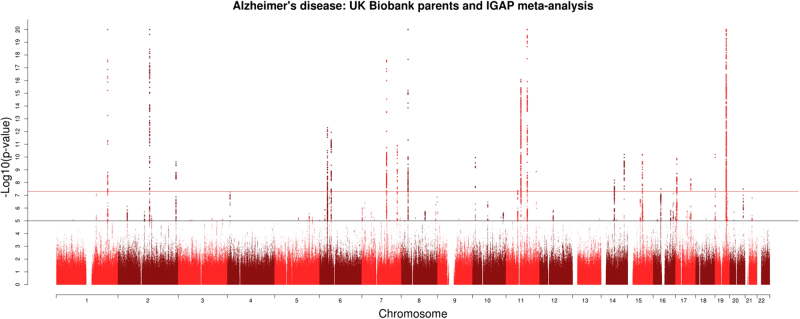
Alzheimer’s disease (AD) is a public health priority for the 21st century. Risk reduction currently revolves around lifestyle changes with much research trying to elucidate the biological underpinnings. We show that self-report of parental history of Alzheimer’s dementia for case ascertainment in a genome-wide association study of 314,278 participants from UK Biobank (27,696 maternal cases, 14,338 paternal cases) is a valid proxy for an AD genetic study. After meta-analysing with published consortium data ( n = 74,046 with 25,580 cases across the discovery and replication analyses), three new AD-associated loci ( P < 5 × 10 −8 ) are identified. These contain genes relevant for AD and neurodegeneration: ADAM10 , BCKDK/KAT8 and ACE . Novel gene-based loci include drug targets such as VKORC1 (warfarin dose). We report evidence that the association of SNPs in the TOMM40 gene with AD is potentially mediated by both gene expression and DNA methylation in the prefrontal cortex. However, it is likely that multiple variants are affecting the trait and gene methylation/expression. Our discovered loci may help to elucidate the biological mechanisms underlying AD and, as they contain genes that are drug targets for other diseases and disorders, warrant further exploration for potential precision medicine applications.
Overview
The claims and statistics of this paper haven’t been checked yet.
Free: it reads the open-access text and checks the first 5 claims that cite a source we can check. Create a free account to check every claim.
Integrity signals
Registry
Cites
Statistics
Figures
Verification
Claims the paper makes
The claims and statistics of this paper haven’t been checked yet.
Free: it reads the open-access text and checks the first 5 claims that cite a source we can check. Create a free account to check every claim.
Claims other papers make about this one
Each is checked against this paper’s own text: does it say what the citing paper says it does?
The source backs part of the claim, not all of it — or backs it for a different population, condition or comparison.
In the citing paper
“the basis of the observed association between age of dementia onset and these variants in TSPAN14 and TSPAN10 (both with a deleterious correlation) may result from disruption of a protective role of ADAM10.”
From Genetic associations with age at dementia onset in the PSEN1 E280A Colombian kindred (2023) · cites this paper as [27]
Experimental — accuracy not yet measuredThe source backs part of the claim, not all of it — or backs it for a different population, condition or comparison.
In the citing paper
“Several genesassoci-ated with AD incidence (APOE, CLU, ABCA7, SORL1, INPP5D, and PLCG2)(Jansen et al., 2019; Kunkle et al., 2019; Marioni et al., 2018) also function in lipid transport or signaling.”
From Alzheimer’s Patient Microglia Exhibit Enhanced Aging and Unique Transcriptional Activation (2020) · cites this paper as Marioni et al., 2018
Experimental — accuracy not yet measuredThe source backs part of the claim, not all of it — or backs it for a different population, condition or comparison.
In the citing paper
“non-coding mutations also modulate AD risk [4–6], likely through modifying gene expression.”
From Association of SPI1 haplotypes with altered SPI1 gene expression and Alzheimer’s disease risk (2022) · cites this paper as [6]
Experimental — accuracy not yet measuredThe source backs part of the claim, not all of it — or backs it for a different population, condition or comparison.
In the citing paper
“PLCG2 polymorphisms are associated with both reduced and increased risk of Alzheimer’s disease (AD) and with longevity.”
From Multi-omics analyses reveal novel effects of PLCγ2 deficiency in the mouse brain (2023) · cites this paper as [6]
Experimental — accuracy not yet measuredThe source backs part of the claim, not all of it — or backs it for a different population, condition or comparison.
In the citing paper
“other rare PLCG2 variants, such as M28L (rs61749044) that confers a modest increased risk of AD (OR ≈ 1.16) [1, 4, 7–13]”
From PLCγ2 deficiency compromises systemic immune tolerance and erodes myelin homeostasis while enhancing oxidative metabolism in the mouse brain (2026) · cites this paper as [10]
Experimental — accuracy not yet measured
20 more claims about this paper
Create a free account to see every claim other papers make about this one.
Self-check
Percentages, sums and reported differences re-computed from the paper’s own numbers.
The self-check needs the paper’s full text.
Citations
Cites
Sudlow, C., Gallacher, J., Allen, N., Beral, V., Burton, P., Danesh, J., Downey, P., Elliott, P., Green, J., Landray, M., et al. (2015) · PLOS Medicine · doi:10.1371/journal.pmed.1001779 · Cited by 12,728 · cited 13×
“There was complete sign-concordance between UK Biobank and IGAP for all 21 SNPs (Supplementary Table 4).”
BackgroundInfluentialA map of human genome variation from population-scale sequencing.
The 1000 Genomes Project Consortium (2010) · Nature · doi:10.1038/nature09534 · Cited by 7,877
Dementia prevention, intervention, and care
Livingston, G., Sommerlad, A., Orgeta, V., Costafreda, S. G., Huntley, J., Ames, D., Ballard, C., Banerjee, S., Burns, A., Cohen-Mansfield, J., et al. (2017) · The Lancet · doi:10.1016/s0140-6736(17)31363-6 · Cited by 6,072
LD Score regression distinguishes confounding from polygenicity in genome-wide association studies
Schizophrenia Working Group of the Psychiatric Genomics Consortium, Bulik-Sullivan, B. K., Loh, P.-R., Finucane, H. K., Ripke, S., Yang, J., Patterson, N., Daly, M. J., Price, A. L., & Neale, B. M. (2015) · Nature Genetics · doi:10.1038/ng.3211 · Cited by 5,559 · cited 2×
“…as 314,278 + 74,046 = 388,324) were included along with expression Quantitative Trait Loci (QTL) summary output from the Common Mind Consortium, which contains data on >600 dorsolateral prefrontal cortex samples, and DNA methylation QTL summary output on 258 prefrontal cortex samples (age >13) 18 .”
MethodSelf-citationMETAL: fast and efficient meta-analysis of genomewide association scans
Willer, C. J., Li, Y., & Abecasis, G. R. (2010) · Bioinformatics · doi:10.1093/bioinformatics/btq340 · Cited by 5,205
Genetic studies of body mass index yield new insights for obesity biology
Study, T. L. C., Locke, A. E., The ADIPOGen Consortium, The AGEN-BMI Working Group, The CARDIOGRAMplusC4D Consortium, The CKDGen Consortium, The, G. L. G. C., The, I. C. B. P., The MAGIC Investigators, The MuTHER Consortium, et al. (2015) · Nature · doi:10.1038/nature14177 · Cited by 4,534
Self-citationCommon SNPs explain a large proportion of the heritability for human height
Yang, J., Benyamin, B., McEvoy, B. P., Gordon, S., Henders, A. K., Nyholt, D. R., Madden, P. A., Heath, A. C., Martin, N. G., Montgomery, G. W., et al. (2010) · Nature Genetics · doi:10.1038/ng.608 · Cited by 4,446
Self-citationMeta-Analysis of 74,046 Individuals Identifies 11 New Susceptibility Loci for Alzheimer’s Disease
(EADI), E. A. D. I., Lambert, J.-C., (GERAD), G. A. E. R. I. A. D., Alzheimer's Disease Genetic Consortium (ADGC), (CHARGE), C. F. H. A. A. R. I. G. E., Ibrahim-Verbaas, C. A., Harold, D., Naj, A. C., Sims, R., Bellenguez, C., et al. (2013) · Nature Genetics · doi:10.1038/ng.2802 · Cited by 4,336 · cited 1×
“Downstream quality control steps conducted for the current analysis included removing (1) those with nonBritish ancestry based on both self-report and a principal components analysis, (2) outliers based on heterozygosity and missingness, (3) individuals with sex chromosome configurations that were neither XX nor XY, (…”
MethodSelf-citationAn atlas of genetic correlations across human diseases and traits
ReproGen Consortium, Bulik-Sullivan, B., Psychiatric Genomics Consortium, Genetic Consortium for Anorexia Nervosa of the Wellcome Trust Case Control Consortium 3, Finucane, H. K., Anttila, V., Gusev, A., Day, F. R., Loh, P.-R., Duncan, L., et al. (2015) · Nature Genetics · doi:10.1038/ng.3406 · Cited by 4,255 · cited 1×
“Linkage disequilibrium score (LDSC) regression was used to estimate the genetic correlation between the maternal and paternal AD GWAS results and to test for residual confounding in the meta-analysis by examining the LDSC intercept 12,13 .”
MethodFunctional mapping and annotation of genetic associations with FUMA
Watanabe, K., Taskesen, E., van Bochoven, A., & Posthuma, D. (2017) · Nature Communications · doi:10.1038/s41467-017-01261-5 · Cited by 4,083 · cited 1×
“The number of independent loci from the meta-analysis was determined by using the default settings in FUMA 14 .”
Method
Cited by
Alzheimer Disease Genetics Consortium (ADGC), Kunkle, B. W., The European Alzheimer’s Disease Initiative (EADI), Cohorts for Heart and Aging Research in Genomic Epidemiology Consortium (CHARGE), Genetic and Environmental Risk in AD/Defining Genetic, P. A. E. R. F. A. D. C. (., Grenier-Boley, B., Sims, R., Bis, J. C., Damotte, V., Naj, A. C., et al. (2019) · Nature Genetics · doi:10.1038/s41588-019-0358-2 · Cited by 2,946
New insights into the genetic etiology of Alzheimer’s disease and related dementias
Bellenguez, C., Küçükali, F., Jansen, I. E., Kleineidam, L., Moreno-Grau, S., Amin, N., Naj, A. C., Campos-Martin, R., Grenier-Boley, B., Andrade, V., et al. (2022) · Nature Genetics · doi:10.1038/s41588-022-01024-z · Cited by 2,498
Jansen, I. E., Savage, J. E., Watanabe, K., Bryois, J., Williams, D. M., Steinberg, S., Sealock, J., Karlsson, I. K., Hägg, S., Athanasiu, L., et al. (2019) · Nature Genetics · doi:10.1038/s41588-018-0311-9 · Cited by 2,277
The Amyloid-β Pathway in Alzheimer’s Disease
Hampel, H., Hardy, J., Blennow, K., Chen, C., Perry, G., Kim, S. H., Villemagne, V. L., Aisen, P., Vendruscolo, M., Iwatsubo, T., et al. (2021) · Molecular Psychiatry · doi:10.1038/s41380-021-01249-0 · Cited by 1,952
Education and cognitive functioning across the life span
Lövdén, M., Fratiglioni, L., Glymour, M. M., Lindenberger, U., & Tucker-Drob, E. M. (2020) · Psychological Science in the Public Interest · doi:10.1177/1529100620920576 · Cited by 1,224
“, 2011), the aggregate effects of more common genetic variants with individually small effects are relevant for risk for more common, sporadic (nonfamilial) forms of the disease (Marioni et al., 2018).”
BackgroundSala Frigerio, C., Wolfs, L., Fattorelli, N., Thrupp, N., Voytyuk, I., Schmidt, I., Mancuso, R., Chen, W.-T., Woodbury, M. E., Srivastava, G., et al. (2019) · Cell Reports · doi:10.1016/j.celrep.2019.03.099 · Cited by 926
“Thus, these GWAS variants, when present in a patient, likely affect the way that microglia cope with the accumulation of amyloid over age.”
BackgroundInfluentialWightman, D. P., Jansen, I. E., Savage, J. E., Shadrin, A. A., Bahrami, S., Holland, D., Rongve, A., Børte, S., Winsvold, B. S., Drange, O. K., et al. (2021) · Nature Genetics · doi:10.1038/s41588-021-00921-z · Cited by 1,011
A Quarter Century of APOE and Alzheimer’s Disease: Progress to Date and the Path Forward
Belloy, M. E., Napolioni, V., & Greicius, M. D. (2019) · Neuron · doi:10.1016/j.neuron.2019.01.056 · Cited by 570
van Rheenen, W., van der Spek, R. A. A., Bakker, M. K., van Vugt, J. J. F. A., Hop, P. J., Zwamborn, R. A. J., de Klein, N., Westra, H.-J., Bakker, O. B., Deelen, P., et al. (2021) · Nature Genetics · doi:10.1038/s41588-021-00973-1 · Cited by 542
Self-citationSchwartzentruber, J., Cooper, S., Liu, J. Z., Barrio-Hernandez, I., Bello, E., Kumasaka, N., Young, A. M. H., Franklin, R. J. M., Johnson, T., Estrada, K., et al. (2021) · Nature Genetics · doi:10.1038/s41588-020-00776-w · Cited by 532
The multiplex model of the genetics of Alzheimer's disease
Sims, R., Hill, M., & Williams, J. (2020) · Nature Neuroscience · doi:10.1038/s41593-020-0599-5 · Cited by 466
Alzheimer’s Patient Microglia Exhibit Enhanced Aging and Unique Transcriptional Activation
Srinivasan, K., Friedman, B. A., Etxeberria, A., Huntley, M. A., van der Brug, M. P., Foreman, O., Paw, J. S., Modrusan, Z., Beach, T. G., Serrano, G. E., et al. (2020) · Cell Reports · doi:10.1016/j.celrep.2020.107843 · Cited by 427
“Several genesassoci-ated with AD incidence (APOE, CLU, ABCA7, SORL1, INPP5D, and PLCG2)(Jansen et al., 2019; Kunkle et al., 2019; Marioni et al., 2018) also function in lipid transport or signaling.”
Genome-wide association study identifies 143 loci associated with 25 hydroxyvitamin D concentration
Revez, J. A., Lin, T., Qiao, Z., Xue, A., Holtz, Y., Zhu, Z., Zeng, J., Wang, H., Sidorenko, J., Kemper, K. E., et al. (2020) · Nature Communications · doi:10.1038/s41467-020-15421-7 · Cited by 415
Self-citationGenome-wide analysis of dental caries and periodontitis combining clinical and self-reported data
Shungin, D., Haworth, S., Divaris, K., Agler, C. S., Kamatani, Y., Keun Lee, M., Grinde, K., Hindy, G., Alaraudanjoki, V., Pesonen, P., et al. (2019) · Nature Communications · doi:10.1038/s41467-019-10630-1 · Cited by 364
Immune Signaling in Neurodegeneration
Hammond, T. R., Marsh, S. E., & Stevens, B. (2019) · Immunity · doi:10.1016/j.immuni.2019.03.016 · Cited by 336
“More than half of the AD risk loci discovered in GWAS are significantly enriched or, in some cases, uniquely expressed in immune cells – genes including CR1, CD33, members of the MS4A family, the HLA locus, and MEF2C (Bennett et al., 2016; GTEx Consortium, 2013; Hammond et al., 2019; Hollingworth et al., 2011; Jansen…”
BackgroundAlzheimer’s Disease: An Updated Overview of Its Genetics
Andrade-Guerrero, J., Santiago-Balmaseda, A., Jeronimo-Aguilar, P., Vargas-Rodríguez, I., Cadena-Suárez, A. R., Sánchez-Garibay, C., Pozo-Molina, G., Méndez-Catalá, C. F., Cardenas-Aguayo, M.-D.-C., Diaz-Cintra, S., et al. (2023) · International Journal of Molecular Sciences · doi:10.3390/ijms24043754 · Cited by 336
Single-Nucleus RNA-Seq Is Not Suitable for Detection of Microglial Activation Genes in Humans
Thrupp, N., Sala Frigerio, C., Wolfs, L., Skene, N. G., Fattorelli, N., Poovathingal, S., Fourne, Y., Matthews, P. M., Theys, T., Mancuso, R., et al. (2020) · Cell Reports · doi:10.1016/j.celrep.2020.108189 · Cited by 351
“In addition, there is significant overlap between those genes involved in the mouse microglial response and AD risk genes identified in genome-wide association studies (Efthymiou and Goate, 2017; Gosselin et al., 2017; Jansen et al., 2019; Kunkle et al., 2019; Lambert et al., 2013; Marioni et al., 2018), for example,…”
BackgroundCommon variants in Alzheimer’s disease and risk stratification by polygenic risk scores
de Rojas, I., Moreno-Grau, S., Tesi, N., Grenier-Boley, B., Andrade, V., Jansen, I. E., Pedersen, N. L., Stringa, N., Zettergren, A., Hernández, I., et al. (2021) · Nature Communications · doi:10.1038/s41467-021-22491-8 · Cited by 324
Interpretation of risk loci from genome-wide association studies of Alzheimer's disease
Andrews, S. J., Fulton-Howard, B., & Goate, A. (2020) · The Lancet Neurology · doi:10.1016/s1474-4422(19)30435-1 · Cited by 314
Self-citationZhao, B., Luo, T., Li, T., Li, Y., Zhang, J., Shan, Y., Wang, X., Yang, L., Zhou, F., Zhu, Z., et al. (2019) · Nature Genetics · doi:10.1038/s41588-019-0516-6 · Cited by 295
Stem-cell-derived human microglia transplanted in mouse brain to study human disease
Mancuso, R., Van Den Daele, J., Fattorelli, N., Wolfs, L., Balusu, S., Burton, O., Liston, A., Sierksma, A., Fourne, Y., Poovathingal, S., et al. (2019) · Nature Neuroscience · doi:10.1038/s41593-019-0525-x · Cited by 295
The neuroimmune axis of Alzheimer’s disease
Jorfi, M., Maaser-Hecker, A., & Tanzi, R. E. (2023) · Genome Medicine · doi:10.1186/s13073-023-01155-w · Cited by 292
Novel Alzheimer risk genes determine the microglia response to amyloid-β but not to TAU pathology
Sierksma, A., Lu, A., Mancuso, R., Fattorelli, N., Thrupp, N., Salta, E., Zoco, J., Blum, D., Buée, L., De Strooper, B., et al. (2020) · EMBO Molecular Medicine · doi:10.15252/emmm.201910606 · Cited by 291
Lopes, K. D. P., Snijders, G. J. L., Humphrey, J., Allan, A., Sneeboer, M. A. M., Navarro, E., Schilder, B. M., Vialle, R. A., Parks, M., Missall, R., et al. (2022) · Nature Genetics · doi:10.1038/s41588-021-00976-y · Cited by 273
Risk prediction of late-onset Alzheimer’s disease implies an oligogenic architecture
Zhang, Q., Sidorenko, J., Couvy-Duchesne, B., Marioni, R. E., Wright, M. J., Goate, A. M., Marcora, E., Huang, K.-L., Porter, T., Laws, S. M., et al. (2020) · Nature Communications · doi:10.1038/s41467-020-18534-1 · Cited by 272
Self-citationGenetic architecture of subcortical brain structures in 38,851 individuals
Satizabal, C. L., Adams, H. H. H., Hibar, D. P., White, C. C., Knol, M. J., Stein, J. L., Scholz, M., Sargurupremraj, M., Jahanshad, N., Roshchupkin, G. V., et al. (2019) · Nature Genetics · doi:10.1038/s41588-019-0511-y · Cited by 260
“This suggests that immune-related processes may be an important determinant influencing subcortical volumes, as has been shown by other GWA studies of neurologic traits 72,73 .”
ResultSelf-citationMicroglia in Alzheimer's Disease: Exploring How Genetics and Phenotype Influence Risk
McQuade, A., & Blurton-Jones, M. (2019) · Journal of Molecular Biology · doi:10.1016/j.jmb.2019.01.045 · Cited by 244
Novikova, G., Kapoor, M., TCW, J., Abud, E. M., Efthymiou, A. G., Chen, S. X., Cheng, H., Fullard, J. F., Bendl, J., Liu, Y., et al. (2021) · Nature Communications · doi:10.1038/s41467-021-21823-y · Cited by 214
Self-citationMicroglia in Brain Development, Homeostasis, and Neurodegeneration
Bohlen, C. J., Friedman, B. A., Dejanovic, B., & Sheng, M. (2019) · Annual Review of Genetics · doi:10.1146/annurev-genet-112618-043515 · Cited by 212
Jiwaji, Z., Tiwari, S. S., Avilés-Reyes, R. X., Hooley, M., Hampton, D., Torvell, M., Johnson, D. A., McQueen, J., Baxter, P., Sabari-Sankar, K., et al. (2022) · Nature Communications · doi:10.1038/s41467-021-27702-w · Cited by 223
Gene–environment interactions in Alzheimer disease: the emerging role of epigenetics
Migliore, L., & Coppedè, F. (2022) · Nature Reviews Neurology · doi:10.1038/s41582-022-00714-w · Cited by 217
Microglia and monocytes in inflammatory CNS disease: integrating phenotype and function
Spiteri, A. G., Wishart, C. L., Pamphlett, R., Locatelli, G., & King, N. J. C. (2022) · Acta Neuropathologica · doi:10.1007/s00401-021-02384-2 · Cited by 244
“4% of AD-risk single-nucleotide polymorphisms are highly expressed by microglia [212, 364], including Apoe, Trem2, Abca7, Cd33 and Cr1 [221].”
BackgroundGenetics of Alzheimer’s disease: where we are, and where we are going
Bellenguez, C., Grenier-Boley, B., & Lambert, J.-C. (2020) · Current Opinion in Neurobiology · doi:10.1016/j.conb.2019.11.024 · Cited by 215
A Map of Transcriptional Heterogeneity and Regulatory Variation in Human Microglia
Young, A. M. H., Kumasaka, N., Calvert, F., Hammond, T. R., Knights, A., Panousis, N., Park, J. S., Schwartzentruber, J., Liu, J., Kundu, K., et al. (2021) · Nature Genetics · doi:10.1038/s41588-021-00875-2 · Cited by 213
Wu, Y., Murray, G. K., Byrne, E. M., Sidorenko, J., Visscher, P. M., & Wray, N. R. (2021) · Nature Communications · doi:10.1038/s41467-021-21280-7 · Cited by 212
Self-citationMicroglial Phagocytosis: A Disease-Associated Process Emerging from Alzheimer’s Disease Genetics
Podleśny-Drabiniok, A., Marcora, E., & Goate, A. M. (2020) · Trends in Neurosciences · doi:10.1016/j.tins.2020.10.002 · Cited by 211
Self-citationDeterminants of accelerated metabolomic and epigenetic aging in a UK cohort
Robinson, O., Chadeau Hyam, M., Karaman, I., Climaco Pinto, R., Ala-Korpela, M., Handakas, E., Fiorito, G., Gao, H., Heard, A., Jarvelin, M., et al. (2020) · Aging Cell · doi:10.1111/acel.13149 · Cited by 205
Coleman, J. R. I., Peyrot, W. J., Purves, K. L., Davis, K. A. S., Rayner, C., Choi, S. W., Hübel, C., Gaspar, H. A., Kan, C., Van der Auwera, S., et al. (2020) · Molecular Psychiatry · doi:10.1038/s41380-019-0546-6 · Cited by 194
Self-citationFunctional enhancer elements drive subclass-selective expression from mouse to primate neocortex
Mich, J. K., Graybuck, L. T., Hess, E. E., Mahoney, J. T., Kojima, Y., Ding, Y., Somasundaram, S., Miller, J. A., Kalmbach, B. E., Radaelli, C., et al. (2021) · Cell Reports · doi:10.1016/j.celrep.2021.108754 · Cited by 193
Wang, M., Li, A., Sekiya, M., Beckmann, N. D., Quan, X., Schrode, N., Fernando, M. B., Yu, A., Zhu, L., Cao, J., et al. (2021) · Neuron · doi:10.1016/j.neuron.2020.11.002 · Cited by 185
“Conventional genome-wide association studies (GWAS) have revealed ~30 loci associated with LOAD (Jansen et al., 2019; Kunkle et al., 2019; Lambert et al., 2013; Marioni et al., 2018), with ~40% of the total phenotypic variance explained by these common variants Wang et al.”
Moulton, M. J., Barish, S., Ralhan, I., Chang, J., Goodman, L. D., Harland, J. G., Marcogliese, P. C., Johansson, J. O., Ioannou, M. S., & Bellen, H. J. (2021) · Proceedings of the National Academy of Sciences · doi:10.1073/pnas.2112095118 · Cited by 180
Genetics of the human microglia regulome refines Alzheimer’s disease risk loci
Kosoy, R., Fullard, J. F., Zeng, B., Bendl, J., Dong, P., Rahman, S., Kleopoulos, S. P., Shao, Z., Girdhar, K., Humphrey, J., et al. (2022) · Nature Genetics · doi:10.1038/s41588-022-01149-1 · Cited by 168
High-Diversity Mouse Populations for Complex Traits
Saul, M. C., Philip, V. M., Reinholdt, L. G., & Chesler, E. J. (2019) · Trends in Genetics · doi:10.1016/j.tig.2019.04.003 · Cited by 165
Translating genetic risk of Alzheimer’s disease into mechanistic insight and drug targets
Sierksma, A., Escott-Price, V., & De Strooper, B. (2020) · Science · doi:10.1126/science.abb8575 · Cited by 146
“Most investigators currently use a partial AD PRS calculated with the lead SNP in the 40 canonic GWAS genome loci mentioned before ( 12 – 14 , 42 ).”
Singh, N., & Bhalla, N. (2020) · Annual Review of Genetics · doi:10.1146/annurev-genet-030620-102906 · Cited by 147
Biological and environmental predictors of heterogeneity in neurocognitive ageing
Nyberg, L. H., Boraxbekk, C., Sörman, D. E., Hansson, P., Herlitz, A., Kauppi, K., Ljungberg, J. K., Lövheim, H., Lundquist, A., Adolfsson, A. N., et al. (2020) · Ageing Research Reviews · doi:10.1016/j.arr.2020.101184 · Cited by 166
“, 2015) and a still growing number of additional genetic factors underlying late onset AD and related endophenotypes have been discovered (Kunkle et al., 2019; Marioni et al., 2018; Tan et al, 2019; Witoelar et al., 2018).”
PRSet: Pathway-based polygenic risk score analyses and software
Choi, S. W., García‐González, J., Ruan, Y., Wu, H. M., Porras, C., Johnson, J., Hoggart, C. J., & O’Reilly, P. F. (2023) · PLoS Genetics · doi:10.1371/journal.pgen.1010624 · Cited by 148
Genetic architecture of Alzheimer's disease
Neuner, S. M., TCW, J., & Goate, A. M. (2020) · Neurobiology of Disease · doi:10.1016/j.nbd.2020.104976 · Cited by 126
“Together, these approaches show substantial genetic overlap with previous case-control GWAS and nominate a number of novel loci associated with proxy risk for AD (Liu et al., 2017; Jansen et al., 2019; Marioni et al., 2018).”
BackgroundResultInfluentialSelf-citation25-Hydroxycholesterol amplifies microglial IL-1β production in an apoE isoform-dependent manner
Wong, M. Y., Lewis, M., Doherty, J. J., Shi, Y., Cashikar, A. G., Amelianchik, A., Tymchuk, S., Sullivan, P. M., Qian, M., Covey, D. F., et al. (2020) · Journal of Neuroinflammation · doi:10.1186/s12974-020-01869-3 · Cited by 121
DESGESCO (Dementia Genetics Spanish Consortium), E. (. D. E. D. B., van der Lee, S. J., biobank), E. (. D. E. D., IFGC (International FTD-Genomics Consortium), I. (. I. P. D. G. C., IPDGC (The International Parkinson Disease Genomics Consortium), Dementia), R.-F. (. A. M. F. I. F.-T., (NBB), N. B. B., The GIFT (Genetic Investigation in Frontotemporal Dementia and Alzheimer’s Disease) Study Group, Conway, O. J., Jansen, I., et al. (2019) · Acta Neuropathologica · doi:10.1007/s00401-019-02026-8 · Cited by 120
Semick, S. A., Bharadwaj, R. A., Collado‐Torres, L., Tao, R., Shin, J. H., Deep‐Soboslay, A., Weiss, J. R., Weinberger, D. R., Hyde, T. M., Kleinman, J. E., et al. (2019) · Acta Neuropathologica · doi:10.1007/s00401-019-01966-5 · Cited by 136
“Meta-analyses of other genomic data types have offered valuable insights into the genetic [28, 32, 42] and transcriptional [51] correlates of Alzheimer’s disease.”
BackgroundGenome-wide association studies for Alzheimer’s disease: bigger is not always better
Escott-Price, V., & Hardy, J. (2022) · Brain Communications · doi:10.1093/braincomms/fcac125 · Cited by 119
“1 Remarkably, the heritability estimates drop from ≏ 40 8,9 to 2 – 3% 1,18 – 21 (see Table 1, Fig.”
The role of the immune system in Alzheimer’s disease
Wu, K., Zhang, Y.-R., Huang, Y., Dong, Q., Tan, L., & Yu, J. (2021) · Ageing Research Reviews · doi:10.1016/j.arr.2021.101409 · Cited by 127
Microglial efferocytosis: Diving into the Alzheimer’s disease gene pool
Romero-Molina, C., Garretti, F., Andrews, S. J., Marcora, E., & Goate, A. M. (2022) · Neuron · doi:10.1016/j.neuron.2022.10.015 · Cited by 111
Self-citationGenetic variability in response to amyloid beta deposition influences Alzheimer’s disease risk
Salih, D. A., Bayram, S., Guelfi, S., Reynolds, R. H., Shoai, M., Ryten, M., Brenton, J. W., Zhang, D., Matarin, M., Botia, J. A., et al. (2019) · Brain Communications · doi:10.1093/braincomms/fcz022 · Cited by 110
“In contrast, despite some rare variants in APP processing enzymes (Kim et al. , 2009; Marioni et al. , 2018; Jansen et al. , 2019; Kunkle et al. , 2019), the majority of the risk in late-onset disease has been shown to be due to sequence variability in genes expressed in the innate immune system…”
A general dimension of genetic sharing across diverse cognitive traits inferred from molecular data
de la Fuente, J., Davies, G., Grotzinger, A. D., Tucker-Drob, E. M., & Deary, I. J. (2020) · Nature Human Behaviour · doi:10.1038/s41562-020-00936-2 · Cited by 105
Self-citationFišar, Z. (2022) · Biomolecules · doi:10.3390/biom12111676 · Cited by 120
Histone Modifications in Alzheimer’s Disease
Santana, D. A., Smith, M. D. A. C., & Chen, E. (2023) · Genes · doi:10.3390/genes14020347 · Cited by 118
“New GWAS have been developed with larger sample sizes, and several other risk loci have been identified and associated with AD, including TMEM106B, LILRB2, CCDC6, TNIP1, APP, TSPAN14, GRN, NCK2, SHARPIN [12,13], CST3, USP8, TGFB2 [14], RABEP1, PILRA, TP53INP1, AP4M1, SPI1, AP4E1, APBB3, ZYX [15], ACE, BCKDK/KAT8, ADAM…”
BackgroundInfluentialRestoring regulatory T-cell dysfunction in Alzheimer’s disease through ex vivo expansion
Faridar, A., Thome, A. D., Zhao, W., Thonhoff, J. R., Beers, D. R., Pascual, B., Masdeu, J. C., & Appel, S. H. (2020) · Brain Communications · doi:10.1093/braincomms/fcaa112 · Cited by 104
Prokopenko, D., Morgan, S. L., Mullin, K., Hofmann, O., Chapman, B., Kirchner, R., (ADNI), A. D. N. I., Amberkar, S., Wohlers, I., Lange, C., et al. (2021) · Alzheimer's & Dementia · doi:10.1002/alz.12319 · Cited by 105
study, T. A. I. B. A. L., Nabais, M. F., Initiative, T. A. D. N., Laws, S. M., Lin, T., Vallerga, C. L., Armstrong, N. J., Blair, I. P., Kwok, J. B., Mather, K. A., et al. (2021) · Genome Biology · doi:10.1186/s13059-021-02275-5 · Cited by 99
Self-citationFeng, H., Mancuso, N., Gusev, A., Majumdar, A., Major, M., Paşaniuc, B., & Kraft, P. L. (2021) · PLoS Genetics · doi:10.1371/journal.pgen.1008973 · Cited by 104
“As expected, by leveraging similarities References: Alzheimer’s disease [19], breast cancer [20], coronary heart disease [21], Type 2 Diabetes [22], Schizophrenia [23], Body mass index, height, smoking status, chronotype, and tanning [24]. https://doi.org/10.1371/journal.pgen.1008973.t001 in…”
MethodInfluentialDing, J., Blencowe, M., Nghiem, T., Ha, S.-M., Chen, Y.-W., Li, G., & Yang, X. (2021) · Nucleic Acids Research · doi:10.1093/nar/gkab405 · Cited by 97
“Association data GWAS Alzheimer’s disease (71) Attention deficit hyperactivity disorder (72) Alcohol dependence (73) Body mass index (74)”
BackgroundHujoel, M. L. A., Gazal, S., Loh, P.-R., Patterson, N., & Price, A. L. (2020) · Nature Genetics · doi:10.1038/s41588-020-0613-6 · Cited by 95
Variable number tandem repeats mediate the expression of proximal genes
Bakhtiari, M., Park, J., Ding, Y.-C., Shleizer-Burko, S., Neuhausen, S. L., Halldórsson, B. V., Stefánsson, K., Gymrek, M., & Bafna, V. (2021) · Nature Communications · doi:10.1038/s41467-021-22206-z · Cited by 103
“Also, the chr17 locus containing the gene has been associated with Alzheimer ’ s in a recent large meta-GWAS study on the UK Biobank data 53 .”
BackgroundGenomics of Alzheimer’s disease implicates the innate and adaptive immune systems
Li, Y., Laws, S. M., Miles, L. A., Wiley, J. S., Huang, X., Masters, C. L., & Gu, B. J. (2021) · Cellular and Molecular Life Sciences · doi:10.1007/s00018-021-03986-5 · Cited by 111
Enhancing face validity of mouse models of Alzheimer’s disease with natural genetic variation
Onos, K. D., Uyar, A., Keezer, K. J., Jackson, H. M., Preuss, C., Acklin, C. J., O’Rourke, R., Buchanan, R., Cossette, T. L., Sukoff Rizzo, S. J., et al. (2019) · PLOS Genetics · doi:10.1371/journal.pgen.1008155 · Cited by 93
The 100-plus Study of cognitively healthy centenarians: rationale, design and cohort description
Holstege, H., Beker, N., Dijkstra, T., Pieterse, K., Wemmenhove, E., Schouten, K., Thiessens, L., Horsten, D., Rechtuijt, S., Sikkes, S., et al. (2018) · European Journal of Epidemiology · doi:10.1007/s10654-018-0451-3 · Cited by 90
Hu, Y., Sun, J.-Y., Zhang, Y., Zhang, H., Gao, S., Wang, T., Han, Z., Wang, L., Sun, B.-L., & Liu, G. (2021) · BMC Medicine · doi:10.1186/s12916-020-01883-5 · Cited by 88
“Using the genetic association analysis, we evaluated the association of rs1990622 variant with AD using two independent large-scale GWAS datasets from IGAP and UK Biobank, and then conducted a meta-analysis [10, 11].”
BackgroundMethodInfluentialCausal inference for heritable phenotypic risk factors using heterogeneous genetic instruments
Wang, J., Zhao, Q., Bowden, J., Hemani, G., Davey Smith, G., Small, D. S., & Zhang, N. R. (2021) · PLOS Genetics · doi:10.1371/journal.pgen.1009575 · Cited by 88
Innovations in 3D Tissue Models of Human Brain Physiology and Diseases
Lovett, M. L., Nieland, T. J. F., Dingle, Y. L., & Kaplan, D. L. (2020) · Advanced Functional Materials · doi:10.1002/adfm.201909146 · Cited by 91
Step by step: towards a better understanding of the genetic architecture of Alzheimer’s disease
Lambert, J.-C., Ramirez, A., Grenier-Boley, B., & Bellenguez, C. (2023) · Molecular Psychiatry · doi:10.1038/s41380-023-02076-1 · Cited by 87
“Although the large number of proxy-AD cases increases the statistical power of the AD GWAS, and the genetic correlation between AD and proxy-AD is high (above 0.65) [20, 23, 25, 117], this “ virtual diagnosis ” might lead to the inclusion of misdiagnosed individuals.”
BackgroundInfluentialSproviero, W., Winchester, L., Newby, D., Fernandes, M., Shi, L., Goodday, S. M., Prats-Uribe, A., Alhambra, D. P., Buckley, N. J., & Nevado-Holgado, A. J. (2021) · Biological Psychiatry · doi:10.1016/j.biopsych.2020.12.015 · Cited by 86
Luningham, J. M., Chen, J., Tang, S., Jager, P. L. D., Bennett, D. A. A., Buchman, A. S., & Yang, J. (2020) · The American Journal of Human Genetics · doi:10.1016/j.ajhg.2020.08.022 · Cited by 98
Self-citationGamache, J., Yun, Y., & Chiba-Falek, O. (2020) · Disease Models & Mechanisms · doi:10.1242/dmm.045211 · Cited by 84
Herpesvirus infections and Alzheimer's disease: a mendelian randomization study
Huang, S.-Y., Yang, Y.-X., Kuo, K., Li, H.-Q., Shen, X.-N., Chen, S.-D., Cui, M., Tan, L., Dong, Q., & Yu, J.-T. (2021) · Alzheimer's Research & Therapy · doi:10.1186/s13195-021-00905-5 · Cited by 82
The role of Alzheimer's disease risk genes in endolysosomal pathways
Szabo, M. P., Mishra, S., Knupp, A., & Young, J. E. (2022) · Neurobiology of Disease · doi:10.1016/j.nbd.2021.105576 · Cited by 82
“In particular, we review genes that have been replicated in multiple genome-wide association studies(Andrews et al., 2020; Jansen et al., 2019; Kunkle et al., 2019; Lambert et al., 2013; Marioni et al., 2018) and reviewed in (Andrews et al.”
Li, Q. S., Sun, Y., & Wang, T. (2020) · Clinical Epigenetics · doi:10.1186/s13148-020-00944-z · Cited by 86
An overview of DNA methylation-derived trait score methods and applications
Nabais, M. F., Gadd, D. A., Hannon, E. J., Mill, J. S., McRae, A. F., & Wray, N. R. (2023) · Genome biology · doi:10.1186/s13059-023-02855-7 · Cited by 83
Self-citationGenetic Evidence Supporting a Causal Role of Depression in Alzheimer’s Disease
Harerimana, N. V., Liu, Y., Gerasimov, E. S., Duong, D., Beach, T. G., Reiman, E. M., Schneider, J. A., Boyle, P., Lori, A., Bennett, D. A., et al. (2022) · Biological Psychiatry · doi:10.1016/j.biopsych.2021.11.025 · Cited by 74
Genomics and Functional Genomics of Alzheimer's Disease
Kamboh, M. I. (2022) · Neurotherapeutics · doi:10.1007/s13311-021-01152-0 · Cited by 73
“8E − 08) when a relaxed relatedness threshold was used for proxy AD cases and controls [72].”
BackgroundMethodResultInfluentialShared genetic etiology underlying Alzheimer’s disease and major depressive disorder
Lutz, M. W., Sprague, D., Barrera, J., & Chiba‐Falek, O. (2020) · Translational Psychiatry · doi:10.1038/s41398-020-0769-y · Cited by 79
A microRNA signature that correlates with cognition and is a target against cognitive decline
Islam, M. R., Kaurani, L., Berulava, T., Heilbronner, U., Budde, M., Centeno, T. P., Elerdashvili, V., Zafieriou, M., Benito, E., Sertel, S. M., et al. (2021) · EMBO Molecular Medicine · doi:10.15252/emmm.202013659 · Cited by 74
“Recent GWAS studies identified 709 genes that are associated with general cognitive function in healthy individuals (Marioni et al, 2018).”
BackgroundPolygenic Risk Scores in Alzheimer's Disease: Current Applications and Future Directions
Baker, E., & Escott-Price, V. (2020) · Frontiers in Digital Health · doi:10.3389/fdgth.2020.00014 · Cited by 71
“The traditional process, PRS(P+T), is to (1) remove SNPs in LD using intelligent pruning which retains SNPs with the strongest association with the disease, (2) choose SNPs which have a p-value below a defined threshold, and (3) compute the PRS on the remaining SNPs as a sum of the number of risk alleles, weighted by…”
MethodKoronyo-Hamaoui, M., Sheyn, J., Hayden, E. Y., Li, S., Fuchs, D.-T., Regis, G. C., Lopes, D. H. J., Black, K. L., Bernstein, K. E., Teplow, D. B., et al. (2020) · Brain · doi:10.1093/brain/awz364 · Cited by 70
“In addition, GWAS-by-familial-proxy of Alzheimer’s or dementia studies have further confirmed ACE relevance to Alzheimer’s disease and identified the single nucleotide polymorphism (SNP) combination of rs4343 and rs4351 in the ACE haplotype to possess a 45-fold increased risk of developing Alzheimer’s disease (Meng et…”
BackgroundSun, Y., Zhu, J., Zhou, D., Canchi, S., Wu, C., Cox, N. J., Rissman, R. A., Gamazon, E. R., & Wu, L. (2021) · Genome Medicine · doi:10.1186/s13073-021-00959-y · Cited by 69
“Based on S-PrediXcan [10], we investigated the associations of genetically predicted gene expression in multiple tissues with AD risk by applying the prediction models to the summary statistics generated from a large GWAS of AD, which included 71,880 (proxy) cases and 383,378 (proxy) controls of European ancestry from…”
MethodThe necroptosis cell death pathway drives neurodegeneration in Alzheimer’s disease
Balusu, S., & Strooper, B. D. (2024) · Acta Neuropathologica · doi:10.1007/s00401-024-02747-5 · Cited by 85
“Notably, genetic studies, in particular genome-wide association studies (GWAS) have identified several risk genes of AD which are operating in the endo-lysosomal network (ELN), such as PICALM, PLD3, BIN1, CSTD, CLU, UBQLN1, GRN, and SORL1 [12, 15, 74, 109].”
BackgroundDesplats, P., Gutierrez, A. M., Antonelli, M. C., & Frasch, M. G. (2019) · Neuroscience & Biobehavioral Reviews · doi:10.1016/j.neubiorev.2019.10.013 · Cited by 87
Tesi, N., van der Lee, S. J., Hulsman, M., Jansen, I. E., Stringa, N., van Schoor, N. M., Scheltens, P., van der Flier, W. M., Huisman, M., Reinders, M. J. T., et al. (2020) · Translational Psychiatry · doi:10.1038/s41398-020-01018-7 · Cited by 67
ABCA7 and the altered lipidostasis hypothesis of Alzheimer's disease
Lyssenko, N. N., & Praticò, D. (2021) · Alzheimer's & Dementia · doi:10.1002/alz.12220 · Cited by 67
Common Factors in Neurodegeneration: A Meta-Study Revealing Shared Patterns on a Multi-Omics Scale
Ruffini, N., Klingenberg, S., Schweiger, S., & Gerber, S. (2020) · Cells · doi:10.3390/cells9122642 · Cited by 76
Xu, J., Bankov, G., Kim, M. G., Wretlind, A., Lord, J., Green, R., Hodges, A., Hye, A., Aarsland, D., Velayudhan, L., et al. (2020) · Translational Neurodegeneration · doi:10.1186/s40035-020-00215-0 · Cited by 77
Walter, S., Jumpertz, T., Hüttenrauch, M., Ogorek, I., Gerber, H., Storck, S. E., Zampar, S., Dimitrov, M., Lehmann, S., Lepka, K., et al. (2019) · Acta Neuropathologica · doi:10.1007/s00401-018-1929-5 · Cited by 65
Tesi, N., van der Lee, S. J., Hulsman, M., Jansen, I. E., Stringa, N., van Schoor, N., Meijers-Heijboer, H., Huisman, M., Scheltens, P., Reinders, M. J. T., et al. (2019) · European Journal of Human Genetics · doi:10.1038/s41431-018-0273-5 · Cited by 65
“in which AD-associations of variants near the MEF2C and FERMT2 genes were not replicated [52, 53] (p= 5.”
BackgroundLi, Q. S., & De Muynck, L. (2021) · Brain, Behavior, & Immunity - Health · doi:10.1016/j.bbih.2021.100227 · Cited by 58
Reassessment of Pioglitazone for Alzheimer’s Disease
Saunders, A. M., Burns, D. K., & Gottschalk, W. K. (2021) · Frontiers in Neuroscience · doi:10.3389/fnins.2021.666958 · Cited by 63
Tang, S., Buchman, A. S., Jager, P. L. D., Bennett, D. A., Epstein, M. P., & Yang, J. (2021) · PLoS Genetics · doi:10.1371/journal.pgen.1009482 · Cited by 69
“Seven of those significant genes were known risk genes of AD by previous GWAS ( CLASRP , TOMM40 , MARK4 , CLPTM1 , CEACAM19 , RELB ) [43,44] and Burden-TWAS using DPR weights ( TRAPPC6A ) [8].”
Self-citationGockley, J., Montgomery, K. S., Poehlman, W. L., Wiley, J. C., Liu, Y., Gerasimov, E., Greenwood, A. K., Sieberts, S. K., Wingo, A. P., Wingo, T. S., et al. (2021) · Genome Medicine · doi:10.1186/s13073-021-00890-2 · Cited by 63
Tan, M. S., Cheah, P., Chin, A., Looi, L., & Chang, S. (2021) · Computers in Biology and Medicine · doi:10.1016/j.compbiomed.2021.104947 · Cited by 69
Hillary, R. F., Baños, D. T., Kousathanas, A., McCartney, D. L., Harris, S. E., Stevenson, A. J., Patxot, M., Ojavee, S. E., Zhang, Q., Liewald, D. C. M., et al. (2020) · Genome Medicine · doi:10.1186/s13073-020-00754-1 · Cited by 71
“is/uk-biobank/); (ii) the 13 proteins which harboured significant pQTLs and Alzheimer’s disease risk [75]; (iii) gene expression and inflammatory protein levels; and (iv) DNA methylation and inflammatory protein levels.”
BackgroundSelf-citation
Metadata
- Authors
- Marioni, R. E., Harris, S. E., Zhang, Q., McRae, A. F., Hagenaars, S. P., Hill, W. D., Davies, G., Ritchie, C. W., Gale, C. R., Starr, J. M., Goate, A. M., Porteous, D. J., Yang, J., Evans, K. L., Deary, I. J., Wray, N. R., & Visscher, P. M.
- Affiliations
- Institute of Genetics and Cancer (GB)
- The University of Queensland (AU)
- King's College London (GB)
- University of Edinburgh (GB)
- Alzheimer Scotland (GB)
- Icahn School of Medicine at Mount Sinai (US)
- Corresponding author
- Marioni, Riccardo E.
- ORCID
- Venue
- Translational Psychiatry
- Published
- 2018-05-18
- Volume
- 8
- Issue
- 1
- Pages
- 99-99
- ISSN
- 2158-3188 (ISSN-L)
- PMC
- PMC5959890
- OpenAlex
- W2787933178
- Cited by
- 564
- References
- 58
- Citations by year
- 2026: 34 · 2025: 50 · 2024: 89 · 2023: 62 · 2022: 76 · 2021: 103 · 2020: 90 · 2019: 50 · 2018: 9
- FWCI
- 45.94
- Type
- journal article
- Language
- en
- Update notices
- correction (2019-06-06)
- Open access
- gold
- doi.org
- Licence
- cc-by
- creativecommons.org/licenses/by/4.0 (tdm)
- creativecommons.org/licenses/by/4.0 (vor)
- Locations
- Translational Psychiatry (publishedVersion, cc-by)
- bioRxiv (Cold Spring Harbor Laboratory) (acceptedVersion, other-oa)
- Europe PMC (PubMed Central) (publishedVersion, other-oa)
- PubMed Central (publishedVersion, cc-by)
- PubMed (publishedVersion)
- ePrints Soton (University of Southampton) (acceptedVersion)
- DOAJ (DOAJ: Directory of Open Access Journals) (submittedVersion)
- Research Portal (King's College London) (submittedVersion, other-oa)
- Edinburgh Research Explorer (University of Edinburgh) (submittedVersion, cc-by)
- Funders
- JPB Foundation
- South London and Maudsley NHS Foundation Trust
- Denali Therapeutics
- National Institute for Health and Care Research (NF-SI-0508-10082, NF-SI-0513-10085)
- Age UK (MR/K026992/1)
- King's College London
- University of Edinburgh (MR/K026992/1)
- University of Queensland
- Centre for Cognitive Ageing and Cognitive Epidemiology (MR/K026992/1)
- Dementias Platform UK (MR/L015382/1)
- National Institutes of Health
- Directorate for Biological Sciences
- Medical Research Council (MR/K026992/1, MR/L015382/1, 1113400, 1078037, 1078901, MC_PC_17228, MC_UU_12011/2, MC_UU_12011/1)
- Biotechnology and Biological Sciences Research Council (MR/K026992/1)
- National Health and Medical Research Council (1113400, 1078901, 1078037)
- National Institute on Aging (RF1AG054014, U01AG049508, U01AG052411, U24AG021886)
- Topics
- Life Sciences › Neuroscience › Cellular and Molecular Neuroscience › Alzheimer's disease research and treatments
- Health Sciences › Medicine › Psychiatry and Mental health › Dementia and Cognitive Impairment Research
- Life Sciences › Biochemistry, Genetics and Molecular Biology › Genetics › Genetic Associations and Epidemiology
- Keywords
- Alzheimer's disease, family history (medicine), parental history, case ascertainment, genetic loci, ADAM10, BCKDK, ACE, VKORC1, TOMM40, DNA methylation, gene expression, prefrontal cortex, neurodegeneration, therapeutic target, precision medicine
- MeSH terms
- Aged, Alzheimer Disease, Apolipoproteins E, Female, Humans, Male, Medical History Taking, Risk Factors, Genetic Predisposition to Disease, Polymorphism, Single Nucleotide, Genome-Wide Association Study, Genetic Loci
About these checks
Registry, retraction, Cites and statistics results are computed, not judged, with one exception: a printed reference that no index lists is read once by a model before it counts as a citation error. Claims are extracted by a model and kept only when their quote appears verbatim in the text; each cited source is then checked, with a model’s help, for whether it says what the claim relies on. Those verdicts can be wrong — read the claim’s quote and the cited source before relying on one.
Statistics and arithmetic are recomputed, not judged.
Confidence bands are shown only for fields calibrated on our annotated test set. None is calibrated yet, so no band is shown.
What counts as a claim ›How we measure confidence ›How we check this ›
Are you an author, or do you see a problem with this page? Request a review
Data sources
Bibliographic data: Semantic Scholar, OpenAlex, Crossref.
Contains information from the Semantic Scholar Academic Graph Datasets, made available under the ODC Attribution License (ODC-BY 1.0).
Semantic Scholar’s data is described in: Kinney, R., et al. (2023). The Semantic Scholar Open Data Platform. arXiv:2301.10140.
