

GWAS on family history of Alzheimer’s disease
Open accessPublished version of a preprint
The DOI matches its Crossref record; 58 of the 58 references it cites were found in a registry or an index.
Abstract
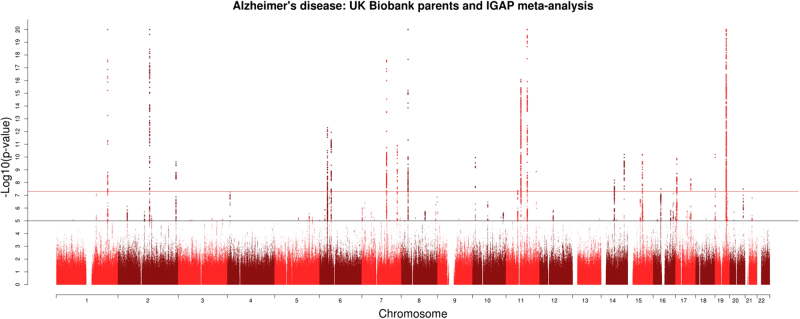
Alzheimer’s disease (AD) is a public health priority for the 21st century. Risk reduction currently revolves around lifestyle changes with much research trying to elucidate the biological underpinnings. We show that self-report of parental history of Alzheimer’s dementia for case ascertainment in a genome-wide association study of 314,278 participants from UK Biobank (27,696 maternal cases, 14,338 paternal cases) is a valid proxy for an AD genetic study. After meta-analysing with published consortium data ( n = 74,046 with 25,580 cases across the discovery and replication analyses), three new AD-associated loci ( P < 5 × 10 −8 ) are identified. These contain genes relevant for AD and neurodegeneration: ADAM10 , BCKDK/KAT8 and ACE . Novel gene-based loci include drug targets such as VKORC1 (warfarin dose). We report evidence that the association of SNPs in the TOMM40 gene with AD is potentially mediated by both gene expression and DNA methylation in the prefrontal cortex. However, it is likely that multiple variants are affecting the trait and gene methylation/expression. Our discovered loci may help to elucidate the biological mechanisms underlying AD and, as they contain genes that are drug targets for other diseases and disorders, warrant further exploration for potential precision medicine applications.
Overview
The claims and statistics of this paper haven’t been checked yet.
Free: it reads the open-access text and checks the first 5 claims that cite a source we can check. Create a free account to check every claim.
Integrity signals
Registry
Cites
Statistics
Figures
Verification
Claims the paper makes
The claims and statistics of this paper haven’t been checked yet.
Free: it reads the open-access text and checks the first 5 claims that cite a source we can check. Create a free account to check every claim.
Claims other papers make about this one
Each is checked against this paper’s own text: does it say what the citing paper says it does?
The source backs part of the claim, not all of it — or backs it for a different population, condition or comparison.
In the citing paper
“the basis of the observed association between age of dementia onset and these variants in TSPAN14 and TSPAN10 (both with a deleterious correlation) may result from disruption of a protective role of ADAM10.”
From Genetic associations with age at dementia onset in the PSEN1 E280A Colombian kindred (2023) · cites this paper as [27]
Experimental — accuracy not yet measuredThe source backs part of the claim, not all of it — or backs it for a different population, condition or comparison.
In the citing paper
“Several genesassoci-ated with AD incidence (APOE, CLU, ABCA7, SORL1, INPP5D, and PLCG2)(Jansen et al., 2019; Kunkle et al., 2019; Marioni et al., 2018) also function in lipid transport or signaling.”
From Alzheimer’s Patient Microglia Exhibit Enhanced Aging and Unique Transcriptional Activation (2020) · cites this paper as Marioni et al., 2018
Experimental — accuracy not yet measuredThe source backs part of the claim, not all of it — or backs it for a different population, condition or comparison.
In the citing paper
“non-coding mutations also modulate AD risk [4–6], likely through modifying gene expression.”
From Association of SPI1 haplotypes with altered SPI1 gene expression and Alzheimer’s disease risk (2022) · cites this paper as [6]
Experimental — accuracy not yet measuredThe source backs part of the claim, not all of it — or backs it for a different population, condition or comparison.
In the citing paper
“PLCG2 polymorphisms are associated with both reduced and increased risk of Alzheimer’s disease (AD) and with longevity.”
From Multi-omics analyses reveal novel effects of PLCγ2 deficiency in the mouse brain (2023) · cites this paper as [6]
Experimental — accuracy not yet measuredThe source backs part of the claim, not all of it — or backs it for a different population, condition or comparison.
In the citing paper
“other rare PLCG2 variants, such as M28L (rs61749044) that confers a modest increased risk of AD (OR ≈ 1.16) [1, 4, 7–13]”
From PLCγ2 deficiency compromises systemic immune tolerance and erodes myelin homeostasis while enhancing oxidative metabolism in the mouse brain (2026) · cites this paper as [10]
Experimental — accuracy not yet measured
20 more claims about this paper
Create a free account to see every claim other papers make about this one.
Self-check
Percentages, sums and reported differences re-computed from the paper’s own numbers.
The self-check needs the paper’s full text.
Citations
Cites
Sudlow, C., Gallacher, J., Allen, N., Beral, V., Burton, P., Danesh, J., Downey, P., Elliott, P., Green, J., Landray, M., et al. (2015) · PLOS Medicine · doi:10.1371/journal.pmed.1001779 · Cited by 12,728 · cited 13×
“There was complete sign-concordance between UK Biobank and IGAP for all 21 SNPs (Supplementary Table 4).”
BackgroundInfluentialA map of human genome variation from population-scale sequencing.
The 1000 Genomes Project Consortium (2010) · Nature · doi:10.1038/nature09534 · Cited by 7,877
Dementia prevention, intervention, and care
Livingston, G., Sommerlad, A., Orgeta, V., Costafreda, S. G., Huntley, J., Ames, D., Ballard, C., Banerjee, S., Burns, A., Cohen-Mansfield, J., et al. (2017) · The Lancet · doi:10.1016/s0140-6736(17)31363-6 · Cited by 6,072
LD Score regression distinguishes confounding from polygenicity in genome-wide association studies
Schizophrenia Working Group of the Psychiatric Genomics Consortium, Bulik-Sullivan, B. K., Loh, P.-R., Finucane, H. K., Ripke, S., Yang, J., Patterson, N., Daly, M. J., Price, A. L., & Neale, B. M. (2015) · Nature Genetics · doi:10.1038/ng.3211 · Cited by 5,559 · cited 2×
“…as 314,278 + 74,046 = 388,324) were included along with expression Quantitative Trait Loci (QTL) summary output from the Common Mind Consortium, which contains data on >600 dorsolateral prefrontal cortex samples, and DNA methylation QTL summary output on 258 prefrontal cortex samples (age >13) 18 .”
MethodSelf-citationMETAL: fast and efficient meta-analysis of genomewide association scans
Willer, C. J., Li, Y., & Abecasis, G. R. (2010) · Bioinformatics · doi:10.1093/bioinformatics/btq340 · Cited by 5,205
Genetic studies of body mass index yield new insights for obesity biology
Study, T. L. C., Locke, A. E., The ADIPOGen Consortium, The AGEN-BMI Working Group, The CARDIOGRAMplusC4D Consortium, The CKDGen Consortium, The, G. L. G. C., The, I. C. B. P., The MAGIC Investigators, The MuTHER Consortium, et al. (2015) · Nature · doi:10.1038/nature14177 · Cited by 4,534
Self-citationCommon SNPs explain a large proportion of the heritability for human height
Yang, J., Benyamin, B., McEvoy, B. P., Gordon, S., Henders, A. K., Nyholt, D. R., Madden, P. A., Heath, A. C., Martin, N. G., Montgomery, G. W., et al. (2010) · Nature Genetics · doi:10.1038/ng.608 · Cited by 4,446
Self-citationMeta-Analysis of 74,046 Individuals Identifies 11 New Susceptibility Loci for Alzheimer’s Disease
(EADI), E. A. D. I., Lambert, J.-C., (GERAD), G. A. E. R. I. A. D., Alzheimer's Disease Genetic Consortium (ADGC), (CHARGE), C. F. H. A. A. R. I. G. E., Ibrahim-Verbaas, C. A., Harold, D., Naj, A. C., Sims, R., Bellenguez, C., et al. (2013) · Nature Genetics · doi:10.1038/ng.2802 · Cited by 4,336 · cited 1×
“Downstream quality control steps conducted for the current analysis included removing (1) those with nonBritish ancestry based on both self-report and a principal components analysis, (2) outliers based on heterozygosity and missingness, (3) individuals with sex chromosome configurations that were neither XX nor XY, (…”
MethodSelf-citationAn atlas of genetic correlations across human diseases and traits
ReproGen Consortium, Bulik-Sullivan, B., Psychiatric Genomics Consortium, Genetic Consortium for Anorexia Nervosa of the Wellcome Trust Case Control Consortium 3, Finucane, H. K., Anttila, V., Gusev, A., Day, F. R., Loh, P.-R., Duncan, L., et al. (2015) · Nature Genetics · doi:10.1038/ng.3406 · Cited by 4,255 · cited 1×
“Linkage disequilibrium score (LDSC) regression was used to estimate the genetic correlation between the maternal and paternal AD GWAS results and to test for residual confounding in the meta-analysis by examining the LDSC intercept 12,13 .”
MethodFunctional mapping and annotation of genetic associations with FUMA
Watanabe, K., Taskesen, E., van Bochoven, A., & Posthuma, D. (2017) · Nature Communications · doi:10.1038/s41467-017-01261-5 · Cited by 4,083 · cited 1×
“The number of independent loci from the meta-analysis was determined by using the default settings in FUMA 14 .”
Method
Cited by
Items 401–500 of 588
Hao, Y., Li, C., Wang, H., & Chen, M. (2023) · Frontiers in Aging Neuroscience · doi:10.3389/fnagi.2023.1241412 · Cited by 4
“Large-scale cohort studies focusing on Alzheimer’s disease have identified approximately 70 genetic risk factors linked with AD (Lambert et al., 2013; Marioni et al., 2018; Jansen et al., 2019; Kunkle et al., 2019; Wightman et al., 2021; Bellenguez et al., 2022; Reitz et al., 2023).”
BackgroundChen, J., Xie, J., Deng, F., Cai, J., Chen, S., Song, X., Xia, S., Shen, Q., Guo, X., & Tang, Y. (2024) · Genomics · doi:10.1016/j.ygeno.2024.110976 · Cited by 5
Impacts of host genetics on gut microbiome composition in Alzheimer’s disease
Liu, J., Cao, J., Jia, L., Gan, Z., Zhao, X., Yang, A., Lai, S., Chen, F., Yang, Y. T., & Zhao, X.-M. (2026) · Microbiome · doi:10.1186/s40168-026-02342-8 · Cited by 4
“Some well-known AD risk genes such as APOE , TOMM40 and APOC [7, 83, 84], as well as some putative AD-related genes such as FOXG1 [85, 86] were included in the ES-Ana-associated genes.”
Polygenic risk of Alzheimer's disease in the Faroe Islands
Johansen, M., Joensen, S., Restorff, M., Stórá, T., Christy, D., Gustavsson, E. K., Bian, J., Guo, Y. M., Farrer, M. J., & Petersen, M. S. (2022) · European Journal of Neurology · doi:10.1111/ene.15351 · Cited by 4
Connecting dementia risk loci to the CSF proteome identifies pathophysiological leads for dementia
Reus, L. M., Jansen, I. E., Tijms, B. M., Visser, P. J., Tesi, N., van der Lee, S. J., Vermunt, L., Peeters, C. F. W., Groot, L. A. D., Hok‐A‐Hin, Y. S., et al. (2024) · Brain · doi:10.1093/brain/awae090 · Cited by 8
DNA Methylation in Alzheimer’s Disease
Weymouth, L. S., Smith, A. R., & Lunnon, K. (2024) · Current topics in behavioral neurosciences · doi:10.1007/7854_2024_530 · Cited by 4
A cautionary tale for Alzheimer’s disease GWAS by proxy
Pedersen, E. M., Wimberley, T., & Vilhjálmsson, B. J. (2024) · Nature Genetics · doi:10.1038/s41588-024-02023-y · Cited by 5
Han, S., Cho, S.-A., Choi, W., Eilbeck, K. L., Coon, H. H., Nho, K. T., & Lee, Y. (2025) · BMC Genomics · doi:10.1186/s12864-025-11362-x · Cited by 7
“In addition, genome-wide association studies (GWAS) have successfully discovered many AD-risk SNPs, giving concrete form to those implicated genetic factors [8, 9], exhibiting 8.9 ~ 31.2% of SNP-based heritability [10–13].”
InfluentialCiobanu, L. G., Stankov, L., Schubert, K. O., Amare, A. T., Jawahar, M. C., Lawrence‐Wood, E., Mills, N. T., Knight, M. J., Clark, S. R., & Aidman, E. (2022) · PLoS ONE · doi:10.1371/journal.pone.0272368 · Cited by 5
Huang, Z., Gong, Z., Lin, Y., Yang, F., Chen, W., Xiang, S., Huang, Y., Xiao, H., Xu, S., & Duan, J. (2024) · Frontiers in Aging Neuroscience · doi:10.3389/fnagi.2024.1267780 · Cited by 5
Zheng, H., Gu, C., & Yang, H. (2024) · Heliyon · doi:10.1016/j.heliyon.2024.e27070 · Cited by 6
Biotechnology and Bioinformatics Applications in Alzheimer’s Disease
ALI, M. A. M., Alexiou, A. T., & Ashraf, G. M. (2019) · Springer eBooks · doi:10.1007/978-981-13-9636-6_12 · Cited by 4
Genetic “General Intelligence,” Objectively Determined and MeasuredPreprint
de la Fuente, J., Davies, G., Grotzinger, A. D., Tucker–Drob, E. M., & Deary, I. J. (2019) · bioRxiv (Cold Spring Harbor Laboratory) · doi:10.1101/766600 · Cited by 4
Self-citationHu, T., Liu, Q., Dai, Q., Parrish, R. L., Buchman, A. S., Tasaki, S., Seyfried, N. T., Wang, Y., Bennett, D. A., Jager, P. L. D., et al. (2024) · medRxiv · doi:10.1101/2024.03.28.24305044 · Cited by 4
“Especially, CSF1R that encodes the tyrosine kinase receptor CSF1R was associated with microglial homeostasis and neuronal survival, implicating its dysfunction in increasing risks for AD 37 .”
Self-citationXavier, C., & Pinto, N. (2025) · Journal of Alzheimer s Disease · doi:10.1177/13872877251317543 · Cited by 4
Yuan, S., Liu, Q., Huang, X., Xu, Z., Bai, Z., Qin, L., Shen, Q., Tang, E., Wu, J., Yang, K., et al. (2025) · Medicine Plus · doi:10.1016/j.medp.2025.100111 · Cited by 3
Analyzing the glial proteome in Alzheimer’s disease
Kim, J., Afridi, R., Lee, W., & Suk, K. (2023) · Expert Review of Proteomics · doi:10.1080/14789450.2023.2260955 · Cited by 4
Hudgins, A. D., Zhou, S., Arey, R. N., Rosenfeld, M. G., Murphy, C. T., & Suh, Y. (2024) · Neuron · doi:10.1016/j.neuron.2024.04.009 · Cited by 5
Deciphering the tissue-specific functional effect of Alzheimer risk SNPs with deep genome annotation
Varathan, P., Xie, L., He, B., Saykin, A. J., Nho, K. T., & Yan, J. (2024) · BioData Mining · doi:10.1186/s13040-024-00400-1 · Cited by 4
He, Y., Zhu, P., Gao, S., Wu, S., Li, X., Huang, C., Chen, Y., & Liu, G. (2024) · Journal of Neurochemistry · doi:10.1111/jnc.16276 · Cited by 3
“However, with the increasing popularity of scRNA-Seq in recent years, numerous ct-eQTL studies have emerged, and the integration of ct-eQTL with disease GWAS results has become a crucial ave-nue for unraveling disease mechanisms (Cuomo et al., 2020; Zhang et al., 2018 ).”
InfluentialMiller, J. B., Brandon, J. A., Harmon, L. M., Sabra, H. W., Lucido, C. C., Murcia, J. D. G., Nations, K. A., Payne, S. H., Ebbert, M., Kauwe, J. S. K., et al. (2025) · Biomedicines · doi:10.3390/biomedicines13030739 · Cited by 5
Brain morphology mediating the effects of common genetic risk variants on Alzheimer’s disease
Breddels, E. M., Snihirova, Y., Pishva, E., Gülöksüz, S., Blokland, G. A. M., Luykx, J. J., Andreassen, O. A., Linden, D. E. J., van der Meer, D., & Initiative, A. D. N. (2025) · Journal of Alzheimer s Disease Reports · doi:10.1177/25424823251328300 · Cited by 3
“Additionally, parental LOAD status may neither strongly correspond to the clinical LOAD status of the participant 13,72,74,75 nor indicate underlying pathophysiology.”
Mustafin, R. N. (2025) · Current Proteomics · doi:10.2174/0115701646349195250327051422 · Cited by 4
Visvanathan, R., Utsuki, T., Beck, D. E., Lendy, E. K., Sun, K.-L., Liu, Y., Hering, K. W., Mesecar, A. D., Zhang, Z., & Putt, K. S. (2023) · SLAS DISCOVERY · doi:10.1016/j.slasd.2023.03.003 · Cited by 3
Identifying Genes Associated with Alzheimer’s Disease Using Gene-Based Polygenic Risk Score
Lai, D., Zhang, M., Li, R., Zhang, C., Zhang, P., Liu, Y., Gao, S., & Foroud, T. (2023) · Journal of Alzheimer s Disease · doi:10.3233/jad-230510 · Cited by 3
“(2019)includedclinicallyandneuropathologi-callydefinedADcasesandcontrols[8],themajority ofADcasesfromtheUKBiobank(UKBB)were proxyADcases,i.e.,first-degreerelativesofAD patients[12,13,18].”
InfluentialChen, X., Zheng, Y., Wang, J., Yue, B., Zhang, X., Nakai, K., & Yan, L. L. (2024) · PeerJ · doi:10.7717/peerj.17073 · Cited by 3
Qiu, S., Sun, M., Xu, Y., & Hu, Y. (2024) · Frontiers in Neuroscience · doi:10.3389/fnins.2024.1277187 · Cited by 2
He, J., Cabrera‐Mendoza, B., Friligkou, E., Mecca, A. P., van Dyck, C. H., Pathak, G. A., & Polimanti, R. A. (2025) · Alzheimer s & Dementia · doi:10.1002/alz.70215 · Cited by 5
Yang, Y., Kuo, K., Li, H., Shen, X., Chen, S.-D., Cui, M., Dong, Q., & Yu, J. (2020) · Journal of Alzheimer s Disease · doi:10.3233/jad-200773 · Cited by 3
“We also drew on another two-large famous GWAS summary statistics datasets from International Genomics of Alzheimer’s Project (IGAP) and The Centre for Cognitive Ageing and Cognitive Epidemiology at the University of Edinburgh (CCACE) to verify our results [23, 24].”
Frederiksen, S., Wicki‐Stordeur, L. E., & Swayne, L. A. (2019) · bioRxiv (Cold Spring Harbor Laboratory) · doi:10.1101/801563 · Cited by 3
de la Fuente, J., Grotzinger, A. D., Marioni, R. E., Nivard, M. G., & Tucker–Drob, E. M. (2021) · medRxiv · doi:10.1101/2021.05.06.21256747 · Cited by 3
“The conventional corrected approach is directly reflective of the approaches taken by Marioni et al.(3) and Bellenguez et al.”
MethodInfluentialSelf-citationZCWPW1 loss-of-function variants in Alzheimer’s DiseasePreprint
Küçükali, F., Nußbaumer, K., Dongen, J. V., Hens, E., Bellenguez, C., Grenier‐Boley, B., Bacq‐Daian, D., Boland, A., Deleuze, J., Lambert, J., et al. (2021) · medRxiv · doi:10.1101/2021.08.13.21261426 · Cited by 5
Savignac, C., Villeneuve, S., Badhwar, A., Saltoun, K., Shafighi, K., Zajner, C., Sharma, V., Taliun, S. A. G., Farhan, S. M. K., Poirier, J., et al. (2022) · bioRxiv (Cold Spring Harbor Laboratory) · doi:10.1101/2022.03.15.484482 · Cited by 3
Hu, T., Parrish, R. L., Dai, Q., Buchman, A. S., Tasaki, S., Bennett, D. A., Seyfried, N. T., Epstein, M. P., & Yang, J. (2022) · medRxiv · doi:10.1101/2022.12.25.22283936 · Cited by 3
Self-citationJiang, M.-Z., Gaynor, S. M., Li, X., Buren, E. V., Stilp, A. M., Buth, E., Wang, F. F., Manansala, R., Gogarten, S. M., Li, Z., et al. (2023) · bioRxiv (Cold Spring Harbor Laboratory) · doi:10.1101/2023.09.10.555215 · Cited by 5
“…including Alzheimer's disease (44–57), cholesterol (39,58–64), red cell distribution width (65), liver enzyme levels (34), blood protein levels (13,28), and CRP levels (5,40,59,63,64,66,67), including in the present analysis. rs8106813 was also reported to be related to Alzheimer's disease (68).”
BackgroundGWAS by Subtraction to Disentangle RBD Genetic Background from α-Synucleinopathies
Gaudio, A., Gotta, F., Ponti, C., Geroldi, A., Barbera, A. L., & Mandich, P. (2025) · International Journal of Molecular Sciences · doi:10.3390/ijms26083578 · Cited by 2
Structural insights into human signal peptide peptidase
Huang, G., Guo, X., Wang, J., Ge, X., Kong, F., Shen, Z., Wang, X., Yan, C., Lei, J., Shi, Y., et al. (2025) · Proceedings of the National Academy of Sciences · doi:10.1073/pnas.2528340122 · Cited by 4
Salvo, M. A., Cuddy, L. K., Prokopenko, D., Watkins, E. J., Tanzi, R. E., & Vassar, R. J. (2026) · Journal of Biological Chemistry · doi:10.1016/j.jbc.2026.111171 · Cited by 2
“Angiotensin-converting enzyme ( ACE ) is a validated risk locus for LOAD (3, 6, 7).”
Cardiovascular-kidney-metabolic syndrome: candidate subtypes and genetic risk factors
Donker, H. C., Bisht, V., Dwivedi, O. P., Mueller, S., Neijzen, D., Ding, Z., & Lunter, G. A. (2026) · BMC Medical Genomics · doi:10.1186/s12920-026-02315-8 · Cited by 4
“0134 ) and were both previously linked to Alzheimer disease [31], which is consistent with previous reports of adiposity as a causal factor in cognitive decline [32–34].”
Li, T., Fili, M., Mohammadiarvejeh, P., Dawson, A. L., Hu, G., & Willette, A. A. (2024) · Nutrients · doi:10.3390/nu16244303 · Cited by 3
Huang, X., Yuan, S., Ling, Y., Tan, S., Bai, Z., Xu, Y., Shen, S. Q., Lyu, J., & Wang, H. (2025) · International Journal of Surgery · doi:10.1097/js9.0000000000002746 · Cited by 4
“Additionally, direct genotyping of the APOE gene’s ε 2, ε 3, and ε 4 haplotypes, along with sequencing of rs429358 and rs7412 sites, defined individuals carrying at least one ε 4 allele as APOE ε 4 carriers, with others categorized as non-APOE ε 4 carriers [33] .”
3D Alzheimer's disease in a dish: Implications for drug discovery
Quinti, L., Park, J., Brand, E., Tanzi, R. E., & Kim, D. Y. (2020) · Elsevier eBooks · doi:10.1016/b978-0-12-816475-4.00014-8 · Cited by 2
Song, J., Lin, C., & Li, H. (2022) · IEEE International Conference on Bioinformatics and Biomedicine (BIBM) · doi:10.1109/bibm55620.2022.9995296 · Cited by 2
“In 2018 Marioni et al. published relevant GWAS summary data in the GWAS study on family history of AD [15], some of which are selected for this paper (UK Biobank and IGAP meta-analysis GWAS of AD - a meta-analysis of 1, 2, and the summary statistics from IGAP).”
BackgroundHan, L., Jiang, H., Yao, X., Ren, Z., Qu, Z., Yu, T., Luo, S., & Wu, T. (2023) · Quantitative Imaging in Medicine and Surgery · doi:10.21037/qims-22-602 · Cited by 2
“Further studies discovered 29 more susceptibility genes in data sets with large samples (19,20).”
Li, Z., Chen, X., He, W., Chen, H.-Z., & Chen, D. (2024) · Frontiers in Genetics · doi:10.3389/fgene.2024.1379865 · Cited by 2
Basics of epigenetics: It is more than simple changes in sequence that govern gene expression
Sharma, S., & Aazmi, O. (2019) · Elsevier eBooks · doi:10.1016/b978-0-12-814259-2.00001-7 · Cited by 3
Cochran, J. N., McKinley, E., Cochran, M., Amaral, M. D., Moyers, B. A., Lasseigne, B. N., Gray, D. E., Lawlor, J. M. J., Prokop, J. W., Geier, E. G., et al. (2019) · bioRxiv (Cold Spring Harbor Laboratory) · doi:10.1101/748046 · Cited by 2
Hillary, R. F., Baños, D. T., Kousathanas, A., McCartney, D. L., Harris, S. E., Stevenson, A. J., Patxot, M., Ojavee, S. E., Zhang, Q., Liewald, D. C. M., et al. (2020) · bioRxiv (Cold Spring Harbor Laboratory) · doi:10.1101/2020.02.17.952135 · Cited by 2
“is/ukbiobank/), (ii) the 13 proteins which harboured significant pQTLs and Alzheimer’s disease risk (62), (iii) gene expression and inflammatory protein levels and (iv) DNA methylation and inflammatory protein levels.”
BackgroundSelf-citationLuningham, J. M., Chen, J., Tang, S., Jager, P. L. D., Bennett, D. A., Buchman, A. S., & Yang, J. (2020) · bioRxiv (Cold Spring Harbor Laboratory) · doi:10.1101/2020.03.05.979187 · Cited by 2
Self-citationStefanovski, L., Meier, J. M., Pai, R. K., Triebkorn, P., Lett, T. A. P., Martin, L., Bülau, K., Hofmann‐Apitius, M., Solodkin, A., McIntosh, A. R., et al. (2020) · PsyArXiv (OSF Preprints) · doi:10.31234/osf.io/4t5qa · Cited by 2
Editorial: ADAM, ADAMTS and Astacin Proteases: Challenges and Breakthroughs in the -Omics Era
Yamamoto, K., de Groot, R., Scilabra, S. D., Kwok, H. F., & Santamaria, S. (2021) · Frontiers in Molecular Biosciences · doi:10.3389/fmolb.2021.780242 · Cited by 3
“, 2011), and ADAM10 in Alzheimer’s disease (Marioni et al., 2018; Schwartzentruber et al., 2021).”
Watts, J. A., Grunseich, C., Rodriguez, Y., Liu, Y., Li, D., Burdick, J. T., Bruzel, A., Crouch, R. J., Mahley, R. W., Wilson, S. H., et al. (2022) · bioRxiv (Cold Spring Harbor Laboratory) · doi:10.1101/2022.05.01.489793 · Cited by 2
“A study of 42,034 patients and 272,244 controls in the United Kingdom found significant association (P <10-50) of these SNPs with Alzheimer’s disease (Marioni et al., 2018).”
BackgroundInfluentialChen, Z., Wu, B., Li, G., Zhou, L., Zhang, L., & Liu, J. (2023) · medRxiv · doi:10.1101/2023.07.20.23292985 · Cited by 2
Gomez, A. R., Byun, H. R., Wu, S., Muhammad, A. G., Ikbariyeh, J., Chen, J., Muro, A., Li, L., Bernstein, K. E., Ainsworth, R. I., et al. (2024) · bioRxiv (Cold Spring Harbor Laboratory) · doi:10.1101/2024.04.24.590837 · Cited by 2
Relationship periodontitis and Alzheimer's disease: Relevant aspects from an epigenetic view
Chacón, T., & Hernández, H. G. (2025) · Journal of Alzheimer s Disease · doi:10.1177/13872877251397406 · Cited by 3
Sequence Variant Analysis of the APOCII Locus among an Arab Cohort
Al‐Bustan, S. A., Alrashid, M. H., Al‐Serri, A., Annice, B. G., & Bahbahani, H. M. (2023) · International Journal of Molecular Sciences · doi:10.3390/ijms242216293 · Cited by 2
Alzheimer’s disease genome-wide association studies in the context of statistical heterogeneity
Gao, S., Zhu, P., Wang, T., Han, Z., Xue, Y., Zhang, Y., Wang, L., Zhang, H., Chen, Y., & Liu, G. (2024) · Molecular Psychiatry · doi:10.1038/s41380-024-02654-x · Cited by 1
E2FP-Net: Elevated Fusion Feature Pyramid Network for Alzheimer Detection
Devi, M. K., Ramadass, P., Karthikeyan, B., Mahendran, R. K., Kavitha, E., & Sanmugasundaram, R. (2024) · International Conference on Signal Processing, Computation, Electronics, Power and Telecommunication (IConSCEPT) · doi:10.1109/iconscept61884.2024.10627785 · Cited by 1
“These days, deep learning is being used to tackle a wide range of problems, one of which is medical image processing [17].”
BackgroundPeng, J., Tang, Q., Li, Y., Liu, L., Biswal, B. B., & Wang, P. (2025) · Scientific Reports · doi:10.1038/s41598-025-90872-w · Cited by 1
“In line with genome-wide association studies (GWAS) in AD 51,52 , the identical ontology terms, particularly those pertaining to synapses, affirm the credibility and sensitivity of genes identified by PLS1-in the study.”
López, S. F., Ferrero, R., Blom-Dahl, J., Alonso-Bernáldez, M., González, A. S. T., Pérez-Solero, G., & Tenorio, J. A. (2025) · Genes · doi:10.3390/genes16040377 · Cited by 1
“Likewise, the number of cases and controls decreased to 2547 and 8699 individuals, respectively No LD analysis was implemented in common with the original articles for the corresponding summary statistics [31,32].”
InfluentialSelf‐Report Alzheimer's Disease Statuses in UK Biobank Distort Downstream Analyses
Hu, S., Zhu, P., Gao, S., Wu, S., He, Y., Liu, F., Wang, K., & Liu, G. (2025) · Journal of Neurochemistry · doi:10.1111/jnc.70151 · Cited by 1
Blue, E., Broome, J., Xue, D., Kingston, H., Chapman, N. H., Gogarten, S. M., Naj, A. C., & Wijsman, E. M. (2025) · Alzheimer s & Dementia · doi:10.1002/alz.70489 · Cited by 2
“3,4,22,36,61,62,64,65,69,70 The heterogenous signals at 5q33.”
Koychev, I. G., Vaci, N., Moonen, J. E. F., Reid, G., Howgego, G., Yaffe, K. S., Nasrallah, I. M., Sidney, S., Jindra, C., Gallacher, J., et al. (2026) · Journal of Alzheimer s Disease · doi:10.1177/13872877251401482 · Cited by 1
Xu, J., Zhang, X., Cui, Y., Zheng, Q., Wang, C. Y., Kang, Y. Q., Xing, L., Zhang, X., Qin, Y., Yuan, K., et al. (2026) · Aging & Mental Health · doi:10.1080/13607863.2026.2632752 · Cited by 1
An Effective Approach for Predicting P-value using High-dimensional SNPs data with Small Sample Size
Wang, J., Nan, F., Yang, P., Yang, Y., & Qi, J. (2021) · International Conference on Ubiquitous Computing and Communications (IUCC) · doi:10.1109/iucc-cit-dsci-smartcns55181.2021.00062 · Cited by 1
Sharafeldin, N., Zhang, J., Singh, P., Bosworth, A., Chen, Y., Patel, S. K., Wang, X., Francisco, L., Forman, S. J., Wong, F. L., et al. (2022) · Bone Marrow Transplantation · doi:10.1038/s41409-022-01642-5 · Cited by 1
Modeling Path Importance for Effective Alzheimer’s Disease Drug Repurposing
Xiang, S., Lawrence, P. J., Peng, B., Chiang, C., Kim, D., Shen, L., & Ning, X. (2023) · Pacific Symposium on Biocomputing (PSB) · doi:10.1142/9789811286421_0024 · Cited by 3
He, R., Ren, J., Malakhov, M. M., & Pan, W. (2025) · PLoS Genetics · doi:10.1371/journal.pgen.1011659 · Cited by 1
“The majority of recently published AD GWAS studies are meta-analyses that merge associations computed from clinically diagnosed AD cases with associations computed from GWAX proxy cases in order to enhance both sample size and statistical power [3,4,11–13].”
Luo, H., Fan, S., Liu, H., Li, W., Fan, Z., Zhu, X., Zhang, C., Liang, H., Cong, S., & Yao, X. (2025) · International Journal of Molecular Sciences · doi:10.3390/ijms26136060 · Cited by 1
“The rs10426401 SNP in the first intron of PVR , identified as a strong eQTL in AD-relevant tissues, may influence transcription factor binding [54].”
How understudied populations leverage our understanding of Alzheimer’s disease genetics
Dehghani, N., Brás, J., & Guerreiro, R. J. (2020) · Alzheimer s & Dementia · doi:10.1002/alz.044901 · Cited by 2
An Approach to Fight Alzheimer's by Finding Its Causes and Risk Factors
Hanan, S. A., & Mawada, S. A. (2022) · EAS Journal of Pharmacy and Pharmacology · doi:10.36349/easjpp.2022.v04i03.003
Wightman, D. P., Savage, J. E., de Leeuw, C., Jansen, I. E., & Danielle Posthuma, B. (2021) · medRxiv · doi:10.1101/2021.10.17.21265070 · Cited by 1
Hemonnot-Girard, A.-L., Meersseman, C., Pastore, M., Linck, N., Rey, C., Lachuer, J., Reynès, C., Rassendren, F., & Hirbec, H. (2021) · Research Square · doi:10.21203/rs.3.rs-876995/v2 · Cited by 1
Malamon, J. S., Farrell, J. J., Xia, L. C., Dombroski, B. A., Lee, W., Das, G., Vardarajan, B. N., Way, J., Kuzma, A. B., Valladares, O., et al. (2022) · bioRxiv (Cold Spring Harbor Laboratory) · doi:10.1101/2022.05.19.492472 · Cited by 1
The circulating proteome and brain health: Mendelian randomisation and cross-sectional analysesPreprint
Walker, R. M., Chong, M., Perrot, N., Pigeyre, M., Gadd, D. A., Stolicyn, A., Shi, L., Campbell, A., Shen, X., Whalley, H. C., et al. (2023) · medRxiv · doi:10.1101/2023.07.27.23293236 · Cited by 1
New Genetic Loci Discovery for Alzheimer’s Disease Using Explainable Deep Neural NetworksPreprint
Gkertsou, C., Parameshwarappa, A. K., Shiyanbola, A., Balkhiyarova, Z., Kouchaki, S., Prokopenko, I., Lagou, V., & Demirkan, A. (2023) · Preprints.org · doi:10.1101/2023.12.11.23299839
Jacobs, T., Jacobson, S. R., Fortea, J., Berger, J. S., Vedvyas, A., Marsh, K., He, T., Gutiérrez‐Jiménez, E., Fillmore, N. R., Bubu, O. M., et al. (2024) · Research Square · doi:10.21203/rs.3.rs-4076789/v1 · Cited by 1
Xiang, J.-C., Xiong, Y., Wang, S., & Xia, Q. (2024) · Journal of Translational Medicine · doi:10.1186/s12967-024-05106-w · Cited by 1
“…used GWAS database, IEU Open GWAS (https:// gwas. mrcieu. ac. uk/) [1], we found several incorrect GWAS datasets were employed: ebi-a-GCST005921 [2] was used as exposure dataset for AD, which is actually “family history of AD”; furthermore, ukb-b-17001 and ukb-a-296 actually represent “ever had…”
MethodHe, J., Cabrera‐Mendoza, B., Friligkou, E., Mecca, A. P., van Dyck, C. H., Pathak, G. A., & Polimanti, R. A. (2024) · medRxiv · doi:10.1101/2024.06.12.24308850 · Cited by 1
Fitzsimons, L. A., Atif-Sheikh, M., Mueth, M. G., Rice, M., Howell, G. R., & Harrison, B. J. (2024) · bioRxiv (Cold Spring Harbor Laboratory) · doi:10.1101/2024.07.24.604961 · Cited by 1
“…by multiple GWAS with multiple populations (African American 14,15 , Chinese 16 , Northern and Western European ancestry (CEU) 17 , UK Biobank 18,19 ) that support the association of Cd2ap variants with small but significant increases in incidence 20 , progression 20,21 , and severity 16,21 of…”
Saunders, D., Sultan, F. A., Vialle, R. A., Kearns, N. A., Ng, B., Clark, E. M., Vyas, H., Tissera, S. L. D., Xu, J., Bennett, D. A., et al. (2025) · bioRxiv (Cold Spring Harbor Laboratory) · doi:10.1101/2025.08.30.673269 · Cited by 2
Gutierrez-Kuri, E., Marie Garcia-Rogers, J. L., Perez, J., Smith, S., Kenwood, M. R., Archuleta, K. S., Xiao, Y., Campos, G., Barannikov, S., Wang, H., et al. (2026) · doi:10.64898/2026.07.13.738356
Konigorski, S., Khorasani, S., & Lippert, C. (2018) · arXiv (Cornell University) · doi:10.48550/arxiv.1812.00448 · Cited by 2
“There is previous evidence for the association of the identified genes with AD [15, 16, 17, 18] to support our findings, and of note, the p-values are much smaller using the new kernels here compared to regular kernels [14].”
MethodChau, C. K.-L., Lau, A., Sham, P. C., & So, H.-C. (2019) · bioRxiv (Cold Spring Harbor Laboratory) · doi:10.1101/648113
Mole, J. P., Fasano, F., Evans, J., Sims, R., Hamilton, D. A., Kidd, E. J., & Metzler‐Baddeley, C. (2019) · bioRxiv (Cold Spring Harbor Laboratory) · doi:10.1101/871160
Ahmed, Z., Zeeshan, S., & Liang, B. T. (2019) · IEEE International Conference on Bioinformatics and Biomedicine (BIBM) · doi:10.1109/bibm47256.2019.8983389
Monocyte-specific changes in gene expression implicate LACTB2 and PLIN2 in Alzheimer’s diseasePreprint
Harwood, J. C., Leonenko, G., Sims, R., Escott‐Price, V., Williams, J. H., & Holmans, P. (2020) · bioRxiv (Cold Spring Harbor Laboratory) · doi:10.1101/2020.06.05.136275
“7.13) script from the LD Score Regression (LDSC) software (URLs) and the hapmap 3.0 reference panel (URLs) resulting in 1,207,073 SNPs. Common variants from UK Biobank GWAS on parental AD : maternal and paternal Biobank data without IGAP (cases = 42,034, controls = 272,244) (Marioni et al., 2018) were filtered as desc…”
MethodResultInfluentialFernandez, F., & Andrews, J. L. (2020) · Elsevier eBooks · doi:10.1016/b978-0-12-815854-8.00009-4 · Cited by 1
Clinical Validation of Neuronal Pentraxin Receptor as a Candidate Biomarker for Alzheimer’s Disease
Lim, B. (2020) · TSpace (University of Toronto)
Ebrahimi, H. A., Tajadini, H., Kamali, H., Khazaneha, M., & Kamali, M. (2021) · DOAJ (DOAJ: Directory of Open Access Journals) · doi:10.22062/jkmu.2021.91665 · Cited by 2
Hemonnot-Girard, A.-L., Meersseman, C., Pastore, M., Linck, N., Rey, C., Lachuer, J., Reynès, C., Rassendren, F., & Hirbec, H. (2021) · Research Square · doi:10.21203/rs.3.rs-876995/v1
Herpesvirus Infections and Alzheimer’s Disease: A Mendelian Randomization StudyPreprint
Huang, S., Yang, Y., Kuo, K., Li, H., Shen, X., Chen, S.-D., Cui, M., Tan, L., Dong, Q., & Yu, J. (2021) · Research Square · doi:10.21203/rs.3.rs-323013/v1
Zampar, S. (2021) · eDiss (Georg-August-Universität Göttingen) · doi:10.53846/goediss-9004
Kikuchi, M., Viet, J., Nagata, K., Sato, M., David, G., Audic, Y., Silverman, M. A., Yamamoto, M. L., Akatsu, H., Hashizume, Y., et al. (2022) · medRxiv · doi:10.1101/2022.02.28.22271320
Dunn, P. J. (2022) · Queensland University of Technology · doi:10.5204/thesis.eprints.229972 · Cited by 1
Crawford, K. L., Leonenko, G., Baker, E. A., Grozeva, D., Lan-Leung, B., Holmans, P., Williams, J. H., O’Donovan, M. C., Escott‐Price, V., & Ivanov, D. K. (2022) · medRxiv · doi:10.1101/2022.06.29.22276952
Wong, A. T., Floud, S., REEVES, G. K., Holmes, M. V., Travis, R. C., van Duijn, C. M., Doherty, A., & Smith‐Byrne, K. (2026) · Frontiers in Dementia · doi:10.3389/frdem.2026.1843867
“…disease and related dementia as the outcome; this parental ADD proxy has been used in other GWASs to increase statistical power (Liu et al., 2017; Marioni et al., 2018; Bellenguez et al., 2022) and in MR studies (Richardson et al., 2021), assuming that those with a family history have more risk…”
Gao, X., Chiariglione, M., & Arch, A. J. (2022) · medRxiv · doi:10.1101/2022.12.22.22283864
“This disease-by-proxy approach has been used in several recent studies on GWAS datasets 3,9,13 .”
MethodGamache, J., Gingerich, D. C., Shwab, E. K., Barrera, J., Garrett, M. E., Hume, C., Crawford, G. E., Ashley‐Koch, A. E., & Chiba‐Falek, O. (2023) · bioRxiv (Cold Spring Harbor Laboratory) · doi:10.1101/2023.05.12.540037
Gilchrist, L., Spargo, T. P., Green, R., Coleman, J. R. I., Howard, D. M., Thorp, J. G., Adey, B. N., Lord, J., Davies, H. L., Mundy, J., et al. (2023) · medRxiv · doi:10.1101/2023.06.05.23290588
Metadata
- Authors
- Marioni, R. E., Harris, S. E., Zhang, Q., McRae, A. F., Hagenaars, S. P., Hill, W. D., Davies, G., Ritchie, C. W., Gale, C. R., Starr, J. M., Goate, A. M., Porteous, D. J., Yang, J., Evans, K. L., Deary, I. J., Wray, N. R., & Visscher, P. M.
- Affiliations
- Institute of Genetics and Cancer (GB)
- The University of Queensland (AU)
- King's College London (GB)
- University of Edinburgh (GB)
- Alzheimer Scotland (GB)
- Icahn School of Medicine at Mount Sinai (US)
- Corresponding author
- Marioni, Riccardo E.
- ORCID
- Venue
- Translational Psychiatry
- Published
- 2018-05-18
- Volume
- 8
- Issue
- 1
- Pages
- 99-99
- ISSN
- 2158-3188 (ISSN-L)
- PMC
- PMC5959890
- OpenAlex
- W2787933178
- Cited by
- 564
- References
- 58
- Citations by year
- 2026: 34 · 2025: 50 · 2024: 89 · 2023: 62 · 2022: 76 · 2021: 103 · 2020: 90 · 2019: 50 · 2018: 9
- FWCI
- 45.94
- Type
- journal article
- Language
- en
- Update notices
- correction (2019-06-06)
- Open access
- gold
- doi.org
- Licence
- cc-by
- creativecommons.org/licenses/by/4.0 (tdm)
- creativecommons.org/licenses/by/4.0 (vor)
- Locations
- Translational Psychiatry (publishedVersion, cc-by)
- bioRxiv (Cold Spring Harbor Laboratory) (acceptedVersion, other-oa)
- Europe PMC (PubMed Central) (publishedVersion, other-oa)
- PubMed Central (publishedVersion, cc-by)
- PubMed (publishedVersion)
- ePrints Soton (University of Southampton) (acceptedVersion)
- DOAJ (DOAJ: Directory of Open Access Journals) (submittedVersion)
- Research Portal (King's College London) (submittedVersion, other-oa)
- Edinburgh Research Explorer (University of Edinburgh) (submittedVersion, cc-by)
- Funders
- JPB Foundation
- South London and Maudsley NHS Foundation Trust
- Denali Therapeutics
- National Institute for Health and Care Research (NF-SI-0508-10082, NF-SI-0513-10085)
- Age UK (MR/K026992/1)
- King's College London
- University of Edinburgh (MR/K026992/1)
- University of Queensland
- Centre for Cognitive Ageing and Cognitive Epidemiology (MR/K026992/1)
- Dementias Platform UK (MR/L015382/1)
- National Institutes of Health
- Directorate for Biological Sciences
- Medical Research Council (MR/K026992/1, MR/L015382/1, 1113400, 1078037, 1078901, MC_PC_17228, MC_UU_12011/2, MC_UU_12011/1)
- Biotechnology and Biological Sciences Research Council (MR/K026992/1)
- National Health and Medical Research Council (1113400, 1078901, 1078037)
- National Institute on Aging (RF1AG054014, U01AG049508, U01AG052411, U24AG021886)
- Topics
- Life Sciences › Neuroscience › Cellular and Molecular Neuroscience › Alzheimer's disease research and treatments
- Health Sciences › Medicine › Psychiatry and Mental health › Dementia and Cognitive Impairment Research
- Life Sciences › Biochemistry, Genetics and Molecular Biology › Genetics › Genetic Associations and Epidemiology
- Keywords
- Alzheimer's disease, family history (medicine), parental history, case ascertainment, genetic loci, ADAM10, BCKDK, ACE, VKORC1, TOMM40, DNA methylation, gene expression, prefrontal cortex, neurodegeneration, therapeutic target, precision medicine
- MeSH terms
- Aged, Alzheimer Disease, Apolipoproteins E, Female, Humans, Male, Medical History Taking, Risk Factors, Genetic Predisposition to Disease, Polymorphism, Single Nucleotide, Genome-Wide Association Study, Genetic Loci
About these checks
Registry, retraction, Cites and statistics results are computed, not judged, with one exception: a printed reference that no index lists is read once by a model before it counts as a citation error. Claims are extracted by a model and kept only when their quote appears verbatim in the text; each cited source is then checked, with a model’s help, for whether it says what the claim relies on. Those verdicts can be wrong — read the claim’s quote and the cited source before relying on one.
Statistics and arithmetic are recomputed, not judged.
Confidence bands are shown only for fields calibrated on our annotated test set. None is calibrated yet, so no band is shown.
What counts as a claim ›How we measure confidence ›How we check this ›
Are you an author, or do you see a problem with this page? Request a review
Data sources
Bibliographic data: Semantic Scholar, OpenAlex, Crossref.
Contains information from the Semantic Scholar Academic Graph Datasets, made available under the ODC Attribution License (ODC-BY 1.0).
Semantic Scholar’s data is described in: Kinney, R., et al. (2023). The Semantic Scholar Open Data Platform. arXiv:2301.10140.
